


SIST IEC 60888:1999
(Main)Zinc-coated steel wires for stranded conductors
Zinc-coated steel wires for stranded conductors
Applies to zinc-coated steel wires used in the construction and/or reinforcement of conductors for overhead power transmission purposes, and is intended to cover all wires used in construction where the individual wire diameters, including coating, are in the range of 1.25 mm to 5.50 mm. Three grades of steel are included to reflect the needs of conductor users: regular steel, high strength steel and extra high strength steel. Two classes of coating represented by minimum zinc mass per unit area are included: Class 1 and Class 2. [
]This English-language version is derived from the original bilingual publication by leaving out all French-language pages. Missing page numbers correspond to the French-language pages.
Zinc-coated steel wires for stranded conductors
General Information
- Status
- Withdrawn
- Publication Date
- 31-Oct-1999
- Withdrawal Date
- 31-May-2003
- Technical Committee
- GAV - Bare aluminium conductors
- Current Stage
- 9900 - Withdrawal (Adopted Project)
- Start Date
- 01-Jun-2003
- Due Date
- 01-Jun-2003
- Completion Date
- 01-Jun-2003
Overview
IEC 60888 specifies requirements for zinc-coated steel wires for stranded conductors used in overhead power transmission. It covers wires with overall diameters (including coating) from 1.25 mm to 5.50 mm, and defines three steel grades-regular, high strength and extra high strength-and two coating classes (Class 1 and Class 2) based on minimum zinc mass per unit area. The standard addresses material, dimensional tolerances, mechanical performance, coating quality and test methods, and is intended for manufacturers, purchasers and users of conductor reinforcement wires.
Key topics and technical requirements
- Scope and dimensions
- Wire diameter measured as the mean of two perpendicular measurements; tolerances specified per diameter range.
- Length and coil tolerance rules; joints allowed only in pre‑finished rod/semi‑finished wire (not in finished coated wires).
- Materials and coating
- Steel grades defined for typical conductor applications.
- Zinc coating may be applied by hot‑dip or electrolytic processes; slab zinc minimum purity 99.85%.
- Two coating classes with minimum zinc mass requirements (Table II). Example values: for 1.24–1.50 mm wires, Class 1 = 185 g/m², Class 2 = 370 g/m².
- Physical values for calculation: density = 7.78 kg/dm³ at 20 °C; coefficient of linear expansion = 11.5×10⁻⁶ /°C.
- Mechanical tests
- Stress at 1% extension, tensile (ultimate) strength, and ductility (ultimate elongation or torsion) measured on finished coated wire.
- Wrapping and torsion tests with specified mandrel diameters and twist requirements per wire grade and size.
- Coating tests
- Mass of zinc coating determined by gas volumetric method (preferred, Appendix A) or gravimetric method (arbitration, Appendix B).
- Tests for coating adherence, continuity and resistance to cracking or flaking.
- Quality control
- Sampling rules, place-of-testing (manufacturer’s works unless agreed otherwise) and certificate of compliance on request.
Applications and who uses it
- Use cases: specification and acceptance of steel reinforcement wires in stranded conductors for overhead transmission and distribution lines.
- Primary users: wire manufacturers, conductor assemblers, utilities, procurement engineers, standards and quality engineers involved in overhead power line design and manufacture.
- Practical benefits: ensures consistent mechanical performance, reliable corrosion protection via zinc coatings, and compatibility between suppliers and purchasers.
Related standards
- IEC 60888 references ISO Standard 1460 (gravimetric method for hot‑dip galvanized coatings) for zinc mass determination methods and practices.
Keywords: IEC 60888, zinc-coated steel wires, stranded conductors, overhead power transmission, zinc coating mass, galvanizing, tensile strength, wire diameters, conductor reinforcement.



Frequently Asked Questions
SIST IEC 60888:1999 is a standard published by the Slovenian Institute for Standardization (SIST). Its full title is "Zinc-coated steel wires for stranded conductors". This standard covers: Applies to zinc-coated steel wires used in the construction and/or reinforcement of conductors for overhead power transmission purposes, and is intended to cover all wires used in construction where the individual wire diameters, including coating, are in the range of 1.25 mm to 5.50 mm. Three grades of steel are included to reflect the needs of conductor users: regular steel, high strength steel and extra high strength steel. Two classes of coating represented by minimum zinc mass per unit area are included: Class 1 and Class 2. [<BR>]This English-language version is derived from the original bilingual publication by leaving out all French-language pages. Missing page numbers correspond to the French-language pages.
Applies to zinc-coated steel wires used in the construction and/or reinforcement of conductors for overhead power transmission purposes, and is intended to cover all wires used in construction where the individual wire diameters, including coating, are in the range of 1.25 mm to 5.50 mm. Three grades of steel are included to reflect the needs of conductor users: regular steel, high strength steel and extra high strength steel. Two classes of coating represented by minimum zinc mass per unit area are included: Class 1 and Class 2. [<BR>]This English-language version is derived from the original bilingual publication by leaving out all French-language pages. Missing page numbers correspond to the French-language pages.
SIST IEC 60888:1999 is classified under the following ICS (International Classification for Standards) categories: 29.060.10 - Wires; 29.240.20 - Power transmission and distribution lines. The ICS classification helps identify the subject area and facilitates finding related standards.
SIST IEC 60888:1999 is available in PDF format for immediate download after purchase. The document can be added to your cart and obtained through the secure checkout process. Digital delivery ensures instant access to the complete standard document.
Standards Content (Sample)
SLOVENSKI STANDARD
01-november-1999
Zinc-coated steel wires for stranded conductors
Zinc-coated steel wires for stranded conductors
Ta slovenski standard je istoveten z: IEC 60888
ICS:
29.060.10 Žice Wires
29.240.20 Daljnovodi Power transmission and
distribution lines
2003-01.Slovenski inštitut za standardizacijo. Razmnoževanje celote ali delov tega standarda ni dovoljeno.
INTERNATIONAL IEC
STANDARD 60888
First edition
Zinc-coated steel wires for stranded conductors
IEC 1987 Copyright - all rights reserved
No part of this publication may be reproduced or utilized in any form or by any means, electronic or mechanical,
including photocopying and microfilm, without permission in writing from the publisher.
International Electrotechnical Commission, 3, rue de Varembé, PO Box 131, CH-1211 Geneva 20, Switzerland
Telephone: +41 22 919 02 11 Telefax: +41 22 919 03 00 E-mail: inmail@iec.ch Web: www.iec.ch
PRICE CODE
M
Commission Electrotechnique Internationale
International Electrotechnical Commission
МеждународнаяЭлектротехническаяКомиссия
For price, see current catalogue
888 © I E C 1987 — 3 ' —
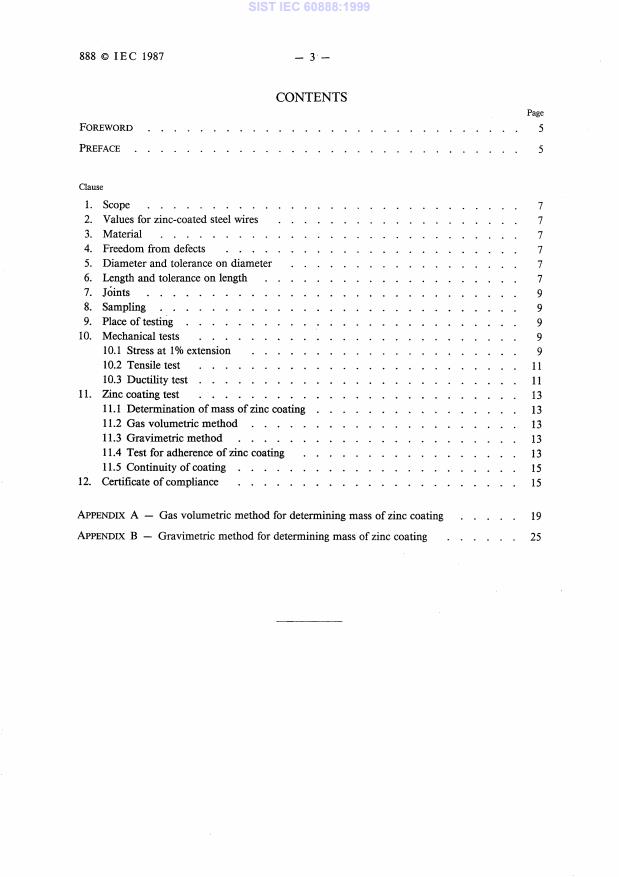
CONTENTS
Page
FOREWORD
PREFACE
Clause
1. Scope 7
2.
Values for zinc-coated steel wires 7
3. Material 7
4.
Freedom from defects 7
5. Diameter and tolerance on diameter 7
6. 7
Length and tolerance on length
7. Jôints 9
8. Sampling 9
9. Place of testing 9
10.
Mechanical tests 9
10.1 Stress at 1% extension
10.2 Tensile test 11
10.3
Ductility test 11
11. Zinc coating test 13
11.1 Determination of mass of zinc coating 13
11.2 Gas volumetric method 13
11.3 Gravimetric method 13
11.4 Test for adherence of zinc coating 13
11.5 Continuity of coating 15
12.
Certificate of compliance 15
APPENDIX A —
Gas volumetric method for determining mass of zinc coating
APPENDIX B —
Gravimetric method for determining mass of zinc coating
888 © I E C 1987 — 5 —
INTERNATIONAL ELECTROTECHNICAL COMMISSION
ZINC-COATED STEEL WIRES FOR STRANDED CONDUCTORS
FOREWORD
The formal decisions or agreements of the I EC on technical matters, prepared by Technical Committees on which all the
1)
ational
National Committees having a special interest therein are represented, express, as nearly as possible, an inte rn
consensus of opinion on the subjects dealt with.
They have the form of recommendations for international use and they are accepted by the National Committees in that
2)
sense.
In order to promote international unification, the IEC expresses the wish that all National Committees should adopt the text of
3)
I E C recommendation for their national rules in so far as national conditions will permit. Any divergence between the I E C
the
corresponding national rules should, as far as possible, be clearly indicated in the latter.
recommendation and the
PREFACE
This standard has been prepared by IEC Technical Committee No. 7 : Bare Aluminium
Conductors.
This standard replaces Clauses 4, 6 and 14, and Sub-clauses 7.2, 13.1 and 13.4 and requirements of
Clause 5 and Sub-clauses 9.1, 13.2 and 13.3 of I E C Publication 209 (1966): Aluminium Conductors,
Steel-reinforced.
It also replaces Clauses 4, 6 and 14, and Sub-clauses 7.2, 13.1 and 13.5 and requirements of Clause 5
and Sub-clauses 9.1, 13.2 and 13.4 of I E C Publication 210 (1966): Aluminium Alloy Conductors,
Steel-reinforced.
The text of this standard is based on the following documents :
on Voting
Six Months' Rule Report
7(CO)421 7(CO)424
on Voting indicated in the table above.
Further information can be found in the Repo rt
The following publication is quoted in this standard :
ISO Standard 1460 (1973) : Metallic Coatings — Hot Dip Galvanized Coatings on Ferrous Materials — Determination of
the Mass per Unit Area — Gravimetric Method.
888 ©IEC 1987 — 7 —
ZINC-COATED STEEL WIRES FOR STRANDED CONDUCTORS
1. Scope
This standard applies to zinc-coated steel wires used in the construction and/or reinforcement of
conductors for overhead power transmission purposes.
It is intended to cover all wires used in constructions where the individual wire diameters,
including coating, are in the range of 1.25 mm to 5.50 mm.
Three grades of steel are included to reflect the needs of conductor users: regular steel, high
strength steel and extra high strength steel.
Two classes of coating represented by minimum zinc mass per unit area are included: Class 1
and Class 2.
2. Values for zinc-coated steel wires
For calculation purposes the following values for zinc-coated steel wires shall be used:
7.78 kg/dm3
Density at 20 °C of both Class 1 and Class 2
Coefficient of linear expansion 11.5 x 10⁻⁶ per °C
3. Material
The steel wires shall have the properties specified hereinafter. The slab zinc shall be of 99.85%
minimum zinc content. The coating on the wires may be applied by the hot dip or the electrolytic
process.
4. Freedom from defects
The uncoated wires shall be smooth and free from all imperfections not consistent with good
commercial practice. The zinc-coated wires shall be reasonably smooth and free from all imper-
fections not consistent with good commercial practice.
5. Diameter and tolerance on diameter
The diameter of the zinc-coated steel wire shall be taken as the mean of two measurements
taken at 90° at the same cross-section.
The zinc-coated steel wires shall not depart from the nominal diameter, when measured over the
coating, by more than the amounts given in Tables III, IV and V.
It is recognized that the surface of zinc-coatings, particularly those produced by hot dip gal-
vanizing, are not perfectly smooth and free from irregularities. It is therefore intended that these
tolerances be used in gauging the diameters within the uniform areas of zinc-coated wire.
6. Length and tolerance on length
Unless otherwise agreed between the purchaser and manufacturer, steel wires shall be supplied
+
with a minimum length specified by the purchaser with a permitted va riation of ô%. Random
lengths shorter or longer than this requirement are only acceptable if prior agreement between the
purchaser and manufacturer is made.
— 9
888 © I E C 1987
7. Joints
Joints are allowed in the base hot rolled rod or semi-finished wire, before or after heat treatment
and prior to cold drawing, by the electric butt or flash welding processes. Finished but uncoated
wires from rod which has been welded shall have a minimum ultimate tensile stress not less than
80% of that obtained by tests on the adjacent unwelded wire and in no case shall the welded wire be
required to have a strength greater than 90% of the ultimate tensile strength (UTS) values shown in
Tables III, IV and V. Other required values from such wires are not changed except that the
finished wire from that portion of the rod which was welded shall not be required to pass ductility
wrapping and/or torsion tests. The coils containing joints shall be clearly identified.
No joints of any kind shall be made in the finished coated steel wires.
8. Sampling
Samples for tests shall be taken by the manufacturer from 10% of the individual lengths of steel
wire. In cases of wire supply in large quantities and where the manufacturer has a demonstrated
capability of meeting or exceeding properties, the number of test samples may be reduced, with
the agreement of the purchaser and the manufacturer, to a level which ensures that each produc-
tion lot of wire is given adequate monitoring.
9. Place of testing
Unless otherwise agreed between the purchaser and the manufacturer at the time of ordering,
all tests shall be made at the manufacturer's works.
10. Mechanical tests
All tests shall be made on the finished coated wires.
10.1
Stress at 1% extension
One specimen from each of the tests samples shall be gripped in the jaws of the tensile testing
machine. A load corresponding to the appropriate tensile stress given in Column 2 of Table I shall
be applied and an extensometer applied on a 250 mm gauge length and ajusted to the initial setting
given in Column 3 of Table I. (A gauge length of 100 mm or 200 mm may be used if agreed between
the purchaser and manufacturer. The initial settings of the extensometer will be adjusted in the
ion of the actual test length divided by the 250 mm length shown in Table I.) The gauge
proport
length shall be marked on the wire prior to application of load when it is required for subsequent
measurements.
TABLE I
Initial stress and extensometer setting for determination
of stress 1% extension
Actual diameter
Initial setting
(mm) of extensometer
Initial stress
(MPa) (gauge length
250 mm)*
including
Over Up to and
100 0.125
1.24 2.25
200 0.250
2.25 3.00
0.375
3.00 4.75 300
0.500
4.75 5.5 400
initial setting factor of gauge length/250 mm.
* For other gauge lengths, use an
888 © I E C 1987 — 11 —
The load shall then be increased uniformly until the extensometer indicates an extension of 1%
of the original gauge length. At this point, the load shall be read from which the value of the stress at
1% extension shall be calculated by dividing this load by the area of the wire based on actual wire
diameter. The value obtained for the specimen shall be not less than the value given in the
appropriate column of Tables III, IV and V.
The specimen may subsequently be used for the tensile and elongation tests.
10.2 Tensile test
The breaking load of one specimen cut from each of the test samples shall be determined by
means of a suitable testing machine.
The load shall be applied uniformly above and below 1% extension and the rate of increasing
separation of the jaws of the testing machine shall be not less than 0.1 times the gauge length in
millimetres per minute and not greater than 0.4 times the gauge length in millimetres per
minute.
The ultimate tensile stress calculated by dividing the breaking load by the area of the wire based
on actual wire diameter shall not be less than the value given in the appropriate column of Tables
III, IV and V.
The specimen may subsequently be used for the ultimate elongation if a test gauge length was
marked on the wire as described in the test for stress at 1% extension.
10.3 Ductility test
The choice between an ultimate elongation test and a torsion test is to be at the discretion of the
manufacturer, unless previously agreed between the manufacturer and purchaser at the time of
placing the order, and the choice of one test or the other in no way prejudices the quality of steel
used.
a)
Elongation test
The ultimate elongation measured under no load after the specimen has been marked as
described in the stress at 1% extension test and loaded as described in the tensile test shall be
determined on one specimen from each of the test samples. After the wire is broken the
specimen ends shall be carefully placed together at the distance between the gauge marks
measured. The elongation is the increase in gauge length expressed as a percentage of the
original gauge length.
For this test to be valid the specimen must break between the gauge marks.
The ultimate elongation shall be not less than the value given in the appropriate column of
Tables III, IV and V.
For routine quality control purposes a factored gauge length may be used (see footnotes to
Tables III, IV and V). However, in cases of dispute, the 250 mm gauge length shall be
mandatory.
Torsion test (not applicable to Class 2 zinc coating)
b)
As an alternative to the ultimate elongation test, one specimen cut from each sample may be
given a torsion test. The specimen shall be gripped in two vice-clamps one of which shall be free
to move longitudinally during the test. A small tensile load, not exceeding 2% of the wire
breaking strength, shall be applied to the sample during testing. The specimen shall be twisted
on its longitudinal axis by causing one of the vices to revolve until fracture occurs and the
number of twists shall be indicated by a counter or other suitable device. The rate of twisting
shall not exceed 60 turns per minute. The number of twists on a length 100 times the wire
diameter shall be not less than the value given in the appropriate column of Tables III, IV
and V.
888 © I E C 1987 — 13 —
c) Wrapping test
One specimen cut from each sample of coated steel wire shall be wrapped around a mandrel at a
rate not exceeding 15 turns per minute, of diameter given in the appropriate column of Tables
III, IV and V to form a close helix of eight turns. The wire shall not break.
11. Zinc coating test
11.1 Determination of mass of zinc coating
The mass of coating may be obtained by either a volumetric or gravimetric method. The former
has an acceptable degree of accuracy and has the advantage of rapidity. It is therefore the preferred
method for routine testing of all the sizes of wire which can be conveniently accommodated in the
measuring apparatus. In case of dispute, the gravimetric method shall be accepted as the arbi-
tration meth
...
Questions, Comments and Discussion
Ask us and Technical Secretary will try to provide an answer. You can facilitate discussion about the standard in here.
Loading comments...