

SIST EN 12921-2:2005+A1:2009
(Main)Machines for surface cleaning and pre-treatment of industrial items using liquids or vapours - Part 2: Safety of machines using water based cleaning liquids
General Information
- Abstract
This European Standard deals only with the significant hazards of machines for surface cleaning and pre-treatment (in the following called "cleaning machines") of industrial items using water based cleaning liquids in the mode of suspension, solution or dispersion of compounds or substances in water applied by immersion and/or spraying in one or more stages.
This European Standard applies in combination with EN 12921-1. Both parts together cover all significant hazards relevant for cleaning machines for industrial items using liquids or vapours, when they are used as intended and under the conditions foreseen by the manufacturer (see clause 4). The specific requirements specified in this standard take precedence over the respective requirements in EN 12921-1. This standard should be applied together with EN 12921-3 in case of release of flammable vapours from water based cleaning liquids.
This European Standard applies together with EN 12921-3 and prEN 12921-4 in case of use of water based cleaning liquids of which evaporating can lead to hazards caused by explosive atmospheres. Water based cleaning liquids containing a quantity of halogenated solvents exceeding 2 % of the volume are considered hazardous with respect to the creation of a potentially explosive atmosphere.
This European Standard does not apply to machinery and related equipment excluded from the scope of EN 12921-1.
This European Standard does not apply to cleaning machines for industrial items using water based cleaning liquids which are manufactured before the publication of this standard by CEN.
- Status
- Published
- Publication Date
- 11-Jan-2009
- Technical Committee
- VSN - Safety of machinery
- Current Stage
- 6060 - National Implementation/Publication (Adopted Project)
- Start Date
- 08-Jan-2009
- Due Date
- 15-Mar-2009
- Completion Date
- 12-Jan-2009
- Directive
- 2006/42/EC - Directive 2006/42/EC of the European Parliament and of the Council of 17 May 2006 on machinery, and amending Directive 95/16/EC (recast)OJ Ref: C 214, TIP C, 7.9.2026 UMIK 20.1.2027 OJ Date: 08-Sep-2009 Conflicting Date: 20-Jan-2027
98/37/EC - MachineryOJ Ref: C 74 OJ Date: 28-Mar-2009

Overview
EN 12921-2:2005+A1:2008 is a European safety standard (CEN) for machines for surface cleaning and pre-treatment of industrial items using water based cleaning liquids. It is a Type C standard that supplements EN 12921-1 (common safety requirements) and focuses on significant hazards arising when water-based cleaning fluids are applied by immersion and/or spraying (suspensions, solutions, dispersions, emulsions). The document was approved by CEN in 2008 and includes Amendment 1. It applies only to machines manufactured after its publication and is intended to be used together with related parts of the EN 12921 series when flammable or explosive atmospheres are possible.
Key topics and requirements
- Scope and risk focus: Covers significant hazards specific to water‑based cleaning machines; specific requirements take precedence over EN 12921-1.
- Hazard identification: Lists mechanical, electrical, thermal, noise, chemical and explosion risks, plus hazard combinations and energy-supply failures.
- Mechanical safety: Protection against crushing, shearing, entanglement, high‑pressure fluid ejection, stability loss and ejection of parts.
- Electrical safety: Special requirements where vapour, mist or liquid may increase electrical risk (IP ratings, earthing, enclosure protection).
- Chemical hazards: Measures for contact or inhalation risks from liquids, mists, vapours and reaction products; attention to backflow into potable water.
- Explosion and fire: Guidance when water-based liquids release flammable vapours or when hydrogen formation or other reactions can occur. Note: water based liquids with >2% halogenated solvents (by volume) are considered hazardous for explosive atmospheres.
- Control systems & verification: Requirements for controls, failure modes, verification testing, marking and user instructions (instruction handbook, minimum marking).
- Normative references: Cross-references EN 12921-1, EN 12921-3, EN ISO 12100, EN 60204-1, EN 1127-1, EN 1717, EN 60529 and others.
Applications
- Use this standard to design, build and validate industrial cleaning and pre-treatment machines that use water‑based cleaning liquids.
- Apply for machine risk assessments, CE conformity documentation and compliance with the Machinery Directive (as documented in the standard’s informative annexes).
- Implement safety measures in production lines, parts‑cleaning stations, immersion/spray washers, and industrial surface treatment equipment.
Who should use this standard
- Machine manufacturers and designers
- Safety, compliance and CE/Regulatory officers
- Risk assessors and test laboratories
- Maintenance and plant engineers responsible for equipment operation and safe servicing
- Procurement teams specifying safe cleaning machinery
Related standards
- EN 12921-1 (Common safety requirements)
- EN 12921-3 (Machines using flammable cleaning liquids)
- prEN 12921-4 (Halogenated solvents)
- EN ISO 12100, EN 60204-1, EN 1127-1, EN 1717, EN 60529, EN 746 (for related safety topics)
Keywords: EN 12921-2:2005+A1:2008, safety standard, machines for surface cleaning, water based cleaning liquids, industrial cleaning machines, CEN, machine safety.
Relations
- Effective Date
- 01-May-2010
- Effective Date
- 01-Apr-2026
- Effective Date
- 09-Feb-2026
- Effective Date
- 09-Feb-2026
- Effective Date
- 28-Jan-2026
- Effective Date
- 28-Jan-2026
- Effective Date
- 28-Jan-2026
- Effective Date
- 28-Jan-2026
- Effective Date
- 28-Jan-2026
- Effective Date
- 28-Jan-2026
- Effective Date
- 28-Jan-2026
- Effective Date
- 28-Jan-2026
- Effective Date
- 28-Jan-2026
- Effective Date
- 28-Jan-2026
- Effective Date
- 28-Jan-2026
Frequently Asked Questions
SIST EN 12921-2:2005+A1:2009 is a standard published by the Slovenian Institute for Standardization (SIST). Its full title is "Machines for surface cleaning and pre-treatment of industrial items using liquids or vapours - Part 2: Safety of machines using water based cleaning liquids". This standard covers: This European Standard deals only with the significant hazards of machines for surface cleaning and pre-treatment (in the following called "cleaning machines") of industrial items using water based cleaning liquids in the mode of suspension, solution or dispersion of compounds or substances in water applied by immersion and/or spraying in one or more stages. This European Standard applies in combination with EN 12921-1. Both parts together cover all significant hazards relevant for cleaning machines for industrial items using liquids or vapours, when they are used as intended and under the conditions foreseen by the manufacturer (see clause 4). The specific requirements specified in this standard take precedence over the respective requirements in EN 12921-1. This standard should be applied together with EN 12921-3 in case of release of flammable vapours from water based cleaning liquids. This European Standard applies together with EN 12921-3 and prEN 12921-4 in case of use of water based cleaning liquids of which evaporating can lead to hazards caused by explosive atmospheres. Water based cleaning liquids containing a quantity of halogenated solvents exceeding 2 % of the volume are considered hazardous with respect to the creation of a potentially explosive atmosphere. This European Standard does not apply to machinery and related equipment excluded from the scope of EN 12921-1. This European Standard does not apply to cleaning machines for industrial items using water based cleaning liquids which are manufactured before the publication of this standard by CEN.
This European Standard deals only with the significant hazards of machines for surface cleaning and pre-treatment (in the following called "cleaning machines") of industrial items using water based cleaning liquids in the mode of suspension, solution or dispersion of compounds or substances in water applied by immersion and/or spraying in one or more stages. This European Standard applies in combination with EN 12921-1. Both parts together cover all significant hazards relevant for cleaning machines for industrial items using liquids or vapours, when they are used as intended and under the conditions foreseen by the manufacturer (see clause 4). The specific requirements specified in this standard take precedence over the respective requirements in EN 12921-1. This standard should be applied together with EN 12921-3 in case of release of flammable vapours from water based cleaning liquids. This European Standard applies together with EN 12921-3 and prEN 12921-4 in case of use of water based cleaning liquids of which evaporating can lead to hazards caused by explosive atmospheres. Water based cleaning liquids containing a quantity of halogenated solvents exceeding 2 % of the volume are considered hazardous with respect to the creation of a potentially explosive atmosphere. This European Standard does not apply to machinery and related equipment excluded from the scope of EN 12921-1. This European Standard does not apply to cleaning machines for industrial items using water based cleaning liquids which are manufactured before the publication of this standard by CEN.
SIST EN 12921-2:2005+A1:2009 is classified under the following ICS (International Classification for Standards) categories: 97.080 - Cleaning appliances. The ICS classification helps identify the subject area and facilitates finding related standards.
SIST EN 12921-2:2005+A1:2009 has the following relationships with other standards: It is inter standard links to SIST EN 12921-2:2005, SIST EN 1717:2025+A1:2026, SIST EN 60204-1:1999, SIST EN 60529:1997, SIST EN 746-1:2000+A1:2009, SIST EN ISO 13577-2:2024, SIST EN ISO 12100-1:2004, SIST EN 12921-3:2005, SIST EN ISO 12100:2011, SIST EN 1127-1:2019, SIST EN 1717:2025, SIST EN 12921-1:2005, SIST EN 17059:2018, SIST EN 14462:2005+A1:2009, SIST EN 14462:2015. Understanding these relationships helps ensure you are using the most current and applicable version of the standard.
SIST EN 12921-2:2005+A1:2009 is associated with the following European legislation: EU Directives/Regulations: 2006/42/EC, 98/37/EC; Standardization Mandates: M/396, M/BC/CEN/88/13. When a standard is cited in the Official Journal of the European Union, products manufactured in conformity with it benefit from a presumption of conformity with the essential requirements of the corresponding EU directive or regulation.
SIST EN 12921-2:2005+A1:2009 is available in PDF format for immediate download after purchase. The document can be added to your cart and obtained through the secure checkout process. Digital delivery ensures instant access to the complete standard document.
Standards Content (Sample)
2003-01.Slovenski inštitut za standardizacijo. Razmnoževanje celote ali delov tega standarda ni dovoljeno.Maschinen zur Oberflächenreinigung und -vorbehandlung von industriellen Produkten mittels Flüssigkeiten oder Dampffasen - Teil 2: Anlagen, in denen wässrige Reinigungsmittel verwendet werdenMachines de nettoyage et de pré-traitement de pièces industrielles utilisant des liquides ou des vapeurs - Partie 2: Sécurité des machines utilisant des liquides de nettoyage à base aqueuseMachines for surface cleaning and pre-treatment of industrial items using liquids or vapours - Part 2: Safety of machines using water based cleaning liquids97.080Aparati za nego talFloor treatment appliancesICS:Ta slovenski standard je istoveten z:EN 12921-2:2005+A1:2008SIST EN 12921-2:2005+A1:2009en,fr01-marec-2009SIST EN 12921-2:2005+A1:2009SLOVENSKI
STANDARDSIST EN 12921-2:20051DGRPHãþD
EUROPEAN STANDARD NORME EUROPÉENNE EUROPÄISCHE NORM
EN 12921-2:2005+A1
November 2008 ICS 97.080 Supersedes EN 12921-2:2005 English Version
Machines for surface cleaning and pre-treatment of industrial items using liquids or vapours - Part 2: Safety of machines using water based cleaning liquids
Machines de nettoyage et de pré-traitement de pièces industrielles utilisant des liquides ou des vapeurs -Partie 2: Sécurité des machines utilisant des liquides de nettoyage à base aqueuse
Maschinen zur Oberflächenreinigung und -vorbehandlung von industriellen Produkten mittels Flüssigkeiten oder Dampffasen - Teil 2: Anlagen, in denen wässrige Reinigungsmittel verwendet werden This European Standard was approved by CEN on 25 March 2008 and includes Amendment 1 approved by CEN on 23 October 2008.
CEN members are bound to comply with the CEN/CENELEC Internal Regulations which stipulate the conditions for giving this European Standard the status of a national standard without any alteration. Up-to-date lists and bibliographical references concerning such national standards may be obtained on application to the CEN Management Centre or to any CEN member.
This European Standard exists in three official versions (English, French, German). A version in any other language made by translation under the responsibility of a CEN member into its own language and notified to the CEN Management Centre has the same status as the official versions.
CEN members are the national standards bodies of Austria, Belgium, Bulgaria, Cyprus, Czech Republic, Denmark, Estonia, Finland, France, Germany, Greece, Hungary, Iceland, Ireland, Italy, Latvia, Lithuania, Luxembourg, Malta, Netherlands, Norway, Poland, Portugal, Romania, Slovakia, Slovenia, Spain, Sweden, Switzerland and United Kingdom.
EUROPEAN COMMITTEE FOR STANDARDIZATION
COMITÉ EUROPÉEN DE NORMALISATION EUROPÄISCHES KOMITEE FÜR NORMUNG
Management Centre: rue de Stassart, 36
B-1050 Brussels © 2008 CEN All rights of exploitation in any form and by any means reserved worldwide for CEN national Members. Ref. No. EN 12921-2:2005+A1:2008: ESIST EN 12921-2:2005+A1:2009
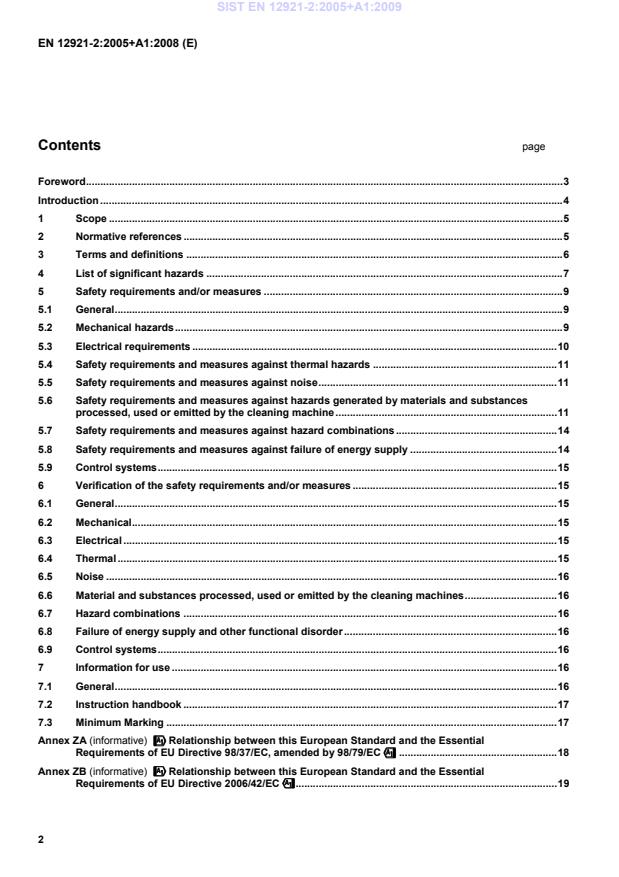
!!!!Relationship between this European Standard and the Essential Requirements of EU Directive 98/37/EC, amended by 98/79/EC"""".18 Annex ZB (informative)
!!!!Relationship between this European Standard and the Essential Requirements of EU Directive 2006/42/EC"""".19
For relationship with EC Directive(s), see informative Annexes ZA and ZB, which are integral parts of this document." This standard is part of a series of standards in the area of safety for development and construction of machines for surface cleaning and pre-treatment of industrial items using liquids or vapours. According to the CEN/CENELEC Internal Regulations, the national standards organizations of the following countries are bound to implement this European Standard: Austria, Belgium, Bulgaria, Cyprus, Czech Republic, Denmark, Estonia, Finland, France, Germany, Greece, Hungary, Iceland, Ireland, Italy, Latvia, Lithuania, Luxembourg, Malta, Netherlands, Norway, Poland, Portugal, Romania, Slovakia, Slovenia, Spain, Sweden, Switzerland and United Kingdom. SIST EN 12921-2:2005+A1:2009
1 Scope This European Standard deals only with the significant hazards of machines for surface cleaning and pre-treatment (in the following called "cleaning machines") of industrial items using water based cleaning liquids in the mode of suspension, solution or dispersion of compounds or substances in water applied by immersion and/or spraying in one or more stages. This European Standard !applies" in combination with EN 12921-1. Both parts together cover all significant hazards relevant for cleaning machines for industrial items using liquids or vapours, when they are used as intended and under the conditions foreseen by the manufacturer (see clause 4). The specific requirements specified in this standard take precedence over the respective requirements in EN 12921-1. This standard should be applied together with EN 12921-3 in case of release of flammable vapours from water based cleaning liquids.
This European Standard !applies" together with EN 12921-3 and prEN 12921-4 in case of use of water based cleaning liquids of which evaporating can lead to hazards caused by explosive atmospheres. Water based cleaning liquids containing a quantity of halogenated solvents exceeding 2 % of the volume are considered hazardous with respect to the creation of a potentially explosive atmosphere. This European Standard does not apply to machinery and related equipment excluded from the scope of EN 12921-1.
This European Standard does not apply to cleaning machines for industrial items using water based cleaning liquids which are manufactured before the publication of this standard by CEN. 2 Normative references
The following referenced documents are indispensable for the application of this document. For dated references, only the edition cited applies. For undated references, the latest edition of the referenced document (including any amendments) applies. EN 746-1, Industrial thermoprocessing equipment — Part 1: Common safety requirements for industrial thermoprocessing equipment EN 746-2, Industrial thermoprocessing equipment — Part 2: Safety requirements for combustion and fuel handling systems EN 1127-1, Explosive atmospheres — Explosion prevention and protection — Part 1: Basic concepts and methodology EN 1717, Protection against pollution of potable water in water installations and general requirements of devices to prevent pollution by backflow EN 12921-1:2004, Machines for surface cleaning and pre-treatment of industrial items using liquids or vapours — Part 1: common safety requirements EN 12921-3:2004, Machines for surface cleaning and pre-treatment of industrial items using liquids or vapours — Part 3: safety of machines using flammable cleaning liquids EN 60204-1:1997, Safety of machinery — Electrical equipment of machines — Part 1: General requirements (IEC 60204-1:1997) EN 60529, Degrees of protection provided by enclosures (IP code) (IEC 60529:1989) EN ISO 12100-1:2003; Safety of machinery — Basic concepts, general principles for design — Part 1: Basic terminology, methodology (ISO 12100-1:2003) SIST EN 12921-2:2005+A1:2009
any water based solution having a pH value between 6.5 and 7.5
Clause/sub-clause of this standard Hazard Clause/sub-clause of EN 12921-1:20044.1 General This clause contains significant hazards, hazardous situations and events, as far as they are dealt with in this standard, identified by risk assessment as significant for this type of machinery using water-based cleaning liquids and which require action to eliminate or reduce the risk.
4.1 4.2 Mechanical hazards 4.2 4.2.1 Crushing, shearing, cutting, entanglement, drawing-in, impact 4.2.1 4.2.2 High pressure fluid ejection 4.2.2 4.2.3 Ejection of parts of the cleaning machine and/or items 4.2.3 4.2.4 Loss of stability (of cleaning machine and cleaning machine parts) 4.2.4 4.2.5 Personnel's slip, trip and fall hazards 4.2.5 4.3. Electrical hazards These hazards can be increased by the presence of vapour, moisture, mist and/or liquid water.
Areas from which vapours or liquid can escape are e.g.: internal chambers of cleaning machines, including dead zones; tanks and spaces over liquid surfaces; exhaust and ducts chambers and enclosures; areas surrounding doors, covers and lids; areas where parts can transit during load/unload operation. 4.3 4.4 Thermal hazards 4.4 4.5 Hazards generated by noise 4.5 4.6 Hazards generated by materials and substances processed, used or emitted by the cleaning machine 4.6 4.6.1 General 4.6.1
NOTE Information on the method of risk analysis is given in EN 1050.
The hazards generated by contact with/or inhalation of dangerous fluids, gases, mists, fumes and dust can be caused by e.g.: contact with irritant of corrosive chemicals (e.g. by pickling, passivating); inhalation of vapours, powder or mist (e.g. during preparation of solutions for chromating and phosphating); backflow of water based cleaning liquid into the public water supply. The above mentioned hazards can occur in the following situations and can be caused by: handling of the cleaning products (due to the necessity of mixing and/or the reaction with water) during the filling and refilling of the cleaning machine; normal operation; chemical reaction caused by the contaminant(s) during the cleaning process; chemical reaction caused by mixing not compatible products; modification of the chemical characteristics of the water based cleaning liquid which may occur during the process; cleaning machine failure or breakdown due to the not compatibility of material of construction with the water based cleaning liquid or the chemical reactions generated during the cleaning process; maintenance. 4.6.2 4.6.3 Fire and explosion hazard See 4.6.3.1 and 4.6.3.2 of EN 12921-1:2004. These hazards may be caused by: the forming of hydrogen caused by chemical reaction of acid or alkaline cleaning liquid with metal (e.g. particularly with aluminium, magnesium or other alloys), in particular fines, small chips and swarf, and/or contaminants; the water based liquid to be used in the cleaning machine (e.g. emulsion); change in composition of the water based liquid due to drag out or flammable residues being removed from items being cleaned; deflagration in oil or gas direct fired heating system. 4.6.3 4.7 Hazards combinations 4.7 4.8 Hazards caused by failure of energy supply 4.8 4.9 Hazards related to failure of control system 4.9 SIST EN 12921-2:2005+A1:2009
In addition, the cleaning machine shall be designed according to the principles of EN ISO 12100-2 for rel
...