

SIST EN 14067-5:2022
(Main)Railway applications - Aerodynamics - Part 5: Requirements and assessment procedures for aerodynamics in tunnels
General Information
- Abstract
This document establishes aerodynamic requirements, test procedures, assessment methods and acceptance criteria for operating rolling stock in tunnels. Aerodynamic pressure variations, loads, micro pressure wave generation and further aerodynamic aspects to be expected in tunnel operation are addressed in this document. Requirements for the aerodynamic design of rolling stock and tunnels of the heavy rail system are provided. The requirements apply to heavy rail systems only.
- Status
- Published
- Public Enquiry End Date
- 20-Jan-2021
- Publication Date
- 06-Jan-2022
- Technical Committee
- IŽNP - Reilway applications
- Current Stage
- 6060 - National Implementation/Publication (Adopted Project)
- Start Date
- 03-Jan-2022
- Due Date
- 10-Mar-2022
- Completion Date
- 07-Jan-2022

Overview
EN 14067-5:2021 - published by CEN - is the European standard that defines aerodynamic requirements and assessment procedures for tunnels in heavy rail systems. It establishes how to evaluate pressure variations, pressure gradients (micro-pressure wave generation), aerodynamic loads and other tunnel-related aerodynamic effects to ensure safe, comfortable and reliable operation of rolling stock in tunnels. This part of the EN 14067 series was approved in December 2021 and supersedes earlier editions.
Key topics and technical requirements
- Scope and applicability: Applies to heavy rail rolling stock and tunnel infrastructure; sets out conformity assessment routes (full and simplified).
- Pressure variations: Requirements and methods to limit and assess pressure changes inside tunnels to meet health and comfort criteria (see clauses on limitation of pressure variations and pressure comfort).
- Micro-pressure waves: Assessment of pressure gradients at train entry that can generate sonic “pops” at tunnel portals and associated predictive and test methods.
- Aerodynamic loads: Rules for evaluating static, transient and fatigue loads on vehicles and tunnel installations due to aerodynamic actions (including wind and passing trains).
- Tests and methods: Prescribes measurement and analysis approaches - full-scale fixed-location measurements, exterior train measurements, reduced-scale tests, moving model rigs, predictive formulae and numerical simulation techniques (CFD).
- Pressure sealing: Tests and acceptance criteria for dynamic pressure tightness and leakage (equivalent leakage area and dynamic tests).
- Documentation and assessment: Defines assessment quantities, transformation methods, and documentation needed for conformity assessment.
Practical applications
- Rolling stock design validation: Use EN 14067-5 for aerodynamic design of train noses, seals and overall vehicle geometry to reduce pressure impacts in tunnels.
- Tunnel design and retrofit: Tunnel sizing, portal design, and mitigation measures (hoods, perforations, micro-pressure wave mitigation) informed by standard assessments.
- Safety and comfort compliance: Demonstrate compliance with passenger comfort (aural pressure comfort) and worker safety criteria when operating trains in tunnels.
- Certification and procurement: Basis for conformity assessment during vehicle acceptance, infrastructure approvals and tender specifications.
- Testing laboratories and simulation teams: Standardizes measurement protocols, model rig setups and CFD validation approaches.
Who should use this standard
- Rolling stock aerodynamicists and vehicle designers
- Railway infrastructure engineers and tunnel designers
- Operators, certification bodies and regulatory authorities
- Test houses, model rig facilities and CFD consultants
- Project managers for new-build and retrofit rail tunnels
Related standards
- Other parts of the EN 14067 series (railway aerodynamics)
- National and European tunnel construction standards and rolling stock safety standards (see CEN member publications)
Keywords: EN 14067-5:2021, aerodynamics in tunnels, railway aerodynamics, micro-pressure wave, pressure variations, rolling stock, tunnel design, heavy rail.
Relations
- Effective Date
- 29-Dec-2021
- Effective Date
- 25-Aug-2026
- Effective Date
- 28-Jan-2026
- Effective Date
- 28-Jan-2026
- Effective Date
- 28-Jan-2026
- Effective Date
- 28-Jan-2026
- Effective Date
- 28-Jan-2026
- Effective Date
- 28-Jan-2026
- Effective Date
- 28-Jan-2026
- Effective Date
- 09-Feb-2026
- Effective Date
- 28-Jan-2026
- Effective Date
- 28-Jan-2026
- Effective Date
- 28-Jan-2026
- Effective Date
- 28-Jan-2026
- Referred By
SIST EN 14752:2020+A1:2022 - Railway applications - Bodyside entrance systems for rolling stock - Effective Date
- 28-Jan-2026
Get Certified
Connect with accredited certification bodies for this standard

IRIS Certification (UNIFE)
International Railway Industry Standard certification.

TÜV SÜD Rail GmbH
TÜV SÜD railway certification services.

Bureau Veritas Railway Certification
Railway and transportation certification.
Sponsored listings
Frequently Asked Questions
SIST EN 14067-5:2022 is a standard published by the Slovenian Institute for Standardization (SIST). Its full title is "Railway applications - Aerodynamics - Part 5: Requirements and assessment procedures for aerodynamics in tunnels". This standard covers: This document establishes aerodynamic requirements, test procedures, assessment methods and acceptance criteria for operating rolling stock in tunnels. Aerodynamic pressure variations, loads, micro pressure wave generation and further aerodynamic aspects to be expected in tunnel operation are addressed in this document. Requirements for the aerodynamic design of rolling stock and tunnels of the heavy rail system are provided. The requirements apply to heavy rail systems only.
This document establishes aerodynamic requirements, test procedures, assessment methods and acceptance criteria for operating rolling stock in tunnels. Aerodynamic pressure variations, loads, micro pressure wave generation and further aerodynamic aspects to be expected in tunnel operation are addressed in this document. Requirements for the aerodynamic design of rolling stock and tunnels of the heavy rail system are provided. The requirements apply to heavy rail systems only.
SIST EN 14067-5:2022 is classified under the following ICS (International Classification for Standards) categories: 45.060.01 - Railway rolling stock in general; 93.060 - Tunnel construction. The ICS classification helps identify the subject area and facilitates finding related standards.
SIST EN 14067-5:2022 has the following relationships with other standards: It is inter standard links to SIST EN 14067-5:2007+A1:2010, SIST ISO 8756:1996, SIST EN 15273-3:2025, SIST EN 15273-1:2025, SIST EN 15273-4:2025, SIST EN 2599:2002, SIST EN 15273-2:2025, SIST EN 17149-1:2024, SIST EN 14067-4:2014+A1:2019, SIST HD 60364-5-52:2011, SIST EN 14752:2025, SIST EN 14752:2020, SIST EN 14752:2006, SIST EN 14752:2015, SIST EN 14752:2020+A1:2022. Understanding these relationships helps ensure you are using the most current and applicable version of the standard.
SIST EN 14067-5:2022 is associated with the following European legislation: EU Directives/Regulations: 2016/797/EU; Standardization Mandates: M/483, M/591. When a standard is cited in the Official Journal of the European Union, products manufactured in conformity with it benefit from a presumption of conformity with the essential requirements of the corresponding EU directive or regulation.
SIST EN 14067-5:2022 is available in PDF format for immediate download after purchase. The document can be added to your cart and obtained through the secure checkout process. Digital delivery ensures instant access to the complete standard document.
Standards Content (Sample)
SLOVENSKI STANDARD
01-februar-2022
Nadomešča:
SIST EN 14067-5:2007+A1:2010
Železniške naprave - Aerodinamika - 5. del: Zahteve in ugotavljanje skladnosti pri
aerodinamiki v predorih
Railway applications - Aerodynamics - Part 5: Requirements and assessment
procedures for aerodynamics in tunnels
Bahnanwendungen - Aerodynamik - Teil 5: Anforderungen und Prüfverfahren für
Aerodynamik im Tunnel
Applications ferroviaires - Aérodynamique - Partie 5: Exigences et procédures d'essai
pour l'aérodynamique en tunnel
Ta slovenski standard je istoveten z: EN 14067-5:2021
ICS:
45.060.01 Železniška vozila na splošno Railway rolling stock in
general
93.060 Gradnja predorov Tunnel construction
2003-01.Slovenski inštitut za standardizacijo. Razmnoževanje celote ali delov tega standarda ni dovoljeno.
EN 14067-5
EUROPEAN STANDARD
NORME EUROPÉENNE
December 2021
EUROPÄISCHE NORM
ICS 45.060.01; 93.060 Supersedes EN 14067-5:2006+A1:2010
English Version
Railway applications - Aerodynamics - Part 5:
Requirements and assessment procedures for
aerodynamics in tunnels
Applications ferroviaires - Aérodynamique - Partie 5: Bahnanwendungen - Aerodynamik - Teil 5:
Exigences et procédures d'essai pour l'aérodynamique Anforderungen und Prüfverfahren für Aerodynamik im
en tunnel Tunnel
This European Standard was approved by CEN on 22 November 2021.
CEN members are bound to comply with the CEN/CENELEC Internal Regulations which stipulate the conditions for giving this
European Standard the status of a national standard without any alteration. Up-to-date lists and bibliographical references
concerning such national standards may be obtained on application to the CEN-CENELEC Management Centre or to any CEN
member.
This European Standard exists in three official versions (English, French, German). A version in any other language made by
translation under the responsibility of a CEN member into its own language and notified to the CEN-CENELEC Management
Centre has the same status as the official versions.
CEN members are the national standards bodies of Austria, Belgium, Bulgaria, Croatia, Cyprus, Czech Republic, Denmark, Estonia,
Finland, France, Germany, Greece, Hungary, Iceland, Ireland, Italy, Latvia, Lithuania, Luxembourg, Malta, Netherlands, Norway,
Poland, Portugal, Republic of North Macedonia, Romania, Serbia, Slovakia, Slovenia, Spain, Sweden, Switzerland, Turkey and
United Kingdom.
EUROPEAN COMMITTEE FOR STANDARDIZATION
COMITÉ EUROPÉEN DE NORMALISATION
EUROPÄISCHES KOMITEE FÜR NORMUNG
CEN-CENELEC Management Centre: Rue de la Science 23, B-1040 Brussels
© 2021 CEN All rights of exploitation in any form and by any means reserved Ref. No. EN 14067-5:2021 E
worldwide for CEN national Members.
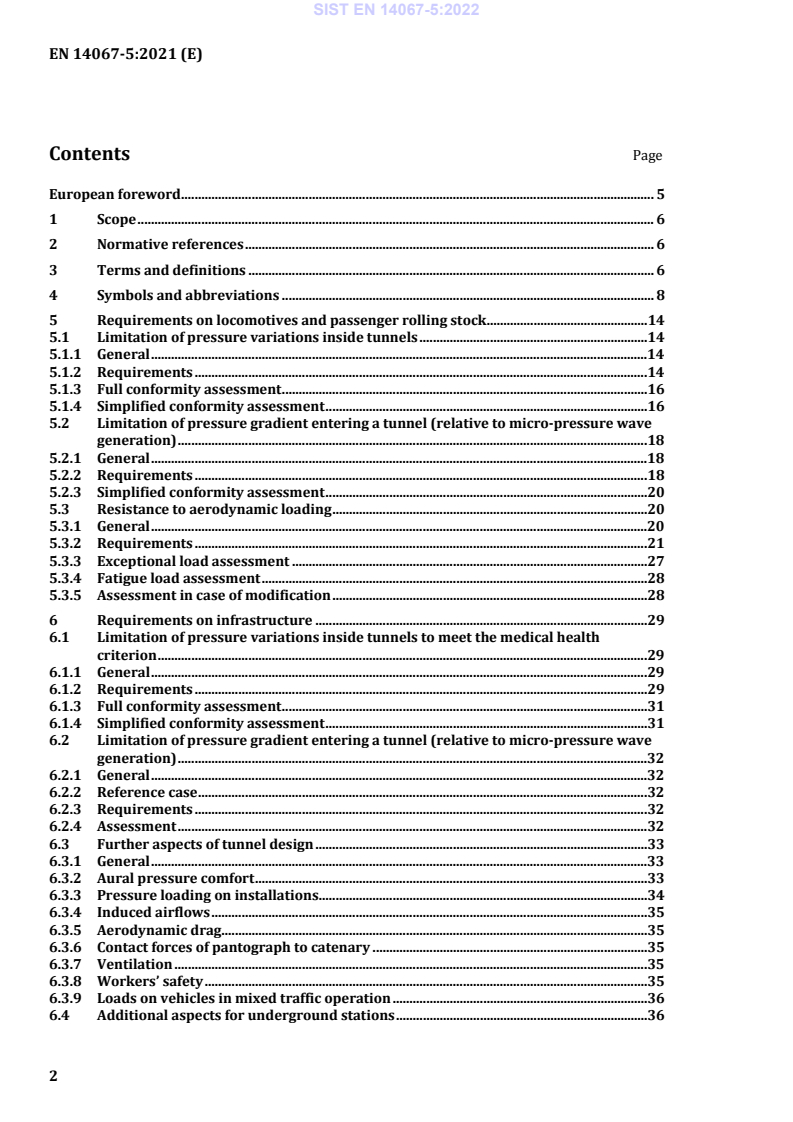
Contents Page
European foreword . 5
1 Scope . 6
2 Normative references . 6
3 Terms and definitions . 6
4 Symbols and abbreviations . 8
5 Requirements on locomotives and passenger rolling stock .14
5.1 Limitation of pressure variations inside tunnels .14
5.1.1 General .14
5.1.2 Requirements .14
5.1.3 Full conformity assessment .16
5.1.4 Simplified conformity assessment .16
5.2 Limitation of pressure gradient entering a tunnel (relative to micro-pressure wave
generation) .18
5.2.1 General .18
5.2.2 Requirements .18
5.2.3 Simplified conformity assessment .20
5.3 Resistance to aerodynamic loading .20
5.3.1 General .20
5.3.2 Requirements .21
5.3.3 Exceptional load assessment .27
5.3.4 Fatigue load assessment .28
5.3.5 Assessment in case of modification .28
6 Requirements on infrastructure .29
6.1 Limitation of pressure variations inside tunnels to meet the medical health
criterion .29
6.1.1 General .29
6.1.2 Requirements .29
6.1.3 Full conformity assessment .31
6.1.4 Simplified conformity assessment .31
6.2 Limitation of pressure gradient entering a tunnel (relative to micro-pressure wave
generation) .32
6.2.1 General .32
6.2.2 Reference case .32
6.2.3 Requirements .32
6.2.4 Assessment .32
6.3 Further aspects of tunnel design .33
6.3.1 General .33
6.3.2 Aural pressure comfort .33
6.3.3 Pressure loading on installations.34
6.3.4 Induced airflows .35
6.3.5 Aerodynamic drag .35
6.3.6 Contact forces of pantograph to catenary .35
6.3.7 Ventilation .35
6.3.8 Workers’ safety .35
6.3.9 Loads on vehicles in mixed traffic operation .36
6.4 Additional aspects for underground stations .36
6.4.1 Pressure changes . 36
6.4.2 Induced airflows . 36
6.4.3 Specific case for loads on platform barrier systems due to trains passing . 37
7 Methods and test procedures . 37
7.1 General . 37
7.2 Methods to determine pressure variations in tunnels . 39
7.2.1 General . 39
7.2.2 Full-scale measurements at fixed locations in a tunnel. 40
7.2.3 Instrumentation . 41
7.2.4 Full-scale measurements on the exterior of the train . 43
7.2.5 Predictive formulae . 44
7.2.6 Assessment by numerical simulation. 44
7.2.7 Reduced scale measurements at fixed locations in a tunnel . 45
7.3 Assessment of maximum pressure changes (vehicle reference case). 46
7.3.1 General . 46
7.3.2 Transformation of measurement values by a factor (approach 1) . 46
7.3.3 Transformation of measurement values based on A.3.3 (approach 2) . 47
7.3.4 Transformation by simulation (approach 3). 47
7.3.5 Assessment of the pressure time history . 48
7.3.6 Assessment quantities and comparison . 52
7.4 Assessment of maximum pressure changes (infrastructure reference case) . 52
7.4.1 General . 52
7.4.2 Assessment method . 52
7.5 Assessment of the pressure gradient of a train entering a tunnel (vehicle reference
case, with respect to micro-pressure wave generation) . 54
7.5.1 General . 54
7.5.2 Assessment by simulations . 54
7.5.3 Assessment by moving model rig tests . 55
7.6 Assessment of the micro-pressure wave (infrastructure reference case) . 55
7.6.1 General . 55
7.6.2 Assessment by numerical simulations. 56
7.6.3 Assessment by moving model rig tests . 58
7.7 Assessment of aerodynamic loads . 59
7.7.1 Assessment of load due to strong wind . 59
7.7.2 Assessment of open air passings for fatigue load assessments . 60
7.7.3 Assessment of transient loads in tunnels . 61
7.7.4 Assessment of fatigue loads . 64
7.7.5 Determination of the damage-equivalent load amplitude for scenario . 66
7.7.6 Documentation . 67
7.7.7 Simplified load cases . 68
7.8 Assessment of pressure sealing. 69
7.8.1 General . 69
7.8.2 Dynamic pressure tightness . 70
7.8.3 Equivalent leakage area . 70
7.8.4 Test methods . 71
7.8.5 Dynamic tests . 73
Annex A (informative) Predictive formulae . 75
A.1 General . 75
A.2 SNCF approach . 75
A.2.1 Entry of the nose of the train . 75
A.2.2 Entry of the body of the train .75
A.2.3 Entry of the rear of the train .76
A.3 TU Vienna approach .76
A.3.1 General .76
A.3.2 Symbols .76
A.3.3 Calculation of Δp .77
N
A.3.4 Calculation of Δp .78
fr
A.3.5 Calculation of Δp .79
T
A.3.6 Calculation of the drag coefficient C .80
x,tu
A.4 GB approach, ignoring changes in air density and the speed of sound .83
A.4.1 General .83
A.4.2 Calculation of ∆p .83
N
A.4.3 Calculation of ∆p .84
fr
A.4.4 Calculation of ∆p .84
T
Annex B (informative) Pressure comfort criteria .85
B.1 General .85
B.2 Unsealed trains (generally τ < 0,5 s) .85
dyn
B.3 Sealed trains (generally τ > 0,5 s) .85
dyn
Annex C (informative) Micro-pressure wave .86
C.1 General .86
C.2 Compression wave generation .86
C.3 Compression wave propagation .87
C.4 Micro-pressure wave radiation.87
Annex D (informative) Pressure loading on unsealed crossing trains .89
Annex E (informative) Validation cases for the assessment of aerodynamic loads .92
E.1 General .92
E.2 Validation procedure .92
Bibliography .94
European foreword
This document (EN 14067-5:2021) has been prepared by Technical Committee CEN/TC 256 “Railway
applications”, the secretariat of which is held by DIN.
This European Standard shall be given the status of a national standard, either by publication of an
identical text or by endorsement, at the latest by June 2022, and conflicting national standards shall be
withdrawn at the latest by June 2022.
Attention is drawn to the possibility that some of the elements of this document may be the subject of
patent rights. CEN shall not be held responsible for identifying any or all such patent rights.
This document supersedes EN 14067-5:2006+A1:2010.
EN 14067, Railway applications — Aerodynamics, consists of the following parts:
— Part 1: Symbols and units;
— Part 3: Aerodynamics in tunnels;
— Part 4: Requirements and test procedures for aerodynamics on open track;
— Part 5: Requirements and test procedures for aerodynamics in tunnels;
— Part 6: Requirements and test procedures for cross wind assessment.
The results of the EU-funded research project “AeroTRAIN” (Grant Agreement No. 233985) have been
used.
The contents of the previous edition of EN 14067-5 have been integrated in this document; they have
been re-structured and extended to support the Technical Specifications for the Interoperability of the
Trans-European rail system. Requirements on conformity assessment for rolling stock were added.
This document has been prepared under a mandate given to CEN by the European Commission and the
European Free Trade Association.
Any feedback and questions on this document should be directed to the users’ national standards body.
A complete listing of these bodies can be found on the CEN website.
According to the CEN-CENELEC Internal Regulations, the national standards organisations of the
following countries are bound to implement this European Standard: Austria, Belgium, Bulgaria, Croatia,
Cyprus, Czech Republic, Denmark, Estonia, Finland, France, Germany, Greece, Hungary, Iceland, Ireland,
Italy, Latvia, Lithuania, Luxembourg, Malta, Netherlands, Norway, Poland, Portugal, Republic of North
Macedonia, Romania, Serbia, Slovakia, Slovenia, Spain, Sweden, Switzerland, Turkey and the United
Kingdom.
1 Scope
This document establishes aerodynamic requirements, test procedures, assessment methods and
acceptance criteria for operating rolling stock in tunnels. Aerodynamic pressure variations, loads, micro
pressure wave generation and further aerodynamic aspects to be expected in tunnel operation are
addressed in this document. Requirements for the aerodynamic design of rolling stock and tunnels of the
heavy rail system are provided. The requirements apply to heavy rail systems only.
2 Normative references
The following documents are referred to in the text in such a way that some or all of their content
constitutes requirements of this document. For dated references, only the edition cited applies. For
undated references, the latest edition of the referenced document (including any amendments) applies.
EN 14067-4:2013+A1:2018, Railway applications - Aerodynamics - Part 4: Requirements and test
procedures for aerodynamics on open track
EN 15273 series, Railway applications — Gauges
EN 17149-1:—, Railway applications — Strength assessment of railway vehicle structures — Part 1:
General
ISO 8756, Air quality — Handling of temperature, pressure and humidity data
3 Terms and definitions
For the purposes of this document, the following terms and definitions apply.
ISO and IEC maintain terminological databases for use in standardization at the following addresses:
— ISO Online browsing platform: available at https://www.iso.org/obp
— IEC Electropedia: available at https://www.electropedia.org/
3.1
compression wave
approximate step increase in pressure that travels at the speed of sound
3.2
expansion wave
approximate step decrease in pressure that travels at the speed of sound
3.3
computational fluid dynamics
CFD
numerical methods of approximating and solving the formulae of fluid dynamics
Under preparation. Stage at time of publication: prEN 17149:2021.
3.4
exceptional load
infrequent load which represents the extremal load or combination of loads for the relevant operation
conditions, including both steady and transient load
Note 1 to entry: Exceptional load is also described with the terms “static load”, “static design load” or “proof load”.
[SOURCE: EN 17149-1:— , 3.1.9; modified – “including both steady and transient load” added]
3.5
fatigue load
frequent load or combination of loads which represents the normal relevant operation conditions
[SOURCE: EN 17149-1:— , 3.1.11]
3.6
steady load
load that is constant or nearly constant with time
Note 1 to entry: These loads include the dynamic pressure due to the airflow acceleration around the front of the
train and pressure changes caused by strong side winds.
3.7
transient load
load that varies in time
Note 1 to entry: Transient loads can be divided into three kinds:
a) loads caused by trains crossing with other trains in the open air or due to the pressure field around the
train;
b) loads caused by trains travelling alone or crossing with other trains in tunnels;
c) loads that arise due to the turbulent nature of the flow around trains.
Note 2 to entry: Loads a) and b) are relevant for all train structures, but loads c) may be only relevant for some
high speed train components and are not considered in this document.
3.8
tunnel
excavation or a construction around the track provided to allow the railway to pass through, for example,
higher land, buildings or water
3.9
tunnel length
length of a tunnel is defined as the length of the fully enclosed section, measured centrally at rail level
3.10
tunnel cross-sectional area
free cross-sectional area of a tunnel not including ballast, rail, sleepers, longitudinal piping, platform
3.11
vehicle cross-sectional area
projected cross-sectional area in lengthwise direction of vehicle
3.12
critical crossing
crossing of two trains in a tunnel leading to maximum pressure changes
Note 1 to entry: The terms crossing and passing are used interchangeably in this document.
3.13
gauge pressure
amount by which the pressure measured in a fluid, such as air, exceeds that of the atmosphere
3.14
fixed formation
group of rail vehicles which can only be coupled/uncoupled or assembled/disassembled (e.g. articulated
vehicles) in a workshop environment
[SOURCE: EN 17343:2020, 3.1.6.4]
3.15
load collective
pressure spectrum
table of loads and their frequency of occurrence
4 Symbols and abbreviations
For the purposes of this document, the symbols in Table 1 below apply.
Table 1 — Symbols
Symbol Significance Explanation or Unit
remark
A , A area of integration see Figure 12 sPa
S T
B train/tunnel blockage ratio
S
tr
B=
S
tu
b width of vehicle see Figure 2 m
C load collective see 7.7.4.1
C train friction factor or coefficient see Formula (15)
f,tr
C tunnel friction factor or coefficient
f,tu
C total load collectives in open air and in see Formula (34)
lifecycle
tunnels
C total load collectives in open air and in see 7.7.4.2
lifecycle,front
tunnels at front of train
Clifecycle,tail total load collectives in open air and in see 7.7.4.2
tunnels at tail of train
C factor depending on the shape of the train see Formula (C.2)
n
nose and the shape of the tunnel portal
C load collective for trains meeting on the see Formula (30)
oa,cros
open track
Symbol Significance Explanation or Unit
remark
C load collective for trains meeting in
oa,cros,i
segment i
C load collective for passing with crossings in see Formula (33)
tu,cross
tunnels
C load collective for passing with crossings in
tu,cross,j
tunnel j
C load collective for solo passages in the see Formula (31)
tu,solo
tunnel
C load collective for solo passages in tunnel j
tu,solo,j
CFL Courant-Friedrich-Levy number see 7.6.2
c speed of sound m/s
D hydraulic diameter see Formula (16) m
h
d measurement distance see Formulae (21), m
x
(22), (23)
F maximum measured force see Figure D.4 N
max
g gravity m/s
h height see Figure 2 m
hl frequency corresponding to a class of see 7.7.5
amplitudes in a rainflow matrix
h distance from top of rail to the underside of see Figure 2 m
the vehicle body
h height of tunnel centre above rail level see Figure 1 m
c
H, H1, H2 relative humidity of air see 7.3.2 %
k S-N curve exponent see 7.7.5
k vehicle structural rigidity factor see 7.8.2
r
k factor see Formula (12)
k factor see Formula (12)
k train roughness parameter see 7.3.3 m
s
L nose length of train see Figure 2 m
n
L nose length of train model see 7.2.7 m
n,model
L length of the route section i see 7.7.4.3 km
section,i
L length of train Length overall m
tr
L length of tunnel m
tu
L critical tunnel length see 7.7.3.6 m
tu,crit
L minimum length of a tunnel measured in see Formula (4) m
tu,min
full-scale tests from entry portal
Symbol Significance Explanation or Unit
remark
L , virtual length of tunnel j see Formula (37) m
virttun j
L distance travelled per year on route section see 7.7.4.2 km/year
year,e
i
Ma Mach number
N number of sections of open track see 7.7.4.2 1/a
oa
N number of cycles of reference value of the see 7.7.5
c
fatigue load
N Number of trains passing a stationary point see 7.7.5 1/h
trainsperhour
in one direction per hour
N total number of tunnels on a route see 7.7.4.2
tu
N calculated entry time gaps for j tunnel see Formula (33)
Δte,j th
n frequency for trains crossing on the open see Formula (36)
oa,cros,i
track in route section i
n frequency for trains crossing in the j see Formula (38)
tu,cros,j th
double track tunnel
n frequency of single train passages without see Formula (31)
tu,solo,j
train encounter in the j double track tunnel
th
Pe perimeter of train m
tr
Pe perimeter of tunnel m
tu
p pressure see Formula (40) Pa
p damage-equivalent amplitude see 7.7.5 Pa
eq
p classified pressure amplitude see 7.7.5 Pa
l
p pressure load see Formula (24) Pa
L
p atmospheric pressure Pa
atm
pd pressure difference between external and see 7.1 Pa
internal pressure
p , p (t) external pressure outside of a vehicle, or see 7.1 Pa
e e
generated by a train in a tunnel
p full-scale pressures determined from see Formula (19) Pa
fullscale
pmodelscale
p , p (t) internal pressure in a vehicle, or in an see 7.1 Pa
i i
enclosed air volume in a tunnel
p pressures measured at model scale see Formula (19) Pa
modelscale
p reference static pressure Pa
p offset pressure see Figure 10 Pa
offset
p(t) pressure signal in tunnel from simulation see 7.3.4 Pa
sim
software
Symbol Significance Explanation or Unit
remark
p(t) pressure signal in tunnel from track test see 7.3.4 Pa
test
r radius distance between m
tunnel exit portal
centre and the point of
interest,
see Figure C.3
r corner radius of the micro-pressure wave see Figure 2 m
b
reference vehicle
R tunnel radius see Figure 1 m
R ratio of full-scale train to its model see 7.6.3.2
model
S equivalent leakage area m
eq
S vehicle cross-sectional area see 3.11 m
tr
S tunnel cross-sectional area see 3.10 m
tu
t, t , t , t , t time see Figures 9 and 11 s
A B S T
t difference in entry time see 7.7.3.4 s
e
t train service life see 7.7.4.2 year
life
t time when pressure rise is 50 % of the value see Figure 12 s
50 %
at time t
T
T absolute temperature K
T tunnel factor see Formula (A.26)
f
U local dominant speed (train speed or see 7.6.2 m/s
pressure wave speed)
U flow velocity in tunnel relative to train see A.4 m/s
before train entry
u the measured air flow in a tunnel at the see 7.3.2 m/s
moment of train entry
v train speed m/s
tr
v train speed see 7.7.4.3 m/s
tr,1
vtr,2 speed of the encountering train see 7.7.4.3 m/s
v design speed of a segment of line Maximum permitted km/h
line,max
speed in a defined
track segment. The
segment may be a
tunnel, a line or a
segment of a line.
v maximum train speed or design speed of a Maximum train speed km/h
tr,max
train refers to train
operation.
Symbol Significance Explanation or Unit
remark
If limited by
infrastructure,
maximum train speed
may be lower than
design speed.
v train reference speed km/h
tr,ref
v train test speed see 7.3.2 m/s
tr,test
V internal volume of the vehicle see 7.8.3 m
int
X , X , X , X dummy variables see A.3
d h fr t
X distance between the entrance portal and m
p
the measuring position in the tunnel
x , x , x longitudinal positions on the train defined in 7.7.3.4 m
1 2 3
Y track distance centre to centre m
tr
Δh maximum altitude difference in a tunnel see 7.2.5 m
ΔL1 additional length see 7.2.2.1 m
Δp, Δp(t) differential pressure at time t Pa
Δp natural pressure variation due to altitude see Formula (9) Pa
alt
Δp maximum difference between internal and see Figure D.4 Pa
d,max
external pressures
Δp amplitude of initial compression wave at the see Formula (C.4) Pa
exit
exit portal inside the tunnel
Δp pressure change due to friction effects see Figure 7 Pa
fr
caused by the entry of the main part of the
train into the tunnel
Δp pressure change due to friction effects see 7.2.4 Pa
fr,o
caused by the entry of the main part of the
train into the tunnel, measured on the
exterior of a train
Δp pressure signature caused by the passing of see Figure 7 Pa
HP
the train nose at the measurement position
in the tunnel
Δp Pressure limit values, i = N, N+fr, N+fr+T see Table 4 Pa
i,limit
Δp maximum peak-to-peak pressure change on Pa
max
outside of train
Δp pressure change caused by the entry of the see Figure 6 Pa
N
nose of the train into a tunnel
Δp pressure change caused by the entry of the see 7.2.4 Pa
N,o
nose of the train into a tunnel measured on
a train on the exterior of the train
Symbol Significance Explanation or Unit
remark
Δp pressure change caused by the entry of the see Figure 6 Pa
T
tail of the train into a tunnel
Δp pressure change caused by the entry of the see 7.2.4 Pa
T,o
tail of the train into a tunnel measured on
the exterior of a train
Δp pressure after train tail entrance see A.3.2 Pa
∆p maximimum permissible pressure change see Formulae (21), Pa
95 %,max
(22) and (23)
average nose entry pressure change see Table 4 Pa
∆p N
average frictional pressure rise see Table 4 Pa
∆p
fr
average tail entry pressure change see Table 4 Pa
∆p
T
Δt characteristic time interval for the pressure see Formula (C.2) s
rise
Δt time increment see Formula (26) s
e
Δx additional distance to ensure a good see 7.2.2.2 m
temporal separation of individual pressure
variations
ε deviation between test and simulation see 7.3.4
Δp
ζ loss coefficient for tunnel portal see A.3
E
ζ loss coefficient of the train nose in the see A.3
h
tunnel
ζh0 loss coefficient of the train nose in the open see A.3
air
ζ coefficient for additional loss of the train see A.3
h1
nose in the tunnel
ζ loss coefficient of the train tail in the tunnel see A.3
t
ζ loss coefficient of the train tail in the open see A.3
t0
air
ζ coefficient for additional loss of the train tail see A.3
t1
in the tunnel
ζ loss coefficient for the train see A.3
ζ train nose pressure loss coefficient see A.4
N
ζ tunnel portal pressure loss coefficient see A.4
p
ζ train tail pressure loss coefficient see A.4
T
θ , θ temperature see 7.3.2 ° C
1 2
ρ ambient atmospheric air density see Formula (12) kg/m
amb
Symbol Significance Explanation or Unit
remark
3 3
ρ Reference air density 1,225 kg/m kg/m
ρ, ρ , ρ air density see 7.3.2 kg/m
1 2
ρ in test scenario see 7.3.2
ρ in reference scenario
τdyn value of pressure tightness coefficient for see 7.7.3.2 s
moving rail vehicles
τ value of pressure tightness coefficient for see 7.8.1 s
stat
static rail vehicles
Ω solid angle representing the configuration see C.4
around the tunnel exit portal
average of the value
, (overbar)
5 Requirements on locomotives and passenger rolling stock
5.1 Limitation of pressure variations inside tunnels
5.1.1 General
When a train enters and exits a tunnel, pressure variations are generated which propagate along the
tunnel at sonic speed and are reflected back at portals into the tunnel. These pressure variations may
cause aural discomfort or, in the worst case, aural damage to train passengers and train staff and will
produce transient loads on the structure of trains and the infrastructure components.
To define a clear interface between the subsystems of rolling stock and infrastructure in the heavy rail
system, the train-induced aerodynamic pressure variations inside tunnels need to be known and limited.
In order to specify and to limit the train-induced aerodynamic pressure variations inside tunnels, two
reference cases for rolling stock assessment are defined.
5.1.2 Requirements
5.1.2.1 Reference case
For track gauges from 1 435 mm to 1 668 mm inclusive, the pressure variations generated by a train
entering a simple, non-inclined tube-like tunnel, (i.e. without any shafts, etc.), are defined by pressure
signatures for two given combinations of train speed and tunnel cross-section. The latter are referred to
as the reference cases.
The pressure signature consists of three characteristic pressure variations: Δp caused by the entry of
N
the nose of the train into the tunnel, Δp due to friction effects caused by the entry of the main part of the
fr
train into the tunnel, and Δp caused by the entry of the tail of the train into the tunnel (see Figure 6).
T
The assessment shall be made for standard meteorological conditions: atmospheric
pressure p = 101 325 Pa, air density ρ = 1,225 kg/m , temperature θ = 15 °C with no initial air flow
atm amb
in the tunnel.
Table 2 — Maximum tunnel characteristic pressure changes, Δp , Δp and Δp for the reference
N fr T
case
Reference case Criteria for the reference case, Pa
Maximum design
Reference S Δp Δp + Δp Δp + Δp + Δp
tu N N fr N fr T
speed
speed, v m
tr,ref
km/h
km/h
v < 200 No requirement
tr,max
200 ≤ v ≤ 230 200 53,6 ≤ 1 750 ≤ 3 000 ≤ 3 700
tr,max
a
230 < v 250 or v 63,0 ≤ 1 600 ≤ 3 000 ≤ 4 100
tr,max tr,max
a
The lower value of vtr,max and 250 km/h shall be applied.
5.1.2.2 Fixed or pre-defined train compositions
A fixed or pre-defined train composition, running at the reference speed in the reference case tunnel
scenario without crossing other trains shall not cause the characteristic pressure variations at a fixed
point in the tunnel to exceed the values set out in Table 2.
NOTE 1 Fixed and pre-defined train compositions are described in TSI LOC&PAS 2014, 2.2.1.
For train compositions that are non-symmetrical with respect to running direction, the requirement
applies for both running directions. For assessment of symmetry see Table 4, column 1, row 1, excluding
the differences that are beneficial.
For fixed or pre-defined train compositions consisting of more than one train unit, the full assessment
shall be made for the maximum length of the train of coupled units, see 7.3.
NOTE 2 Full-scale tests provide input data for the assessment and can be carried out using shorter train
configurations, see 7.2.2.3.
5.1.2.3 Single rolling stock units fitted with a driver’s cab
A single unit fitted with a driver’s cab running as the leading vehicle at the reference speed in the
reference case tunnel scenario without crossing other trains shall not cause the characteristic pressure
variations Δp and Δp to exceed the values set out in Table 2. The pressure variation Δp shall be set to
N T fr
1 250 Pa for trains with 200 km/h ≤ v ≤ 230 km/h or, respectively to 1 400 Pa for trains with
tr,max
v > 230 km/h.
tr,max
For single rolling stock units capable of bidirectional operation as a leading vehicle the requirement
applies for both running directions.
5.1.2.4 Other passenger rolling stock
Other passenger rolling stock running at the reference speed in the reference case tunnel scenario shall
not cause the characteristic pressure variations Δp to exceed the values set out in Table 2. The pressure
fr
variation Δp shall be set to 1 750 Pa and Δp shall be set to 700 Pa for trains with
N T
200 km/h ≤ v ≤ 230 km/h or, respectively to 1 600 Pa and 1 100 Pa for trains with v > 230 km/h.
tr,max tr,max
For passenger rolling stock that is not covered in 5.1.2.2 or 5.1.2.3, conformity shall be assessed for a
possible real train configuration, including realistic end vehicles featuring a cab, as close as possible to
400 m train length. If the vehicle might be suitable for train compositions longer than 400 m, the
maximum train length, (length of cabs plus rolling stock), shall be determined, which just meets the
criterion in Table 2. This maximum train length shall be documented in the vehicle register. See 7.3.6 for
scaling for the train length.
5.1.3 Full conformity assessment
A full conformity assessment of rolling stock shall be undertaken according to Table 3.
Table 3 — Methods applicable for the full conformity assessment of rolling stock
Maximum design speed Methods
km/h
v < 200 No assessment needed
tr,max
v ≥ 200 Documentation of compliance according to 5.1.4 if applicable; or
tr,max
Full-scale tests according to 7.2.2 and Assessment according to 7.3
5.1.4 Simplified conformity assessment
A simplified conformity assessment may be carried out for rolling stock that is subject to minor design
differences by comparison with rolling stock for which a full conformity assessment already exists.
With respect to pressure variations in tunnels, the only relevant design differences are changes in
external geometry and differences in design speed and train length.
This simplified conformity assessment shall take one of the following forms in accordance with Table 4:
— a statement that the design differences have no impact on the pressure variations inside tunnels; or
— a comparative evaluation of the design differences relevant to the rolling stock for which a full
conformity assessment already exists.
Table 4 — Methods and requirements applicable for simplified conformity assessment of rolling
stock
Design differences Methods and requirements
Differences in external geometry limited to: Documentation of differences, statement of no
impact and reference to an existing compliant full
— reordering in a new consist examined
conformity as
...