


SIST EN 15634-1:2019
(Main)Foodstuffs - Detection of food allergens by molecular biological methods - Part 1: General considerations
Foodstuffs - Detection of food allergens by molecular biological methods - Part 1: General considerations
This document provides the overall framework for detection of sequences corresponding to species containing allergens using the polymerase chain reaction (PCR). It relates to the requirements for the specific amplification of target nucleic acid sequences (DNA) and for the confirmation of the identity of the amplified nucleic acid sequence.
Guidelines, minimum requirements and performance criteria laid down in European Standards are intended to ensure that comparable and reproducible results are obtained in different laboratories. This document has been established for food matrices.
This document is intended to be used in addition to EN 15842.
Lebensmittel - Nachweis von Lebensmittelallergenen mit molekularbiologischen Verfahren - Teil 1: Allgemeine Betrachtungen
Dieses Dokument legt den Gesamtrahmen für den Nachweis von Sequenzen, die Arten entsprechen, die Allergene enthalten, durch Polymerase-Kettenreaktion (PCR) fest. Er bezieht sich auf die Anforderungen an die spezifische Amplifikation von Target-Nukleinsäuresequenzen (DNA) und an die Bestätigung der Identität der amplifizierten Nukleinsäuresequenz.
Die in den Europäischen Normen angeführten Leitlinien, Mindestanforderungen und Leistungskriterien sind dafür vorgesehen, sicherzustellen, dass in verschiedenen Laboratorien vergleichbare und reproduzierbare Ergebnisse erhalten werden. Dieses Dokument wurde für Lebensmittelmatrices erarbeitet.
Dieses Dokument ist für die Verwendung zusätzlich zu EN 15842 vorgesehen.
Produits alimentaires - Détection des allergènes alimentaires par des méthodes d’analyse de biologie moléculaire - Partie 1: Considérations générales
Le présent document fournit un cadre général pour la détection des séquences correspondant aux espèces qui contiennent des allergènes, à l’aide de la méthode d’amplification en chaîne par polymérase (méthode PCR). Il traite des exigences requises pour l’amplification spécifique de séquences cibles d’acide nucléique (ADN) et la confirmation de l’identité de la séquence d’acide nucléique amplifiée.
Les lignes directrices, les exigences minimales et les critères de performances établis dans les Normes européennes sont destinés à assurer que des laboratoires différents obtiendront des résultats comparables et reproductibles. Le présent document a été élaboré pour les matrices alimentaires.
Le présent document est destiné à être utilisé conjointement avec l’EN 15842.
Živila - Odkrivanje prisotnosti alergenov v živilih z molekularno biološkimi metodami - 1. del: Splošne ugotovitve
Ta dokument podaja splošen okvir za odkrivanje zaporedij v vrstah, ki vsebujejo alergene, s polimerazno verižno reakcijo (PCR). Navezuje se na zahteve za specifično povečanje ciljnih zaporedij nukleinske kisline (DNA) in za potrditev identitete povečanega zaporedja nukleinske kisline.
Smernice, minimalne zahteve in merila učinkovitosti iz tega dokumenta so namenjeni zagotavljanju, da se v različnih laboratorijih pridobijo primerljivi in ponovljivi rezultati. Ta dokument je bil pripravljen za zmesi živil.
General Information
- Status
- Published
- Public Enquiry End Date
- 09-Sep-2018
- Publication Date
- 06-Nov-2019
- Technical Committee
- KŽP - Agricultural food products
- Current Stage
- 6060 - National Implementation/Publication (Adopted Project)
- Start Date
- 16-Oct-2019
- Due Date
- 21-Dec-2019
- Completion Date
- 07-Nov-2019
Relations
- Effective Date
- 01-Dec-2019
Overview - EN 15634-1:2019 (Food allergen detection by molecular methods)
EN 15634-1:2019 is a CEN European standard that provides a general framework for the detection of DNA sequences corresponding to species that contain food allergens using polymerase chain reaction (PCR) and related molecular biological methods. The standard focuses on requirements for specific amplification of target nucleic acid sequences and on confirmation of the identity of the amplified product. It is established for food matrices and is intended to be used in addition to EN 15842.
Key topics and technical requirements
- Scope and purpose: Qualitative (presence/absence) and quantitative detection of DNA markers for allergenic ingredients in foods.
- Laboratory organization: Forward-flow sample handling and a minimum of three physically or functionally separated work areas for (a) extraction, (b) PCR setup, and (c) post‑amplification analysis to minimize contamination.
- Sample preparation and DNA extraction: Methods must release and purify DNA from food matrices while removing PCR inhibitors; extraction procedures should recover DNA fragments larger than the intended amplicon.
- Controls and validation:
- Positive/negative DNA target controls
- Extraction blank and positive extraction controls
- PCR inhibition controls
- Amplification reagent (no-template) controls
- Amplification and detection: Guidance centers on PCR and real‑time PCR; other amplification technologies (e.g., digital PCR) may be considered given technological developments.
- DNA quantitation and quality: UV/VIS spectrometry, real‑time PCR or digital PCR can be used for DNA quantification. DNA quality must be sufficient for amplification and free of inhibitors.
- Confirmation, interpretation and reporting: Identity of amplicons must be confirmed (e.g., sequence or pattern comparison); results and test reports should follow EN ISO/IEC 17025 requirements and clearly state detection limits, controls used and interpretation criteria.
- Equipment and reagents: Use molecular‑biology grade reagents, contamination‑controlled consumables (aerosol‑resistant tips, sterile ware), and routinely calibrated equipment.
Practical applications and users
This standard is targeted at:
- Food testing laboratories performing allergen screening by molecular methods
- Method developers and manufacturers of diagnostic assays
- Regulatory and public health laboratories validating food allergen tests
- Accreditation bodies and quality managers ensuring compliance with EN ISO/IEC 17025
Practical uses include routine screening for allergenic species in complex food matrices, method validation, establishing laboratory workflows to avoid cross‑contamination, and producing reproducible, comparable results across laboratories.
Related standards
- EN 15842 - General considerations and validation of methods for food allergen detection (to be used in addition to EN 15634-1)
- EN ISO/IEC 17025 - General requirements for the competence of testing and calibration laboratories (reporting and quality management)
Keywords: EN 15634-1:2019, food allergen detection, PCR, DNA extraction, PCR inhibition control, real-time PCR, digital PCR, food matrices, EN 15842, EN ISO/IEC 17025.

Frequently Asked Questions
SIST EN 15634-1:2019 is a standard published by the Slovenian Institute for Standardization (SIST). Its full title is "Foodstuffs - Detection of food allergens by molecular biological methods - Part 1: General considerations". This standard covers: This document provides the overall framework for detection of sequences corresponding to species containing allergens using the polymerase chain reaction (PCR). It relates to the requirements for the specific amplification of target nucleic acid sequences (DNA) and for the confirmation of the identity of the amplified nucleic acid sequence. Guidelines, minimum requirements and performance criteria laid down in European Standards are intended to ensure that comparable and reproducible results are obtained in different laboratories. This document has been established for food matrices. This document is intended to be used in addition to EN 15842.
This document provides the overall framework for detection of sequences corresponding to species containing allergens using the polymerase chain reaction (PCR). It relates to the requirements for the specific amplification of target nucleic acid sequences (DNA) and for the confirmation of the identity of the amplified nucleic acid sequence. Guidelines, minimum requirements and performance criteria laid down in European Standards are intended to ensure that comparable and reproducible results are obtained in different laboratories. This document has been established for food matrices. This document is intended to be used in addition to EN 15842.
SIST EN 15634-1:2019 is classified under the following ICS (International Classification for Standards) categories: 07.100.30 - Food microbiology; 67.050 - General methods of tests and analysis for food products. The ICS classification helps identify the subject area and facilitates finding related standards.
SIST EN 15634-1:2019 has the following relationships with other standards: It is inter standard links to SIST EN 15634-1:2009. Understanding these relationships helps ensure you are using the most current and applicable version of the standard.
SIST EN 15634-1:2019 is associated with the following European legislation: EU Directives/Regulations: 882/2004. When a standard is cited in the Official Journal of the European Union, products manufactured in conformity with it benefit from a presumption of conformity with the essential requirements of the corresponding EU directive or regulation.
SIST EN 15634-1:2019 is available in PDF format for immediate download after purchase. The document can be added to your cart and obtained through the secure checkout process. Digital delivery ensures instant access to the complete standard document.
Standards Content (Sample)
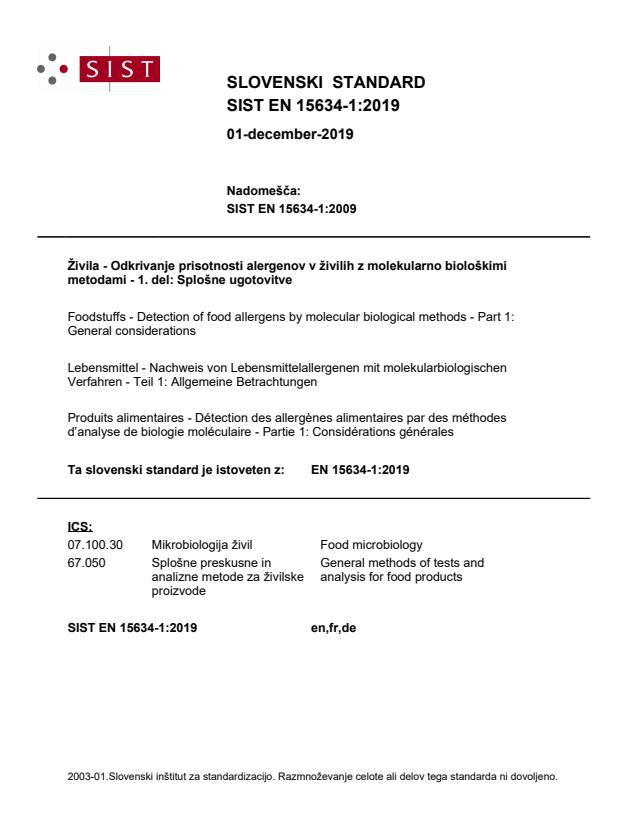
SLOVENSKI STANDARD
01-december-2019
Nadomešča:
SIST EN 15634-1:2009
Živila - Odkrivanje prisotnosti alergenov v živilih z molekularno biološkimi
metodami - 1. del: Splošne ugotovitve
Foodstuffs - Detection of food allergens by molecular biological methods - Part 1:
General considerations
Lebensmittel - Nachweis von Lebensmittelallergenen mit molekularbiologischen
Verfahren - Teil 1: Allgemeine Betrachtungen
Produits alimentaires - Détection des allergènes alimentaires par des méthodes
d’analyse de biologie moléculaire - Partie 1: Considérations générales
Ta slovenski standard je istoveten z: EN 15634-1:2019
ICS:
07.100.30 Mikrobiologija živil Food microbiology
67.050 Splošne preskusne in General methods of tests and
analizne metode za živilske analysis for food products
proizvode
2003-01.Slovenski inštitut za standardizacijo. Razmnoževanje celote ali delov tega standarda ni dovoljeno.
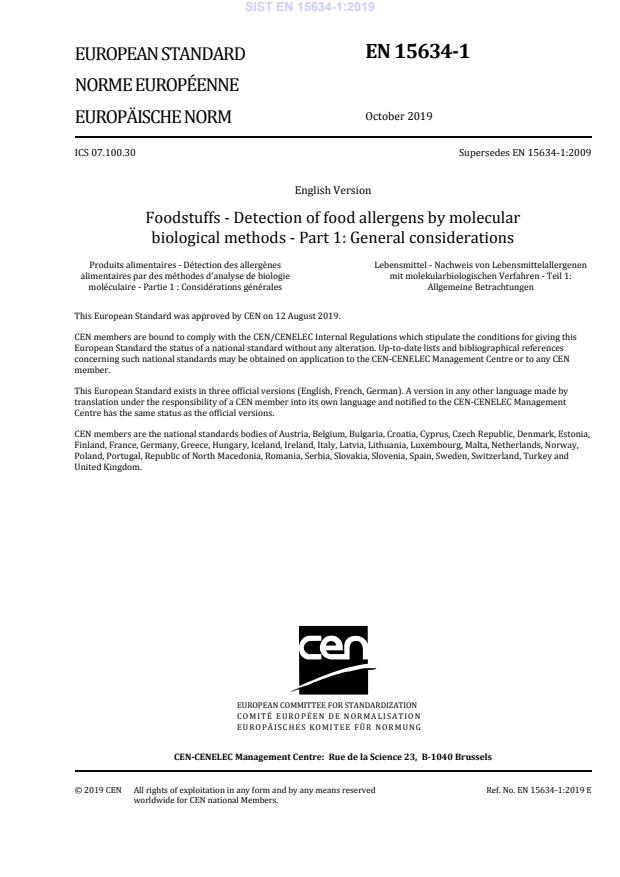
EN 15634-1
EUROPEAN STANDARD
NORME EUROPÉENNE
October 2019
EUROPÄISCHE NORM
ICS 07.100.30 Supersedes EN 15634-1:2009
English Version
Foodstuffs - Detection of food allergens by molecular
biological methods - Part 1: General considerations
Produits alimentaires - Détection des allergènes Lebensmittel - Nachweis von Lebensmittelallergenen
alimentaires par des méthodes d'analyse de biologie mit molekularbiologischen Verfahren - Teil 1:
moléculaire - Partie 1 : Considérations générales Allgemeine Betrachtungen
This European Standard was approved by CEN on 12 August 2019.
CEN members are bound to comply with the CEN/CENELEC Internal Regulations which stipulate the conditions for giving this
European Standard the status of a national standard without any alteration. Up-to-date lists and bibliographical references
concerning such national standards may be obtained on application to the CEN-CENELEC Management Centre or to any CEN
member.
This European Standard exists in three official versions (English, French, German). A version in any other language made by
translation under the responsibility of a CEN member into its own language and notified to the CEN-CENELEC Management
Centre has the same status as the official versions.
CEN members are the national standards bodies of Austria, Belgium, Bulgaria, Croatia, Cyprus, Czech Republic, Denmark, Estonia,
Finland, France, Germany, Greece, Hungary, Iceland, Ireland, Italy, Latvia, Lithuania, Luxembourg, Malta, Netherlands, Norway,
Poland, Portugal, Republic of North Macedonia, Romania, Serbia, Slovakia, Slovenia, Spain, Sweden, Switzerland, Turkey and
United Kingdom.
EUROPEAN COMMITTEE FOR STANDARDIZATION
COMITÉ EUROPÉEN DE NORMALISATION
EUROPÄISCHES KOMITEE FÜR NORMUNG
CEN-CENELEC Management Centre: Rue de la Science 23, B-1040 Brussels
© 2019 CEN All rights of exploitation in any form and by any means reserved Ref. No. EN 15634-1:2019 E
worldwide for CEN national Members.
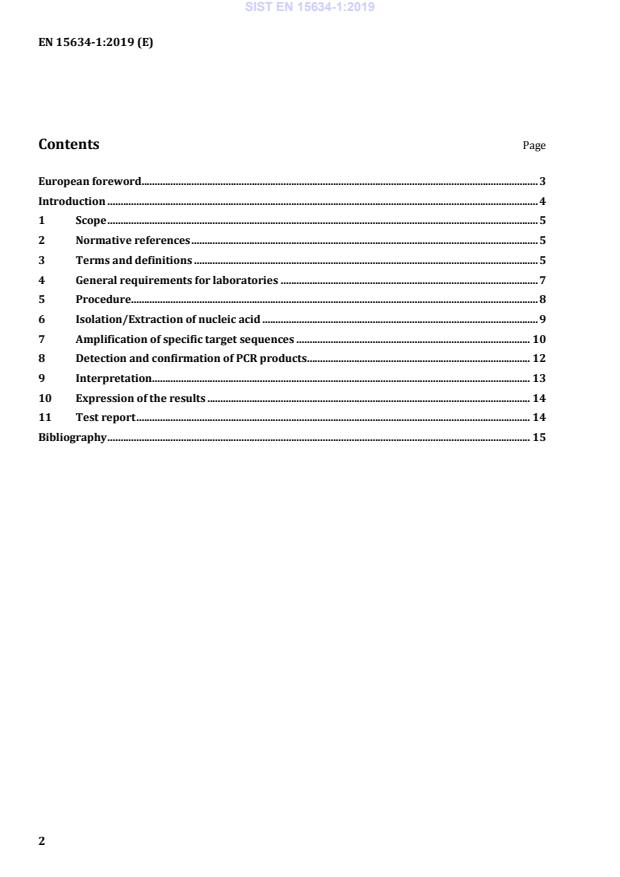
Contents Page
European foreword . 3
Introduction . 4
1 Scope . 5
2 Normative references . 5
3 Terms and definitions . 5
4 General requirements for laboratories . 7
5 Procedure. 8
6 Isolation/Extraction of nucleic acid . 9
7 Amplification of specific target sequences . 10
8 Detection and confirmation of PCR products . 12
9 Interpretation . 13
10 Expression of the results . 14
11 Test report . 14
Bibliography . 15
European foreword
This document (EN 15634-1:2019) has been prepared by Technical Committee CEN/TC 275 “Food
analysis - Horizontal methods”, the secretariat of which is held by DIN.
This European Standard shall be given the status of a national standard, either by publication of an
identical text or by endorsement, at the latest by April 2020, and conflicting national standards shall be
withdrawn at the latest by April 2020.
Attention is drawn to the possibility that some of the elements of this document may be the subject of
patent rights. CEN shall not be held responsible for identifying any or all such patent rights.
This document supersedes EN 15634-1:2009.
Significant technical changes between this standard and EN 15634-1:2009 are as follows:
a) updated terms and definitions (3);
b) requirements regarding the preparation of samples changed (6.1);
c) clause 6.3 on DNA quantitation changed;
d) clause 7.2.1 on primer design changed;
e) requirements regarding quantitation of PCR products (8.2) changed;
f) clause on "Quality assurance requirements" deleted;
g) the test report should comply with EN ISO/IEC 17025;
h) updated bibliography.
According to the CEN-CENELEC Internal Regulations, the national standards organisations of the
following countries are bound to implement this European Standard: Austria, Belgium, Bulgaria,
Croatia, Cyprus, Czech Republic, Denmark, Estonia, Finland, France, Germany, Greece, Hungary, Iceland,
Ireland, Italy, Latvia, Lithuania, Luxembourg, Malta, Netherlands, Norway, Poland, Portugal, Republic of
North Macedonia, Romania, Serbia, Slovakia, Slovenia, Spain, Sweden, Switzerland, Turkey and the
United Kingdom.
Introduction
This document describes the procedure to qualitatively detect and/or quantitate DNA fragments as
markers for potentially allergenic ingredients or constituents by analysing the nucleic acids extracted
from the sample under study.
The qualitative detection of DNA targets is performed in order to get a yes or no answer to the question
whether a certain DNA sequence is detected or not relative to appropriate controls and within the
detection limits of the analytical method used and the test portion analysed.
The quantitative detection of DNA targets is performed to express the quantity of DNA targets, relative
to the quantity of a specific reference, appropriate calibrants and controls and within the dynamic range
of the analytical method used and the test portion analysed. Appropriate procedures for extraction of
nucleic acids are included in each method.
The main focus of this document will be on PCR based amplification methods. However, because of the
rapid rate of technological change in this area, other amplification technologies and detection methods
may be considered.
For the use of this document the term:
— ‘shall’ indicates a requirement;
— ‘should’ indicates a recommendation;
— ‘may’ indicates a permission; and
— ‘can’ indicates a possibility and/or a capability.
1 Scope
This document provides the overall framework for detection of sequences corresponding to species
containing allergens using the polymerase chain reaction (PCR). It relates to the requirements for the
specific amplification of target nucleic acid sequences (DNA) and for the confirmation of the identity of
the amplified nucleic acid sequence.
Guidelines, minimum requirements and performance criteria laid down in European Standards are
intended to ensure that comparable and reproducible results are obtained in different laboratories. This
document has been established for food matrices.
This document is intended to be used in addition to EN 15842.
2 Normative references
The following documents are referred to in the text in such a way that some or all of their content
constitutes requirements of this document. For dated references, only the edition cited applies. For
undated references, the latest edition of the referenced document (including any amendments) applies.
EN 15842, Foodstuffs — Detection of food allergens — General considerations and validation of methods
3 Terms and definitions
For the purposes of this document, the terms and definitions given in EN 15842 and the following apply.
ISO and IEC maintain terminological databases for use in standardization at the following addresses:
• IEC Electropedia: available at http://www.electropedia.org/
• ISO Online browsing platform: available at https://www.iso.org/obp
3.1 Terms relative to extraction and purification of DNA
3.1.1
DNA extraction
separation of DNA from the other components in a test sample
Note 1 to entry: The factors of major importance for the isolated DNA are:
a) purity,
b) amount or concentration and
c) quality (integrity).
[SOURCE: EN ISO 24276:2006, 3.2.1, modified — note was added]
3.1.2
DNA purification
method resulting in a DNA intended to reduce observable measurable effects of PCR inhibitors
Note 1 to entry: In this context, purity refers to the reduction of observable measurable effects of PCR
inhibitors.
3.1.3
PCR quality DNA
DNA template of sufficient length, chemical purity, and structural integrity to be amplified by PCR
3.2 Terms relative to amplification of DNA
3.2.1
species specific target sequence
sequence known to be specific for the species or higher taxa
3.2.2
identification of amplified nucleic acid sequences
proof of identity of amplified nucleic acid sequences (amplicons) by comparison with a reference
nucleic acid fragment pattern or sequence
3.3 Definitions referring to controls
3.3.1
positive DNA target control
reference DNA, or DNA extracted from a certified reference material, or known positive samples
representative of the sequence or target under study
Note 1 to entry: The control is intended to demonstrate the result of analyses of test sample containing the
sequence under study.
[SOURCE: EN ISO 24276:2006, 3.4.1, modified — replaced organism by target, note was changed]
3.3.2
negative DNA target control
reference DNA, or DNA extracted from a certified negative (blank matrix) reference material, or known
negative sample not containing the sequence under study
Note 1 to entry The control is intended to demonstrate the result of analyses of test samples not containing the
sequence under study.
[SOURCE: EN ISO 24276:2006, 3.4.2, modified — note was changed]
3.3.3
PCR inhibition control
control containing known amounts of defined template DNA added in the same or less amount as
analyte DNA to the reaction
Note 1 to entry: This control allows the detection of the presence of soluble PCR inhibitors, particularly
necessary in case of non-specific or none amplification and of quantitative PCR.
3.3.4
amplification reagent control
no template control
control containing all the reagents, except extracted test sample template DNA
Note 1 to entry: Instead of the template DNA, a corresponding volume of nucleic acid free water or buffer is
added to the reaction.
3.3.5
extraction blank control
control performing all steps of the extraction procedure, except addition of the test portion, e.g. by
substitution of water for the test portion
Note 1 to entry: It is used to detect possible contaminating nucleic acid in a buffer or chemicals used during
extraction.
3.3.6
positive extraction control
control sample to demonstrate that the nucleic acid extraction procedure has been performed in a way
that will allow extraction and subsequent amplification of the target nucleic acid, i.e. by using a sample
material known to contain the target nucleic acid
Note 1 to entry: The DNA amount is usually e.g. tenfold over the LOD of the method to ensure amplification.
4 General requirements for laboratories
4.1 General
In addition to EN ISO/IEC 17025, also EN 15842 dealing with general considerations and validation
criteria of methods exists.
4.2 Laboratory organization
Compliance with applicable requirements with respect to safety regulations should be followed and
manufacturer’s safety recommendation should be taken into account.
Accidental contamination of DNA can originate from dust or spreading aerosols. As a consequence, the
organization of the work area in the laboratory is logically based on:
— the systemic containment of the methodological steps involved in the analysis, and
— a forward flow principle for sample handling.
A minimum of three separately designated work areas with their own apparatus is required:
a) a work area for extraction of the nucleic acid from the test portion (sample);
b) a work area dedicated to the setup of PCR/amplification reactions; and
c) a work area dedicated for subsequent processing including analysis and characterization of the
amplified DNA segments.
If dust particle producing grinding techniques are used, this shall be carried out in a separate work area.
Physical separation through the use of different rooms is the most effective and preferable way of
ensuring separated work areas, but other physical or biochemical methods may be used as a protection
against contamination provided their effectiveness is comparable.
Staff should preferably wear different sets of lab coats at each dedicated work area. They shall also wear
disposable gloves. Gloves and lab coats should be changed at appropriated frequencies.
4.3 Apparatus and equipment
The laboratory should use properly maintained equipment suitable for the method employed, e.g.
according to the requirements outlined by EN ISO/IEC 17025. In addition to standard laboratory
equipment, additional apparatus are described in the specific methods.
Apparatus and equipment should be maintained according to manufacturer’s instructions. Calibration
systems should be available and calibration routinely performed for equipment which could impact the
data produced, according to laboratory quality assurance programs.
4.4 Material and reagents
For the analysis, unless otherwise stated, use only analytically pure reagents suitable for molecular
biology, free from DNA and DNAses. Reagents and solutions should be stored at room temperature,
unless otherwise specified. PCR reagents should be stored in small aliquots to minimize the risk of
contamination. The water used shall be double distilled or equivalent, free from DNA and nucleases
(nucleic acid based grade). Solutions are prepared by dissolving the appropriate reagents in water and
autoclaved unless specified differently. Filtration can be performed for obtaining sterile solutions, when
autoclaving is not possible.
In order to avoid contamination, all the appliances and the parts of equipment in contact with the
samples, as well as work surfaces should be easy to clean and decontaminate. Work surfaces cleaning
and decontamination is recommended before use
...
Questions, Comments and Discussion
Ask us and Technical Secretary will try to provide an answer. You can facilitate discussion about the standard in here.
Loading comments...