


kSIST FprEN 16383:2025
(Main)Thermal insulation products for building applications - Determination of the water tightness of external thermal insulation composite kits with a rendering system (ETICS kits)
Thermal insulation products for building applications - Determination of the water tightness of external thermal insulation composite kits with a rendering system (ETICS kits)
This document specifies the equipment and procedures for determining the hygrothermal behaviour of external thermal insulation composite kits with a rendering system (ETICS kits).
Wärmedämmstoffe für das Bauwesen - Bestimmung der Wasserdichtheit von außenseitigen Wärmedämm-Verbundsystemen mit Putzen (WDVS)
Dieses Dokument legt Prüfeinrichtungen und Verfahren zur Bestimmung des hygrothermischen Verhaltens von außenseitigen Wärmedämm-Verbundsystem-Bausätzen mit Putzsystem (WDVS Bausätze) fest.
Produits isolants thermiques destinés aux applications du bâtiment - Détermination de l’étanchéité à l’eau des kits composites d’isolation thermique extérieure avec un système d’enduit (kits ETICS)
Le présent document spécifie l’équipement et les modes opératoires pour déterminer le comportement hygrothermique des kits composites d’isolation thermique extérieure avec un système d’enduit (kits ETICS).
Toplotnoizolacijski proizvodi za uporabo v gradbeništvu - Ugotavljanje vodotesnosti zunanjih toplotnoizolacijskih kompozitnih sistemov z ometi (ETICS kompleti)
General Information
- Status
- Not Published
- Public Enquiry End Date
- 23-Jan-2025
- Technical Committee
- TOP - Thermal insulation
- Current Stage
- 5020 - Formal vote (FV) (Adopted Project)
- Start Date
- 27-Oct-2025
- Due Date
- 15-Dec-2025
- Completion Date
- 16-Mar-2026
Relations
- Effective Date
- 22-Mar-2023
Overview
The standard kSIST FprEN 16383:2025, prepared by CEN/TC 88 and scheduled for publication in 2025, specifies the equipment, procedures, and test methods for determining the hygrothermal behaviour of External Thermal Insulation Composite Systems (ETICS kits) with rendering. This standard focuses primarily on assessing the water tightness and durability of ETICS kits when subjected to various hygrothermal cycles involving heating, wetting, cooling, freezing, and thawing.
By providing a uniform testing framework, kSIST FprEN 16383:2025 enables manufacturers, building professionals, and regulators to evaluate the performance and reliability of ETICS systems under real-world climatic stresses, ensuring safer and more energy-efficient building envelopes.
Key Topics
Scope and Objective:
The standard defines how to test ETICS kits installed on substrates for their resistance to water penetration and their behaviour under climatic conditions simulating heat, moisture, freezing, and thawing.Test Setup:
- Preparation of a test wall with specified dimensions (minimum 2.0 m height and 2.5–3.0 m width depending on number of openings).
- Application of ETICS kits according to system holder instructions, including thermal insulation, adhesives, reinforced base coats, finishing layers, and protective seals around openings.
- Conditioning of the test wall for at least 28 days at ambient temperature (~20°C).
Hygrothermal Cycles:
- Heating and Wetting: Repeated cycles of heating the test wall surface to 70°C and applying water at controlled rates and temperature.
- Heating and Cooling: Heating to 50°C followed by cooling to -20°C to simulate temperature fluctuations.
- Wetting, Freezing, and Thawing: Cycles that expose the test wall to wetting, freezing temperatures, and thawing to evaluate freeze-thaw resistance.
Testing Equipment:
- Devices to control and maintain temperature and humidity during heating, wetting, cooling, freezing, and thawing phases.
- Water application systems ensuring uniform spray with defined flow rate and temperature.
Assessment Criteria:
Visual inspection for surface integrity, presence of defects such as blistering, cracking, delamination, and other moisture-induced damages after each cycle set. Evaluation of different wall sections separately: upper two-thirds with finishing coats and lower one-third with base coat only.Test Report:
Documentation requirements including test conditions, specimen descriptions, cycle sequences, observations, and final assessment results.
Applications
Building Construction and Renovation:
This standard guides manufacturers and contractors in certifying ETICS kits are water-tight, resistant to moisture ingress and thermal stresses, helping to ensure long-term durability of thermal insulation in building façades.Quality Control and Certification:
Used by testing laboratories and certification bodies to verify conformity of ETICS products with European norms and building codes.Product Development:
Enables product developers to simulate environmental impacts in a controlled setting, thereby optimizing material composition, adhesive properties, reinforcement methods, and coating systems.Regulation Compliance:
Supports compliance with energy efficiency and building durability regulations, improving building performance and occupant comfort.
Related Standards
kSIST FprEN 16383:2025 refers to and complements other standards in the thermal insulation and rendering system domain, including:
- EN 998-1: Specification for rendering and plastering mortars used in masonry and ETICS systems.
- EN 15824: Specifications for external renders and internal plasters based on organic binders.
- EN ISO 9229: Vocabulary for thermal insulation materials, ensuring consistent terminology.
Understanding and aligning with these related standards enhances holistic evaluation and certification of external insulation composite systems in building construction.
This evolving European standard plays a crucial role in advancing the reliability, safety, and performance of ETICS kits used in the building sector, encouraging innovation and market acceptance of sustainable thermal insulation solutions.

Get Certified
Connect with accredited certification bodies for this standard

ICC Evaluation Service
Building products evaluation and certification.

QAI Laboratories
Building and construction product testing and certification.

Aboma Certification B.V.
Specialized in construction, metal, and transport sectors.
Sponsored listings
Frequently Asked Questions
kSIST FprEN 16383:2025 is a draft published by the Slovenian Institute for Standardization (SIST). Its full title is "Thermal insulation products for building applications - Determination of the water tightness of external thermal insulation composite kits with a rendering system (ETICS kits)". This standard covers: This document specifies the equipment and procedures for determining the hygrothermal behaviour of external thermal insulation composite kits with a rendering system (ETICS kits).
This document specifies the equipment and procedures for determining the hygrothermal behaviour of external thermal insulation composite kits with a rendering system (ETICS kits).
kSIST FprEN 16383:2025 is classified under the following ICS (International Classification for Standards) categories: 91.100.60 - Thermal and sound insulating materials. The ICS classification helps identify the subject area and facilitates finding related standards.
kSIST FprEN 16383:2025 has the following relationships with other standards: It is inter standard links to SIST EN 16383:2017. Understanding these relationships helps ensure you are using the most current and applicable version of the standard.
kSIST FprEN 16383:2025 is available in PDF format for immediate download after purchase. The document can be added to your cart and obtained through the secure checkout process. Digital delivery ensures instant access to the complete standard document.
Standards Content (Sample)
SLOVENSKI STANDARD
oSIST prEN 16383:2025
01-januar-2025
Toplotnoizolacijski proizvodi za uporabo v gradbeništvu - Ugotavljanje
vodotesnosti zunanjih toplotnoizolacijskih kompozitnih sistemov z ometi (ETICS
kompleti)
Thermal insulation products for building applications - Determination of the water
tightness of external thermal insulation composite kits with a rendering system (ETICS
kits)
Wärmedämmstoffe für das Bauwesen - Bestimmung der Wasserdichtheit von
außenseitigen Wärmedämm-Verbundsystemen mit Putzen (WDVS)
Produits isolants thermiques destinés aux applications du bâtiment - Détermination de
l’étanchéité à l’eau des kits composites d’isolation thermique extérieure avec un système
d’enduit (kits ETICS)
Ta slovenski standard je istoveten z: prEN 16383
ICS:
91.100.60 Materiali za toplotno in Thermal and sound insulating
zvočno izolacijo materials
oSIST prEN 16383:2025 en,fr,de
2003-01.Slovenski inštitut za standardizacijo. Razmnoževanje celote ali delov tega standarda ni dovoljeno.
oSIST prEN 16383:2025
oSIST prEN 16383:2025
DRAFT
EUROPEAN STANDARD
prEN 16383
NORME EUROPÉENNE
EUROPÄISCHE NORM
November 2024
ICS 91.100.60 Will supersede EN 16383:2016
English Version
Thermal insulation products for building applications -
Determination of the water tightness of external thermal
insulation composite kits with a rendering system (ETICS
kits)
Produits isolants thermiques destinés aux applications Wärmedämmstoffe für das Bauwesen - Bestimmung
du bâtiment - Détermination de l'étanchéité à l'eau des der Wasserdichtheit von außenseitigen Wärmedämm-
kits composites d'isolation thermique extérieure avec Verbundsystemen mit Putzen (WDVS)
un système d'enduit (kits ETICS)
This draft European Standard is submitted to CEN members for enquiry. It has been drawn up by the Technical Committee
CEN/TC 88.
If this draft becomes a European Standard, CEN members are bound to comply with the CEN/CENELEC Internal Regulations
which stipulate the conditions for giving this European Standard the status of a national standard without any alteration.
This draft European Standard was established by CEN in three official versions (English, French, German). A version in any other
language made by translation under the responsibility of a CEN member into its own language and notified to the CEN-CENELEC
Management Centre has the same status as the official versions.
CEN members are the national standards bodies of Austria, Belgium, Bulgaria, Croatia, Cyprus, Czech Republic, Denmark, Estonia,
Finland, France, Germany, Greece, Hungary, Iceland, Ireland, Italy, Latvia, Lithuania, Luxembourg, Malta, Netherlands, Norway,
Poland, Portugal, Republic of North Macedonia, Romania, Serbia, Slovakia, Slovenia, Spain, Sweden, Switzerland, Türkiye and
United Kingdom.
Recipients of this draft are invited to submit, with their comments, notification of any relevant patent rights of which they are
aware and to provide supporting documentation.
Warning : This document is not a European Standard. It is distributed for review and comments. It is subject to change without
notice and shall not be referred to as a European Standard.
EUROPEAN COMMITTEE FOR STANDARDIZATION
COMITÉ EUROPÉEN DE NORMALISATION
EUROPÄISCHES KOMITEE FÜR NORMUNG
CEN-CENELEC Management Centre: Rue de la Science 23, B-1040 Brussels
© 2024 CEN All rights of exploitation in any form and by any means reserved Ref. No. prEN 16383:2024 E
worldwide for CEN national Members.
oSIST prEN 16383:2025
prEN 16383:2024 (E)
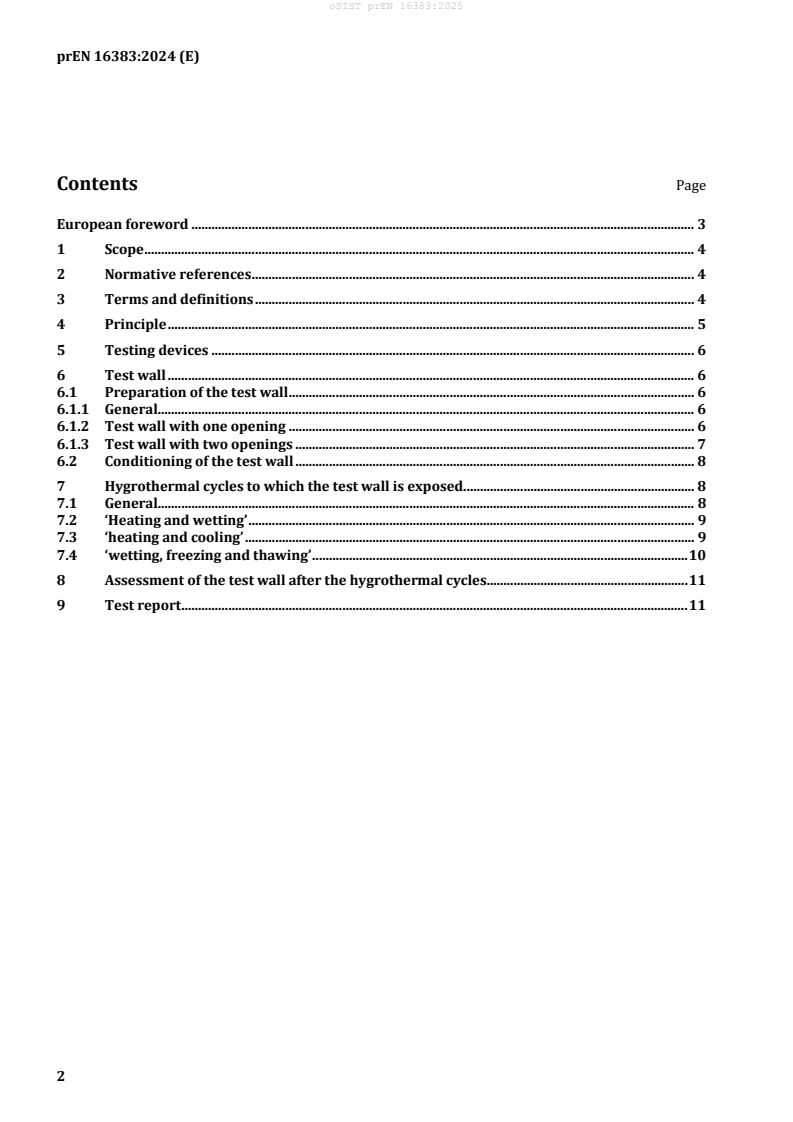
Contents Page
European foreword . 3
1 Scope . 4
2 Normative references . 4
3 Terms and definitions . 4
4 Principle . 5
5 Testing devices . 6
6 Test wall . 6
6.1 Preparation of the test wall . 6
6.1.1 General. 6
6.1.2 Test wall with one opening . 6
6.1.3 Test wall with two openings . 7
6.2 Conditioning of the test wall . 8
7 Hygrothermal cycles to which the test wall is exposed. 8
7.1 General. 8
7.2 ‘Heating and wetting’ . 9
7.3 ‘heating and cooling’ . 9
7.4 ‘wetting, freezing and thawing’ . 10
8 Assessment of the test wall after the hygrothermal cycles. 11
9 Test report . 11
oSIST prEN 16383:2025
prEN 16383:2024 (E)
European foreword
This document (prEN 16383:2024) has been prepared by Technical Committee CEN/TC 88 “Thermal
insulating materials and products”, the secretariat of which is held by DIN.
This document is currently submitted to the CEN Enquiry.
This document will supersede EN 16383:2016.
This document includes the following significant technical changes with respect to EN 16383:2016:
— the normative references have been updated;
— terms and definitions have been revised;
— editorial changes in Clause 6, Clause 7 and Clause 8 have been made;
— the test report, Clause 9, was revised.
oSIST prEN 16383:2025
prEN 16383:2024 (E)
1 Scope
This document specifies the equipment and procedures for determining the water tightness of external
thermal insulation composite kits with a rendering system (ETICS kits).
2 Normative references
The following documents are referred to in the text in such a way that some or all of their content
constitutes requirements of this document. For dated references, only the edition cited applies. For
undated references, the latest edition of the referenced document (including any amendments) applies.
EN 998-1, Specification for mortar for masonry - Part 1: Rendering and plastering mortar
EN 15824, Specifications for external renders and internal plasters based on organic binders
EN ISO 9229, Thermal insulation - Vocabulary (ISO 9229)
3 Terms and definitions
For the purposes of this document, the terms and definitions given in EN ISO 9229 and the following
apply.
ISO and IEC maintain terminology databases for use in standardization at the following addresses:
— ISO Online browsing platform: available at https://www.iso.org/obp
— IEC Electropedia: available at https://www.electropedia.org/
3.1
substrate
part of the wall or test assembly to which an ETICS kit is fixed
3.2
test wall
substrate covered by an ETICS kit or set of ETICS kits to test the water tightness
3.3
adhesive
component used for bonding the thermal insulation to the substrate or used for an adhesive bed
Note 1 to entry: Adhesives are available as dry mix, ready to use or PU adhesive foam.
3.4
thermal insulation
component, thermal insulation material in its finished form, including all directly and factory-applied
facings or coatings
3.5
mechanical fixing device
component used for fixing parts of a kit to the substrate
oSIST prEN 16383:2025
prEN 16383:2024 (E)
3.6
base coat
component applied directly to the thermal insulation after fixing and/or bonding to the substrate
Note 1 to entry: Base coats are available as dry mix or ready to use.
Note 2 to entry: Base coats contain either organic or inorganic binders.
3.7
reinforcement
component, mesh, embedded in the base coat to reinforce the rendering system
3.8
reinforced base coat
base coat with embedded reinforcement
3.9
key coat
component applied to the base coat as a preparation for the application of the finishing coat
Note 1 to entry: A key coat is a very thin coating material which can be applied to the base coat as a preparation
for the application of the finishing coat. It can also be used for aesthetic reasons.
3.10
finishing coat
component, available as dry mix mortar or ready to use mortar, applied to the reinforced base coat or
key coat
Note 1 to entry: Finishing coats are available as dry mix or ready to use.
Note 2 to entry: Finishing coats contain either organic or inorganic binders.
3.11
decorative coat
component which is applied to the finishing coat
Note 1 to entry: A decorative coat is a thin coating material, mainly used for aesthetic reasons.
3.12
finishing layer
finishing coat with a key coat (optional) and/or a decorative coat (optional)
4 Principle
Expose an ETICS kit or part of an ETICS kit to a set out of hygrothermal cycles of heating, wetting,
cooling and freeze/thaw cycles.
oSIST prEN 16383:2025
prEN 16383:2024 (E)
5 Testing devices
The following test devices are necessary:
— device for heating the surface of the assembled kit regulated to (70 ± 5) °C and maintaining the
relative humidity of the air close to the surface of the kit to less than 30 %;
— device for wetting the surface of the kit with tap or demineralized or deionized water with a
temperature of (15 ± 5) °C and an amount of (1,5 ± 0,5) l/(m min) with the use of spraying nozzles
to ensure uniform water distribution;
— device for cooling the surface of the kit to (−20 ± 5) °C.
These devices shall meet the required test conditions described in Clause 7.
6 Test wall
6.1 Preparation of the test wall
6.1.1 General
The ETICS kit(s) shall be applied to the substrate according to the instructions of the system holder.
The thermal insulation shall be fixed to the substrate and covered by the reinforced base coat. The
perimeter edges of the test wall shall be wrapped/covered with the reinforced base coat. The upper 2/3
of the height of the test wall shall be covered additionally with one or more finishing layers according to
Figure 1 and Figure 2. Within the lower 1/3 from the bottom edge shall be at least one horizontal joint
between the thermal insulation boards (see “a” in Figure 1 and Figure 2). The distance between the
horizontal joint and the 1/3 of the height of the test wall (see “b” in Figure 1 and Figure 2) shall be at
least 200 mm.
If the height of the thermal insulation board is bigger than 1/3 of the height of the test wall minus
200 mm, the thermal in
...
Questions, Comments and Discussion
Ask us and Technical Secretary will try to provide an answer. You can facilitate discussion about the standard in here.
Loading comments...