

SIST EN 50365:2024
(Main)Live Working - Electrically insulating helmets for use on low and medium voltage installations
General Information
- Abstract
This standard is applicable to electrically insulating helmets used for working live or close to live parts on installations not exceeding 1 000 V AC or 1 500 V DC. These helmets, when used in conjunction with other electrically insulating protective equipment prevent dangerous current from passing through persons via their head.
- Status
- Published
- Public Enquiry End Date
- 31-Jan-2021
- Publication Date
- 16-Jan-2024
- Technical Committee
- DPN - Live Working
- Current Stage
- 6060 - National Implementation/Publication (Adopted Project)
- Start Date
- 15-Jan-2024
- Due Date
- 21-Mar-2024
- Completion Date
- 17-Jan-2024
- Directive
- 2016/425 - Regulation (EU) 2016/425 of the European Parliament and of the Council of 9 March 2016 on personal protective equipment and repealing Council Directive 89/686/EECOJ Ref: 2024, 2024/2599, OJ L OJ Date: 08-Oct-2024
- Mandate
- M/PPE - PPE


Overview
EN 50365:2023 - published by CLC/CENELEC - is the European standard for electrically insulating helmets for live working on low and medium voltage installations. It specifies the electrical requirements, classification and testing needed to ensure a helmet prevents dangerous current passing through a person’s head when working on or close to live parts. The 2023 edition supersedes EN 50365:2002 and extends the scope to helmets tested up to electrical Class 2 (see Key Topics).
Keywords: EN 50365:2023, electrically insulating helmets, live working, low and medium voltage, CLC, PPE
Key Topics
- Scope and classification
- Defines electrical classes: Class 00, 0, 1, 2 covering nominal voltages up to specified AC/DC limits (EN 50365 details class voltage ranges).
- Design types
- Two helmet design types: Type A (full brim) and Type B (peak/ no brim), with crown protection and clearance requirements.
- Electrical tests
- Mandatory electrical testing includes AC proof test, AC withstand test, and where applicable DC proof test. Type testing, routine testing and sampling procedures are specified.
- Marking and identification
- Helmets must carry the IEC double-triangle symbol (suitable for live working), the EN number/date, electrical class, “AC” or “AC/DC”, serial/batch, manufacture date, and space for inspection/use dates.
- Colour coding for the symbol is recommended (e.g., beige for Class 00, red for Class 0, white for Class 1, yellow for Class 2).
- Scope exclusions
- EN 50365 covers only the electrical aspects of insulating helmets. It does not cover mechanical performance, arc-flash protection, or accessories (face shields, lamps, ear defenders, detectors).
- Production and conformity
- Includes requirements for type testing, marking durability, packaging, instructions for use, and alternative testing after production.
Applications
- Used by utilities, electricians, live-line technicians, maintenance crews and industrial safety managers for procurement, specification and certification of insulating head protection during live electrical work.
- Guides manufacturers and test laboratories designing and validating helmets for use on or near live conductors.
- Supports safety officers and compliance teams implementing PPE programs for work in substations, overhead-line maintenance, and switchgear operations.
Related Standards
- EN 50110-1 (operation of electrical installations)
- EN 397 / EN 14052 (mechanical/industrial helmet requirements) - mechanical aspects are referenced but EN 50365 focuses on electrical insulation
- EN 60060-1 (high-voltage test techniques)
- EN IEC 61318 (methods for assessment of defects and verification of performance)
EN 50365:2023 is essential when specifying insulating helmets for live working and ensuring compliance with European electrical safety practice.
Relations
- Effective Date
- 10-Apr-2018
- Effective Date
- 09-Feb-2026
- Effective Date
- 01-Nov-2024
Get Certified
Connect with accredited certification bodies for this standard

CIS Institut d.o.o.
Personal Protective Equipment (PPE) certification body. Notified Body NB-2890 for EU Regulation 2016/425 PPE.

Kiwa BDA Testing
Building and construction product certification.
Kmetijski inštitut Slovenije
Agricultural Institute of Slovenia. Soil testing, plant health, agricultural product analysis.
Sponsored listings
Frequently Asked Questions
SIST EN 50365:2024 is a standard published by the Slovenian Institute for Standardization (SIST). Its full title is "Live Working - Electrically insulating helmets for use on low and medium voltage installations". This standard covers: This standard is applicable to electrically insulating helmets used for working live or close to live parts on installations not exceeding 1 000 V AC or 1 500 V DC. These helmets, when used in conjunction with other electrically insulating protective equipment prevent dangerous current from passing through persons via their head.
This standard is applicable to electrically insulating helmets used for working live or close to live parts on installations not exceeding 1 000 V AC or 1 500 V DC. These helmets, when used in conjunction with other electrically insulating protective equipment prevent dangerous current from passing through persons via their head.
SIST EN 50365:2024 is classified under the following ICS (International Classification for Standards) categories: 13.260 - Protection against electric shock. Live working; 13.340.20 - Head protective equipment. The ICS classification helps identify the subject area and facilitates finding related standards.
SIST EN 50365:2024 has the following relationships with other standards: It is inter standard links to SIST EN 50365:2002, SIST EN 397:2025, SIST EN 50365:2024/AC:2024. Understanding these relationships helps ensure you are using the most current and applicable version of the standard.
SIST EN 50365:2024 is associated with the following European legislation: EU Directives/Regulations: 2016/425; Standardization Mandates: M/571, M/571 Amd 1, M/571 Amd 1, M/PPE. When a standard is cited in the Official Journal of the European Union, products manufactured in conformity with it benefit from a presumption of conformity with the essential requirements of the corresponding EU directive or regulation.
SIST EN 50365:2024 is available in PDF format for immediate download after purchase. The document can be added to your cart and obtained through the secure checkout process. Digital delivery ensures instant access to the complete standard document.
Standards Content (Sample)
SLOVENSKI STANDARD
01-marec-2024
Nadomešča:
SIST EN 50365:2002
Delo pod napetostjo - Elektroizolacijske čelade za delo na nizko- in
srednjenapetostnih inštalacijah
Live Working - Electrically insulating helmets for use on low and medium voltage
installations
Elektrisch isolierende Helme für Arbeiten an Nieder- und Mittelspannungsanlagen
Travaux sous tension - Casques électriquement isolants pour utilisation sur installations
à basse et à moyenne tension
Ta slovenski standard je istoveten z: EN 50365:2023
ICS:
13.260 Varstvo pred električnim Protection against electric
udarom. Delo pod napetostjo shock. Live working
13.340.20 Varovalna oprema za glavo Head protective equipment
2003-01.Slovenski inštitut za standardizacijo. Razmnoževanje celote ali delov tega standarda ni dovoljeno.
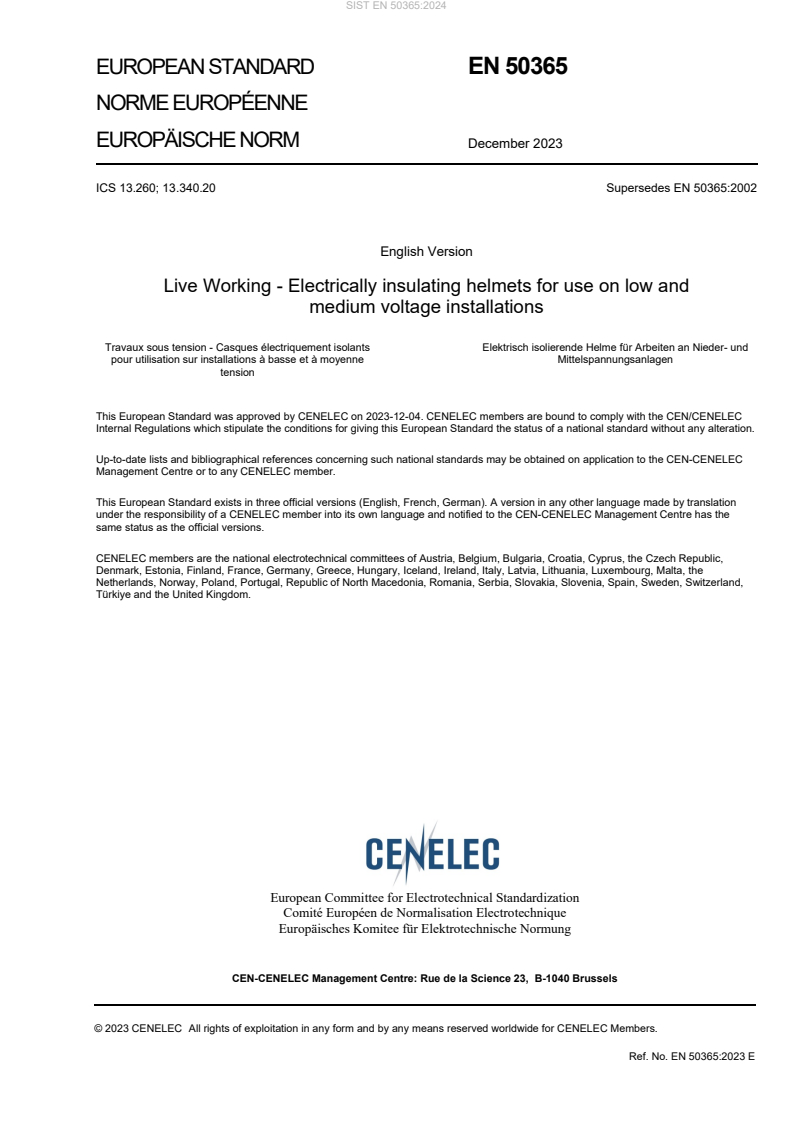
EUROPEAN STANDARD EN 50365
NORME EUROPÉENNE
EUROPÄISCHE NORM December 2023
ICS 13.260; 13.340.20 Supersedes EN 50365:2002
English Version
Live Working - Electrically insulating helmets for use on low and
medium voltage installations
Travaux sous tension - Casques électriquement isolants Elektrisch isolierende Helme für Arbeiten an Nieder- und
pour utilisation sur installations à basse et à moyenne Mittelspannungsanlagen
tension
This European Standard was approved by CENELEC on 2023-12-04. CENELEC members are bound to comply with the CEN/CENELEC
Internal Regulations which stipulate the conditions for giving this European Standard the status of a national standard without any alteration.
Up-to-date lists and bibliographical references concerning such national standards may be obtained on application to the CEN-CENELEC
Management Centre or to any CENELEC member.
This European Standard exists in three official versions (English, French, German). A version in any other language made by translation
under the responsibility of a CENELEC member into its own language and notified to the CEN-CENELEC Management Centre has the
same status as the official versions.
CENELEC members are the national electrotechnical committees of Austria, Belgium, Bulgaria, Croatia, Cyprus, the Czech Republic,
Denmark, Estonia, Finland, France, Germany, Greece, Hungary, Iceland, Ireland, Italy, Latvia, Lithuania, Luxembourg, Malta, the
Netherlands, Norway, Poland, Portugal, Republic of North Macedonia, Romania, Serbia, Slovakia, Slovenia, Spain, Sweden, Switzerland,
Türkiye and the United Kingdom.
European Committee for Electrotechnical Standardization
Comité Européen de Normalisation Electrotechnique
Europäisches Komitee für Elektrotechnische Normung
CEN-CENELEC Management Centre: Rue de la Science 23, B-1040 Brussels
© 2023 CENELEC All rights of exploitation in any form and by any means reserved worldwide for CENELEC Members.
Ref. No. EN 50365:2023 E
Contents
European foreword .6
1 Scope .7
2 Normative references .7
3 Terms and definitions .7
4 Requirements .8
4.1 General .8
4.2 Non-electrical requirements.8
4.2.1 General .8
4.2.2 Helmet Design .8
4.3 Electrical requirements . 10
4.3.1 General . 10
4.3.2 Electrical Classification . 10
4.4 Marking . 10
4.4.1 General . 10
4.4.2 Colour code . 11
4.5 Packaging . 11
4.6 Instruction for use . 11
5 Type testing . 12
5.1 General . 12
5.2 Non-electrical type tests . 12
5.3 Electrical type tests . 12
5.3.1 General . 12
5.3.2 Test arrangement . 12
5.3.3 Preconditioning . 14
5.3.4 AC Proof test voltage . 14
5.3.5 AC Withstand test voltage . 15
5.3.6 DC Proof voltage test . 15
5.4 Marking . 15
5.4.1 Visual inspection . 15
5.4.2 Durability. 15
5.5 Packaging . 16
5.6 Instructions of use . 16
6 Alternative testing after production . 16
7 Method for assessment of defects and verification of performance applicable to electrically
insulating helmets having completed the production phase . 16
8 Modifications . 16
Annex A (normative) Suitable for live working: double triangle (IEC 60417-5216:2002-10) . 17
Annex B (normative) Example of Marking . 18
Annex C (informative) Additional recommendations and information to the instructions for use . 19
C.1 General . 19
C.2 Storage . 19
C.3 Examination before use. 19
C.4 Precaution in use . 19
C.5 Precaution after use . 19
C.6 Periodic test . 20
C.7 Obsolescence . 20
Annex D (normative) Chronological order for type testing . 21
Annex E (normative) Classification of tests and defects to be allocated . 22
Annex F (informative) Rationale for the classification of defects . 23
Annex ZZ (informative) Relationship between this European standard and the essential
requirements of Regulation (EU) 2016/425 aimed to be covered . 24
Bibliography . 25
European foreword
This document (EN 50365:2023) has been prepared by CLC/TC 78 “Equipment and tools for live working”.
The following dates are fixed:
• Latest date which this document has to be (dop) 2024-12-04
implemented at national level by publication of an
identical national standard or by endorsement
• latest date by which the national standards (dow) 2026-12-04
conflicting with this document have to
be withdrawn
This document supersedes EN 50365:2002 and all its amendments and corrigenda (if any).
— Change of scope to test helmets up to Class 2
— Update on normative references
— Definitions for Brim, Crown and Shell
— Helmet design types Type A and B
— Additional marking required for voltage and design type
— DC testing
— Alternative testing after production
— Removal of air hole design test
— Only electrical aspect are covered
— Addition of Annex ZZ
Terms defined in Clause 3 are given in italic print throughout this standard.
Attention is drawn to the possibility that some of the elements of this document may be the subject of patent
rights. CENELEC shall not be held responsible for identifying any or all such patent rights.
This document has been prepared under a standardization request addressed to CENELEC by the
European Commission. The Standing Committee of the EFTA States subsequently approves these
requests for its Member States.
For the relationship with EU Legislation, see informative Annex ZZ, which is an integral part of this
document.
Any feedback and questions on this document should be directed to the users’ national committee. A
complete listing of these bodies can be found on the CENELEC website.
1 Scope
This document specifies the electrical requirements and testing for electrically insulating helmets that
provide electrical insulating protection of head of the worker against electric shock used for when working
live or near to live parts on installations not exceeding 17 000 V AC or 1 500 V DC.
The products designed and manufactured according to this document contribute to the safety of the users
provided they are used by skilled persons, in accordance with EN 50110-1:2023 and/or National
Regulations.
This document does not cover arc flash or additional helmet accessories such as face shields, ear
defenders, lamps and voltage detectors and doesn’t cover mechanical requirements and tests.
2 Normative references
The following documents are referred to in the text in such a way that some or all of their content constitutes
requirements of this document. For dated references, only the edition cited applies. For undated references,
the latest edition of the referenced document (including any amendments) applies.
EN 397:2012+A1:2012, Industrial safety helmets
EN 443:2008, Helmets for fire fighting in buildings and other structures
EN 14052:2012+A1:2012, High performance industrial helmets
EN 50110-1:2023, Operation of electrical installations - Part 1: General requirements
EN 60060-1:2010, High-voltage test techniques - Part 1: General definitions and test requirements
(IEC 60060-1:2010)
EN 60212:2011, Standard conditions for use prior to and during the testing of solid electrical insulating
materials (IEC 60212:2010)
EN IEC 61318:2021, Live working - Methods for assessment of defects and verification of performance
applicable to tools, devices and equipment (IEC 61318:2021)
3 Terms and definitions
For the purposes of the present document, the following terms and definitions apply.
ISO and IEC maintain terminological databases for use in standardization at the following addresses:
— ISO Online browsing platform: available at https://www.iso.org/obp
— IEC Electropedia: available at http://www.electropedia.org/
3.1
brim
rim surrounding the shell
[SOURCE: ISO 3873:1977,3.4]
3.2
crown
area on the upper outside surface of the helmet centred on the top
3.3
electrically insulating helmet
safety helmet which protects the wearer against electrical shocks by preventing the passage of dangerous
current through the body via the head
3.4
proof test voltage
specified value of voltage that is applied to a device, item or component for the time defined under specified
conditions to assure that the electrical strength of the insulation is above a specified value
3.5
routine test
conformity test made on each individual item during or after manufacture
[SOURCE: IEC 60050-151:2001, 151-16-17]
3.6
sampling test
test performed on a number of devices taken at a random from a batch
[SOURCE: IEC 60050-151:2001, 151-16-20, modified – definition has been adapted]
3.7
shell
rigid cover which gives the helmet its shape
[SOURCE: EN 397:2012+A1:2012, 3.2]
3.8
type test
test performed on one or more devices made to a certain design to show that the design meets certain
specifications
[SOURCE IEC 60050-151:2001, 151-16-16, modified – definition has been adapted]
3.9
withstand test voltage
specified value of voltage that a device, item or component must withstand without flashover, disruptive
discharge, puncture or other electric failure when that value of voltage is applied under specified conditions
4 Requirements
4.1 General
Electrically insulating helmets shall fulfil the following requirements.
4.2 Non-electrical requirements
4.2.1 General
This document does not cover non-electrical essential requirements.
The non-electrical requirements shall conform to the relevant standard it is certified to.
Nevertheless, the applicable non-electrical requirements shall not conflict with the electrical requirements
and tests given in this document.
4.2.2 Helmet Design
Electrically insulating helmets shall not consist of conductive parts or materials and have no apertures that
affects the electrical insulating properties.
The crown area differs according to the types of helmets and the electrical class giving protection to the top
of the head as defined by the vertical clearance distances given in Table 1 and the contour given in Figure 3.
Electrically insulating helmets used on or near electrical installations shall be classified by types of design
to protect the crown area of the head.
Type A – With a full brim greater than 30 mm at any point. (Figure 1).
Type B – Peak cap and no brim (Figure 2).
Figure 1 — Type A helmet design
a) b)
c)
Figure 2 — Type B helmet designs
4.3 Electrical requirements
4.3.1 General
Electrically insulating helmet shell shall pass, for AC use, an AC proof test voltage and an AC withstand
test voltage according to 5.3.4 and 5.3.5 and, for AC/DC use, an AC proof test voltage, an AC withstand
test voltage and a DC proof test voltage according to 5.3.4, 5.3.5 and 5.3.6.
4.3.2 Electrical Classification
Electrically insulating helmets used on or near electrical installations shall be classified in:
— electrical class 00 for installations with nominal voltage up to 500 V AC and 750 V DC;
— electrical class 0 for installations with nominal voltage up to 1 000 V AC and 1 500 V DC;
— electrical class 1 for installations with nominal voltage up to 7 500 V AC;
— electrical class 2 for installations with nominal voltage up to 17 000 V AC.
4.4 Marking
4.4.1 General
Marking to comply with this document shall be as follows.
Each electrically insulating helmet shell which claims to comply with the requirements of this document,
shall bear a label and/or marking giving the following information:
— symbol IEC 60417-5216:2002:10 – suitable for live working: double triangle (See Annex A);
NOTE The exact ratio of the height of the figure to the base of the triangle is 1,43. For the purpose of convenience,
this ratio can be between the values of 1,4 and 1,5.
— number and date of EN 50365:2023 standard immediately adjacent to the symbol;
— electrical class;
— “AC” or “AC/DC” according to the use;
— serial or batch number;
— month and year of manufacture;
— name of manufacturer or representative;
— product type, commercial name or code.
In addition, each unit of electrically insulating helmet shall have a strip or space provided to note the date
of first use, the date of examination or the date of each periodic inspection. This shall be located near to
the IEC symbol.
The marking shall be clearly identifiable by persons with normal or corrected sight without further
magnification. The marking shall be durable, clearly legible on the bottom of the helmet shell peak or other
visible area on either the internal or external surface and shall not impair the helmet’s quality.
An example of marking is given in Annex B.
4.4.2 Colour code
If a colour code is used, the symbol (double triangle) shall be:
— Beige for class 00;
— Red for class 0;
— White for class 1;
— Yellow for class 2.
4.5 Packaging
The type of packaging suitable for transport shall be defined by the manufacturer.
The outside of the transport packaging shall be marked with the name of the manufacturer or supplier,
classification, size and product type.
4.6 Instruction for use
Each electrically insulating helmet shall be accompanied by the instructions for use, which contain the
i
...