

SIST EN 1992-1-2:2023/oprA1:2026
(Amendment)Eurocode 2 - Design of concrete structures - Part 1-2: Structural fire design
- Abstract
1.1 Scope of prEN 1992 1 2
(1) This document deals with the design of concrete structures for the accidental situation of fire exposure and is intended to be used in conjunction with prEN 1992 1 1 and EN 1991 1 2. This document identifies differences from, or supplements to, normal temperature design.
(2) This document applies to concrete structures required to fulfil a loadbearing function, separating function or both.
(3) This document gives principles and application rules for the design of structures for specified requirements in respect of the aforementioned functions and the levels of performance.
(4) This document applies to structures, or parts of structures, that are within the scope of prEN 1992 1 1 and are designed accordingly.
(5) The methods given in this document are applicable to normal weight concrete up to strength class C100/115 and lightweight concrete up to strength class LC50/60.
1.2 Assumptions
(1) In addition to the general assumptions of prEN 1990 the following assumptions apply:
- the choice of the relevant design fire scenario is made by appropriate qualified and experienced personnel or is given by the relevant national regulation;
- any fire protection measure taken into account in the design will be adequately maintained.
- Status
- Not Published
- Public Enquiry End Date
- 29-Jul-2026
- Technical Committee
- KON - Structures
- Current Stage
- 4020 - Public enquire (PE) (Adopted Project)
- Start Date
- 10-Jun-2026
- Due Date
- 28-Oct-2026

SIST EN 1992-1-2:2023/oprA1:2026 is a CEN draft amendment to Eurocode 2, Part 1-2, for the structural fire design of concrete structures. It is intended for use with the Eurocode basis of design and the fire actions part of EN 1991, and it updates references, definitions, design rules, and annex material for fire-exposed concrete members.
What does SIST EN 1992-1-2:2023/oprA1:2026 specify?
SIST EN 1992-1-2:2023/oprA1:2026 specifies amendments to the European Standard for structural fire design of concrete structures. The scope remains focused on the accidental situation of fire exposure, covering structures that must maintain a loadbearing function, a separating function, or both.
The document applies to structures within the scope of EN 1992-1-1 and to normal weight concrete up to strength class C100/115 and lightweight concrete up to LC50/60. It is organized as amendments to the title, references, introduction, scope, normative references, terms, basis of design, tabulated design data, simplified design methods, advanced design methods, and annexes A, D and E.
| Annex | What it covers |
|---|---|
| A | Lightweight aggregate concrete structures |
| D | Buckling of columns under fire conditions |
| E | Load-bearing solid walls - complementary tables |
What are the key requirements of SIST EN 1992-1-2:2023/oprA1:2026?
SIST EN 1992-1-2:2023/oprA1:2026 mainly updates how fire design is linked to other Eurocodes and clarifies how the design methods are to be used in practice. The most important points are the revised references, the clarified assumptions, and the tightened limits on tabulated and simplified methods.
Updated links to other Eurocodes
Clause 1 and Clause 2 are amended so the document is used with EN 1990-1, EN 1991 (all parts), EN 1991-1-2:2024, EN 1991-1-7:2025, and EN 1992-1-1. In practice, this means the fire design rules are not standalone - the designer must take actions, basis of design, and the normal-temperature member design from the connected Eurocode parts.
Assumptions for the design fire and fire protection
Clause 1.2 keeps two core assumptions: the relevant design fire scenario is chosen by qualified and experienced personnel or by national regulation, and any fire protection measure used in the design is maintained adequately. That matters because the fire design is only as valid as the fire scenario and the reliability of the protection measures assumed in the calculation.
Basis of design for fire exposure
Clause 4 clarifies that the design must address not only loadbearing failure but also integrity and insulation failure. It also states that non-loadbearing elements are expected to keep loadbearing function under self-weight so that they can still perform their separating function.
Clause 4.7 updates the recommended factor for the fire design situation when the fire action is obtained from EN 1991-1-2:2024. The note gives the recommended values of ηfi, with a different value for imposed loads in category E unless the National Annex sets another value. For practice, this affects the design fire load level used in the fire combination.
Tabulated design data
Clause 6 limits tabulated design data to member analysis according to 4.7 and to standard fire exposure only, without extrapolation outside the stated application range. The clause also states that these data may come from tests, calculation models, or both, and that they give safe-sided results. In practice, a designer can use tables for a recognized solution, but only within the exact member type and scope covered by the tables.
Simplified design methods
Clause 7 says simplified design methods also refer to member analysis according to 4.7 and must not be extrapolated beyond their range of application. The clause explains that these methods rely on global equilibrium equations and produce a single design result such as a section temperature or a member fire resistance. In practice, they are intended for fast design checks, but only where the method assumptions fit the member being designed.
Advanced design methods
Clause 8 requires advanced design methods to be validated against relevant test results and checked by sensitivity analysis of critical parameters. This means more sophisticated calculations must still be anchored in test evidence and engineering judgement, especially for buckling length, element size, and load level.
Annex-specific changes
Annex A updates references for lightweight aggregate concrete structures. Annex D revises the definition of the modified mechanical reinforcement degree, ωmod, for columns under fire conditions. Annex E updates a complementary table parameter for load-bearing solid walls.
What terms does SIST EN 1992-1-2:2023/oprA1:2026 define?
- Design fire scenario - The fire exposure case chosen for design, either by qualified and experienced personnel or by national regulation.
- Loadbearing function - The ability of a concrete structure or member to carry load under fire exposure.
- Separating function - The ability of a member to separate fire-exposed spaces during the fire situation.
- National Annex - The national document that may set nationally determined parameters where the Eurocode allows national choice.
- NDP - Nationally determined parameters used where the Eurocode leaves values to national selection.
- Tabulated design data - Design data given in table or equation form, derived from tests, models, or both, and used for recognized fire design solutions.
- Simplified design methods - Methods based on global equilibrium equations that produce one design quantity for a section or member.
- Advanced design methods - More detailed calculation methods that must be validated by test evidence and checked by sensitivity analysis.
Who uses SIST EN 1992-1-2:2023/oprA1:2026?
SIST EN 1992-1-2:2023/oprA1:2026 is used by structural engineers, fire designers, and checkers who design concrete buildings and civil structures for fire exposure. It is also used by authorities and national code bodies that set or review nationally determined parameters through National Annexes.
In practice, it supports the design of members that must keep carrying load, members that must separate compartments, and projects that use tabulated, simplified, or advanced fire design methods. Manufacturers, testing organizations, and consultants may also use it when their fire protection measures or calculation methods are part of the design basis.
What changed in SIST EN 1992-1-2:2023/oprA1:2026 from the previous edition?
SIST EN 1992-1-2:2023/oprA1:2026 amends EN 1992-1-2:2023. The changes listed in the document include updated references to other Eurocodes, revised terms and symbols, clarifications in the basis of design, revised rules for tabulated and simplified methods, updated validation rules for advanced methods, and changes in Annexes A, D, and E.
Which standards are used with SIST EN 1992-1-2:2023/oprA1:2026?
- EN 1990 (all parts) - provides the basis of structural and geotechnical design used with the fire design rules.
- EN 1990-1:2023+A1:2026 - supplies the referenced load-combination and category-related values used in the amendment.
- EN 1991 (all parts) - provides actions on structures used alongside the fire design clauses.
- EN 1991-1-2:2024 - provides the fire actions and related data that feed the design fire situation.
- EN 1991-1-7:2025 - contributes accidental actions where referenced.
- EN 1992-1-1 - provides the normal-temperature concrete design rules used together with this part.
- EN 1993-1-2 - is referenced in the bibliography as a related fire design standard for steel structures.
What does the SIST EN 1992-1-2:2023/oprA1:2026 document contain?
SIST EN 1992-1-2:2023/oprA1:2026 contains editorial and technical amendments to the Eurocode text rather than a full standalone design code. It revises the introduction, scope, normative references, definitions, basis of design, tabulated design data, simplified design methods, and advanced design methods.
The document also revises a formula and multiple figures, including those used for tabulated and simplified design procedures, and it updates references inside the annexes. In practical use, those changes affect how designers select fire scenarios, apply design methods, and read the annex material for lightweight aggregate concrete, column buckling, and load-bearing solid walls.
Relations
- Effective Date
- 05-Nov-2025
Get Certified
Connect with accredited certification bodies for this standard

DIBt (Deutsches Institut für Bautechnik)
German Institute for Building Technology.
DIN CERTCO
DIN Group product certification.

Kiwa BDA Testing
Building and construction product certification.
Sponsored listings
Frequently Asked Questions
SIST EN 1992-1-2:2023/oprA1:2026 is a draft published by the Slovenian Institute for Standardization (SIST). Its full title is "Eurocode 2 - Design of concrete structures - Part 1-2: Structural fire design". This standard covers: 1.1 Scope of prEN 1992 1 2 (1) This document deals with the design of concrete structures for the accidental situation of fire exposure and is intended to be used in conjunction with prEN 1992 1 1 and EN 1991 1 2. This document identifies differences from, or supplements to, normal temperature design. (2) This document applies to concrete structures required to fulfil a loadbearing function, separating function or both. (3) This document gives principles and application rules for the design of structures for specified requirements in respect of the aforementioned functions and the levels of performance. (4) This document applies to structures, or parts of structures, that are within the scope of prEN 1992 1 1 and are designed accordingly. (5) The methods given in this document are applicable to normal weight concrete up to strength class C100/115 and lightweight concrete up to strength class LC50/60. 1.2 Assumptions (1) In addition to the general assumptions of prEN 1990 the following assumptions apply: - the choice of the relevant design fire scenario is made by appropriate qualified and experienced personnel or is given by the relevant national regulation; - any fire protection measure taken into account in the design will be adequately maintained.
1.1 Scope of prEN 1992 1 2 (1) This document deals with the design of concrete structures for the accidental situation of fire exposure and is intended to be used in conjunction with prEN 1992 1 1 and EN 1991 1 2. This document identifies differences from, or supplements to, normal temperature design. (2) This document applies to concrete structures required to fulfil a loadbearing function, separating function or both. (3) This document gives principles and application rules for the design of structures for specified requirements in respect of the aforementioned functions and the levels of performance. (4) This document applies to structures, or parts of structures, that are within the scope of prEN 1992 1 1 and are designed accordingly. (5) The methods given in this document are applicable to normal weight concrete up to strength class C100/115 and lightweight concrete up to strength class LC50/60. 1.2 Assumptions (1) In addition to the general assumptions of prEN 1990 the following assumptions apply: - the choice of the relevant design fire scenario is made by appropriate qualified and experienced personnel or is given by the relevant national regulation; - any fire protection measure taken into account in the design will be adequately maintained.
SIST EN 1992-1-2:2023/oprA1:2026 is classified under the following ICS (International Classification for Standards) categories: 13.220.50 - Fire-resistance of building materials and elements; 91.010.30 - Technical aspects; 91.080.40 - Concrete structures. The ICS classification helps identify the subject area and facilitates finding related standards.
SIST EN 1992-1-2:2023/oprA1:2026 has the following relationships with other standards: It is inter standard links to kSIST FprEN 1992-1-2:2023. Understanding these relationships helps ensure you are using the most current and applicable version of the standard.
SIST EN 1992-1-2:2023/oprA1:2026 is available in PDF format for immediate download after purchase. The document can be added to your cart and obtained through the secure checkout process. Digital delivery ensures instant access to the complete standard document.
Standards Content (Sample)
SLOVENSKI STANDARD
01-julij-2026
Evrokod 2 - Projektiranje betonskih konstrukcij - 1-2. del: Projektiranje
požarnovarnih konstrukcij
Eurocode 2 - Design of concrete structures - Part 1-2: Structural fire design
Eurocode 2 - Bemessung und Konstruktion von Stahlbeton- und Spannbetontragwerken
- Teil 1-2: Tragwerksbemessung für den Brandfall
Eurocode 2 - Calcul des structures en béton - Partie 1-2 : Calcul du comportement au
feu
Ta slovenski standard je istoveten z: EN 1992-1-2:2023/prA1
ICS:
13.220.50 Požarna odpornost Fire-resistance of building
gradbenih materialov in materials and elements
elementov
91.010.30 Tehnični vidiki Technical aspects
91.080.40 Betonske konstrukcije Concrete structures
2003-01.Slovenski inštitut za standardizacijo. Razmnoževanje celote ali delov tega standarda ni dovoljeno.
DRAFT
EUROPEAN STANDARD
EN 1992-1-2:2023
NORME EUROPÉENNE
EUROPÄISCHE NORM
prA1
May 2026
ICS 91.080.40
English Version
Eurocode 2 - Design of concrete structures - Part 1-2:
Structural fire design
Eurocode 2 - Calcul des structures en béton - Partie 1-2 Eurocode 2 - Bemessung und Konstruktion von
: Calcul du comportement au feu Stahlbeton- und Spannbetontragwerken - Teil 1-2:
Tragwerksbemessung für den Brandfall
This draft amendment is submitted to CEN members for enquiry. It has been drawn up by the Technical Committee CEN/TC 250.
This draft amendment A1, if approved, will modify the European Standard EN 1992-1-2:2023. If this draft becomes an
amendment, CEN members are bound to comply with the CEN/CENELEC Internal Regulations which stipulate the conditions for
inclusion of this amendment into the relevant national standard without any alteration.
This draft amendment was established by CEN in three official versions (English, French, German). A version in any other
language made by translation under the responsibility of a CEN member into its own language and notified to the CEN-CENELEC
Management Centre has the same status as the official versions.
CEN members are the national standards bodies of Austria, Belgium, Bulgaria, Croatia, Cyprus, Czech Republic, Denmark, Estonia,
Finland, France, Germany, Greece, Hungary, Iceland, Ireland, Italy, Latvia, Lithuania, Luxembourg, Malta, Netherlands, Norway,
Poland, Portugal, Republic of North Macedonia, Romania, Serbia, Slovakia, Slovenia, Spain, Sweden, Switzerland, Türkiye and
United Kingdom.
Recipients of this draft are invited to submit, with their comments, notification of any relevant patent rights of which they are
aware and to provide supporting documentation.
Warning : This document is not a European Standard. It is distributed for review and comments. It is subject to change without
notice and shall not be referred to as a European Standard.
EUROPEAN COMMITTEE FOR STANDARDIZATION
COMITÉ EUROPÉEN DE NORMALISATION
EUROPÄISCHES KOMITEE FÜR NORMUNG
CEN-CENELEC Management Centre: Rue de la Science 23, B-1040 Brussels
© 2026 CEN All rights of exploitation in any form and by any means reserved Ref. No. EN 1992-1-2:2023/prA1:2026 E
worldwide for CEN national Members.
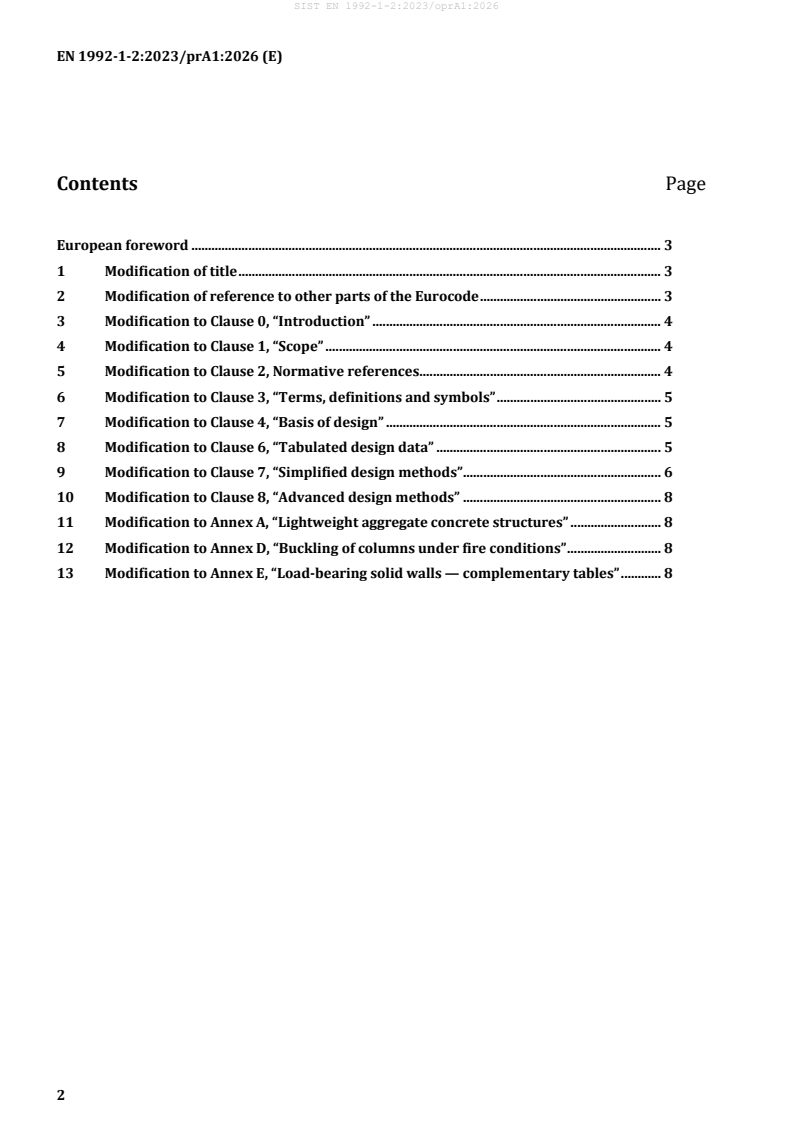
Contents Page
European foreword . 3
1 Modification of title . 3
2 Modification of reference to other parts of the Eurocode . 3
3 Modification to Clause 0, “Introduction” . 4
4 Modification to Clause 1, “Scope” . 4
5 Modification to Clause 2, Normative references . 4
6 Modification to Clause 3, “Terms, definitions and symbols” . 5
7 Modification to Clause 4, “Basis of design” . 5
8 Modification to Clause 6, “Tabulated design data” . 5
9 Modification to Clause 7, “Simplified design methods” . 6
10 Modification to Clause 8, “Advanced design methods” . 8
11 Modification to Annex A, “Lightweight aggregate concrete structures” . 8
12 Modification to Annex D, “Buckling of columns under fire conditions” . 8
13 Modification to Annex E, “Load-bearing solid walls — complementary tables” . 8
European foreword
This document (EN 1992-1-2:2023/prA1:2026) has been prepared by Technical Committee CEN/TC 250
“Structural Eurocodes”, the secretariat of which is held by BSI. CEN/TC 250 is responsible for all
Structural Eurocodes and has been assigned responsibility for structural and geotechnical design matters
by CEN.
This document is currently submitted to the CEN Enquiry.
This document is an amendment to EN 1992-1-2:2023.
NOTE Some modifications are purely editorial corrections to improve the quality of the document and these
will not be tagged in the consolidated publication, as noted after the modification.
The first generation of EN Eurocodes was published between 2002 and 2007. This document forms part
of the second generation of the Eurocodes, which have been prepared under Mandate M/515 issued to
CEN by the European Commission and the European Free Trade Association.
The Eurocodes have been drafted to be used in conjunction with relevant execution, material, product
and test standards, and to identify requirements for execution, materials, products and testing that are
relied upon by the Eurocodes.
The Eurocodes recognize the responsibility of each Member State and have safeguarded their right to
determine values related to regulatory safety matters at national level through the use of National
Annexes.
1 Modification of title
Replace “Stahlbeton- und Spannbetontragwerken“ by “Betontragwerken“ in German title.
2 Modification of reference to other parts of the Eurocode
Replace in the following subclauses the references by the following new references:
— 0.2(1): „EN 1990 (all parts)“
— 1.2(1): „EN 1990 (all parts)“
— 3.1: „EN 1990 (all parts)“
— 4.3(1): „EN 1991-1-2:2024“
— 4.4(1): „EN 1991-1-2“
— 4.6(2): „EN 1991-1-2“
— 4.6(3): „EN 1990-1:2023+A1:2026“
— 4.7(1): „EN 1991-1-2:2024“
— 4.8(1): „EN 1991-1-2:2024“
— 5.2.1(1): „EN 1991-1-2:2024“
— 5.3.1.1(5): „EN 1991-1-2:2024“
— 5.3.2.1(8): „EN 1991-1-2:2024“
— 5.3.3.1(3): „EN 1991-1-2:2024“
— 6.2(1): „EN 1990-1“
— 6.2(3): „EN 1991-1-2:2024“
— 8.2(2): „EN 1991-1-2“
— D.1(1): „EN 1992-1-1“
— Bibliography, Reference [1]: „EN 1993-1-2“
3 Modification to Clause 0, “Introduction”
0.1 Replace “— New Eurocodes under development, e.g. Eurocode for design of structural glass” with “—
EN 19100, Eurocode 10: Design of glass structures”
0.1 Add the following new list item: “— New parts are under development, e.g. EN 19101 Eurocode 11 for
design of fibre-polymer composite structures and EN 19102 Eurocode 12 for design of tensioned
membrane structures.”
0.3(5) delete “:— ” and footnote, after EN 1991-1-2.
0.5 add “4.7(2)” to the list of NDP.
4 Modification to Clause 1, “Scope”
Add in 1.2 a new paragraph (1) and renumber the existing paragra
...