

SIST ISO 8528-12:2023
(Main)Reciprocating internal combustion engine driven alternating current generating sets - Part 12: Emergency power supply to safety services
General Information
- Abstract
This document applies to generating sets driven by reciprocating internal combustion (RIC) engines for emergency power supply to safety services.
This document applies, for example, to safety equipment in hospitals, high-rise buildings and public gathering places. It establishes the special requirements for the performance, design and maintenance of generating sets used in these applications referred to previously and takes into account the provisions of ISO 8528-1 to ISO 8528-6 and ISO 8528-10.
- Status
- Published
- Publication Date
- 08-Mar-2023
- Current Stage
- 6060 - National Implementation/Publication (Adopted Project)
- Start Date
- 07-Mar-2023
- Due Date
- 12-May-2023
- Completion Date
- 09-Mar-2023
Buy Documents



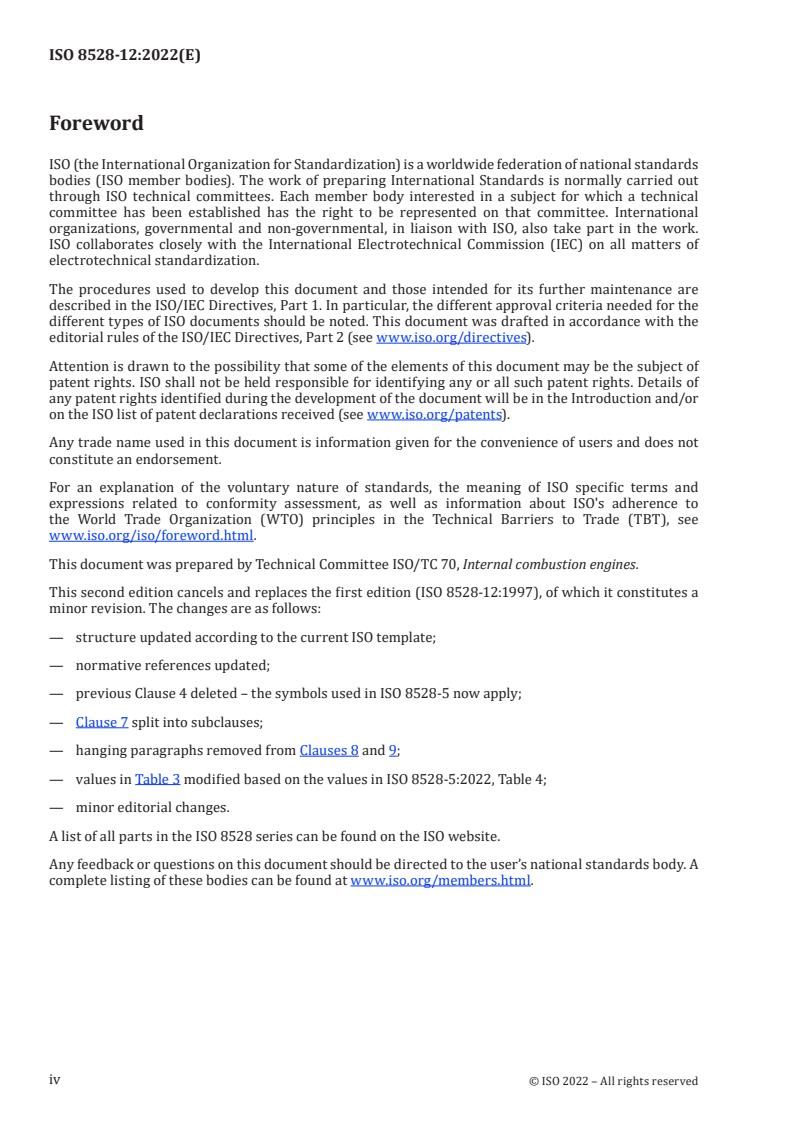
ISO 8528-12:2022 - Reciprocating internal combustion engine driven alternating current generating sets — Part 12: Emergency power supply to safety services Released:30. 08. 2022
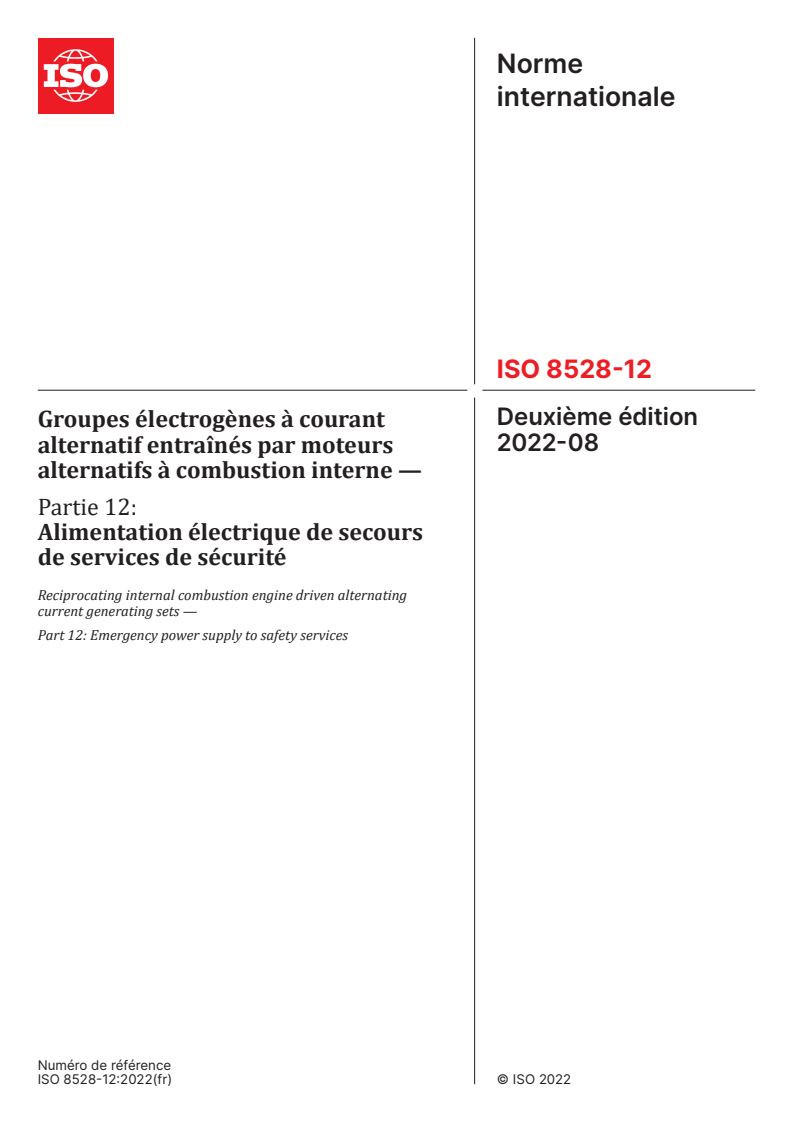
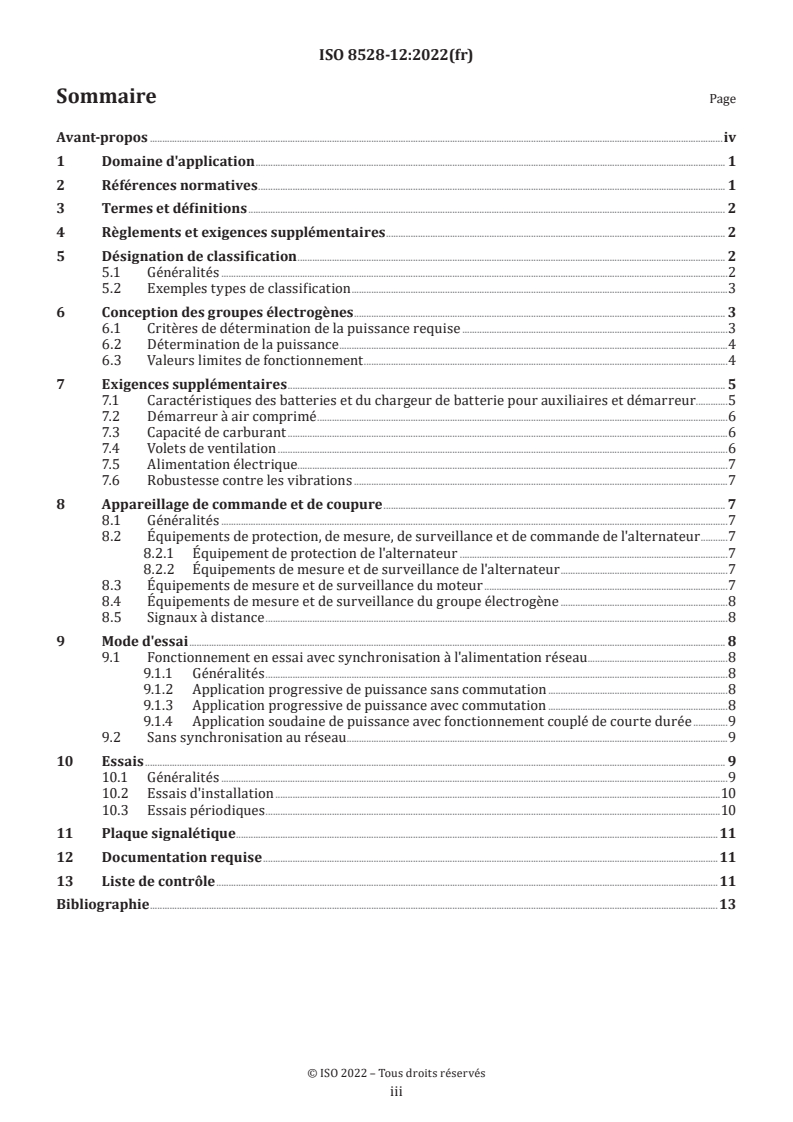
ISO 8528-12:2022 - Groupes électrogènes à courant alternatif entraînés par moteurs alternatifs à combustion interne — Partie 12: Alimentation électrique de secours de services de sécurité/6/2024
REDLINE ISO 8528-12:2022 - Groupes électrogènes à courant alternatif entraînés par moteurs alternatifs à combustion interne — Partie 12: Alimentation électrique de secours de services de sécurité/6/2024
Overview
ISO 8528-12:2022 - "Reciprocating internal combustion engine driven alternating current generating sets - Part 12: Emergency power supply to safety services" defines special requirements for generator sets (driven by reciprocating internal combustion - RIC - engines) intended to supply emergency power to safety services. It applies to installations such as hospitals, high‑rise buildings and public gathering places and complements the general requirements in ISO 8528‑1 to ISO 8528‑6 and ISO 8528‑10.
Key topics and requirements
- Scope and classification: Generating sets are classified by performance class (G2) and by changeover/bridging times (no‑break, short‑break, long‑break) with typical examples for each class.
- Power determination & load acceptance: Methods to determine required power including short load peaks (e.g., lifts, pumps, fans, lighting) and stepped load acceptance for turbocharged engines.
- Design and robustness: Requirements for mechanical and electrical design to tolerate vibrations and transient loading; guidance on rotating mass/flywheel sizing when larger load steps are needed.
- Auxiliaries and starting systems: Specifications for batteries and chargers, compressed‑air starters and their characteristics.
- Fuel and ventilation: Minimum considerations for fuel capacity, fueling arrangements and ventilation louvers to ensure reliable emergency operation.
- Controlgear, switchgear and monitoring: Requirements for protection, measurement, monitoring and control equipment for both the engine and AC generator, plus remote signalling.
- Testing and commissioning: Test modes covering operation with/without mains synchronization, gradual and sudden power application, installation and periodic tests.
- Documentation and marking: Required rating plate information, documentation and a checklist for design, installation and maintenance.
Practical applications and users
ISO 8528‑12:2022 is used to specify, design, test and maintain emergency generating sets for life‑safety systems, including:
- Hospitals and medical locations (backup for critical medical equipment)
- High‑rise and commercial buildings (fire pumps, elevator emergency power, lighting)
- Public venues and safety‑critical facilities (evacuation systems, alarm systems) Primary users:
- Generator manufacturers and OEMs
- Consulting and design engineers (M&E / building services)
- Facility and hospital engineers, commissioning agents
- Specifiers, procurement teams and regulators
- Test laboratories and maintenance contractors
Related standards
- ISO 8528‑1 to ISO 8528‑6, ISO 8528‑10 (series on RIC engine driven generating sets)
- IEC 60364‑7‑710 (medical locations)
- Relevant IEC battery standards (IEC 60622, IEC 60623, IEC 60896‑11/21, IEC 61951‑1)
ISO 8528‑12:2022 is essential when you need prescriptive, safety‑focused guidance for emergency power systems feeding life‑safety services and to ensure regulatory and operational reliability.
Relations
- Effective Date
- 06-Jun-2022
Buy Documents
ISO 8528-12:2022 - Reciprocating internal combustion engine driven alternating current generating sets — Part 12: Emergency power supply to safety services Released:30. 08. 2022
ISO 8528-12:2022 - Groupes électrogènes à courant alternatif entraînés par moteurs alternatifs à combustion interne — Partie 12: Alimentation électrique de secours de services de sécurité/6/2024
REDLINE ISO 8528-12:2022 - Groupes électrogènes à courant alternatif entraînés par moteurs alternatifs à combustion interne — Partie 12: Alimentation électrique de secours de services de sécurité/6/2024
Get Certified
Connect with accredited certification bodies for this standard

DNV
DNV is an independent assurance and risk management provider.

BSI Group
BSI (British Standards Institution) is the business standards company that helps organizations make excellence a habit.

Bureau Veritas
Bureau Veritas is a world leader in laboratory testing, inspection and certification services.
Sponsored listings
Frequently Asked Questions
SIST ISO 8528-12:2023 is a standard published by the Slovenian Institute for Standardization (SIST). Its full title is "Reciprocating internal combustion engine driven alternating current generating sets - Part 12: Emergency power supply to safety services". This standard covers: This document applies to generating sets driven by reciprocating internal combustion (RIC) engines for emergency power supply to safety services. This document applies, for example, to safety equipment in hospitals, high-rise buildings and public gathering places. It establishes the special requirements for the performance, design and maintenance of generating sets used in these applications referred to previously and takes into account the provisions of ISO 8528-1 to ISO 8528-6 and ISO 8528-10.
This document applies to generating sets driven by reciprocating internal combustion (RIC) engines for emergency power supply to safety services. This document applies, for example, to safety equipment in hospitals, high-rise buildings and public gathering places. It establishes the special requirements for the performance, design and maintenance of generating sets used in these applications referred to previously and takes into account the provisions of ISO 8528-1 to ISO 8528-6 and ISO 8528-10.
SIST ISO 8528-12:2023 is classified under the following ICS (International Classification for Standards) categories: 13.100 - Occupational safety. Industrial hygiene; 27.020 - Internal combustion engines; 29.160.40 - Generating sets. The ICS classification helps identify the subject area and facilitates finding related standards.
SIST ISO 8528-12:2023 has the following relationships with other standards: It is inter standard links to SIST ISO 8528-12:2002. Understanding these relationships helps ensure you are using the most current and applicable version of the standard.
SIST ISO 8528-12:2023 is available in PDF format for immediate download after purchase. The document can be added to your cart and obtained through the secure checkout process. Digital delivery ensures instant access to the complete standard document.
Standards Content (Sample)
SLOVENSKI STANDARD
01-april-2023
Agregati za proizvodnjo izmeničnega toka, gnani z batnim motorjem z notranjim
zgorevanjem - 12. del: Zasilna preskrba z električno energijo za varnostne naprave
Reciprocating internal combustion engine driven alternating current generating sets -
Part 12: Emergency power supply to safety services
Groupes électrogènes à courant alternatif entraînés par moteurs alternatifs à combustion
interne - Partie 12: Alimentation électrique de secours de services de sécurité
Ta slovenski standard je istoveten z: ISO 8528-12:2022
ICS:
27.020 Motorji z notranjim Internal combustion engines
zgorevanjem
29.160.40 Električni agregati Generating sets
2003-01.Slovenski inštitut za standardizacijo. Razmnoževanje celote ali delov tega standarda ni dovoljeno.
INTERNATIONAL ISO
STANDARD 8528-12
Second edition
2022-08
Reciprocating internal combustion
engine driven alternating current
generating sets —
Part 12:
Emergency power supply to safety
services
Groupes électrogènes à courant alternatif entraînés par moteurs
alternatifs à combustion interne —
Partie 12: Alimentation électrique de secours de services de sécurité
Reference number
© ISO 2022
All rights reserved. Unless otherwise specified, or required in the context of its implementation, no part of this publication may
be reproduced or utilized otherwise in any form or by any means, electronic or mechanical, including photocopying, or posting on
the internet or an intranet, without prior written permission. Permission can be requested from either ISO at the address below
or ISO’s member body in the country of the requester.
ISO copyright office
CP 401 • Ch. de Blandonnet 8
CH-1214 Vernier, Geneva
Phone: +41 22 749 01 11
Email: copyright@iso.org
Website: www.iso.org
Published in Switzerland
ii
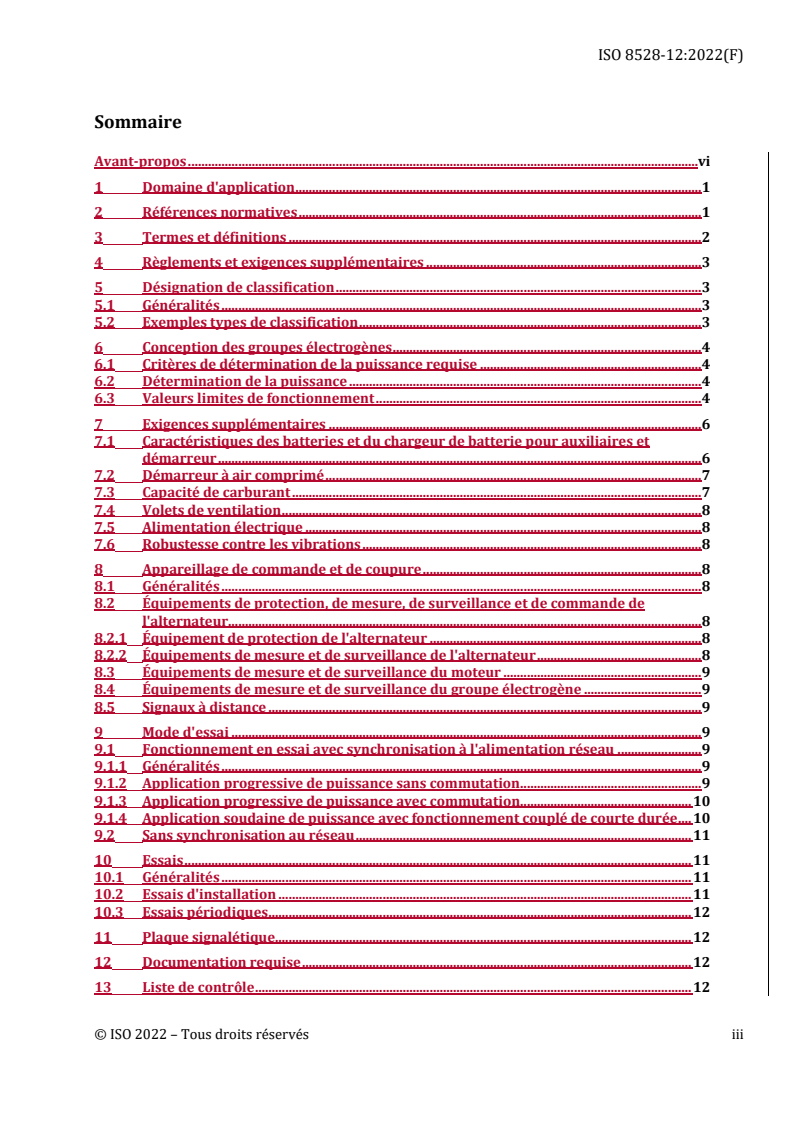
Contents Page
Foreword .iv
1 S c op e . 1
2 Nor m at i ve r ef er enc e s . 1
3 Terms and definitions . 2
4 Additional regulations and requirements . 2
5 Classification designation .2
5.1 G eneral . 2
5.2 T ypical examples of classification . 3
6 G enerating set design .3
6.1 C riteria for determining the required power . 3
6 . 2 Power de t er m i n at ion . 4
6.3 O perating limit values . 4
7 A dd it ion a l r e qu i r ement s .5
7.1 C haracteristics of batteries and battery charger for auxiliaries and starter . 5
7.2 C ompressed air starter . 6
7.3 F uel capacity . 6
7.4 Vent i l at ion lou ver s . 6
7.5 E lectric power supply . 6
7.6 R obustness against vibrations . 7
8 C ontrolgear and switchgear .7
8.1 General . 7
8.2 P rotection, measurement, monitoring and control equipment for the AC generator . 7
8.2.1 AC generator protection equipment . 7
8.2.2 A C generator measurement and monitoring equipment . 7
8.3 E ngine measurement and monitoring equipment . 7
8.4 G enerating set measurement and monitoring equipment . 7
8 . 5 R emot e s i g n a l s . 8
9 Te s t mo de . 8
9.1 T est operation with synchronization to the mains supply . 8
9.1.1 G eneral . 8
9.1.2 Gradual power application without switching . 8
9.1.3 Gradual power application with switching . 8
9.1.4 Sudden power application with short time parallel operation . 9
9.2 W ithout mains synchronization . 9
10 Te s t i n g. 9
10.1 G eneral . 9
10 . 2 I n s t a l l at ion t e s t s . 9
10 . 3 Per io d ic t e s t s . 10
11 R at i n g pl at e.10
12 R e qu i r e d do c u ment at ion .10
13 C heck l i s t .10
Bibliography .12
iii
Foreword
ISO (the International Organization for Standardization) is a worldwide federation of national standards
bodies (ISO member bodies). The work of preparing International Standards is normally carried out
through ISO technical committees. Each member body interested in a subject for which a technical
committee has been established has the right to be represented on that committee. International
organizations, governmental and non-governmental, in liaison with ISO, also take part in the work.
ISO collaborates closely with the International Electrotechnical Commission (IEC) on all matters of
electrotechnical standardization.
The procedures used to develop this document and those intended for its further maintenance are
described in the ISO/IEC Directives, Part 1. In particular, the different approval criteria needed for the
different types of ISO documents should be noted. This document was drafted in accordance with the
editorial rules of the ISO/IEC Directives, Part 2 (see www.iso.org/directives).
Attention is drawn to the possibility that some of the elements of this document may be the subject of
patent rights. ISO shall not be held responsible for identifying any or all such patent rights. Details of
any patent rights identified during the development of the document will be in the Introduction and/or
on the ISO list of patent declarations received (see www.iso.org/patents).
Any trade name used in this document is information given for the convenience of users and does not
constitute an endorsement.
For an explanation of the voluntary nature of standards, the meaning of ISO specific terms and
expressions related to conformity assessment, as well as information about ISO's adherence to
the World Trade Organization (WTO) principles in the Technical Barriers to Trade (TBT), see
www.iso.org/iso/foreword.html.
This document was prepared by Technical Committee ISO/TC 70, Internal combustion engines.
This second edition cancels and replaces the first edition (ISO 8528-12:1997), of which it constitutes a
minor revision. The changes are as follows:
— structure updated according to the current ISO template;
— normative references updated;
— previous Clause 4 deleted – the symbols used in ISO 8528-5 now apply;
— Clause 7 split into subclauses;
— hanging paragraphs removed from Clauses 8 and 9;
— values in Table 3 modified based on the values in ISO 8528-5:2022, Table 4;
— minor editorial changes.
A list of all parts in the ISO 8528 series can be found on the ISO website.
Any feedback or questions on this document should be directed to the user’s national standards body. A
complete listing of these bodies can be found at www.iso.org/members.html.
iv
INTERNATIONAL STANDARD ISO 8528-12:2022(E)
Reciprocating internal combustion engine driven
alternating current generating sets —
Part 12:
Emergency power supply to safety services
1 S cope
This document applies to generating sets driven by reciprocating internal combustion (RIC) engines for
emergency power supply to safety services.
This document applies, for example, to safety equipment in hospitals, high-rise buildings and public
gathering places. It establishes the special requirements for the performance, design and maintenance
of generating sets used in these applications referred to previously and takes into account the provisions
1)
of ISO 8528-1 to ISO 8528-6 and ISO 8528-10 .
2 Normat ive references
The following documents are referred to in the text in such a way that some or all of their content
constitutes requirements of this document. For dated references, only the edition cited applies. For
undated references, the latest edition of the referenced document (including any amendments) applies.
ISO 8528-1:2018, Reciprocating internal combustion engine driven alternating current generating sets —
Part 1: Application, ratings and performance
ISO 8528-2:2018, Reciprocating internal combustion engine driven alternating current generating sets —
Part 2: Engines
ISO 8528-3, Reciprocating internal combustion engine driven alternating current generating sets — Part
3: Alternating current generators for generating sets
ISO 8528-4:2005, Reciprocating internal combustion engine driven alternating current generating sets —
Part 4: Controlgear and switchgear
ISO 8528-5:2022, Reciprocating internal combustion engine driven alternating current generating sets —
Part 5: Generating sets
ISO 8528-6:2005, Reciprocating internal combustion engine driven alternating current generating sets —
Part 6: Test methods
IEC 60364-7-710, Low-voltage electrical installations — Part 7-710: Requirements for special installations
and locations — Medical locations
IEC 60622, Secondary cells and batteries containing alkaline or other non-acid electrolytes — Sealed
nickel-cadmium prismatic rechargeable single cells
IEC 60623, Secondary cells and batteries containing alkaline or other non-acid electrolytes — Vented
nickel-cadmium prismatic rechargeable single cells
IEC 60896-11, Stationary lead-acid batteries — Part 11: Vented types — General requirements and
methods of tests
IEC 60896-21, Stationary lead-acid batteries — Part 21: Valve regulated types — Methods of test
1) Under preparation. Stage at the time of publication: ISO/FDIS 8528-10:2022.
IEC 61951-1, Secondary cells and batteries containing alkaline or other non-acid electrolytes — Secondary
sealed cells and batteries for portable applications — Part 1: Nickel-Cadmium
3 Terms and definitions
For the purposes of this document, the terms and definitions given in ISO 8528-1 to ISO 8528-6 and the
following apply.
ISO and IEC maintain terminology databases for use in standardization at the following addresses:
— ISO Online browsing platform: available at https:// www .iso .org/ obp
— IEC Electropedia: available at https:// www .electropedia .org/
3.1
changeover time
time interval from the appearance of a malfunction of the normal electrical power supply system until
the safety services are again connected to the emergency power supply
Note 1 to entry: This connection to the safety services may be applied in several load steps.
3.2
bridging time
minimum time for which the generating station supplies the consumers with electrical power under
predetermined operating conditions
Note 1 to entry: The bridging time corresponds with the rated operating time as defined in IEC 60601-1.
3.3
safety services
equipment for the safety of persons which is installed and kept prepared in case of failure of the usual
electrical power supply system
3.4
consumer power demand
total of all intended demands of the connected consumers, taking into consideration the actual load
steps
3.5
power demand for safety services
required power demand to fulfil the safety service requirements
4 A dditional regulations and requirements
If special requirements or additional regulations are to be observed, they shall be stated by the
customer and agreed upon between manufacturer and customer.
5 Classification designation
5.1 General
Classification of generating sets for safety services is based on performance class G2 as defined in
ISO 8528-1 and the required changeover time, t , according to IEC 60364-5-56 and Table 1.
co
Table 1 — Classification by changeover time
Generating sets No break Short break Long break
Changeover time 0 < 0,5 s < 15 s > 15 s
Classification 1 2 3 4
5.2 Typical examples of classification
Typical examples of classification as defined in Table 1 are given in Table 2.
Table 2 — Examples
Classification Typical examples
The mains voltage drops below the rated voltage by more than 10 %.
After a changeover time of 0 s the power for the consumer power demand for safe-
ty services shall be available. The design of the no-break generating sets depends
on the required frequency and voltage deviations.
The mains voltage drops below the rated voltage by more than 10 %.
After a changeover time of 0,5 s the power for the consumer power demand for
safety services shall be available. The design of the short-break generation set
depends on the required frequency and voltage deviations.
The mains voltage drops below the rated voltage by more than 10 % for a period
longer than 0,5 s.
After a changeover time of maximum 15 s, power for 100 % of the consumer power
demand for safety services shall be available in steps.
The mains voltage drops below the rated voltage by more than 10 % for a period
longer than 0,5 s.
After a changeover time of maximum 15 s, power for 80 % of the consumer power
demand for safety services shall be available in two steps, and the power for 100 %
of the consumer demand shall be available after an additional 5 s has passed.
6 Gener ating set design
6.1 Crit eria for determining the required power
To ensure a reliable supply of electrical power by the generating set, the generating set manufacturer
shall be informed of the power requirements of the installations to be supplied.
The power requirements shall include short load peaks when switching in electrical installations (e.g.
lifts, pumps, fans, lighting equipment and nonlinear electrical installations). Where applicable, for
example for reasons of redundancy, the use of several generating sets operating in parallel will possibly
be required.
Since many modern RIC engines are turbocharged, it will be necessary to arrange load acceptance in
several steps.
For load acceptance, the definitions and values laid down in ISO 8528-5:2022, 8.4, Figure 5 and Figure 6
apply, where the load acceptance capability of the generating set is shown to be dependent on the brake
mean effective pressure of the RIC engine.
If larger steps are used than those recommended in ISO 8528-5:2022, Figure 5 and Figure 6, either
suitable additional measures shall be taken or the generating set power rating and, where applicable,
the rotating mass of the flywheel shall be increased.
The information provided by the checklist in Clause 13 is recommended for designing the generating
set.
Essential equipment of emergency generating sets, such as a cooling system, a fuel system including
storage tank and a lubrication system, shall be provided to ensure the operation of the generating set
for the required period.
The cooling system of the RIC engine shall be self-contained.
6.2 Power determinati o
...
INTERNATIONAL ISO
STANDARD 8528-12
Second edition
2022-08
Reciprocating internal combustion
engine driven alternating current
generating sets —
Part 12:
Emergency power supply to safety
services
Groupes électrogènes à courant alternatif entraînés par moteurs
alternatifs à combustion interne —
Partie 12: Alimentation électrique de secours de services de sécurité
Reference number
© ISO 2022
All rights reserved. Unless otherwise specified, or required in the context of its implementation, no part of this publication may
be reproduced or utilized otherwise in any form or by any means, electronic or mechanical, including photocopying, or posting on
the internet or an intranet, without prior written permission. Permission can be requested from either ISO at the address below
or ISO’s member body in the country of the requester.
ISO copyright office
CP 401 • Ch. de Blandonnet 8
CH-1214 Vernier, Geneva
Phone: +41 22 749 01 11
Email: copyright@iso.org
Website: www.iso.org
Published in Switzerland
ii
Contents Page
Foreword .iv
1 S c op e . 1
2 Nor m at i ve r ef er enc e s . 1
3 Terms and definitions . 2
4 Additional regulations and requirements . 2
5 Classification designation .2
5.1 G eneral . 2
5.2 T ypical examples of classification . 3
6 G enerating set design .3
6.1 C riteria for determining the required power . 3
6 . 2 Power de t er m i n at ion . 4
6.3 O perating limit values . 4
7 A dd it ion a l r e qu i r ement s .5
7.1 C haracteristics of batteries and battery charger for auxiliaries and starter . 5
7.2 C ompressed air starter . 6
7.3 F uel capacity . 6
7.4 Vent i l at ion lou ver s . 6
7.5 E lectric power supply . 6
7.6 R obustness against vibrations . 7
8 C ontrolgear and switchgear .7
8.1 General . 7
8.2 P rotection, measurement, monitoring and control equipment for the AC generator . 7
8.2.1 AC generator protection equipment . 7
8.2.2 A C generator measurement and monitoring equipment . 7
8.3 E ngine measurement and monitoring equipment . 7
8.4 G enerating set measurement and monitoring equipment . 7
8 . 5 R emot e s i g n a l s . 8
9 Te s t mo de . 8
9.1 T est operation with synchronization to the mains supply . 8
9.1.1 G eneral . 8
9.1.2 Gradual power application without switching . 8
9.1.3 Gradual power application with switching . 8
9.1.4 Sudden power application with short time parallel operation . 9
9.2 W ithout mains synchronization . 9
10 Te s t i n g. 9
10.1 G eneral . 9
10 . 2 I n s t a l l at ion t e s t s . 9
10 . 3 Per io d ic t e s t s . 10
11 R at i n g pl at e.10
12 R e qu i r e d do c u ment at ion .10
13 C heck l i s t .10
Bibliography .12
iii
Foreword
ISO (the International Organization for Standardization) is a worldwide federation of national standards
bodies (ISO member bodies). The work of preparing International Standards is normally carried out
through ISO technical committees. Each member body interested in a subject for which a technical
committee has been established has the right to be represented on that committee. International
organizations, governmental and non-governmental, in liaison with ISO, also take part in the work.
ISO collaborates closely with the International Electrotechnical Commission (IEC) on all matters of
electrotechnical standardization.
The procedures used to develop this document and those intended for its further maintenance are
described in the ISO/IEC Directives, Part 1. In particular, the different approval criteria needed for the
different types of ISO documents should be noted. This document was drafted in accordance with the
editorial rules of the ISO/IEC Directives, Part 2 (see www.iso.org/directives).
Attention is drawn to the possibility that some of the elements of this document may be the subject of
patent rights. ISO shall not be held responsible for identifying any or all such patent rights. Details of
any patent rights identified during the development of the document will be in the Introduction and/or
on the ISO list of patent declarations received (see www.iso.org/patents).
Any trade name used in this document is information given for the convenience of users and does not
constitute an endorsement.
For an explanation of the voluntary nature of standards, the meaning of ISO specific terms and
expressions related to conformity assessment, as well as information about ISO's adherence to
the World Trade Organization (WTO) principles in the Technical Barriers to Trade (TBT), see
www.iso.org/iso/foreword.html.
This document was prepared by Technical Committee ISO/TC 70, Internal combustion engines.
This second edition cancels and replaces the first edition (ISO 8528-12:1997), of which it constitutes a
minor revision. The changes are as follows:
— structure updated according to the current ISO template;
— normative references updated;
— previous Clause 4 deleted – the symbols used in ISO 8528-5 now apply;
— Clause 7 split into subclauses;
— hanging paragraphs removed from Clauses 8 and 9;
— values in Table 3 modified based on the values in ISO 8528-5:2022, Table 4;
— minor editorial changes.
A list of all parts in the ISO 8528 series can be found on the ISO website.
Any feedback or questions on this document should be directed to the user’s national standards body. A
complete listing of these bodies can be found at www.iso.org/members.html.
iv
INTERNATIONAL STANDARD ISO 8528-12:2022(E)
Reciprocating internal combustion engine driven
alternating current generating sets —
Part 12:
Emergency power supply to safety services
1 S cope
This document applies to generating sets driven by reciprocating internal combustion (RIC) engines for
emergency power supply to safety services.
This document applies, for example, to safety equipment in hospitals, high-rise buildings and public
gathering places. It establishes the special requirements for the performance, design and maintenance
of generating sets used in these applications referred to previously and takes into account the provisions
1)
of ISO 8528-1 to ISO 8528-6 and ISO 8528-10 .
2 Normat ive references
The following documents are referred to in the text in such a way that some or all of their content
constitutes requirements of this document. For dated references, only the edition cited applies. For
undated references, the latest edition of the referenced document (including any amendments) applies.
ISO 8528-1:2018, Reciprocating internal combustion engine driven alternating current generating sets —
Part 1: Application, ratings and performance
ISO 8528-2:2018, Reciprocating internal combustion engine driven alternating current generating sets —
Part 2: Engines
ISO 8528-3, Reciprocating internal combustion engine driven alternating current generating sets — Part
3: Alternating current generators for generating sets
ISO 8528-4:2005, Reciprocating internal combustion engine driven alternating current generating sets —
Part 4: Controlgear and switchgear
ISO 8528-5:2022, Reciprocating internal combustion engine driven alternating current generating sets —
Part 5: Generating sets
ISO 8528-6:2005, Reciprocating internal combustion engine driven alternating current generating sets —
Part 6: Test methods
IEC 60364-7-710, Low-voltage electrical installations — Part 7-710: Requirements for special installations
and locations — Medical locations
IEC 60622, Secondary cells and batteries containing alkaline or other non-acid electrolytes — Sealed
nickel-cadmium prismatic rechargeable single cells
IEC 60623, Secondary cells and batteries containing alkaline or other non-acid electrolytes — Vented
nickel-cadmium prismatic rechargeable single cells
IEC 60896-11, Stationary lead-acid batteries — Part 11: Vented types — General requirements and
methods of tests
IEC 60896-21, Stationary lead-acid batteries — Part 21: Valve regulated types — Methods of test
1) Under preparation. Stage at the time of publication: ISO/FDIS 8528-10:2022.
IEC 61951-1, Secondary cells and batteries containing alkaline or other non-acid electrolytes — Secondary
sealed cells and batteries for portable applications — Part 1: Nickel-Cadmium
3 Terms and definitions
For the purposes of this document, the terms and definitions given in ISO 8528-1 to ISO 8528-6 and the
following apply.
ISO and IEC maintain terminology databases for use in standardization at the following addresses:
— ISO Online browsing platform: available at https:// www .iso .org/ obp
— IEC Electropedia: available at https:// www .electropedia .org/
3.1
changeover time
time interval from the appearance of a malfunction of the normal electrical power supply system until
the safety services are again connected to the emergency power supply
Note 1 to entry: This connection to the safety services may be applied in several load steps.
3.2
bridging time
minimum time for which the generating station supplies the consumers with electrical power under
predetermined operating conditions
Note 1 to entry: The bridging time corresponds with the rated operating time as defined in IEC 60601-1.
3.3
safety services
equipment for the safety of persons which is installed and kept prepared in case of failure of the usual
electrical power supply system
3.4
consumer power demand
total of all intended demands of the connected consumers, taking into consideration the actual load
steps
3.5
power demand for safety services
required power demand to fulfil the safety service requirements
4 A dditional regulations and requirements
If special requirements or additional regulations are to be observed, they shall be stated by the
customer and agreed upon between manufacturer and customer.
5 Classification designation
5.1 General
Classification of generating sets for safety services is based on performance class G2 as defined in
ISO 8528-1 and the required changeover time, t , according to IEC 60364-5-56 and Table 1.
co
Table 1 — Classification by changeover time
Generating sets No break Short break Long break
Changeover time 0 < 0,5 s < 15 s > 15 s
Classification 1 2 3 4
5.2 Typical examples of classification
Typical examples of classification as defined in Table 1 are given in Table 2.
Table 2 — Examples
Classification Typical examples
The mains voltage drops below the rated voltage by more than 10 %.
After a changeover time of 0 s the power for the consumer power demand for safe-
ty services shall be available. The design of the no-break generating sets depends
on the required frequency and voltage deviations.
The mains voltage drops below the rated voltage by more than 10 %.
After a changeover time of 0,5 s the power for the consumer power demand for
safety services shall be available. The design of the short-break generation set
depends on the required frequency and voltage deviations.
The mains voltage drops below the rated voltage by more than 10 % for a period
longer than 0,5 s.
After a changeover time of maximum 15 s, power for 100 % of the consumer power
demand for safety services shall be available in steps.
The mains voltage drops below the rated voltage by more than 10 % for a period
longer than 0,5 s.
After a changeover time of maximum 15 s, power for 80 % of the consumer power
demand for safety services shall be available in two steps, and the power for 100 %
of the consumer demand shall be available after an additional 5 s has passed.
6 Gener ating set design
6.1 Crit eria for determining the required power
To ensure a reliable supply of electrical power by the generating set, the generating set manufacturer
shall be informed of the power requirements of the installations to be supplied.
The power requirements shall include short load peaks when switching in electrical installations (e.g.
lifts, pumps, fans, lighting equipment and nonlinear electrical installations). Where applicable, for
example for reasons of redundancy, the use of several generating sets operating in parallel will possibly
be required.
Since many modern RIC engines are turbocharged, it will be necessary to arrange load acceptance in
several steps.
For load acceptance, the definitions and values laid down in ISO 8528-5:2022, 8.4, Figure 5 and Figure 6
apply, where the load acceptance capability of the generating set is shown to be dependent on the brake
mean effective pressure of the RIC engine.
If larger steps are used than those recommended in ISO 8528-5:2022, Figure 5 and Figure 6, either
suitable additional measures shall be taken or the generating set power rating and, where applicable,
the rotating mass of the flywheel shall be increased.
The information provided by the checklist in Clause 13 is recommended for designing the generating
set.
Essential equipment of emergency generating sets, such as a cooling system, a fuel system including
storage tank and a lubrication system, shall be provided to ensure the operation of the generating set
for the required period.
The cooling system of the RIC engine shall be self-contained.
6.2 Power determinati on
ISO 8528-1:2018, Clauses 13 and 14 apply for determining the power requirement.
6.3 Oper ating limit values
The operating limits shall at least meet the requirements of performance class G2 in ISO 8528-5:2022.
Special requirements for the limit values are given in ISO 8528-5:2022, Table 4.
The transient operating limits given in ISO 8528-5:2022, Table 4 generally apply.
Classifications given in Table 2 are listed in Table 3.
Table 3 — Special requirements for examples given in Table 2
Classification
Parameter Symbol Unit Reference
1 2 3 4
Frequency ISO 8528-5:20
...
Norme
internationale
ISO 8528-12
Deuxième édition
Groupes électrogènes à courant
2022-08
alternatif entraînés par moteurs
alternatifs à combustion interne —
Partie 12:
Alimentation électrique de secours
de services de sécurité
Reciprocating internal combustion engine driven alternating
current generating sets —
Part 12: Emergency power supply to safety services
Numéro de référence
DOCUMENT PROTÉGÉ PAR COPYRIGHT
© ISO 2022
Tous droits réservés. Sauf prescription différente ou nécessité dans le contexte de sa mise en œuvre, aucune partie de cette
publication ne peut être reproduite ni utilisée sous quelque forme que ce soit et par aucun procédé, électronique ou mécanique,
y compris la photocopie, ou la diffusion sur l’internet ou sur un intranet, sans autorisation écrite préalable. Une autorisation peut
être demandée à l’ISO à l’adresse ci-après ou au comité membre de l’ISO dans le pays du demandeur.
ISO copyright office
Case postale 401 • Ch. de Blandonnet 8
CH-1214 Vernier, Genève
Tél.: +41 22 749 01 11
E-mail: copyright@iso.org
Web: www.iso.org
Publié en Suisse
ii
Sommaire Page
Avant-propos .iv
1 Domaine d'application . 1
2 Références normatives . 1
3 Termes et définitions . 2
4 Règlements et exigences supplémentaires . 2
5 Désignation de classification . 2
5.1 Généralités .2
5.2 Exemples types de classification .3
6 Conception des groupes électrogènes . 3
6.1 Critères de détermination de la puissance requise .3
6.2 Détermination de la puissance .4
6.3 Valeurs limites de fonctionnement .4
7 Exigences supplémentaires . 5
7.1 Caractéristiques des batteries et du chargeur de batterie pour auxiliaires et démarreur .5
7.2 Démarreur à air comprimé .6
7.3 Capacité de carburant .6
7.4 Volets de ventilation .6
7.5 Alimentation électrique.7
7.6 Robustesse contre les vibrations .7
8 Appareillage de commande et de coupure . 7
8.1 Généralités .7
8.2 Équipements de protection, de mesure, de surveillance et de commande de l'alternateur .7
8.2.1 Équipement de protection de l'alternateur .7
8.2.2 Équipements de mesure et de surveillance de l'alternateur .7
8.3 Équipements de mesure et de surveillance du moteur .7
8.4 Équipements de mesure et de surveillance du groupe électrogène .8
8.5 Signaux à distance .8
9 Mode d'essai . 8
9.1 Fonctionnement en essai avec synchronisation à l'alimentation réseau .8
9.1.1 Généralités .8
9.1.2 Application progressive de puissance sans commutation .8
9.1.3 Application progressive de puissance avec commutation .8
9.1.4 Application soudaine de puissance avec fonctionnement couplé de courte durée .9
9.2 Sans synchronisation au réseau .9
10 Essais . 9
10.1 Généralités .9
10.2 Essais d'installation .10
10.3 Essais périodiques .10
11 Plaque signalétique .11
12 Documentation requise .11
13 Liste de contrôle .11
Bibliographie .13
iii
Avant-propos
L'ISO (Organisation internationale de normalisation) est une fédération mondiale d'organismes nationaux
de normalisation (comités membres de l'ISO). L'élaboration des Normes internationales est en général
confiée aux comités techniques de l'ISO. Chaque comité membre intéressé par une étude a le droit de faire
partie du comité technique créé à cet effet. Les organisations internationales, gouvernementales et non
gouvernementales, en liaison avec l'ISO participent également aux travaux. L'ISO collabore étroitement avec
la Commission électrotechnique internationale (IEC) en ce qui concerne la normalisation électrotechnique.
Les procédures utilisées pour élaborer le présent document et celles destinées à sa mise à jour sont
décrites dans les Directives ISO/IEC, Partie 1. Il convient, en particulier, de prendre note des différents
critères d'approbation requis pour les différents types de documents ISO. Le présent document
a été rédigé conformément aux règles de rédaction données dans les Directives ISO/IEC, Partie 2
(voir www.iso.org/directives).
L'attention est appelée sur le fait que certains des éléments du présent document peuvent faire l'objet de
droits de propriété intellectuelle ou de droits analogues. L'ISO ne saurait être tenue pour responsable
de ne pas avoir identifié de tels droits de propriété et averti de leur existence. Les détails concernant les
références aux droits de propriété intellectuelle ou autres droits analogues identifiés lors de l'élaboration du
document sont indiqués dans l'Introduction et/ou dans la liste des déclarations de brevets reçues par l'ISO
(voir www.iso.org/brevets).
Les appellations commerciales éventuellement mentionnées dans le présent document sont données pour
information, par souci de commodité, à l'intention des utilisateurs, et ne sauraient constituer un engagement.
Pour une explication de la nature volontaire des normes, la signification des termes et expressions
spécifiques de l'ISO liés à l'évaluation de la conformité, ou pour toute information au sujet de l'adhésion de
l'ISO aux principes de l'Organisation mondiale du commerce (OMC) concernant les obstacles techniques au
commerce (OTC), voir www.iso.org/iso/fr/avant-propos.
Le présent document a été élaboré par le Comité technique ISO/TC 70, Moteurs à combustion interne.
Cette deuxième édition annule et remplace la première édition (ISO 8528-12:1997), dont elle constitue une
révision mineure. Les modifications sont les suivantes:
— structure mise à jour selon le modèle ISO actuel;
— références normatives mises à jour;
— Article 4 précédent supprimé – les symboles utilisés dans l'ISO 8528-5 s'appliquent désormais;
— Article 7 divisé en paragraphes;
— alinéas suspendus supprimés des Articles 8 et 9;
— valeurs dans le Tableau 3 modifiées sur la base des valeurs de l'ISO 8528-5:2022, Tableau 4;
— modifications rédactionnelles mineures.
Une liste de toutes les parties de la série ISO 8528 se trouve sur le site web de l'ISO.
Il convient que l'utilisateur adresse tout retour d'information ou toute question concernant le présent
document à l'organisme national de normalisation de son pays. Une liste exhaustive desdits organismes se
trouve à l'adresse www.iso.org/members.html.
iv
Norme internationale ISO 8528-12:2022(fr)
Groupes électrogènes à courant alternatif entraînés par
moteurs alternatifs à combustion interne —
Partie 12:
Alimentation électrique de secours de services de sécurité
1 Domaine d'application
Le présent document s'applique aux groupes électrogènes entraînés par moteurs alternatifs à combustion
interne (AIC) pour une alimentation électrique de secours de services de sécurité.
Le présent document s'applique, par exemple, aux équipements de sécurité des hôpitaux, des immeubles
de grande hauteur et des lieux de rassemblement publics. Il établit les exigences spéciales relatives à la
performance, à la conception et à la maintenance des groupes électrogènes utilisés dans les applications
mentionnées précédemment, et prend en compte les dispositions des ISO 8528-1 à ISO 8528-6 et de
l'ISO 8528-10.
2 Références normatives
Les documents suivants sont cités dans le texte de sorte qu’ils constituent, pour tout ou partie de leur
contenu, des exigences du présent document. Pour les références datées, seule l’édition citée s’applique. Pour
les références non datées, la dernière édition du document de référence s'applique (y compris les éventuels
amendements).
ISO 8528-1:2018, Groupes électrogènes à courant alternatif entraînés par moteurs alternatifs à combustion
interne — Partie 1: Application, caractéristiques et performances
ISO 8528-2:2018, Groupes électrogènes à courant alternatif entraînés par moteurs alternatifs à combustion
interne — Partie 2: Moteurs
ISO 8528-3, Groupes électrogènes à courant alternatif entraînés par moteurs alternatifs à combustion interne
— Partie 3: Alternateurs pour groupes électrogènes
ISO 8528-4:2005, Groupes électrogènes à courant alternatif entraînés par moteurs alternatifs à combustion
interne — Partie 4: Appareillage de commande et de coupure
ISO 8528-5:2022, Groupes électrogènes à courant alternatif entraînés par moteurs alternatifs à combustion
interne — Partie 5: Groupes électrogènes
ISO 8528-6:2005, Groupes électrogènes à courant alternatif entraînés par moteurs alternatifs à combustion
interne — Partie 6: Méthodes d’essais
IEC 60364-7-710, Installations électriques basse-tension — Partie 7-710: Exigences pour les installations ou
emplacements spéciaux — Locaux à usages médicaux
IEC 60622, Accumulateurs alcalins et autres accumulateurs à électrolyte non acide — Éléments individuels
parallélépipédiques rechargeables étanches au nickel-cadmium
IEC 60623, Accumulateurs alcalins ou autres accumulateurs à électrolyte non acide — Éléments individuels
parallélépipédiques rechargeables ouverts au nickel-cadmium
IEC 60896-11, Batteries stationnaires au plomb — Partie 11: Batteries au plomb du type ouvert — Prescriptions
générales et méthodes d’essai
IEC 60896-21, Batteries stationnaires au plomb — Partie 21: Types étanches à soupapes — Méthodes d’essai
IEC 61951-1, Accumulateurs alcalins et autres accumulateurs à électrolyte non acide — Accumulateurs étanches
pour applications portables — Partie 1: Nickel-cadmium
3 Termes et définitions
Pour les besoins du présent document, les termes et définitions donnés dans les normes ISO 8528-1
à ISO 8528-6, ainsi que les suivants s'appliquent.
L'ISO et l'IEC tiennent à jour des bases de données terminologiques destinées à être utilisées en normalisation,
consultables aux adresses suivantes:
— ISO Online browsing platform: disponible à l'adresse https:// www .iso .org/ obp
— IEC Electropedia: disponible à l'adresse https:// www .electropedia .org/
3.1
temps de basculement
intervalle de temps entre l'apparition d'un dysfonctionnement du système d'alimentation électrique normal
et le moment où les services de sécurité sont à nouveau connectés à l'alimentation électrique de secours
Note 1 à l'article: Cette connexion aux services de sécurité peut être appliquée en plusieurs paliers de charge.
3.2
temps de chevauchement
temps minimal pendant lequel la centrale électrogène fournit une alimentation électrique aux
consommateurs dans des conditions de fonctionnement prédéterminées
Note 1 à l'article: Le temps de chevauchement correspond au temps de fonctionnement nominal tel que défini dans
l'IEC 60601-1.
3.3
services de sécurité
équipement pour la sécurité des personnes qui est installé et prêt à fonctionner en cas de défaillance du
système d'alimentation électrique habituel
3.4
demande d'électricité des consommateurs
total de toutes les demandes prévues des consommateurs connectés, tenant compte des paliers de charge réels
3.5
demande d'électricité pour les services de sécurité
demande de puissance requise pour répondre aux exigences des services de sécurité
4 Règlements et exigences supplémentaires
Si des exigences spéciales ou des règlements supplémentaires sont observés, ils doivent être indiqués par le
client et faire l'objet d'un accord entre le constructeur et le client.
5 Désignation de classification
5.1 Généralités
La classification des groupes électrogènes pour les services de sécurité est basée sur la classe de
performance G2 telle que définie dans l'ISO 8528-1 et le temps de basculement requis, t , selon
co
l'IEC 60364-5-56 et le Tableau 1.
Tableau 1 — Classification par temps de basculement
Groupes électro- Groupes sans cou- Groupes à courte Groupes à longue coupure
gènes pure coupure
Temps de basculement 0 < 0,5 s < 15 s > 15 s
Classification 1 2 3 4
5.2 Exemples types de classification
Des exemples types de classification telle que définie dans le Tableau 1 sont donnés dans le Tableau 2.
Tableau 2 — Exemples
Classification Exemples types
La tension réseau chute au-dessous de la tension nominale de plus de 10 %.
Après un temps de basculement de 0 s, la demande d'électricité des consommateurs pour les
services de sécurité doit être disponible. La conception des groupes électrogènes sans coupure
dépend des écarts de fréquence et de tension requis.
La tension réseau chute au-dessous de la tension nominale de plus de 10 %.
Après un temps de basculement de 0,5 s, la demande d'électricité des consommateurs pour les
services de sécurité doit être disponible. La conception du groupe électrogène à courte coupure
dépend des écarts de fréquence et de tension requis.
La tension réseau chute au-dessous de la tension nominale de plus de 10 % pendant une période
supérieure à 0,5 s.
Après un temps de basculement d'au maximum 15 s, la puissance pour 100 % de la demande
d'électricité des consommateurs pour les services de sécurité doit être disponible par paliers.
La tension réseau chute au-dessous de la tension nominale de plus de 10 % pendant une période
supérieure à 0,5 s.
Après un temps de basculement d'au maximum 15 s, la puissance pour 80 % de la demande d'élec-
tricité des consommateurs pour les services de sécurité doit être disponible en deux paliers, et
la puissance pour 100 % de la demande des consommateurs doit être disponible après que 5 s
supplémentaires se sont écoulées.
6 Conception des groupes électrogènes
6.1 Critères de détermination de la puissance requise
Pour assurer une fourniture fiable d'alimentation électrique par le groupe électrogène, le constructeur du
groupe électrogène doit être informé des exigences de puissance des installations à alimenter.
Les exigences de puissance doivent inclure de courtes pointes de charge lors d'une commutation dans
des installations électriques (par exemple ascenseurs, pompes, ventilateurs, équipements d'éclairage
et installations électriques non linéaires). Le cas échéant, par exemple pour des raisons de redondance,
l'utilisation de plusieurs groupes électrogènes fonctionnant couplés est éventuellement requise.
Puisque de nombreux moteurs alternatifs à combustion interne modernes sont turbocompressés, il est
nécessaire de prévoir une prise de charge en plusieurs étapes.
Pour une prise de charge, les définitions et les valeurs spécifiées dans l'ISO 8528-5:2022, 8.4, Figure 5
et Figure 6 s'appliquent lorsqu'il est montré que la capacité de prise de charge du groupe électrogène dépend
de la pression moyenne effective au frein du moteur alternatif à combustion interne.
S'il est utilisé des paliers supérieurs à ceux recommandés dans l'ISO 8528-5:2022, Figure 5 et Figure 6, des
mesures supplémentaires adaptées doivent être prises ou la puissance nominale du groupe électrogène et, le
cas échéant, la masse en rotation du volant doit être augmentée.
Les informations fournies par la liste de contrôle de l'Article 13 sont recommandées pour la conception du
groupe électrogène.
Les équipements essentiels de groupes électrogènes de secours, tels qu'un système de refroidissement, un
circuit d'alimentation en carburant comprenant un réservoir de stockage et un système de lubrification,
doivent être fournis pour assurer le fonctionnement du groupe électrogène pendant la période requise.
Le système de refroidissement du moteur alternatif à combustion interne doit être autonome.
6.2 Détermination de la puissance
L'ISO 8528-1:2018, Articles 13 et 14, s'applique pour déterminer l'exigence de puissance.
6.3 Valeurs limites de fonctionnement
Les limites de fonctionnement doivent au moins satisfaire aux exigences de la classe de performance G2 de
l'ISO 8528-5:2022.
Des exigences spéciales pour les valeurs limites sont données dans l'ISO 8528-5:2022, Tableau 4.
Les limites de fonctionnement transitoires données dans l'ISO 8528-5:2022, Tableau 4 s'appliquent
généralement.
Les classifications données dans le Tableau 2 sont énumérées dans le Tableau 3.
Tableau 3 — Exigences spéciales pour des exemples donnés dans le Tableau 2
Classification
Paramètre Symbole Unité Référence
1 2 3 4
Statisme de ISO 8528-5:2022,
a
δf % AMC AMC ≤ 5 ≤ 4
st
fréquence 3.1.26
Bande de
fréquence en ISO 8528-5:2022,
β % AMC AMC ≤ 1,5 ≤ 0,5
f
régime perma- 3.1.23
nent
Écart de
fréquence
transitoire
−
δf % ISO 8528-5:2022, 3.2 AMC AMC −10 −10
dyn
par rapport à
la fréquence
nominale
Écart de tension
ISO 8528-5:2022,
en régime per- ΔU % AMC AMC ≤ ±2,5 ≤ ±1
st
3.1.28
manent
+
ΔU
% +20 +10
Écart de tension dyn
ISO 8528-5:2022, 3.2 AMC AMC
transitoire −
% −15 −10
ΔU
dyn
Temps de réta-
t
s ISO 8528-5:2022, 3.2
ud, e
blissement de la AMC AMC 4 4
t s ISO 8528-5:2022, 3.2
ui, n
tension
...
ISO 8528--12:2022(Ffr)
ISO/TC 70/WG 10
Date: Août Deuxième édition
2022-08
Groupes électrogènes à courant alternatif entraînés par moteurs
alternatifs à combustion interne —
Partie 12:
Alimentation électrique de secours de services de sécurité
Reciprocating internal combustion engine driven alternating current generating sets — —
Part 12: Emergency power supply to safety services
© ISO 2022
Tous droits réservés. Sauf spécification contraire,prescription différente ou exigencenécessité dans le contexte de
sa mise en œuvreoeuvre, aucune partie de cette publication ne peut être reproduite ni utilisée sous quelque forme
que ce soit et par aucun procédé, électronique ou mécanique, y compris la photocopie, ou l'affichagela diffusion sur
l'Internetl’internet ou sur un Intranetintranet, sans autorisation écrite préalable. Les demandes d'autorisation
peuventUne autorisation peut être adresséesdemandée à l'ISOl’ISO à l'adressel’adresse ci-après ou au comité
membre de l'ISOl’ISO dans le pays du demandeur.
ISO copyright office
CP 401 • Ch. de Blandonnet 8
CH-1214 Vernier, Geneva
Phone: + 41 22 749 01 11
EmailE-mail: copyright@iso.org
Web: www.iso.org
Website: www.iso.org
Publié en Suisse
ii © ISO 2022 – Tous droits réservés
Sommaire
Avant-propos .vi
1 Domaine d'application . 1
2 Références normatives . 1
3 Termes et définitions . 2
4 Règlements et exigences supplémentaires . 3
5 Désignation de classification . 3
5.1 Généralités . 3
5.2 Exemples types de classification . 3
6 Conception des groupes électrogènes . 4
6.1 Critères de détermination de la puissance requise . 4
6.2 Détermination de la puissance . 4
6.3 Valeurs limites de fonctionnement . 4
7 Exigences supplémentaires . 6
7.1 Caractéristiques des batteries et du chargeur de batterie pour auxiliaires et
démarreur . 6
7.2 Démarreur à air comprimé . 7
7.3 Capacité de carburant . 7
7.4 Volets de ventilation . 8
7.5 Alimentation électrique . 8
7.6 Robustesse contre les vibrations . 8
8 Appareillage de commande et de coupure . 8
8.1 Généralités . 8
8.2 Équipements de protection, de mesure, de surveillance et de commande de
l'alternateur. 8
8.2.1 Équipement de protection de l'alternateur . 8
8.2.2 Équipements de mesure et de surveillance de l'alternateur . 8
8.3 Équipements de mesure et de surveillance du moteur . 9
8.4 Équipements de mesure et de surveillance du groupe électrogène . 9
8.5 Signaux à distance . 9
9 Mode d'essai . 9
9.1 Fonctionnement en essai avec synchronisation à l'alimentation réseau . 9
9.1.1 Généralités . 9
9.1.2 Application progressive de puissance sans commutation . 9
9.1.3 Application progressive de puissance avec commutation . 10
9.1.4 Application soudaine de puissance avec fonctionnement couplé de courte durée . 10
9.2 Sans synchronisation au réseau . 11
10 Essais . 11
10.1 Généralités . 11
10.2 Essais d'installation . 11
10.3 Essais périodiques . 12
11 Plaque signalétique. 12
12 Documentation requise . 12
13 Liste de contrôle . 12
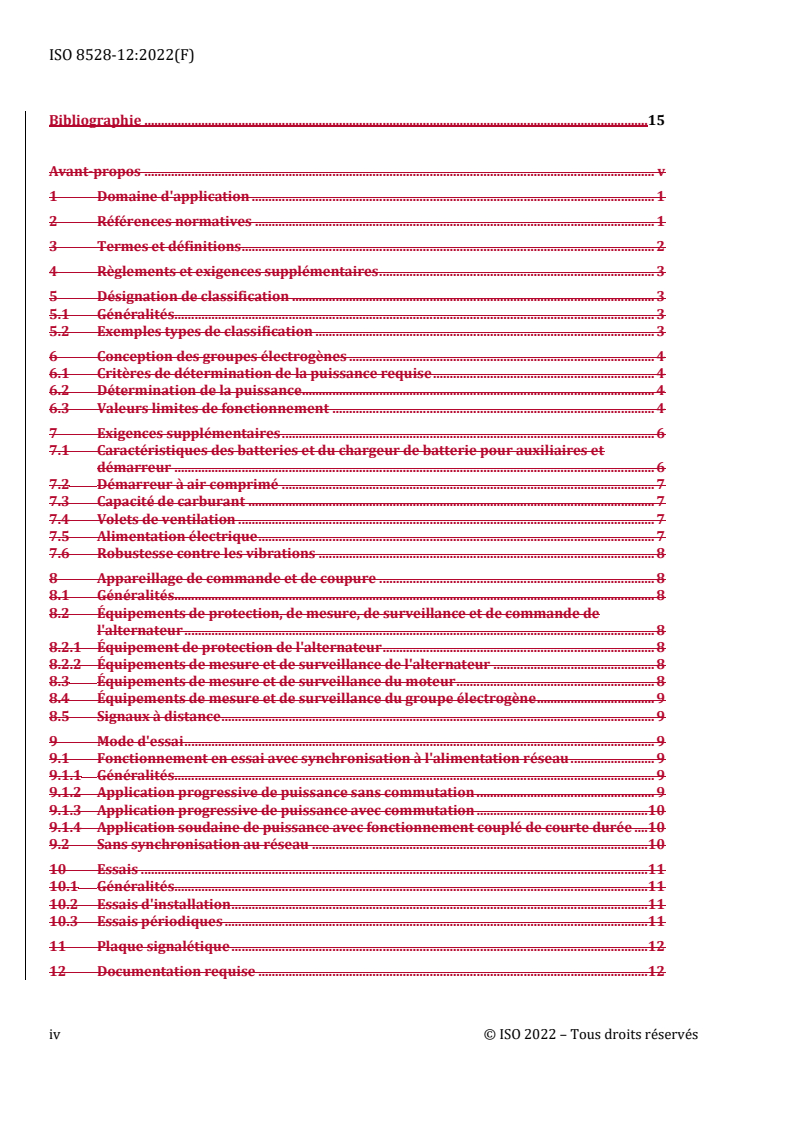
Bibliographie .15
Avant-propos . v
1 Domaine d'application . 1
2 Références normatives . 1
3 Termes et définitions . 2
4 Règlements et exigences supplémentaires . 3
5 Désignation de classification . 3
5.1 Généralités . 3
5.2 Exemples types de classification . 3
6 Conception des groupes électrogènes . 4
6.1 Critères de détermination de la puissance requise . 4
6.2 Détermination de la puissance . 4
6.3 Valeurs limites de fonctionnement . 4
7 Exigences supplémentaires . 6
7.1 Caractéristiques des batteries et du chargeur de batterie pour auxiliaires et
démarreur . 6
7.2 Démarreur à air comprimé . 7
7.3 Capacité de carburant . 7
7.4 Volets de ventilation . 7
7.5 Alimentation électrique . 7
7.6 Robustesse contre les vibrations . 8
8 Appareillage de commande et de coupure . 8
8.1 Généralités . 8
8.2 Équipements de protection, de mesure, de surveillance et de commande de
l'alternateur . 8
8.2.1 Équipement de protection de l'alternateur . 8
8.2.2 Équipements de mesure et de surveillance de l'alternateur . 8
8.3 Équipements de mesure et de surveillance du moteur . 8
8.4 Équipements de mesure et de surveillance du groupe électrogène . 9
8.5 Signaux à distance . 9
9 Mode d'essai . 9
9.1 Fonctionnement en essai avec synchronisation à l'alimentation réseau . 9
9.1.1 Généralités . 9
9.1.2 Application progressive de puissance sans commutation . 9
9.1.3 Application progressive de puissance avec commutation .10
9.1.4 Application soudaine de puissance avec fonctionnement couplé de courte durée .10
9.2 Sans synchronisation au réseau .10
10 Essais .11
10.1 Généralités .11
10.2 Essais d'installation .11
10.3 Essais périodiques .11
11 Plaque signalétique .12
12 Documentation requise .12
iv © ISO 2022 – Tous droits réservés
13 Liste de contrôle . 12
Bibliographie . 14
Avant-propos
L'ISO (Organisation internationale de normalisation) est une fédération mondiale d'organismes
nationaux de normalisation (comités membres de l'ISO). L'élaboration des Normes internationales est en
général confiée aux comités techniques de l'ISO. Chaque comité membre intéressé par une étude a le droit
de faire partie du comité technique créé à cet effet. Les organisations internationales, gouvernementales
et non gouvernementales, en liaison avec l'ISO participent également aux travaux. L'ISO collabore
étroitement avec la Commission électrotechnique internationale (IEC) en ce qui concerne la
normalisation électrotechnique.
Les procédures utilisées pour élaborer le présent document et celles destinées à sa mise à jour sont
décrites dans les Directives ISO/IEC, Partie 1. Il convient, en particulier, de prendre note des différents
critères d'approbation requis pour les différents types de documents ISO. Le présent document a été
rédigé conformément aux règles de rédaction données dans les Directives ISO/IEC, Partie 2
(voir www.iso.org/directiveswww.iso.org/directives).
L'attention est appelée sur le fait que certains des éléments du présent document peuvent faire l'objet de
droits de propriété intellectuelle ou de droits analogues. L'ISO ne saurait être tenue pour responsable de
ne pas avoir identifié de tels droits de propriété et averti de leur existence. Les détails concernant les
références aux droits de propriété intellectuelle ou autres droits analogues identifiés lors de l'élaboration
du document sont indiqués dans l'Introduction et/ou dans la liste des déclarations de brevets reçues par
l'ISO (voir www.iso.org/brevetswww.iso.org/brevets).
Les appellations commerciales éventuellement mentionnées dans le présent document sont données
pour information, par souci de commodité, à l'intention des utilisateurs, et ne sauraient constituer un
engagement.
Pour une explication de la nature volontaire des normes, la signification des termes et expressions
spécifiques de l'ISO liés à l'évaluation de la conformité, ou pour toute information au sujet de l'adhésion
de l'ISO aux principes de l'Organisation mondiale du commerce (OMC) concernant les obstacles
techniques au commerce (OTC), voir le lien suivant: www.iso.org/iso/fr/avant-
proposwww.iso.org/iso/fr/avant-propos.
Le présent document a été élaboré par le Comité technique ISO/TC 70, Moteurs à combustion interne.
Cette secondedeuxième édition annule et remplace la première édition (ISO 8528-12:1997), dont elle
constitue une révision mineure. Les modifications sont les suivantes:
— — structure mise à jour selon le modèle ISO actuel;
— — références normatives mises à jour;
— — Article 4Article 4 précédent supprimé – les symboles utilisés dans l'ISO 8528-5 s'appliquent
désormais;
— — Article 7Article 7 divisé en paragraphes;
— — alinéas suspendus supprimés des Articles 8Articles 8 et 9;9;
— — valeurs dans le Tableau 3Tableau 3 modifiées sur la base des valeurs de l'ISO 8528-5:2022,
Tableau 4;
vi © ISO 2022 – Tous droits réservés
— — modifications rédactionnelles mineures.
Une liste de toutes les parties de la série ISO 8528 se trouve sur le site web de l'ISO.
Il convient que l'utilisateur adresse tout retour d'information ou toute question concernant le présent
document à l'organisme national de normalisation de son pays. Une liste exhaustive desdits organismes
se trouve à l'adresse www.iso.org/members.html.
ISO 8528-12:2022(Ffr)
www.iso.org/members.html.
viii © ISO 2022 – Tous droits réservés
viii
NORME INTERNATIONALE
Groupes électrogènes à courant alternatif entraînés par moteurs
alternatifs à combustion interne —
Partie 12:
Alimentation électrique de secours de services de sécurité
1 Domaine d'application
Le présent document s'applique aux groupes électrogènes entraînés par moteurs alternatifs à combustion
interne (AIC) pour une alimentation électrique de secours de services de sécurité.
Le présent document s'applique, par exemple, aux équipements de sécurité des hôpitaux, des immeubles de
grande hauteur et des lieux de rassemblement publics. Il établit les exigences spéciales relatives à la
performance, à la conception et à la maintenance des groupes électrogènes utilisés dans les applications
mentionnées précédemment, et prend en compte les dispositions des ISO 8528-1 à ISO 8528-6 et de
1)
l'ISO 8528-10 . .
2 Références normatives
Les documents suivants sont cités dans le texte de sorte qu’ils constituent, pour tout ou partie de leur contenu,
des exigences du présent document. Pour les références datées, seule l'éditionl’édition citée
s'appliques’applique. Pour les références non datées, la dernière édition du document de référence s'applique
(y compris les éventuels amendements).
ISO 8528-1:2018, Groupes électrogènes à courant alternatif entraînés par moteurs alternatifs à combustion
interne — Partie 1: Application, caractéristiques et performances
ISO 8528-2:2018, Groupes électrogènes à courant alternatif entraînés par moteurs alternatifs à combustion
interne — Partie 2: Moteurs
ISO 8528-3, Groupes électrogènes à courant alternatif entraînés par moteurs alternatifs à combustion interne
— Partie 3: Alternateurs pour groupes électrogènes
ISO 8528-4:2005, Groupes électrogènes à courant alternatif entraînés par moteurs alternatifs à combustion
interne — Partie 4: Appareillage de commande et de coupure
ISO 8528-5:2022, Groupes électrogènes à courant alternatif entraînés par moteurs alternatifs à combustion
interne — Partie 5: Groupes électrogènes
ISO 8528-6:2005, Groupes électrogènes à courant alternatif entraînés par moteurs alternatifs à combustion
interne — Partie 6: Méthodes d'essaisd’essais
IEC 60364-7-710, Installations électriques basse-tension — Partie 7-710: Exigences pour les installations ou
emplacements spéciaux — Locaux à usages médicaux
En cours de préparation. Etape au moment de la publication : ISO/FDIS 8528-10:2022.
1)
En cours de préparation. Stade au moment de la publication : ISO/FDIS 8528-10:2022.
ISO 8528-12:2022(Ffr)
IEC 60622, Accumulateurs alcalins et autres accumulateurs à électrolyte non acide — Éléments individuels
parallélépipédiques rechargeables étanches au nickel-cadmium
IEC 60623, Accumulateurs alcalins ou autres accumulateurs à électrolyte non acide — Éléments individuels
parallélépipédiques rechargeables ouverts au nickel-cadmium
IEC 60896-11, Batteries stationnaires au plomb — Partie 11: Batteries au plomb du type ouvert — Prescriptions
générales et méthodes d'essaid’essai
IEC 60896-21, Batteries stationnaires au plomb — Partie 21: Types étanches à soupapes — Méthodes
d'essaid’essai
IEC 61951-1, Accumulateurs alcalins et autres accumulateurs à électrolyte non acide — Accumulateurs étanches
pour applications portables — Partie 1: Nickel-cadmium
3 Termes et définitions
Pour les besoins du présent document, les termes et définitions donnés dans les normes ISO 8528-1
à ISO 8528-6, ainsi que les suivants s'appliquent.
L'ISO et l'IEC tiennent à jour des bases de données terminologiques destinées à être utilisées en normalisation,
consultables aux adresses suivantes:
— — ISO Online browsing platform: disponible à l'adresse
https://www.iso.org/obphttps://www.iso.org/obp
— — IEC Electropedia: disponible à l'adresse
https://www.electropedia.org/https://www.electropedia.org/
3.1
temps de basculement
intervalle de temps entre l'apparition d'un dysfonctionnement du système d'alimentation électrique normal
et le moment où les services de sécurité sont à nouveau connectés à l'alimentation électrique de secours
Note 1 à l'article: Cette connexion aux services de sécurité peut être appliquée en plusieurs paliers de charge.
3.2
temps de chevauchement
temps minimal pendant lequel la centrale électrogène fournit une alimentation électrique aux consommateurs
dans des conditions de fonctionnement prédéterminées
Note 1 à l'article: Le temps de chevauchement correspond au temps de fonctionnement nominal tel que défini dans
l'IEC 60601-1.
3.3
services de sécurité
équipement pour la sécurité des personnes qui est installé et prêt à fonctionner en cas de défaillance du
système d'alimentation électrique habituel
3.4
demande d'électricité des consommateurs
total de toutes les demandes prévues des consommateurs connectés, tenant compte des paliers de charge réels
2 © ISO 2022 – Tous droits réservés
ISO 8528-12:2022(Ffr)
3.5
demande d'électricité pour les services de sécurité
demande de puissance requise pour répondre aux exigences des services de sécurité
4 Règlements et exigences supplémentaires
Si des exigences spéciales ou des règlements supplémentaires sont observés, ils doivent être indiqués par le
client et faire l'objet d'un accord entre le constructeur et le client.
5 Désignation de classification
5.1 Généralités
La classification des groupes électrogènes pour les services de sécurité est basée sur la classe de
t
co
performance G2 telle que définie dans l'ISO 8528-1 et le temps de basculement requis, ,𝑡𝑡 , selon
co
l'IEC 60364-5-56 et au Tableau 1.le Tableau 1.
Tableau 1 — Classification par temps de basculement
Groupes Groupes sans Groupes à courte Groupes à longue coupure
électrogènes coupure coupure
Temps de < 15 s
0 < 0,5 s > 15 s
basculement
Classification 1 2 3 4
5.2 Exemples types de classification
Des exemples types de classification telle que définie dans le Tableau 1Tableau 1 sont donnés dans
le Tableau 2.Tableau 2.
Tableau 2 — Exemples
Classification Exemples types
La tension réseau chute au-dessous de la tension nominale de plus de 10 %.
Après un temps de basculement de 0 s, la demande d'électricité des consommateurs pour les
services de sécurité doit être disponible. La conception des groupes électrogènes sans
coupure dépend des écarts de fréquence et de tension requis.
La tension réseau chute au-dessous de la tension nominale de plus de 10 %.
Après un temps de basculement de 0,5 s, la demande d'électricité des consommateurs pour
les services de sécurité doit être disponible. La conception du groupe électrogène à courte
coupure dépend des écarts de fréquence et de tension requis.
La tension réseau chute au-dessous de la tension nominale de plus de 10 % pendant une
période supérieure à 0,5 s.
Après un temps de basculement d'au maximum 15 s, la puissance pour 100 % de la demande
d'électricité des consommateurs pour les services de sécurité doit être disponible par paliers.
La tension réseau chute au-dessous de la tension nominale de plus de 10 % pendant une
période supérieure à 0,5 s.
Après un temps de basculement d'au maximum 15 s, la puissance pour 80 % de la demande
d'électricité des consommateurs pour les services de sécurité doit être disponible en deux
ISO 8528-12:2022(Ffr)
Classification Exemples types
paliers, et la puissance pour 100 % de la demande des consommateurs doit être disponible
après que 5 s supplémentaires se sont écoulées.
6 Conception des groupes électrogènes
6.1 Critères de détermination de la puissance requise
Pour assurer une fourniture fiable d'alimentation électrique par le groupe électrogène, le constructeur du
groupe électrogène doit être informé des exigences de puissance des installations à alimenter.
Les exigences de puissance doivent inclure de courtes pointes de charge lors d'une commutation dans des
installations électriques (par exemple ascenseurs, pompes, ventilateurs, équipements d'éclairage et
installations électriques non linéaires). Le cas échéant, par exemple pour des raisons de redondance,
l'utilisation de plusieurs groupes électrogènes fonctionnant couplés est éventuellement requise.
Puisque de nombreux moteurs alternatifs à combustion interne modernes sont turbocompressés, il est
nécessaire de prévoir une prise de charge en plusieurs étapes.
Pour une prise de charge, les définitions et les valeurs spécifiées dans l'ISO 8528-5:2022, 8.4, Figure 5
et Figure 6 s'appliquent lorsqu'il est montré que la capacité de prise de charge du groupe électrogène dépend
de la pression moyenne effective au frein du moteur alternatif à combustion interne.
S'il est utilisé des paliers supérieurs
...