

SIST EN 1786:1998
(Main)Foodstuffs - Detection of irradiated food containing bone - Method by ESR spectroscopy
- Abstract
This draft European Standard specifies a method for the detection of meat containing bone and fish containing bone which have been treated with ionizing radiation, by analysing the electron spin resonance (ESR) spectrum or electron paramagnetic resonance (EPR) spectrum of the bones. On the basis of results of analysis of meat containing bone from duck, frog, goose, chicken, hare, lamb, turkey, beef and pork, it is assumed that the same signals occur when other animal species are analysed.
- Status
- Published
- Publication Date
- 31-Oct-1998
- Technical Committee
- KŽP - Agricultural food products
- Current Stage
- 6060 - National Implementation/Publication (Adopted Project)
- Start Date
- 01-Nov-1998
- Due Date
- 01-Nov-1998
- Completion Date
- 01-Nov-1998



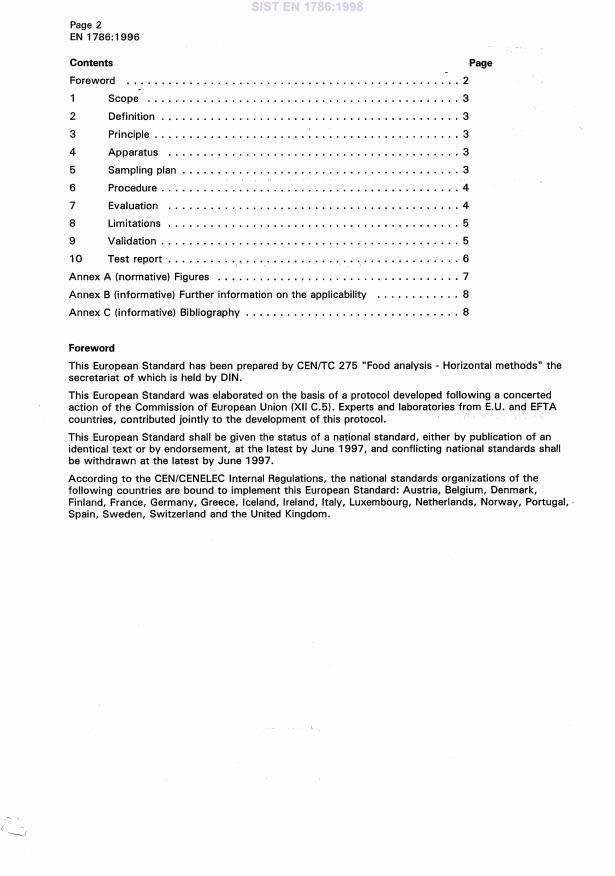
SIST EN 1786:1998 is a Slovenski inštitut za standardizacijo standard that adopts EN 1786:1996. It specifies a laboratory method for detecting meat containing bone and fish containing bone that have been treated with ionizing radiation, by examining the electron spin resonance (ESR) or electron paramagnetic resonance (EPR) spectrum of the bones.
What does SIST EN 1786:1998 specify?
SIST EN 1786:1998 specifies a method for identifying irradiated food of two types: meat containing bone and fish containing bone. The method looks at the ESR or EPR spectrum of the bones, so the test is based on the physical signal left in the bone material rather than on the food appearance or packaging.
The scope text also notes that the method was developed from results on bone-containing meat from duck, frog, goose, chicken, hare, lamb, turkey, beef and pork. On that basis, the same signals are assumed to occur when other animal species are analysed, which matters when a laboratory has to apply the method beyond the listed examples.
The document front matter identifies the standard as a food testing method under ICS 67.050, which places it in general methods of tests and analysis for food products. It also states the multilingual title and the equivalence to EN 1786:1996.
What are the key requirements of SIST EN 1786:1998?
The key technical point in SIST EN 1786:1998 is the use of ESR spectroscopy or EPR spectroscopy on bone material to detect prior ionizing radiation treatment. In practice, a lab needs to prepare the bone sample and interpret the measured spectrum for the characteristic signal pattern associated with irradiation.
What the method is applied to
SIST EN 1786:1998 applies to:
- meat containing bone
- fish containing bone
This matters because the method is not described as a general test for all foods. It is aimed at foods where bone is available as the analytical material.
What the signal interpretation is based on
SIST EN 1786:1998 is based on signals observed in bones from specific animal species:
- duck
- frog
- goose
- chicken
- hare
- lamb
- turkey
- beef
- pork
For users, this means the standard supports routine identification work using these known examples as the analytical basis.
What the method tells the user to look for
SIST EN 1786:1998 focuses on the spectrum of the bone, not on chemical extraction or sensory inspection. That makes it useful where the question is whether the food has been irradiated and the bones are still available for measurement.
What terms does SIST EN 1786:1998 define?
Electron spin resonance (ESR) is the spectroscopy technique used to detect signals from unpaired electrons in the bone after irradiation.
Electron paramagnetic resonance (EPR) is the alternate name used in the standard for the same type of spectrum-based analysis.
Ionizing radiation is the treatment the standard is intended to detect in bone-containing foods.
Meat containing bone means meat products where bone is present and can be analysed by the method.
Fish containing bone means fish products where bone is present and can be used as the analytical material.
Who uses SIST EN 1786:1998?
SIST EN 1786:1998 is used by food testing laboratories, analytical chemists, and inspection bodies that need to check whether bone-containing foods have been irradiated. It is also relevant to quality managers in meat and fish processing, import control, and buyers who need a laboratory method for verifying food treatment claims. Because it is a method standard for food products, it fits routine control work rather than product design.
What changed in SIST EN 1786:1998 from EN 1786:1996?
SIST EN 1786:1998 is the Slovenian standard identified as being identical to EN 1786:1996.
What does the SIST EN 1786:1998 document contain?
SIST EN 1786:1998 contains the multilingual front matter, the classification information, and the scope statement for the ESR-based detection method. The technical content centers on detecting irradiation in bones from meat and fish, using the ESR/EPR signal as the analytical indicator.
The standard is framed as a laboratory test method for general food analysis. In practice, it supports screening and confirmation work where the question is whether bone-containing food has been exposed to ionizing radiation.
Relations
- Effective Date
- 09-Feb-2026
- Effective Date
- 09-Feb-2026
Get Certified
Connect with accredited certification bodies for this standard

BSI Group
BSI (British Standards Institution) is the business standards company that helps organizations make excellence a habit.

Bureau Veritas
Bureau Veritas is a world leader in laboratory testing, inspection and certification services.

DNV
DNV is an independent assurance and risk management provider.
Sponsored listings
Frequently Asked Questions
SIST EN 1786:1998 is a standard published by the Slovenian Institute for Standardization (SIST). Its full title is "Foodstuffs - Detection of irradiated food containing bone - Method by ESR spectroscopy". This standard covers: This draft European Standard specifies a method for the detection of meat containing bone and fish containing bone which have been treated with ionizing radiation, by analysing the electron spin resonance (ESR) spectrum or electron paramagnetic resonance (EPR) spectrum of the bones. On the basis of results of analysis of meat containing bone from duck, frog, goose, chicken, hare, lamb, turkey, beef and pork, it is assumed that the same signals occur when other animal species are analysed.
This draft European Standard specifies a method for the detection of meat containing bone and fish containing bone which have been treated with ionizing radiation, by analysing the electron spin resonance (ESR) spectrum or electron paramagnetic resonance (EPR) spectrum of the bones. On the basis of results of analysis of meat containing bone from duck, frog, goose, chicken, hare, lamb, turkey, beef and pork, it is assumed that the same signals occur when other animal species are analysed.
SIST EN 1786:1998 is classified under the following ICS (International Classification for Standards) categories: 67.050 - General methods of tests and analysis for food products. The ICS classification helps identify the subject area and facilitates finding related standards.
SIST EN 1786:1998 has the following relationships with other standards: It is inter standard links to SIST EN IEC 62590-1:2025, SIST EN 62924:2017. Understanding these relationships helps ensure you are using the most current and applicable version of the standard.
SIST EN 1786:1998 is associated with the following European legislation: Standardization Mandates: M/029. When a standard is cited in the Official Journal of the European Union, products manufactured in conformity with it benefit from a presumption of conformity with the essential requirements of the corresponding EU directive or regulation.
SIST EN 1786:1998 is available in PDF format for immediate download after purchase. The document can be added to your cart and obtained through the secure checkout process. Digital delivery ensures instant access to the complete standard document.
Standards Content (Sample)
2003-01.Slovenski inštitut za standardizacijo. Razmnoževanje celote ali delov tega standarda ni dovoljeno.Živila - Detekcija obsevane hrane, ki vsebuje kosti - Metoda z ESR spektroskopijoLebensmittel - Nachweis von bestrahlten knochen- bzw. grätenhaltigen Lebensmitteln - Verfahren mittels ESR-SpektroskopieProduits alimentaires - Détection d'aliments ionisés contenant des os ou des aretes - Méthode par spectroscopie RPEFoodstuffs - Detection of irradiated food containing bone
...