

SIST EN 17636:2023
(Main)Railway applications - Infrastructure - Track alignment design parameters - Urban rail
General Information
- Abstract
This document specifies rules and limits for track alignment design parameters, including alignments within switches and crossings. Several of these limits are functions of speed. Alternatively, for a given track alignment, it specifies rules and limits that determine permissible speed with regards to track alignment.
This document applies to urban or suburban rail networks for passenger services not integrated with the national network.
Sections of urban or suburban rail networks integrated in the national rail networks are not covered by this document. They are covered by EN 13803 (or for nominal track gauges smaller than 1 435 mm by national alignment rules).
For the purpose of this document, urban or suburban rail networks include:
- Networks designed for own right of way and segregated from general road and pedestrian traffic,
and
- Networks (partly) not segregated from general road and pedestrian traffic, with shared lanes.
This document applies to rail systems with steel wheels running on steel vignole or grooved rails. Rail systems with specific construction issues (e.g. rack railways, funicular railways and other types of cable drawn rail systems) are not covered by this document.
This document defines the parameters, rules and limits for nominal track gauges of 1 435 mm and 1 000 mm with permissible speeds up to 120 km/h. For other nominal track gauges, this document defines conversion rules which shall be used to define the limits.
- Status
- Published
- Public Enquiry End Date
- 31-Mar-2021
- Publication Date
- 23-Oct-2023
- Technical Committee
- IŽNP - Reilway applications
- Current Stage
- 6060 - National Implementation/Publication (Adopted Project)
- Start Date
- 19-Oct-2023
- Due Date
- 24-Dec-2023
- Completion Date
- 24-Oct-2023


Overview
EN 17636:2023 - "Railway applications - Infrastructure - Track alignment design parameters - Urban rail" (CEN) specifies rules and limits for track alignment design in urban and suburban passenger rail networks that are not integrated with the national network. The standard covers alignment elements including switches and crossings and establishes how alignment parameters relate to permissible speeds (several limits are speed-dependent). It applies to steel-wheel systems on vignole or grooved rails for nominal gauges 1 435 mm and 1 000 mm (permissible speeds up to 120 km/h) and provides conversion rules for other gauges.
Key topics and technical requirements
- Scope and applicability
- Urban/suburban networks with segregated right-of-way or shared lanes with road/pedestrian traffic.
- Excludes sections integrated in national networks (those fall under EN 13803) and special systems (rack railways, funiculars, cable-drawn systems).
- Core alignment parameters (document defines rules and limits)
- Horizontal radius and curvature
- Applied cant and cant transition lengths
- Cant deficiency and cant excess (including limits and exceptional cases)
- Lengths of transition curves (e.g., clothoids) and linear cant transitions
- Cant gradient and rate of change of cant / cant deficiency
- Abrupt changes of horizontal curvature and cant deficiency
- Track gradient, vertical radius and vertical curve lengths
- Lengths between abrupt changes and between small-radius opposite curves
- Supplementary normative annexes
- Conversion rules for gauges other than 1 435 mm (Annex A)
- Three-dimensional geometry effects on resulting cant gradients and vertical radius (Annex B)
- Sign rules, and calculation guidance for cant and gradient changes (Annex D)
- Informative relations between cant deficiency and non-compensated lateral acceleration (Annex C)
Practical applications
- Designing track alignments for urban tram, light rail and metro-type systems
- Determining permissible line speeds from a given geometry or conversely deriving geometry limits from a target speed
- Specifying alignment within switches and crossings to meet comfort, safety and maintenance constraints
- Supporting asset owners, infrastructure designers and maintenance planners to set limits that balance ride comfort, wear and lifecycle costs
- Providing conversion guidance when adapting parameter limits to alternative nominal gauges
Who should use this standard
- Railway infrastructure engineers and designers
- Urban transport authorities, system integrators and planners
- Rolling-stock engineers concerned with track/vehicle interaction
- Contractors, consultants and maintenance teams involved in alignment specification and verification
Related standards and references
- EN 13803 - alignment rules for sections integrated in national networks
- ISO/IEC terminology resources (for standard definitions referenced by EN 17636)
Keywords: EN 17636:2023, track alignment design, urban rail, cant, cant deficiency, transition curve, clothoid, permissible speed, CEN standard.
Get Certified
Connect with accredited certification bodies for this standard

Zavod za gradbeništvo Slovenije (ZAG) - Inšpekcija
ZAG inspection body for construction products, structures, and materials.
Sponsored listings
Frequently Asked Questions
SIST EN 17636:2023 is a standard published by the Slovenian Institute for Standardization (SIST). Its full title is "Railway applications - Infrastructure - Track alignment design parameters - Urban rail". This standard covers: This document specifies rules and limits for track alignment design parameters, including alignments within switches and crossings. Several of these limits are functions of speed. Alternatively, for a given track alignment, it specifies rules and limits that determine permissible speed with regards to track alignment. This document applies to urban or suburban rail networks for passenger services not integrated with the national network. Sections of urban or suburban rail networks integrated in the national rail networks are not covered by this document. They are covered by EN 13803 (or for nominal track gauges smaller than 1 435 mm by national alignment rules). For the purpose of this document, urban or suburban rail networks include: - Networks designed for own right of way and segregated from general road and pedestrian traffic, and - Networks (partly) not segregated from general road and pedestrian traffic, with shared lanes. This document applies to rail systems with steel wheels running on steel vignole or grooved rails. Rail systems with specific construction issues (e.g. rack railways, funicular railways and other types of cable drawn rail systems) are not covered by this document. This document defines the parameters, rules and limits for nominal track gauges of 1 435 mm and 1 000 mm with permissible speeds up to 120 km/h. For other nominal track gauges, this document defines conversion rules which shall be used to define the limits.
This document specifies rules and limits for track alignment design parameters, including alignments within switches and crossings. Several of these limits are functions of speed. Alternatively, for a given track alignment, it specifies rules and limits that determine permissible speed with regards to track alignment. This document applies to urban or suburban rail networks for passenger services not integrated with the national network. Sections of urban or suburban rail networks integrated in the national rail networks are not covered by this document. They are covered by EN 13803 (or for nominal track gauges smaller than 1 435 mm by national alignment rules). For the purpose of this document, urban or suburban rail networks include: - Networks designed for own right of way and segregated from general road and pedestrian traffic, and - Networks (partly) not segregated from general road and pedestrian traffic, with shared lanes. This document applies to rail systems with steel wheels running on steel vignole or grooved rails. Rail systems with specific construction issues (e.g. rack railways, funicular railways and other types of cable drawn rail systems) are not covered by this document. This document defines the parameters, rules and limits for nominal track gauges of 1 435 mm and 1 000 mm with permissible speeds up to 120 km/h. For other nominal track gauges, this document defines conversion rules which shall be used to define the limits.
SIST EN 17636:2023 is classified under the following ICS (International Classification for Standards) categories: 93.100 - Construction of railways. The ICS classification helps identify the subject area and facilitates finding related standards.
SIST EN 17636:2023 is associated with the following European legislation: Standardization Mandates: M/486. When a standard is cited in the Official Journal of the European Union, products manufactured in conformity with it benefit from a presumption of conformity with the essential requirements of the corresponding EU directive or regulation.
SIST EN 17636:2023 is available in PDF format for immediate download after purchase. The document can be added to your cart and obtained through the secure checkout process. Digital delivery ensures instant access to the complete standard document.
Standards Content (Sample)
SLOVENSKI STANDARD
01-december-2023
Železniške naprave - Infrastruktura - Parametri za načrtovanje trase proge -
Mestna železnica
Railway applications - Infrastructure - Track alignment design parameters - Urban rail
Bahnanwendungen - Oberbau - Streckentrassierungsparameter für den städtischen
Schienenverkehr
Applications ferroviaires - Infrastructure - Paramètres de conception du tracé de la voie
pour le rail urbain
Ta slovenski standard je istoveten z: EN 17636:2023
ICS:
93.100 Gradnja železnic Construction of railways
2003-01.Slovenski inštitut za standardizacijo. Razmnoževanje celote ali delov tega standarda ni dovoljeno.
EN 17636
EUROPEAN STANDARD
NORME EUROPÉENNE
October 2023
EUROPÄISCHE NORM
ICS 93.100
English Version
Railway applications - Infrastructure - Track alignment
design parameters - Urban rail
Applications ferroviaires - Infrastructure - Paramètres Bahnanwendungen - Oberbau -
de conception du tracé de la voie pour le rail urbain Streckentrassierungsparameter für den städtischen
Schienenverkehr
This European Standard was approved by CEN on 9 July 2023.
CEN members are bound to comply with the CEN/CENELEC Internal Regulations which stipulate the conditions for giving this
European Standard the status of a national standard without any alteration. Up-to-date lists and bibliographical references
concerning such national standards may be obtained on application to the CEN-CENELEC Management Centre or to any CEN
member.
This European Standard exists in three official versions (English, French, German). A version in any other language made by
translation under the responsibility of a CEN member into its own language and notified to the CEN-CENELEC Management
Centre has the same status as the official versions.
CEN members are the national standards bodies of Austria, Belgium, Bulgaria, Croatia, Cyprus, Czech Republic, Denmark, Estonia,
Finland, France, Germany, Greece, Hungary, Iceland, Ireland, Italy, Latvia, Lithuania, Luxembourg, Malta, Netherlands, Norway,
Poland, Portugal, Republic of North Macedonia, Romania, Serbia, Slovakia, Slovenia, Spain, Sweden, Switzerland, Türkiye and
United Kingdom.
EUROPEAN COMMITTEE FOR STANDARDIZATION
COMITÉ EUROPÉEN DE NORMALISATION
EUROPÄISCHES KOMITEE FÜR NORMUNG
CEN-CENELEC Management Centre: Rue de la Science 23, B-1040 Brussels
© 2023 CEN All rights of exploitation in any form and by any means reserved Ref. No. EN 17636:2023 E
worldwide for CEN national Members.
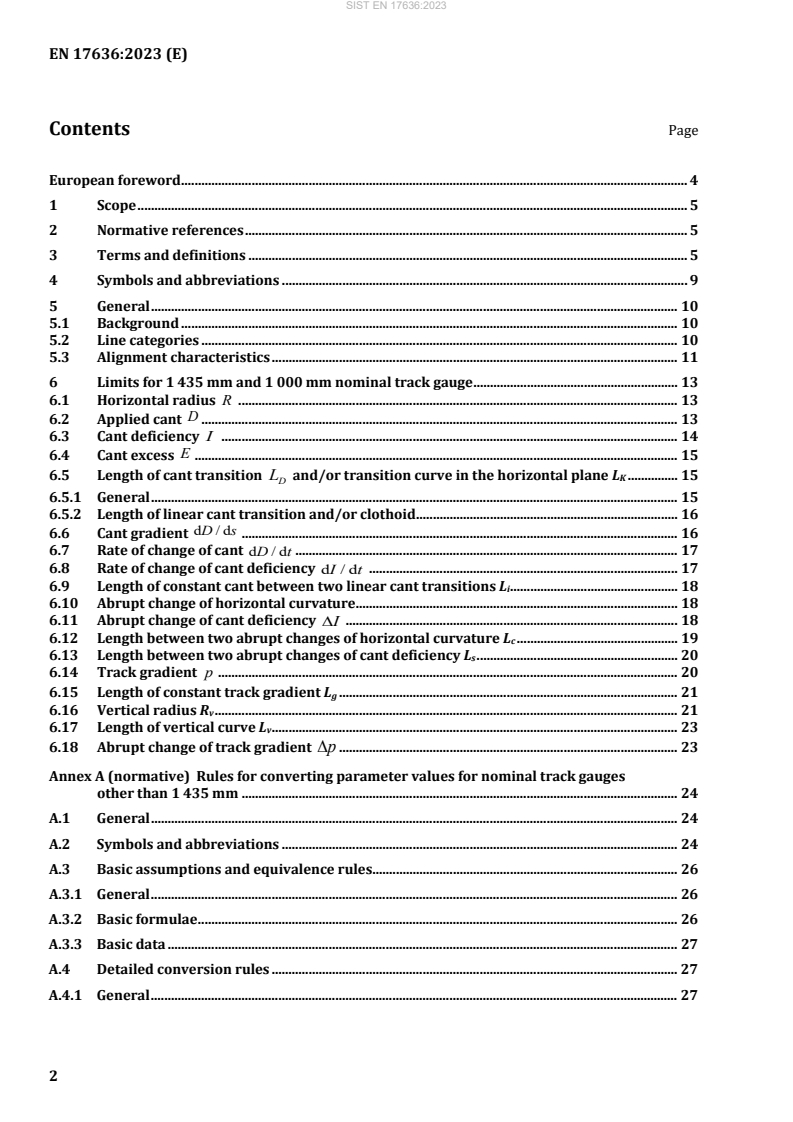
Contents Page
European foreword . 4
1 Scope . 5
2 Normative references . 5
3 Terms and definitions . 5
4 Symbols and abbreviations . 9
5 General . 10
5.1 Background . 10
5.2 Line categories . 10
5.3 Alignment characteristics . 11
6 Limits for 1 435 mm and 1 000 mm nominal track gauge . 13
6.1 Horizontal radius R . 13
D
6.2 Applied cant . 13
6.3 Cant deficiency I . 14
E
6.4 Cant excess . 15
6.5 Length of cant transition and/or transition curve in the horizontal plane L . 15
L K
D
6.5.1 General . 15
6.5.2 Length of linear cant transition and/or clothoid . 16
dDs/d
6.6 Cant gradient . 16
6.7 Rate of change of cant . 17
dDt/d
6.8 Rate of change of cant deficiency dIt/d . 17
6.9 Length of constant cant between two linear cant transitions L . 18
i
6.10 Abrupt change of horizontal curvature . 18
6.11 Abrupt change of cant deficiency ∆I . 18
6.12 Length between two abrupt changes of horizontal curvature L . 19
c
6.13 Length between two abrupt changes of cant deficiency L . 20
s
6.14 Track gradient . 20
p
6.15 Length of constant track gradient L . 21
g
6.16 Vertical radius R . 21
v
6.17 Length of vertical curve L . 23
v
6.18 Abrupt change of track gradient ∆p . 23
Annex A (normative) Rules for converting parameter values for nominal track gauges
other than 1 435 mm . 24
A.1 General . 24
A.2 Symbols and abbreviations . 24
A.3 Basic assumptions and equivalence rules . 26
A.3.1 General . 26
A.3.2 Basic formulae . 26
A.3.3 Basic data . 27
A.4 Detailed conversion rules . 27
A.4.1 General . 27
A.4.2 Cant D (6.2) . 27
A.4.3 Cant deficiency I (6.3) . 29
A.4.4 Cant excess E (6.4) . 30
A.4.5 Length of cant transition L and transition curve in the horizontal plane L (6.5). 31
D K
A.4.6 Cant gradient dD /dt (6.6) . 31
A.4.7 Rate of change of cant dDt/d (6.7) . 32
A.4.8 Rate of change of cant deficiency dI /dt (6.8) . 33
A.4.9 Abrupt change of curvature and abrupt change of cant deficiency ∆I (6.10 and
6.11) . 34
A.4.10 Other parameters (6.1, 6.9, 6.12, 6.13, 6.14, 6.15, 6.16, 6.17 and 6.18) . 34
Annex B (normative) Three-dimensional track geometry with regards to resulting cant
gradient and resulting vertical radius . 35
B.1 General considerations regarding three-dimensional track geometry . 35
B.2 Angular twist T and resulting cant gradient (dD/ds) . 35
A r
B.2.1 Calculation of resulting cant gradient (dD/ds) where cant is applied by lifting one
r
rail D / 2 and lowering the other rail D / 2 . 35
B.2.2 Calculation of resulting cant gradient (dD/ds) when cant is applied by lifting one
r
rail D . 36
B.3 Resulting vertical radius (R ) . 36
v r
Annex C (informative) The relations between cant deficiency, non-compensated lateral
acceleration and related parameters . 38
C.1 Introduction. 38
C.2 Applied cant and roll angle . 38
C.3 Equilibrium cant . 39
C.4 Cant deficiency and non-compensated lateral acceleration . 40
C.5 Applications . 41
∆p
Annex D (normative) Sign rules for calculation of ∆D , ∆I and . 42
D.1 General regarding the sign rules . 42
D.2 Sign rules for calculation of ∆D . 42
D.3 Sign rules for calculation of ∆I . 42
D.4 Sign rules for calculation of ∆p . 43
Annex E (normative) Lengths of intermediate elements L between small radius curves in
c
opposite directions . 45
E.1 General . 45
E.2 Lengths of intermediate elements Lc for Line Category A1435 . 45
E.3 Lengths of intermediate elements L for Line Category B1435 and C1000 . 46
c
Bibliography . 48
European foreword
This document (EN 17636:2023) has been prepared by Technical Committee CEN/TC 256 “Railway
applications”, the secretariat of which is held by DIN.
This European Standard shall be given the status of a national standard, either by publication of an
identical text or by endorsement, at the latest by April 2024, and conflicting national standards shall be
withdrawn at the latest by April 2024.
Attention is drawn to the possibility that some of the elements of this document may be the subject of
patent rights. CEN shall not be held responsible for identifying any or all such patent rights.
This document has been prepared under a Standardization Request given to CEN by the European
Commission and the European Free Trade Association.
Any feedback and questions on this document should be directed to the users’ national standards body.
A complete listing of these bodies can be found on the CEN website.
According to the CEN-CENELEC Internal Regulations, the national standards organisations of the
following countries are bound to implement this European Standard: Austria, Belgium, Bulgaria, Croatia,
Cyprus, Czech Republic, Denmark, Estonia, Finland, France, Germany, Greece, Hungary, Iceland, Ireland,
Italy, Latvia, Lithuania, Luxembourg, Malta, Netherlands, Norway, Poland, Portugal, Republic of North
Macedonia, Romania, Serbia, Slovakia, Slovenia, Spain, Sweden, Switzerland, Türkiye and the United
Kingdom.
1 Scope
This document specifies rules and limits for track alignment design parameters, including alignments
within switches and crossings. Several of these limits are functions of speed. Alternatively, for a given
track alignment, it specifies rules and limits that determine permissible speed with regards to track
alignment.
This document is applicable to urban or suburban rail networks for passenger services not integrated
with the national network.
Sections of urban or suburban rail networks integrated in the national rail networks are not covered by
this document. They are covered by EN 13803 (or for nominal track gauges smaller than 1 435 mm by
national alignment rules).
For the purpose of this document, urban or suburban rail networks include:
— Networks designed for own right of way and segregated from general road and pedestrian traffic,
and
— Networks (partly) not segregated from general road and pedestrian traffic, with shared lanes.
This document is applicable to rail systems with steel wheels running on steel vignole rails or steel
grooved rails. Rail systems with specific construction issues (e.g. rack railways, funicular railways and
other types of cable drawn rail systems) are not covered by this document.
This document defines the parameters, and specifies rules and limits for nominal track gauges of
1 435 mm and 1 000 mm with permissible speeds up to 120 km/h. For other nominal track gauges, this
document defines conversion rules which are used to specify the limits.
2 Normative references
There are no normative references in this document.
3 Terms and definitions
For the purposes of this document, the following terms and definitions apply.
ISO and IEC maintain terminology databases for use in standardization at the following addresses:
— ISO Online browsing platform: available at https://www.iso.org/obp
— IEC Electropedia: available at https://www.electropedia.org
3.1
track gauge
distance between the corresponding running edges of the two rails
3.2
nominal track gauge
single value which identifies the track gauge but may differ from the design track gauge
3.3
limit
restriction for design values not to be exceeded
Note 1 to entry: These values ensure that track maintenance costs and ride comfort are within a reasonable
range.
Note 2 to entry: For certain parameters, this document specifies both a normal limit and an exceptional limit.
Exceptional limits are intended for use only under special circumstances and can require an associated maintenance
regime as well as requiring to be verified against the local rolling stock.
3.4
alignment element
segment of the track with either vertical direction, horizontal direction or cant obeying a unique
mathematical description as a function of chainage
Note 1 to entry: Unless otherwise stated, the appertaining track alignment design parameters are defined for the
track centre line and the longitudinal distance for the track centre line is defined in a projection in a horizontal
plane.
3.5
chainage
longitudinal distance along the horizontal projection of the track centre line
3.6
curvature
derivative of the horizontal direction of the track centre line with respect to chainage
Note 1 to entry: In the direction of the chainage, curvature is positive in a right-hand curve and negative in a left-
hand curve. The magnitude of the curvature corresponds to the inverse of the horizontal radius.
3.7
circular curve
curved alignment element of constant curvature
3.8
transition curve
alignment element where curvature changes with respect to chainage
Note 1 to entry: The clothoid (sometimes approximated as a 3rd degree polynomial, “cubic parabola”) is
normally used for transition curves, giving a linear variation of curvature. In some cases, curvature is smoothed at
the ends of the transition. A transition can also be created by a sequence of short circular curves with radii which
change stepwise.
Note 2 to entry: It is possible to use other forms of transition curve, which show a nonlinear variation of
curvature.
Note 3 to entry: Normally, a transition curve is not used for the vertical alignment.
3.9
reverse curve
sequence of curved alignment elements, containing alignment elements which curve in opposite
directions
3.10
running plane
flat plane tangential to the running surface of both rail heads at the considered cross section
3.11
track gradient
absolute value of the derivative (with respect to chainage) of track level
3.12
cant
amount by which one running rail is raised above the other running rail, in a track cross section
Note 1 to entry: Measured over e the base measurement for cant.
3.13
applied cant
design value for cant
3.14
equilibrium cant
cant at a particular speed at which the vehicle will have a resultant force perpendicular to the running
plane
3.15
cant deficiency
difference between applied cant and a higher equilibrium cant
Note 1 to entry: When there is cant deficiency, there will be an unbalanced lateral force in the running plane. The
resultant force will move towards the outer rail of the curve.
3.16
cant excess
difference between applied cant and a lower equilibrium cant
Note 1 to entry: When there is cant excess, there will be an unbalanced lateral force in the running plane. The
resultant force will move towards the inner rail of the curve.
Note 2 to entry: Cant on a straight track results in cant excess, generating a lateral force towards the low rail.
3.17
cant transition
alignment element where cant changes with respect to chainage
Note 1 to entry: Normally, a cant transition coincides with a transition curve.
Note 2 to entry: Cant transitions giving a linear variation of cant are usually used. In some cases, cant is smoothed
at the ends of the transition.
Note 3 to entry: It is possible to use other forms of cant transition, which show a nonlinear variation of cant.
3.18
cant gradient
absolute value of the derivative (with respect to chainage) of cant
3.19
helical track
track with a track gradient combined with horizontal curvature
Note 1 to entry: This combination leads to a twisted track, even though applied cant is not changing along the
track.
3.20
resulting cant gradient
equivalent gradient of cant for a helical track situation (plus coexisting cant gradient, if present), which
results in the same angular twist as a cant gradient on a level track
3.21
angular twist
derivative of roll angle (rotation around the longitudinal axis) with respect to longitudinal distance
measured in coordinate system which has the same direction as the sloping track on a track gradient
3.22
rate of change of cant
absolute value of the time derivative of cant (resulting from vehicle speed)
3.23
rate of change of cant deficiency
absolute value of the time derivative of cant deficiency and/or cant excess (resulting from vehicle speed)
4 Symbols and abbreviations
No. Symbol Designation Unit
1 dD/ds cant gradient mm/m
2 (dD/ds)r resulting cant gradient mm/m
3 dD/dt rate of change of cant mm/s
4 dI/dt rate of change of cant deficiency (and/or cant excess) mm/s
5 D applied cant mm
6 DEQ equilibrium cant mm
7 e base measurement for cant mm
8 E cant excess mm
9 g acceleration due to gravity m/s
10 I cant deficiency mm
11 Lc length between two abrupt changes of curvature m
12 LD length of cant transition m
13 L length of constant track gradient m
g
14 L length of transition curve m
K
15 Li length of alignment elements between two linear cant transitions m
16 Ls length between two abrupt changes of cant deficiency m
17 Lv length of vertical curve m
18 p track gradient -
19 q factor for calculation of equilibrium cant mm∙m/(km/h)
E
20 qN factor for calculation of length of cant transition or transition curve with -
non-constant gradient of cant and curvature, respectively
21 qRv factor for calculation of vertical radius m/(km/h)
22 qs factor for calculation of lengths between abrupt changes of cant deficiency m/(km/h)
23 q factor for conversion of the units for vehicle speed (km/h)/(m/s)
V
24 R radius of horizontal curve m
25 Rv radius of vertical curve m
26 (Rv)r resulting vertical radius m
27 s longitudinal distance m
28 t time s
29 T angular twist rad/m
A
30 V speed km/h
31 lim limit (index) -
32 index for resulting parameters in three-dimensional calculations -
r
33 additional limit applicable at small radius curves (index) -
R, lim
5 General
5.1 Background
This document specifies rules and limits for track alignment design. These limits assume that standards
for acceptance of vehicle, track construction and maintenance are fulfilled (construction and in-service
tolerances are not specified in this document). Engineering requirements specific to the mechanical
behaviour of switch and crossing components and subsystems are to be found in the relevant standards.
This document is not a design manual. The normal limits are not intended to be used as usual design
values. However, design values shall be within the limits stated in this document.
This document takes into account the usually tighter and more manifold alignment situations in urban
environments, by differentiating into line categories A, B and C (see 5.2). Due to the strong interrelation
of alignment limits and kinematic vehicle restrictions, local vehicles have often been tailored to the
respective network and vice versa. The main reason for this may be the absence of European Standards
within the urban rail sector, a situation the present document may contribute to leave in the long run.
Limits in this document are based on practical experiences of European Urban Rail networks. Limits are
applied where it is necessary to compromise between train performance (including safety) and comfort
levels, maintenance of the vehicle and track, and construction costs.
The use of design values close to normal limits should be avoided; substantial margins to them should be
provided. There are often conflicts between the desire for margins to one parameter and another; these
should be distributed over all design parameters, possibly by applying a margin with respect to speed.
For certain parameters, this document also specifies exceptional limits less restrictive than normal limits.
Such limits are intended for use only under special circumstances and can require an associated
maintenance regime as well as requiring to be verified against the local rolling stock. In particular, use of
exceptional limits (instead of normal limits) for several parameters at the same location shall be avoided.
The use of design values outside the normal limits should be documented.
Operational limits for speed and cant deficiency shall be applied to specific vehicles according to their
approval parameters. Limits for train speed shall be calculated from the speed dependent alignment
limits by solving for vehicle speed V , using 6.3, 6.4, 6.7, 6.8, 6.11, 6.13 and 6.16. As different vehicle
sections may be located on alignment sections with different speed limits, it is always the most restrictive
speed limit over the train length that applies. Speed may also be restricted for other reasons than track
alignment, for example reduced visibility and operational rules.
The limits are specified for normal service operations. If and when running trials are conducted, for
example to ascertain the vehicle dynamic behaviour (by continual monitoring of the vehicle responses),
exceeding the limits (particularly in terms of cant deficiency) should be permitted and it is up to the
responsible body to decide any appropriate arrangement.
NOTE In common with other track alignment standards and specifications, this document uses vehicle speed
expressed in km/h.
V
5.2 Line categories
Urban and suburban rail systems are local systems of different character. The requirements on the
infrastructure are related to the vehicle types to be used on the network. Three line categories are
defined, including systems for nominal track gauge 1 435 mm and 1 000 mm:
— Category A1435, lines for metro types of rail vehicles with nominal track gauge 1 435 mm
— Category B1435, lines for tram types of rail vehicles with nominal track gauge 1 435 mm
— Category C1000, lines for tram types of rail vehicles with nominal track gauge 1 000 mm
Table 1 specifies fixed parameters for Line Categories A1435, B1435 and C1000.
Table 1 — Fixed parameters for Line Categories A1435, B1435 and C1000
Parameter Line Category
A1435 B1435 C1000
nominal track gauge [mm] 1 435 1 435 1 000
e , base measurement for cant [mm] 1 500 1 500 1 060
11,8 11,8 8,3
q , factor for calculation of equilibrium cant [mm∙m/(km/h) ]
E
For other nominal track gauges, limits that depend on track gauge (6.2, 6.3, 6.4, 6.6, 6.7, 6.8 and 6.9) shall
be specified based on the limit values of A1435 and B1435 applying conversion factors (see normative
Annex A).
The conversion is done by multiplying the respective limit with the ratio W= ee/ , where e is the base
1 1
measurement for cant for the considered track gauge. However, for the cant gradient (6.6), the limit is
We⋅ +500mm/ e+500mm
obtained by multiplying with ( ) ( ) .
It is assumed that all vehicles have been assessed and approved according to the relevant standards for
the line category in question.
5.3 Alignment characteristics
The alignment defines the geometrical position of the track. It is divided into horizontal alignment and
vertical alignment.
The horizontal alignment is the projection of the track centre line on the horizontal plane. The horizontal
alignment consists of a sequence of alignment elements, each obeying a unique mathematical description
as a function of longitudinal distance along the horizontal projection (chainage). The elements for
horizontal alignment are connected at tangent points, where two connected elements have the same
coordinates and the same directions. Elements for horizontal alignment are specified in Table 2.
Table 2 — Elements for horizontal alignment
Alignment element Characteristics
Straight line No horizontal curvature
Circular curve Constant horizontal curvature
a
Transition curve, Clothoid type Horizontal curvature varies linearly with chainage
Compound transition A sequence of short circular curves where curvature
increases or decreases stepwise
a
EN 13803 gives a detailed account of certain alternative types of transition curves that may be used
in track alignment design
Most modern switches have a tangential geometry, where the diverging track starts with an alignment
that is tangential with the through track. However, switch designs may start with an abrupt change of
horizontal direction at the beginning of the switch. When a turnout is placed on a track gradient other
than zero, a vertical curve and/or cant, the horizontal geometry of the diverging track will deviate slightly
from the element types in Table 2.
The vertical alignment defines the level of the track as a function of chainage (the longitudinal position
along the horizontal projection of the track centre line). The elements for vertical alignment are
connected at tangent points where two connected elements have the same level and the same track
gradient p (with certain exceptions). Elements for vertical alignment are specified in Table 3.
Table 3 — Elements for vertical alignment
Alignment element Characteristics
Constant track gradient No vertical curvature
Vertical curve, parabola Derivative of track gradient with respect to chainage is constant
Vertical curve, circular Derivative of vertical angle with respect to sloping length along the track is
constant
NOTE A vertical curve in track that starts or ends in canted switches and crossings can be of a higher order
polynomial than a parabola.
The applied cant D in the track is the difference in level of two running rails. Cant can be applied by
raising one rail above the level of the vertical profile and keeping the other rail on the same level as the
vertical profile, or by a pre-defined relation raising one rail and lowering the other rail. The cant can be
considered as a sequence of elements connected at tangent points where two elements have the same
magnitude of applied cant. (At a tangent point with cant, the same rail is the high rail before and after the
tangent point.) Elements for applied cant are specified in Table 4.
Table 4 — Elements for cant
Characteristics
Alignment element
Constant cant Cant is constant along the entire element
a
Cant transition, linear Cant varies linearly with chainage
a
EN 13803 gives a detailed account of certain alternative types of cant transitions that may
be used in track alignment design.
Cant transitions should normally coincide with transition curves, but exceptions are possible.
Lateral and vertical directions in track alignment design refers to the directions of an earth-bound
coordinate system. When the alignment has a track gradient and/or applied cant, lateral and/or vertical
directions (as perceived by vehicles as well as track components) will change. The effects can be
significant for resulting vertical radius (combination of small radius curves with high value of applied
cant) and angular twist/resulting cant gradient (helical tracks with steep track gradient and small-radius
curves). Normative Annex B specifies formulae to quantify the effects.
All limits in Clause 6 apply, hence the permissible range for one parameter, for example horizontal radius
R can be further restricted due to the chosen values of other parameters. For example, at a certain
location in an alignment sequence, the permissible range for horizontal radius R can be limited due to
applied cant D , limit for cant deficiency I , track gradient , vertical radius R and/or characteristics
p
v
of adjacent elements.
6 Limits for 1 435 mm and 1 000 mm nominal track gauge
6.1 Horizontal radius R
In this document, radius is positive on both right-hand and left-hand curves.
Speed independent lower limits for horizontal radius R are specified in Table 5.
lim
Table 5 — Lower limits for horizontal radius R
lim
Line Category A1435 B1435 C1000
a
Normal limit [m] 50 25 25
a
Exceptional limit [m] 42 16 11,8
a
More restrictive lower limits for the radius along platforms may
apply, in order to minimize the gap between the vehicle floor and the
platform.
dD
Combination of horizontal radius R and track gradient p affects the resulting cant gradient , and
ds
r
combination of horizontal radius R and applied cant D affects the resulting vertical radius R , see
( )
v
r
normative Annex B.
There is no upper limit for horizontal radius in this document. However, local standards can have such
an upper limit, related to capabilities of the alignment software to handle very large numbers or to other
practical aspects. Larger horizontal radius than 99 999 m should not be used.
D
6.2 Applied cant
In this document, applied cant on a horizontal curve is positive if the outer rail is higher than the inner
rail. For Line Categories A1435 and B1435, the base measurement for cant e is 1 500 mm. For Line
e
Category C1000, the base measurement for cant is 1 060 mm.
NOTE 1 Negative cant is unavoidable at switches and crossings on a canted main line where the turnout is
curving in the opposite direction to the main line and, in certain cases, on the plain line immediately adjoining a
canted turnout. Due to camber, negative cant may be applied on street running tracks. Negative cant can also be
used on temporary tracks.
Upper limits for applied cant D , independent of horizontal radius R , are specified in Table 6.
lim
Table 6 — Upper limits for applied cant D
lim
Line Category A1435 B1435 C1000
a
Normal limit [mm] 150 150 100
a
Exceptional limit [mm] 165 165 110
a
More restrictive upper limits for cant along platforms may
apply, for the convenience for boarding and alighting passengers.
Combination of horizontal radius R and applied cant D affects the resulting vertical radius , see
R
( )
v
r
normative Annex B.
Upper limits for applied cant D , as a function of horizontal radius R , are specified in Table 7.
R , lim
Table 7 — Upper limits for applied cant D as a function of horizontal radius R
R , lim
Line Category A1435 B1435 C1000
a
Normal limit [mm]
R /1,6m (R+ 24m) /1,6m (R+ 24m) / 2,3m
Exceptional limit [mm] Same as exceptional Same as exceptional Same as exceptional
limit in Table 6 limit in Table 6 limit in Table 6
a
This limit may be increased provided that measures are taken to ensure safety, for
example installing check rails.
NOTE 2 High cant on small-radius curves (where the angles of attack for some wheels are large) increases the
risk of derailing when vehicles are running at low speed. Under these conditions, vertical wheel forces applied to
the outer rail are much reduced, especially where track twist causes additional force reductions.
6.3 Cant deficiency I
For given values of local radius R and cant D , and speed V , the cant deficiency I is defined according
to Formula (1):
V
I=D− Dq= ⋅ − D
(1)
EQ E
R
where
D is equilibrium cant [mm]
EQ
= 11,8 mm∙m/(km/h) for 1 435 mm nominal track gauge (assuming a base measurement
q
E
for cant of 1 500 mm), and
= 8,3 mm∙m/(km/h) for 1 000 mm nominal track gauge (assuming a base measurement
q
E
for cant of 1 060 mm).
NOTE 1 With negative cant D , the cant deficiency I will be higher than equilibrium cant D .
EQ
Upper limits for cant deficiency I are specified in Table 8.
lim
Table 8 — Upper limits for cant deficiency I
lim
Line Category A1435 B1435 C1000
Normal limit [mm] 100 100 70
Exceptional limit [mm] 150 150 106
Depending on the characteristics of specific features in track, such as bridges carrying direct-laid
ballastless track, tracks with jointed rails, sections of line exposed to very strong cross winds, etc., it may
be necessary to further restrict the permissible cant deficiency . Rules in respect of these restrictions
I
cannot be formulated beforehand since they will be dictated by the design of these features.
NOTE 2 Cant deficiency I is close to proportional to non-compensated lateral acceleration. 1 m/s non-
compensated lateral acceleration corresponds approximately to 153 mm cant deficiency for line categories A1435
and B1435, and 108 mm cant deficiency for line category C1000, see Annex C. High values of cant deficiency I are
related to passenger (dis)comfort.
E
6.4 Cant excess
On a horizontal curve where cant deficiency I (defined in Formula (1)) is negative, there is cant excess
E defined by Formula (2).
EI=− (2)
On canted turnouts, on plain tracks in close conjunction to canted switch and crossing units, and on street
tracks, there may be applied cant D on straight track. Cant may also be applied on temporary straight
tracks. On a canted straight track, there is cant excess E defined by Formula (3):
ED= (3)
Upper limits for cant excess are the same as the upper limit for cant deficiency see Table 8. The
E I
limits for cant excess apply, for a certain section of the track, for the regular speed of the slowest part
E
of a train.
NOTE High values of E reduce the quasi-static vertical wheel/rail force on the outer rail.
Requirements regarding changes in cant deficiency (6.5, 6.8, 6.11 and 6.13) apply also for changes in
I
cant excess .
E
6.5 Length of cant transition L and/or transition curve in the horizontal plane LK
D
6.5.1 General
Cant transitions should normally coincide with transition curves. However, it can be necessary to provide
cant transitions in circular curves and straights. Similarly, transition curves are preferred, in some cases
necessary, where no cant is applied or applied cant is constant.
For cant transitions and transition curves the limits are as follows:
— speed independent lower limits for lengths of transition curves are specified in Table 9;
L
K ,lim
dD
— upper limits for cant gradient are specified in 6.6;
ds
lim
dD
— upper limits for rate of change of cant are specified in 6.7; and
dt
lim
dI
— upper limits for rate of change of cant deficiency are specified in 6.8.
dt
lim
Table 9 — Lower limits for length of transition curve L
K ,lim
Line Category A1435 B1435 C1000
Normal limit [m] 10 10 10
Exceptional limit [m] 0 0 0
Very short transition curves may be necessary in turnouts or in close conjunction to turnouts.
6.5.2 Length of linear cant transition and/or clothoid
dD dD
For linear cant transition and/or clothoid, cant gradient , rate of change of cant and rate of
ds dt
dI
change of cant deficiency can be calculated according to Formulae (4), (5) and (6):
dt
dDD∆
=
(4)
dsL
D
dDV ∆D
⋅ (5)
dt qL
V D
dIV ∆I
⋅
(6)
dt qL
VK
where
ΔD is the change of applied cant over the length L , as defined in normative Annex D,
D
ΔI is the change of cant deficiency over the length LK, as defined in normative Annex D,
V is the speed in km/h and
q = 3,6 (km/h)/(m/s).
V
Formula (6) assumes that any cant transition coincides with a transition curve, LL= , and
KD
Formulae (4), (5) and (6) assume that the mathematical properties are constant over this length.
Otherwise, the transition curve and the cant transition shall be divided in parts with constant properties,
which are evaluated separately.
dDs/d
6.6 Cant gradient
dD
Upper limits for cant gradient are specified in Table 10.
ds
lim
dD
Table 10 — Upper limits for cant gradient and resulting cant gradient
ds
lim
Line Category A1435 B1435 C1000
Normal limit [mm/m] 2,5 2,5 2,0
Exceptional limit [mm/m] 3,33 3,33 3,33
dD
The resulting cant gradient depends also on combination of horizontal radius R and track
ds
r
gradient p . See normative Annex B. Limits in Table 10 apply also for (the absolute value of) the resulting
dD
cant gradient .
ds
r
=
=
6.7 Rate of change of cant dDt/d
dD
Upper limits for rate of change of cant for cant transitions are specified in Table 11.
dt
lim
dD
Table 11 — Upper limits for rate of change of cant
dt
lim
Line Category A1435 B1435 C1000
Normal limit [mm/s] 50 50 35
Exceptional limit [mm/s] 70 70 50
6.8 Rate of change of cant deficiency
dIt/d
dI
Upper limits for rate of change of cant deficiency are specified in Table 12.
dt
lim
dI
Table 12 — Upper limits for rate of change of cant deficiency
dt
lim
Line Category A1435 B1435 C1000
Normal limit [mm/s] 55 55 40
Exceptional limit [mm/s] 110 110 80
dI
Where a transition curve is of substandard length with respect to the criterion, this criterion shall be
dt
replaced with the criterion that the change of cant deficiency over its length shall be less than the upper
limit for abrupt change of cant deficiency ∆I , as specified in 6.11.
dI
NOTE Rate of change of cant deficiency is close to proportional to non-compensated lateral jerk. 1m/s
dt
non-compensated lateral jerk corresponds approximately to 153 mm/s rate of change of cant deficiency for line
categories A1435 and B1435, and 108 mm/s rate of change of cant deficiency for line category C1000, see Annex C.
dI
High values for rate of change of cant deficiency are related to passenger (dis)comfort and may also
dt
considerably increase wheel-rail forces.
6.9 Length of constant cant between two linear cant transitions Li
Lower limits for length of constant cant placed between two linear cant transitions are specified in
L
i,lim
Table 13.
Table 13 — Lower limits for length of constant cant between two linear cant transitions
L
i,lim
Line Cate
...