


oSIST prEN IEC 60953-4:2025
(Main)Rules for steam turbine thermal acceptance tests - Part 4: Routine testing
Rules for steam turbine thermal acceptance tests - Part 4: Routine testing
Pravila za preskuse toplotne sprejemljivosti parne turbine - 4. del: Rutinsko preskušanje
General Information
- Status
- Not Published
- Public Enquiry End Date
- 31-Oct-2025
- Technical Committee
- I10 - Imaginarni 10 za neaktivna TDT na elektro področju
- Current Stage
- 4020 - Public enquire (PE) (Adopted Project)
- Start Date
- 03-Sep-2025
- Due Date
- 21-Jan-2026
- Completion Date
- 28-Oct-2025
Overview
prEN IEC 60953-4:2025 - Rules for steam turbine thermal acceptance tests - Part 4: Routine testing - is a committee draft (CDV) produced under IEC TC 5 (Steam turbines) and submitted for CENELEC parallel voting. This part concentrates on routine thermal acceptance testing for steam turbines, providing structured guidance for planning, instrumentation, data collection, evaluation and correction of test results. The document supports consistent measurement of thermal performance, output and steam flow capacity, including special considerations for extraction and mixed‑pressure turbines and for nuclear applications (thermal load capacity).
Key topics and technical requirements
The standard details technical topics and requirements relevant to routine steam turbine testing, including:
- Guiding principles and test planning
- Advance planning, preparatory agreements, test direction and timing, constancy of test conditions.
- Test definitions and parameters
- Primary/secondary parameters, thermal efficiency, heat rate, steam rate, main steam flow capacity, power output and guarantee values.
- Measuring techniques and instruments
- Measurement of mechanical and electrical power, flow measurement (primary and secondary), pressure measurement (including condensing turbine exhaust), temperature measurement, steam quality determination (tracer and condensing methods), speed and time measurement.
- Instrument management
- Instrument accuracy, calibration, measuring uncertainty, installation and inspection of flow and pressure devices, precautions for permanently installed instruments.
- Evaluation and correction
- Data averaging, conversion and correction of readings, thermodynamic properties, computation of test results, correction methods for output and thermal performance and comparison with guarantee conditions.
- Special procedures
- Preliminary tests, repetition of acceptance tests, alternative methods, recording and additional measurements.
Practical applications
This routine testing guidance is intended to ensure reproducible, traceable evaluation of steam turbine thermal performance during commissioning and routine acceptance. Practical uses include:
- Verifying vendor guarantee parameters (power, heat rate, steam flow capacity)
- Commissioning and routine acceptance on fossil, combined‑cycle and nuclear steam turbine installations
- Supporting performance monitoring, maintenance planning and contract dispute resolution
- Establishing calibrated test procedures and measurement uncertainty for plant operators and test laboratories
Who should use this standard
- Steam turbine manufacturers and suppliers
- Commissioning and test engineers
- Power plant operators and utilities (including nuclear plant testers)
- Measurement and calibration laboratories
- Engineering consultants and contract managers involved in performance guarantees
Related standards
- Other parts of the IEC 60953 series and IEC/CLC guidance on turbine testing and instrumentation (refer to IEC TC 5 outputs and national adoptions such as CLC/EN implementations).
Keywords: steam turbine, thermal acceptance tests, routine testing, IEC 60953-4, turbine performance, heat rate, flow measurement, instrument calibration, steam quality.

Frequently Asked Questions
oSIST prEN IEC 60953-4:2025 is a draft published by the Slovenian Institute for Standardization (SIST). Its full title is "Rules for steam turbine thermal acceptance tests - Part 4: Routine testing". This standard covers: Rules for steam turbine thermal acceptance tests - Part 4: Routine testing
Rules for steam turbine thermal acceptance tests - Part 4: Routine testing
oSIST prEN IEC 60953-4:2025 is classified under the following ICS (International Classification for Standards) categories: 27.040 - Gas and steam turbines. Steam engines. The ICS classification helps identify the subject area and facilitates finding related standards.
oSIST prEN IEC 60953-4:2025 is available in PDF format for immediate download after purchase. The document can be added to your cart and obtained through the secure checkout process. Digital delivery ensures instant access to the complete standard document.
Standards Content (Sample)
SLOVENSKI STANDARD
01-oktober-2025
Pravila za preskuse toplotne sprejemljivosti parne turbine - 4. del: Rutinsko
preskušanje
Rules for steam turbine thermal acceptance tests - Part 4: Routine testing
Ta slovenski standard je istoveten z: prEN IEC 60953-4:2025
ICS:
27.040 Plinske in parne turbine. Gas and steam turbines.
Parni stroji Steam engines
2003-01.Slovenski inštitut za standardizacijo. Razmnoževanje celote ali delov tega standarda ni dovoljeno.
5/282/CDV
COMMITTEE DRAFT FOR VOTE (CDV)
Project number:
IEC 60953-4 ED1
Date of circulation: Closing date for voting:
2025-08-29 2025-11-21
Supersedes documents:
5/279/CD, 5/281A/CC
IEC TC 5 : Steam turbines
Secretariat: Secretary:
China Mr Chang Fu
Of interest to the following committees: Horizontal function(s):
Aspects concerned:
Energy Efficiency
Submitted for CENELEC parallel voting Not submitted for CENELEC parallel voting
Attention IEC-CENELEC parallel voting
The attention of IEC National Committees, members of
CENELEC, is drawn to the fact that this Committee Draft for
Vote (CDV) is submitted for parallel voting.
The CENELEC members are invited to vote through the
CENELEC online voting system.
This document is still under study and subject to change. It should not be used for reference purposes.
Recipients of this document are invited to submit, with their comments, notification of any relevant patent rights of which t hey
are aware and to provide supporting documentation.
Recipients of this document are invited to submit, with their comments, notification of any relevant “In Some Countries”
clauses to be included should this proposal proceed. Recipients are reminded that the CDV stage is the final stage for
submitting ISC clauses. (SEE AC/22/2007 OR NEW GUIDANCE DOC).
Title:
Rules for steam turbine thermal acceptance tests - Part 4: Routine testing
proposed stability date: 2035
Note from TC/SC officers:
electronic file, to make a copy and to print out the content for the sole purpose of preparing National Committee positions.
You may not copy or "mirror" the file or printed version of the document, or any part of it, for any other purpose without
permission in writing from IEC.
IEC CDV 60953-4 ED1 © IEC 2025
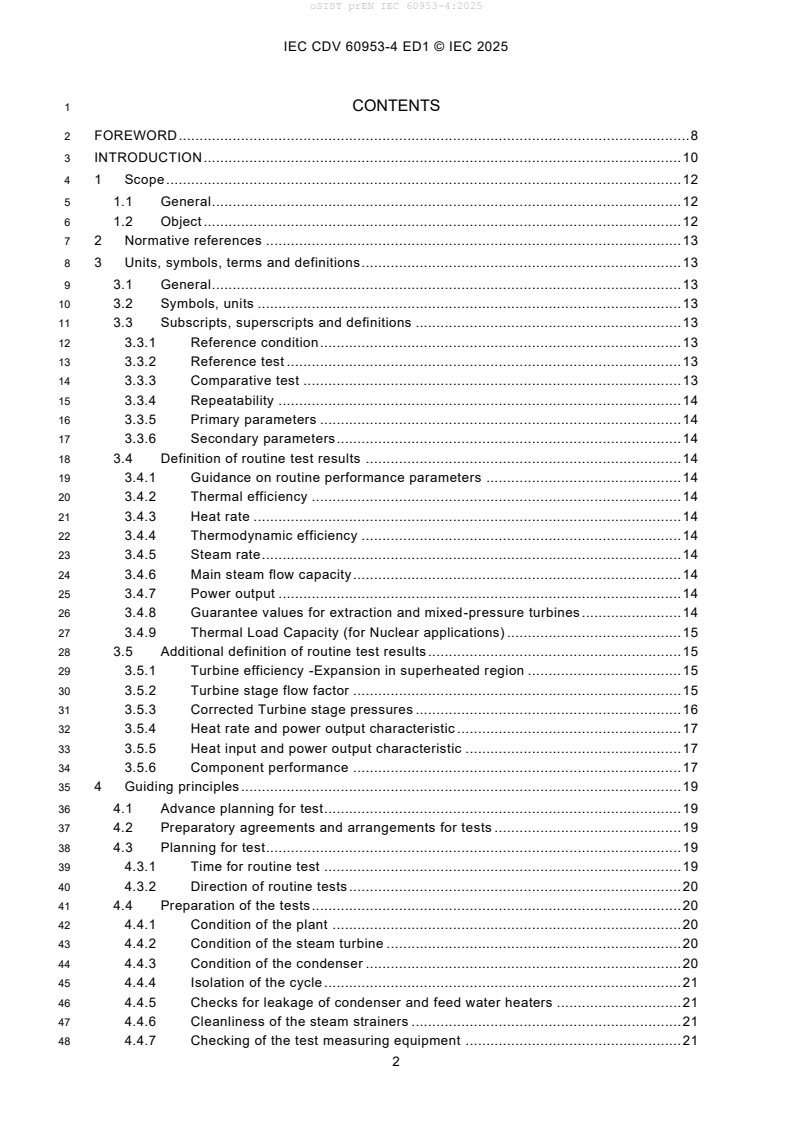
1 CONTENTS
2 FOREWORD . 8
3 INTRODUCTION . 10
4 1 Scope . 12
5 1.1 General . 12
6 1.2 Object . 12
7 2 Normative references . 13
8 3 Units, symbols, terms and definitions . 13
9 3.1 General . 13
10 3.2 Symbols, units . 13
11 3.3 Subscripts, superscripts and definitions . 13
12 3.3.1 Reference condition . 13
13 3.3.2 Reference test . 13
14 3.3.3 Comparative test . 13
15 3.3.4 Repeatability . 14
16 3.3.5 Primary parameters . 14
17 3.3.6 Secondary parameters . 14
18 3.4 Definition of routine test results . 14
19 3.4.1 Guidance on routine performance parameters . 14
20 3.4.2 Thermal efficiency . 14
21 3.4.3 Heat rate . 14
22 3.4.4 Thermodynamic efficiency . 14
23 3.4.5 Steam rate . 14
24 3.4.6 Main steam flow capacity . 14
25 3.4.7 Power output . 14
26 3.4.8 Guarantee values for extraction and mixed-pressure turbines . 14
27 3.4.9 Thermal Load Capacity (for Nuclear applications) . 15
28 3.5 Additional definition of routine test results . 15
29 3.5.1 Turbine efficiency -Expansion in superheated region . 15
30 3.5.2 Turbine stage flow factor . 15
31 3.5.3 Corrected Turbine stage pressures . 16
32 3.5.4 Heat rate and power output characteristic . 17
33 3.5.5 Heat input and power output characteristic . 17
34 3.5.6 Component performance . 17
35 4 Guiding principles . 19
36 4.1 Advance planning for test. 19
37 4.2 Preparatory agreements and arrangements for tests . 19
38 4.3 Planning for test. 19
39 4.3.1 Time for routine test . 19
40 4.3.2 Direction of routine tests . 20
41 4.4 Preparation of the tests . 20
42 4.4.1 Condition of the plant . 20
43 4.4.2 Condition of the steam turbine . 20
44 4.4.3 Condition of the condenser . 20
45 4.4.4 Isolation of the cycle . 21
46 4.4.5 Checks for leakage of condenser and feed water heaters . 21
47 4.4.6 Cleanliness of the steam strainers . 21
48 4.4.7 Checking of the test measuring equipment . 21
IEC CDV 60953-4 ED1 © IEC 2025
49 4.5 Comparison measurements . 21
50 4.6 Settings for tests . 22
51 4.6.1 Load settings . 22
52 4.6.2 Special settings . 22
53 4.7 Preliminary tests . 22
54 4.8 Acceptance tests . 22
55 4.8.1 Constancy of test conditions . 22
56 4.8.2 Maximum deviation and fluctuation in test conditions . 22
57 4.8.3 Duration of test runs and frequency of reading. 22
58 4.8.4 Reading of integrating measuring instruments . 22
59 4.8.5 Alternative methods . 22
60 4.8.6 Recording of tests . 22
61 4.8.7 Additional measurement . 22
62 4.8.8 Preliminary calculations . 22
63 4.8.9 Consistency and number of tests . 22
64 4.9 Repetition of Acceptance tests . 23
65 5 Measuring techniques and measuring instruments . 23
66 5.1 Overview . 23
67 5.1.1 Instrument accuracy requirements . 23
68 5.1.2 Measuring instruments . 23
69 5.1.3 Measuring uncertainty . 23
70 5.1.4 Calibration of instruments . 23
71 5.1.5 Alternative instrumentation . 23
72 5.1.6 Consistency of comparative test instruments . 23
73 5.1.7 Special considerations of permanently installed instrument . 24
74 5.2 Measurement of power. 25
75 5.2.1 Determination of mechanical turbine output . 25
76 5.2.2 Measurement of boiler feed pump power . 25
77 5.2.3 Determination of electrical power of a turbine generator . 25
78 5.2.4 Measurement of electrical power . 25
79 5.2.5 Electrical instrument connections. 25
80 5.2.6 Electrical instruments . 25
81 5.2.7 Instrument transformers . 25
82 5.3 Flow measurement . 25
83 5.3.1 Determination of flows to be measured . 25
84 5.3.2 Measurement of primary flow . 29
85 5.3.3 Installation and location of flow measuring devices . 29
86 5.3.4 Calibration of primary flow devices for water flow . 29
87 5.3.5 Inspection of flow measuring devices . 30
88 5.3.6 Differential pressure measurements . 30
89 5.3.7 Water flow fluctuation . 30
90 5.3.8 Secondary flow measurements . 30
91 5.3.9 Occasional secondary flows. 31
92 5.3.10 Density of water and steam . 31
93 5.3.11 Determination of cooling water flow of condenser . 31
94 5.4 Pressure measurement (excluding condensing turbine exhaust pressure) . 31
95 5.4.1 Pressures to be measured . 31
96 5.4.2 Instruments . 32
97 5.4.3 Main pressure measurements . 32
IEC CDV 60953-4 ED1 © IEC 2025
98 5.4.4 Pressure tapping holes and connecting lines . 32
99 5.4.5 Shut-off valves . 32
100 5.4.6 Calibration of pressure measuring devices . 32
101 5.4.7 Atmospheric pressure . 33
102 5.4.8 Correction of readings . 33
103 5.5 Condensing turbine exhaust pressure measurement . 33
104 5.5.1 General . 33
105 5.5.2 Plane of measurement . 33
106 5.5.3 Pressure taps . 33
107 5.5.4 Manifolds . 33
108 5.5.5 Connecting lines . 33
109 5.5.6 Instruments . 33
110 5.5.7 Calibration . 33
111 5.6 Temperature measurement . 34
112 5.6.1 Points of temperature measurement . 34
113 5.6.2 Instruments . 34
114 5.6.3 Main temperature measurements . 34
115 5.6.4 Feed train temperature measurements (including bled steam) . 34
116 5.6.5 Condenser cooling water temperature measurement . 34
117 5.6.6 Thermometer wells . 34
118 5.6.7 Precautions to be observed in the measurement of temperature . 34
119 5.7 Steam quality determination . 35
120 5.7.1 General . 35
121 5.7.2 Tracer technique . 35
122 5.7.3 Condensing method . 35
123 5.7.4 Constant rate injection method . 35
124 5.7.5 Extraction enthalpy determined by constant rate injection method . 35
125 5.7.6 Tracers and their use . 35
126 5.8 Time measurement . 35
127 5.9 Speed measurement . 36
128 6 Evaluation of tests . 36
129 6.1 Preparation of evaluation . 36
130 6.2 Computation of results . 36
131 6.2.1 Calculation of average values of instrument readings . 36
132 6.2.2 Correction and conversion of averaged readings . 36
133 6.2.3 Checking of measured data . 36
134 6.2.4 Thermodynamic properties of steam and water . 37
135 6.2.5 Calculation of test results . 37
136 7 Correction of test results and comparison with guarantee . 37
137 7.1 Guarantee values and guarantee conditions . 37
138 7.2 Correction of initial steam flow capacity . 37
139 7.3 Correction of output . 37
140 7.3.1 Correction of maximum output . 37
141 7.3.2 Correction of Output with specified initial steam flow . 37
142 7.4 Correction of the thermal performance . 37
143 7.5 Definition and application of correction values . 38
144 7.6 Correction methods . 38
145 7.6.1 General . 38
146 7.6.2 Correction by heat balance calculation . 38
IEC CDV 60953-4 ED1 © IEC 2025
147 7.6.3 Correction by use of correction curves prepared by the manufacturer . 38
148 7.6.4 Tests to determine correction values . 38
149 7.7 Variables to be considered in the correction of specific turbine cycles . 38
150 7.7.1 Scope of corrections . 38
151 7.7.2 Turbines with regenerative feed-water heating . 38
152 7.7.3 Turbines which have no provision for the addition or extraction of steam
153 after partial expansion . 39
154 7.7.4 Turbines with steam extraction for purposes other than feed-water
155 heating (extraction turbines) . 40
156 7.7.5 Other types of turbine . 40
157 7.8 Guarantee comparison . 40
158 7.8.1 Tolerance and weighting . 40
159 7.8.2 Guarantee comparison with locus curve . 40
160 7.8.3 Guarantee comparison with guarantee point . 40
161 7.8.4 Guarantee comparison for turbines with throttle governing . 40
162 7.8.5 Guarantee comparison for extraction turbines . 40
163 7.8.6 Additional consideration for routine test results comparison . 40
164 7.9 Deterioration of turbine performance (ageing) . 42
165 7.9.1 Timing to minimise deterioration . 42
166 7.9.2 Correction with comparison tests . 42
167 7.9.3 Correction without comparison tests . 42
168 8 Measuring uncertainty . 42
169 8.1 General . 42
170 8.2 Determination of measuring uncertainty of steam and water properties . 42
171 8.2.1 Pressure . 42
172 8.2.2 Temperature . 42
173 8.2.3 Enthalpy and enthalpy difference . 42
174 8.3 Calculation of measuring uncertainty of output . 42
175 8.3.1 Electrical measurement . 42
176 8.3.2 Mechanical measurement . 43
177 8.3.3 Additional uncertainty allowance because of unsteady load conditions . 43
178 8.4 Determination of measuring uncertainty of mass flow . 43
179 8.4.1 Measuring uncertainty of mass flow measurements . 43
180 8.4.2 Measuring uncertainty of multiple measurements of primary flow . 43
181 8.4.3 Uncertainty allowance for cycle imperfections . 43
182 8.5 Calculation of measuring uncertainty of results . 43
183 8.5.1 General . 43
184 8.5.2 Measuring uncertainty of thermal efficiency . 43
185 8.5.3 Measuring uncertainty of thermodynamic efficiency . 43
186 8.5.4 Uncertainty of corrections . 43
187 8.5.5 Guiding values for the measuring uncertainty of results . 43
188 8.5.6 Routine testing uncertainty . 43
189 8.6 Example uncertainty calculation . 43
190 Annex A (normative) Feedwater heater leakage and condenser leakage tests . 44
191 Annex B (normative) Evaluation of multiple measurements, compatibility . 45
192 Annex C (normative) Mass flow balances . 46
193 Annex D (informative) Short-statistical definition of measuring uncertainty and error
194 propagation in acceptance test . 47
195 Annex E (informative/normative) Temperature variation method . 48
IEC CDV 60953-4 ED1 © IEC 2025
196 Annex F (informative) Guidance on selection a type of routine test to be performed . 49
197 F.1 Routine monitoring . 49
198 F.1.1 Components performance (cylinder, Heater, Deaerator, Condenser,
199 Pump& feed Turbine, system leakage) . 49
200 F.1.2 Output monitoring . 49
201 F.1.3 Flow capacity monitoring . 49
202 F.1.4 Pressure and temperature profiles . 50
203 F.2 Periodical performance tests . 50
204 F.2.1 Maximum power test . 50
205 F.2.2 Steam rate test . 50
206 F.2.3 Thermal efficiency test (Heat rate) . 50
207 F.2.4 Cylinder isentropic efficiency test(Enthalpy drop test) . 50
208 F.2.5 Measurement of heat input to cycle . 51
209 F.2.6 Measurement of heat rejected from cycle. 51
210 Annex G (informative) Sensitivity factors for some component performance on overall
211 cycle performance . 52
212 G.1 Large reheat fossil cycle . 52
213 G.2 Small industrial back pressure turbine with extraction . 52
214 G.3 Combined cycle condensing turbine with injection . 53
215 Annex H (informative) Typical thermodynamic boundary and instrument layout for
216 routine tests . 54
217 H.1 Typical thermodynamic boundary and instrument layouts . 54
218 Annex I (informative) Calculation and analysis of test results – numerical example . 57
219 I.1 General . 57
220 I.2 Instrumentation . 58
221 I.3 Measuring points layout . 61
222 I.4 Conduct of the test. 61
223 I.5 Calculation and Interpretation of test results . 62
224 I.5.1 Corrections and main test results for turbine . 62
225 I.5.2 Heat Rate Diagnosis . 64
226 I.5.3 Flow capacity and power output . 65
227 I.5.4 HP/IP cylinder efficiency . 65
228 I.5.5 HP Heaters performance . 66
229 I.5.6 System leakage status . 67
230 Annex J (informative) Numerical example of uncertainty calculation –periodic routine
231 tests . 68
232 J.1 General . 68
233 J.2 Measurement uncertainty . 68
234 J.3 Uncertainty calculation results . 68
235 Annex K (informative) Typical reasons for deviations of steam turbine performance
236 from reference or design level . 72
237 Bibliography . 74
239 Figure 1 – Isentropic efficiency of cylinder . 15
240 Figure 2 – Diagram showing location and type of test instrumentation for a typical
241 periodical thermal efficiency test . 27
242 Figure 3 – Diagram showing location and type of test instrumentation for a typical
243 periodical thermal efficiency test(final feedwater flow as primary flow) . 28
244 Figure H.1 – Example 1 . 54
IEC CDV 60953-4 ED1 © IEC 2025
245 Figure H.2 – Example 2 . 55
246 Figure H.3 – Example 3 . 56
247 Figure H.4 – Example 3 . 56
248 Figure I.1 – Measuring points layout . 61
249 Figure I.2 – Corrected heat rate vs. power output relationship curve . 65
251 Table 1 – Apportionment of unaccounted leakages . 37
252 Table G.1 – Sensitivity of component performance on overall cycle performance for a
253 typical reheat fossil cycle . 52
254 Table G.2 – Sensitivity of components on overall cycle performance for a typical co-
255 generating unit . 52
256 Table G.3 – Sensitivity of components on overall cycle performance for a CCGT
257 turbine unit . 53
258 Table I.1 – Turbine technical specifications . 57
259 Table I.2 – Instrumentation list . 58
260 Table I.3 – Main test results of 350MW and VWO condition . 62
261 Table I.4 – Main test results of partial load conditions . 63
262 Table I.5 – Heat rate change due to boundary parameters (350MW, Post-outage test) . 64
263 Table I.6 – Heat rate change due to component performance (350MW, Post-outage
264 test) 64
265 Table I.7 – Heaters performance results . 66
266 Table J.1 – Assumed total measured variable uncertainty for pressure, temperature,
267 flow and generator output . 68
268 Table J.2 – The uncertainty result for Heat Rate difference of a fossil fired plant . 70
IEC CDV 60953-4 ED1 © IEC 2025
270 INTERNATIONAL ELECTROTECHNICAL COMMISSION
271 ____________
273 RULES FOR STEAM TURBINE THERMAL ACCEPTANCE TESTS –
274 Part4: Routine testing
276 FOREWORD
277 1) The International Electrotechnical Commission (IEC) is a worldwide organization for standardization comprising
278 all national electrotechnical committees (IEC National Committees). The object of IEC is to promote
279 international co-operation on all questions concerning standardization in the electrical and electronic fields. To
280 this end and in addition to other activities, IEC publishes International Standards, Technical Specifications,
281 Technical Reports, Publicly Available Specifications (PAS) and Guides (hereafter referred to as “IEC
282 Publication(s)”). Their preparation is entrusted to technical committees; any IEC National Committee interested
283 in the subject dealt with may participate in this preparatory work. International, governmental and non -
284 governmental organizations liaising with the IEC also participate in this preparation. IEC collaborates closely
285 with the International Organization for Standardization (ISO) in accordance with conditions determined by
286 agreement between the two organizations.
287 2) The formal decisions or agreements of IEC on technical matters express, as nearly as possible, an international
288 consensus of opinion on the relevant subjects since each technical committee has representation from all
289 interested IEC National Committees.
290 3) IEC Publications have the form of recommendations for international use and are accepted by IEC National
291 Committees in that sense. While all reasonable efforts are made to ensure that the technical content of IEC
292 Publications is accurate, IEC cannot be held responsible for the way in which they are used or for any
293 misinterpretation by any end user.
294 4) In order to promote international uniformity, IEC National Committees undertake to apply IEC Publications
295 transparently to the maximum extent possible in their national and regional publications. Any divergence
296 between any IEC Publication and the corresponding national or regional publication shall be clearly indicated in
297 the latter.
298 5) IEC itself does not provide any attestation of conformity. Independent certification bodies provide conformity
299 assessment services and, in some areas, access to IEC marks of conformity. IEC is not responsible for any
300 services carried out by independent certification bodies.
301 6) All users should ensure that they have the latest edition of this publication.
302 7) No liability shall attach to IEC or its directors, employees, servants or agents including individual experts and
303 members of its technical committees and IEC National Committees for any personal injury, property damage or
304 other damage of any nature whatsoever, whether direct or indirect, or for costs (including legal fees) and
305 expenses arising out of the publication, use of, or reliance upon, this IEC Publication or any other IEC
306 Publications.
307 8) Attention is drawn to the Normative references cited in this publication. Use of the referenced publications is
308 indispensable for the correct application of this publication.
309 9) Attention is drawn to the possibility that some of the elements of this IEC Publication may be the subject of
310 patent rights. IEC shall not be held responsible for identifying any or all such patent rights.
311 IEC 60953-4 has been prepared by subcommittee WG11/PT60953-4: Thermal Acceptance Test, of IEC technical
312 committee 5: Steam Turbines.
313 The text of this International Standard is based on the following documents:
Draft Report on voting
5/XX/FDIS 5/XX/RVD
315 Full information on the voting for its approval can be found in the report on voting indicated in the above table.
316 The language used for the development of this International Standard is English.
317 A list of all parts in the IEC 60953 series, published under the general title Rules for steam turbine thermal
318 acceptance tests, can be found on the IEC website.
319 This document was drafted in accordance with ISO/IEC Directives, Part 2, and developed in accordance with
320 ISO/IEC Directives, Part 1 and ISO/IEC Directives, IEC Supplement, available at
321 www.iec.ch/members_experts/refdocs. The main document types developed by IEC are described in greater detail
322 at www.iec.ch/standardsdev/publications.
IEC CDV 60953-4 ED1 © IEC 2025
323 The committee has decided that the contents of this document will remain unchanged until the stability date
324 indicated on the IEC website under webstore.iec.ch in the data related to the specific document. At this date, the
325 document will be
326 • reconfirmed,
327 • withdrawn,
328 • replaced by a revised edition, or
329 • amended.
IEC CDV 60953-4 ED1 © IEC 2025
331 INTRODUCTION
332 Routine test in an existing power plant mainly involves an analysis, monitoring and
333 supervision of steam turbine performance. IEC 60953-0, which defines the rules for steam
334 turbine thermal acceptance tests in power plants, does not cater for all the requirements
335 specific to routine test. It was considered necessary to draw up a Supplementary Standard
336 (this document) for guidance on the routine tests of existing steam turbines.
337 However, a large number of the provisions and recommendations of IEC 60953 -0 are still
338 applicable to routine tests and, therefore, in order to avoid a repetitive and bulky document,
339 only the routine-specific addenda will be found in this document.
340 This part of IEC 60953-4 shall be read in conjunction with IEC 60953-0, and the words
341 ‘routine test’ should be read in place of ‘acceptance test’, the words‘ reference conditions’
342 should be read in place of ‘guarantee conditions’, the words ‘reference value’ should be read
343 in place of‘guarantee value’ as well.
344 Although this document is intended to apply to the routine test of large condensing steam
345 turbines, it can nevertheless be used for other types and sizes of turbines to define the basis
346 of a specific procedure to be agreed upon by the parties involved.
347 The purpose of this document is to cover the existing steam turbine components which
348 influence the efficiency of the power plant. This document helps the parties determine the
349 most appropriate parameters that characterise the relative performance change and that
350 could be used as long-term performance monitoring and analysis.
351 The accuracy of the routine test can approach that obtained while following IEC 60953-0, but
352 generally the simplified test results will yield less information about the plant and give less
353 assurance of accuracy. The relative performance rather than absolute value is emphasized in
354 this document. The repeatability of test result rather than test uncertainty is emphasized here
355 as well. In addition depending on the type of test and thermodynamic boundary chosen, the
356 full condition of each component might not be known. In some case, as per the result of
357 routine test, full or further diagnostic test maybe needed.
358 For reference purposes only, a numerical sample calculation and analysis of a fossil steam
359 turbine unit is presented in Annex I
360 The structure and clause numbering of this document follow that of IEC 60953-0. Subclauses
361 found in this document supersede the whole of the equivalent subclause in IEC 60953 -0.
362 Subclause numbering has been extended whenever new items have been included.
363 The main differences between this document and the IEC 60953-0 are listed below.
364 Clause 1: Scope
365 This document gives additional clauses for routine test of steam turbine, regarding the
366 analysis and supervision of relative performance by routine testing.
367 General principles and the determination of the measurement uncertainty of periodic routine
368 tests are given.
369 The purpose of this document is to provide simple and economic test procedures guider for
370 long-term and relative performance of the turbine and turbine cycles.
371 Specific simplified testing procedure is allowed, which results in less accuracy for absolute
372 values and wider uncertainty range. The accuracy for the results of performance changes is
373 sufficient for the purpose of the test.
IEC CDV 60953-4 ED1 © IEC 2025
374 Clause 2: Normative references
375 IEC 60953-0 and IEC 60953-3 were added as reference.
376 Clause 3: Units symbols, terms and definitions
377 The definitions given in IEC 60953-0 applies to this document. Some new definitions involved
378 features of routine testing were added.
379 Clause 4: Guidance principles
380 The majority of the guiding principles contained in the IEC 60953-0 are also applicable to the
381 routine testing. This document gives further guidelines on the planning, timing, leadership of
382 the tests, the setting of the test and cycle isolation, and allowable test conditions.
383 Clause 4: Measuring techniques and measuring instruments
384 According to the purpose and scope of routine test, the specific requirements of the
385 consistency of the test instruments, the calibration of the instruments and the usage of
386 permanently installed instruments are given.
387 Clause 6: Evaluation of tests
388 This document gives further advice on allowable cycle leakages.
389 Clause 7: Correction of test results and comparison
390 Additional considerations for routine test results comparison including performance
391 parameters trending and heat rate diagnosis are given.
392 Clause 8: Measuring uncertainty
393 This clause of IEC 60953-0 is supplemented by provisions for special cases encountered in
394 routine testing in Annex J. The examples can be used as reference basis.
395 Annexes:
396 Annexes A to E of IEC 60953-0:20222022 applies.
397 Six new annexes were added to the existing ones.
398 Annex F Guidance on selection a type of routine test to be performed.
399 Annex G: Sensitivity factors for some component performance on overall cycle efficiency
400 Annex H: Typical thermodynamic boundary and instrument layout for routine tests
401 Annex I: Calculation and analysis of test results – numerical example
402 Annex J: Numerical examples of uncertainty calculation – periodic comparative test
403 Annex K: Typical reaso
...
Questions, Comments and Discussion
Ask us and Technical Secretary will try to provide an answer. You can facilitate discussion about the standard in here.
Loading comments...