

SIST EN 2367:2001
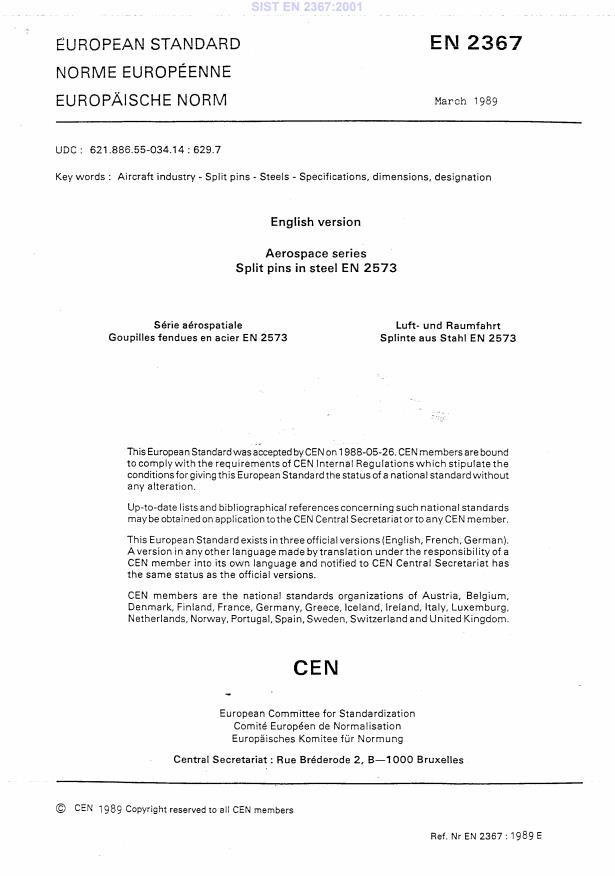
(Main)Aerospace series - Split pins in steel EN 2573
General Information
- Abstract
This standard specifies the characteristics of steel EN 2573 split pins passivated, for use in aerospace applications at a maximum temperature of 600 °C.
- Status
- Published
- Publication Date
- 31-Dec-2000
- Technical Committee
- SS SPL - Technical Board for the general field
- Current Stage
- 6060 - National Implementation/Publication (Adopted Project)
- Start Date
- 01-Jan-2001
- Due Date
- 01-Jan-2001
- Completion Date
- 01-Jan-2001

Overview
SIST EN 2367:2001 is a European standard developed by CEN, titled "Aerospace series - Split pins in steel EN 2573". This standard defines the specifications for steel split pins made according to EN 2573, which are specifically passivated for aerospace applications. The standard ensures these components meet strict requirements for mechanical performance and corrosion resistance at elevated temperatures, with a maximum operating temperature of 600 °C. Split pins covered by this standard are essential fastening elements used to secure assemblies in aerospace engineering, where reliability and safety are critical.
Key Topics
Material Specification
The split pins must be manufactured from steel conforming to EN 2573, ensuring uniformity in chemical composition and mechanical properties suitable for aerospace use.Passivation Process
Passivation treatment is required to enhance corrosion resistance, crucial for aerospace environments where exposure to moisture and temperature variations occur.Temperature Limitation
SIST EN 2367:2001 specifies these split pins are fit for use up to maximum temperatures of 600 °C, ensuring dimensional stability and performance under thermal stress.Dimensional and Mechanical Requirements
The standard enforces strict adherence to dimensional tolerances, tensile strength, and flexibility, guaranteeing the split pins perform reliably as locking devices in aircraft components.Quality Assurance
Compliance with this standard helps manufacturers and users maintain high-quality manufacturing practices and consistent product reliability in aerospace assemblies.
Applications
Aerospace Fastening Solutions
EN 2367 steel split pins are primarily used in securing clevis pins, shafts, and other fasteners in aircraft assemblies. Their design ensures that joints remain secure despite vibration and mechanical stress conditions common in aviation.High-Temperature Aerospace Systems
Due to their ability to withstand temperatures up to 600 °C, these split pins are suitable for components exposed to engine environments, exhaust systems, and other areas experiencing elevated heat.Safety-Critical Mechanical Assemblies
The pins are widely applied in mechanical systems where safety is paramount, such as landing gear, flight control mechanisms, and structural attachments in aerospace vehicles.
Related Standards
EN 2573
Defines the steel material requirements for the split pins covered under EN 2367.Other Aerospace Fastening Standards
CEN issues several standards related to aerospace fasteners, including those for bolts, nuts, and washers, that complement the use of EN 2367 split pins.Corrosion Protection Standards
Relevant standards addressing passivation and protective coatings ensure compatibility with EN 2367 requirements for corrosion resistance.
Practical Value
Adoption of SIST EN 2367:2001 ensures aerospace manufacturers and maintenance providers use split pins that meet stringent performance criteria, significantly reducing the risk of fastening failures. This standard offers a trusted reference for designing, selecting, and verifying split pins intended for critical aerospace applications where mechanical integrity and temperature resilience are mandatory.
By adhering to EN 2367, companies can improve product safety, maintain regulatory compliance, and enhance overall reliability of aerospace hardware.
Relations
- Effective Date
- 28-Jan-2026
- Effective Date
- 28-Jan-2026
- Effective Date
- 28-Jan-2026
- Effective Date
- 28-Jan-2026
- Effective Date
- 28-Jan-2026
- Effective Date
- 28-Jan-2026
Get Certified
Connect with accredited certification bodies for this standard

BUREAU VERITAS Certification Germany
Bureau Veritas certification in Germany.

Element Materials Technology
Materials testing and product certification.

AQMS Ltd.
AQMS provides ISO certification to SMEs across the UK.
Sponsored listings
Frequently Asked Questions
SIST EN 2367:2001 is a standard published by the Slovenian Institute for Standardization (SIST). Its full title is "Aerospace series - Split pins in steel EN 2573". This standard covers: This standard specifies the characteristics of steel EN 2573 split pins passivated, for use in aerospace applications at a maximum temperature of 600 °C.
This standard specifies the characteristics of steel EN 2573 split pins passivated, for use in aerospace applications at a maximum temperature of 600 °C.
SIST EN 2367:2001 is classified under the following ICS (International Classification for Standards) categories: 49.030.40 - Pins, nails. The ICS classification helps identify the subject area and facilitates finding related standards.
SIST EN 2367:2001 has the following relationships with other standards: It is inter standard links to SIST EN 2811:2017, SIST EN 2810:2002, SIST EN 3230:2002, SIST EN 2809:2002, SIST EN 2868:2019, SIST EN 3434:2023. Understanding these relationships helps ensure you are using the most current and applicable version of the standard.
SIST EN 2367:2001 is available in PDF format for immediate download after purchase. The document can be added to your cart and obtained through the secure checkout process. Digital delivery ensures instant access to the complete standard document.
Standards Content (Sample)
2003-01.Slovenski inštitut za standardizacijo. Razmnoževanje celote ali delov tega standarda ni dovoljeno.Aerospace series - Split pins in steel EN 2573Luft- und Raumfahrt - Splinte aus Stahl EN 2573Série aérospatiale - Goupilles fendues en acier EN 2573Aerospace series - Split pins in steel EN 257349.
...