

SIST EN 2267-011:2024
(Main)Aerospace series - Cables, electrical, for general purpose - Operating temperatures between -65 °C and 260 °C - Part 011: DZA family, single and multicore assembly for use in low pressure atmosphere - Product standard
General Information
- Abstract
This document specifies the characteristics of electrical wires DZA family for use in the on board:
- 115 VAC (phase to neutral) or 200 VAC (phase to phase) electrical network of aircraft;
- 230 VAC (phase to neutral) or 400 VAC (phase to phase) electrical network of aircraft and particularly use in non-pressurized areas.
This cable family is used at operating temperature between -65 °C and 260 °C. These cables are demonstrated to be arc resistant for both networks (115 VAC and 230 VAC).
- Status
- Published
- Public Enquiry End Date
- 14-Sep-2022
- Publication Date
- 15-Jan-2024
- Technical Committee
- I13 - Imaginarni 13
- Current Stage
- 6060 - National Implementation/Publication (Adopted Project)
- Start Date
- 03-Jan-2024
- Due Date
- 09-Mar-2024
- Completion Date
- 16-Jan-2024

Overview
EN 2267-011:2023 is a CEN product standard in the Aerospace series that defines the characteristics and tests for the DZA family of single- and multi‑core electrical cables intended for use in low pressure atmosphere on board aircraft. The standard covers cables rated for aircraft electrical networks (115/200 VAC and 230/400 VAC) with an operating temperature range from −65 °C to 260 °C and specifies that these cables are arc resistant for both 115 VAC and 230 VAC networks. EN 2267-011:2023 was approved July 2023 and supersedes the 2015 edition.
Key topics and technical requirements
- Scope & application: Cables for onboard aircraft electrical networks, particularly in non‑pressurized areas and low pressure atmospheres.
- Materials & construction:
- Conductors: copper or copper alloy, nickel plated (code D) per EN 4434:2005.
- Insulation: foamed insulation is forbidden; insulation design must minimise internal cavities (gas traps) to reduce partial discharge.
- Lightweight variants identified by an “L” section code with specified diameters and masses.
- Temperature & performance:
- Operating temperatures: −65 °C to 260 °C.
- Thermal endurance: demonstrated via long‑term tests (e.g., 10 000 h at 260 °C; equivalent curve extrapolation to 100 000 h at 200 °C).
- Electrical & safety tests (selected):
- Voltage proof tests: immersion and dry spark at 2.5 kV RMS; dry impulse at 4.0 kV RMS.
- Partial discharge / corona: Method B at 45 000 ft (145 mbar) and 150 °C with PDIV ≥ 566 V RMS (800 V peak) and PDEV ≥ 509 V RMS (720 V peak).
- Flammability: extinguishing time ≤ 3 s.
- Mechanical and environmental tests per EN 3475 series (bending, cold bend, ageing, humidity, resistance to fluids, etc.).
- Quality, marking & designation: requirements for QA, identification, type coding, packaging and delivery lengths are included (Clauses 6–9).
Applications
- Wiring harnesses and power distribution in aircraft electrical systems (115/200 VAC and 230/400 VAC networks).
- Areas subject to low ambient pressure (non‑pressurized zones, high‑altitude sections) where arc resistance and partial discharge control are critical.
- Use cases requiring high temperature resistance (engine bay proximity, environmental exposure up to 260 °C).
Who should use this standard
- Aerospace cable manufacturers and suppliers
- Aircraft electrical/harness designers and systems engineers
- Quality assurance and test laboratories performing EN 3475 series tests
- Procurement teams and certification bodies verifying compliance for installation in non‑pressurized/low pressure aircraft zones
Related standards
- EN 2267-002 (general requirements for the EN 2267 series)
- EN 2084 (general cable technical specification)
- EN 2235 (single and multicore screened/jacketed cable specs)
- EN 4434 (conductors)
- EN 3475 series (aircraft cable test methods)
Keywords: EN 2267-011:2023, aerospace cables, DZA family, low pressure atmosphere, arc resistant, −65 °C to 260 °C, aircraft electrical networks.
Relations
- Effective Date
- 28-Jan-2026
- Effective Date
- 28-Jan-2026
- Effective Date
- 28-Jan-2026
- Effective Date
- 28-Jan-2026
- Effective Date
- 28-Jan-2026
- Effective Date
- 28-Jan-2026
- Effective Date
- 28-Jan-2026
- Effective Date
- 28-Jan-2026
- Effective Date
- 28-Jan-2026
- Effective Date
- 28-Jan-2026
- Effective Date
- 28-Jan-2026
- Effective Date
- 28-Jan-2026
- Effective Date
- 28-Jan-2026
- Effective Date
- 28-Jan-2026
- Effective Date
- 28-Jan-2026
Get Certified
Connect with accredited certification bodies for this standard

BUREAU VERITAS Certification Germany
Bureau Veritas certification in Germany.

Element Materials Technology
Materials testing and product certification.

IMQ S.p.A. (Certification)
Italian electrical product certification.
Sponsored listings
Frequently Asked Questions
SIST EN 2267-011:2024 is a standard published by the Slovenian Institute for Standardization (SIST). Its full title is "Aerospace series - Cables, electrical, for general purpose - Operating temperatures between -65 °C and 260 °C - Part 011: DZA family, single and multicore assembly for use in low pressure atmosphere - Product standard". This standard covers: This document specifies the characteristics of electrical wires DZA family for use in the on board: - 115 VAC (phase to neutral) or 200 VAC (phase to phase) electrical network of aircraft; - 230 VAC (phase to neutral) or 400 VAC (phase to phase) electrical network of aircraft and particularly use in non-pressurized areas. This cable family is used at operating temperature between -65 °C and 260 °C. These cables are demonstrated to be arc resistant for both networks (115 VAC and 230 VAC).
This document specifies the characteristics of electrical wires DZA family for use in the on board: - 115 VAC (phase to neutral) or 200 VAC (phase to phase) electrical network of aircraft; - 230 VAC (phase to neutral) or 400 VAC (phase to phase) electrical network of aircraft and particularly use in non-pressurized areas. This cable family is used at operating temperature between -65 °C and 260 °C. These cables are demonstrated to be arc resistant for both networks (115 VAC and 230 VAC).
SIST EN 2267-011:2024 is classified under the following ICS (International Classification for Standards) categories: 29.060.20 - Cables; 49.060 - Aerospace electric equipment and systems. The ICS classification helps identify the subject area and facilitates finding related standards.
SIST EN 2267-011:2024 has the following relationships with other standards: It is inter standard links to SIST EN 3475-411:2018, SIST EN 3475-402:2004, SIST EN 3475-304:2004, SIST EN 3475-503:2004, SIST EN 3475-201:2004, SIST EN 3475-303:2004, SIST EN 3475-404:2025, SIST EN 3475-601:2007, SIST EN 3475-507:2007, SIST EN 3475-502:2004, SIST EN 3475-306:2006, SIST EN 3475-703:2004, SIST EN 3475-602:2007, SIST EN 3475-505:2023, SIST EN 3475-100:2010. Understanding these relationships helps ensure you are using the most current and applicable version of the standard.
SIST EN 2267-011:2024 is available in PDF format for immediate download after purchase. The document can be added to your cart and obtained through the secure checkout process. Digital delivery ensures instant access to the complete standard document.
Standards Content (Sample)
SLOVENSKI STANDARD
01-februar-2024
Aeronavtika - Električni kabli za splošno uporabo - Delovne temperature med –55
°C in 260 °C - 011. del: Družina DZA, enožilni in večžilni, za uporabo v nizkotlačni
atmosferi - Standard za proizvod
Aerospace series - Cables, electrical, for general purpose - Operating temperatures
between -65 °C and 260 °C - Part 011: DZA family, single and multicore assembly for
use in low pressure atmosphere - Product standard
Luft- und Raumfahrt - Leitungen, elektrisch, für allgemeine Verwendung -
Betriebstemperaturen zwischen -65 °C und 260 °C - Teil 011: DZA-Familie, ein- und
mehradrige Leitungen zur Anwendung bei niedrigem Luftdruck - Produktnorm
Série aérospatiale - Câbles, électriques, d'usage général - Températures de
fonctionnement comprises entre -65 °C et 260 °C - Partie 011 : Famille DZA, fil simple et
éléments assemblés pour emploi en basse pression - Norme de produit
Ta slovenski standard je istoveten z: EN 2267-011:2023
ICS:
29.060.20 Kabli Cables
49.060 Letalska in vesoljska Aerospace electric
električna oprema in sistemi equipment and systems
2003-01.Slovenski inštitut za standardizacijo. Razmnoževanje celote ali delov tega standarda ni dovoljeno.
EN 2267-011
EUROPEAN STANDARD
NORME EUROPÉENNE
December 2023
EUROPÄISCHE NORM
ICS 49.060 Supersedes EN 2267-011:2015
English Version
Aerospace series - Cables, electrical, for general purpose -
Operating temperatures between -65 °C and 260 °C - Part
011: DZA family, single and multicore assembly for use in
low pressure atmosphere - Product standard
Série aérospatiale - Câbles, électriques, d'usage général Luft- und Raumfahrt - Leitungen, elektrisch, für
- Températures de fonctionnement comprises entre - allgemeine Verwendung - Betriebstemperaturen
65 °C et 260 °C - Partie 011 : Famille DZA, fil simple et zwischen -65 °C und 260 °C - Teil 011: DZA-Familie,
éléments assemblés pour emploi en basse pression - ein- und mehradrige Leitungen zur Anwendung bei
Norme de produit niedrigem Luftdruck - Produktnorm
This European Standard was approved by CEN on 16 July 2023.
CEN members are bound to comply with the CEN/CENELEC Internal Regulations which stipulate the conditions for giving this
European Standard the status of a national standard without any alteration. Up-to-date lists and bibliographical references
concerning such national standards may be obtained on application to the CEN-CENELEC Management Centre or to any CEN
member.
This European Standard exists in three official versions (English, French, German). A version in any other language made by
translation under the responsibility of a CEN member into its own language and notified to the CEN-CENELEC Management
Centre has the same status as the official versions.
CEN members are the national standards bodies of Austria, Belgium, Bulgaria, Croatia, Cyprus, Czech Republic, Denmark, Estonia,
Finland, France, Germany, Greece, Hungary, Iceland, Ireland, Italy, Latvia, Lithuania, Luxembourg, Malta, Netherlands, Norway,
Poland, Portugal, Republic of North Macedonia, Romania, Serbia, Slovakia, Slovenia, Spain, Sweden, Switzerland, Türkiye and
United Kingdom.
EUROPEAN COMMITTEE FOR STANDARDIZATION
COMITÉ EUROPÉEN DE NORMALISATION
EUROPÄISCHES KOMITEE FÜR NORMUNG
CEN-CENELEC Management Centre: Rue de la Science 23, B-1040 Brussels
© 2023 CEN All rights of exploitation in any form and by any means reserved Ref. No. EN 2267-011:2023 E
worldwide for CEN national Members.
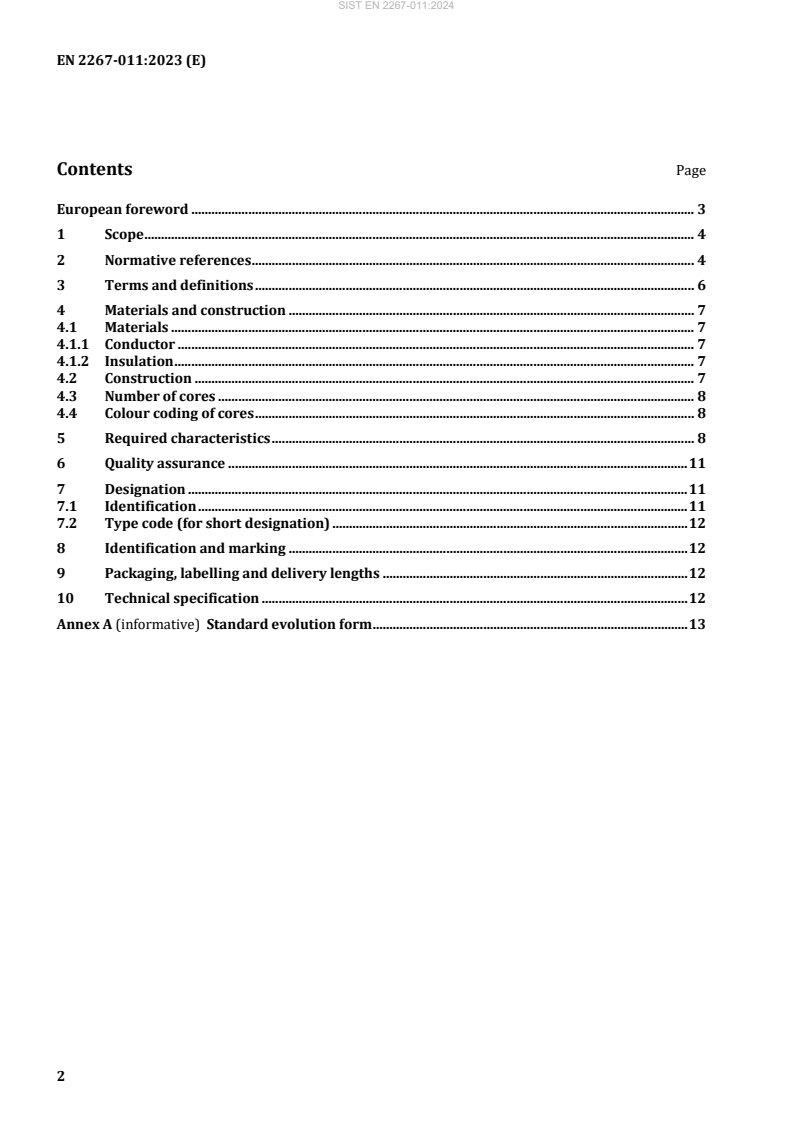
Contents Page
European foreword . 3
1 Scope . 4
2 Normative references . 4
3 Terms and definitions . 6
4 Materials and construction . 7
4.1 Materials . 7
4.1.1 Conductor . 7
4.1.2 Insulation . 7
4.2 Construction . 7
4.3 Number of cores . 8
4.4 Colour coding of cores . 8
5 Required characteristics . 8
6 Quality assurance . 11
7 Designation . 11
7.1 Identification . 11
7.2 Type code (for short designation) . 12
8 Identification and marking . 12
9 Packaging, labelling and delivery lengths . 12
10 Technical specification . 12
Annex A (informative) Standard evolution form . 13
European foreword
This document (EN 2267-011:2023) has been prepared by the Aerospace and Defence Industries
Association of Europe — Standardization (ASD-STAN).
After enquiries and votes carried out in accordance with the rules of this Association, this
document has received the approval of the National Associations and the Official Services of the
member countries of ASD-STAN, prior to its presentation to CEN.
This document shall be given the status of a national standard, either by publication of an identical
text or by endorsement, at the latest by June 2024, and conflicting national standards shall be
withdrawn at the latest by June 2024.
Attention is drawn to the possibility that some of the elements of this document may be the subject
of patent rights. CEN shall not be held responsible for identifying any or all such patent rights.
This document supersedes EN 2267-011:2015.
According to the CEN-CENELEC Internal Regulations, the national standards organizations of the
following countries are bound to implement this document: Austria, Belgium, Bulgaria, Croatia,
Cyprus, Czech Republic, Denmark, Estonia, Finland, France, Germany, Greece, Hungary, Iceland,
Ireland, Italy, Latvia, Lithuania, Luxembourg, Malta, Netherlands, Norway, Poland, Portugal,
Republic of North Macedonia, Romania, Serbia, Slovakia, Slovenia, Spain, Sweden, Switzerland,
Türkiye and the United Kingdom.
1 Scope
This document specifies the characteristics of electrical wires DZA family for use in the on board:
— 115 VAC (phase to neutral) or 200 VAC (phase to phase) electrical network of aircraft;
— 230 VAC (phase to neutral) or 400 VAC (phase to phase) electrical network of aircraft and
particularly use in non-pressurized areas.
This cable family is used at operating temperature between -65 °C and 260 °C. These cables are
demonstrated to be arc resistant for both networks (115 VAC and 230 VAC).
2 Normative references
The following documents are referred to in the text in such a way that some or all of their content
constitutes requirements of this document. For dated references, only the edition cited applies. For
undated references, the latest edition of the referenced document (including any amendments) applies.
EN 2084:2018, Aerospace series — Cables, electrical, general purpose, with conductors in copper or
copper alloy — Technical specification
EN 2235:2015, Aerospace series — Single and multicore electrical cables, screened and jacketed —
Technical specification
EN 2267-002, Aerospace series — Cables, electrical, for general purpose — Operating temperatures
between -55 °C and 260 °C — Part 002: General
EN 3475-100:2010, Aerospace series — Cables, electrical, aircraft use — Test methods — Part 100:
General
EN 3475-201, Aerospace series — Cables, electrical, aircraft use — Test methods — Part 201: Visual
examination
EN 3475-202, Aerospace series — Cables, electrical, aircraft use — Test methods — Part 202: Mass
EN 3475-203, Aerospace series — Cables, electrical, aircraft use — Test methods — Part 203: Dimensions
EN 3475-301, Aerospace series — Cables, electrical, aircraft use — Test methods — Part 301: Ohmic
resistance per unit length
EN 3475-302, Aerospace series — Cable, electrical, aircraft use — Test methods — Part 302: Voltage
proof test
EN 3475-303, Aerospace series — Cables, electrical, aircraft use — Test methods — Part 303: Insulation
resistance
EN 3475-304, Aerospace series — Cables, electrical, aircraft use — Test methods — Part 304: Surface
resistance
EN 3475-305, Aerospace series — Cables, electrical, aircraft use — Test methods — Part 305: Overload
resistance
EN 3475-306, Aerospace series — Cables, electrical, aircraft use — Test methods — Part 306: Continuity
of conductors
EN 3475-307, Aerospace series — Cables, electrical, aircraft use — Test methods — Part 307: Corona
extinction voltage
EN 3475-401, Aerospace series — Cables, electrical, aircraft use — Test Methods — Part 401: Accelerated
ageing
EN 3475-402, Aerospace series — Cables, electrical, aircraft use — Test methods — Part 402: Shrinkage
and delamination
EN 3475-403, Aerospace series — Cables, electrical, aircraft use — Test methods — Part 403:
Delamination and blocking
EN 3475-404, Aerospace series — Cables, electrical, aircraft use — Test methods — Part 404: Thermal
sho
...