


oSIST prEN IEC 61010-2-020:2020
(Main)Safety requirements for electrical equipment for measurement, control, and laboratory use - Part 2-020: Particular requirements for laboratory centrifuges
Safety requirements for electrical equipment for measurement, control, and laboratory use - Part 2-020: Particular requirements for laboratory centrifuges
2019-12-20 HAS Consultants advised that the standard should be harmonised with the Machinery Directive.
Sicherheitsbestimmungen für elektrische Mess-, Steuer-, Regel- und Laborgeräte – Teil 2-020: Besondere Anforderungen an Laborzentrifugen
Règles de sécurité pour appareils électriques de mesurage, de régulation et de laboratoire - Partie 2-020: Exigences particulières pour centrifugeuses de laboratoire
Varnostne zahteve za električno opremo za meritve, nadzor in laboratorijsko uporabo - 2-020. del: Posebne zahteve za laboratorijske centrifuge
General Information
- Status
- Not Published
- Public Enquiry End Date
- 30-Mar-2020
- Technical Committee
- MOV - Measuring equipment for electromagnetic quantities
- Current Stage
- 4020 - Public enquire (PE) (Adopted Project)
- Start Date
- 16-Jan-2020
- Due Date
- 04-Jun-2020
- Completion Date
- 03-Apr-2020
Relations
- Effective Date
- 26-Mar-2019
Overview
prEN IEC 61010-2-020:2020 specifies safety requirements for electrically powered laboratory centrifuges as a Part 2 standard in the IEC 61010 series (Electrical equipment for measurement, control and laboratory use). This fourth-edition draft aligns the particular requirements for laboratory centrifuges with IEC 61010-1 (third edition + Amendment 1:2016). HAS Consultants advised that the standard should be harmonised with the Machinery Directive. The document complements and modifies Part 1 where necessary and includes new terms, definitions and annexes addressing rotor disruption, bioseals and rotor kinetic energy testing.
Key topics and technical requirements
- Scope and applicability
- Applies to electrically powered laboratory centrifuges (not retroactive to units manufactured before publication).
- Exclusions include areas covered by IEC 60034 (rotating electrical machinery) where relevant.
- Definitions introduced
- LABORATORY CENTRIFUGE, ROTOR, ROTOR ASSEMBLY, BIOSEAL, DISRUPTION, MCA (Maximum Credible Accident), CLEARANCE ENVELOPE, etc.
- Environmental conditions
- Normal ambient temperature range specified: 2 °C to 40 °C (extended conditions defined separately).
- Marking and documentation
- Mandatory identification (serial number or batch), mains-supply notes, and specific marking/packaging requirements for operator-replaceable rotors and accessories.
- Safety and protection clauses
- Protection against electric shock, mechanical hazards (including contact with moving parts and movement during disruption), shock and impact resistance, fire spread, temperature limits, fluid hazards, radiation and ultrasonic pressures, liberated gases/substances, interlocks and component requirements.
- Testing and risk assessment
- Clause 4 (Tests) applies; annexes provide test methods such as a dynamic microbiological test for BIOSEALS (Annex AA) and an empirical method to determine rotor kinetic energy (Annex CC). MCA-based testing is used to evaluate worst-case mechanical safety.
Applications and who uses it
- Manufacturers and designers of laboratory centrifuges for product safety, design validation and CE marking.
- Compliance and regulatory engineers, notified bodies and test laboratories performing conformity assessment against IEC 61010 series and Machinery Directive alignment.
- Laboratory managers and procurement teams specifying safe centrifuge equipment and ensuring correct documentation, marking and operator-replaceable-rotor traceability.
- Risk assessors and safety officers applying the standard’s requirements to lab installations and procedures.
Related standards and references
- IEC 61010-1 (general requirements) - to be used in conjunction with this Part 2-020.
- IEC 60034 (rotating electrical machinery) - referenced for exclusions.
- ISO 3864 (graphical symbols – safety colours and signs) included as a normative reference.
- Annexes BB and CC provide guidance and rationale for testing and rotor energy evaluation.
Keywords: IEC 61010-2-020, laboratory centrifuges standard, centrifuge safety, rotor disruption, bioseals, electrical equipment for laboratory use, risk assessment.


Frequently Asked Questions
oSIST prEN IEC 61010-2-020:2020 is a draft published by the Slovenian Institute for Standardization (SIST). Its full title is "Safety requirements for electrical equipment for measurement, control, and laboratory use - Part 2-020: Particular requirements for laboratory centrifuges". This standard covers: 2019-12-20 HAS Consultants advised that the standard should be harmonised with the Machinery Directive.
2019-12-20 HAS Consultants advised that the standard should be harmonised with the Machinery Directive.
oSIST prEN IEC 61010-2-020:2020 is classified under the following ICS (International Classification for Standards) categories: 19.080 - Electrical and electronic testing; 71.040.10 - Chemical laboratories. Laboratory equipment. The ICS classification helps identify the subject area and facilitates finding related standards.
oSIST prEN IEC 61010-2-020:2020 has the following relationships with other standards: It is inter standard links to SIST EN 61010-2-020:2017. Understanding these relationships helps ensure you are using the most current and applicable version of the standard.
oSIST prEN IEC 61010-2-020:2020 is associated with the following European legislation: EU Directives/Regulations: 2006/42/EC, 2014/35/EU; Standardization Mandates: M/396, M/511. When a standard is cited in the Official Journal of the European Union, products manufactured in conformity with it benefit from a presumption of conformity with the essential requirements of the corresponding EU directive or regulation.
oSIST prEN IEC 61010-2-020:2020 is available in PDF format for immediate download after purchase. The document can be added to your cart and obtained through the secure checkout process. Digital delivery ensures instant access to the complete standard document.
Standards Content (Sample)
SLOVENSKI STANDARD
01-marec-2020
Varnostne zahteve za električno opremo za meritve, nadzor in laboratorijsko
uporabo - 2-020. del: Posebne zahteve za laboratorijske centrifuge
Safety requirements for electrical equipment for measurement, control, and laboratory
use - Part 2-020: Particular requirements for laboratory centrifuges
Règles de sécurité pour appareils électriques de mesurage, de régulation et de
laboratoire - Partie 2-020: Exigences particulières pour centrifugeuses de laboratoire
Ta slovenski standard je istoveten z: prEN IEC 61010-2-020:2020
ICS:
19.080 Električno in elektronsko Electrical and electronic
preskušanje testing
71.040.10 Kemijski laboratoriji. Chemical laboratories.
Laboratorijska oprema Laboratory equipment
2003-01.Slovenski inštitut za standardizacijo. Razmnoževanje celote ali delov tega standarda ni dovoljeno.
66/711/CDV
COMMITTEE DRAFT FOR VOTE (CDV)
PROJECT NUMBER:
IEC 61010-2-020 ED4
DATE OF CIRCULATION: CLOSING DATE FOR VOTING:
2020-01-10 2020-04-03
SUPERSEDES DOCUMENTS:
66/682/RR
IEC TC 66 : SAFETY OF MEASURING, CONTROL AND LABORATORY EQUIPMENT
SECRETARIAT: SECRETARY:
United Kingdom Mr David Hyde
OF INTEREST TO THE FOLLOWING COMMITTEES: PROPOSED HORIZONTAL STANDARD:
Other TC/SCs are requested to indicate their interest, if
any, in this CDV to the secretary.
FUNCTIONS CONCERNED:
EMC ENVIRONMENT QUALITY ASSURANCE SAFETY
SUBMITTED FOR CENELEC PARALLEL VOTING NOT SUBMITTED FOR CENELEC PARALLEL VOTING
Attention IEC-CENELEC parallel voting
The attention of IEC National Committees, members of
CENELEC, is drawn to the fact that this Committee Draft
for Vote (CDV) is submitted for parallel voting.
The CENELEC members are invited to vote through the
CENELEC online voting system.
This document is still under study and subject to change. It should not be used for reference purposes.
Recipients of this document are invited to submit, with their comments, notification of any relevant patent rights of
which they are aware and to provide supporting documentation.
TITLE:
Safety requirements for electrical equipment for measurement, control, and laboratory use - Part
2-020: Particular requirements for laboratory centrifuges
PROPOSED STABILITY DATE: 2024
NOTE FROM TC/SC OFFICERS:
The revision is to align IEC 61010-2-020:2016 with IEC 61010-1:2010 and its amendment 1:2016. A
revision this soon is justified by the large number of significant changes introduced by this amendment
1. With this revision IEC 61010-2-020 will be in line with the latest requirements of IEC 61010-1 + A1.
Establishment of a new edition is for better readability instead of amending edition 3.
download this electronic file, to make a copy and to print out the content for the sole purpose of preparing National
Committee positions. You may not copy or "mirror" the file or printed version of the document, or any part of it, for
any other purpose without permission in writing from IEC.
61010-2-020/Ed.4/CDV © IEC(E) 2 66/711/CDV
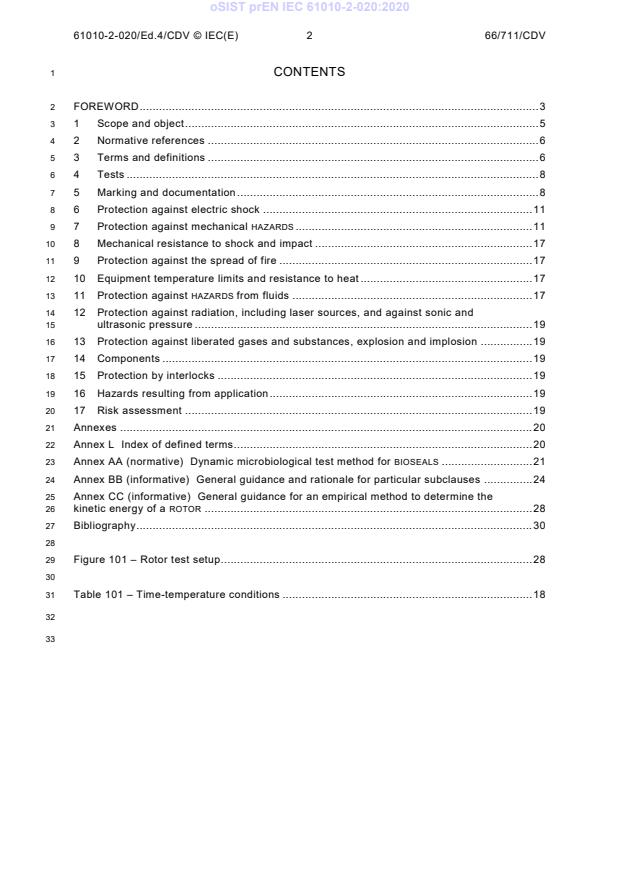
1 CONTENTS
2 FOREWORD . 3
3 1 Scope and object . 5
4 2 Normative references . 6
5 3 Terms and definitions . 6
6 4 Tests . 8
7 5 Marking and documentation . 8
8 6 Protection against electric shock . 11
9 7 Protection against mechanical HAZARDS . 11
10 8 Mechanical resistance to shock and impact . 17
11 9 Protection against the spread of fire . 17
12 10 Equipment temperature limits and resistance to heat . 17
13 11 Protection against HAZARDS from fluids . 17
14 12 Protection against radiation, including laser sources, and against sonic and
15 ultrasonic pressure . 19
16 13 Protection against liberated gases and substances, explosion and implosion . 19
17 14 Components . 19
18 15 Protection by interlocks . 19
19 16 Hazards resulting from application . 19
20 17 Risk assessment . 19
21 Annexes . 20
22 Annex L Index of defined terms . 20
23 Annex AA (normative) Dynamic microbiological test method for BIOSEALS . 21
24 Annex BB (informative) General guidance and rationale for particular subclauses . 24
25 Annex CC (informative) General guidance for an empirical method to determine the
26 kinetic energy of a ROTOR . 28
27 Bibliography . 30
29 Figure 101 – Rotor test setup . 28
31 Table 101 – Time-temperature conditions . 18
61010-2-020/Ed.4/CDV © IEC(E) 3 66/711/CDV
34 INTERNATIONAL ELECTROTECHNICAL COMMISSION
35 ____________
37 SAFETY REQUIREMENTS FOR ELECTRICAL EQUIPMENT FOR
38 MEASUREMENT, CONTROL, AND LABORATORY USE –
40 Part 2-020: Particular requirements for LABORATORY CENTRIFUGES
42 FOREWORD
43 1) The International Electrotechnical Commission (IEC) is a worldwide organization for standardization comprising
44 all national electrotechnical committees (IEC National Committees). The object of IEC is to promote
45 international co-operation on all questions concerning standardization in the electrical and electronic fields. To
46 this end and in addition to other activities, IEC publishes International Standards, Technical Specifications,
47 Technical Reports, Publicly Available Specifications (PAS) and Guides (hereafter referred to as “IEC
48 Publication(s)”). Their preparation is entrusted to technical committees; any IEC National Committee interested
49 in the subject dealt with may participate in this preparatory work. International, governmental and non-
50 governmental organizations liaising with the IEC also participate in this preparation. IEC collaborates closely
51 with the International Organization for Standardization (ISO) in accordance with conditions determined by
52 agreement between the two organizations.
53 2) The formal decisions or agreements of IEC on technical matters express, as nearly as possible, an international
54 consensus of opinion on the relevant subjects since each technical committee has representation from all
55 interested IEC National Committees.
56 3) IEC Publications have the form of recommendations for international use and are accepted by IEC National
57 Committees in that sense. While all reasonable efforts are made to ensure that the technical content of IEC
58 Publications is accurate, IEC cannot be held responsible for the way in which they are used or for any
59 misinterpretation by any end user.
60 4) In order to promote international uniformity, IEC National Committees undertake to apply IEC Publications
61 transparently to the maximum extent possible in their national and regional publications. Any divergence
62 between any IEC Publication and the corresponding national or regional publication shall be clearly indicated in
63 the latter.
64 5) IEC provides no marking procedure to indicate its approval and cannot be rendered responsible for any
65 equipment declared to be in conformity with an IEC Publication.
66 6) All users should ensure that they have the latest edition of this publication.
67 7) No liability shall attach to IEC or its directors, employees, servants or agents including individual experts and
68 members of its technical committees and IEC National Committees for any personal injury, property damage or
69 other damage of any nature whatsoever, whether direct or indirect, or for costs (including legal fees) and
70 expenses arising out of the publication, use of, or reliance upon, this IEC Publication or any other IEC
71 Publications.
72 8) Attention is drawn to the Normative references cited in this publication. Use of the referenced publications is
73 indispensable for the correct application of this publication.
74 9) Attention is drawn to the possibility that some of the elements of this IEC Publication may be the subject of
75 patent rights. IEC shall not be held responsible for identifying any or all such patent rights.
76 International Standard IEC 61010-2-020 has been prepared by IEC technical committee 66:
77 Safety of measuring, control and laboratory equipment.
78 This fourth edition cancels and replaces the third edition published in 2016. It constitutes a
79 technical revision and includes the following significant changes from the second edition:
80 a) alignment with changes introduced by Amendment 1 of 61010-1 third edition.
81 It has the status of a product safety publication in accordance with IEC Guide 104.
61010-2-020/Ed.4/CDV © IEC(E) 4 66/711/CDV
83 The text of this standard is based on the following documents:
CDV Report on voting
66/542/CDV 66/565A/RVC
85 Full information on the voting for the approval of this standard can be found in the report on
86 voting indicated in the above table.
87 This publication has been drafted in accordance with the ISO/IEC Directives, Part 2.
88 This Part 2-020 is intended to be used in conjunction with IEC 61010-1. It was established on
89 the basis of the third edition (2010) and its Amendment 1 (2016).
90 This Part 2-020 supplements or modifies the corresponding clauses in IEC 61010-1 so as to
91 convert that publication into the IEC standard: Safety requirements for LABORATORY
92 CENTRIFUGES.
93 Where a particular subclause of Part 1 is not mentioned in this Part 2, that subclause applies
94 as far as is reasonable. Where this part states "addition", "modification" or "replacement", the
95 relevant requirement, test specification or note in Part 1 should be adapted accordingly.
96 In this standard:
97 1) the following print types are used:
98 – requirements: in roman type;
99 – NOTES: in small roman type;
100 – conformity and tests: in italic type;
101 – terms used throughout this standard which have been defined in Clause 3: SMALL
102 ROMAN CAPITALS.
103 2) subclauses, tables or figures which are additional to those in Part 1 are numbered starting
104 from 101; additional annexes are lettered AA, BB, etc.
105 A list of all parts of the IEC 61010 series, under the general title: Safety requirements for
106 electrical equipment for measurement, control, and laboratory use, may be found on the IEC
107 website.
108 The committee has decided that the contents of this publication will remain unchanged until
109 the stability date indicated on the IEC website under "http://webstore.iec.ch" in the data
110 related to the specific publication. At this date, the publication will be
111 • reconfirmed,
112 • withdrawn,
113 • replaced by a revised edition, or
114 • amended.
61010-2-020/Ed.4/CDV © IEC(E) 5 66/711/CDV
117 SAFETY REQUIREMENTS FOR ELECTRICAL EQUIPMENT FOR
118 MEASUREMENT, CONTROL, AND LABORATORY USE –
120 Part 2-020: Particular requirements for laboratory centrifuges
124 1 Scope and object
125 This clause of Part 1 is applicable except as follows:
126 1.1.1 Scope
127 Replacement:
128 This Part 2 is applicable to electrically powered LABORATORY CENTRIFUGES.
129 It is possible that all or part of the equipment falls within the scope of one or more
130 other Part 2 standards of IEC 61010 as well as within the scope of this standard . In that
131 case, the requirements of those other Part 2 standards will also apply
132 This document is not applicable to electrically powered LABORATORY CENTRIFUGES.
133 manufactured before the date of its publication.
134 1.1.2 Equipment excluded from scope
135 Addition:
136 Add the following new item:
137 aa) IEC 60034 (Rotating electrical machinery);
138 1.2 Object
139 1.2.1 Aspects included in scope
140 Addition:
141 Add the following new items:
142 aa) contact with moving parts (see 7.3);
143 bb) LABORATORY CENTRIFUGE movement during any DISRUPTION (see 7.3.101);
144 cc) high energy chemical reaction after ROTOR DISRUPTION (see 7.7.2.2 l));
145 dd) ineffectiveness of BIOSEALS (see 13.101)
146 1.2.2 Aspects excluded from scope
147 Addition:
148 Add the following new items:
149 aa) additional precautions which may need to be observed when centrifuging materials
150 which are flammable or explosive (see 5.4.101);
151 bb) additional precautions which may need to be observed when centrifuging materials that
152 could react chemically with sufficient vigour to cause a HAZARD (see 5.4.101).
61010-2-020/Ed.4/CDV © IEC(E) 6 66/711/CDV
153 1.4 Environmental conditions
154 1.4.1 Normal environmental conditions
155 Replacement:
156 Replace item c) by the following:
157 c) temperature 2 °C to 40 °C;
158 1.4.2 Extended environmental conditions
159 Replacement:
160 Replace item c) by the following:
161 c) ambient temperatures below 2 °C or above 40 °C;
162 2 Normative references
163 This clause of Part 1 is applicable except as follows:
164 Addition:
165 ISO 3864 (all parts), Graphical symbols – Safety colours and safety signs
166 3 Terms and definitions
167 This clause of Part 1 is applicable except as follows:
168 3.1 Equipment and states of equipment
169 Addition:
170 Add the following new terms and definitions:
171 3.1.101
172 LABORATORY CENTRIFUGE
173 apparatus intended for laboratory use that applies a centrifuging effect to sample materials
174 3.1.102
175 CENTRIFUGE-ROTOR COMBINATION
176 LABORATORY CENTRIFUGE and ROTOR ASSEMBLY that are intended to operate together and which
177 have to be evaluated together
178 3.1.103
179 DISRUPTION
180 event in which the ROTOR ASSEMBLY, or part of it, fails or becomes detached during rotation
61010-2-020/Ed.4/CDV © IEC(E) 7 66/711/CDV
182 3.2 Parts and accessories
183 Addition:
184 Add the following new terms and definitions:
185 3.2.101
186 CHAMBER
187 enclosed space within a LABORATORY CENTRIFUGE in which the ROTOR ASSEMBLY rotates
188 3.2.102
189 ROTOR
190 primary component of a LABORATORY CENTRIFUGE which holds the material to be subjected to
191 centrifugal force and which is rotated by the DRIVE SYSTEM
192 3.2.103
193 BUCKET
194 sub-assembly of a ROTOR designed to support one or more containers
195 3.2.104
196 PROTECTIVE CASING
197 casing which completely surrounds the ROTOR ASSEMBLY and which includes the LID and its
198 securing devices
199 3.2.105
200 LID
201 access cover of the CHAMBER
202 3.2.106
203 ROTOR ASSEMBLY
204 ROTOR carrying a combination of ROTOR accessories specified by the manufacturer
205 Note 1 to entry: In the context of a ROTOR ASSEMBLY, ROTOR accessories include all components used with or in
206 the CENTRIFUGE ROTOR for the purpose of holding samples, including adaptors, tubes and bottles.
207 3.2.107
208 DRIVE SYSTEM
209 all components of the CENTRIFUGE associated with the provision of torque to, or the rotational
210 support of, the ROTOR ASSEMBLY
211 3.2.108
212 BIOSEAL
213 device or mechanism additional to, or integral with, a ROTOR or BUCKET and a closure
214 assembly, and which is designed to prevent the escape of contents, for example micro-
215 biological material, during centrifuging
216 3.5 Safety terms
217 Addition:
218 Add the following new terms and definitions:
219 3.5.101
220 CLEARANCE ENVELOPE
221 space around a LABORATORY CENTRIFUGE which is needed for safety
61010-2-020/Ed.4/CDV © IEC(E) 8 66/711/CDV
223 3.5.102
224 MCA
225 MAXIMUM CREDIBLE ACCIDENT
226 planned event chosen to represent worst-case conditions for a test that will evaluate the
227 inherent mechanical safety of a CENTRIFUGE-ROTOR COMBINATION (see 7.7 and Annex BB)
228 4 Tests
229 This clause of Part 1 is applicable.
230 5 Marking and documentation
231 This clause of Part 1 is applicable except as follows.
232 5.1.2 Identification
233 Replacement:
234 Replace item b) by the following:
235 b) serial number or other means to identify the production batch of the equipment.
236 Addition:
237 Add the following addition:
238 5.1.3 Mains Supply
239 Addition:
240 Add the following note
241 NOTE - The maximum power or input current considered is usually during the acceleration phase of the rotor, with
242 any options such as cooling or heating energized.
243 Add the following new subclause:
244 5.1.101 ROTORS and accessories
245 All OPERATOR-replaceable ROTORS and ROTOR ASSEMBLIES, including ROTOR ACCESSORIES, shall
246 be marked with the manufacturer's or supplier's name or registered trade mark, and
247 identification code. (such as id code, serial number or batch number)
248 If components are too small, or are not suitable for such marking, the required information
249 shall be marked on the original packaging, as well as being stated in the documentation.
250 NOTE Packaging can be the outer box, an insert, etc.
251 If the manufacturer specifies that an individual part, for example a BUCKET, is to be fitted only
252 to a specific ROTOR or in specific ROTOR positions for balance or some other reason, each
253 BUCKET and ROTOR position should be identified by marking with corresponding numbers or
254 letters.
255 Conformity is checked by inspection.
256 5.4.2 Equipment ratings
257 Addition:
61010-2-020/Ed.4/CDV © IEC(E) 9 66/711/CDV
258 Add the following new items:
259 aa) a list of all ROTORS and ROTOR accessories specified for use with a LABORATORY
260 CENTRIFUGE, together with their RATED rotational frequencies;
261 bb) any restrictions by the manufacturer warning against the use of particular materials to
262 be centrifuged;
263 cc) density and volume limits for ROTOR ASSEMBLY loading and, if applicable, derating
264 instructions.
265 5.4.3 Equipment installation
266 Addition:
267 Add, after item a), the following sub-items:
268 i) floor or bench area required for the CLEARANCE ENVELOPE for the intended use (see
269 7.4.101);
270 ii) total weight of the CENTRIFUGE;
271 iii) instructions for site preparation;
272 iv) methods for levelling of the CENTRIFUGE;
273 v) means for securing to the mounting surface.
274 5.4.4 Equipment operation
275 Addition:
276 Add the following new items:
277 aa) loading and balancing procedures;
278 bb) ROTOR changing procedure;
279 cc) any specific requirement for an OPERATOR to be present at stated phases of the
280 centrifuging procedure;
281 dd) necessary safeguards for personnel. Instructions shall include at least the following:
282 – not to lean on a LABORATORY CENTRIFUGE;
283 – not to stay within the CLEARANCE ENVELOPE longer than necessary for operational
284 reasons;
285 – not to deposit any potentially hazardous materials within the CLEARANCE ENVELOPE;
286 – methods for safe operation during open LID procedures (see 7.3.102.2);
287 ee) instructions for use of BIOSEALS and other biocontainment components, including the
288 proper closure techniques. These instructions shall indicate that BIOSEALS and related
289 components are intended to be part of biocontainment systems, as specified in
290 international and national biosafety guidelines. They are not to be relied on as the only
291 means of safeguarding workers and the environment when handling pathogenic micro-
292 organisms.
293 5.4.5 Equipment maintenance and service
294 Addition:
295 Add the following new paragraph:
296 Where applicable, the instructions shall specify:
297 aa) inspection of any means of fixing the equipment to the mounting surface and the
298 condition of the mounting surface itself;
299 bb) safeguards for the OPERATOR during cleaning;
61010-2-020/Ed.4/CDV © IEC(E) 10 66/711/CDV
300 cc) inspection of the PROTECTIVE CASING;
301 dd) inspection of the ROTOR ASSEMBLY, and safety considerations;
302 ee) checking the continuity of the PROTECTIVE BONDING;
303 ff) frequency of inspection, routine maintenance and the method of replacement of
304 BIOSEALS and other biocontainment components.
305 Addition:
306 Add the following new subclauses:
307 5.4.101 Hazardous substances
308 The instructions for use shall state the precautions to be observed when the materials to be
309 used with a LABORATORY CENTRIFUGE are known to be toxic, radioactive, or contaminated with
310 pathogenic micro-organisms.
311 NOTE This information is relevant to the safety of both OPERATORS and service personnel.
312 The use within the LABORATORY CENTRIFUGE of the following materials shall be prohibited in
313 the instructions for use:
314 a) flammable or explosive materials;
315 b) materials which could react chemically with sufficient vigour to cause a HAZARD.
316 Conformity is checked by inspection.
317 5.4.102 Cleaning and decontamination
318 Documentation shall include:
319 a) a statement that, if hazardous material is spilt on or inside the equipment, the user has
320 responsibility for carrying out appropriate decontamination;
321 b) manufacturer's recommendations for cleaning and, where necessary, decontaminating,
322 together with the recognized generic names of recommended materials for cleaning and
323 decontaminating:
324 c) the following statement:
325 "Before using any cleaning or decontamination methods except those recommended by
326 the manufacturer, users should check with the manufacturer that the proposed method will
327 not damage the equipment”
328 d) the following statement:
329 Cleaning and decontamination may be necessary as a safeguard before LABORATORY
330 CENTRIFUGES, ROTORS, and any accessories are maintained, repaired, or transferred.
331 Manufacturers may provide a format for users to document that such treatment has been
332 carried out
333 NOTE Be advised, there are national guidelines and the internationally recognized "Laboratory Biosafety Manual",
334 published in 1993 by the Wor5ld Health Organization in Geneva, which gives information on decontaminants, their
335 use, dilutions, properties, and potential applications.
336 Conformity is checked by inspection.
337 5.4.103 Effects of chemicals and environmental influences
338 To ensure continued safe use of a LABORATORY CENTRIFUGE the documentation shall identify
339 damage which could result from, for example:
340 a) the effect of chemicals;
341 b) environmental influences, including natural ultra-violet radiation likely to be encountered;
342 c) corrosion, and other weakening of construction materials that are part of the PROTECTIVE
343 CASING or other protective components.
61010-2-020/Ed.4/CDV © IEC(E) 11 66/711/CDV
344 Conformity is checked by inspection of the documentation and the relevant data and/or
345 additional testing (if needed).
346 6 Protection against electric shock
347 This clause of Part 1 is applicable except as follows.
348 6.8.3.1 The AC voltage test
350 Replacement:
352 Replace the first sentence by the following new sentence:
353 The voltage tester shall be capable of maintaining the test voltage throughout the test within
354 ±5 % of the specified value.
355 7 Protection against mechanical HAZARDS
356 This clause of Part 1 is applicable except as follows.
357 7.1 General
358 Addition:
359 Add the following new note:
360 NOTE 101 A DISRUPTION, resulting in damage to a part of the PROTECTIVE CASING, for example a LID-locking
361 mechanism, is considered to be a SINGLE FAULT CONDITION.
362 7.3 Moving parts
363 Addition:
364 Add the following new subclauses.
365 7.3.101 LID
366 7.3.101.1 Requirements
367 The LID shall be locked closed when the ROTOR drive is energized, and shall remain locked
368 until the circumferential velocity of the ROTOR ASSEMBLY is not more than 2 m/s (see
369 Annex BB).
370 In the event of a power failure, the LID-locking mechanism shall not release, and subsequent
371 release shall require the use of a TOOL.
372 The LID shall be held closed with sufficient strength to withstand the results of testing
373 according to 7.7.3. Fragments produced by any DISRUPTION shall be contained as specified in
374 item a) of 7.7.
375 To evaluate which of the following points are appropriate for the CENTRIFUGE-ROTOR
376 COMBINATION under consideration, information shall be recorded showing the tests conducted
377 by the manufacturer or by a test facility:
378 a) mechanical abuse;
379 b) mislatching;
380 c) misalignment;
381 d) corrosion;
382 e) material degradation;
61010-2-020/Ed.4/CDV © IEC(E) 12 66/711/CDV
383 f) material defects;
384 g) vibration;
385 h) cleaning and decontamination;
386 i) environmental influences;
387 j) other considerations appropriate for the design.
388 Conformity is checked by visual inspection; by the review of recorded information, by the tests
389 carried out under 7.7.3, and by any further tests considered appropriate for safety.
390 7.3.101.2 Exception
391 For LABORATORY CENTRIFUGES that satisfy all the following limitations, a device which merely
392 interrupts motor power may be used instead of an interlock mechanism (see Annex BB):
393 a) the LABORATORY CENTRIFUGE incorporates a device which holds the LID closed;
394 b) the device which interrupts motor power does not permit the drive motor to be
395 energized unless the LID is closed;
396 c) the rotational frequency of the ROTOR ASSEMBLY does not exceed 3 600 rpm;
397 d) the energy at maximum rotational frequency for the highest energy ROTOR ASSEMBLY when
398 fully loaded does not exceed 1 kJ;
399 e) the maximum centrifugal force does not exceed 2 000 g;
400 f) the largest ROTOR ASSEMBLY diameter does not exceed 250 mm;
401 g) a switch is provided for disconnecting motor power, independent of the LID position;
402 h) the ROTOR ASSEMBLY is visible when the LID is closed, to permit observation of any
403 rotation;
404 i) all ROTOR ASSEMBLIES used conform to 7.3 of Part 1;
405 j) if access is possible at a circumferential velocity of the ROTOR ASSEMBLY of more than
406 2 m/s, a warning label in accordance with ISO 3864 is provided on or near the access
407 point, indicating that the LID should not be opened until rotation has stopped. Where there
408 is insufficient space for such a label, symbol 14 of Table 1 is considered to be an
409 acceptable marking.
410 Conformity is checked by visual inspection and by the review of data to confirm that all the
411 above limitations are met.
412 7.3.102 ROTOR ASSEMBLIES
413 7.3.102.1 General
414 If a HAZARD could result from contact with moving parts of the ROTOR ASSEMBLY or DRIVE
415 SYSTEM in NORMAL CONDITION or SINGLE FAULT CONDITION, suitable protective means shall be
416 provided to prevent OPERATOR access, except as permitted by 7.3.101.2 and 7.3.102.2.
417 There shall be no holes or other openings in the top of the CHAMBER which permit the
418 penetration of a 4 mm diameter pin.
419 Conformity is checked by inspection and by using the test fingers shown in Figures B.1 and
420 B.2, and by checking openings in the top with a 4 mm diameter pin, in NORMAL CONDITION and
421 SINGLE FAULT CONDITION.
422 The jointed test finger shown in Figure B.2 is applied in every possible position without
423 applying any force. If it is possible to touch a part by applying a force, the rigid test finger
424 shown in Figure B.1 is applied with a force of 10 N. The force is exerted against all outer
425 surfaces, including the bottom, by the tip of the test finger so as to avoid wedge or lever
426 action. The finger shall not touch any moving part that could cause a HAZARD.
61010-2-020/Ed.4/CDV © IEC(E) 13 66/711/CDV
427 7.3.102.2 ROTOR ASSEMBLIES requiring access during rotation
428 If the manufacturer supplies ROTOR ASSEMBLIES requiring OPERATOR interaction (e.g. zonal or
429 continuous-flow ROTOR ASSEMBLIES), LABORATORY CENTRIFUGES are permitted to have an
430 override control which allows the motor to be energized while the access LID is open, provided
431 that:
432 a) the override control allows the motor to be energized only by use of a device (which can
433 be a code or code-card) that makes it possible to override a protective system and
434 functions by means that cannot be performed using other tools, or when a special guard
435 plate allows only limited access to the rotor assembly;
436 b) means are provided to cancel the override function automatically when use of the rotor
437 assembly requiring OPERATOR interaction is ended;
438 c) maximum speed while the LID is open is limited to 5 000 rpm.
439 Conformity is checked by inspection
440 7.4 Stability
441 Addition:
442 Add a new third paragraph as follows:
443 No displacement of the LABORATORY CENTRIFUGE from its installed position shall be visible
444 during NORMAL USE.
445 Addition:
446 Add the following new subclause:
447 7.4.101 LABORATORY CENTRIFUGE movement during malfunction
448 After installation according to the manufacturer's instructions, movement of a LABORATORY
449 CENTRIFUGE as a result of ROTOR ASSEMBLY imbalance, ROTOR ASSEMBLY DISRUPTION, or drive
450 failure (seizure), shall not present a HAZARD.
451 Movement shall be limited either by design, or by fastening to the mounting surface, or a
452 combination of both, so that no part of the LABORATORY CENTRIFUGE moves outside a
453 CLEARANCE ENVELOPE extending 300 mm, or less if stated by the manufacturer, in any direction
454 from the outermost parts of the LABORATORY CENTRIFUGE in its original position (for rationale
455 see Clause BB.6).
456 Conformity is checked by testing to confirm that the 300 mm limit, or any lower limit stated by
457 the manufacturer, is not exceeded in NORMAL USE and after inducing the worst-case situation
458 according to 7.7.2.2 for:
459 a) imbalance;
460 Use of an imbalance sensor is acceptable as a means for limiting movement. , but its possible
461 failure should be considered when determining the worst-case condition unless examination
462 of the equipment and design demonstrates conclusively that the sensor will not fail.
463 b) disruption of the ROTOR ASSEMBLY;
464 c) DRIVE SYSTEM failure;
465 d) seizure of the DRIVE SYSTEM.
466 NOTE The failure mode which will produce the greatest movement can be different from the failure mode of the
467 MCA determined for testing the PROTECTIVE CASING according to 7.7.3. See Annex CC for additional guidance in
468 determining the worst case rotor.
469 For these tests, the LABORATORY CENTRIFUGE is mounted on, or fixed to, a horizontal smooth
61010-2-020/Ed.4/CDV © IEC(E) 14 66/711/CDV
470 concrete test surface of dimensions appropriate for the size of LABORATORY CENTRIFUGE
471 being tested, and as specified in the manufacturer's instructions.
472 7.7 Expelled parts
473 Replacement:
474 Replace the title and text by the following new title and text.
475 7.7 Protection against expelled parts or projected parts
476 7.7.1 General
477 shall be designed for safe operation in NORMAL USE and SINGLE
LABORATORY CENTRIFUGES
478 FAULT CONDITION, when used with ROTOR ASSEMBLIES specified by the manufacturer.
479 In the event of a DISRUPTION:
480 a) no parts or fragments of the ROTOR ASSEMBLY exceeding 5 mm in any dimension shall
481 completely penetrate the PROTECTIVE CASING. Smaller material (except for aerosols and
482 liquids) shall remain within a trajectory extending 1 m in any direction from the outermost
483 parts of the LABORATORY CENTRIFUGE; (See rationale in Annex BB.6)
484 b) no part of the LABORATORY CENTRIFUGE shall become detached or expelled in such a way
485 as to present a HAZARD to personnel or the environment. In the case of parts detached or
486 expelled from the centrifuge (not part of the ROTOR ASSEMBLY) this is to be evaluated in
487 accordance with Clause 17.
488 c) the fastenings of the access LID shall not be loosened, and there shall be no distortion
489 which could create an unimpeded path between any point on the ROTOR ASSEMBLY and any
490 point outside the LABORATORY CENTRIFUGE.
491 Conformity of every CENTRIFUGE-ROTOR COMBINATION specified by the manufacturer is checked
492 by testing as specified in 7.7.3, under MCA conditions, or by causing DISRUPTION by partially
493 cutting the ROTOR, or by overloading the ROTOR ASSEMBLY, or by other appropriate means. If
494 more than one worst-case ROTOR ASSEMBLY selection exists, each can be tested with a new
495 .
PROTECTIVE CASING
496 After the tests, the criteria of a) to c) above shall be met, and visible cracks shall be examined
497 to determine whether or not the PROTECTIVE CASING would have contained the ROTOR parts
498 irrespective of their trajectory. A questionable result shall require the test to be repeated once
499 only, and a further questionable result is considered to be a failure. The equipment is checked
500 to ensure that parts which are HAZARDOUS LIVE have not become ACCESSIBLE and that
501 ACCESSIBLE conductive parts do not exceed the values of 6.3.2. In the event that the test
502 causes the operation of an overcurrent protection device, if the device can not be reset
503 without operating again, the unit is considered to have failed safe. (See rationale Annex
504 BB6.2)
505 NOTE 1 Consideration should be given to the presence of temporary gaps in containment during the MCA test in
506 determining questionable results.
507 Alternatively, the safety of a CENTRIFUGE-ROTOR COMBINATION can be established by analytical
508 evaluation based on comparison with one of more of the CENTRIFUGE-ROTOR COMBINATIONS
509 already tested, to confirm that the PROTECTIVE CASING would have passed the relevant test of
510 7.7.3.
511 NOTE 2 CENTRIFUGE-ROTOR COMBINATIONS designed such that satisfactory evaluation by comparison with another
512 CENTRIFUGE-ROTOR COMBINATION already tested cannot be made are tested as specified in 7.7.3.
61010-2-020/Ed.4/CDV © IEC(E) 15 66/711/CDV
513 7.7.2 Considerations for MCA tests
514 7.7.2.1 Information to be recorded
515 Recorded information shall include:
516 a) corrosion effects to be expected;
517 b) material fatigue behaviour;
518 c) material degradation considerations, including effects of inspection, maintenance, and
519 component replacement schedules;
520 d) temperature limitation considerations;
521 e) material defect considerations;
522 f) improper BUCKET installation considerations;
523 g) relevant environmental considerations;
524 h) relevant maximum loading considerations;
525 i) electrical circuit diagram and functional descriptions;
526 j) material specifications and technical data;
527 k) pre-treatment methods to induce ROTOR ASSEMBLY failure;
528 l) traceability of all measuring instruments used during tests;
529 m) any other relevant information.
530 Conformity is checked by inspection of documentation relating to the above items.
531 7.7.2.2 Considerations for worst-case conditions
532 All combinations of the following that are possible shall be considered:
533 a) ROTOR selection: the worst-case specified ROTOR ASSEMBLY or ROTOR ASSEMBLIES; (for
534 calculating the kinetic energy of rotors, refer to annex CC)
535 b) rotational frequency control setting: the maximum that an OPERATOR can select;
536 c) supply voltage: 10 % above the maximum RATED voltage marked on the equipment;
537 d) ROTOR ASSEMBLY load: the maximum specified load, partial load, and no load, including
538 state and density of load (e.g. liquid, solid);
539 e) ROTOR accessories, worst case loading of specified accessories used with or in the ROTOR
540 for the purpose of holding samples, including adaptors, tubes, and bottles;
541 f) ROTOR ASSEMBLY imbalance: the most severe condition;
542 g) altitude factors: the effect of reduced atmospheric pressure and density at increased
543 altitude on ROTOR DRIVE SYSTEMS which rely on windage to limit maximum rotational
544 frequency (see 1.4.1 b) and 1.4.2 b)).
545 NOTE 1 The windage limitation can be determined by conducting a rotational frequency test in a cabinet or
546 room in which the pressure is controlled to 80 kPa or less, or alternatively the rotational frequency n , which
547 would be reached at 2 000 m altitude, can be determined from:
548 n = n × R
2 1
549 where
550 n is the maximum rotational frequency at standard atmospheric pressure at sea-level (101 kPa);
551 n is the corresponding maximum rotational frequency at an atmospheric pressure equivalent to 2 000 m;
552 R = 1,27 (the ratio of the density of air at sea-level, to that at 2 000 m).
553 h) friction between the LABORATORY CENTRIFUGE or LABORATORY CENTRIFUGE feet and the
554 surface on which the LABORATORY CENTRIFUGE is placed;
555 i) ambient temperature: the effect on components of working at any temperature in the
556 permitted range from 2 °C to 40 °C;
61010-2-020/Ed.4/CDV © IEC(E) 16 66/711/CDV
557 j) a combination of ROTOR ASSEMBLY and drive unit causing an instability of the dynamic
558 behaviour;
559 k) installation as specified by the manufacturer;
560 l) the possibility of high energy chemical reaction after DISRUPTION
561 NOTE 2 In LABORATORY CENTRIFUGES which develop energies of the order of 275 kJ and above, and which
562 are refrigerated under vacuum, it is possible for a DISRUPTION to cause a chemical explosion if parts of the
563 ROTOR ASSEMBLY are made of reactive material, such as aluminium and titanium. An explosion can occur due
564 to interaction at high energies of the ROTOR ASSEMBLY fragments with refrigerants and water.
565 In such cases, the worst-case conditions can be achieved by the following combination of
566 means:
567 i) disabling rotational frequency controls and limiting devices so that the highest
568 rotational frequency is reached;
569 ii) selecting whichever ROTOR of reactive material has the highest rotational energy, and
570 pretreating it so as to cause a DISRUPTION. The pre-treatment shall maximize the
571 surface area of the resulting fragments;
572 iii) adjusting the refrigeration system to have the maximum amount of refrigerant in the
573 evaporator which cools the CHAMBER;
574 iv) loading the ROTOR ASSEMBLY with water to 80 % of its nominal capacity;
575 v) running the LABORATORY CENTRIFUGE in worst-case conditions of all other unspecified
576 factors until a DISRUPTION occurs.
577 NOTE 3 Test personnel should be aware that extraordinary energy release can result from the tests where a
578 high-energy chemical reaction is possible after DISRUPTION. A remote bunker facility is recommended.
579 Conformity is checked by inspection of documentation relating to the above items.
580 7.7.2.3 SINGLE FAULT CONDITIONS to be considered
581 The following SINGLE FAULT CONDITIONS shall be considered:
582 a) rotational frequency control condition: whichever SINGLE FAULT CONDITION that results in the
583 highest rotational frequency;
584 b) rotational frequency limiting system whichever SINGLE FAULT CONDITION permits the highest
585 rotational frequency;
586 c) MAINS power interruption: intermittent or permanent loss of MAINS power, if either presents
587 a hazardous condition;
588 d) drive seizure: the sudden application of the rotational energy to the frame and case of a
589 LABORATORY CENTRIFUGE;
590 e) any component failure;
591 f) non-quantitative SINGLE FAULT CONDITIONS:
592 i) corrosion effects, for example corrosion at the bottom of a BUCKET or cavity, stress
593 corrosion cracking of alloys, corrosion of welds in the PROTECTIVE CASING,
594 environmental crazing of polymers, etc.;
595 ii) material fatigue behaviour, which may affect the mode of failure;
596 iii) material defects;
597 iv) improper installation of a BUCKET or any other component that is fitted in a swinging
598 BUCKET system (e.g. the omission of a BUCKET), incorrect mounting of a BUCKET at its
599 pivot points, use of an incorrect BUCKET, and overloading a BUCKET;
600 v) temperature effects, such as expected extremes during transportation, high ROTOR
601 ASSEMBLY temperatures during operation, and any necessary treatment specified by
602 the manufacturer.
603 Conformity is checked by inspection of documentation relating to the above items.
61010-2-020/Ed.4/CDV © IEC(E) 17 66/711/CDV
604 7.7.3 Testing the PROTECTIVE CASING
605 For each worst-case ROTOR ASSEMBLY selection in each MCA, determined according to 7.7.2.1
606 to 7.7.2.3, testing as necessary shall be carried out to prove the adequacy of the PROTECTIVE
607 CASING, and to show that it would have contained the ROTOR parts irrespective of their
608 trajectory. No parts or fragments shall be expelled from the PROTECTIVE CASING during the
609 tests, other than those permitted by 7.7.1 a).
610 Each test may be carried out with a new PROTECTIVE CASING.
611 The ROTOR ASSEMBLY under test may first be appropriately weakened to induce it to fail during
612 the test of the PROTECTIVE CASING in accordance with the MCA failure mode.
613 One of the more difficult fragments of a ROTOR ASSEMBLY to contain in a DISRUPTION is an
614 approximate half ROTOR. Experience over the years has shown that many designs of ROTOR
615 can disrupt to give such a size of fragment. This should be taken into accou
...
Questions, Comments and Discussion
Ask us and Technical Secretary will try to provide an answer. You can facilitate discussion about the standard in here.
Loading comments...