

SIST EN 302 858-1 V1.3.1:2014
(Main)Electromagnetic compatibility and Radio spectrum Matters (ERM) - Road Transport and Traffic Telematics (RTTT) - Automotive radar equipment operating in the 24,05 GHz up to 24,25 GHz or 24,50 GHz frequency range - Part 1: Technical characteristics and test methods
- Abstract
The present document specifies the technical requirements and methods of measurement for automotive radar equipment operating in the 24,05 GHz to 24,25 GHz frequency range or in the 24,05 GHz to 24,50 GHz frequency range intended for Narrow Band Short Range Radar (NB SRR) for Road Transport and Traffic Telematics (RTTT) applications such as Automotive Cruise Control (ACC), Collision Warning, Anti-Collision (AC) systems, obstacle detection, Stop and Go, blind spot detection, parking aid, precrash, backup aid and other safety relevant automotive applications. The present document contains the technical characteristics and test methods for narrowband short range radar equipment fitted with integral antennas and applies to transmitters and receivers with integral antennas operating in all or part of the range from 24,05 GHz to 24,50 GHz. The present document covers the basic NB SRR as provided by the EN 302 858-1 (V1.2.1) operating in the frequency range of 24,05 GHz to 24,25 GHz. Additionally, the present document specifies the WLAM (Wideband Low Activity Mode) mode, operating from 24,05 GHz to 24,50 GHz. The operation of this mode is optional and specified in the normative annex B of the present document. The present document does not necessarily include all the characteristics which may be required by a user, nor does it necessarily represent the optimum performance achievable. The present document covers only NB SRR equipment for vehicles. The present document complies with field limits for human exposure to electromagnetic fields as provided by the EC Recommendation 1999/519/EC [i.4] and the methods for compliance demonstration in EN 62479:2010 [i.5]. Table 1 shows the frequency bands as designated to narrow band short range radar devices.
- Status
- Published
- Public Enquiry End Date
- 30-Sep-2013
- Publication Date
- 17-Dec-2013
- Technical Committee
- MOC - Mobile Communications
- Current Stage
- 6060 - National Implementation/Publication (Adopted Project)
- Start Date
- 25-Nov-2013
- Due Date
- 30-Jan-2014
- Completion Date
- 18-Dec-2013
Buy Documents
ETSI EN 302 858-1 V1.3.1 (2013-07) - Electromagnetic compatibility and Radio spectrum Matters (ERM); Road Transport and Traffic Telematics (RTTT); Automotive radar equipment operating in the 24,05 GHz up to 24,25 GHz or 24,50 GHz frequency range; Part 1: Technical characteristics and test methods
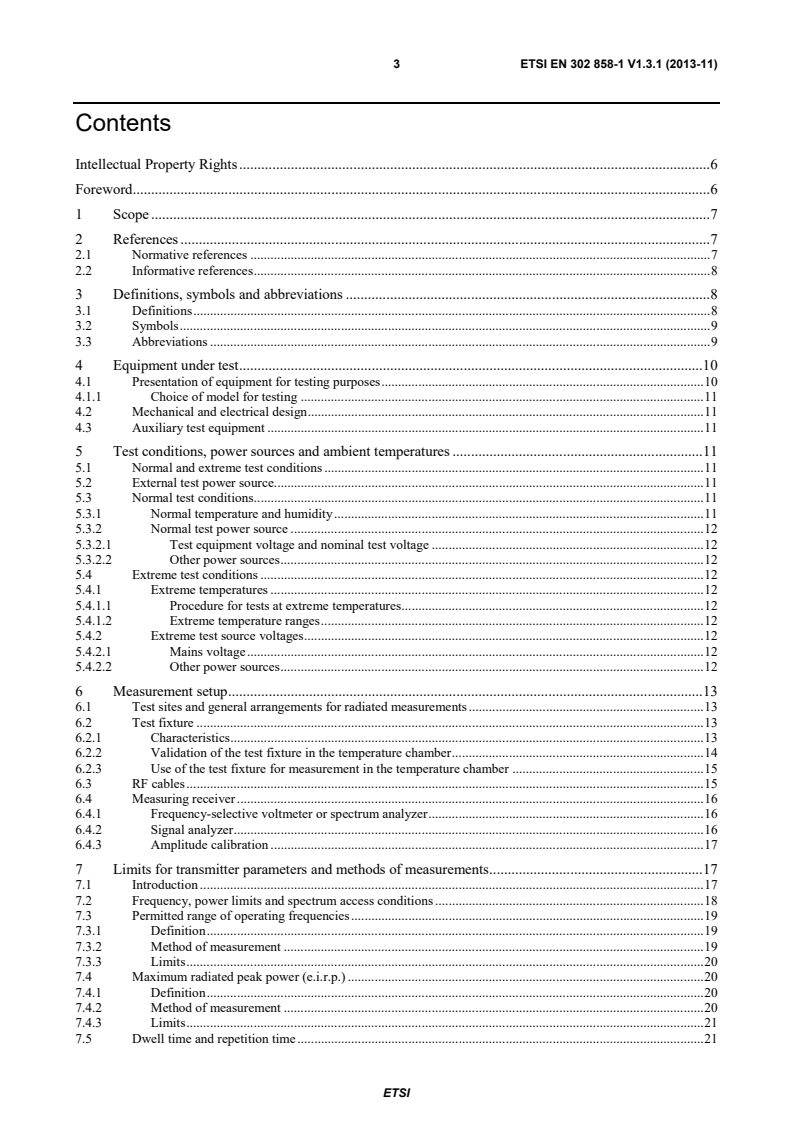
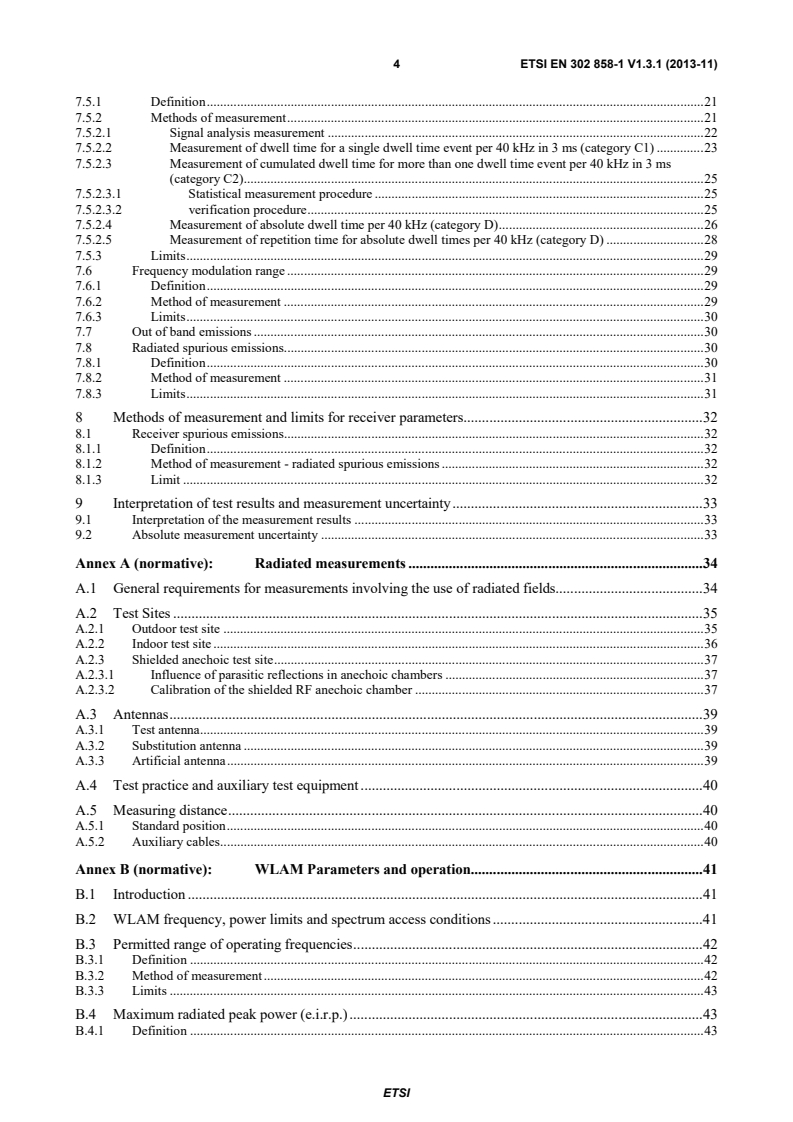
ETSI EN 302 858-1 V1.3.1 (2013-11) - Electromagnetic compatibility and Radio spectrum Matters (ERM); Road Transport and Traffic Telematics (RTTT); Automotive radar equipment operating in the 24,05 GHz up to 24,25 GHz or 24,50 GHz frequency range; Part 1: Technical characteristics and test methods

SIST EN 302 858-1 V1.3.1:2014 is the SIST adoption of ETSI EN 302 858-1 V1.3.1 for automotive radar equipment in the 24,05 GHz to 24,25 GHz or 24,50 GHz range. It specifies technical characteristics and measurement methods for Narrow Band Short Range Radar (NB SRR) used in Road Transport and Traffic Telematics (RTTT), including the optional WLAM mode, for vehicle-mounted equipment with integral antennas.
What does SIST EN 302 858-1 V1.3.1:2014 specify?
SIST EN 302 858-1 V1.3.1:2014 defines how 24 GHz automotive radar equipment is to be characterized and tested so that laboratories can check the same transmitter and receiver parameters in the same way. The document is limited to NB SRR equipment for vehicles and to transmitters and receivers with integral antennas.
The standard is organized into clauses for scope, references, definitions, equipment under test, test conditions, measurement setup, transmitter limits, receiver limits, and interpretation of results. Its annexes add radiated test-site requirements, WLAM-specific requirements, installation requirements, an e.i.r.p. conversion example, and a bibliography.
| Annex | What it covers |
|---|---|
| Annex A | Radiated measurements, test sites, antennas, and far-field practice |
| Annex B | WLAM parameters and operation, including duty cycle and vertical emissions |
| Annex C | Installation requirements for 24 GHz NB SRR systems |
| Annex D | Example conversion from power density to e.i.r.p. |
| Annex E | Bibliography |
What are the key requirements of SIST EN 302 858-1 V1.3.1:2014?
The main technical requirements are the transmitter and receiver limits, the required test conditions, and the measurement methods used to prove compliance. In practice, the document tells a test laboratory what to measure, how to measure it, and which result to compare with each limit.
Equipment under test and test conditions
Clause 4 requires the provider to submit representative equipment, technical documentation, and operating manuals. The equipment is tested as a stand-alone assembly, with the sensor, antenna, and radome if needed, and the most complex feature set and highest intended power level are used for testing. This matters because the test has to represent the worst case likely to be sold.
Clause 5 requires normal and, where stated, extreme test conditions, using an external test power source with low internal impedance. Clause 6 requires radiated measurements under far-field conditions and defines when a test fixture may be used. The test fixture has to be described, stable, and reproducible so the results can be repeated by another lab.
Transmitter requirements
Clause 7 covers the permitted operating frequency range, maximum radiated peak power (e.i.r.p.), dwell time and repetition time, frequency modulation range, out-of-band emissions, and radiated spurious emissions. For a buyer or quality manager, these are the core pass-fail checks for the radar transmitter.
The dwell-time requirements are especially important because the document separates different dwell-time categories and measurement methods. That means the radar waveform is not judged only by power, but also by how long energy occupies each part of the band.
Receiver and reporting requirements
Clause 8 sets the method for receiver spurious emissions. If the receiver is co-located with the transmitter, separate radiated spurious measurements are not needed. Clause 9 requires the measured value to be compared with the relevant limit and the measurement uncertainty to be recorded in the test report.
WLAM and installation
Annex B adds the WLAM-specific operating mode, including its own frequency, power, duty-cycle, and unwanted vertical-emission requirements. Annex C gives installation requirements for 24 GHz NB SRR systems, including permanent fixed mounting on a vehicle and a tighter dwell-time condition in one band when mounted without a bumper or in front of the bumper. This matters for vehicle integration because the mounting position can change the permitted operating behaviour.
What terms does SIST EN 302 858-1 V1.3.1:2014 define?
- NB SRR - Narrow Band Short Range Radar, the vehicle radar type covered by the standard.
- WLAM - Wideband Low Activity Mode, an optional mode specified in Annex B.
- EUT - Equipment Under Test, the radar sensor with its integrated antenna and any external antenna parts that affect performance.
- e.i.r.p. - equivalent isotropically radiated power, the apparent radiated power of the transmitter and antenna.
- dwell time - the time a frequency range is occupied by the signal.
- duty cycle - the ratio of total transmit on-time to total off-time in one hour.
- boresight - the axis of the main beam of a directional antenna.
Who uses SIST EN 302 858-1 V1.3.1:2014?
Manufacturers of automotive radar sensors, accredited test laboratories, and vehicle installers use this standard to set up compliance tests and installation checks. It is also relevant to automotive quality teams, approval engineers, and buyers who need to confirm that a radar product is intended for vehicle use in the 24 GHz NB SRR band.
What changed in SIST EN 302 858-1 V1.3.1:2014 from the previous edition?
SIST EN 302 858-1 V1.3.1:2014 covers the basic NB SRR function from EN 302 858-1 V1.2.1 and adds the WLAM mode operating from 24,05 GHz to 24,50 GHz. The document history lists V1.2.1 as published in July 2011 and V1.3.1 as published in November 2013.
Which standards are used with SIST EN 302 858-1 V1.3.1:2014?
The normative references that support application of the standard are:
- CISPR 16 - measuring apparatus and methods for radio disturbance and immunity.
- ETSI TR 100 028 - methods for evaluating measurement uncertainty.
- ETSI TR 102 273 - improved radiated methods of measurement and uncertainty evaluation.
- ETSI TS 103 051 - expanded measurement uncertainty for radiated electromagnetic fields.
- ETSI TS 103 052 - radiated measurement methods and general arrangements for test sites up to 100 GHz.
These documents provide the measurement framework, uncertainty approach, and test-site practice used in the standard.
What does the SIST EN 302 858-1 V1.3.1:2014 document contain?
The document includes measurement methods for operating frequency, radiated power, dwell time, frequency modulation range, out-of-band emissions, and radiated spurious emissions. It also contains detailed radiated test-site arrangements, a test fixture description and validation procedure, and WLAM-specific measurement methods. Annex C adds installation rules, while Annex D gives a worked example for converting power density to e.i.r.p.
Buy Documents
ETSI EN 302 858-1 V1.3.1 (2013-07) - Electromagnetic compatibility and Radio spectrum Matters (ERM); Road Transport and Traffic Telematics (RTTT); Automotive radar equipment operating in the 24,05 GHz up to 24,25 GHz or 24,50 GHz frequency range; Part 1: Technical characteristics and test methods
ETSI EN 302 858-1 V1.3.1 (2013-11) - Electromagnetic compatibility and Radio spectrum Matters (ERM); Road Transport and Traffic Telematics (RTTT); Automotive radar equipment operating in the 24,05 GHz up to 24,25 GHz or 24,50 GHz frequency range; Part 1: Technical characteristics and test methods
Get Certified
Connect with accredited certification bodies for this standard

BSI Group
BSI (British Standards Institution) is the business standards company that helps organizations make excellence a habit.

NYCE
Mexican standards and certification body.

ANCE
Mexican certification and testing association.
Sponsored listings
Frequently Asked Questions
SIST EN 302 858-1 V1.3.1:2014 is a standard published by the Slovenian Institute for Standardization (SIST). Its full title is "Electromagnetic compatibility and Radio spectrum Matters (ERM) - Road Transport and Traffic Telematics (RTTT) - Automotive radar equipment operating in the 24,05 GHz up to 24,25 GHz or 24,50 GHz frequency range - Part 1: Technical characteristics and test methods". This standard covers: The present document specifies the technical requirements and methods of measurement for automotive radar equipment operating in the 24,05 GHz to 24,25 GHz frequency range or in the 24,05 GHz to 24,50 GHz frequency range intended for Narrow Band Short Range Radar (NB SRR) for Road Transport and Traffic Telematics (RTTT) applications such as Automotive Cruise Control (ACC), Collision Warning, Anti-Collision (AC) systems, obstacle detection, Stop and Go, blind spot detection, parking aid, precrash, backup aid and other safety relevant automotive applications. The present document contains the technical characteristics and test methods for narrowband short range radar equipment fitted with integral antennas and applies to transmitters and receivers with integral antennas operating in all or part of the range from 24,05 GHz to 24,50 GHz. The present document covers the basic NB SRR as provided by the EN 302 858-1 (V1.2.1) operating in the frequency range of 24,05 GHz to 24,25 GHz. Additionally, the present document specifies the WLAM (Wideband Low Activity Mode) mode, operating from 24,05 GHz to 24,50 GHz. The operation of this mode is optional and specified in the normative annex B of the present document. The present document does not necessarily include all the characteristics which may be required by a user, nor does it necessarily represent the optimum performance achievable. The present document covers only NB SRR equipment for vehicles. The present document complies with field limits for human exposure to electromagnetic fields as provided by the EC Recommendation 1999/519/EC [i.4] and the methods for compliance demonstration in EN 62479:2010 [i.5]. Table 1 shows the frequency bands as designated to narrow band short range radar devices.
The present document specifies the technical requirements and methods of measurement for automotive radar equipment operating in the 24,05 GHz to 24,25 GHz frequency range or in the 24,05 GHz to 24,50 GHz frequency range intended for Narrow Band Short Range Radar (NB SRR) for Road Transport and Traffic Telematics (RTTT) applications such as Automotive Cruise Control (ACC), Collision Warning, Anti-Collision (AC) systems, obstacle detection, Stop and Go, blind spot detection, parking aid, precrash, backup aid and other safety relevant automotive applications. The present document contains the technical characteristics and test methods for narrowband short range radar equipment fitted with integral antennas and applies to transmitters and receivers with integral antennas operating in all or part of the range from 24,05 GHz to 24,50 GHz. The present document covers the basic NB SRR as provided by the EN 302 858-1 (V1.2.1) operating in the frequency range of 24,05 GHz to 24,25 GHz. Additionally, the present document specifies the WLAM (Wideband Low Activity Mode) mode, operating from 24,05 GHz to 24,50 GHz. The operation of this mode is optional and specified in the normative annex B of the present document. The present document does not necessarily include all the characteristics which may be required by a user, nor does it necessarily represent the optimum performance achievable. The present document covers only NB SRR equipment for vehicles. The present document complies with field limits for human exposure to electromagnetic fields as provided by the EC Recommendation 1999/519/EC [i.4] and the methods for compliance demonstration in EN 62479:2010 [i.5]. Table 1 shows the frequency bands as designated to narrow band short range radar devices.
SIST EN 302 858-1 V1.3.1:2014 is classified under the following ICS (International Classification for Standards) categories: 33.060.99 - Other equipment for radiocommunications; 33.100.01 - Electromagnetic compatibility in general; 35.240.60 - IT applications in transport. The ICS classification helps identify the subject area and facilitates finding related standards.
SIST EN 302 858-1 V1.3.1:2014 is available in PDF format for immediate download after purchase. The document can be added to your cart and obtained through the secure checkout process. Digital delivery ensures instant access to the complete standard document.
Standards Content (Sample)
Draft ETSI EN 302 858-1 V1.3.1 (2013-07)
European Standard
Electromagnetic compatibility
and Radio spectrum Matters (ERM);
Road Transport and Traffic Telematics (RTTT);
Automotive radar equipment operating in the
24,05 GHz up to 24,25 GHz or 24,50 GHz frequency range;
Part 1: Technical characteristics and test methods
2 Draft ETSI EN 302 858-1 V1.3.1 (2013-07)
Reference
REN/ERM-TGSRR-061-1
Keywords
radar, radio, RTTT, SRD, testing
ETSI
650 Route des Lucioles
F-06921 Sophia Antipolis Cedex - FRANCE
Tel.: +33 4 92 94 42 00 Fax: +33 4 93 65 47 16
Siret N° 348 623 562 00017 - NAF 742 C
Association à but non lucratif enregistrée à la
Sous-Préfecture de Grasse (06) N° 7803/88
Important notice
Individual copies of the present document can be downloaded from:
http://www.etsi.org
The present document may be made available in more than one electronic version or in print. In any case of existing or
perceived difference in contents between such versions, the reference version is the Portable Document Format (PDF).
In case of dispute, the reference shall be the printing on ETSI printers of the PDF version kept on a specific network drive
within ETSI Secretariat.
Users of the present document should be aware that the document may be subject to revision or change of status.
Information on the current status of this and other ETSI documents is available at
http://portal.etsi.org/tb/status/status.asp
If you find errors in the present document, please send your comment to one of the following services:
http://portal.etsi.org/chaircor/ETSI_support.asp
Copyright Notification
No part may be reproduced except as authorized by written permission.
The copyright and the foregoing restriction extend to reproduction in all media.
© European Telecommunications Standards Institute 2013.
All rights reserved.
TM TM TM
DECT , PLUGTESTS , UMTS and the ETSI logo are Trade Marks of ETSI registered for the benefit of its Members.
TM
3GPP and LTE™ are Trade Marks of ETSI registered for the benefit of its Members and
of the 3GPP Organizational Partners.
GSM® and the GSM logo are Trade Marks registered and owned by the GSM Association.
ETSI
3 Draft ETSI EN 302 858-1 V1.3.1 (2013-07)
Contents
Intellectual Property Rights . 6
Foreword . 6
1 Scope . 7
2 References . 7
2.1 Normative references . 7
2.2 Informative references . 8
3 Definitions, symbols and abbreviations . 8
3.1 Definitions . 8
3.2 Symbols . 9
3.3 Abbreviations . 9
4 Equipment under test . 10
4.1 Presentation of equipment for testing purposes . 10
4.1.1 Choice of model for testing . 11
4.2 Mechanical and electrical design . 11
4.3 Auxiliary test equipment . 11
5 Test conditions, power sources and ambient temperatures . 11
5.1 Normal and extreme test conditions . 11
5.2 External test power source. 11
5.3 Normal test conditions . 11
5.3.1 Normal temperature and humidity . 11
5.3.2 Normal test power source . 12
5.3.2.1 Test equipment voltage and nominal test voltage . 12
5.3.2.2 Other power sources . 12
5.4 Extreme test conditions . 12
5.4.1 Extreme temperatures . 12
5.4.1.1 Procedure for tests at extreme temperatures . 12
5.4.1.2 Extreme temperature ranges . 12
5.4.2 Extreme test source voltages . 12
5.4.2.1 Mains voltage . 12
5.4.2.2 Other power sources . 12
6 Measurement setup . 13
6.1 Test sites and general arrangements for radiated measurements . 13
6.2 Test fixture . 13
6.2.1 Characteristics . 13
6.2.2 Validation of the test fixture in the temperature chamber . 14
6.2.3 Use of the test fixture for measurement in the temperature chamber . 15
6.3 RF cables . 15
6.4 Measuring receiver . 16
6.4.1 Frequency-selective voltmeter or spectrum analyzer . 16
6.4.2 Signal analyzer . 16
6.4.3 Amplitude calibration . 17
7 Limits for transmitter parameters and methods of measurements . 17
7.1 Introduction . 17
7.2 Frequency, power limits and spectrum access conditions . 18
7.3 Permitted range of operating frequencies . 19
7.3.1 Definition . 19
7.3.2 Method of measurement . 19
7.3.3 Limits . 20
7.4 Maximum radiated peak power (e.i.r.p.) . 20
7.4.1 Definition . 20
7.4.2 Method of measurement . 20
7.4.3 Limits . 21
7.5 Dwell time and repetition time . 21
ETSI
4 Draft ETSI EN 302 858-1 V1.3.1 (2013-07)
7.5.1 Definition . 21
7.5.2 Methods of measurement . 21
7.5.2.1 Signal analysis measurement . 22
7.5.2.2 Measurement of dwell time for a single dwell time event per 40 kHz in 3 ms (category C1) . 23
7.5.2.3 Measurement of cumulated dwell time for more than one dwell time event per 40 kHz in 3 ms
(category C2) . 25
7.5.2.3.1 Statistical measurement procedure . 25
7.5.2.3.2 verification procedure . 25
7.5.2.4 Measurement of absolute dwell time per 40 kHz (category D) . 26
7.5.2.5 Measurement of repetition time for absolute dwell times per 40 kHz (category D) . 28
7.5.3 Limits . 29
7.6 Frequency modulation range . 29
7.6.1 Definition . 29
7.6.2 Method of measurement . 29
7.6.3 Limits . 30
7.7 Out of band emissions . 30
7.8 Radiated spurious emissions. 30
7.8.1 Definition . 30
7.8.2 Method of measurement . 31
7.8.3 Limits . 31
8 Methods of measurement and limits for receiver parameters . 32
8.1 Receiver spurious emissions. 32
8.1.1 Definition . 32
8.1.2 Method of measurement - radiated spurious emissions . 32
8.1.3 Limit . 32
9 Interpretation of test results and measurement uncertainty . 33
9.1 Interpretation of the measurement results . 33
9.2 Absolute measurement uncertainty . 33
Annex A (normative): Radiated measurements . 34
A.1 General requirements for measurements involving the use of radiated fields. 34
A.2 Test Sites . 35
A.2.1 Outdoor test site . 35
A.2.2 Indoor test site . 36
A.2.3 Shielded anechoic test site . 37
A.2.3.1 Influence of parasitic reflections in anechoic chambers . 37
A.2.3.2 Calibration of the shielded RF anechoic chamber . 37
A.3 Antennas . 39
A.3.1 Test antenna . 39
A.3.2 Substitution antenna . 39
A.3.3 Artificial antenna . 39
A.4 Test practice and auxiliary test equipment . 40
A.5 Measuring distance . 40
A.5.1 Standard position . 40
A.5.2 Auxiliary cables . 40
Annex B (normative): WLAM Parameters and operation. 41
B.1 Introduction . 41
B.2 WLAM frequency, power limits and spectrum access conditions . 41
B.3 Permitted range of operating frequencies . 42
B.3.1 Definition . 42
B.3.2 Method of measurement . 42
B.3.3 Limits . 43
B.4 Maximum radiated peak power (e.i.r.p.) . 43
B.4.1 Definition . 43
ETSI
5 Draft ETSI EN 302 858-1 V1.3.1 (2013-07)
B.4.2 Method of measurement . 43
B.5 WLAM Duty cycle . 45
B.5.1 Definition . 45
B.5.2 Method of measurement . 45
B.5.3 Limits . 47
B.6 Unwanted vertical plane transmitter emissions in the 23,6 GHz to 24,0 GHz band . 47
B.6.1 Definition . 47
B.6.2 Method of measurement . 47
B.6.3 Limits . 47
B.7 Out of band emissions . 48
B.8 Radiated spurious emissions . 48
B.8.1 Definition . 48
B.8.2 Method of measurement . 49
B.8.3 Limits . 49
B.9 Methods of measurement and limits for receiver parameters . 50
B.9.1 Receiver spurious emissions. 50
B.9.1.1 Definition . 50
B.9.1.2 Method of measurement - radiated spurious emissions . 50
B.9.1.3 Limit . 50
B.10 Typical antenna elevation pattern in the passive band and the elevation pattern above 30 . 51
Annex C (normative): Installation requirements . 52
C.1 Installation requirements of 24 GHz Narrow Band Short Range Radar (NB SRR) systems . 52
Annex D (informative): Conversion of power density to e.i.r.p. 53
D.1 Assumptions . 53
D.2 Example . 53
Annex E (informative): Bibliography . 54
History . 55
ETSI
6 Draft ETSI EN 302 858-1 V1.3.1 (2013-07)
Intellectual Property Rights
IPRs essential or potentially essential to the present document may have been declared to ETSI. The information
pertaining to these essential IPRs, if any, is publicly available for ETSI members and non-members, and can be found
in ETSI SR 000 314: "Intellectual Property Rights (IPRs); Essential, or potentially Essential, IPRs notified to ETSI in
respect of ETSI standards", which is available from the ETSI Secretariat. Latest updates are available on the ETSI Web
server (http://ipr.etsi.org).
Pursuant to the ETSI IPR Policy, no investigation, including IPR searches, has been carried out by ETSI. No guarantee
can be given as to the existence of other IPRs not referenced in ETSI SR 000 314 (or the updates on the ETSI Web
server) which are, or may be, or may become, essential to the present document.
Foreword
This draft European Standard (EN) has been produced by ETSI Technical Committee Electromagnetic compatibility
and Radio spectrum Matters (ERM), and is now submitted for the combined Public Enquiry and Vote phase of the ETSI
standards EN Approval Procedure.
For non EU countries the present document may be used for regulatory (Type Approval) purposes.
Equipment compliant with the present document is intended for fitment into road vehicles, therefore it is subject to
automotive EMC type approval and needs to comply with Directive 95/54/EC [i.3]. For use on vehicles outside the
scope of Directive 95/54/EC [i.3] compliance with an EMC directive/standard appropriate for that use is required.
The present document is part 1 of a multi-part deliverable covering Electromagnetic compatibility and Radio spectrum
Matters (ERM); Road Transport and Traffic Telematics (RTTT); Automotive radar equipment operating in the
24,05 GHz up to 24,25 GHz or 24,50 GHz frequency range, as identified below:
Part 1: "Technical characteristics and test methods";
Part 2: "Harmonized EN covering the essential requirements of article 3.2 of the R&TTE Directive".
Proposed national transposition dates
Date of latest announcement of this EN (doa): 3 months after ETSI publication
Date of latest publication of new National Standard
or endorsement of this EN (dop/e): 6 months after doa
Date of withdrawal of any conflicting National Standard (dow): 6 months after doa
ETSI
7 Draft ETSI EN 302 858-1 V1.3.1 (2013-07)
1 Scope
The present document specifies the technical requirements and methods of measurement for automotive radar
equipment operating in the 24,05 GHz to 24,25 GHz frequency range or in the 24,05 GHz to 24,50 GHz frequency
range intended for Narrow Band Short Range Radar (NB SRR) for Road Transport and Traffic Telematics (RTTT)
applications such as Automotive Cruise Control (ACC), Collision Warning, Anti-Collision (AC) systems, obstacle
detection, Stop and Go, blind spot detection, parking aid, precrash, backup aid and other safety relevant automotive
applications.
The present document contains the technical characteristics and test methods for narrowband short range radar
equipment fitted with integral antennas and applies to transmitters and receivers with integral antennas operating in all
or part of the range from 24,05 GHz to 24,50 GHz.
The present document covers the basic NB SRR as provided by the EN 302 858-1 (V1.2.1) operating in the frequency
range of 24,05 GHz to 24,25 GHz.
Additionally, the present document specifies the WLAM (Wideband Low Activity Mode) mode, operating from
24,05 GHz to 24,50 GHz. The operation of this mode is optional and specified in the normative annex B of the present
document.
The present document does not necessarily include all the characteristics which may be required by a user, nor does it
necessarily represent the optimum performance achievable.
The present document covers only NB SRR equipment for vehicles.
The present document complies with field limits for human exposure to electromagnetic fields as provided by the
EC Recommendation 1999/519/EC [i.4] and the methods for compliance demonstration in EN 62479:2010 [i.5].
Table 1 shows the frequency bands as designated to narrow band short range radar devices.
Table 1: Narrow band short range radar devices frequency of operation
Frequency Bands/frequencies Applications
Transmit and Receive 24,05 GHz to 24,25 GHz Short range radar for vehicle applications
Transmit and Receive 24,05 GHz to 24,50 GHz Short range radar for vehicle applications
(see note)
NOTE: For WLAM operation mode only.
2 References
References are either specific (identified by date of publication and/or edition number or version number) or
non-specific. For specific references, only the cited version applies. For non-specific references, the latest version of the
reference document (including any amendments) applies.
Referenced documents which are not found to be publicly available in the expected location might be found at
http://docbox.etsi.org/Reference.
NOTE: While any hyperlinks included in this clause were valid at the time of publication ETSI cannot guarantee
their long term validity.
2.1 Normative references
The following referenced documents are necessary for the application of the present document.
[1] CISPR 16 (2006) (parts 1-1, 1-4 and 1-5): "Specification for radio disturbance and immunity
measuring apparatus and methods; Part 1: Radio disturbance and immunity measuring apparatus".
[2] ETSI TR 100 028 (V1.4.1) (all parts): "Electromagnetic compatibility and Radio spectrum Matters
(ERM); Uncertainties in the measurement of mobile radio equipment characteristics".
ETSI
8 Draft ETSI EN 302 858-1 V1.3.1 (2013-07)
[3] ETSI TR 102 273 (V1.2.1) (all parts): "Electromagnetic compatibility and Radio spectrum
Matters (ERM); Improvement on Radiated Methods of Measurement (using test site) and
evaluation of the corresponding measurement uncertainties".
[4] ETSI TS 103 051 (V1.1.1): "Electromagnetic compatibility and Radio spectrum Matters (ERM);
Expanded measurement uncertainty for the measurement of radiated electromagnetic fields".
[5] ETSI TS 103 052 (V1.1.1): "Electromagnetic compatibility and Radio spectrum Matters (ERM);
Radiated measurement methods and general arrangements for test sites up to 100 GHz".
2.2 Informative references
The following referenced documents are not necessary for the application of the present document but they assist the
user with regard to a particular subject area.
[i.1] CEPT/ERC Recommendation 70-03: "Relating to the use of Short Range Devices (SRD)".
[i.2] CEPT/ECC Report #134 on analysis of potential impact of mobile vehicle Radars (vR) on Radar
Speed Meters (RSM) operating at 24 GHz.
[i.3] Commission Directive 95/54/EC of 31 October 1995 adapting to technical progress Council
Directive 72/245/EEC on the approximation of the laws of the Member States relating to the
suppression of radio interference produced by spark-ignition engines fitted to motor vehicles and
amending Directive 70/156/EEC on the approximation of the laws of the Member States relating
to the type-approval of motor vehicles and their trailers.
[i.4] Council Recommendation 1999/519/EC of 12 July 1999 on the limitation of exposure of the
general public to electromagnetic fields (0 Hz to 300 GHz).
[i.5] CENELEC EN 62479:2010: "Assessment of the compliance of low power electronic anelectrical
equipment with the basic restrictions related to human exposure to electromagnetic fields
(10 MHz - 300 GHz)".
[i.6] CEPT/ERC/REC 74-01: "Unwanted emissions in the spurious domain".
[i.7] Recommendation ITU-R SM.328-10: "Spectra and Bandwidth of Emissions".
[i.8] Recommendation ITU-R SM.329: "Variation of the boundary between the out-of-band and
spurious domains".
[i.9] Void.
[i.10] CEPT/ECC Report #164: "Compatibility between wide band low activity mode (wlam)
automotive radars in the frequency range 24.25 GHz to 24.5 GHz and other radiocommunication
systems/services".
3 Definitions, symbols and abbreviations
3.1 Definitions
For the purposes of the present document, the following terms and definitions apply:
assigned frequency band: frequency band within which the device is authorized to operate
boresight: axis of the main beam in a directional antenna
bumper: generally 3D shaped plastic sheet normally mounted in front of the NB SRR
co-located receiver: receiver is located in the same module box as the transmitter
ETSI
9 Draft ETSI EN 302 858-1 V1.3.1 (2013-07)
duty cycle: ratio of the total Tx on time to the total off-time in any one hour period
NOTE: The device may be triggered either automatically or manually, whether the duty cycle is fixed or random
depends on how the device is triggered.
dwell time: in general, a time interval for which a certain frequency range is occupied
NOTE: "Cumulated dwell time" is the sum of individual dwell times within a measurement time frame
and in a defined frequency range.
"Absolute dwell time" is the time from first entrance into a defined frequency range until last exit from a
defined frequency range.
Equipment Under Test (EUT): radar sensor including the integrated antenna together with any external antenna
components which affect or influence its performance
equivalent isotropically radiated power (e.i.r.p.): total power or power density transmitted, assuming an isotropic
radiator
NOTE: e.i.r.p. is conventionally the product of "power or power density into the antenna" and "antenna gain".
e.i.r.p. is used for both peak or average power and peak or average power density.
far field measurement: measurement at a distance "X" of at least 2d /λ , where d is the largest dimension of the
antenna aperture of the EUT
operating frequency (operating centre frequency): nominal frequency at which equipment is operated
power envelope: power supplied to the antenna by a transmitter during one radio frequency cycle at the crest of the
modulation envelope taken under normal operating conditions
precrash: time before the crash occurs when safety mechanism are deployed
radome: external protective cover which is independent of the associated antenna, and which may contribute to the
overall performance of the antenna (and hence, the EUT)
3.2 Symbols
For the purposes of the present document, the following symbols apply:
DT Dwell Time
DT0 Average dwell time value
E Field strength
f Carrier frequency
c
f The frequency of the upper marker resulting from the OBW function
H
f The frequency of the lower marker resulting from the OBW function
L
G Antenna gain
a
NB Narrow Band
P Radiated power
rad
R Distance
R Reference distance
o
Rx Receiver
T Dwell time
dw
Tx Transmitter
3.3 Abbreviations
For the purposes of the present document, the following abbreviations apply:
ac alternating current
AC Anti-Collision systems
ACC Automotive Cruise Control
APPS Automatical Pedestrian Protection System
ETSI
10 Draft ETSI EN 302 858-1 V1.3.1 (2013-07)
CAN Controller Area Network
CISPR Comité International Spécial des Perturbations Radioélectriques
dB decibel
DC Direct Current
DT Dwell Time
e.i.r.p. equivalent isotropically radiated power
ECC Electronic Communications Committee
EMC Electro Magnetic Compatibility
ERC European Radiocommunication Committee
EUT Equipment Under Test
FFT Fast Fourier Transform
FH Frequency Hopping
IF Intermediate Frequency
LNA Low Noise Amplifier
NB SRR Narrow Band Short Range Radar
OATS Open Area Test Site
FMCW Frequency Modulation Continuous Wave
OBW Occupied BandWidth
R&TTE Radio and Telecommunications Terminal Equipment
RBW Resolution BandWidth
RF Radio Frequency
RMS Root Mean Square
RSM Radar Speed Meters
RTTT Road Transport and Traffic Telematics
Rx Receiver (Receive)
SM Sub-Mode
SRD Short Range Device
SRR Short Range Radar
VBW Video BandWidth
VSWR Voltage Standing Wave Ratio
WLAM Wideband Low Activity Mode
4 Equipment under test
4.1 Presentation of equipment for testing purposes
Each equipment submitted for testing, where applicable, shall fulfil the requirements of the present document on all
frequencies over which it is intended to operate. EMC type approval testing to Directive 95/54/EC [i.3] shall be done on
the vehicle.
The provider shall provide one or more samples of the equipment, as appropriate for testing.
Additionally, technical documentation and operating manuals, sufficient to allow testing to be performed, shall be
supplied.
The performance of the equipment submitted for testing shall be representative of the performance of the corresponding
production model. In order to avoid any ambiguity in that assessment, the present document contains instructions for the
presentation of equipment for testing purposes, conditions of testing (clause 5) and the measurement methods
(clause 7). Instructions for installation of the equipment in a road vehicle are provided in annex B.
Stand alone equipment submitted for testing shall be offered by the provider complete with any ancillary equipment
needed for testing. The provider shall declare the frequency range(s), the range of operation conditions and power
requirements, as applicable, in order to establish the appropriate test conditions.
The EUT will comprise the sensor, antenna and radome if needed and is tested as a stand alone assembly. The EUTs
test fixtures may be supplied by the provider to facilitate the tests (clause 6.2).
These clauses are intended to give confidence that the requirements set out in the present document have been met
without the necessity of performing measurements on all frequencies.
ETSI
11 Draft ETSI EN 302 858-1 V1.3.1 (2013-07)
4.1.1 Choice of model for testing
If an equipment has several optional features, considered not to affect the RF parameters then the tests need only to be
performed on the equipment configured with that combination of features considered to be the most complex, as
proposed by the provider and agreed by the test laboratory.
If an equipment is designed to operate with different powers, measurements of each transmitter parameter shall be
performed at the highest power level at which the transmitter is intended to operate.
4.2 Mechanical and electrical design
The equipment submitted by the provider shall be designed, constructed and manufactured in accordance with good
engineering practice and with the aim of minimizing harmful interference to other equipment and services.
4.3 Auxiliary test equipment
All necessary test signal sources and set-up information shall accompany the equipment when it is submitted for testing.
5 Test conditions, power sources and ambient
temperatures
5.1 Normal and extreme test conditions
Testing shall be carried out under normal test conditions, and also, where stated, under extreme test conditions.
The test conditions and procedures shall be as specified in clauses 5.2 to 5.4.
All measurements shall be preceded by calibrated measurements according to annex A.
5.2 External test power source
During tests the power source of the equipment shall be an external test power source, capable of producing normal and
extreme test voltages as specified in clauses 5.3.2 and 5.4.2. The internal impedance of the external test power source
shall be low enough for its effect on the test results to be negligible.
The test voltage shall be measured at the point of connection of the power cable to the equipment.
During tests the external test power source voltages shall be within a tolerance of ±1 % relative to the voltage at the
beginning of each test. The level of this tolerance can be critical for certain measurements. Using a smaller tolerance
provides a reduced uncertainty level for these measurements.
5.3 Normal test conditions
5.3.1 Normal temperature and humidity
The normal temperature and humidity conditions for tests shall be any convenient combination of temperature and
humidity within the following ranges:
• temperature: +15 °C to +35 °C;
• relative humidity: 20 % to 75 %.
When it is impracticable to carry out tests under these conditions, a note to this effect, stating the ambient temperature
and relative humidity during the tests, shall be added to the test report.
ETSI
12 Draft ETSI EN 302 858-1 V1.3.1 (2013-07)
5.3.2 Normal test power source
The internal impedance of the test power source shall be low enough for its effect on the test results to be negligible.
For the purpose of the tests, the voltage of the external test power source shall be measured at the input terminals of the
equipment.
5.3.2.1 Test equipment voltage and nominal test voltage
The normal test voltage for equipment shall be the nominal mains voltage. For the purpose of the present document, the
nominal voltage shall be the declared voltage, or any of the declared voltages, for which the equipment was designed.
The frequency of the test power source corresponding to the ac mains shall be between 49 Hz and 51 Hz.
5.3.2.2 Other power sources
For operation from other power sources the normal test voltage shall be that declared by the provider. Such values shall
be stated in the test report.
5.4 Extreme test conditions
5.4.1 Extreme temperatures
5.4.1.1 Procedure for tests at extreme temperatures
Before measurements are made, the equipment shall have reached thermal balance in the test chamber. The equipment
shall not be switched off during the temperature stabilizing period.
If the thermal balance is not checked by measurements, a temperature stabilizing period of at least one hour, or such
period as may be decided by the accredited test laboratory, shall be allowed. The sequence of measurements shall be
chosen, and the humidity content in the test chamber shall be controlled so that excessive condensation does not occur.
5.4.1.2 Extreme temperature ranges
For tests at extreme temperatures, measurements shall be made in accordance with the procedures specified in
clause 5.4.1.1, at the upper and lower temperatures of one of the following ranges as declared by the provider:
• Temperature category I: -10 °C to +55 °C.
• Temperature category II: -20 °C to +55 °C.
• Temperature category III: -40 °C to +70 °C.
The manufacturer can specify a wider temperature range than given as a minimum above. The test report shall state
which range is used.
5.4.2 Extreme test source voltages
5.4.2.1 Mains voltage
The extreme test voltages for equipment to be connected to an ac mains source shall be the nominal mains voltage
±10 %.
5.4.2.2 Other power sources
For equipment using other power sources, or capable of being operated from a variety of power sources, the extreme
test voltages shall be that declared by the provider. These shall be recorded in the test report.
ETSI
13 Draft ETSI EN 302 858-1 V1.3.1 (2013-07)
6 Measurement setup
6.1 Test sites and general arrangements for radiated
measurements
Detailed descriptions of the radiated measurement arrangements are included in annex A. In general, measurements
shall be carried out under far field conditions. The far field condition for the EUTs is considered to be fulfilled in a
minimum radial distance "X" that shall be a minimum of 2d /λ , where d is the largest dimension of the antenna
aperture of the EUT, for a single device measurement.
Absolute power measurements shall be made using an appropriate method to ensure that the wave front is properly
formed (i.e. operating in far field conditions).
6.2 Test fixture
The test fixture may be used to facilitate measurements for equipment having an integral antenna, if required even under
extreme conditions. Tests on radiated signals may be carried out using the test fixture. For tests of unwanted emissions
in the spurious domain, the test fixture bandwidth shall be used up to 50 GHz. If this is not the case, a radiated
measurement according to annex A shall be used.
6.2.1 Characteristics
The fixture is a radio frequency device for coupling the integral antenna of the NB SRR to a 50 Ω RF terminal at all
frequencies for which measurements need to be performed.
The test fixture shall be fully described.
In addition, the test fixture shall provide:
a) a connection to an external power supply;
b) a method to provide the input to or output from the equipment. This may include coupling to or from the
antenna. The test fixture could also provide the suitable coupling means e.g. for data or video outputs.
The test fixture is normally be supplied by the provider.
The performance characteristics of the test fixture shall be approved by the testing laboratory and shall conform to the
following basic parameters:
a) the coupling loss shall not be greater than 30 dB;
b) adequate bandwidth properties;
c) a coupling loss variation over the frequency range used for the measurement shall not exceed 2 dB;
d) circuitry associated with the RF coupling shall contain no active or non-linear devices;
e) the VSWR at the 50 Ω socket shall not be more than 1,5 over the frequency range of the measurements;
f) the coupli
...
ETSI EN 302 858-1 V1.3.1 (2013-11)
European Standard
Electromagnetic compatibility
and Radio spectrum Matters (ERM);
Road Transport and Traffic Telematics (RTTT);
Automotive radar equipment operating in the
24,05 GHz up to 24,25 GHz or 24,50 GHz frequency range;
Part 1: Technical characteristics and test methods
2 ETSI EN 302 858-1 V1.3.1 (2013-11)
Reference
REN/ERM-TGSRR-061-1
Keywords
radar, radio, RTTT, SRD, testing
ETSI
650 Route des Lucioles
F-06921 Sophia Antipolis Cedex - FRANCE
Tel.: +33 4 92 94 42 00 Fax: +33 4 93 65 47 16
Siret N° 348 623 562 00017 - NAF 742 C
Association à but non lucratif enregistrée à la
Sous-Préfecture de Grasse (06) N° 7803/88
Important notice
Individual copies of the present document can be downloaded from:
http://www.etsi.org
The present document may be made available in more than one electronic version or in print. In any case of existing or
perceived difference in contents between such versions, the reference version is the Portable Document Format (PDF).
In case of dispute, the reference shall be the printing on ETSI printers of the PDF version kept on a specific network drive
within ETSI Secretariat.
Users of the present document should be aware that the document may be subject to revision or change of status.
Information on the current status of this and other ETSI documents is available at
http://portal.etsi.org/tb/status/status.asp
If you find errors in the present document, please send your comment to one of the following services:
http://portal.etsi.org/chaircor/ETSI_support.asp
Copyright Notification
No part may be reproduced except as authorized by written permission.
The copyright and the foregoing restriction extend to reproduction in all media.
© European Telecommunications Standards Institute 2013.
All rights reserved.
TM TM TM
DECT , PLUGTESTS , UMTS and the ETSI logo are Trade Marks of ETSI registered for the benefit of its Members.
TM
3GPP and LTE™ are Trade Marks of ETSI registered for the benefit of its Members and
of the 3GPP Organizational Partners.
GSM® and the GSM logo are Trade Marks registered and owned by the GSM Association.
ETSI
3 ETSI EN 302 858-1 V1.3.1 (2013-11)
Contents
Intellectual Property Rights . 6
Foreword . 6
1 Scope . 7
2 References . 7
2.1 Normative references . 7
2.2 Informative references . 8
3 Definitions, symbols and abbreviations . 8
3.1 Definitions . 8
3.2 Symbols . 9
3.3 Abbreviations . 9
4 Equipment under test . 10
4.1 Presentation of equipment for testing purposes . 10
4.1.1 Choice of model for testing . 11
4.2 Mechanical and electrical design . 11
4.3 Auxiliary test equipment . 11
5 Test conditions, power sources and ambient temperatures . 11
5.1 Normal and extreme test conditions . 11
5.2 External test power source. 11
5.3 Normal test conditions . 11
5.3.1 Normal temperature and humidity . 11
5.3.2 Normal test power source . 12
5.3.2.1 Test equipment voltage and nominal test voltage . 12
5.3.2.2 Other power sources . 12
5.4 Extreme test conditions . 12
5.4.1 Extreme temperatures . 12
5.4.1.1 Procedure for tests at extreme temperatures . 12
5.4.1.2 Extreme temperature ranges . 12
5.4.2 Extreme test source voltages . 12
5.4.2.1 Mains voltage . 12
5.4.2.2 Other power sources . 12
6 Measurement setup . 13
6.1 Test sites and general arrangements for radiated measurements . 13
6.2 Test fixture . 13
6.2.1 Characteristics . 13
6.2.2 Validation of the test fixture in the temperature chamber . 14
6.2.3 Use of the test fixture for measurement in the temperature chamber . 15
6.3 RF cables . 15
6.4 Measuring receiver . 16
6.4.1 Frequency-selective voltmeter or spectrum analyzer . 16
6.4.2 Signal analyzer . 16
6.4.3 Amplitude calibration . 17
7 Limits for transmitter parameters and methods of measurements . 17
7.1 Introduction . 17
7.2 Frequency, power limits and spectrum access conditions . 18
7.3 Permitted range of operating frequencies . 19
7.3.1 Definition . 19
7.3.2 Method of measurement . 19
7.3.3 Limits . 20
7.4 Maximum radiated peak power (e.i.r.p.) . 20
7.4.1 Definition . 20
7.4.2 Method of measurement . 20
7.4.3 Limits . 21
7.5 Dwell time and repetition time . 21
ETSI
4 ETSI EN 302 858-1 V1.3.1 (2013-11)
7.5.1 Definition . 21
7.5.2 Methods of measurement . 21
7.5.2.1 Signal analysis measurement . 22
7.5.2.2 Measurement of dwell time for a single dwell time event per 40 kHz in 3 ms (category C1) . 23
7.5.2.3 Measurement of cumulated dwell time for more than one dwell time event per 40 kHz in 3 ms
(category C2) . 25
7.5.2.3.1 Statistical measurement procedure . 25
7.5.2.3.2 verification procedure . 25
7.5.2.4 Measurement of absolute dwell time per 40 kHz (category D) . 26
7.5.2.5 Measurement of repetition time for absolute dwell times per 40 kHz (category D) . 28
7.5.3 Limits . 29
7.6 Frequency modulation range . 29
7.6.1 Definition . 29
7.6.2 Method of measurement . 29
7.6.3 Limits . 30
7.7 Out of band emissions . 30
7.8 Radiated spurious emissions. 30
7.8.1 Definition . 30
7.8.2 Method of measurement . 31
7.8.3 Limits . 31
8 Methods of measurement and limits for receiver parameters . 32
8.1 Receiver spurious emissions. 32
8.1.1 Definition . 32
8.1.2 Method of measurement - radiated spurious emissions . 32
8.1.3 Limit . 32
9 Interpretation of test results and measurement uncertainty . 33
9.1 Interpretation of the measurement results . 33
9.2 Absolute measurement uncertainty . 33
Annex A (normative): Radiated measurements . 34
A.1 General requirements for measurements involving the use of radiated fields. 34
A.2 Test Sites . 35
A.2.1 Outdoor test site . 35
A.2.2 Indoor test site . 36
A.2.3 Shielded anechoic test site . 37
A.2.3.1 Influence of parasitic reflections in anechoic chambers . 37
A.2.3.2 Calibration of the shielded RF anechoic chamber . 37
A.3 Antennas . 39
A.3.1 Test antenna . 39
A.3.2 Substitution antenna . 39
A.3.3 Artificial antenna . 39
A.4 Test practice and auxiliary test equipment . 40
A.5 Measuring distance . 40
A.5.1 Standard position . 40
A.5.2 Auxiliary cables . 40
Annex B (normative): WLAM Parameters and operation. 41
B.1 Introduction . 41
B.2 WLAM frequency, power limits and spectrum access conditions . 41
B.3 Permitted range of operating frequencies . 42
B.3.1 Definition . 42
B.3.2 Method of measurement . 42
B.3.3 Limits . 43
B.4 Maximum radiated peak power (e.i.r.p.) . 43
B.4.1 Definition . 43
ETSI
5 ETSI EN 302 858-1 V1.3.1 (2013-11)
B.4.2 Method of measurement . 43
B.4.3 Limits . 44
B.5 WLAM Duty cycle . 45
B.5.1 Definition . 45
B.5.2 Method of measurement . 45
B.5.3 Limits . 47
B.6 Unwanted vertical plane transmitter emissions in the 23,6 GHz to 24,0 GHz band . 47
B.6.1 Definition . 47
B.6.2 Method of measurement . 47
B.6.3 Limits . 48
B.7 Out of band emissions . 48
B.8 Radiated spurious emissions . 49
B.8.1 Definition . 49
B.8.2 Method of measurement . 49
B.8.3 Limits . 49
B.9 Methods of measurement and limits for receiver parameters . 50
B.9.1 Receiver spurious emissions. 50
B.9.1.1 Definition . 50
B.9.1.2 Method of measurement - radiated spurious emissions . 50
B.9.1.3 Limit . 51
B.10 Typical antenna elevation pattern in the passive band and the elevation pattern above 30 . 51
Annex C (normative): Installation requirements . 52
C.1 Installation requirements of 24 GHz Narrow Band Short Range Radar (NB SRR) systems . 52
Annex D (informative): Conversion of power density to e.i.r.p. 53
D.1 Assumptions . 53
D.2 Example . 53
Annex E (informative): Bibliography . 54
History . 55
ETSI
6 ETSI EN 302 858-1 V1.3.1 (2013-11)
Intellectual Property Rights
IPRs essential or potentially essential to the present document may have been declared to ETSI. The information
pertaining to these essential IPRs, if any, is publicly available for ETSI members and non-members, and can be found
in ETSI SR 000 314: "Intellectual Property Rights (IPRs); Essential, or potentially Essential, IPRs notified to ETSI in
respect of ETSI standards", which is available from the ETSI Secretariat. Latest updates are available on the ETSI Web
server (http://ipr.etsi.org).
Pursuant to the ETSI IPR Policy, no investigation, including IPR searches, has been carried out by ETSI. No guarantee
can be given as to the existence of other IPRs not referenced in ETSI SR 000 314 (or the updates on the ETSI Web
server) which are, or may be, or may become, essential to the present document.
Foreword
This European Standard (EN) has been produced by ETSI Technical Committee Electromagnetic compatibility and
Radio spectrum Matters (ERM).
For non EU countries the present document may be used for regulatory (Type Approval) purposes.
Equipment compliant with the present document is intended for fitment into road vehicles, therefore it is subject to
automotive EMC type approval and needs to comply with Directive 95/54/EC [i.3]. For use on vehicles outside the
scope of Directive 95/54/EC [i.3] compliance with an EMC directive/standard appropriate for that use is required.
The present document is part 1 of a multi-part deliverable covering Electromagnetic compatibility and Radio spectrum
Matters (ERM); Road Transport and Traffic Telematics (RTTT); Automotive radar equipment operating in the
24,05 GHz up to 24,25 GHz or 24,50 GHz frequency range, as identified below:
Part 1: "Technical characteristics and test methods";
Part 2: "Harmonized EN covering the essential requirements of article 3.2 of the R&TTE Directive".
National transposition dates
Date of adoption of this EN: 31 October 2013
Date of latest announcement of this EN (doa): 31 January 2014
Date of latest publication of new National Standard
or endorsement of this EN (dop/e): 31 July 2014
Date of withdrawal of any conflicting National Standard (dow): 31 July 2014
ETSI
7 ETSI EN 302 858-1 V1.3.1 (2013-11)
1 Scope
The present document specifies the technical requirements and methods of measurement for automotive radar
equipment operating in the 24,05 GHz to 24,25 GHz frequency range or in the 24,05 GHz to 24,50 GHz frequency
range intended for Narrow Band Short Range Radar (NB SRR) for Road Transport and Traffic Telematics (RTTT)
applications such as Automotive Cruise Control (ACC), Collision Warning, Anti-Collision (AC) systems, obstacle
detection, Stop and Go, blind spot detection, parking aid, precrash, backup aid and other safety relevant automotive
applications.
The present document contains the technical characteristics and test methods for narrowband short range radar
equipment fitted with integral antennas and applies to transmitters and receivers with integral antennas operating in all
or part of the range from 24,05 GHz to 24,50 GHz.
The present document covers the basic NB SRR as provided by the EN 302 858-1 (V1.2.1) operating in the frequency
range of 24,05 GHz to 24,25 GHz.
Additionally, the present document specifies the WLAM (Wideband Low Activity Mode) mode, operating from
24,05 GHz to 24,50 GHz. The operation of this mode is optional and specified in the normative annex B of the present
document.
The present document does not necessarily include all the characteristics which may be required by a user, nor does it
necessarily represent the optimum performance achievable.
The present document covers only NB SRR equipment for vehicles.
The present document complies with field limits for human exposure to electromagnetic fields as provided by the
EC Recommendation 1999/519/EC [i.4] and the methods for compliance demonstration in EN 62479:2010 [i.5].
Table 1 shows the frequency bands as designated to narrow band short range radar devices.
Table 1: Narrow band short range radar devices frequency of operation
Frequency Bands/frequencies Applications
Transmit and Receive 24,05 GHz to 24,25 GHz Short range radar for vehicle applications
Transmit and Receive 24,05 GHz to 24,50 GHz Short range radar for vehicle applications
(see note)
NOTE: For WLAM operation mode only.
2 References
References are either specific (identified by date of publication and/or edition number or version number) or
non-specific. For specific references, only the cited version applies. For non-specific references, the latest version of the
reference document (including any amendments) applies.
Referenced documents which are not found to be publicly available in the expected location might be found at
http://docbox.etsi.org/Reference.
NOTE: While any hyperlinks included in this clause were valid at the time of publication ETSI cannot guarantee
their long term validity.
2.1 Normative references
The following referenced documents are necessary for the application of the present document.
[1] CISPR 16 (2006) (parts 1-1, 1-4 and 1-5): "Specification for radio disturbance and immunity
measuring apparatus and methods; Part 1: Radio disturbance and immunity measuring apparatus".
[2] ETSI TR 100 028 (V1.4.1) (all parts): "Electromagnetic compatibility and Radio spectrum Matters
(ERM); Uncertainties in the measurement of mobile radio equipment characteristics".
ETSI
8 ETSI EN 302 858-1 V1.3.1 (2013-11)
[3] ETSI TR 102 273 (V1.2.1) (all parts): "Electromagnetic compatibility and Radio spectrum
Matters (ERM); Improvement on Radiated Methods of Measurement (using test site) and
evaluation of the corresponding measurement uncertainties".
[4] ETSI TS 103 051 (V1.1.1): "Electromagnetic compatibility and Radio spectrum Matters (ERM);
Expanded measurement uncertainty for the measurement of radiated electromagnetic fields".
[5] ETSI TS 103 052 (V1.1.1): "Electromagnetic compatibility and Radio spectrum Matters (ERM);
Radiated measurement methods and general arrangements for test sites up to 100 GHz".
2.2 Informative references
The following referenced documents are not necessary for the application of the present document but they assist the
user with regard to a particular subject area.
[i.1] CEPT/ERC Recommendation 70-03: "Relating to the use of Short Range Devices (SRD)".
[i.2] CEPT/ECC Report #134 on analysis of potential impact of mobile vehicle Radars (vR) on Radar
Speed Meters (RSM) operating at 24 GHz.
[i.3] Commission Directive 95/54/EC of 31 October 1995 adapting to technical progress Council
Directive 72/245/EEC on the approximation of the laws of the Member States relating to the
suppression of radio interference produced by spark-ignition engines fitted to motor vehicles and
amending Directive 70/156/EEC on the approximation of the laws of the Member States relating
to the type-approval of motor vehicles and their trailers.
[i.4] Council Recommendation 1999/519/EC of 12 July 1999 on the limitation of exposure of the
general public to electromagnetic fields (0 Hz to 300 GHz).
[i.5] CENELEC EN 62479:2010: "Assessment of the compliance of low power electronic anelectrical
equipment with the basic restrictions related to human exposure to electromagnetic fields
(10 MHz - 300 GHz)".
[i.6] CEPT/ERC/REC 74-01: "Unwanted emissions in the spurious domain".
[i.7] Recommendation ITU-R SM.328-10: "Spectra and Bandwidth of Emissions".
[i.8] Recommendation ITU-R SM.329: "Variation of the boundary between the out-of-band and
spurious domains".
[i.9] Void.
[i.10] CEPT/ECC Report #164: "Compatibility between wide band low activity mode (wlam)
automotive radars in the frequency range 24.25 GHz to 24.5 GHz and other radiocommunication
systems/services".
3 Definitions, symbols and abbreviations
3.1 Definitions
For the purposes of the present document, the following terms and definitions apply:
assigned frequency band: frequency band within which the device is authorized to operate
boresight: axis of the main beam in a directional antenna
bumper: generally 3D shaped plastic sheet normally mounted in front of the NB SRR
co-located receiver: receiver is located in the same module box as the transmitter
ETSI
9 ETSI EN 302 858-1 V1.3.1 (2013-11)
duty cycle: ratio of the total Tx on time to the total off-time in any one hour period
NOTE: The device may be triggered either automatically or manually, whether the duty cycle is fixed or random
depends on how the device is triggered.
dwell time: in general, a time interval for which a certain frequency range is occupied
NOTE: "Cumulated dwell time" is the sum of individual dwell times within a measurement time frame
and in a defined frequency range.
"Absolute dwell time" is the time from first entrance into a defined frequency range until last exit from a
defined frequency range.
Equipment Under Test (EUT): radar sensor including the integrated antenna together with any external antenna
components which affect or influence its performance
equivalent isotropically radiated power (e.i.r.p.): total power or power density transmitted, assuming an isotropic
radiator
NOTE: e.i.r.p. is conventionally the product of "power or power density into the antenna" and "antenna gain".
e.i.r.p. is used for both peak or average power and peak or average power density.
far field measurement: measurement at a distance "X" of at least 2d /λ , where d is the largest dimension of the
antenna aperture of the EUT
operating frequency (operating centre frequency): nominal frequency at which equipment is operated
power envelope: power supplied to the antenna by a transmitter during one radio frequency cycle at the crest of the
modulation envelope taken under normal operating conditions
precrash: time before the crash occurs when safety mechanism are deployed
radome: external protective cover which is independent of the associated antenna, and which may contribute to the
overall performance of the antenna (and hence, the EUT)
3.2 Symbols
For the purposes of the present document, the following symbols apply:
DT Dwell Time
DT0 Average dwell time value
E Field strength
f Carrier frequency
c
f The frequency of the upper marker resulting from the OBW function
H
f The frequency of the lower marker resulting from the OBW function
L
G Antenna gain
a
NB Narrow Band
P Radiated power
rad
R Distance
R Reference distance
o
Rx Receiver
T Dwell time
dw
Tx Transmitter
3.3 Abbreviations
For the purposes of the present document, the following abbreviations apply:
ac alternating current
AC Anti-Collision systems
ACC Automotive Cruise Control
APPS Automatical Pedestrian Protection System
ETSI
10 ETSI EN 302 858-1 V1.3.1 (2013-11)
CAN Controller Area Network
CISPR Comité International Spécial des Perturbations Radioélectriques
dB decibel
DC Direct Current
DT Dwell Time
e.i.r.p. equivalent isotropically radiated power
ECC Electronic Communications Committee
EMC Electro Magnetic Compatibility
ERC European Radiocommunication Committee
EUT Equipment Under Test
FFT Fast Fourier Transform
FH Frequency Hopping
FMCW Frequency Modulation Continuous Wave
IF Intermediate Frequency
LNA Low Noise Amplifier
NB SRR Narrow Band Short Range Radar
OATS Open Area Test Site
OBW Occupied BandWidth
R&TTE Radio and Telecommunications Terminal Equipment
RBW Resolution BandWidth
RF Radio Frequency
RMS Root Mean Square
RSM Radar Speed Meters
RTTT Road Transport and Traffic Telematics
Rx Receiver (Receive)
SM Sub-Mode
SRD Short Range Device
SRR Short Range Radar
VBW Video BandWidth
VSWR Voltage Standing Wave Ratio
WLAM Wideband Low Activity Mode
4 Equipment under test
4.1 Presentation of equipment for testing purposes
Each equipment submitted for testing, where applicable, shall fulfil the requirements of the present document on all
frequencies over which it is intended to operate. EMC type approval testing to Directive 95/54/EC [i.3] shall be done on
the vehicle.
The provider shall provide one or more samples of the equipment, as appropriate for testing.
Additionally, technical documentation and operating manuals, sufficient to allow testing to be performed, shall be
supplied.
The performance of the equipment submitted for testing shall be representative of the performance of the corresponding
production model. In order to avoid any ambiguity in that assessment, the present document contains instructions for the
presentation of equipment for testing purposes, conditions of testing (clause 5) and the measurement methods
(clause 7). Instructions for installation of the equipment in a road vehicle are provided in annex B.
Stand alone equipment submitted for testing shall be offered by the provider complete with any ancillary equipment
needed for testing. The provider shall declare the frequency range(s), the range of operation conditions and power
requirements, as applicable, in order to establish the appropriate test conditions.
The EUT will comprise the sensor, antenna and radome if needed and is tested as a stand alone assembly. The EUTs
test fixtures may be supplied by the provider to facilitate the tests (clause 6.2).
These clauses are intended to give confidence that the requirements set out in the present document have been met
without the necessity of performing measurements on all frequencies.
ETSI
11 ETSI EN 302 858-1 V1.3.1 (2013-11)
4.1.1 Choice of model for testing
If an equipment has several optional features, considered not to affect the RF parameters then the tests need only to be
performed on the equipment configured with that combination of features considered to be the most complex, as
proposed by the provider and agreed by the test laboratory.
If an equipment is designed to operate with different powers, measurements of each transmitter parameter shall be
performed at the highest power level at which the transmitter is intended to operate.
4.2 Mechanical and electrical design
The equipment submitted by the provider shall be designed, constructed and manufactured in accordance with good
engineering practice and with the aim of minimizing harmful interference to other equipment and services.
4.3 Auxiliary test equipment
All necessary test signal sources and set-up information shall accompany the equipment when it is submitted for testing.
5 Test conditions, power sources and ambient
temperatures
5.1 Normal and extreme test conditions
Testing shall be carried out under normal test conditions, and also, where stated, under extreme test conditions.
The test conditions and procedures shall be as specified in clauses 5.2 to 5.4.
All measurements shall be preceded by calibrated measurements according to annex A.
5.2 External test power source
During tests the power source of the equipment shall be an external test power source, capable of producing normal and
extreme test voltages as specified in clauses 5.3.2 and 5.4.2. The internal impedance of the external test power source
shall be low enough for its effect on the test results to be negligible.
The test voltage shall be measured at the point of connection of the power cable to the equipment.
During tests the external test power source voltages shall be within a tolerance of ±1 % relative to the voltage at the
beginning of each test. The level of this tolerance can be critical for certain measurements. Using a smaller tolerance
provides a reduced uncertainty level for these measurements.
5.3 Normal test conditions
5.3.1 Normal temperature and humidity
The normal temperature and humidity conditions for tests shall be any convenient combination of temperature and
humidity within the following ranges:
• temperature: +15 °C to +35 °C;
• relative humidity: 20 % to 75 %.
When it is impracticable to carry out tests under these conditions, a note to this effect, stating the ambient temperature
and relative humidity during the tests, shall be added to the test report.
ETSI
12 ETSI EN 302 858-1 V1.3.1 (2013-11)
5.3.2 Normal test power source
The internal impedance of the test power source shall be low enough for its effect on the test results to be negligible.
For the purpose of the tests, the voltage of the external test power source shall be measured at the input terminals of the
equipment.
5.3.2.1 Test equipment voltage and nominal test voltage
The normal test voltage for equipment shall be the nominal mains voltage. For the purpose of the present document, the
nominal voltage shall be the declared voltage, or any of the declared voltages, for which the equipment was designed.
The frequency of the test power source corresponding to the ac mains shall be between 49 Hz and 51 Hz.
5.3.2.2 Other power sources
For operation from other power sources the normal test voltage shall be that declared by the provider. Such values shall
be stated in the test report.
5.4 Extreme test conditions
5.4.1 Extreme temperatures
5.4.1.1 Procedure for tests at extreme temperatures
Before measurements are made, the equipment shall have reached thermal balance in the test chamber. The equipment
shall not be switched off during the temperature stabilizing period.
If the thermal balance is not checked by measurements, a temperature stabilizing period of at least one hour, or such
period as may be decided by the accredited test laboratory, shall be allowed. The sequence of measurements shall be
chosen, and the humidity content in the test chamber shall be controlled so that excessive condensation does not occur.
5.4.1.2 Extreme temperature ranges
For tests at extreme temperatures, measurements shall be made in accordance with the procedures specified in
clause 5.4.1.1, at the upper and lower temperatures of one of the following ranges as declared by the provider:
• Temperature category I: -10 °C to +55 °C.
• Temperature category II: -20 °C to +55 °C.
• Temperature category III: -40 °C to +70 °C.
The manufacturer can specify a wider temperature range than given as a minimum above. The test report shall state
which range is used.
5.4.2 Extreme test source voltages
5.4.2.1 Mains voltage
The extreme test voltages for equipment to be connected to an ac mains source shall be the nominal mains voltage
±10 %.
5.4.2.2 Other power sources
For equipment using other power sources, or capable of being operated from a variety of power sources, the extreme
test voltages shall be that declared by the provider. These shall be recorded in the test report.
ETSI
13 ETSI EN 302 858-1 V1.3.1 (2013-11)
6 Measurement setup
6.1 Test sites and general arrangements for radiated
measurements
Detailed descriptions of the radiated measurement arrangements are included in annex A. In general, measurements
shall be carried out under far field conditions. The far field condition for the EUTs is considered to be fulfilled in a
minimum radial distance "X" that shall be a minimum of 2d /λ , where d is the largest dimension of the antenna
aperture of the EUT, for a single device measurement.
Absolute power measurements shall be made using an appropriate method to ensure that the wave front is properly
formed (i.e. operating in far field conditions).
6.2 Test fixture
The test fixture may be used to facilitate measurements for equipment having an integral antenna, if required even under
extreme conditions. Tests on radiated signals may be carried out using the test fixture. For tests of unwanted emissions
in the spurious domain, the test fixture bandwidth shall be used up to 50 GHz. If this is not the case, a radiated
measurement according to annex A shall be used.
6.2.1 Characteristics
The fixture is a radio frequency device for coupling the integral antenna of the NB SRR to a 50 Ω RF terminal at all
frequencies for which measurements need to be performed.
The test fixture shall be fully described.
In addition, the test fixture shall provide:
a) a connection to an external power supply;
b) a method to provide the input to or output from the equipment. This may include coupling to or from the
antenna. The test fixture could also provide the suitable coupling means e.g. for data or video outputs.
The test fixture is normally be supplied by the provider.
The performance characteristics of the test fixture shall be approved by the testing laboratory and shall conform to the
following basic parameters:
a) the coupling loss shall not be greater than 30 dB;
b) adequate bandwidth properties;
c) a coupling loss variation over the frequency range used for the measurement shall not exceed 2 dB;
d) circuitry associated with the RF coupling shall contain no active or non-linear devices;
e) the VSWR at the 50 Ω socket shall not be more than 1,5 over the frequency range of the measurements;
f) the coupling loss
...
2003-01.Slovenski inštitut za standardizacijo. Razmnoževanje celote ali delov tega standarda ni dovoljeno.DGDUVNDElectromagnetic compatibility and Radio spectrum Matters (ERM) - Road Transport and Traffic Telematics (RTTT) - Automotive radar equipment operating in the 24,05 GHz up to 24,25 GHz or 24,50 GHz frequency range - Part 1: Technical characteristics and test methods35.240.60Uporabniške rešitve IT v transportu in trgoviniIT applications in transport and trade33.100.01Elektromagnetna združljivost na splošnoElectromagnetic compatibility in general33.060.99Druga oprema za radijske komunikacijeOther equipment for radiocommunicationsICS:Ta slovenski standard je istoveten z:EN 302 858-1 Version 1.3.1SIST EN 302 858-1 V1.3.1:2014en01-januar-2014SIST EN 302 858-1 V1.3.1:2014SLOVENSKI
STANDARD
ETSI EN 302 858-1 V1.3.1 (2013-11) Electromagnetic compatibility and Radio spectrum Matters (ERM); Road Transport and Traffic Telematics (RTTT); Automotive radar equipment operating in the 24,05 GHz up to 24,25 GHz or 24,50 GHz frequency range;
Part 1: Technical characteristics and test methods
European Standard SIST EN 302 858-1 V1.3.1:2014
ETSI ETSI EN 302 858-1 V1.3.1 (2013-11) 2
Reference REN/ERM-TGSRR-061-1 Keywords radar, radio, RTTT, SRD, testing ETSI 650 Route des Lucioles F-06921 Sophia Antipolis Cedex - FRANCE
Tel.: +33 4 92 94 42 00
Fax: +33 4 93 65 47 16
Siret N° 348 623 562 00017 - NAF 742 C Association à but non lucratif enregistrée à la Sous-Préfecture de Grasse (06) N° 7803/88
Important notice Individual copies of the present document can be downloaded from: http://www.etsi.org The present document may be made available in more than one electronic version or in print. In any case of existing or perceived difference in contents between such versions, the reference version is the Portable Document Format (PDF). In case of dispute, the reference shall be the printing on ETSI printers of the PDF version kept on a specific network drive within ETSI Secretariat. Users of the present document should be aware that the document may be subject to revision or change of status. Information on the current status of this and other ETSI documents is available at http://portal.etsi.org/tb/status/status.asp If you find errors in the present document, please send your comment to one of the following services: http://portal.etsi.org/chaircor/ETSI_support.asp Copyright Notification No part may be reproduced except as authorized by written permission. The copyright and the foregoing restriction extend to reproduction in all media.
© European Telecommunications Standards Institute 2013. All rights reserved.
DECTTM, PLUGTESTSTM, UMTSTM and the ETSI logo are Trade Marks of ETSI registered for the benefit of its Members. 3GPPTM and LTE™ are Trade Marks of ETSI registered for the benefit of its Members and of the 3GPP Organizational Partners. GSM® and the GSM logo are Trade Marks registered and owned by the GSM Association. SIST EN 302 858-1 V1.3.1:2014
ETSI ETSI EN 302 858-1 V1.3.1 (2013-11) 3 Contents Intellectual Property Rights . 6 Foreword . 6 1 Scope . 7 2 References . 7 2.1 Normative references . 7 2.2 Informative references . 8 3 Definitions, symbols and abbreviations . 8 3.1 Definitions . 8 3.2 Symbols . 9 3.3 Abbreviations . 9 4 Equipment under test . 10 4.1 Presentation of equipment for testing purposes . 10 4.1.1 Choice of model for testing . 11 4.2 Mechanical and electrical design . 11 4.3 Auxiliary test equipment . 11 5 Test conditions, power sources and ambient temperatures . 11 5.1 Normal and extreme test conditions . 11 5.2 External test power source. 11 5.3 Normal test conditions . 11 5.3.1 Normal temperature and humidity . 11 5.3.2 Normal test power source . 12 5.3.2.1 Test equipment voltage and nominal test voltage . 12 5.3.2.2 Other power sources . 12 5.4 Extreme test conditions . 12 5.4.1 Extreme temperatures . 12 5.4.1.1 Procedure for tests at extreme temperatures . 12 5.4.1.2 Extreme temperature ranges . 12 5.4.2 Extreme test source voltages . 12 5.4.2.1 Mains voltage . 12 5.4.2.2 Other power sources . 12 6 Measurement setup . 13 6.1 Test sites and general arrangements for radiated measurements . 13 6.2 Test fixture . 13 6.2.1 Characteristics . 13 6.2.2 Validation of the test fixture in the temperature chamber . 14 6.2.3 Use of the test fixture for measurement in the temperature chamber . 15 6.3 RF cables . 15 6.4 Measuring receiver . 16 6.4.1 Frequency-selective voltmeter or spectrum analyzer . 16 6.4.2 Signal analyzer . 16 6.4.3 Amplitude calibration . 17 7 Limits for transmitter parameters and methods of measurements . 17 7.1 Introduction . 17 7.2 Frequency, power limits and spectrum access conditions . 18 7.3 Permitted range of operating frequencies . 19 7.3.1 Definition . 19 7.3.2 Method of measurement . 19 7.3.3 Limits . 20 7.4 Maximum radiated peak power (e.i.r.p.) . 20 7.4.1 Definition . 20 7.4.2 Method of measurement . 20 7.4.3 Limits . 21 7.5 Dwell time and repetition time . 21 SIST EN 302 858-1 V1.3.1:2014
ETSI ETSI EN 302 858-1 V1.3.1 (2013-11) 4 7.5.1 Definition . 21 7.5.2 Methods of measurement . 21 7.5.2.1 Signal analysis measurement . 22 7.5.2.2 Measurement of dwell time for a single dwell time event per 40 kHz in 3 ms (category C1) . 23 7.5.2.3 Measurement of cumulated dwell time for more than one dwell time event per 40 kHz in 3 ms (category C2) . 25 7.5.2.3.1 Statistical measurement procedure . 25 7.5.2.3.2 verification procedure . 25 7.5.2.4 Measurement of absolute dwell time per 40 kHz (category D) . 26 7.5.2.5 Measurement of repetition time for absolute dwell times per 40 kHz (category D) . 28 7.5.3 Limits . 29 7.6 Frequency modulation range . 29 7.6.1 Definition . 29 7.6.2 Method of measurement . 29 7.6.3 Limits . 30 7.7 Out of band emissions . 30 7.8 Radiated spurious emissions. 30 7.8.1 Definition . 30 7.8.2 Method of measurement . 31 7.8.3 Limits . 31 8 Methods of measurement and limits for receiver parameters . 32 8.1 Receiver spurious emissions. 32 8.1.1 Definition . 32 8.1.2 Method of measurement - radiated spurious emissions . 32 8.1.3 Limit . 32 9 Interpretation of test results and measurement uncertainty . 33 9.1 Interpretation of the measurement results . 33 9.2 Absolute measurement uncertainty . 33 Annex A (normative): Radiated measurements . 34 A.1 General requirements for measurements involving the use of radiated fields. 34 A.2 Test Sites . 35 A.2.1 Outdoor test site . 35 A.2.2 Indoor test site . 36 A.2.3 Shielded anechoic test site . 37 A.2.3.1 Influence of parasitic reflections in anechoic chambers . 37 A.2.3.2 Calibration of the shielded RF anechoic chamber . 37 A.3 Antennas . 39 A.3.1 Test antenna . 39 A.3.2 Substitution antenna . 39 A.3.3 Artificial antenna . 39 A.4 Test practice and auxiliary test equipment . 40 A.5 Measuring distance . 40 A.5.1 Standard position . 40 A.5.2 Auxiliary cables . 40 Annex B (normative): WLAM Parameters and operation. 41 B.1 Introduction . 41 B.2 WLAM frequency, power limits and spectrum access conditions . 41 B.3 Permitted range of operating frequencies . 42 B.3.1 Definition . 42 B.3.2 Method of measurement . 42 B.3.3 Limits . 43 B.4 Maximum radiated peak power (e.i.r.p.) . 43 B.4.1 Definition . 43 SIST EN 302 858-1 V1.3.1:2014
ETSI ETSI EN 302 858-1 V1.3.1 (2013-11) 5 B.4.2 Method of measurement . 43 B.4.3 Limits . 44 B.5 WLAM Duty cycle . 45 B.5.1 Definition . 45 B.5.2 Method of measurement . 45 B.5.3 Limits . 47 B.6 Unwanted vertical plane transmitter emissions in the 23,6 GHz to 24,0 GHz band . 47 B.6.1 Definition . 47 B.6.2 Method of measurement . 47 B.6.3 Limits . 48 B.7 Out of band emissions . 48 B.8 Radiated spurious emissions . 49 B.8.1 Definition . 49 B.8.2 Method of measurement . 49 B.8.3 Limits . 49 B.9 Methods of measurement and limits for receiver parameters . 50 B.9.1 Receiver spurious emissions. 50 B.9.1.1 Definition . 50 B.9.1.2 Method of measurement - radiated spurious emissions . 50 B.9.1.3 Limit . 51 B.10 Typical antenna elevation pattern in the passive band and the elevation pattern above 300 . 51 Annex C (normative): Installation requirements . 52 C.1 Installation requirements of 24 GHz Narrow Band Short Range Radar (NB SRR) systems . 52 Annex D (informative): Conversion of power density to e.i.r.p. 53 D.1 Assumptions . 53 D.2 Example . 53 Annex E (informative): Bibliography . 54 History . 55
ETSI ETSI EN 302 858-1 V1.3.1 (2013-11) 6 Intellectual Property Rights IPRs essential or potentially essential to the present document may have been declared to ETSI. The information pertaining to these essential IPRs, if any, is publicly available for ETSI members and non-members, and can be found in ETSI SR 000 314: "Intellectual Property Rights (IPRs); Essential, or potentially Essential, IPRs notified to ETSI in respect of ETSI standards", which is available from the ETSI Secretariat. Latest updates are available on the ETSI Web server (http://ipr.etsi.org). Pursuant to the ETSI IPR Policy, no investigation, including IPR searches, has been carried out by ETSI. No guarantee can be given as to the existence of other IPRs not referenced in ETSI SR 000 314 (or the updates on the ETSI Web server) which are, or may be, or may become, essential to the present document. Foreword This European Standard (EN) has been produced by ETSI Technical Committee Electromagnetic compatibility and Radio spectrum Matters (ERM). For non EU countries the present document may be used for regulatory (Type Approval) purposes. Equipment compliant with the present document is intended for fitment into road vehicles, therefore it is subject to automotive EMC type approval and needs to comply with Directive 95/54/EC [i.3]. For use on vehicles outside the scope of Directive 95/54/EC [i.3] compliance with an EMC directive/standard appropriate for that use is required. The present document is part 1 of a multi-part deliverable covering Electromagnetic compatibility and Radio spectrum Matters (ERM); Road Transport and Traffic Telematics (RTTT); Automotive radar equipment operating in the
24,05 GHz up to 24,25 GHz or 24,50 GHz frequency range, as identified below: Part 1: "Technical characteristics and test methods"; Part 2: "Harmonized EN covering the essential requirements of article 3.2 of the R&TTE Directive".
National transposition dates Date of adoption of this EN: 31 October 2013 Date of latest announcement of this EN (doa): 31 January 2014 Date of latest publication of new National Standard or endorsement of this EN (dop/e):
31 July 2014 Date of withdrawal of any conflicting National Standard (dow): 31 July 2014
ETSI ETSI EN 302 858-1 V1.3.1 (2013-11) 7 1 Scope The present document specifies the technical requirements and methods of measurement for automotive radar equipment operating in the 24,05 GHz to 24,25 GHz frequency range or in the 24,05 GHz to 24,50 GHz frequency range intended for Narrow Band Short Range Radar (NB SRR) for Road Transport and Traffic Telematics (RTTT) applications such as Automotive Cruise Control (ACC), Collision Warning, Anti-Collision (AC) systems, obstacle detection, Stop and Go, blind spot detection, parking aid, precrash, backup aid and other safety relevant automotive applications. The present document contains the technical characteristics and test methods for narrowband short range radar equipment fitted with integral antennas and applies to transmitters and receivers with integral antennas operating in all or part of the range from 24,05 GHz to 24,50 GHz. The present document covers the basic NB SRR as provided by the EN 302 858-1 (V1.2.1) operating in the frequency range of 24,05 GHz to 24,25 GHz. Additionally, the present document specifies the WLAM (Wideband Low Activity Mode) mode, operating from 24,05 GHz to 24,50 GHz. The operation of this mode is optional and specified in the normative annex B of the present document. The present document does not necessarily include all the characteristics which may be required by a user, nor does it necessarily represent the optimum performance achievable. The present document covers only NB SRR equipment for vehicles. The present document complies with field limits for human exposure to electromagnetic fields as provided by the EC Recommendation 1999/519/EC [i.4] and the methods for compliance demonstration in EN 62479:2010 [i.5]. Table 1 shows the frequency bands as designated to narrow band short range radar devices. Table 1: Narrow band short range radar devices frequency of operation
Frequency Bands/frequencies Applications Transmit and Receive 24,05 GHz to 24,25 GHz Short range radar for vehicle applications Transmit and Receive 24,05 GHz to 24,50 GHz Short range radar for vehicle applications (see note) NOTE:
For WLAM operation mode only.
2 References References are either specific (identified by date of publication and/or edition number or version number) or non-specific. For specific references, only the cited version applies. For non-specific references, the latest version of the reference document (including any amendments) applies. Referenced documents which are not found to be publicly available in the expected location might be found at http://docbox.etsi.org/Reference. NOTE: While any hyperlinks included in this clause were valid at the time of publication ETSI cannot guarantee their long term validity. 2.1 Normative references The following referenced documents are necessary for the application of the present document. [1] CISPR 16 (2006) (parts 1-1, 1-4 and 1-5): "Specification for radio disturbance and immunity measuring apparatus and methods; Part 1: Radio disturbance and immunity measuring apparatus". [2] ETSI TR 100 028 (V1.4.1) (all parts): "Electromagnetic compatibility and Radio spectrum Matters (ERM); Uncertainties in the measurement of mobile radio equipment characteristics". SIST EN 302 858-1 V1.3.1:2014
ETSI ETSI EN 302 858-1 V1.3.1 (2013-11) 8 [3] ETSI TR 102 273 (V1.2.1) (all parts): "Electromagnetic compatibility and Radio spectrum
Matters (ERM); Improvement on Radiated Methods of Measurement (using test site) and evaluation of the corresponding measurement uncertainties". [4] ETSI TS 103 051 (V1.1.1): "Electromagnetic compatibility and Radio spectrum Matters (ERM); Expanded measurement uncertainty for the measurement of radiated electromagnetic fields". [5] ETSI TS 103 052 (V1.1.1): "Electromagnetic compatibility and Radio spectrum Matters (ERM); Radiated measurement methods and general arrangements for test sites up to 100 GHz". 2.2 Informative references The following referenced documents are not necessary for the application of the present document but they assist the user with regard to a particular subject area. [i.1] CEPT/ERC Recommendation 70-03: "Relating to the use of Short Range Devices (SRD)". [i.2] CEPT/ECC Report #134 on analysis of potential impact of mobile vehicle Radars (vR) on Radar Speed Meters (RSM) operating at 24 GHz. [i.3] Commission Directive 95/54/EC of 31 October 1995 adapting to technical progress Council Directive 72/245/EEC on the approximation of the laws of the Member States relating to the suppression of radio interference produced by spark-ignition engines fitted to motor vehicles and amending Directive 70/156/EEC on the approximation of the laws of the Member States relating to the type-approval of motor vehicles and their trailers. [i.4] Council Recommendation 1999/519/EC of 12 July 1999 on the limitation of exposure of the general public to electromagnetic fields (0 Hz to 300 GHz). [i.5] CENELEC EN 62479:2010: "Assessment of the compliance of low power electronic anelectrical equipment with the basic restrictions related to human exposure to electromagnetic fields
(10 MHz - 300 GHz)". [i.6] CEPT/ERC/REC 74-01: "Unwanted emissions in the spurious domain". [i.7] Recommendation ITU-R SM.328-10: "Spectra and Bandwidth of Emissions". [i.8] Recommendation ITU-R SM.329: "Variation of the boundary between the out-of-band and spurious domains". [i.9] Void. [i.10] CEPT/ECC Report #164: "Compatibility between wide band low activity mode (wlam) automotive radars in the frequency range 24.25 GHz to 24.5 GHz and other radiocommunication systems/services". 3 Definitions, symbols and abbreviations 3.1 Definitions For the purposes of the present document, the following terms and definitions apply: assigned frequency band: frequency band within which the device is authorized to operate boresight: axis of the main beam in a directional antenna bumper: generally 3D shaped plastic sheet normally mounted in front of the NB SRR co-located receiver: receiver is located in the same module box as the transmitter SIST EN 302 858-1 V1.3.1:2014
ETSI ETSI EN 302 858-1 V1.3.1 (2013-11) 9 duty cycle: ratio of the total Tx on time to the total off-time in any one hour period NOTE: The device may be triggered either automatically or manually, whether the duty cycle is fixed or random depends on how the device is triggered. dwell time: in general, a time interval for which a certain frequency range is occupied NOTE: "Cumulated dwell time" is the sum of individual dwell times within a measurement time frame and in a defined frequency range. "Absolute dwell time" is the time from first entrance into a defined frequency range until last exit from a defined frequency range. Equipment Under Test (EUT): radar sensor including the integrated antenna together with any external antenna components which affect or influence its performance equivalent isotropically radiated power (e.i.r.p.): total power or power density transmitted, assuming an isotropic radiator NOTE: e.i.r.p. is conventionally the product of "power or power density into the antenna" and "antenna gain". e.i.r.p. is used for both peak or average power and peak or average power density. far field measurement: measurement at a distance "X" of at least 2d2/λ, where d is the largest dimension of the antenna aperture of the EUT operating frequency (operating centre frequency): nominal frequency at which equipment is operated power envelope: power supplied to the antenna by a transmitter during one radio frequency cycle at the crest of the modulation envelope taken under normal operating conditions precrash: time before the crash occurs when safety mechanism are deployed radome: external protective cover which is independent of the associated antenna, and which may contribute to the overall performance of the antenna (and hence, the EUT) 3.2 Symbols For the purposes of the present document, the following symbols apply: DT Dwell Time DT0 Average dwell time value E Field strength fc Carrier frequency fH The frequency of the upper marker resulting from the OBW function fL The frequency of the lower marker resulting from the OBW function Ga Antenna gain NB Narrow Band Prad Radiated power R Distance Ro Reference distance Rx Receiver Tdw Dwell time Tx Transmitter 3.3 Abbreviations For the purposes of the present document, the following abbreviations apply: ac alternating current AC Anti-Collision systems ACC Automotive Cruise Control APPS Automatical Pedestrian Protection System SIST EN 302 858-1 V1.3.1:2014
ETSI ETSI EN 302 858-1 V1.3.1 (2013-11) 10 CAN Controller Area Network CISPR Comité International Spécial des Perturbations Radioélectriques dB decibel DC Direct Current DT Dwell Time e.i.r.p. equivalent isotropically radiated power ECC Electronic Communications Committee EMC Electro Magnetic Compatibility ERC European Radiocommunication Committee EUT Equipment Under Test FFT Fast Fourier Transform FH Frequency Hopping FMCW Frequency Modulation Continuous Wave IF Intermediate Frequency LNA Low Noise Amplifier NB SRR Narrow Band Short Range Radar OATS Open Area Test Site
OBW Occupied BandWidth R&TTE Radio and Telecommunications Terminal Equipment RBW Resolution BandWidth RF Radio Frequency RMS Root Mean Square RSM Radar Speed Meters RTTT Road Transport and Traffic Telematics Rx Receiver (Receive) SM Sub-Mode SRD Short Range Device SRR Short Range Radar VBW Video BandWidth VSWR Voltage Standing Wave Ratio WLAM Wideband Low Activity Mode 4 Equipment under test 4.1 Presentation of equipment for testing purposes Each equipment submitted for testing, where applicable, shall fulfil the requirements of the present document on all frequencies over which it is intended to operate. EMC type approval testing to Directive 95/54/EC [i.3] shall be done on the vehicle. The provider shall provide one or more samples of the equipment, as appropriate for testing. Additionally, technical documentation and operating manuals, sufficient to allow testing to be performed, shall be supplied. The performance of the equipment submitted for testing shall be representative of the performance of the corresponding production model. In order to avoid any ambiguity in that assessment, the present document contains instructions for the presentation of equipment for testing purposes, conditions of testing (clause 5) and the measurement methods (clause 7). Instructions for installation of the equipment in a road vehicle are provided in annex B. Stand alone equipment submitted for testing shall be offered by the provider complete with any ancillary equipment needed for testing. The provider shall declare the frequency range(s), the range of operation conditions and power requirements, as applicable, in order to establish the appropriate test conditions. The EUT will comprise the sensor, antenna and radome if needed and is tested as a stand alone assembly. The EUTs test fixtures may be supplied by the provider to facilitate the tests (clause 6.2). These clauses are intended to give confidence that the requirements set out in the present document have been met without the necessity of performing measurements on all frequencies. SIST EN 302 858-1 V1.3.1:2014
ETSI ETSI EN 302 858-1 V1.3.1 (2013-11) 11 4.1.1 Choice of model for testing If an equipment has several optional features, considered not to affect the RF parameters then the tests need only to be performed on the equipment configured with that combination of features considered to be the most complex, as proposed by the provider and agreed by the test laboratory. If an equipment is designed to operate with different powers, measurements of each transmitter parameter shall be performed at the highest power level at which the transmitter is intended to operate. 4.2 Mechanical and electrical design The equipment submitted by the provider shall be designed, constructed and manufactured in accordance with good engineering practice and with the aim of minimizing harmful interference to other equipment and services. 4.3 Auxiliary test equipment All necessary test signal sources and set-up information shall accompany the equipment when it is submitted for testing. 5 Test conditions, power sources and ambient temperatures 5.1 Normal and extreme test conditions Testing shall be carried out under normal test conditions, and also, where stated, under extreme test conditions. The test conditions and procedures shall be as specified in clauses 5.2 to 5.4. All measurements shall be preceded by calibrated measurements according to annex A. 5.2 External test power source During tests the power source of the equipment shall be an external test power source, capable of producing normal and extreme test voltages as specified in clauses 5.3.2 and 5.4.2. The internal impedance of the external test power source shall be low enough for its effect on the test results to be negligible. The test voltage shall be measured at the point of connection of the power cable to the equipment. During tests the external test power source voltages shall be within a tolerance of ±1 % relative to the voltage at the beginning of each test. The level of this tolerance can be critical for certain measurements. Using a smaller tolerance provides a reduced uncertainty level for these measurements. 5.3 Normal test conditions 5.3.1 Normal temperature and humidity The normal temperature and humidity conditions for tests shall be any convenient combination of temperature and humidity within the following ranges: • temperature: +15 °C to +35 °C; • relative humidity: 20 % to 75 %. When it is impracticable to carry out tests under these conditions, a note to this effect, stating the ambient temperature and relative humidity during the tests, shall be added to the test report. SIST EN 302 858-1 V1.3.1:2014
ETSI ETSI EN 302 858-1 V1.3.1 (2013-11) 12 5.3.2 Normal test power source The internal impedance of the test power source shall be low enough for its effect on the test results to be negligible. For the purpose of the tests, the voltage of the external test power source shall be measured at the input terminals of the equipment. 5.3.2.1 Test equipment voltage and nominal test voltage The normal test voltage for equipment shall be the nominal mains voltage. For the purpose of the present document, the nominal voltage shall be the declared voltage, or any of the declared voltages, for which the equipment was designed. The frequency of the test power source corresponding to the ac mains shall be between 49 Hz and 51 Hz. 5.3.2.2 Other power sources For operation from other power sources the normal test voltage shall be that declared by the provider. Such values shall be stated in the test report. 5.4 Extreme test conditions 5.4.1 Extreme temperatures 5.4.1.1 Procedure for tests at extreme temperatures Before measurements are made, the equipment shall have reached thermal balance in the test chamber. The equipment shall not be switched off during the temperature stabilizing period. If the thermal balance is not checked by measurements, a temperature stabilizing period of at least one hour, or such period as may be decided by the accredited test laboratory, shall be allowed. The sequence of measurements shall be chosen, and the humidity content in the test chamber shall be controlled so that excessive condensation does not occur. 5.4.1.2 Extreme temperature ranges For tests at extreme temperatures, measurements shall be made in accordance with the procedures specified in clause 5.4.1.1, at the upper and lower temperatures of one of the following ranges as declared by the provider: • Temperature category I: -10 °C to +55 °C. • Temperature category II: -20 °C to +55 °C. • Temperature category III: -40 °C to +70 °C. The manufacturer can specify a wider temperature range than given as a minimum above. The test report shall state which range is used. 5.4.2 Extreme test source voltages 5.4.2.1 Mains voltage The extreme test voltages for equipment to be connected to an ac mains source shall be the nominal mains voltage ±10 %. 5.4.2.2 Other power sources For equipment using other power sources, or capable of being operated from a variety of power sources, the extreme test voltages shall be that declared by the provider. These shall be recorded in the test report. SIST EN 302 858-1 V1.3.1:2014
ETSI ETSI EN 302 858-1 V1.3.1 (2013-11) 13 6 Measurement setup 6.1 Test sites and general arrangements for radiated measurements Detailed descriptions of the radiated measurement arrangements are included in annex A. In general, measurements shall be carried out under far field conditions. The far field condition for the EUTs is considered to be fulfilled in a minimum radial distance "X" that shall be a minimum of 2d2/λ, where d is the largest dimension of the antenna aperture of the EUT, for a single device measurement. Absolute power measurements shall be made using an appropriate method to ensure that the wave front is properly formed (i.e. operating in far field conditions).
6.2 Test fixture The test fixture may be used to facilitate measurements for equipment having an integral antenna, if required even under extreme conditions. Tests on radiated signals may be carried out using the test fixture. For tests of unwanted emissions in the spurious domain, the test fixture bandwidth shall be used up to 50 GHz. If this is not the case, a radiated measurement according to annex A shall be used. 6.2.1 Characteristics The fixture is a radio frequency device for coupling the integral antenna of the NB SRR to a 50 Ω RF terminal at all frequencies for which measurements need to be performed. The test fixture shall be fully described. In addition, the test fixture shall provide: a) a connection to an external power supply; b) a method to provide the input to or output from the equipment. This may include coupling to or from the antenna. The test fixture could also provide the suitable coupling means e.g. for data or video outputs.
The test fixture is normally be supplied by the provider. The performance characteristics of the test fixture shall be approved by the testing laboratory and shall conform to the following basic parameters: a) the coupling loss shall not be greater than 30 dB; b) adequate bandwidth properties; c) a coupling loss variation over the frequency range used for the measurement shall not exceed 2 dB; d) circuitry associated with the RF coupling shall contain no active or non-linear devices; e) the VSWR at the 50 Ω socket shall not be more than 1,5 over the frequency range of the measurements; f) the coupling loss shall be indepen
...