

kSIST FprEN 17774:2026
(Main)Organic and organo-mineral fertilizers - Determination of the content of specific elements by ICP-AES after extraction by water and weak solvents
- Abstract
This document specifies a method for the determination of boron (B), cobalt (Co), copper (Cu), iron (Fe), manganese (Mn), molybdenum (Mo), phosphorous (P) and zinc (Zn) in organic and organo-mineral fertilizers using inductively coupled plasma-atomic emission spectrometry (ICP-AES).
This method is applicable to extracts prepared according to EN 17766, EN 17767 and EN 17779.
This document is applicable to fertilizing product blends, where the blend is a mix of at least two of the following components: fertilizers, liming materials, soil improvers, growing media, inhibitors, plant biostimulants, and where the following category: organic fertilizers or organo-mineral fertilizers is the highest % in the blend by mass or volume, or in the case of liquid form by dry mass. If the organic fertilizer or the organo-mineral fertilizer is not the highest % in the blend, the European Standard for the highest % of the blend applies. In case a fertilizing product blend is composed of components in equal quantity, the user decides which standard to apply.
NOTE Variations in analytical methods for fertilizing product blends can lead to differing results as some components or matrix interactions can affect the outcome. Validation procedures have shown that developed standard methods are robust and reliable across diverse product compositions, but possible interferences and unexpected results when analysing fertilizing product blends are possible.
- Status
- Not Published
- Public Enquiry End Date
- 01-Apr-2026
- Technical Committee
- KAT - Soil quality
- Current Stage
- 5020 - Formal vote (FV) (Adopted Project)
- Start Date
- 17-Nov-2026
- Due Date
- 05-Jan-2027

kSIST FprEN 17774:2026 is the Slovenian adoption of the CEN draft European Standard prEN 17774:2026 for organic and organo-mineral fertilizers. It specifies an inductively coupled plasma-atomic emission spectrometry (ICP-AES) method for determining boron, cobalt, copper, iron, manganese, molybdenum, phosphorous and zinc in fertilizer extracts. The document is used where these elements must be measured in organic fertilizers, organo-mineral fertilizers, and certain fertilizing product blends.
What does kSIST FprEN 17774:2026 specify?
kSIST FprEN 17774:2026 specifies the analytical method, the sample preparation link to related extraction standards, and the way results are calculated and reported. It is structured into Clauses 1 to 10, with Annex A giving supporting interlaboratory data.
The document applies to extracts prepared according to prEN 17766, prEN 17767 and prEN 17779. It also explains how to handle fertilizing product blends, where the relevant standard depends on which component category is present at the highest percentage by mass, volume, or dry mass for liquid forms.
| Annex | What it covers |
|---|---|
| Annex A | Informative results of the interlaboratory study, including the sample set and statistical evaluation for the specific elements |
What are the key requirements of kSIST FprEN 17774:2026?
kSIST FprEN 17774:2026 is built around ICP-AES measurement of the target elements in prepared extracts, with direct measurement or measurement after dilution. In practice, the user must prepare the extract, set up the instrument, control interferences, calibrate correctly, and document the result in a consistent way.
Scope and applicability
Clause 1 limits the method to boron, cobalt, copper, iron, manganese, molybdenum, phosphorous and zinc in organic and organo-mineral fertilizers. The same clause extends the method to fertilizing product blends when the organic fertilizer or organo-mineral fertilizer category is the highest share in the blend; otherwise, the standard for the highest share applies. If the blend is present in equal quantity, the user decides which standard to apply.
Clause 1 also notes that ICP-MS may be used if the user proves it gives the same results. That matters because a laboratory may use different equipment, but it must show equivalence before relying on it for routine reporting.
Principle of measurement
Clause 4 says the method measures element concentrations in the extract by ICP-AES, using a nebulizer, a plasma source, a spectrometer and photosensitive detection. Sequential or simultaneous optical systems may be used, and both axial and radial viewing are allowed. In practice, the laboratory chooses the instrument setup that gives stable sensitivity while controlling interference.
Interferences and matrix control
Clause 5 groups the main problems as spectral, transport, excitation, chemical and memory interferences. The document describes how to reduce them by background correction, selection of another wavelength, dilution, matrix matching, standard addition, and rinse steps.
This matters especially for unknown or complex matrices, because the document warns that sample composition can change the response. The operator therefore has to check line interference, confirm the chosen wavelength, and react if the matrix changes the result.
Reagents and apparatus
Clause 6 requires analytical-grade reagents with negligible amounts of the analytes being measured. It also gives the required water quality, the ammonium hydroxide solution, neutral ammonium citrate solution, formic acid solution, stock standards, argon purity and nitric acid preparation.
Clause 7 adds practical equipment requirements. For boron determination, the document requires avoiding borosilicate glass contact and using suitable plastic or silica ware instead. That is important because boron contamination can come from the labware itself.
Procedure, calibration and quality control
Clause 8 sets out the test solution, blank solution and calibration solution preparation. The extract is diluted so the final concentration sits roughly in the middle of the calibration range, which helps keep the measurement within the best part of the calibration curve. The document then gives separate calibration ranges for micronutrients and for phosphorous.
Clause 8 also requires the instrument to be stabilized, calibration to be verified during the run, and emission intensity to be read at least twice and averaged. A calibration blank and a calibration check solution are run every 20 samples or less and again at the end of the measurement. In practice, this is the routine control that shows whether the instrument drifted during the batch.
For unknown matrices, Clause 8 requires matrix checks by spiking, fivefold dilution, or measurement at a different wavelength. The stated acceptance checks are a spike recovery between 90 % and 110 % and a difference of less than 10 % between the original sample and the fivefold-diluted sample. If those checks fail, the standard addition method is used.
Calculation and reporting
Clause 9 gives the formula for calculating the content of each element and shows how to express results either as received or on a dry matter basis. It also defines the dilution factor and the dry matter correction factor. Clause 10 then sets the minimum contents of the test report, including the sample identification, extraction method, standard used, test method reference, results, sampling information and any unusual operating details.
What terms does kSIST FprEN 17774:2026 define?
kSIST FprEN 17774:2026 uses the vocabulary of EN 12944-1 and EN 12944-2, and several technical terms are central to the method.
- Inductively coupled plasma-atomic emission spectrometry (ICP-AES) - The measurement technique used here, where excited atoms emit element-specific light that is measured by the instrument.
- Inductively coupled plasma optical emission spectrometry (ICP-OES) - A synonym for ICP-AES in the introduction; the document treats both names as the same technique.
- Fertilizing product blends - Mixtures of at least two listed fertilizing components, where the applicable standard depends on which component category dominates.
- Blank test solution - A solution prepared by the same procedure as the sample, used to correct the measured result for background contribution.
- Standard addition method - A check and correction approach where a known amount of analyte is added to the sample to assess matrix effects.
- Dry matter content - The basis used to recalculate results for samples reported on a dry matter basis, using prEN 17773.
- Calibration check solution - A calibration standard used during the run to verify that calibration remains stable.
Who uses kSIST FprEN 17774:2026?
kSIST FprEN 17774:2026 is used by laboratories that test organic fertilizers, organo-mineral fertilizers and fertilizing product blends containing them. It is also relevant to quality control teams in fertilizer production, because the method is designed for routine determination of micronutrients and phosphorous in prepared extracts.
The document is also useful to analytical staff who must validate the instrument, check for matrix effects, and report results in a standard format. That makes it relevant for product control, conformity assessment and laboratory comparison work.
What changed in kSIST FprEN 17774:2026 from the previous edition?
kSIST FprEN 17774:2026 supersedes CEN/TS 17774:2022. The European foreword states these significant changes:
- the CEN Technical Specification was adopted as a European Standard;
- the title was adapted;
- the European foreword was updated;
- Clause 1 was updated, including clarification for fertilizing product blends and applicability to prEN 17767 and prEN 17779;
- the bibliography was updated;
- Annex A was added.
Which standards are used with kSIST FprEN 17774:2026?
kSIST FprEN 17774:2026 refers to several companion standards that support the method:
- prEN 17766 - provides extraction by water for subsequent element determination.
- prEN 17767 - provides extraction of phosphorous by formic acid.
- prEN 17779 - provides extraction of phosphorous soluble in a neutral ammonium citrate solution.
- prEN 17773 - provides the dry matter content needed for result correction.
- EN 12944-1 - supplies general fertilizer vocabulary.
- EN 12944-2 - supplies fertilizer-specific vocabulary.
What does the kSIST FprEN 17774:2026 document contain?
kSIST FprEN 17774:2026 contains the full analytical workflow from principle to reporting. Clauses 5 to 8 give the practical laboratory content: interference handling, reagents, apparatus, sample preparation, calibration, measurement and matrix checks.
It also includes Table 1 with recommended wavelengths for each element and notes on likely interfering elements, which helps the analyst choose a usable line for the instrument. Clause 9 provides the calculation formula and correction factors, and Clause 10 defines what has to be recorded in the test report.
Annex A adds the interlaboratory study behind the method. It summarizes the sample set, the participating laboratories and the statistical evaluation for the elements measured in extracts prepared according to the linked extraction standards.
Relations
- Effective Date
- 01-Mar-2026
Get Certified
Connect with accredited certification bodies for this standard

Control Union Certifications
Global certification for agriculture and sustainability.

ECOCERT
Organic and sustainability certification.

FSC International
Forest Stewardship Council certification.
Sponsored listings
Frequently Asked Questions
kSIST FprEN 17774:2026 is a draft published by the Slovenian Institute for Standardization (SIST). Its full title is "Organic and organo-mineral fertilizers - Determination of the content of specific elements by ICP-AES after extraction by water and weak solvents". This standard covers: This document specifies a method for the determination of boron (B), cobalt (Co), copper (Cu), iron (Fe), manganese (Mn), molybdenum (Mo), phosphorous (P) and zinc (Zn) in organic and organo-mineral fertilizers using inductively coupled plasma-atomic emission spectrometry (ICP-AES). This method is applicable to extracts prepared according to EN 17766, EN 17767 and EN 17779. This document is applicable to fertilizing product blends, where the blend is a mix of at least two of the following components: fertilizers, liming materials, soil improvers, growing media, inhibitors, plant biostimulants, and where the following category: organic fertilizers or organo-mineral fertilizers is the highest % in the blend by mass or volume, or in the case of liquid form by dry mass. If the organic fertilizer or the organo-mineral fertilizer is not the highest % in the blend, the European Standard for the highest % of the blend applies. In case a fertilizing product blend is composed of components in equal quantity, the user decides which standard to apply. NOTE Variations in analytical methods for fertilizing product blends can lead to differing results as some components or matrix interactions can affect the outcome. Validation procedures have shown that developed standard methods are robust and reliable across diverse product compositions, but possible interferences and unexpected results when analysing fertilizing product blends are possible.
This document specifies a method for the determination of boron (B), cobalt (Co), copper (Cu), iron (Fe), manganese (Mn), molybdenum (Mo), phosphorous (P) and zinc (Zn) in organic and organo-mineral fertilizers using inductively coupled plasma-atomic emission spectrometry (ICP-AES). This method is applicable to extracts prepared according to EN 17766, EN 17767 and EN 17779. This document is applicable to fertilizing product blends, where the blend is a mix of at least two of the following components: fertilizers, liming materials, soil improvers, growing media, inhibitors, plant biostimulants, and where the following category: organic fertilizers or organo-mineral fertilizers is the highest % in the blend by mass or volume, or in the case of liquid form by dry mass. If the organic fertilizer or the organo-mineral fertilizer is not the highest % in the blend, the European Standard for the highest % of the blend applies. In case a fertilizing product blend is composed of components in equal quantity, the user decides which standard to apply. NOTE Variations in analytical methods for fertilizing product blends can lead to differing results as some components or matrix interactions can affect the outcome. Validation procedures have shown that developed standard methods are robust and reliable across diverse product compositions, but possible interferences and unexpected results when analysing fertilizing product blends are possible.
kSIST FprEN 17774:2026 is classified under the following ICS (International Classification for Standards) categories: 65.080 - Fertilizers. The ICS classification helps identify the subject area and facilitates finding related standards.
kSIST FprEN 17774:2026 has the following relationships with other standards: It is inter standard links to SIST-TS CEN/TS 17774:2023. Understanding these relationships helps ensure you are using the most current and applicable version of the standard.
kSIST FprEN 17774:2026 is associated with the following European legislation: EU Directives/Regulations: 2019/1009; Standardization Mandates: M/564. When a standard is cited in the Official Journal of the European Union, products manufactured in conformity with it benefit from a presumption of conformity with the essential requirements of the corresponding EU directive or regulation.
kSIST FprEN 17774:2026 is available in PDF format for immediate download after purchase. The document can be added to your cart and obtained through the secure checkout process. Digital delivery ensures instant access to the complete standard document.
Standards Content (Sample)
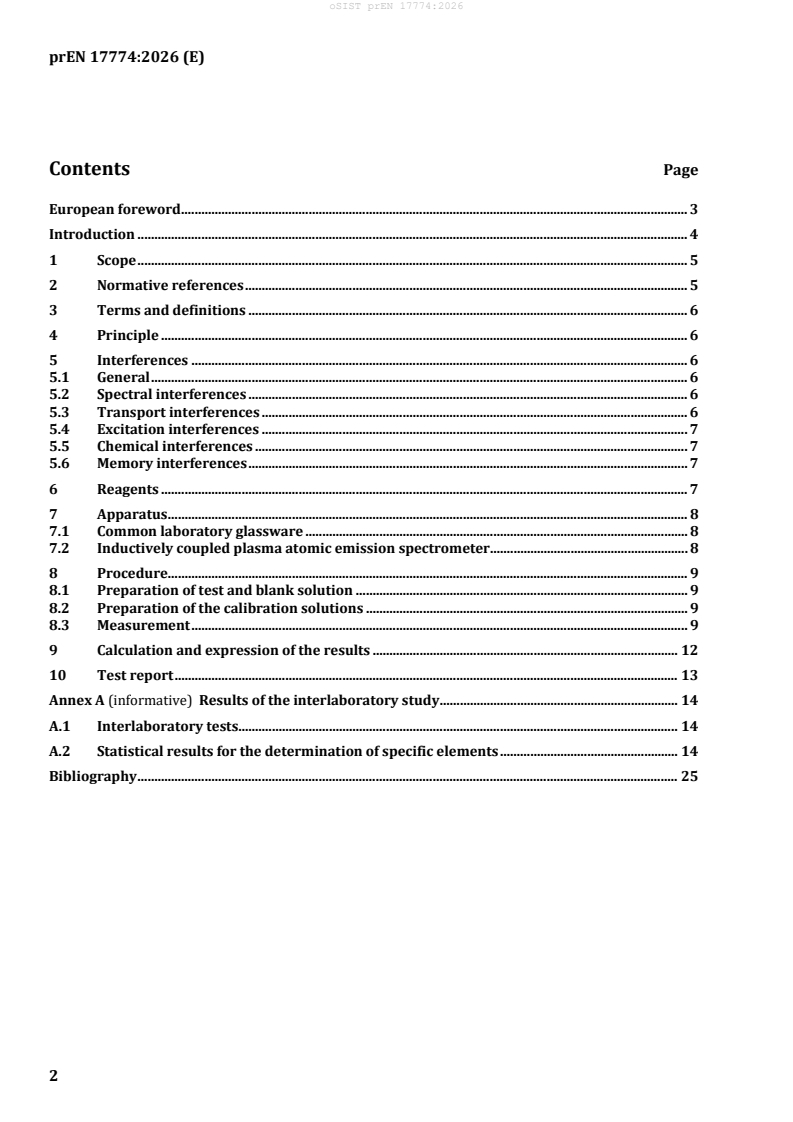
Contents
- Introduction
- 1 Scope
- 2 Normative references
- 3 Terms and definitions
- 4 Principle
- 5 Interferences
- 5.1 General
- 5.2 Spectral interferences
- 5.3 Transport interferences
- 5.4 Excitation interferences
- 5.5 Chemical interferences
- 5.6 Memory interferences
- 6 Reagents
- 6.6 Standard solution for boron, cobalt, copper, iron, manganese, molybdenum and zinc, mass
- 7 Apparatus
- 7.1 Common laboratory glassware
- 7.2 Inductively coupled plasma atomic emission spectrometer
- 8 Procedure
- 8.1 Preparation of test and blank solution
- 8.2 Preparation of the calibration solutions
- 8.3 Measurement
- 9 Calculation and expression of the results
- 10 Test report
- Annex A
- Bibliography
Introduction
Water is applied to extract available fraction of micronutrients from different matrices for their subsequent determination by ICP-AES. A similar procedure was applied for extraction of micronutrients from inorganic fertilizers [2].
Inductively coupled plasma atomic emission spectrometry (ICP-AES) is nowadays widely used and a wellestablished method in many laboratories. Inductively coupled plasma atomic emission spectrometry (ICP-AES) is often called also inductively coupled plasma optical emission spectrometry (ICP-OES). Both these terms are synonyms for the same analytical technique.
WARNING — Persons using this document should be familiar with usual laboratory practice. This document does not purport to address all of the safety issues, if any, associated with its use. It is the responsibility of the user to establish appropriate health and safety practices and to ensure compliance with any national regulatory conditions.
IMPORTANT — It is absolutely essential that tests conducted according to this document are carried out by suitably trained staff.
oSIST prEN 17774:2026 prEN 17774:2026 (E)
1 Scope
This document specifies a method for the determination of boron (B), cobalt (Co), copper (Cu), iron (Fe), manganese (Mn), molybdenum (Mo), phosphorous (P) and zinc (Zn) in organic and organo-mineral fertilizers using inductively coupled plasma-atomic emission spectrometry (ICP-AES). NOTE 1 Alternatively, inductively coupled plasma mass spectrometry (ICP-MS) can be used for the measurement if the user proves that the method gives the same results.
This method is applicable to extracts prepared according to prEN 17766, prEN 17767 and prEN 17779. NOTE 2 The method can be used for the determination of other elements, provided the user has verified the applicability.
This document is applicable to the fertilizing products blends where a blend is a mix of at least two of the following components: fertilizers, liming materials, soil improvers, growing media, inhibitors, plant biostimulants, and where the following category: organic fertilizers, organo-mineral fertilizers is the highest % in the blend by mass or volume, or in the case of liquid form by dry mass. If the organic fertilizer or the organo-mineral fertilizer is not the highest % in the blend, the European Standard for the highest % of the blend applies. In case a fertilizing product blend is composed of components in equal quantity, the user decides which standard to apply. Variations in analytical methods for fertilizing product blends can lead to differing results as some components or matrix interactions can affect the outcome. Validation procedures have shown that developed standard methods are robust and reliable across diverse product compositions, but possible interferences and unexpected results when analysing fertilizing product blends are possible.
2 Normative references
The following documents are referred to in the text in such a way that some or all of their content constitutes requirements of this document. For dated references, only the edition cited applies. For undated references, the latest edition of the referenced document (including any amendments) applies.
prEN 17766 , Organic and organo-mineral fertilizers — Extraction by water for subsequent determination of elements
prEN 17767, Organo-mineral fertilizers — Extraction of phosphorus by formic acid
prEN 17779, Organo-mineral fertilizers — Extraction of phosphorus soluble in a neutral ammonium citrate solution
prEN 17773, Organic and organo-mineral fertilizers — Determination of the dry matter content EN 12944-1, Fertilizers and liming materials — Vocabulary — Part 1: General terms EN 12944-2, Fertilizers and liming materials — Vocabulary — Part 2: Terms relating to fertilizers
Under preparation.
Under preparation.
Under preparation.
Under preparation.
oSIST prEN 17774:2026 prEN 17774:2026 (E)
3 Terms and definitions
For the purposes of this document, the terms and definitions given in EN 12944-1 and EN 12944-2 apply. ISO and IEC maintain terminological databases for use in standardization at the following addresses:
- ISO Online browsing platform: available at https://www.iso.org/obp
- IEC Electropedia: available at https://www.electropedia.org/
4 Principle
The method is based on the ICP-AES measurement of the concentration of boron (B), cobalt (Co), copper (Cu), iron (Fe), manganese (Mn), molybdenum (Mo) and zinc (Zn) in fertilizer extracts prepared according to prEN 17766 and can also be used for determination of phosphorous in the extracts prepared according to prEN 17767 and prEN 17779. The elements are determined directly or after appropriate dilution of the extract. The solution is dispersed by a nebulizer of the ICP-AES instrument and the resulting aerosol is transported into the plasma. Element specific emission spectra are produced by a radio-frequency inductively coupled argon plasma where atoms or ions are excited at high temperature. The emission spectra are dispersed by a spectrometer, and the intensities of the emission lines are monitored by photosensitive devices. Multi-element determinations using sequential or simultaneous optical systems and axial or radial viewing of the plasma may be used. The method may be used for the determination of other elements, provided the user has verified the applicability.
5 Interferences
5.1 General
Interferences and matrix effects shall be recognized and appropriate measures to minimize them shall be made. There are several types of interferences (see 5.2 to 5.6).
5.2 Spectral interferences
Spectral interferences are due to incomplete isolation of the radiation emitted by the analyte from other detected radiation sources. Spectral interferences are caused by background emission from continuous or recombination phenomena, by stray light which causes background increase or overlap of a spectral line from another element, or unresolved overlap of molecular band spectra. Background emission and stray light can usually be compensated for by subtracting the background emission measured adjacent to the analyte wavelength peak. To correct a sloping background shift two background correction points on each side of the peak are used. Increase of background is more intensive with axial-view instruments. Background correction is not required in cases of line broadening where a background correction measurement would actually degrade the analytical result. A spectral line overlap usually leads to the choice of an alternative line. If this is not possible, mathematical correction procedures (e.g. inter-element correction technique, multi-component spectral fitting) can be used to compensate for the interference. These correction procedures are usually a part of the instrument software.
5.3 Transport interferences
Transport interferences are caused by differences in the properties between the sample solutions and the calibration solutions (viscosity, surface tension, density, dissolved solid content, type and concentration of acids). As a consequence, the supply of solution to the nebuliser, the efficiency of nebulisation and the droplet size distribution of the aerosol is altered, resulting in a change of sensitivity. Errors due to these interferences can be overcome by dilution of the solutions, by matrix matching, by standard addition or by internal standard.
oSIST prEN 17774:2026 prEN 17774:2026 (E)
5.4 Excitation interferences
Excitation interferences are attributed to a change in the excitation conditions in the plasma, especially by the presence of easily ionisable elements. The interference depends on the operating conditions of the plasma (e.g. power, sample introduction, gas flowrate or observation height) and differ from element to element. Improvement of the plasma conditions can therefore reduce excitation interferences. Other possibilities are dilution of the solutions, matrix matching or the standard addition technique.
5.5 Chemical interferences
Chemical interferences are not significant with the ICP-AES technique, but if observed, they can be minimized by a careful selection of operating conditions (e.g. radio frequency power, observation position, gas flow rate and so forth).
5.6 Memory interferences
Memory interferences result when analytes in a previous sample contribute to the signals measured in a new sample. This type of interference can be caused by sample deposits or the accumulation in pump tubing, nebulizer, spray chamber or plasma torch. The possibility of memory interferences should be recognized within an analytical run and suitable rinse steps and rinse times should be used.
6 Reagents
All reagents shall be of recognized analytical grade and they shall have negligible concentration of the element to be determined if compared to the lowest concentration of that element in the sample solution. All solutions should be stored in clean boron-free vessels to avoid contamination during storage. 6.1 Water, with a specific conductivity not higher than 0,2 mS/m at 25 °C, free from the elements to be determined.
6.2 Ammonium hydroxide solution, containing 28 % to 29 % of NH .
6.3 Neutral ammonium citrate solution(C H O ·H O), pH = 7, mass concentration, 6 8 7 2 ρ(C H O ·H O) = 185 g/l, relative density = 1,09 at 20 °C.
6 8 7 2 Prepare the reagent as follows:
H O⋅H O) in about 1,5 l of water and make an approximately Dissolve 370 g of crystalline citric acid (C6 8 7 2 neutral solution by adding 345 ml of ammonium hydroxide solution (6.2). Cool and make exactly neutral by keeping the electrodes of a pH-meter immersed in the solution. Add the ammonium hydroxide solution (6.2), drop by drop, stirring continuously (e.g. with a mechanical stirrer) until obtaining exactly a pH of 7 at a temperature of 20 °C. At this point make up the volume with water (6.1) to 2 l and check the pH again. Keep the reagent in a closed container and check the pH at regular intervals.
Alternatively, a commercially certified solution can be used.
6.4 Formic acid 2 %, (ρ ≈ 20 g/l).
Make 82 ml of formic acid (concentration 98 % to 100 %; mass concentration at 20 °C ρ20 = 1,22 g/ml) up to 5 l with distilled water.
6.5 Standard stock solutions for boron, cobalt, copper, iron, manganese, molybdenum and zinc, mass concentration ρ = 1 000 mg/l for each element.
oSIST prEN 17774:2026 prEN 17774:2026 (E) Both single-element stock solutions and multi-element stock solutions with adequate specification, stating the acid used and the preparation technique, are commercially available. Multi-element stock solutions are usually available at the individual mass concentration ρ = 100 mg/l for each element. These solutions are considered to be stable for more than one year, but in reference to guaranteed stability, the recommendations of the manufacturer should be considered. Alternatively, the stock solutions may be prepared by dissolution of high purity metals.
NOTE If additional elements are to be determined, they can be included in the stock solution as well.
6.6 Standard solution for boron, cobalt, copper, iron, manganese, molybdenum and zinc, mass
concentration ρ = 100 mg/l of element.
Use commercially available multi-element solution of this concentration for each element or pipette 10 ml of the appropriate element stock solution (6.5) into a 100 ml volumetric flask, add 5 ml of diluted nitric acid (6.9.1), fill to the mark with water and mix well. This solution is used to prepare spiked test solutions and calibration solutions.
6.7 Standard stock solution for phosphorous, ρ = 1000 mg/l of P. This single-element stock solution is commercially available.
6.8 Argon, purity 99,995 % or higher.
6.9 Nitric acid, substance concentration c(HNO ) ≈ 14,3 mol/l; ρ ≈ 1,4 g/ml.
6.9.1 Diluted nitric acid solution, c(HNO ) = 5 mol/l.
Add 350 ml of nitric acid (6.9) to 650 ml of water.
7 Apparatus
7.1 Common laboratory glassware
If boron content is to be determined, it is necessary to avoid the contact of all solutions with borosilicate glassware. Suitable plastic or silica ware shall be used. Glass volumetric flasks may be used for making up to volume but not for storage of digests, reagents, and solutions.
7.2 Inductively coupled plasma atomic emission spectrometer
WARNING — It is essential that the manufacturer’s safety instructions are strictly observed when using this apparatus.
The ICP atomic-emission spectrometer consists of a sample introduction system, the plasma as an excitation source, an optical system, a detector and a computer with suitable software. The sample is transported by the introduction system (rotation tube pump, nebulizer and a spray chamber) to the plasma torch. Around the torch a water-cooled radio frequency (RF) coil is placed. A frequency from 27 MHz to 56 MHz with a power of 600 W to 2 000 W is usually used. The emission from the plasma can be observed either from the side (radial) or from the torch central symmetrical axis (axial). Axial viewing gives more signal intensity due to the increased observation path length of the normal analytical zone of the plasma but an increase of interference is also commonly observed. Spectral lines are measured and registered either in a sequential or a simultaneous manner.
oSIST prEN 17774:2026 prEN 17774:2026 (E)
...