

FprEN 17774
(Main)Organic and organo-mineral fertilizers - Determination of the content of specific elements by ICP-AES after extraction by water and weak solvents
- Abstract
This document specifies a method for the determination of boron (B), cobalt (Co), copper (Cu), iron (Fe), manganese (Mn), molybdenum (Mo), phosphorous (P) and zinc (Zn) in organic and organo-mineral fertilizers using inductively coupled plasma-atomic emission spectrometry (ICP-AES).
NOTE 1 Alternatively, inductively coupled plasma mass spectrometry (ICP-MS) can be used for the measurement if the user proves that the method gives the same results.
This method is applicable to extracts prepared according to prEN 17766, prEN 17767 and prEN 17779.
NOTE 2 The method can be used for the determination of other elements, provided the user has verified the applicability.
This document is applicable to the fertilizing products blends where a blend is a mix of at least two of the following components: fertilizers, liming materials, soil improvers, growing media, inhibitors, plant biostimulants, and where the following category: organic fertilizers, organo-mineral fertilizers is the highest % in the blend by mass or volume, or in the case of liquid form by dry mass. If the organic fertilizer or the organo-mineral fertilizer is not the highest % in the blend, the European Standard for the highest % of the blend applies. In case a fertilizing product blend is composed of components in equal quantity, the user decides which standard to apply. Variations in analytical methods for fertilizing product blends can lead to differing results as some components or matrix interactions can affect the outcome. Validation procedures have shown that developed standard methods are robust and reliable across diverse product compositions, but possible interferences and unexpected results when analysing fertilizing product blends are possible.
- Status
- Not Published
- Publication Date
- 17-Feb-2027
- Technical Committee
- CEN/TC 260 - Fertilizers and liming materials
- Drafting Committee
- CEN/TC 260/WG 8 - Organic and organo-mineral fertilizers
- Current Stage
- 4599 - Dispatch of FV draft to CMC - Finalization for Vote
- Start Date
- 27-Aug-2026
- Due Date
- 14-Mar-2027
- Completion Date
- 27-Aug-2026

FprEN 17774 is a CEN draft European Standard for laboratories measuring specific elements in organic and organo-mineral fertilizers. It specifies an ICP-AES method, after extraction by water and weak solvents, for boron, cobalt, copper, iron, manganese, molybdenum, phosphorous and zinc. The document is written for users who test extracts prepared according to prEN 17766, prEN 17767 or prEN 17779, including some fertilizing product blends.
What does FprEN 17774 specify?
FprEN 17774 specifies an analytical method for determining the content of selected elements in organic and organo-mineral fertilizers by inductively coupled plasma-atomic emission spectrometry (ICP-AES). The method is built around extracts from the companion extraction standards, so the fertilizer first has to be prepared in the right extract before the spectrometric measurement.
The document is organized into 10 clauses and one informative annex.
| Annex | What it covers |
|---|---|
| Annex A | Informative results of the interlaboratory study, including the sample set and statistical evaluation |
Clause 1 gives the scope, Clause 2 lists normative references, Clause 3 points to the applicable terms and definitions, and Clauses 4 to 10 cover the principle, interferences, reagents, apparatus, procedure, calculation and test report. Annex A provides supporting precision data from the collaborative trial.
The scope also covers fertilizing product blends when the organic fertilizer or organo-mineral fertilizer is the highest share in the blend. When another component dominates, the standard for that highest-share component applies.
What are the key requirements of FprEN 17774?
FprEN 17774 is a measurement method, so its practical requirements are mainly about using the right extract, controlling interferences, preparing calibration solutions correctly, and reporting the result in a traceable way.
Measurement principle and analytes
Clause 4 states that the method measures boron, cobalt, copper, iron, manganese, molybdenum, phosphorous and zinc in fertilizer extracts. The elements are measured directly or after suitable dilution, and the instrument may use sequential or simultaneous optics with axial or radial viewing. In practice, the user must choose operating conditions that suit the instrument and the matrix.
Clause 4 also allows the use of other elements if the user has verified applicability. Clause 1 adds that the method applies to extracts prepared according to prEN 17766, prEN 17767 and prEN 17779. That means the analytical step depends on the correct extraction step before the ICP-AES run.
Interferences and matrix control
Clause 5 requires the user to recognize and minimize interferences and matrix effects. It separates them into spectral, transport, excitation, chemical and memory interferences. In practice, this means checking line overlap, correcting background where needed, matching matrices or diluting samples, and using rinse steps between samples.
Clause 8 adds specific checks for unknown matrices. The standard calls for spike recovery, fivefold dilution checks, and measurement at another wavelength when needed. If the spike recovery or the dilution check falls outside the stated limits, the standard addition method is used. For the user, this is the document’s main safeguard against wrong results caused by a difficult fertilizer matrix.
Reagents and contamination control
Clause 6 sets basic reagent quality requirements. Reagents shall be of recognized analytical grade, and their element content shall be negligible compared with the lowest sample level. Water must be free from the target elements, and solutions should be stored in clean boron-free vessels.
The clause also lists the stock and working solutions needed for the micronutrients and for phosphorous. This matters in practice because contamination, especially with boron, can distort low-level results before the sample is even measured.
Apparatus and boron precautions
Clause 7 describes the ICP-AES instrument as a sample introduction system, plasma source, optical system, detector and software. It also states that borosilicate glassware shall be avoided when boron is being determined. In practice, laboratories need plastic or silica ware for boron work and should not store reagents or solutions in borosilicate containers.
Clause 7 also notes that manufacturers’ operating instructions shall be followed, and that higher RF power is preferable because it can reduce some interferences. The standard leaves detailed instrument settings to the user and the instrument type, which is normal for ICP-AES methods.
Procedure, calibration and quality checks
Clause 8 requires the test solution and blank solution to be prepared from the extract and diluted so the analyte concentration falls near the middle of the calibration range. Separate calibration schemes are given for micronutrients and for phosphorous. The user must measure calibration blank, calibration solutions, blank test solution, test sample solutions and quality control solutions under the same optimized conditions.
The clause also requires calibration stability checks during the run, with a calibration blank and calibration check solution every 20 samples or less and at the end. This means routine runs must include control points, not just samples.
Result calculation and reporting
Clause 9 gives the calculation of the element content from the measured sample and blank concentrations, the final volume, dilution factor and dry matter factor. Results may be expressed as received or recalculated on a dry matter content basis, and in mg/kg or %. For the reader, this clause shows how the instrument reading becomes the reportable fertilizer result.
Clause 10 lists the minimum report content: sample identification, extraction method, the standard used, the test method reference, results, sampling information if known, the analysis date and any optional operating details or incidents that could affect the result.
What terms does FprEN 17774 define?
FprEN 17774 uses the general fertilizer vocabulary from EN 12944-1 and EN 12944-2, and several recurring terms are central to reading the method.
- ICP-AES - inductively coupled plasma-atomic emission spectrometry, the technique used to measure the emitted light from the elements in the extract.
- ICP-MS - inductively coupled plasma mass spectrometry, which the scope allows as an alternative if the user proves equivalent results.
- Fertilizing product blend - a mix of at least two listed component types, with the applicable standard chosen according to the dominant component category.
- Blank test solution - a solution prepared by the same procedure as the test solution and used to correct the measured result.
- Calibration check solution - a calibration standard used during the run to verify that the calibration remains stable.
- Standard addition method - a matrix-check approach where a known amount of analyte is added to the sample to verify recovery.
- Dry matter content - the basis used when results are recalculated to a dry matter basis using prEN 17773.
- Matrix effects - signal changes caused by the sample composition, which can require dilution, matrix matching or standard addition.
Who uses FprEN 17774?
FprEN 17774 is used by laboratories that test organic fertilizers, organo-mineral fertilizers and relevant fertilizing product blends. It is relevant for routine quality control, supplier verification, contract laboratories, and conformity assessment work linked to fertilizer placing on the market.
The introduction also stresses that testing should be done by suitably trained staff. In practice, the method fits analysts who already work with ICP-AES, extraction procedures and analytical quality control.
What changed in FprEN 17774 from the previous edition?
FprEN 17774 is intended to supersede CEN/TS 17774:2022. The foreword states the following significant changes:
- the CEN Technical Specification has been adopted as a European Standard
- the title has been adapted
- the European foreword has been updated
- Clause 1 has been updated, including clarification on fertilizing product blends and applicability to prEN 17767 and prEN 17779
- the bibliography has been updated
- Annex A with interlaboratory study results has been added
Which standards are used with FprEN 17774?
| Standard | Contribution to FprEN 17774 |
|---|---|
| prEN 17766 | Water extraction of elements before ICP-AES measurement |
| prEN 17767 | Formic acid extraction of phosphorus |
| prEN 17779 | Neutral ammonium citrate extraction of phosphorus soluble in that solution |
| prEN 17773 | Determination of dry matter content for dry-matter-based reporting |
| EN 12944-1 | General vocabulary for fertilizers and liming materials |
| EN 12944-2 | Fertilizer-specific vocabulary |
| EN 16963 | Related ICP-AES method for boron, cobalt, copper, iron, manganese, molybdenum and zinc |
| ISO 5725-2 | Statistical basis used for the interlaboratory study evaluation in Annex A |
What does the FprEN 17774 document contain?
FprEN 17774 contains the analytical principle, interference guidance, reagent requirements, apparatus description, calibration and measurement steps, calculation formulas and reporting rules. It also includes Table 1 with recommended wavelengths and listed interfering elements, which helps the user choose a suitable analytical line.
The procedure sections describe how to prepare test, blank and calibration solutions, how to check matrix effects, and how to use spiking or standard addition when needed. Annex A collects the interlaboratory study information and statistical results behind the method’s precision data.
Relations
- Effective Date
- 11-Jun-2025
Get Certified
Connect with accredited certification bodies for this standard

Control Union Certifications
Global certification for agriculture and sustainability.

ECOCERT
Organic and sustainability certification.

FSC International
Forest Stewardship Council certification.
Sponsored listings
Frequently Asked Questions
FprEN 17774 is a draft published by the European Committee for Standardization (CEN). Its full title is "Organic and organo-mineral fertilizers - Determination of the content of specific elements by ICP-AES after extraction by water and weak solvents". This standard covers: This document specifies a method for the determination of boron (B), cobalt (Co), copper (Cu), iron (Fe), manganese (Mn), molybdenum (Mo), phosphorous (P) and zinc (Zn) in organic and organo-mineral fertilizers using inductively coupled plasma-atomic emission spectrometry (ICP-AES). NOTE 1 Alternatively, inductively coupled plasma mass spectrometry (ICP-MS) can be used for the measurement if the user proves that the method gives the same results. This method is applicable to extracts prepared according to prEN 17766, prEN 17767 and prEN 17779. NOTE 2 The method can be used for the determination of other elements, provided the user has verified the applicability. This document is applicable to the fertilizing products blends where a blend is a mix of at least two of the following components: fertilizers, liming materials, soil improvers, growing media, inhibitors, plant biostimulants, and where the following category: organic fertilizers, organo-mineral fertilizers is the highest % in the blend by mass or volume, or in the case of liquid form by dry mass. If the organic fertilizer or the organo-mineral fertilizer is not the highest % in the blend, the European Standard for the highest % of the blend applies. In case a fertilizing product blend is composed of components in equal quantity, the user decides which standard to apply. Variations in analytical methods for fertilizing product blends can lead to differing results as some components or matrix interactions can affect the outcome. Validation procedures have shown that developed standard methods are robust and reliable across diverse product compositions, but possible interferences and unexpected results when analysing fertilizing product blends are possible.
This document specifies a method for the determination of boron (B), cobalt (Co), copper (Cu), iron (Fe), manganese (Mn), molybdenum (Mo), phosphorous (P) and zinc (Zn) in organic and organo-mineral fertilizers using inductively coupled plasma-atomic emission spectrometry (ICP-AES). NOTE 1 Alternatively, inductively coupled plasma mass spectrometry (ICP-MS) can be used for the measurement if the user proves that the method gives the same results. This method is applicable to extracts prepared according to prEN 17766, prEN 17767 and prEN 17779. NOTE 2 The method can be used for the determination of other elements, provided the user has verified the applicability. This document is applicable to the fertilizing products blends where a blend is a mix of at least two of the following components: fertilizers, liming materials, soil improvers, growing media, inhibitors, plant biostimulants, and where the following category: organic fertilizers, organo-mineral fertilizers is the highest % in the blend by mass or volume, or in the case of liquid form by dry mass. If the organic fertilizer or the organo-mineral fertilizer is not the highest % in the blend, the European Standard for the highest % of the blend applies. In case a fertilizing product blend is composed of components in equal quantity, the user decides which standard to apply. Variations in analytical methods for fertilizing product blends can lead to differing results as some components or matrix interactions can affect the outcome. Validation procedures have shown that developed standard methods are robust and reliable across diverse product compositions, but possible interferences and unexpected results when analysing fertilizing product blends are possible.
FprEN 17774 is classified under the following ICS (International Classification for Standards) categories: 65.080 - Fertilizers. The ICS classification helps identify the subject area and facilitates finding related standards.
FprEN 17774 has the following relationships with other standards: It is inter standard links to CEN/TS 17774:2022. Understanding these relationships helps ensure you are using the most current and applicable version of the standard.
FprEN 17774 is associated with the following European legislation: EU Directives/Regulations: 2019/1009; Standardization Mandates: M/564, M/564 AMD 1, M/564 AMD 2. When a standard is cited in the Official Journal of the European Union, products manufactured in conformity with it benefit from a presumption of conformity with the essential requirements of the corresponding EU directive or regulation.
FprEN 17774 is available in PDF format for immediate download after purchase. The document can be added to your cart and obtained through the secure checkout process. Digital delivery ensures instant access to the complete standard document.
Standards Content (Sample)
SLOVENSKI STANDARD
01-marec-2026
Organska in organsko-mineralna gnojila - Določanje specifičnih elementov z
atomsko emisijsko spektrometrijo z induktivno sklopljeno plazmo (ICP-AES) po
ekstrakciji z vodo in šibkimi topili
Organic and organo-mineral fertilizers - Determination of the content of specific elements
by ICP-AES after extraction by water and weak solvents
Organische und organisch-mineralische Düngemittel - Bestimmung des Gehalts
spezifischer Elemente mittels ICP-AES nach Extraktion mit Wasser und schwachen
Lösungsmitteln
Engrais organiques et organo-minéraux - Détermination de la teneur en éléments
spécifiques par ICP-AES après extraction à l’eau et aux solvants faibles
Ta slovenski standard je istoveten z: prEN 17774
ICS:
65.080 Gnojila Fertilizers
2003-01.Slovenski inštitut za standardizacijo. Razmnoževanje celote ali delov tega standarda ni dovoljeno.
DRAFT
EUROPEAN STANDARD
prEN 17774
NORME EUROPÉENNE
EUROPÄISCHE NORM
January 2026
ICS 65.080 Will supersede CEN/TS 17774:2022
English Version
Organic and organo-mineral fertilizers - Determination of
the content of specific elements by ICP-AES after
extraction by water and weak solvents
Engrais organiques et organo-minéraux - Organische und organisch-mineralische Düngemittel -
Détermination de la teneur en éléments spécifiques par Bestimmung des Gehalts spezifischer Elemente mittels
ICP-AES après extraction à l'eau et aux solvants faibles ICP-AES nach Extraktion mit Wasser und schwachen
Lösungsmitteln
This draft European Standard is submitted to CEN members for enquiry. It has been drawn up by the Technical Committee
CEN/TC 260.
If this draft becomes a European Standard, CEN members are bound to comply with the CEN/CENELEC Internal Regulations
which stipulate the conditions for giving this European Standard the status of a national standard without any alteration.
This draft European Standard was established by CEN in three official versions (English, French, German). A version in any other
language made by translation under the responsibility of a CEN member into its own language and notified to the CEN-CENELEC
Management Centre has the same status as the official versions.
CEN members are the national standards bodies of Austria, Belgium, Bulgaria, Croatia, Cyprus, Czech Republic, Denmark, Estonia,
Finland, France, Germany, Greece, Hungary, Iceland, Ireland, Italy, Latvia, Lithuania, Luxembourg, Malta, Netherlands, Norway,
Poland, Portugal, Republic of North Macedonia, Romania, Serbia, Slovakia, Slovenia, Spain, Sweden, Switzerland, Türkiye and
United Kingdom.
Recipients of this draft are invited to submit, with their comments, notification of any relevant patent rights of which they are
aware and to provide supporting documentation.
Warning : This document is not a European Standard. It is distributed for review and comments. It is subject to change without
notice and shall not be referred to as a European Standard.
EUROPEAN COMMITTEE FOR STANDARDIZATION
COMITÉ EUROPÉEN DE NORMALISATION
EUROPÄISCHES KOMITEE FÜR NORMUNG
CEN-CENELEC Management Centre: Rue de la Science 23, B-1040 Brussels
© 2026 CEN All rights of exploitation in any form and by any means reserved Ref. No. prEN 17774:2026 E
worldwide for CEN national Members.
prEN 17774:2026 (E)
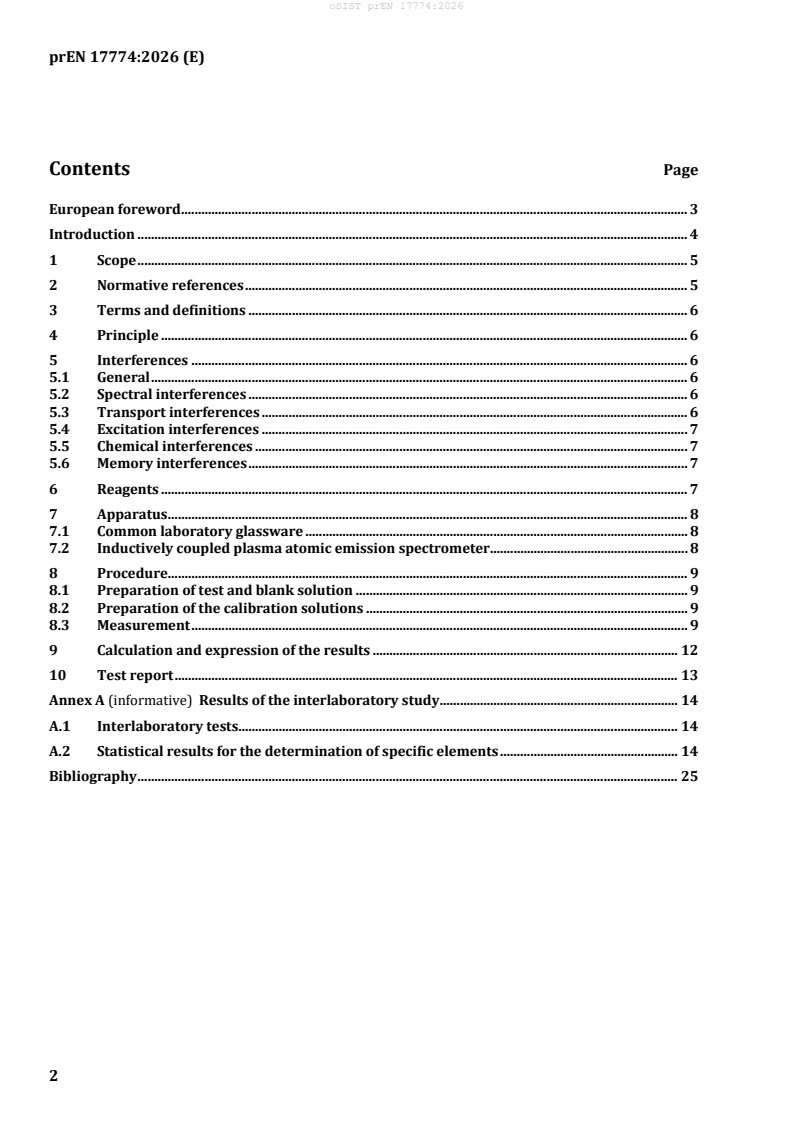
Contents Page
European foreword . 3
Introduction . 4
1 Scope . 5
2 Normative references . 5
3 Terms and definitions . 6
4 Principle . 6
5 Interferences . 6
5.1 General . 6
5.2 Spectral interferences . 6
5.3 Transport interferences . 6
5.4 Excitation interferences . 7
5.5 Chemical interferences . 7
5.6 Memory interferences . 7
6 Reagents . 7
7 Apparatus . 8
7.1 Common laboratory glassware . 8
7.2 Inductively coupled plasma atomic emission spectrometer . 8
8 Procedure. 9
8.1 Preparation of test and blank solution . 9
8.2 Preparation of the calibration solutions . 9
8.3 Measurement . 9
9 Calculation and expression of the results . 12
10 Test report . 13
Annex A (informative) Results of the interlaboratory study . 14
A.1 Interlaboratory tests . 14
A.2 Statistical results for the determination of specific elements . 14
Bibliography . 25
prEN 17774:2026 (E)
European foreword
This document (prEN 17774:2026) has been prepared by Technical Committee CEN/TC 260 “Fertilizers
and liming materials”, the secretariat of which is held by DIN.
This document is currently submitted to the CEN Enquiry.
This document will supersede CEN/TS 17774:2022.
Compared to the previous edition, prEN 17774:2026 includes the following significant technical changes:
— the CEN Technical Specification has been adopted as a European Standard;
— title adapted;
— European foreword updated;
— Scope (Clause 1) updated including the clarification on fertilizing product blends and the applicability
to prEN 17767, Organo-mineral fertilizers — Extraction of phosphorus by formic acid and prEN 17779,
Organo-mineral fertilizers — Extraction of phosphorus, soluble in a neutral ammonium citrate solution;
— Bibliography updated;
— Annex A (Results of the inter-laboratory study) added.
This document has been prepared under a Standardization Request addressed to CEN by the European
Commission. The Standing Committee of the EFTA States subsequently approves these requests for its
Member States.
prEN 17774:2026 (E)
Introduction
Water is applied to extract available fraction of micronutrients from different matrices for their
subsequent determination by ICP-AES. A similar procedure was applied for extraction of micronutrients
from inorganic fertilizers [2].
Inductively coupled plasma atomic emission spectrometry (ICP-AES) is nowadays widely used and a well-
established method in many laboratories.
Inductively coupled plasma atomic emission spectrometry (ICP-AES) is often called also inductively
coupled plasma optical emission spectrometry (ICP-OES). Both these terms are synonyms for the same
analytical technique.
WARNING — Persons using this document should be familiar with usual laboratory practice. This
document does not purport to address all of the safety issues, if any, associated with its use. It is the
responsibility of the user to establish appropriate health and safety practices and to ensure compliance
with any national regulatory conditions.
IMPORTANT — It is absolutely essential that tests conducted according to this document are carried out
by suitably trained staff.
prEN 17774:2026 (E)
1 Scope
This document specifies a method for the determination of boron (B), cobalt (Co), copper (Cu), iron (Fe),
manganese (Mn), molybdenum (Mo), phosphorous (P) and zinc (Zn) in organic and organo-mineral
fertilizers using inductively coupled plasma-atomic emission spectrometry (ICP-AES).
NOTE 1 Alternatively, inductively coupled plasma mass spectrometry (ICP-MS) can be used for the measurement
if the user proves that the method gives the same results.
This method is applicable to extracts prepared according to prEN 17766, prEN 17767 and prEN 17779.
NOTE 2 The method can be used for the determination of other elements, provided the user has verified the
applicability.
This document is applicable to the fertilizing products blends where a blend is a mix of at least two of the
following components: fertilizers, liming materials, soil improvers, growing media, inhibitors, plant
biostimulants, and where the following category: organic fertilizers, organo-mineral fertilizers is the
highest % in the blend by mass or volume, or in the case of liquid form by dry mass. If the organic fertilizer
or the organo-mineral fertilizer is not the highest % in the blend, the European Standard for the highest
% of the blend applies. In case a fertilizing product blend is composed of components in equal quantity,
the user decides which standard to apply. Variations in analytical methods for fertilizing product blends
can lead to differing results as some components or matrix interactions can affect the outcome. Validation
procedures have shown that developed standard methods are robust and reliable across diverse product
compositions, but possible interferences and unexpected results when analysing fertilizing product
blends are possible.
2 Normative references
The following documents are referred to in the text in such a way that some or all of their content
constitutes requirements of this document. For dated references, only the edition cited applies. For
undated references, the latest edition of the referenced document (including any amendments) applies.
prEN 17766 , Organic and organo-mineral fertilizers — Extraction by water for subsequent determination
of elements
prEN 17767, Organo-mineral fertilizers — Extraction of phosphorus by formic acid
prEN 17779, Organo-mineral fertilizers — Extraction of phosphorus soluble in a neutral ammonium
citrate solution
prEN 17773, Organic and organo-mineral fertilizers — Determination of the dry matter content
EN 12944-1, Fertilizers and liming materials — Vocabulary — Part 1: General terms
EN 12944-2, Fertilizers and liming materials — Vocabulary — Part 2: Terms relating to fertilizers
Under preparation.
Under preparation.
Under preparation.
Under preparation.
prEN 17774:2026 (E)
3 Terms and definitions
For the purposes of this document, the terms and definitions given in EN 12944-1 and EN 12944-2 apply.
ISO and IEC maintain terminological databases for use in standardization at the following addresses:
— ISO Online browsing platform: available at https://www.iso.org/obp
— IEC Electropedia: available at https://www.electropedia.org/
4 Principle
The method is based on the ICP-AES measurement of the concentration of boron (B), cobalt (Co), copper
(Cu), iron (Fe), manganese (Mn), molybdenum (Mo) and zinc (Zn) in fertilizer extracts prepared
according to prEN 17766 and can also be used for determination of phosphorous in the extracts prepared
according to prEN 17767 and prEN 17779. The elements are determined directly or after appropriate
dilution of the extract. The solution is dispersed by a nebulizer of the ICP-AES instrument and the
resulting aerosol is transported into the plasma. Element specific emission spectra are produced by a
radio-frequency inductively coupled argon plasma where atoms or ions are excited at high temperature.
The emission spectra are dispersed by a spectrometer, and the intensities of the emission lines are
monitored by photosensitive devices. Multi-element determinations using sequential or simultaneous
optical systems and axial or radial viewing of the plasma may be used.
The method may be used for the determination of other elements, provided the user has verified the
applicability.
5 Interferences
5.1 General
Interferences and matrix effects shall be recognized and appropriate measures to minimize them shall be
made. There are several types of interferences (see 5.2 to 5.6).
5.2 Spectral interferences
Spectral interferences are due to incomplete isolation of the radiation emitted by the analyte from other
detected radiation sources. Spectral interferences are caused by background emission from continuous
or recombination phenomena, by stray light which causes background increase or overlap of a spectral
line from another element, or unresolved overlap of molecular band spectra. Background emission and
stray light can usually be compensated for by subtracting the background emission measured adjacent to
the analyte wavelength peak. To correct a sloping background shift two background correction points on
each side of the peak are used. Increase of background is more intensive with axial-view instruments.
Background correction is not required in cases of line broadening where a background correction
measurement would actually degrade the analytical result. A spectral line overlap usually leads to the
choice of an alternative line. If this is not possible, mathematical correction procedures (e.g. inter-element
correction technique, multi-component spectral fitting) can be used to compensate for the interference.
These correction procedures are usually a part of the instrument software.
5.3 Transport interferences
Transport interferences are caused by differences in the properties between the sample solutions and
the calibration solutions (viscosity, surface tension, density, dissolved solid content, type and
concentration of acids). As a consequence, the supply of solution to the nebuliser, the efficiency of
nebulisation and the droplet size distribution of the aerosol is altered, resulting in a change of sensitivity.
Errors due to these interferences can be overcome by dilution of the solutions, by matrix matching, by
standard addition or by internal standard.
prEN 17774:2026 (E)
5.4 Excitation interferences
Excitation interferences are attributed to a change in the excitation conditions in the plasma, especially
by the presence of easily ionisable elements. The interference depends on the operating conditions of the
plasma (e.g. power, sample introduction, gas flowrate or observation height) and differ from element to
element. Improvement of the plasma conditions can therefore reduce excitation interferences. Other
possibilities are dilution of the solutions, matrix matching or the standard addition technique.
5.5 Chemical interferences
Chemical interferences are not significant with the ICP-AES technique, but if observed, they can be
minimized by a careful selection of operating conditions (e.g. radio frequency power, observation
position, gas flow rate and so forth).
5.6 Memory interferences
Memory interferences result when analytes in a previous sample contribute to the signals measured in a
new sample. This type of interference can be caused by sample deposits or the accumulation in pump
tubing, nebulizer, spray chamber or plasma torch. The possibility of memory interferences should be
recognized within an analytical run and suitable rinse steps and rinse times should be used.
6 Reagents
All reagents shall be of recognized analytical grade and they shall have negligible concentration of the
element to be determined if compared to the lowest concentration of that element in the sample solution.
All solutions should be stored in clean boron-free vessels to avoid contamination during storage.
6.1 Water, with a specific conductivity not higher than 0,2 mS/m at 25 °C, free from the elements to be
determined.
6.2 Ammonium hydroxide solution, containing 28 % to 29 % of NH .
6.3 Neutral ammonium citrate solution(C H O ·H O), pH = 7, mass concentration,
6 8 7 2
ρ(C H O ·H O) = 185 g/l, relative density = 1,09 at 20 °C.
6 8 7 2
Prepare the reagent as follows:
H O⋅H O) in about 1,5 l of water and make an approximately
Dissolve 370 g of crystalline citric acid (C6 8 7 2
neutral solution by adding 345 ml of ammonium hydroxide solution (6.2).
Cool and make exactly neutral by keeping the electrodes of a pH-meter immersed in the solution. Add the
ammonium hydroxide solution (6.2), drop by drop, stirring continuously (e.g. with a mechanical stirrer)
until obtaining exactly a pH of 7 at a temperature of 20 °C. At this point make up the volume with water
(6.1) to 2 l and check the pH again. Keep the reagent in a closed container and check the pH at regular
intervals.
Alternatively, a commercially certified solution can be used.
6.4 Formic acid 2 %, (ρ ≈ 20 g/l).
Make 82 ml of formic acid (concentration 98 % to 100 %; mass concentration at 20 °C ρ20 = 1,22 g/ml)
up to 5 l with distilled water.
6.5 Standard stock solutions for boron, cobalt, copper, iron, manganese, molybdenum and zinc,
mass concentration ρ = 1 000 mg/l for each element.
prEN 17774:2026 (E)
Both single-element stock solutions and multi-element stock solutions with adequate specification,
stating the acid used and the preparation technique, are commercially available. Multi-element stock
solutions are usually available at the individual mass concentration ρ = 100 mg/l for each element. These
solutions are considered to be stable for more than one year, but in reference to guaranteed stability, the
recommendations of the manufacturer should be considered. Alternatively, the stock solutions may be
prepared by dissolution of high purity metals.
NOTE If additional elements are to be determined, they can be included in the stock solution as well.
6.6 Standard solution for boron, cobalt, copper, iron, manganese, molybdenum and zinc, mass
concentration ρ = 100 mg/l of element.
Use commercially available multi-element solution of this concentration for each element or pipette
10 ml of the appropriate element stock solution (6.5) into a 100 ml volumetric flask, add 5 ml of diluted
nitric acid (6.9.1), fill to the mark with water and mix well. This solution is used to prepare spiked test
solutions and calibration solutions.
6.7 Standard stock solution for phosphorous, ρ = 1000 mg/l of P.
This single-element stock solution is commercially available.
6.8 Argon, purity 99,995 % or higher.
6.9 Nitric acid, substance concentration c(HNO ) ≈ 14,3 mol/l; ρ ≈ 1,4 g/ml.
6.9.1 Diluted nitric acid solution, c(HNO ) = 5 mol/l.
Add 350 ml of nitric acid (6.9) to 650 ml of water.
7 Apparatus
7.1 Common laboratory glassware
If boron content is to be determined, it is necessary to avoid the contact of all solutions with borosilicate
glassware. Suitable plastic or silica ware shall be used. Glass volumetric flasks may be used for making
up to volume but not for storage of digests, reagents, and solutions.
7.2 Inductively coupled plasma atomic emission spectrometer
WARNING — It is essential that the manufacturer’s safety instructions are strictly observed when using
this apparatus.
The ICP atomic-emission spectrometer consists of a sample introduction system, the plasma as an
excitation source, an optical system, a detector and a computer with suitable software. The sample is
transported by the introduction system (rotation tube pump, nebulizer and a spray chamber) to the
plasma torch. Around the torch a water-cooled radio frequency (RF) coil is placed. A frequency from
27 MHz to 56 MHz with a power of 600 W to 2 000 W is usually used. The emission from the plasma can
be observed either from the side (radial) or from the torch central symmetrical axis (axial). Axial viewing
gives more signal intensity due to the increased observation path length of the normal analytical zone of
the plasma but an increase of interference is also commonly observed. Spectral lines are measured and
registered either in a sequential or a simultaneous manner.
prEN 17774:2026 (E)
8 Procedure
8.1 Preparation of test and blank solution
Dilute an aliquot portion of the extract, obtained according to prEN 17766, prEN 17767 or prEN 17779
in one or more steps so that the final concentration of the element to be determined is approximately in
the middle of the given calibration range (8.2). In the final diluting step add a suitable volume of the
extract or diluted extract to a 100 ml volumetric flask, add 5 ml diluted nitric acid (6.9.1), fill to the mark
with water and mix well.
A blank test solution is prepared for the measurement following the same procedure as for test sample
solutions. If dilution is necessary, dilute an aliquot portion of the extract in one or more steps so that the
final concentration of the element to be determined is approximately in the middle of the given
calibration range (8.2). In the final diluting step fill to the mark with water (6.1) or extracting solutions
for phosphorus determination (6.3; 6.4) and mix well. Prepare a diluted blank test solution by pipetting
a blank test solution and dilute in the same way as the test sample solution
8.2 Preparation of the calibration solutions
8.2.1 Calibration solutions for micro-nutrients
Pipette volumes of 0 ml; 0,5 ml; 2 ml; 5 ml and 10 ml of the standard solution (6.6) and 5 ml of diluted
nitric acid (6.9.1) into five 100 ml volumetric flasks respectively. Fill to the mark with water. The mass
concentrations of each element in the calibration solutions are: 0 mg/l; 0,5 mg/l; 2 mg/l; 5 mg/l and
10 mg/l. Mixed calibration solutions for all elements or individual sets of calibration solutions for each
element may be used. If necessary, calibration solutions of higher or lower concentrations may be
prepared in the same way.
NOTE It is possible to calibrate the instrument for higher concentrations of the micronutrients if the calibration
curve is linear.
8.2.2 Calibration solutions for phosphorus
Pipette volumes of 0 ml; 10 ml; 20 ml, 30 ml, 40 ml and 50
...