

SIST EN 14069:2026
(Main)Liming materials - Denominations, specifications and labelling
General Information
- Abstract
This document describes and specifies the requirements of products of natural origin and products from industrial processes of basic and fine quality to be used as liming materials in agriculture for raising the pH of soil (and water).
- Status
- Published
- Public Enquiry End Date
- 19-Aug-2024
- Publication Date
- 12-Feb-2026
- Technical Committee
- KAT - Soil quality
- Current Stage
- 6060 - National Implementation/Publication (Adopted Project)
- Start Date
- 21-Nov-2025
- Due Date
- 26-Jan-2026
- Completion Date
- 13-Feb-2026

Overview
EN 14069:2025 (CEN) - Liming materials - Denominations, specifications and labelling - defines minimum requirements, labelling and testable characteristics for liming materials of natural origin and industrial origin used to raise soil (and water) pH. The standard covers both basic (standard) and fine-quality liming products and aligns with Regulation (EU) 2019/1009. It supersedes EN 14069:2017 and is intended for use across CEN member countries.
Key topics and technical requirements
- Scope and structure: Clauses include scope, normative references, terms/definitions, denominations/specifications, analytical methods, tolerances, use of terms and declaration requirements.
- Product categories: Detailed type designations and minimum specifications are presented in tables (Table 1–6) for:
- Natural limes (limestone, magnesian, dolomitic, marine, chalk)
- Oxide/hydroxide limes of natural origin
- Limes from industrial processes
- Silicate limes, mixed limes and mixtures with fertilizing products
- Neutralizing value: Requirements expressed as CaO-equivalent (with an alternative expression in brackets). Example minimum neutralizing values in the standard:
- Limestone (standard): NV ≥ 42% CaO
- Limestone (fine): NV ≥ 50% CaO
- Magnesian limestone (standard): NV ≥ 45% CaO (fine: 52% CaO)
- Dolomitic limestone (standard): NV ≥ 48% CaO (fine: 54% CaO)
- Marine limestone and chalk have defined NV and fineness criteria
- Fineness and reactivity: Specific sieving distributions (e.g., ≥97% passing 3.15 mm; fine grades require higher proportions passing 2 mm, 1 mm, 0.315 mm and 0.1 mm) and reactivity tests (EN 13971, EN 16357, EN 14984) are specified for performance classification.
- Analytical methods and tolerances: References to established test methods for moisture (EN 12048), neutralizing value (EN 12945), Ca/Mg content (EN 12946/EN 12947/EN 13475), sieving (EN 12948), CO2 (EN 14397-2), and breakdown of granules (EN 15704).
- Labelling and declaration: Mandatory declaration elements and permitted product denominations, enabling consistent labelling across the EU and reference to the Fertiliser Product Regulation.
Applications
- Agricultural liming to correct soil acidity and improve fertility
- Forestry and environmental applications (forest liming, lake and water catchment area treatment)
- Formulation and quality control of liming products (producers and processors)
- Regulatory compliance and market labelling across EU member states
Who should use this standard
- Liming material manufacturers and granulators
- Fertilizer and agri-input distributors
- Agricultural laboratories and testing bodies
- Agronomists, soil specialists and farm advisors
- National regulators implementing fertiliser product rules
Related standards and references
- Regulation (EU) 2019/1009 (Fertiliser Product Regulation)
- EN 12048, EN 12945, EN 12946, EN 12947, EN 12948, EN 13971, EN 14397‑2, EN 14984, EN 15704, EN 16357, ISO 6598, ISO 7497
Keywords: EN 14069:2025, liming materials, limestone specification, neutralizing value, soil pH, CEN standard, fineness, reactivity, liming labelling, fertilizer standard.
Relations
- Effective Date
- 01-Mar-2026
- Effective Date
- 28-Jan-2026
- Effective Date
- 28-Jan-2026
- Effective Date
- 28-Jan-2026
- Effective Date
- 28-Jan-2026
- Effective Date
- 28-Jan-2026
- Effective Date
- 28-Jan-2026
- Effective Date
- 28-Jan-2026
- Effective Date
- 28-Jan-2026
- Effective Date
- 28-Jan-2026
- Effective Date
- 28-Jan-2026
- Effective Date
- 28-Jan-2026
- Refers
SIST EN 12948:2011 - Liming materials - Determination of size distribution by dry and wet sieving - Effective Date
- 28-Jan-2026
- Effective Date
- 28-Jan-2026
- Effective Date
- 28-Jan-2026
Get Certified
Connect with accredited certification bodies for this standard

Control Union Certifications
Global certification for agriculture and sustainability.

ECOCERT
Organic and sustainability certification.

FSC International
Forest Stewardship Council certification.
Sponsored listings
Frequently Asked Questions
SIST EN 14069:2026 is a standard published by the Slovenian Institute for Standardization (SIST). Its full title is "Liming materials - Denominations, specifications and labelling". This standard covers: This document describes and specifies the requirements of products of natural origin and products from industrial processes of basic and fine quality to be used as liming materials in agriculture for raising the pH of soil (and water).
This document describes and specifies the requirements of products of natural origin and products from industrial processes of basic and fine quality to be used as liming materials in agriculture for raising the pH of soil (and water).
SIST EN 14069:2026 is classified under the following ICS (International Classification for Standards) categories: 65.080 - Fertilizers. The ICS classification helps identify the subject area and facilitates finding related standards.
SIST EN 14069:2026 has the following relationships with other standards: It is inter standard links to SIST EN 14069:2018, SIST EN 12946:2024, SIST CR 13960:2002, SIST EN 13856:2002, SIST EN 14397-2:2005, SIST EN 12944-1:2002, SIST EN 12945:2014+A1:2016, SIST EN 14984:2017, SIST EN 12048:1999, SIST EN 13475:2002, SIST EN 12944-3:2026, SIST EN 12049:1999, SIST EN 12948:2011, SIST EN 13971:2020, SIST EN 16357:2013. Understanding these relationships helps ensure you are using the most current and applicable version of the standard.
SIST EN 14069:2026 is available in PDF format for immediate download after purchase. The document can be added to your cart and obtained through the secure checkout process. Digital delivery ensures instant access to the complete standard document.
Standards Content (Sample)
SLOVENSKI STANDARD
01-marec-2026
Nadomešča:
SIST EN 14069:2018
Sredstva za apnjenje - Opisi, specifikacije in označevanje
Liming materials - Denominations, specifications and labelling
Kalkdünger - Bezeichnung, Spezifizierung und Kennzeichnung
Amendements minéraux basiques - Dénominations, spécifications et étiquetage
Ta slovenski standard je istoveten z: EN 14069:2025
ICS:
65.080 Gnojila Fertilizers
2003-01.Slovenski inštitut za standardizacijo. Razmnoževanje celote ali delov tega standarda ni dovoljeno.
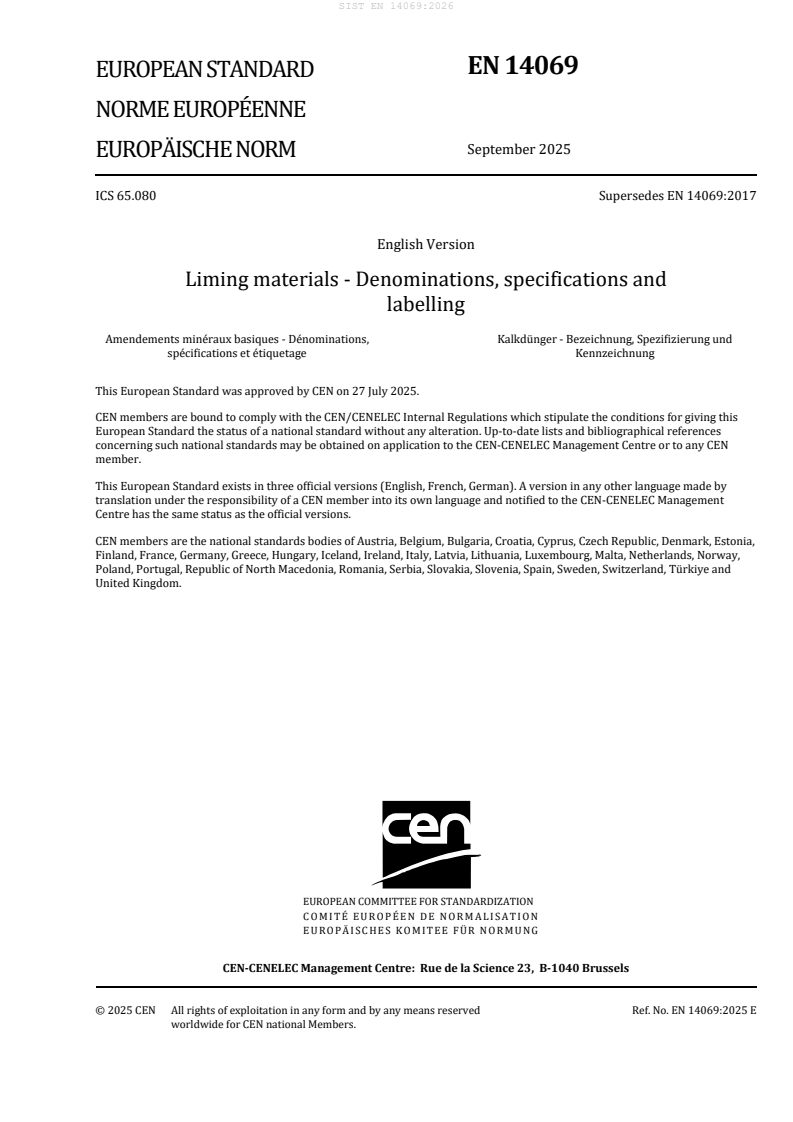
EN 14069
EUROPEAN STANDARD
NORME EUROPÉENNE
September 2025
EUROPÄISCHE NORM
ICS 65.080 Supersedes EN 14069:2017
English Version
Liming materials - Denominations, specifications and
labelling
Amendements minéraux basiques - Dénominations, Kalkdünger - Bezeichnung, Spezifizierung und
spécifications et étiquetage Kennzeichnung
This European Standard was approved by CEN on 27 July 2025.
CEN members are bound to comply with the CEN/CENELEC Internal Regulations which stipulate the conditions for giving this
European Standard the status of a national standard without any alteration. Up-to-date lists and bibliographical references
concerning such national standards may be obtained on application to the CEN-CENELEC Management Centre or to any CEN
member.
This European Standard exists in three official versions (English, French, German). A version in any other language made by
translation under the responsibility of a CEN member into its own language and notified to the CEN-CENELEC Management
Centre has the same status as the official versions.
CEN members are the national standards bodies of Austria, Belgium, Bulgaria, Croatia, Cyprus, Czech Republic, Denmark, Estonia,
Finland, France, Germany, Greece, Hungary, Iceland, Ireland, Italy, Latvia, Lithuania, Luxembourg, Malta, Netherlands, Norway,
Poland, Portugal, Republic of North Macedonia, Romania, Serbia, Slovakia, Slovenia, Spain, Sweden, Switzerland, Türkiye and
United Kingdom.
EUROPEAN COMMITTEE FOR STANDARDIZATION
COMITÉ EUROPÉEN DE NORMALISATION
EUROPÄISCHES KOMITEE FÜR NORMUNG
CEN-CENELEC Management Centre: Rue de la Science 23, B-1040 Brussels
© 2025 CEN All rights of exploitation in any form and by any means reserved Ref. No. EN 14069:2025 E
worldwide for CEN national Members.
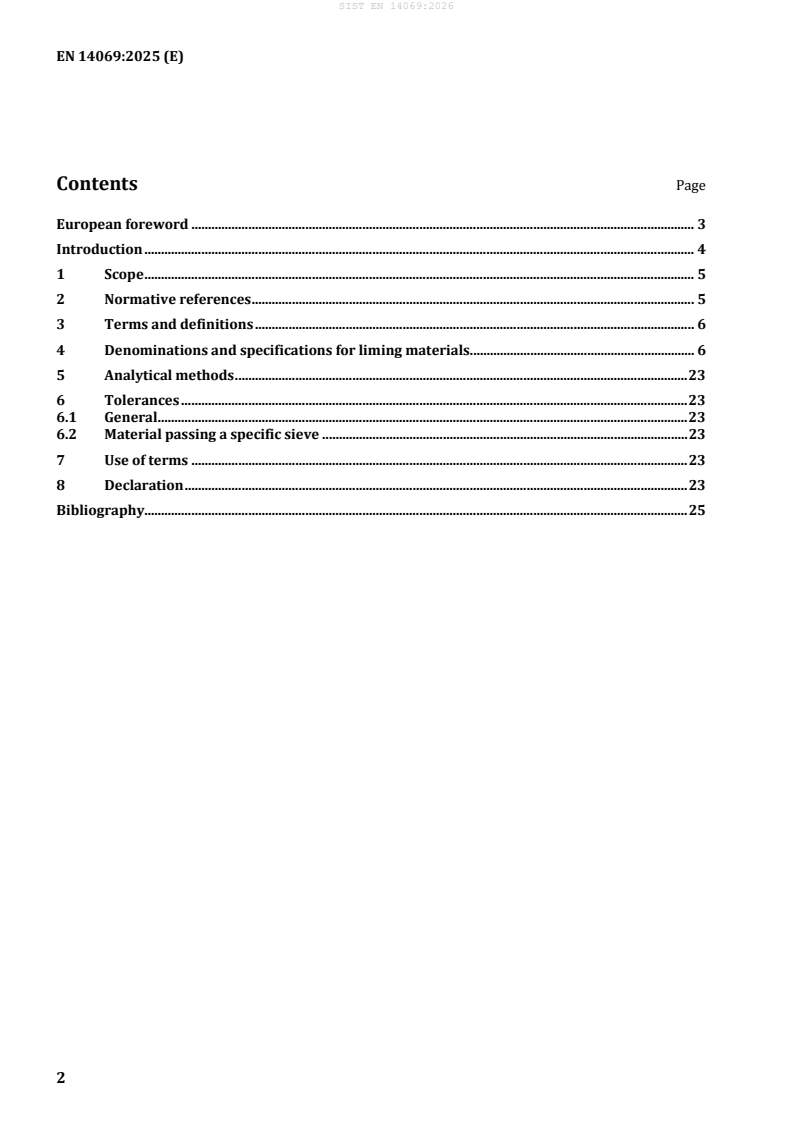
Contents Page
European foreword . 3
Introduction . 4
1 Scope . 5
2 Normative references . 5
3 Terms and definitions . 6
4 Denominations and specifications for liming materials. 6
5 Analytical methods . 23
6 Tolerances . 23
6.1 General . 23
6.2 Material passing a specific sieve . 23
7 Use of terms . 23
8 Declaration . 23
Bibliography. 25
European foreword
This document (EN 14069:2025) has been prepared by Technical Committee CEN/TC 260 “Fertilizers
and liming materials”, the secretariat of which is held by DIN.
This European Standard shall be given the status of a national standard, either by publication of an
identical text or by endorsement, at the latest by March 2026, and conflicting national standards shall be
withdrawn at the latest by March 2026.
Attention is drawn to the possibility that some of the elements of this document may be the subject of
patent rights. CEN shall not be held responsible for identifying any or all such patent rights.
This document supersedes EN 14069:2017.
a) Informational reference to the Fertilisers Product Regulation (Regulation (EU) 2019/1009)
repealing Regulation (EC) 2003/2003;
b) Revision of chalk definition using Regulation (EU) 2019/1009 as a source;
c) Modification of Clause 8 on Declaration.
Any feedback and questions on this document should be directed to the users’ national standards body.
A complete listing of these bodies can be found on the CEN website.
According to the CEN-CENELEC Internal Regulations, the national standards organisations of the
following countries are bound to implement this European Standard: Austria, Belgium, Bulgaria, Croatia,
Cyprus, Czech Republic, Denmark, Estonia, Finland, France, Germany, Greece, Hungary, Iceland, Ireland,
Italy, Latvia, Lithuania, Luxembourg, Malta, Netherlands, Norway, Poland, Portugal, Republic of North
Macedonia, Romania, Serbia, Slovakia, Slovenia, Spain, Sweden, Switzerland, Türkiye and the United
Kingdom.
Introduction
Throughout the member countries of CEN, regular liming to regulate the soil pH level and to neutralize
the effect of soil acidification is a well-established and essential agricultural operation on all soils in
humid climates and under all systems of agricultural cultivation. Liming improves soil fertility and
supplies essential plant nutrients.
Liming materials are also used in forest liming, lake liming and the liming of water catchment areas.
A wide range of natural geological deposits of liming materials is found in all member countries of CEN.
Some industrial processes produce materials acceptable as liming products. This very wide range of
material differs substantially in both chemical and physical properties. The use of these various materials
will vary according to the type of material.
However, for the purpose of comparison of these products, it is relevant to describe and specify the
minimum requirements of a liming material.
NOTE Regulation (EU) 2019/1009 [1], which replaces Regulation (EC) No 2003/2003 [2] and has an
accompanying communication on visual aspects of labels [3] that allows to refer to denominations (type
designations) of this standard in the label section “additional information”, has been used as a source for this
document.
Liming materials in Europe show a large diversity due to factors as climate and type of crops, production,
transport, storing and spreading of lime adapted to regional conditions. Standard quality covers these
varying liming materials, whilst fine quality credits rapidly dissolving materials needed for certain
specialized agricultural productions or to allow the dissolution of the liming material in some soil types
having a higher pH value in a rapid and controlled way.
1 Scope
This document describes and specifies the requirements of products of natural origin and products from
industrial processes of basic and fine quality to be used as liming materials in agriculture for raising the
pH of soil (and water).
2 Normative references
The following documents are referred to in the text in such a way that some or all of their content
constitutes requirements of this document. For dated references, only the edition cited applies. For
undated references, the latest edition of the referenced document (including any amendments) applies.
EN 12048, Solid fertilizers and liming materials — Determination of moisture content — Gravimetric
method by drying at (105 ± 2)°C (ISO 8190:1992, modified)
EN 12049, Solid fertilizers and liming materials - Determination of moisture content - Gravimetric method
by drying under reduced pressure (ISO 8189:1992 modified)
EN 12944-1, Fertilizers and liming materials — Vocabulary — Part 1: General terms
EN 12944-3, Fertilizers and liming materials — Vocabulary — Part 3: Terms relating to liming materials
EN 12945, Liming materials — Determination of neutralizing value — Titrimetric methods
EN 12946, Liming materials — Determination of the calcium content and magnesium content —
Complexometric method
EN 12947, Liming materials — Determination of magnesium content — Atomic absorption spectrometric
method
EN 12948, Liming materials — Determination of size distribution by dry and wet sieving
EN 13475, Liming materials — Determination of calcium content — Oxalate method
EN 13971, Carbonate and silicate liming materials — Determination of reactivity — Potentiometric
titration method with hydrochloric acid
EN 14397-2, Fertilizers and liming materials — Determination of carbon dioxide — Part 2: Method for
liming materials
EN 14984, Liming materials — Determination of product effect on soil pH — Soil incubation method
EN 15704, Liming materials — Determination of the breakdown of granulated calcium and
calcium/magnesium carbonates under the influence of water
EN 16357, Carbonate liming materials — Determination of reactivity — Automatic titration method with
citric acid
ISO 6598, Fertilizers — Determination of phosphorus content — Quinoline phosphomolybdate gravimetric
method
ISO 7497, Fertilizers — Extraction of phosphates soluble in mineral acids
3 Terms and definitions
For the purposes of this document, the terms and definitions given in EN 12944-1 and EN 12944-3 apply.
ISO and IEC maintain terminology databases for use in standardization at the following addresses:
— ISO Online browsing platform: available at https://www.iso.org/obp/
— IEC Electropedia: available at https://www.electropedia.org/
4 Denominations and specifications for liming materials
The denominations (type designations), specifications and elements to be declared are specified in
Table 1 to Table 6 as follows:
— Table 1: Natural limes;
— Table 2: Oxide and hydroxide limes of natural origin;
— Table 3: Limes from industrial processes;
— Table 4: Silicate limes;
— Table 5: Mixed limes;
— Table 6: Mixtures of liming materials with other fertilizing products.
NOTE 1 Regarding limits to contaminants, EU or local regulations and requirements can apply.
Granulated liming materials which are produced by aggregating smaller primary particles shall break
down when stirred in water into particles with fineness distributions as specified in the type descriptions,
and as measured using the method specified in EN 15704.
All the properties mentioned in the Table 1 to Table 6 refer to the product as supplied unless otherwise
specified.
-
All the neutralizing requirements are expressed as CaO-equivalent and as HO -equivalent in brackets.
NOTE 2 For mixed limes other than specified in Table 5, EU or local regulations and requirements for agricultural
liming materials can apply.
For products obtained by mixing, the type designation shall be completed by the list of the components
with the maximum of three types.
In case of mixtures of raw materials containing dolomite for common grinding, the final mixed product
shall be finer than 97 % at 1,5 mm.
Table 1 — Natural limes
Nutrient content to be
declared as supplied
Minimum content of nutrients as
supplied (percentage by mass)
Data on method of Other data on Forms and solubility of the
Type designation production and essential the type nutrients in dry matter
ingredients designation
Data on the expression of nutrients Other criteria to be declared
Other requirements Methods of determination
Minimum neutralizing value: 42 as CaO
-
(25,5 as HO )
Fineness determined by sieving:
Usual trade
— at least 97 % to pass through a names or
Limestone –
3,15 mm sieve and alternative
Neutralizing value (EN 12945)
standard quality
names may be
— at least 70 % to pass through a 1 mm
Total calcium (EN 12946 or
added.
sieve and
EN 13475 and EN 14397-2)
Product or mixture of
— at least 50 % to pass through a
Total magnesium (EN 12946 or
products of Table 1
0,5 mm sieve.
EN 12947)
containing as its essential
Minimum neutralizing value: 50 as CaO Wet product (if moisture
ingredient calcium
-
(30,3 as HO ) content > 2 % (EN 12048))
carbonate, obtained by
Fineness determined by sieving
Fineness determined by sieving:
grinding of natural deposits
(EN 12948)
of limestone
— at least 97 % to pass through a 2 mm
Usual trade
Reactivity and method of
sieve and
names or
Limestone – fine
determination (EN 13971,
alternative
— at least 80 % to pass through a 1 mm
quality
EN 16357, EN 14984)
names may be
sieve and
added.
— at least 50 % to pass through a
0,315 mm sieve and
— at least 30 % to pass through a
0,1 mm sieve.
Nutrient content to be
declared as supplied
Minimum content of nutrients as
supplied (percentage by mass)
Data on method of Other data on Forms and solubility of the
Type designation production and essential the type nutrients in dry matter
ingredients designation
Data on the expression of nutrients Other criteria to be declared
Other requirements Methods of determination
Minimum neutralizing value: 45 as CaO
-
(27,3 as HO )
Total magnesium: ≥ 3 % MgO to ˂ 12 %
MgO
Usual trade
Fineness determined by sieving:
Magnesian names or
limestone – alternative
— at least 97 % to pass through a
standard quality names may be
3,15 mm sieve and
Neutralizing value (EN 12945)
added.
— at least 70 % to pass through a
Total calcium (EN 12946 or
1 mm sieve and
Product or mixture of
EN 13475 and EN 14397-2)
products of Table 1
— at least 50 % to pass through a
Total magnesium (EN 12946 or
containing as its essential
0,5 mm sieve.
EN 12947)
ingredients calcium
Minimum neutralizing value: 52 as CaO Wet product (if moisture
carbonate and magnesium
-
content > 2 % (EN 12048))
(31,5 as HO )
carbonate, obtained by
Fineness determined by sieving
Total magnesium: ≥ 3 % MgO to ˂ 12 %
grinding of natural
(EN 12948)
MgO
deposits of magnesian
limestone
Reactivity and method of
Fineness determined by sieving:
Usual trade
determination (EN 13971,
Magnesian — at least 97 % to pass through a names or
EN 16357, EN 14984)
limestone – fine 2 mm sieve and alternative
quality names may be
— at least 80 % to pass through a
added.
1 mm sieve and
— at least 50 % to pass through a
0,315 mm sieve and
— at least 30 % to pass through a
0,1 mm sieve.
Nutrient content to be
declared as supplied
Minimum content of nutrients as
supplied (percentage by mass)
Data on method of Other data on Forms and solubility of the
Type designation production and essential the type nutrients in dry matter
ingredients designation
Data on the expression of nutrients Other criteria to be declared
Other requirements Methods of determination
Minimum neutralizing value: 48 as CaO
-
(29,1 as HO )
Total magnesium: ≥ 12 % MgO
Usual trade
Fineness determined by sieving:
Dolomitic
names or
— at least 97 % to pass through a
limestone – alternative
3,15 mm sieve and
Neutralizing value (EN 12945)
standard quality names may be
— at least 70 % to pass through a
added.
Total calcium (EN 12946 or
1 mm sieve and
EN 13475 and EN 14397-2)
Product or mixture of
— at least 50 % to pass through a
Total magnesium (EN 12946 or
products of Table 1
0,5 mm sieve.
EN 12947)
containing as its essential
ingredients calcium
Minimum neutralizing value: 54 as CaO Wet product (if moisture
carbonate and magnesium -
(32,8 as HO ) content > 2 % (EN 12048))
carbonate, obtained by
Fineness determined by sieving
Total magnesium: ≥ 12 % MgO
grinding of natural
(EN 12948)
Fineness determined by sieving:
deposits of dolomite
Usual trade
Reactivity and method of
— at least 97 % to pass through a
Dolomitic names or
determination (EN 13971,
2 mm sieve and
limestone – fine alternative
EN 16357, EN 14984)
— at least 80 % to pass through a
quality names may be
1 mm sieve and
added.
— at least 50 % to pass through a
0,315 mm sieve and
— at least 30 % to pass through a
0,1 mm sieve.
Nutrient content to be
declared as supplied
Minimum content of nutrients as
supplied (percentage by mass)
Data on method of Other data on Forms and solubility of the
Type designation production and essential the type nutrients in dry matter
ingredients designation
Data on the expression of nutrients Other criteria to be declared
Other requirements Methods of determination
Minimum neutralizing value: 30 as CaO
-
(18,2 as HO )
Usual trade
Fineness determined by sieving:
names or
Marine limestone –
alternative
— at least 97 % to pass through a
Neutralizing value (EN 12945)
standard quality
names may be
3,15 mm sieve and
Total calcium (EN 12946 or
added.
— at least 70 % to pass through a
EN 13475 and EN 14397-2)
Product or mixture of
1 mm sieve.
Total magnesium (EN 12946 or
products of Table 1
EN 12947)
containing as its essential
Minimum neutralizing value: 40 as CaO
-
ingredient calcium
(24,3 as HO ) Wet product (if moisture
carbonate, obtained by
content > 2 % (EN 12048))
Fineness determined by sieving:
grinding of natural
Fineness determined by sieving
— at least 97 % to pass through a
Usual trade
deposits of limestone of
(EN 12948)
2 mm sieve and
names or
marine origin.
Marine limestone –
Reactivity and method of
alternative
— at least 80 % to pass through a
fine quality
determination (EN 13971,
names may be
1 mm sieve and
added. EN 16357, EN 14984)
— at least 50 % to pass through a
0,315 mm sieve and
— at least 30 % to pass through a
0,1 mm sieve.
Nutrient content to be
declared as supplied
Minimum content of nutrients as
supplied (percentage by mass)
Data on method of Other data on Forms and solubility of the
Type designation production and essential the type nutrients in dry matter
ingredients designation
Data on the expression of nutrients Other criteria to be declared
Other requirements Methods of determination
Minimum neutralizing value: 42 as CaO
-
(25,5 as HO )
Neutralizing value (EN 12945)
Usual trade
Fineness determined by wet sieving:
names or
Total calcium (EN 12946 or
Chalk – standard
— at least 97 % to pass through a alternative
EN 13475 and EN 14397-2)
quality
Product or mixture of 25 mm sieve and names may be
Total magnesium (EN 12946 or
added.
products of Table 1
— at least 30 % to pass through a
EN 12947)
containing as its essential
2 mm sieve.
Wet product (if moisture
ingredient calcium
content > 2 % (EN 12048))
Minimum neutralizing value: 48 as CaO
carbonate, obtained by
-
(29,1 as HO ) Fineness determined by wet
grinding of natural
Usual trade
Fineness determined by wet sieving:
sieving (EN 12948)
deposits of chalk names or
Chalk – fine quality — at least 97 % to pass through a alternative
Reactivity and method of
10 mm sieve and names may be
determination (EN 13971,
added.
EN 16357, EN 14984)
— at least 50 % to pass through a
1,6 mm sieve.
Minimum neutralizing value: 35 as CaO Neutralizing value (EN 12945)
Product or mixture of
-
(21,2 as HO )
products of Table 1
Total calcium (EN 12946 or
containing as its essential
Fineness determined by wet sieving: EN 13475 and EN 14397-2)
ingredients calcium
— at least 97 % to pass through a Total magnesium if MgO ≥ 3 %
Usual trade
carbonate and/or
2 mm sieve and (EN 12946 or EN 12947)
names or
Carbonate magnesium carbonate,
alternative
— at least 80 % to pass through a Moisture content (EN 12048)
suspension obtained by grinding and
names may be
1 mm sieve and
Fineness determined by wet
suspending in water of
added.
— at least 50 % to pass through a sieving (EN 12948)
natural deposits of
0,315 mm sieve and
limestone, magnesian
Reactivity and method of
limestone, dolomite or
— at least 30 % to pass through a determination (EN 13971,
chalk.
0,1 mm sieve. EN 16357, EN 14984)
Table 2 — Oxide and hydroxide limes of natural origin
Nutrient content to be declared
as supplied
Minimum content of nutrients as
supplied (percentage by mass)
Data on method of
Forms and solubility of the
Other data on the
Type designation production and
nutrients in dry matter
type designation
essential ingredients
Data on the expression of nutrients Other criteria to be declared
Other requirements Methods of determination
Minimum neutralizing value: 75 as
-
CaO (45,5 as HO )
The type
designation shall
Fineness determined by dry sieving:
include the
crushed:
fineness type
— at least 97 % to pass through a
'crushed' or
Burnt lime –
4 mm sieve.
'screened'.
standard quality
screened:
Usual trade names
Neutralizing value (EN 12945)
— at least 97 % to pass through a
or alternative
Total calcium (EN 12946 or
8 mm sieve and
Product or mixture of
names may be
EN 13475)
products of Table 2
added.
— no more than 5 % to pass through a
containing as its Total magnesium (EN 12946 or
0,4 mm sieve.
essential ingredient EN 12947)
Minimum neutralizing value: 85 as
calcium oxide obtained
Fineness determined by dry
-
CaO (51,6 as HO )
The type
by burning of natural
sieving (EN 12948)
designation shall
deposits of limestone. Fineness determined by dry sieving:
Soil incubation results (optional)
include the
crushed:
(EN 14984)
fineness type
— at least 97 % to pass through a
'crushed' or
Burnt lime – fine
4 mm sieve.
'screened'.
quality
screened:
Usual
...