

SIST EN 17860-3:2024
(Main)Carrier Cycles - Part 3: Lightweight multi track carrier cycles - Mechanical aspects
General Information
- Abstract
This standard specifies mechanical aspects of lightweight multi track carrier cycles.
- Status
- Published
- Public Enquiry End Date
- 14-Sep-2022
- Publication Date
- 03-Oct-2024
- Technical Committee
- SPO - Sports
- Current Stage
- 6060 - National Implementation/Publication (Adopted Project)
- Start Date
- 19-Sep-2024
- Due Date
- 24-Nov-2024
- Completion Date
- 04-Oct-2024
- Directive
- 2001/95/EC - General product safety

Overview
EN 17860-3:2024 - Carrier Cycles, Part 3: Lightweight multi track carrier cycles - Mechanical aspects (CEN) specifies mechanical requirements and test methods for lightweight multi-track (three wheels and above) carrier cycles. The standard covers private and commercial/professional use, and is intended to ensure safe, durable and predictable mechanical performance of cargo-oriented cycles.
Key topics and technical requirements
The standard defines terms, normative references and detailed mechanical requirements including test methods. Major technical areas covered include:
- General vehicle requirements: specimen numbers for strength tests, tolerances for brake and strength tests, protection against protrusions and sharp edges, securing of safety-relevant fasteners, and prevention of shimmy.
- Stability and parking: static tipping stability, dynamic tipping tests (including slopes), parking stability while loading, and prevention of wheel jamming.
- Braking systems: hand-operated and back-pedal brake requirements, lever ergonomics, attachment strength, bench and test-track braking tests, and brake-pad safety tests.
- Steering and control: handlebar/stem strength, insertion-depth/positive stops, dynamic steering tests and vibration/ergonomics considerations.
- Frame and structural tests: dynamic and static tests with pedalling, horizontal, lateral and vertical loads, brake mount fatigue and static torque tests, trailer suitability stress tests and overall structural integrity.
- Wheels, tyres and rims: concentricity and lateral tolerances, static and dynamic wheel/tyre strength tests, rim/tyre compatibility, tyre inflation guidance and composite wheel greenhouse-effect testing.
- Other mechanical components: front forks, mudguards, pedals/crank drives, drive chain/belt, chain-wheel protection, saddles/seatposts, seats, lighting, reflectors, warning device, rear-view mirror, safety belts, marking and manufacturer’s instructions.
- Annexes: Annex A - tests for professional/commercial use (normative); Annex B - centre of gravity calculation (informative).
Applications and who uses it
EN 17860-3:2024 is used by:
- Manufacturers and designers of lightweight multi-track carrier cycles for product development and compliance.
- Test laboratories and certification bodies performing mechanical and safety testing.
- Fleet operators and procurement teams specifying safe cargo cycles for last-mile delivery or municipal services.
- Regulators and standards committees aligning national rules with CEN requirements.
- Component suppliers (brakes, wheels, steering) to ensure compatibility and durability.
Practical benefits include improved safety, reduced warranty risk, consistent test methods, and clearer market access across CEN member countries.
Related standards
This part is one module in the EN 17860 series for carrier cycles. Users should consult other parts of EN 17860 and relevant bicycle standards for electrical, electrical-assist or additional functional requirements.
Relations
- Effective Date
- 28-Jan-2026
- Effective Date
- 28-Jan-2026
- Effective Date
- 28-Jan-2026
- Effective Date
- 28-Jan-2026
- Effective Date
- 28-Jan-2026
- Effective Date
- 28-Jan-2026
- Effective Date
- 28-Jan-2026
- Effective Date
- 28-Jan-2026
Get Certified
Connect with accredited certification bodies for this standard

TÜV Rheinland
TÜV Rheinland is a leading international provider of technical services.

TÜV SÜD
TÜV SÜD is a trusted partner of choice for safety, security and sustainability solutions.

DEKRA Certification Inc.
DEKRA US certification services.
Sponsored listings
Frequently Asked Questions
SIST EN 17860-3:2024 is a standard published by the Slovenian Institute for Standardization (SIST). Its full title is "Carrier Cycles - Part 3: Lightweight multi track carrier cycles - Mechanical aspects". This standard covers: This standard specifies mechanical aspects of lightweight multi track carrier cycles.
This standard specifies mechanical aspects of lightweight multi track carrier cycles.
SIST EN 17860-3:2024 is classified under the following ICS (International Classification for Standards) categories: 43.150 - Cycles. The ICS classification helps identify the subject area and facilitates finding related standards.
SIST EN 17860-3:2024 has the following relationships with other standards: It is inter standard links to SIST EN ISO 12100:2011, SIST EN 17860-2:2024, SIST EN ISO 4210-3:2023, SIST EN 17860-1:2024, SIST EN ISO 4210-6:2023, SIST EN 17860-7:2025, SIST EN 17860-6:2025, SIST EN 17860-4:2025. Understanding these relationships helps ensure you are using the most current and applicable version of the standard.
SIST EN 17860-3:2024 is associated with the following European legislation: EU Directives/Regulations: 2001/95/EC. When a standard is cited in the Official Journal of the European Union, products manufactured in conformity with it benefit from a presumption of conformity with the essential requirements of the corresponding EU directive or regulation.
SIST EN 17860-3:2024 is available in PDF format for immediate download after purchase. The document can be added to your cart and obtained through the secure checkout process. Digital delivery ensures instant access to the complete standard document.
Standards Content (Sample)
SLOVENSKI STANDARD
01-november-2024
Tovorna kolesa - 3. del: Lahka večsledna tovorna kolesa - Mehanski vidiki
Carrier Cycles - Part 3: Lightweight multi track carrier cycles - Mechanical aspects
Lastenfahrräder - Teil 3: Leichte mehrspurige Lastenfahrräder - Mechanische Aspekte
Cycles utilitaires - Partie 3 : Cycles utilitaires légers à 3 roues et plus - Aspects
mécaniques
Ta slovenski standard je istoveten z: EN 17860-3:2024
ICS:
43.150 Kolesa Cycles
2003-01.Slovenski inštitut za standardizacijo. Razmnoževanje celote ali delov tega standarda ni dovoljeno.
EN 17860-3
EUROPEAN STANDARD
NORME EUROPÉENNE
September 2024
EUROPÄISCHE NORM
ICS 43.150
English Version
Carrier Cycles - Part 3: Lightweight multi track carrier
cycles - Mechanical aspects
Cycles utilitaires - Partie 3 : Cycles utilitaires légers à 3 Lastenfahrräder - Teil 3: Leichte mehrspurige
roues et plus - Aspects mécaniques Lastenfahrräder - Mechanische Aspekte
This European Standard was approved by CEN on 14 July 2024.
CEN members are bound to comply with the CEN/CENELEC Internal Regulations which stipulate the conditions for giving this
European Standard the status of a national standard without any alteration. Up-to-date lists and bibliographical references
concerning such national standards may be obtained on application to the CEN-CENELEC Management Centre or to any CEN
member.
This European Standard exists in three official versions (English, French, German). A version in any other language made by
translation under the responsibility of a CEN member into its own language and notified to the CEN-CENELEC Management
Centre has the same status as the official versions.
CEN members are the national standards bodies of Austria, Belgium, Bulgaria, Croatia, Cyprus, Czech Republic, Denmark, Estonia,
Finland, France, Germany, Greece, Hungary, Iceland, Ireland, Italy, Latvia, Lithuania, Luxembourg, Malta, Netherlands, Norway,
Poland, Portugal, Republic of North Macedonia, Romania, Serbia, Slovakia, Slovenia, Spain, Sweden, Switzerland, Türkiye and
United Kingdom.
EUROPEAN COMMITTEE FOR STANDARDIZATION
COMITÉ EUROPÉEN DE NORMALISATION
EUROPÄISCHES KOMITEE FÜR NORMUNG
CEN-CENELEC Management Centre: Rue de la Science 23, B-1040 Brussels
© 2024 CEN All rights of exploitation in any form and by any means reserved Ref. No. EN 17860-3:2024 E
worldwide for CEN national Members.
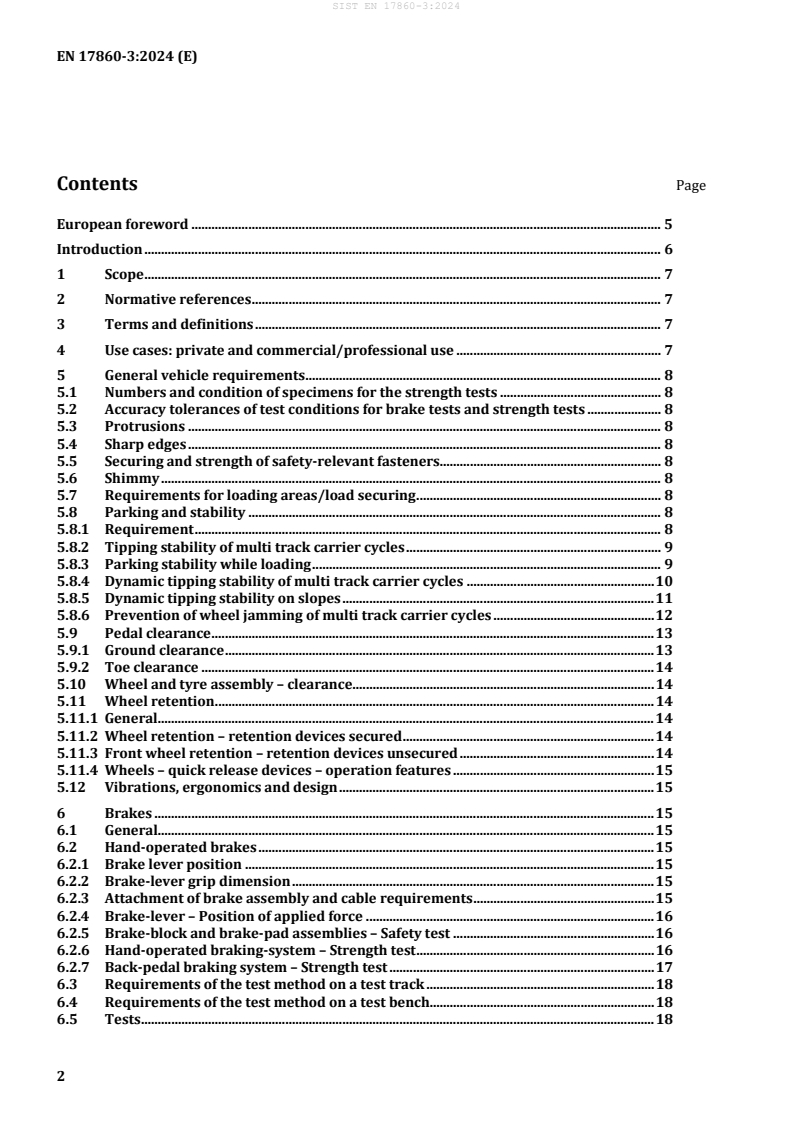
Contents Page
European foreword . 5
Introduction . 6
1 Scope . 7
2 Normative references . 7
3 Terms and definitions . 7
4 Use cases: private and commercial/professional use . 7
5 General vehicle requirements . 8
5.1 Numbers and condition of specimens for the strength tests . 8
5.2 Accuracy tolerances of test conditions for brake tests and strength tests . 8
5.3 Protrusions . 8
5.4 Sharp edges . 8
5.5 Securing and strength of safety-relevant fasteners. 8
5.6 Shimmy . 8
5.7 Requirements for loading areas/load securing . 8
5.8 Parking and stability . 8
5.8.1 Requirement . 8
5.8.2 Tipping stability of multi track carrier cycles . 9
5.8.3 Parking stability while loading . 9
5.8.4 Dynamic tipping stability of multi track carrier cycles . 10
5.8.5 Dynamic tipping stability on slopes . 11
5.8.6 Prevention of wheel jamming of multi track carrier cycles . 12
5.9 Pedal clearance . 13
5.9.1 Ground clearance . 13
5.9.2 Toe clearance . 14
5.10 Wheel and tyre assembly – clearance . 14
5.11 Wheel retention . 14
5.11.1 General. 14
5.11.2 Wheel retention – retention devices secured . 14
5.11.3 Front wheel retention – retention devices unsecured . 14
5.11.4 Wheels – quick release devices – operation features . 15
5.12 Vibrations, ergonomics and design . 15
6 Brakes . 15
6.1 General. 15
6.2 Hand-operated brakes . 15
6.2.1 Brake lever position . 15
6.2.2 Brake-lever grip dimension . 15
6.2.3 Attachment of brake assembly and cable requirements . 15
6.2.4 Brake-lever – Position of applied force . 16
6.2.5 Brake-block and brake-pad assemblies – Safety test . 16
6.2.6 Hand-operated braking-system – Strength test . 16
6.2.7 Back-pedal braking system – Strength test . 17
6.3 Requirements of the test method on a test track . 18
6.4 Requirements of the test method on a test bench. 18
6.5 Tests . 18
7 Steering . 19
7.1 General . 19
7.2 Handlebar . 21
7.2.1 General . 21
7.2.2 Handlebar stem – Insertion-depth mark or positive stop . 21
7.2.3 Handlebar stem to fork steerer – Clamping requirements . 21
7.2.4 Handlebar grips or handlebar plugs. 21
7.2.5 Steering unit – Static strength and fastening tests . 21
7.2.6 Handlebar stem: Forward bending test . 21
7.2.7 Handlebar to handlebar stem — Torsional security test . 21
7.3 Dynamic steering test . 21
7.4 Handlebar/stem unit – Dynamic test . 21
8 Frame . 21
8.1 Suspension frames — Special requirements . 21
8.2 Requirements for all frame types . 21
8.3 Frame – Dynamic test with pedalling forces . 22
8.3.1 General . 22
8.3.2 Test method . 22
8.4 Frame – Dynamic test with horizontal forces . 25
8.4.1 General . 25
8.4.2 Determination of the test loads . 25
8.4.3 Test method . 26
8.5 Frame — Dynamic test with a vertical force onto the seatpost . 28
8.6 Frame – Dynamic test with vertical forces onto the loading area . 28
8.7 Frame – Dynamic test with lateral forces . 28
8.7.1 General . 28
8.7.2 Requirement . 29
8.7.3 Test method . 29
8.8 Frame – Brake mount test . 31
8.8.1 Requirements . 31
8.8.2 Brake mount fatigue test. 32
8.8.3 Brake mount static torque test . 32
8.9 Frame – Trailer suitability stress test . 33
8.9.1 Requirement . 33
8.9.2 Test method . 33
9 Front wheel fork . 33
10 Wheels and wheel/tyre assembly. 33
10.1 Wheels/tyre assembly – Concentricity tolerance and lateral tolerance . 33
10.1.1 Requirements . 33
10.2 Wheel/tyre assembly – static strength test . 33
10.2.1 Requirements . 33
10.2.2 Test method . 34
10.3 Wheel and wheel/tyre unit — Dynamic test for carrier cycles . 34
10.3.1 Requirement . 34
10.3.2 Test method . 35
11 Rims, tyres and tubes . 36
11.1 General . 36
11.2 Tyre inflation pressure . 36
11.3 Tyre and rim compatibility . 36
11.4 Rim-wear . 37
11.5 Greenhouse effect test for composite wheels . 37
11.5.1 General. 37
11.5.2 Requirement . 37
11.5.3 Test method . 37
12 Mudguards/wheel covers . 38
13 Pedals and pedal/crank drive system . 38
14 Drive chain and drive belt . 38
15 Chain-wheel and belt-drive protective device . 38
16 Saddles, seatposts and seats . 38
16.1 Saddles and seatposts . 38
16.2 Seats . 39
16.2.1 Requirement . 39
16.2.2 Test method for dynamic loads . 39
16.2.3 Test method for static loads . 39
17 Lighting systems and reflectors . 41
18 Warning device . 41
19 Rear-view mirror . 41
20 Safety belts for cyclists . 41
21 Marking . 42
22 Manufacturer’s instructions . 42
23 Structural integrity test . 42
Annex A (normative) Test of cycles professional/commercial use . 43
Annex B (informative) Calculation of the centre of gravity of cycles or carrier cycles. 44
Bibliography . 52
European foreword
This document (EN 17860-3:2024) has been prepared by Technical Committee CEN/TC 333 “Cycles”, the
secretariat of which is held by UNI.
This European Standard shall be given the status of a national standard, either by publication of an
identical text or by endorsement, at the latest by March 2025, and conflicting national standards shall be
withdrawn at the latest by March 2025.
Attention is drawn to the possibility that some of the elements of this document may be the subject of
patent rights. CEN shall not be held responsible for identifying any or all such patent rights.
This document is part of standard series consisting of the following parts, users are invited to check which
parts are applicable to their situation
— FprEN 17860-1:2023, Cycles — Carrier Cycles — Part 1: Vocabulary
— FprEN 17860-2:2023, Cycles — Carrier Cycles — Part 2: Lightweight single track carrier cycles –
mechanical and functional aspects
— FprEN 17860-3:2023, Cycles — Carrier Cycles — Part 3: Lightweight multi track carrier cycles –
mechanical and functional aspects
— prEN 17860-4, Cycles — Carrier Cycles — Heavyweight multi track carrier cycles – mechanical and
functional aspects
— prEN 17860-5:2023, Cycles — Carrier Cycles — Electrical aspects
— prEN 17860-6, Cycles — Carrier Cycles — Passenger transport
— prEN 17860-7:2023, Cycles — Carrier Cycles — Trailers
Examples of carrier cycle configurations can be found in EN 17860-2:2024, Annex A. EN 17860-2:2024,
Annex B provides a reading guide for parts 2,3 and 4 of this standard series.
Any feedback and questions on this document should be directed to the users’ national standards body.
A complete listing of these bodies can be found on the CEN website.
According to the CEN-CENELEC Internal Regulations, the national standards organisations of the
following countries are bound to implement this European Standard: Austria, Belgium, Bulgaria, Croatia,
Cyprus, Czech Republic, Denmark, Estonia, Finland, France, Germany, Greece, Hungary, Iceland, Ireland,
Italy, Latvia, Lithuania, Luxembourg, Malta, Netherlands, Norway, Poland, Portugal, Republic of North
Macedonia, Romania, Serbia, Slovakia, Slovenia, Spain, Sweden, Switzerland, Türkiye and the United
Kingdom.
Introduction
This document gives requirements and test methods for mechanical and functional aspects for multi track
carrier cycles.
This document has been developed in response to demand throughout Europe. Its aim is to provide a
standard for the assessment of mechanical aspects for multi track carrier cycles of a type which are
excluded from type approval by Regulation (EU) No. 168/2013.
Because of the diversity of geometries and solutions of carrier cycles not all requirements and test
methods in this document may apply to every carrier cycle.
— Annex A in FprEN 17860-2:2023 gives an overview of vehicle configurations.
— Annex B in FprEN 17860-2:2023 provides a reading guide for the parts of this standard series.
— Annex J in FprEN 17860-2:2023 contains a rationale explaining the choices made when developing
the standard series
This document is based on a risk analysis, the focus is on mechanical aspects for multitrack carrier cycles.
This document is a type C standard as specified in EN ISO 12100. The machinery concerned and the extent
to which hazards, hazardous situations and hazardous events are covered are indicated in the scope of
this document.
1 Scope
This document is applicable to multi track carrier cycles with or without electric assistance and a
maximum gross vehicle weight of 300 kg.
NOTE1 Requirements that are similar to single track carrier cycles are covered in Part 2 of this
standard series.
NOTE2 Requirements for electrical power assisted carrier cycles will be covered in Part 5 of this
standard series.
2 Normative references
The following documents are referred to in the text in such a way that some or all of their content
constitutes requirements of this document. For dated references, only the edition cited applies. For
undated references, the latest edition of the referenced document (including any amendments) applies.
EN 17860-1:2024, Cycles — Carrier Cycles — Part 1: Vocabulary
EN 17860-2:2024, Cycles — Carrier Cycles — Part 2: Lightweight single track carrier cycles – mechanical
and functional aspects
EN 17860-7:—, Cycles — Carrier Cycles — Trailers
EN ISO 4210-3:2023, Cycles - Safety requirements for bicycles - Part 3: Common test methods (ISO 4210-
3:2023)
EN ISO 4210-6:2023, Cycles - Safety requirements for bicycles - Part 6: Frame and fork test methods (ISO
4210-6:2023, Corrected version 2023-08)
EN ISO 12100:2010, Safety of machinery - General principles for design - Risk assessment and risk reduction
(ISO 12100:2010)
ISO 5775-1:2023, Bicycle tyres and rims — Part 1: Tyre designations and dimensions
3 Terms and definitions
For the purposes of this document, the terms and definitions given in EN 17860-1:2024 and
EN ISO 12100:2010 apply.
ISO and IEC maintain terminology databases for use in standardization at the following addresses:
— ISO Online browsing platform: available at https://www.iso.org/obp/
— IEC Electropedia: available at https://www.electropedia.org/
4 Use cases: private and commercial/professional use
The requirements in the main part of this standard refer to carrier cycles for private use. In case the
manufacturer defines the carrier cycles to be intended for commercial/professional use higher test
values for dynamic tests apply. Annex A gives the higher test values for the relevant tests.
Under preparation. Stage at time of publication: FprEN 17860-7:2024.
5 General vehicle requirements
5.1 Numbers and condition of specimens for the strength tests
EN 17860-2:2024, 5.1 applies.
5.2 Accuracy tolerances of test conditions for brake tests and strength tests
EN 17860-2:2024, 5.2 applies.
5.3 Protrusions
EN 17860-2:2024, 5.3 applies.
5.4 Sharp edges
EN 17860-2:2024, 5.4 applies.
5.5 Securing and strength of safety-relevant fasteners
EN 17860-2:2024, 5.5 applies.
5.6 Shimmy
EN 17860-2:2024, 5.7 applies.
5.7 Requirements for loading areas/load securing
The position of the transported load or the seats shall be selected such that the carrier cycle can be ridden
and braked safely in each loading and operating situation, the rider is not hindered and vision is not
limited. A rear-view mirror shall be installed if vision to the rear is limited due to normal positioning of
the payload or the vehicles construction.
Uniform wheel load distribution and the lowest possible overall centre of gravity shall be strived for.
Loading areas shall only be attached to the intended parts of the carrier cycle and shall be securely and
firmly connected to the frame (no vibration).
Loading areas shall not impede riding (handlebar angle, pedal movement) or mounting and dismounting.
Loading areas should be attached to the frame such that the centre of gravity of the carrier cycle is as low
as possible.
In the case of several loading areas, attention shall be paid to even load distribution.
Each individual loading area shall be clearly marked by the manufacturer with the maximum permissible
payload weight.
Loading areas should include devices with which the carrier can be secured to prevent slipping, falling
over, rolling back and forth, falling down in the event of full braking or sudden evasive motions, e.g. non-
slip floor covering, load securing nets, covers, eyelets or options for attaching lashing straps.
5.8 Parking and stability
5.8.1 Requirement
Carrier cycle shall be equipped with a mechanical parking function. This parking function can be fulfilled,
for instance, by a stand and/or a mechanical parking brake.
With the parking function, it shall be possible to secure the loaded and unladen carrier cycle to prevent
it from rolling away on a slope of 10 % (5,7°) in one direction.
Suitable, additional measures (wheel chocks, for instance) are permissible for larger slopes.
5.8.2 Tipping stability of multi track carrier cycles
5.8.2.1 Static tipping stability of multi track carrier cycles
No wheel shall visibly lose contact with the ground in the test in accordance with 5.8.2.2.
5.8.2.2 Test method
The test shall be conducted on a surface inclined by the inclination angle, α, (see Figure 1) by at least 18 %
(10,2°).
The test shall be conducted with the seat pillar extended to its maximum limit.
The tyres shall be inflated to (100 ± 5) % of the maximum permissible tyre pressure printed on the tyre.
The test loads on the seat surfaces and carrier areas shall be applied in accordance with the
manufacturer's load specifications or, if these are not specified, shall be selected and applied centrally
such that the centre of gravity height of the load is 150 mm above the seat surface and the surface of the
carrier areas, unless otherwise or determined by the design.
50 kg shall be applied on the seat, and 10 kg on the left and right on the handlebar; max. payload in the
carrier areas as specified by the manufacturer.
The static, lateral tipping stability shall be verified for all loading conditions up to the respective
maximum payload per carrier area.
If a loading condition is clearly identifiable as the most critical in terms of tipping stability, verification
for this loading condition is sufficient.
Key
α inclination angle
Figure 1 — Static tipping stability
5.8.3 Parking stability while loading
5.8.3.1 Requirements
No wheel shall visibly lift .
5.8.3.2 Test method
The cycle shall be positioned on a flat surface. The parking system shall be engaged.
A person of 90 ± 10 kg shall step on the most critical (outer) edge of the loading area standing straight
up, without holding on to something (Figure 2). The test person shall gradually shift their full weight to
the edge, without jumping on.
Figure 2 — Parking stability while loading
5.8.4 Dynamic tipping stability of multi track carrier cycles
5.8.4.1 Requirement
At a constant centripetal acceleration of 0,99 m/s , no wheel shall visibly lose contact with the ground in
the test in accordance with 5.8.4.2.
5.8.4.2 Test method
Riding circles shall be performed on a flat surface.
An applicable test diameter and speed shall be selected from reference values in Table 1. Intermediate
diameter -velocity combinations may be provided the resulting centripetal acceleration remains
0,99 m/s .
The diameter shall not exceed 15,5 m.
The chosen test track diameter shall be ridden along with the carrier cycle. The diameter line should be
kept centrally between the wheels.
The test shall be conducted at a speed applicable for the diameter as given in Table 1, measured centrally
on the circular track or at an outer wheel.
Testing shall be conducted with maximum inflation pressure.
During the test drive, the test person shall maintain in the sitting position the cycle is designed for.
The test shall be commenced with a flying start.
The dynamic, lateral tipping stability shall be verified for all loading conditions up to the respective
maximum payload per cargo area.
If a loading condition is clearly identifiable as the most critical in terms of tipping stability, verification
for this loading condition is sufficient.
The test is regarded as passed if a complete lap has been covered and no wheel visibly loses contact with
the ground.
Table 1 — Reference values for centripetal acceleration
2 2
Diameter [m] Speed [km/h] Velocity [m/s] v /r [m/s ]
5,6 6 1,66 0,99
6,6 6,5 1,81 0,99
7,6 7 1,94 0,99
8,7 7,5 2,07 0,99
10 8 2,22 0,99
11,2 8,5 2,35 0,99
12,6 9 2,49 0,99
14 9,5 2,63 0,99
15,5 10 2,77 0,99
5.8.5 Dynamic tipping stability on slopes
5.8.5.1 General
While remaining within any constraints mandated by the manufacturer in the user manual, all loads shall
be adjusted to create a least stable configuration of the cycle. This determination may require several
iterations to determine the configuration or configurations, that is or are the least stable.
5.8.5.2 Requirement
Cycle shall return in stable position with all wheels on the ground when tested in accordance with 5.8.5.3.
During testing it is allowed that wheels loose contact with the ground.
In case of tipping, it is allowed to add anti-tipping wheels to help the cycle return in stable position.
5.8.5.3 Test method
5.8.5.3.1 General
The test shall be performed as follows:
a) For tests on slopes the test plane is inclined to 6° relative to the horizontal angle.
b) If the rated slope specified by the manufacturer is greater than the applicable rated slope test the
cycle with the test plane set at the rated slope specified by the manufacturer.
5.8.5.3.2 Starting forwards horizontal and uphill
NOTE This test determines stability when a cycle starts on a horizontal surface and on an uphill slope.
The test shall be performed as follows:
a) Position the cycle on the horizontal test plane and uphill slope of 6°, laden and unladen.
b) From a stationary position, use maximum electrical support (when applicable) and use start up
assistance mode (when applicable). Accelerate the cycle from the lowest gear and give maximum
acceleration in the forward direction.
c) Observe the dynamic response of the cycle.
If the manufacturer recommends a technique for driving on a slope, test the cycle using the recommended
technique.
5.8.5.3.3 Stopping forwards downhill
The test shall be performed as follows:
a) Run the cycle at a speed of 15 km/h forward on a downhill slope of 6° or more, laden and unladen.
b) Apply braking with increasing braking force to the front axle of the cycle to stop it. The last test run
must be conducted with maximum possible braking deceleration.
c) Observe the dynamic response of the cycle.
Braking force should be increased slowly to ensure the safety of the test rider.
If the manufacturer recommends a technique for driving on a slope, test the cycle using the recommended
technique.
5.8.5.3.4 Stopping backwards downhill
NOTE This test assesses the cycle's stability when it abruptly stops at its fastest reverse speed while moving
both horizontally and backwards downhill.
The test shall be performed as follows:
The maximum reverse speed is 6 km/h.
a) Run the cycle at maximum reverse speed on a downhill slope of 6° or more, laden and unladen.
b) Apply braking with increasing braking force to the rear axle of the cycle to stop it. The last test run
has to be conducted with maximum possible braking deceleration.
c) Observe the dynamic response of the cycle.
Braking force should be increased slowly to ensure the safety of the test rider.
If the manufacturer recommends a technique for driving on a slope, test the cycle using the recommended
technique.
5.8.6 Prevention of wheel jamming of multi track carrier cycles
Manufacturers are encouraged to consider deflective devices to mitigate a scenario of obstacles, such as
posts, colliding with the carrier cycle between a wheel and other parts of the cycle (Figure 3). If this
functionality is not obvious by design, it may be tested with an obstacle with minimum height of 300 mm
and diameter of 90 mm.
a) Four-wheeler
b) Three-wheeler
Key
1 deflection devices
2 vertical obstacles
3 direction of travel
Figure 3 — Example of deflection devices
5.9 Pedal clearance
5.9.1 Ground clearance
If the cycle is capable of tilting during use, EN 17860-2:2024, 5.10.1 applies.
Multi track carrier cycles must be able to ride over a rectangular obstacle with a height of 110 mm and a
width of 50 % of the track width in the centre, with a pedal crank tilted forward by 45° to the horizontal.
In doing so, neither the pedal, the pedal crank, the chain ring or any other part of the cargo cycle may
touch the obstacle.
The air pressure shall be 90 % of the maximum tyre pressure specified by the tyre manufacturer and the
vehicle shall be ridden by a rider weighing (100 ± 5) kg.
The front and rear of the obstacle may be provided with a ramp to facilitate passing over the single wheel
in the case of three-wheeled carrier cycles.
For four-wheeled carrier cycles, the width of the obstacle shall be 50 % of the track width of the narrower
axle.
When the carrier cycle is equipped with a suspension system, this measurement shall be taken with the
suspension dampers (of fork and shock) set to full open positions and with the carrier cycle depressed
into a position such as would be caused by a rider weighing (100 ± 5) kg.
5.9.2 Toe clearance
EN 17860-2:2024, 5.10.2 applies.
5.10 Wheel and tyre assembly – clearance
EN 17860-2:2024, 5.11 applies.
5.11 Wheel retention
5.11.1 General
Wheel retention safety is related to the combination of wheel, retention device, and dropout design.
Wheels shall be secured to carrier cycle frame and fork such that when adjusted to the manufacturer's
instructions they comply with 5.11.2, 5.11.3 and 5.11.4.
Wheel nuts shall have a minimum removal torque of 70 % of the manufacturer's recommended
tightening torque.
Where quick-release axle devices are used they shall comply with 5.11.4.
5.11.2 Wheel retention – retention devices secured
5.11.2.1 Requirement
When tested by the method described in 5.11.2.2, there shall be no relative motion between the axle and
the front fork/frame.
5.11.2.2 Test method
Apply a force of 2 300 N distributed symmetrically to both ends of the axle for a period of 1 min in the
direction of the removal of the front and rear wheel independently.
5.11.3 Front wheel retention – retention devices unsecured
The carrier cycle shall be equipped with secondary retention system that retains the front wheel in the
dropouts when the primary retention system is in the open (unlocked) position and wheel off the ground.
Where threaded axles and nuts are fitted, and the nuts are unscrewed by at least 360 ° from the finger
tight condition and the brake system disconnected or released, the wheel shall not detach from the front
fork when a force of 100 N is applied radially outwards, in line with the dropout slots, and maintained for
1 min.
Where quick-release is fitted, and the quick-release lever is fully open and the brake system is
disconnected or released, the wheel shall not detach from the front fork when a force of 100 N is applied
to the wheel radially outwards, in line with the dropout slots, and maintained for 1 min.
5.11.4 Wheels – quick release devices – operation features
Any quick-release device shall have the following operating features:
a) it shall be adjustable to allow setting for tightness;
b) its form and marking shall clearly indicate whether the device is in the open or locked position;
c) if adjustable by a lever, the force required to close a properly set lever shall not exceed 200 N and, at
this closing force there shall be no permanent deformation of the quick-release device;
d) the releasing force of the clamping device when closed shall not be less than 50 N;
e) if operated by a lever, the quick-release device shall withstand without fracture or permanent
deformation a closing force of not less than 250 N applied with the adjustment set to prevent closure
at this force;
f) the wheel retention with the quick-release device in the clamped position shall be in accordance with
5.11.2
g) the front wheel retention with the quick-release device in the open position shall be in accordance
with 5.11.3
If applied to a lever, the forces specified in c), d), and e) shall be applied 5 mm from the tip end of the
lever.
5.12 Vibrations, ergonomics and design
EN 17860-2:2024, 5.14 applies.
6 Brakes
6.1 General
EN 17860-2:2024, 6.1 applies.
6.2 Hand-operated brakes
6.2.1 Brake lever position
EN 17860-2: 2024, 6.2.1 applies.
6.2.2 Brake-lever grip dimension
EN 17860-2: 2024, 6.2.2 applies.
6.2.3 Attachment of brake assembly and cable requirements
Cable pinch-bolts shall not sever any of the cable strands when assembled to the manufacturer's
instructions. In the event of a cable failing, no part of the brake mechanism shall inadvertently inhibit the
rotation of the wheel.
The cable end shall either be protected with a cap that shall withstand a removal force of not less than
20 N or be otherwise treated to prevent unravelling.
6.2.4 Brake-lever – Position of applied force
For the purposes of braking tests in this standard, for brake-levers similar to Type A, the test force shall
be applied at a distance, b, which is equal to either dimension a as determined in
EN 17860-2:2024, 6.2.2.2.2 or 25 mm from the free end of the brake-lever, whichever is the greater (see
Figure 4).
Key
F applied force
b 25 mm or dimensions a, whichever is greater
Figure 4 — Position of applied force on the brake-lever type A
6.2.5 Brake-block and brake-pad assemblies – Safety test
6.2.5.1 Requirements
The friction material shall be securely attached to the holder, backing-plate, or shoe and there shall be no
failure of the braking system or any component thereof when tested by the method specified in 6.2.5.2.
6.2.5.2 Test method
Conduct the test on a fully-assembled carrier cycle with the brakes adjusted to a correct position with a
rider or equivalent mass on the saddle or seat. The test shall be performed with the carrier cycle loaded
to the gross vehicle weight as specified by the manufacturer.
Actuate each brake-lever with a force of 180 N applied at the point as specified in Figure 4 or a force
sufficient to bring the brake-lever into contact with the handlebar grip, whichever is the lesser. Maintain
this force while subjecting the carrier cycle to five forward and five rearward movements, each of which
is not less than 75 mm distance.
Then conduct the test described in 6.2.6 or 6.2.7 as appropriate depending on the style of brake.
6.2.6 Hand-operated braking-system – Strength test
6.2.6.1 Requirement
When tested by the method described in 6.2.6.2, there shall be no failure of the braking-system or of any
component thereof.
6.2.6.2 Test method
Conduct the test on a fully-assembled carrier cycle. After it has been ensured that the braking system is
adjusted according to the recommendations in the manufacturer's instructions, apply a force to the
brake-lever at the point as specified in Figure 4. This force shall be 450 N, or such lesser force as is
required to bring:
a) a brake-lever into contact with the handlebar grip or the handlebar where the manufacturer does
not fit a grip;
b) brake extension-lever level with the surface of the handlebar or in contact with the handlebar;
c) a secondary brake lever to the end of its travel.
Repeat the test for a total of 10 times on each brake-lever, secondary brake lever or extension lever.
6.2.7 Back-pedal braking system – Strength test
6.2.7.1 General
If a back-pedal braking system is fitted, the brake shall be actuated by the operator's foot applying force
to the pedal in a direction opposite to that of the drive force. The brake mechanism shall function
regardless of any drive-gear positions or adjustments. The differential between the drive and brake
positions of the crank shall not exceed 60°.
The measurement shall be taken with the crank held against each position with a pedal force of at least
250 N. The force shall be maintained for 1 min in each position.
6.2.7.2 Requirement
When tested in accordance with 6.2.7.3, there shall be no failure of the brake system or any component
thereof.
6.2.7.3 Test method
Conduct the test
...