


SIST EN 18029:2025
(Main)Animal health diagnostic analyses - Electronic data exchange in laboratory analysis
Animal health diagnostic analyses - Electronic data exchange in laboratory analysis
This document specifies a common data exchange format (i.e. format of the messages and the dictionary of all the items that compose the message) between the prescribers and the laboratories in the animal health sector.
This document is intended for prescribers (purchasers) and service providers in charge of collecting samples and conducting analyses (including laboratories) who are interested in computerizing and standardizing their data exchanges, particularly in the animal health sector.
This document excludes the code lists that are required for unambiguous data exchange.
Tiergesundheit - Elektronischer Datenaustausch bei Labortests
Dieses Dokument legt ein gemeinsames Datenaustauschformat (d. h. das Format der Nachrichten und den Katalog aller Elemente, aus denen die Nachricht besteht) zwischen den Verordnern und den Laboratorien im Bereich der Tiergesundheit fest.
Dieses Dokument richtet sich an Verordner (Einkäufer) und Dienstleister, die für die Entnahme von Proben und die Durchführung von Analysen zuständig sind (einschließlich Laboratorien) und die daran interessiert sind, ihren Datenaustausch zu computerisieren und zu standardisieren, insbesondere im Bereich der Tiergesundheit.
Dieses Dokument schließt die Codelisten aus, die für einen eindeutigen Datenaustausch erforderlich sind.
Analyses de diagnostic en santé animale - Échange de donnée électronique dans les analyses de laboratoire
Le présent document spécifie un format commun d’échange de données (c’est à dire le format des messages et le dictionnaire de tous les éléments qui composent le message) entre les prescripteurs et les laboratoires dans le domaine de la santé animale.
Le présent document s’adresse aux prescripteurs (donneurs d’ordre) et aux prestataires chargés de réaliser les prélèvements et analyses (dont les laboratoires) qui sont intéressés par la mise en œuvre d’une démarche d’informatisation et de standardisation de leurs échanges de données, particulièrement dans le domaine de la santé animale.
Le présent document ne couvre pas les listes de codes qui sont nécessaires à un échange de données sans équivoque.
Diagnostične analize zdravja živali - Elektronska izmenjava podatkov v laboratorijskih analizah
General Information
- Status
- Published
- Public Enquiry End Date
- 23-Jan-2024
- Publication Date
- 09-Nov-2025
- Technical Committee
- VAZ - Healthcare
- Current Stage
- 6060 - National Implementation/Publication (Adopted Project)
- Start Date
- 07-Nov-2025
- Due Date
- 12-Jan-2026
- Completion Date
- 10-Nov-2025
Overview
EN 18029:2025 - Animal health diagnostic analyses: Electronic data exchange in laboratory analysis (CEN) defines a common, standardized data exchange format for electronic messages between prescribers (requesters) and laboratories in the animal health sector. Based on the e‑Labs approach and using UN/CEFACT tools, the standard specifies message formats and a data dictionary to make laboratory test requests, results and acknowledgements interoperable and machine‑readable across information systems. Note: EN 18029:2025 does not include the specific code lists required for unambiguous data exchange.
Key topics and technical requirements
- e‑Labs message model: a set of files, processes and rules for standardizing laboratory exchanges.
- Core file types: Request file, Result file, and Acknowledgement file (defined in the standard’s file descriptions and scenarios).
- Data dictionary and tags: a detailed dictionary of items (entities and tags) used in messages; tags are to remain untranslated so systems interpret them consistently.
- Exchange scenarios & processes: defined use cases, simplified data diagrams, and operational sequences for sending requests and receiving results.
- Partners and roles: prescribers, laboratories, samplers, operators, owners and party contacts are defined with responsibilities for data exchange.
- Operational controls: guidance on exchange parameters, communication protocol considerations, acknowledgement protocols, import/export controls and qualification phases for implementation.
- Reference lists & nomenclatures: management framework for reference lists and nomenclatures (standard excludes the code lists themselves but specifies how reference lists should be handled).
- Interoperability focus: built using UN/CEFACT principles to ensure compatibility across systems and countries.
Applications and who uses it
EN 18029 is intended for:
- Veterinary laboratories and diagnostic service providers standardizing electronic reporting.
- Prescribers and purchasers (veterinarians, authorities, farms) sending sample/analysis requests.
- Sampling organisations and field teams capturing sampling location, sampler and sample metadata.
- Animal health surveillance programs, competent authorities, and epidemiology units** for automated data ingestion and analysis.
- IT vendors and integrators building laboratory information management systems (LIMS) or interfaces for animal health data exchange.
Practical benefits include faster processing of large volumes of laboratory tests (critical during outbreaks), improved data quality, reliable reporting and streamlined interoperability across the animal health community.
Related standards and references
- Built on UN/CEFACT data‑exchange tools and concepts.
- References to ISO/IEC terminology resources for standardized definitions (e.g., ISO Online Browsing Platform, IEC Electropedia) are provided in the document.
Keywords: EN 18029:2025, animal health diagnostic analyses, electronic data exchange, e‑Labs, laboratory data exchange, CEN, data dictionary, interoperability.

Frequently Asked Questions
SIST EN 18029:2025 is a standard published by the Slovenian Institute for Standardization (SIST). Its full title is "Animal health diagnostic analyses - Electronic data exchange in laboratory analysis". This standard covers: This document specifies a common data exchange format (i.e. format of the messages and the dictionary of all the items that compose the message) between the prescribers and the laboratories in the animal health sector. This document is intended for prescribers (purchasers) and service providers in charge of collecting samples and conducting analyses (including laboratories) who are interested in computerizing and standardizing their data exchanges, particularly in the animal health sector. This document excludes the code lists that are required for unambiguous data exchange.
This document specifies a common data exchange format (i.e. format of the messages and the dictionary of all the items that compose the message) between the prescribers and the laboratories in the animal health sector. This document is intended for prescribers (purchasers) and service providers in charge of collecting samples and conducting analyses (including laboratories) who are interested in computerizing and standardizing their data exchanges, particularly in the animal health sector. This document excludes the code lists that are required for unambiguous data exchange.
SIST EN 18029:2025 is classified under the following ICS (International Classification for Standards) categories: 11.220 - Veterinary medicine; 35.240.99 - IT applications in other fields. The ICS classification helps identify the subject area and facilitates finding related standards.
SIST EN 18029:2025 is available in PDF format for immediate download after purchase. The document can be added to your cart and obtained through the secure checkout process. Digital delivery ensures instant access to the complete standard document.
Standards Content (Sample)
SLOVENSKI STANDARD
01-december-2025
Diagnostične analize zdravja živali - Elektronska izmenjava podatkov v
laboratorijskih analizah
Animal health diagnostic analyses - Electronic data exchange in laboratory analysis
Tiergesundheit - Elektronischer Datenaustausch bei Labortests
Analyses de diagnostic en santé animale - Échange de donnée électronique dans les
analyses de laboratoire
Ta slovenski standard je istoveten z: EN 18029:2025
ICS:
11.220 Veterinarstvo Veterinary medicine
35.240.99 Uporabniške rešitve IT na IT applications in other fields
drugih področjih
2003-01.Slovenski inštitut za standardizacijo. Razmnoževanje celote ali delov tega standarda ni dovoljeno.
EN 18029
EUROPEAN STANDARD
NORME EUROPÉENNE
October 2025
EUROPÄISCHE NORM
ICS 11.220; 35.240.99
English Version
Animal health diagnostic analyses - Electronic data
exchange in laboratory analysis
Analyses de diagnostic en santé animale - Échange de Tiergesundheitsdiagnostische Analysen -
données électroniques concernant les analyses de Elektronischer Datenaustausch bei Labortests
laboratoire
This European Standard was approved by CEN on 15 September 2025.
CEN members are bound to comply with the CEN/CENELEC Internal Regulations which stipulate the conditions for giving this
European Standard the status of a national standard without any alteration. Up-to-date lists and bibliographical references
concerning such national standards may be obtained on application to the CEN-CENELEC Management Centre or to any CEN
member.
This European Standard exists in three official versions (English, French, German). A version in any other language made by
translation under the responsibility of a CEN member into its own language and notified to the CEN-CENELEC Management
Centre has the same status as the official versions.
CEN members are the national standards bodies of Austria, Belgium, Bulgaria, Croatia, Cyprus, Czech Republic, Denmark, Estonia,
Finland, France, Germany, Greece, Hungary, Iceland, Ireland, Italy, Latvia, Lithuania, Luxembourg, Malta, Netherlands, Norway,
Poland, Portugal, Republic of North Macedonia, Romania, Serbia, Slovakia, Slovenia, Spain, Sweden, Switzerland, Türkiye and
United Kingdom.
EUROPEAN COMMITTEE FOR STANDARDIZATION
COMITÉ EUROPÉEN DE NORMALISATION
EUROPÄISCHES KOMITEE FÜR NORMUNG
CEN-CENELEC Management Centre: Rue de la Science 23, B-1040 Brussels
© 2025 CEN All rights of exploitation in any form and by any means reserved Ref. No. EN 18029:2025 E
worldwide for CEN national Members.
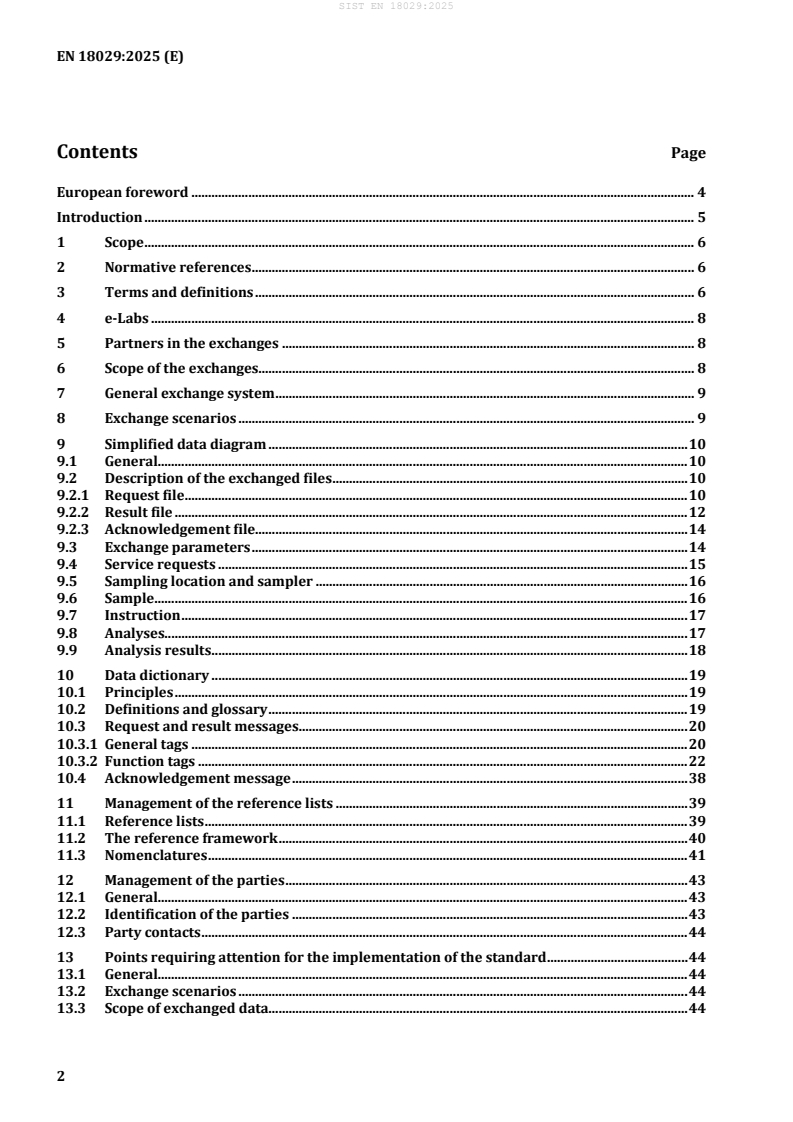
Contents Page
European foreword . 4
Introduction . 5
1 Scope . 6
2 Normative references . 6
3 Terms and definitions . 6
4 e-Labs . 8
5 Partners in the exchanges . 8
6 Scope of the exchanges. 8
7 General exchange system . 9
8 Exchange scenarios . 9
9 Simplified data diagram . 10
9.1 General. 10
9.2 Description of the exchanged files . 10
9.2.1 Request file . 10
9.2.2 Result file . 12
9.2.3 Acknowledgement file. 14
9.3 Exchange parameters . 14
9.4 Service requests . 15
9.5 Sampling location and sampler . 16
9.6 Sample . 16
9.7 Instruction . 17
9.8 Analyses. 17
9.9 Analysis results . 18
10 Data dictionary . 19
10.1 Principles . 19
10.2 Definitions and glossary . 19
10.3 Request and result messages. 20
10.3.1 General tags . 20
10.3.2 Function tags . 22
10.4 Acknowledgement message . 38
11 Management of the reference lists . 39
11.1 Reference lists . 39
11.2 The reference framework . 40
11.3 Nomenclatures . 41
12 Management of the parties . 43
12.1 General. 43
12.2 Identification of the parties . 43
12.3 Party contacts . 44
13 Points requiring attention for the implementation of the standard . 44
13.1 General. 44
13.2 Exchange scenarios . 44
13.3 Scope of exchanged data. 44
13.4 Organization of the exchanges . 45
13.4.1 General . 45
13.4.2 Implementation of an acknowledgement protocol . 45
13.4.3 Implementation of import and export controls . 45
13.4.4 Implementation of a qualification phase . 45
13.5 Communication protocol . 46
Annex A (informative) The entities in the data dictionary . 47
Bibliography . 53
European foreword
This document (EN 18029:2025) has been prepared by Technical Committee CEN/TC 469 “Animal health
diagnostic analyses”, the secretariat of which is held by AFNOR.
This European Standard shall be given the status of a national standard, either by publication of an
identical text or by endorsement, at the latest by April 2026, and conflicting national standards shall be
withdrawn at the latest by April 2026.
Attention is drawn to the possibility that some of the elements of this document may be the subject of
patent rights. CEN shall not be held responsible for identifying any or all such patent rights.
Any feedback and questions on this document should be directed to the users’ national standards body.
A complete listing of these bodies can be found on the CEN website.
According to the CEN-CENELEC Internal Regulations, the national standards organisations of the
following countries are bound to implement this European Standard: Austria, Belgium, Bulgaria, Croatia,
Cyprus, Czech Republic, Denmark, Estonia, Finland, France, Germany, Greece, Hungary, Iceland, Ireland,
Italy, Latvia, Lithuania, Luxembourg, Malta, Netherlands, Norway, Poland, Portugal, Republic of North
Macedonia, Romania, Serbia, Slovakia, Slovenia, Spain, Sweden, Switzerland, Türkiye and the United
Kingdom.
Introduction
Numerous partners are involved in animal health monitoring/surveillance, such as the competent
authorities and public establishments, and other professional organizations.
A standardized and efficient exchange of electronic information on animal health knowledge is essential.
This sharing process involves exchanging information and making sure that the information is
comparable and coherent, and it requires that the information systems of the various players in this field
are interoperable.
The use of a common language based on a standard data exchange format is the most appropriate
response to this need – one that is open and accessible to all, and uses lists of common codes.
This standardization offers numerous advantages:
— to be able to process data from a large number of laboratory tests in a short period of time, especially
in the context of a health crisis;
— to facilitate animal health data reporting and analysis;
— to guarantee interoperability within the animal health community on the laboratory test data;
— to improve data reliability and data quality.
The ultimate goal is to propose a common data exchange language (format of the messages and the
dictionary of all the items that compose the message) between the prescribers and the laboratories in the
animal health sector. This document provides only the format of the common data exchanges language.
It can be considered as the first step in the standardization of electronic data exchange in laboratory
analysis. A subsequent step could be the development of code lists.
This standardization is based on the e-Labs format, which consists of a set of files, processes and rules
allowing for the standardization of data exchanges between prescribers and laboratories. e-Labs is the
name of the messages that are proposed to be standardized in order to exchange laboratory data between
two different information systems. This name refers to e for electronic and lab for laboratories.
This standard exchange format has been developed using tools designed by UN/CEFACT (United Nations
Centre for Trade Facilitation and Electronic Business). UN/CEFACT is a United Nations organization that
promotes and establishes the interoperability of information exchanges through the definition of data
exchange format standards. These standards are available on the UN/CEFACT website [1].
UN/CEFACT designed an e-Labs exchange format to standardize transactions of analytical data in
agriculture in the broadest sense.
The name of the tags mentioned in this document should not be translated into a national language, since
the tags are used by computer systems to understand and interpret the message. Therefore, it is
important that these tags are identical for all computer systems and are not translated into a national
language.
This document will have a positive effect on several Sustainable Development Goals (SDG’s). By
supporting animal health and reducing severe diseases and losses in animal production, it contributes
towards zero hunger (Goal 2) and responsible consumption and production (Goal 12) [2].
1 Scope
This document specifies a common data exchange format (i.e. format of the messages and the dictionary
of all the items that compose the message) between the prescribers and the laboratories in the animal
health sector.
This document is intended for prescribers (purchasers) and service providers in charge of collecting
samples and conducting analyses (including laboratories) who are interested in computerizing and
standardizing their data exchanges, particularly in the animal health sector.
This document excludes the code lists that are required for unambiguous data exchange.
2 Normative references
There are no normative references in this document.
3 Terms and definitions
For the purposes of this document, the following terms and definitions apply.
ISO and IEC maintain terminology databases for use in standardization at the following addresses:
— ISO Online browsing platform: available at https://www.iso.org/obp/
— IEC Electropedia: available at https://www.electropedia.org/
3.1
computerized request
message sent between two parties for the delivery of a service, such as sampling and/or analyses
3.2
contract
formal definition of analytical services expected by the prescribers and that are delivered by the
laboratory
3.3
instruction
group of analyses to be performed as defined by the prescriber
3.4
laboratory
party that analyses the samples according to the analysis request received
Note 1 to entry: The laboratory issues the results in an electronic format. For subcontracting, the e-Labs format
identifies the analyses concerned by identifying the subcontractor laboratory. When the subscriber chooses to call
on several laboratories (e.g. a first-line laboratory for screening analyses and a second-line laboratory for
confirmation analyses), each laboratory receives a request for an analysis and the sender of the message receives
the results of the relevant analyses.
3.5
operator
person in charge of the sampled object from which the sample is collected and responsible for carrying
out the laboratory tests
3.6
owner
person who owns the sampled object from which the sample was collected
Note 1 to entry: One sampled object can have several owners.
3.7
party contact
individual who is answerable to a party
3.8
prescriber
party that issues the analysis request or the request for samples and analyses
Note 1 to entry: The prescriber is also the issuer of the computerized request (requests can only be raised by one
prescriber). The prescriber doesn’t need to be the sole receiver of the results of a request that he/she has made.
3.9
reference
structured additional information that specifies the characteristics of an entity
Note 1 to entry: References can be provided for the following entities: the sample, the sampling location, the
contract, the sampled object, the analysis request, the result of the analysis.
3.10
sample
result of the sampling process performed on all or part of the sampled object, that can be an animal or a
lot of animals (biological samples) or a building housing livestock – production unit (environmental
samples)
Note 1 to entry: Livestock or wildlife animals can be concerned and used by the laboratory to perform the analysis
according to the prescribers’ requests.
3.11
sampled object
object from which the samples are collected
Note 1 to entry: The sampled object can be an animal or a lot of animals (biological samples) or a building housing
livestock – production unit (environmental samples). Livestock or wildlife animals can be concerned.
3.12
sampler
party that collects the samples
Note 1 to entry: The sampler can be the prescriber or an external party receiving a sampling request from the
prescriber corresponding to the analysis request sent to the laboratory.
3.13
sampling
operation that produces one or more samples that are taken from the sampled object
3.14
sampling location
precise geographic place (identified and located) where the sampling takes place
4 e-Labs
Animal health e-Labs is a subset of the e-Labs format, adapted to the needs of information exchanges
between the prescribers of analyses and the laboratories in the animal health field.
Animal health e-Labs is made up of two elements:
— the data dictionary that is used to precisely describe the definition and the terminology of all the data
used in the format. The purpose of this dictionary is to define a common language between the
various partners using this data exchange system. The dictionary covers several aspects of the data:
— the meaning;
— the essential rules for codification;
— the electronic exchange formats intended to describe an interface between the computer systems
and the organization of the exchanged data. For animal health e-Labs, these formats are defined in
three XSD files (XML Schema Definition) describing the different types of exchanged messages
(requests, results and acknowledgements):
— LaboratoryObservationReport_1.xsd: this file is used for sending the results;
— LaboratoryAnalysisRequest_1.xsd: this file is used for requesting an analysis;
— LaboratoryAcknowledgement_1.xsd: acknowledgement file.
The close link between animal health e-Labs and e-Labs ensures that animal health e-Labs is
internationally recognized, while also focusing on the needs of operators in animal health field.
5 Partners in the exchanges
The partners in this system of data exchanges are:
— Prescribers with an information system that is able to import the data of analysis results sent in an
XML file structured according to the animal health e-Labs. The analysis request files (creation of the
request files) and acknowledgement files (sending and receiving) should be controlled, depending
on the exchange rules defined with partners;
— Laboratories with a computer system able to create files containing the analysis results data in XML
format structured according to the animal health e-Labs. The analysis request files (import of the
request files) and acknowledgement files (sending and receiving) should be controlled depending on
the exchange rules defined with partners.
6 Scope of the exchanges
The scope of exchanges of the animal health e-Labs format covers veterinary analytical services, including
sampling and quantitative or qualitative analyses of all types. Several exchange configurations can be
managed, according to the number of parties in the exchanges: prescribers, samplers, first-line
laboratories (e.g. for screening analyses), second-line laboratories (e.g. for confirmation of analyses) and
the computerized management of service requests.
Exchanges related to invoicing or pricing are not modelled in the animal health e-Labs format.
7 General exchange system
Different data exchange scenarios can be supported by the e-Labs format. See Figure 1 for an example of
some scenarios that can be operated thanks to the e-Labs format. Other data exchange scenarios can also
be supported by this format: e.g. the first line laboratory can forward the request to the subcontractor
laboratories and can receive the results directly from the subcontractor laboratory.
Figure 1 — Scheme of an example of exchanges
8 Exchange scenarios
The animal health e-Labs format manages several exchange configurations. However, this document is
not intended to present and describe in detail the exchange scenarios specific to each prescriber and their
organization. The goal of this clause is to show the possible flows that can be managed by the animal
health e-Labs format:
— Scheduled Intervention mode – IP: In this exchange configuration, the prescriber sends a
computerized analysis request containing details of the request to the laboratory: information on the
sampling, the intervention and the analyses to be made. An acknowledgement file can be sent when
the laboratory receives the analysis request. In this scenario, the results subsequently sent by the
laboratory contain the identifiers included in the request: request No., sample No., etc.;
— Unscheduled Intervention – INP: In this exchange configuration, the laboratory sends the results
without having previously received and accepted a computerized analysis request. In this case, the
results do not refer to a request or a sample number sent by the prescriber;
— the animal health e-Labs format can also manage dual flows of requests and results:
— a sampling request is sent to the sampler, who returns a result that can contain the results of
field observations and information on the collected samples;
— the prescriber then sends an analysis request for the collected samples in response to the initial
computerized request to the laboratory. This analysis request can contain the field results sent
by the sampler, if they are of any interest to the laboratory. The laboratory then sends the results
of the analyses performed by the laboratory;
— this dual flow can include flows of acknowledgements of the request and results files;
— the animal health e-Labs format can also be useful when a second-line laboratory is involved.
9 Simplified data diagram
9.1 General
Figures 2 to 21 describe the part of the e-Labs message that is within the scope of this document.
9.2 Description of the exchanged files
9.2.1 Request file
Figure 2 — The request file overview (1 of 2)
Figure 2 — The request file overview (2 of 2)
9.2.2 Result file
Figure 3 — The result file overview (1 of 3)
Figure 3 — The result file overview (2 of 3)
Figure 3 — The result file overview (3 of 3)
9.2.3 Acknowledgement file
Figure 4 — The acknowledgement file overview
9.3 Exchange parameters
The exchange parameters define the content of the exchanged data and the partners in the exchange.
Figure 5 — Conceptual data model (simplified)
9.4 Service requests
See 3.1.
Requests are identified by an identifier attributed by the prescriber.
A request can contain a request for sampling, a request for analyses, or a request for sampling and
analyses.
Requests are usually raised under the terms of a contract that defines the broad scope of the relationship
between the 2 parties and the period of application of the request.
Figure 6 — Conceptual data model (simplified) of the service requests
9.5 Sampling location and sampler
See 3.12 and 3.14.
The sampling location can be identified in general terms (legal structure of the sampling location) or more
precisely, by identifying the production unit within the structure or a more precise location of the
sampling. The production unit can be identified by an identifier.
The sampling location can be identified by its address or geographic coordinates. Geographic reference
system used for the coordinates can also be specified. References are also associated with the sampling
location that provide additional information (approval, certification, etc.), according to the type of
sampling location.
The sampler who performs the operation is determined by the organization to which they belong
(mandatory information) and by the name of the person (contact) who performs the sampling (optional
information).
Figure 7 — Conceptual data model (simplified) of the sampling location
9.6 Sample
See 3.10.
The sample shall be uniquely identified in the request. To this end, it is identified by a unique arbitrary
number (sample number) for the sampling operation concerned in the request. The laboratory and the
service provider tasked with the sampling shall attribute a unique identifier to each sample.
It is mandatory to define the matrix (sample type) and the sampled object from which the sample is taken.
The sample can be accompanied by files (photographs, documents, etc.).
Figure 8 — Conceptual data model (simplified) of the sample
9.7 Instruction
See 3.3.
An instruction consists of all the analyses to be performed by a laboratory on one or more given samples,
in accordance with the computerized request raised by a prescriber, who will receive the results in a
computerized format.
The list of the analyses to be performed as part of an instruction is drawn up according to the following
rules:
— the description of the matrix on which the instruction is based;
— the (specific) analysis method to be used;
— the parameter to be detected.
9.8 Analyses
An analysis produces all the information required by the laboratory to determine the value of a result of
the analysis for a given parameter, for a given analysis method and for a given sample.
Analyses can be made on the sampling site or in the laboratory.
An analysis is made up of five factors: the sample, the instruction, the analyte (parameter), the matrix and
the method.
Figure 9 — Conceptual data model (simplified) of the analyses
9.9 Analysis results
An analysis result is made up of six factors: the sample, the instruction, the analyte (parameter), the
matrix, the method and the expression of the result.
The analysis result can be expressed in a quantitative form, with an operator, a numerical value and a
unit of expression of the result, or in a qualitative form, by a code defined in a list of references, or in the
form of comments (text).
For each result, the following values can be mentioned:
— a minimum value of the result or limit of detection, which is the lowest value of a parameter that can
be detected and considered;
— a maximum value or saturation limit, above which the laboratory is no longer capable of accurately
determining the quantity of the parameter in question;
— the expected value of the result;
— the measured value of the result.
An analysis result can be characterized by references, such as the kit number, the robot used, etc.
Figure 10 — Conceptual data model (simplified) of the analyses results
10 Data dictionary
10.1 Principles
The animal health e-Labs format is made up of building blocks, or entities, that can be used several times
in the request or results files. For example, the Laboratory Observation_Party (contact) entity
characterizes the contact of the message sender or the laboratory that performs the analyses. For each of
these specific uses, the name of the entity is adapted to the situation in order to clearly define its meaning
in the file. But the attributes of the entity remain the same, with the same control rules.
10.2 Definitions and glossary
The entities used are presented below in tabular format (see tables from 10.3.2).
The first row describes the entity itself. The elementary attributes are written in bold, then followed by
their associated entities in normal print.
The columns contain the following information:
— the name of the element corresponding to the name of the tag in the XML file;
— the data type indicates how each item of data are expressed. The following data types are used:
— Text (T): the “Text” type is used for textual information, such as comments or names;
— Date (D): the “Date” type. The “yyyy-mm-dd” format shall be used;
— Numerical (N): the “Numerical” type is used for decimal or integer numerical information.
Decimal points shall be used as decimal separators (“.”);
— Identifier (Id): the “Identifier” type is used for the XML elements used to exchange identification
keys;
— Code (C): the “Code” type is used for the XML elements used to exchange data having to respect
a list of clearly defined values;
— Indicator (I): the “Indicator” type is a Boolean value (0/1);
— Graphic object (G): graphic objects are photos or PDF documents that can be stored directly in
the database.
The cardinality (abbreviated: “card”) gives the possible number of successive elements that can appear
on the indicated level, assuming that any parent elements of the element are actually present.
10.3 Request and result messages
10.3.1 General
In the Tables 1 to 11, an explanation of each tag present in the message is described.
10.3.2 General tags
Table 1 lists the general tags entities that can be used.
Table 1 — Result message overview of general tags
Element name Type Card. Description
Element related to the information on
LOR Exchanged Document 1–1
the message
Identification Id 1.1 Physical name of the file
Description T 0.1 Scenario version
Issue D 1.1 File creation date
Type C 0.1 Code indicating the file type
Code indicating the prescriber reference
Purpose C 0.1
framework
For Results files, a reference to the
request / order, if one exists (name of
Information T 0.1 the XML request file taken into account
by the laboratory to perform its
analysis)
Sequence Id 0.1 Send number of the request or result
Sender_Laboratory Observation_Party 1–1 Sender of the message
Recipient_Laboratory
1–1 Recipient of the message
Observation_Party
LaboratoryObservation_AccessControl Controls the versions of the reference
0-n
List lists used in the file
Version of the reference framework
Type C 0.1 used: type and version of the reference
framework
Access Right C 0.1 Not used
For requests, identifies the
Included_Laboratory
0-n laboratories authorized to perform
Observation_Party
the analysis
“Laboratory Observation Party” type entity described in Table A.1.
Figure 11 — Diagram of general tags
10.3.3 Function tags
Tables 2 to 11 list the entities that can be used in each tag.
Table 2 — The sample (“SpecifiedAgriculturalSample” tag)
Type Card. Description
Element name
Element related to the information on the
SpecifiedAgricultureSample 1–1
sample
Intake ID Id 0.1 Unique identifier of the sample in the laboratory
Serial ID Id 0.1 Label number of the sample
Sampling Date Time D 0.1 Date when the sample was taken
Sealed Indicator I 0.1 Indicates whether the sample is sealed
Date when the sample was sealed, where
Sealed Date Time D 0.1
appropriate
Sender Assigned ID Id 0.1 Identifier of the sample by the prescriber
Receipt Date Time D 0.1 Date of receipt at the laboratory
Information T 0.1 Comment
Storage Temperature Measure N 0.1 Storage temperature of the sample
Preservation Date Time D 0.1 Preservation expiry date of the sample
Processing Status Code C 0.1 Code of the reason for non-analysability
Sampling Referenced Location 0-n Sampling location
Sampling Laboratory
0.1 Sampler
Observation Party
Specified Sample Observation
0.n Lines of analysis results
Result
Specified Laboratory
0.1 Contract
Observation Contract
Specified Agricultural Sample
1–1 Identifies the sampled object
Object
Specified Agricultural Sample
1.1 Sample type (matrix)
Type
Specified Laboratory
0.n References of the sample
Observation Reference
Specified Sample Observation
0.n Lines of analysis requests
Request
Attached Photographic Picture 0.n Photograph linked to the sample
Attached Specified Binary File 0.n File linked to the sample
“Laboratory Observation Party” type entity described in Table A.1.
This entity is only present in results files.
Laboratory Observation Reference” type entity described in Table A.5.
Figure 12 — Diagram of the “SpecifiedAgriculturalSample” tag
Table 3 — Sampling location of the sample (“SamplingReferencedLocation” tag)
Element name Type Card. Description
SamplingReferencedLocation 0-n Element related to the sampling location
Identifier of the sampling location in the form
ID Id 0.1
of an identifier type and identifier in the type
Name of the sampling location or company
Name T 0.1
name
Physical Specified Geographic Geographic coordinates of the sampling
0–1
Coordinate location
Physical Structured Address 0–1 Address of the sampling location
Specified Observation
0-n References of the sampling location
Reference
Included Specified Polygon 0–1 Out of scope of the standard
Figure 13 — Diagram of the “SamplingReferencedLocation” tag
"Specified Geographical Coordinate" type entity described in Table A.11.
"Structured Address" type entity described in Table A.13.
"Laboratory Observation Reference" type entity described in Table A.5.
Table 4 — The contract associated with the sample
(“SpecifiedLaboratoryObservationContract” tag)
Element name Type Card. Description
Element related to the information
SpecifiedLaboratoryObservationContract 0–1
on the contract
Unique file No. given by the information
ID Id 1.1
system of the laboratory
Internal identifier controlled by the
Observer Assigned ID Id 0.1
laboratory
Type Code C 0.1 Identifier of the context
Indicator of partial sampling: C
Submission Reason Description T 0.1
(complete) or P (partial) or F (end)
Issue Date Time D 1.1 Issue date of the contract
Observation End Date D 0.1 Date of validation of the file
Deadline for sending the results (only
Last Item Delivery Date D 0.1
entered in the analysis request)
Observation Information T 0.1 Complete file indicator: Y or N
Project ID Id 0.1 Contract No. given by the prescriber
Information on the prescriber of the
Ordering Laboratory Observation Party 0–1
contract
Laboratory performing the
Observing Laboratory Observation Party 0–1
analyses
Specified Laboratory Observation Instructions requested under the
0-n
Instructions terms of the contract
Order Specified Laboratory Observation
0-n References of the contract
Reference
"Laboratory Observation Party" type entity described in Table A.1.
"Laboratory Observation Instructions" type entity described in Table A.3.
"Laboratory Observation Reference" type entity described in Table A.5.
Figure 14 — Diagram of the “SpecifiedLaboratoryObservationContract” tag
Table 5 — The sampled object (“SpecifiedAgriculturalSampleObject” tag)
Element name Type Card. Description
Element related to the information on the
SpecifiedAgriculturalSampleObject 1–1
sampled object
Identifier of the sampled object. This
ID Id 1.1 identification is made on the basis of an identifier
type and an identifier in the type
Name T 0.1 Name of the sampled object
Standard Type Code C 0.1 International classification: species, etc.
Production Date Time D 0.1 Date of production
Sampling Procedure Type Code C 0.1 Identifier of the sampling method used
Country Of Origin ID C 0.1 International code of the country of origin
Country Of Origin SubDivision Name T 0.1 Details of the region or state of origin
Size Measure N 1.1 Size of the sample
Batch Population Size Measure N 0.1 Size of the population forming the lot
BatchIdentificationID Id 0.1 Number of the production lot (identified by the
producer)
Additional Information Specified Additional information on the sampled
0–1
Laboratory Observation Note object
Owner Laboratory Observation
0-n Owner of the sampled object
Party
Specified Laboratory Observation Interpretation of the results of the instruction
0-n
Instructions on the sampled object
Specified Laboratory Observation
0-n References of the sampled object
Reference
"Laboratory Observation Note" type entity described in Table A.4.
"Laboratory Observation Party" type entity described in Table A.1.
"Laboratory Observation Instructions" type entity described in Table A.3.
"Laboratory Observation Reference" type entity described in Table A.5.
Figure 15 — Diagram of the “SpecifiedAgriculturalSampleObject” tag
Table 6 — Sample type (“SpecifiedAgriculturalSampleType” tag)
Type Card. Description
Element name
Element related to the information
SpecifiedAgriculturalSampleType 1–1
on the sample type (matrix)
Code of the sample type (matrix)
Standard Type Code C 0.1
taken from the list of references
Code of the generic sample type
Material Type Code C 0.1 (matrix) taken from the list of
references
Figure 16 — Diagram of the “SpecifiedAgriculturalSampleType” tag
Table 7 — Details of the analysis request (“SpecifiedSampleObservationRequest” tag)
Element name Type Card. Description
Element related to the requested
SpecifiedSampleObservationRequest 0-n
analyses
Analysis identifier: Number provided by
ID Id 0.1 the prescriber of the request (sample
pairing)
Name of the sample type (matrix) of the
Material Type T 0.1
analysis
General Characteristic T 0.1 Not used
Start date of the period of validity of the
Requested Observation Start Date Time D 0.1
analysis request
End date of the period of validity of the
Requested Observation End Date Time D 0.1
analysis request
Indicates whether the analysis was
Emergency Observation I 0.1
performed as an emergency
Indicates whether the analysis was
Outsourced Observation I 0.1
subcontracted
Specified Laboratory Observation
0-n References of the analyses
Reference
Outsourced Laboratory Observation
0–1 Subcontractor laboratory
Party
Authorization Laboratory Observation
0–1 Laboratory performing the analysis
Party
Requested Laboratory Observation
0–1 Analysis method
Analysis Method
Minimum Standard Value Specified
Minimum threshold of the expected
Sample Observation Request 0-n
result
Characteristic
"Laboratory Observation Reference" type entity described in Table A.5.
"Laboratory Observation Party" type entity described in Table A.1.
"Laboratory Observation Analysis Method" type entity described in Table A.6.
"Sample Observation Request Characteristic" type entity described Table A.8.
Element name Type Card. Description
Maximum Standard Value Specified
Maximum threshold of the expected
Sample Observation Request 0-n
result
Characteristic
Expected Specified Standard Value
Specified Sample Observation Request 0-n Expected value of the result
Characteristic
Specified Laboratory Observation
1–1 Instruction requested for the sample
Instructions
Applicable Observation Objective
0–1 Parameter of the analysis
Parameter
Figure 17 — Diagram of the “SpecifiedSampleObservationRequest” tag
"Laboratory Observation Instructions" type entity described in Table A.3.
"Observation Objective Parameter" type entity described in Table A.7.
Table 8 — T
...
Questions, Comments and Discussion
Ask us and Technical Secretary will try to provide an answer. You can facilitate discussion about the standard in here.
Loading comments...