

SIST-TP CEN/CLC/TR 17603-10-03:2022
(Main)Space engineering - Testing guidelines
General Information
- Abstract
This handbook provides additional information for the application of the Testing standard EN 16603-10-03.
This handbook will be the guideline for all space projects, related equipment and complete systems, by providing background information that aids the reader to better understand and meet the requirements of the standard.
The document would follow the flow of the Testing standard and in particular w hatever is excluded from the testing standard (see Scope of EN 16603-10-03) should also be excluded.
NOTE: EN 16603-10-03:2014 will be in parallel also updated to take into account the new TR.
- Status
- Published
- Public Enquiry End Date
- 14-Jul-2021
- Publication Date
- 08-Sep-2022
- Technical Committee
- I13 - Imaginarni 13
- Current Stage
- 6060 - National Implementation/Publication (Adopted Project)
- Start Date
- 07-Sep-2022
- Due Date
- 12-Nov-2022
- Completion Date
- 09-Sep-2022



Overview
CEN/CLC/TR 17603-10-03:2022 - "Space engineering - Testing guidelines" is a CEN Technical Report that provides detailed guidance for applying the testing standard EN 16603-10-03. Approved by CEN and developed by Technical Committee CEN/CLC/JTC 5, this handbook explains test-programme logic, test management, test objectives and implementation for space projects, equipment and complete systems. It follows the flow of the core Testing standard and explicitly aligns exclusions with the scope of EN 16603-10-03.
Key Topics
- Test programme and test management: principles for planning, reviewing and documenting test campaigns, handling anomalies and retesting strategies.
- Test objectives: guidance for qualification, acceptance and protoflight test approaches.
- Test conditions and measurement uncertainty: input tolerances, guard-band decision rules and methods to assess conformity.
- Space segment equipment & element requirements: implementation details for mechanical, thermal, electrical/RF and mission-specific tests at equipment and element level.
- Pre-launch testing: considerations and activities prior to launch.
- Extensive annexes: practical procedures and examples, including:
- Annex A: Mechanical tests (static, vibration, acoustic, shock, centrifuge, micro‑vibration, etc.)
- Annex B: Structural integrity under pressure (leak, proof, burst)
- Annex C: Audible noise
- Annex D: Passive Intermodulation (PIM) tests
- Annex E: Alignment measurements
- Annex F: Test bench names and Annex G: referenced documents
Practical Applications
- Use this TR to develop and justify test programmes for spacecraft, payloads, subsystems and ground support equipment.
- Helps test engineers select appropriate thermal‑vacuum, vibration, acoustic, pressure and electromagnetic test methods.
- Supports mission assurance and quality teams in creating test documentation, conformity assessments and decision rules for out‑of‑tolerance inputs.
- Valuable for test labs, integrators, prime contractors, satellite manufacturers, payload teams and national space agencies who must demonstrate compliance with EN 16603-10-03.
Who Should Use It
- Spacecraft and payload test engineers
- System and test managers planning qualification/acceptance campaigns
- Mission assurance and quality authorities
- Test facility operators and equipment suppliers
Related Standards
- EN 16603-10-03 (primary testing standard - this TR provides explanatory guidance)
- The TR references mappings to ECSS test terminology and methodologies (see figures and annexes for cross‑references).
Keywords: CEN/CLC/TR 17603-10-03:2022, Space engineering, Testing guidelines, EN 16603-10-03, qualification testing, acceptance testing, protoflight, thermal vacuum, vibration testing, mechanical tests, test programme, mission assurance.
Get Certified
Connect with accredited certification bodies for this standard

BUREAU VERITAS Certification Germany
Bureau Veritas certification in Germany.

Element Materials Technology
Materials testing and product certification.

AQMS Ltd.
AQMS provides ISO certification to SMEs across the UK.
Sponsored listings
Frequently Asked Questions
SIST-TP CEN/CLC/TR 17603-10-03:2022 is a technical report published by the Slovenian Institute for Standardization (SIST). Its full title is "Space engineering - Testing guidelines". This standard covers: This handbook provides additional information for the application of the Testing standard EN 16603-10-03. This handbook will be the guideline for all space projects, related equipment and complete systems, by providing background information that aids the reader to better understand and meet the requirements of the standard. The document would follow the flow of the Testing standard and in particular w hatever is excluded from the testing standard (see Scope of EN 16603-10-03) should also be excluded. NOTE: EN 16603-10-03:2014 will be in parallel also updated to take into account the new TR.
This handbook provides additional information for the application of the Testing standard EN 16603-10-03. This handbook will be the guideline for all space projects, related equipment and complete systems, by providing background information that aids the reader to better understand and meet the requirements of the standard. The document would follow the flow of the Testing standard and in particular w hatever is excluded from the testing standard (see Scope of EN 16603-10-03) should also be excluded. NOTE: EN 16603-10-03:2014 will be in parallel also updated to take into account the new TR.
SIST-TP CEN/CLC/TR 17603-10-03:2022 is classified under the following ICS (International Classification for Standards) categories: 49.140 - Space systems and operations. The ICS classification helps identify the subject area and facilitates finding related standards.
SIST-TP CEN/CLC/TR 17603-10-03:2022 is associated with the following European legislation: Standardization Mandates: M/496. When a standard is cited in the Official Journal of the European Union, products manufactured in conformity with it benefit from a presumption of conformity with the essential requirements of the corresponding EU directive or regulation.
SIST-TP CEN/CLC/TR 17603-10-03:2022 is available in PDF format for immediate download after purchase. The document can be added to your cart and obtained through the secure checkout process. Digital delivery ensures instant access to the complete standard document.
Standards Content (Sample)
SLOVENSKI STANDARD
01-oktober-2022
Vesoljska tehnika - Smernice za preskušanje
Space engineering - Testing guidelines
Raumfahrttechnik - Prüfrichtlinien
Ingénierie spatiale - Lignes directrices pour les essais
Ta slovenski standard je istoveten z: CEN/CLC/TR 17603-10-03:2022
ICS:
49.140 Vesoljski sistemi in operacije Space systems and
operations
2003-01.Slovenski inštitut za standardizacijo. Razmnoževanje celote ali delov tega standarda ni dovoljeno.
CEN/CLC/TR 17603-10-03
TECHNICAL REPORT
RAPPORT TECHNIQUE
TECHNISCHER REPORT August 2022
ICS 49.140
English version
Space engineering - Testing guidelines
Ingénierie spatiale - Lignes directrices pour les essais Raumfahrttechnik - Prüfrichtlinien
This Technical Report was approved by CEN on 16 August 2021. It has been drawn up by the Technical Committee CEN/CLC/JTC
5.
CEN and CENELEC members are the national standards bodies and national electrotechnical committees of Austria, Belgium,
Bulgaria, Croatia, Cyprus, Czech Republic, Denmark, Estonia, Finland, France, Germany, Greece, Hungary, Iceland, Ireland, Italy,
Latvia, Lithuania, Luxembourg, Malta, Netherlands, Norway, Poland, Portugal, Republic of North Macedonia, Romania, Serbia,
Slovakia, Slovenia, Spain, Sweden, Switzerland, Türkiye and United Kingdom.
CEN-CENELEC Management Centre:
Rue de la Science 23, B-1040 Brussels
© 2022 CEN/CENELEC All rights of exploitation in any form and by any means Ref. No. CEN/CLC/TR 17603-10-03:2022 E
reserved worldwide for CEN national Members and for
CENELEC Members.
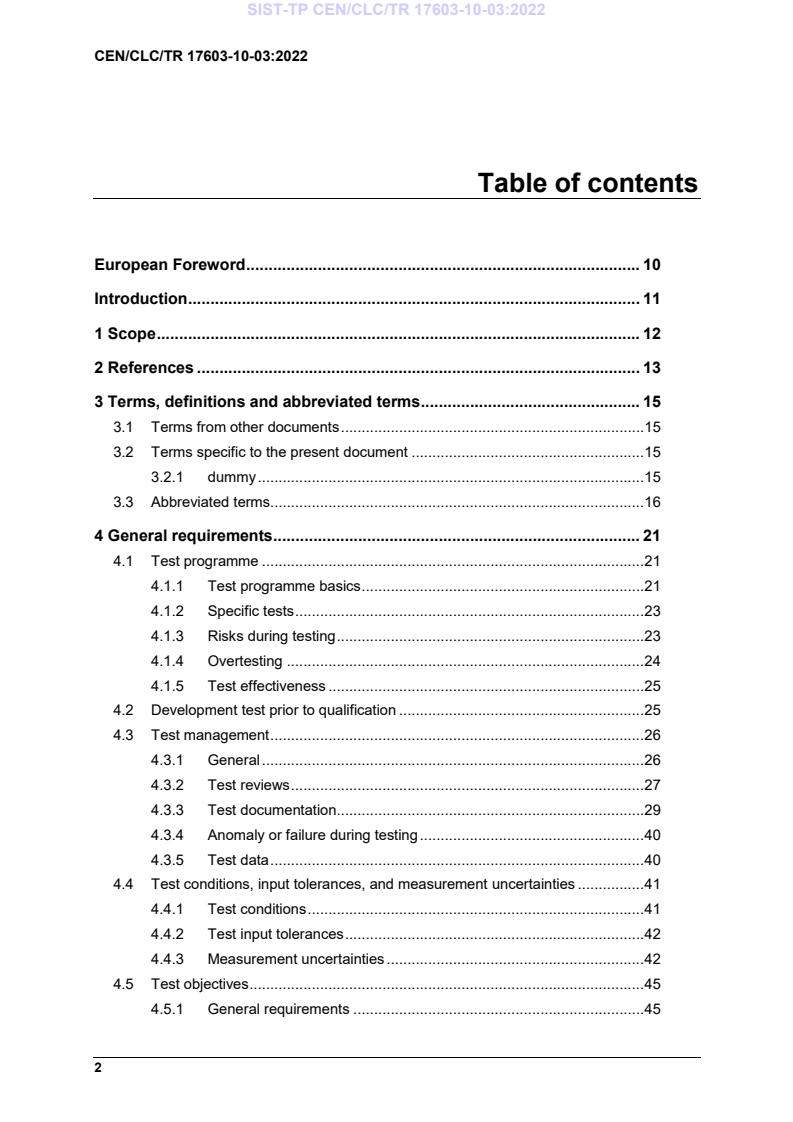
Table of contents
European Foreword . 10
Introduction . 11
1 Scope . 12
2 References . 13
3 Terms, definitions and abbreviated terms . 15
3.1 Terms from other documents . 15
3.2 Terms specific to the present document . 15
3.2.1 dummy . 15
3.3 Abbreviated terms. 16
4 General requirements. 21
4.1 Test programme . 21
4.1.1 Test programme basics . 21
4.1.2 Specific tests . 23
4.1.3 Risks during testing . 23
4.1.4 Overtesting . 24
4.1.5 Test effectiveness . 25
4.2 Development test prior to qualification . 25
4.3 Test management . 26
4.3.1 General . 26
4.3.2 Test reviews . 27
4.3.3 Test documentation . 29
4.3.4 Anomaly or failure during testing . 40
4.3.5 Test data . 40
4.4 Test conditions, input tolerances, and measurement uncertainties . 41
4.4.1 Test conditions . 41
4.4.2 Test input tolerances . 42
4.4.3 Measurement uncertainties . 42
4.5 Test objectives . 45
4.5.1 General requirements . 45
4.5.2 Qualification testing . 45
4.5.3 Acceptance testing . 45
4.5.4 Protoflight testing . 46
4.6 Retesting . 46
4.6.1 Overview . 46
4.6.2 Implementation of a design modification after completion of
qualification . 46
4.6.3 Storage after protoflight or acceptance testing . 46
4.6.4 Space segment element or equipment to be re-flown . 46
4.6.5 Flight use of qualification Space segment element or equipment . 47
5 Space segment equipment test requirements . 48
5.1 General requirements . 48
5.2 Qualification tests requirements . 49
5.3 Acceptance test requirements . 49
5.4 Protoflight test requirements . 49
5.5 Space segment equipment test programme implementation requirements . 50
5.5.1 General tests . 50
5.5.2 Mechanical tests . 53
5.5.3 Structural integrity under pressure tests . 56
5.5.4 Thermal tests . 57
5.5.5 Electrical/RF tests . 87
5.5.6 Mission specific test . 88
6 Space segment element test requirements . 89
6.1 General requirements . 89
6.2 Qualification tests requirements . 89
6.3 Acceptance test requirements . 90
6.4 Protoflight test requirements . 90
6.5 Space segment element test programme implementation requirements . 90
6.5.1 General tests . 90
6.5.2 Mechanical tests . 113
6.5.3 Structural integrity under pressure tests . 117
6.5.4 Thermal test . 117
6.5.5 Electromagnetic test . 134
6.5.6 Mission specific tests . 135
6.5.7 Crewed mission specific tests . 135
7 Pre-launch testing . 137
Annex A Mechanical tests . 138
A.1 Foreword . 138
A.2 Physical properties measurements . 138
A.3 Static Test . 143
A.4 Spin test . 156
A.5 Centrifuge test . 159
A.6 Sine burst test . 161
A.7 Sinusoidal vibration test . 165
A.8 Random vibration testing . 177
A.9 Acoustic testing . 182
A.10 Shock testing . 188
A.11 Thermal distortion test . 188
A.12 Gravity release test . 193
A.13 Micro-vibration environment verification by test . 194
Annex B Structural integrity under pressure tests . 212
B.1 Foreword . 212
B.2 Leak test . 214
B.3 Proof pressure test . 220
B.4 Pressure cycling test . 221
B.5 Design burst pressure test . 223
B.6 Burst test . 224
Annex C Audible noise test . 226
C.1 Space segment equipment audible noise emission test . 226
C.2 Space segment element audible noise emission test . 230
Annex D PIM tests . 234
D.1 PIM – guidelines for equipment testing . 234
D.2 PIM – guidelines for payload testing . 240
D.3 PIM – Guidelines for Element testing . 247
Annex E Alignment measurements . 251
E.1 Purpose . 251
E.2 General . 251
E.3 Test configuration and test aspects . 254
E.4 Test preparation . 259
E.5 Test execution . 260
E.6 Test evaluation . 264
E.7 Other alignment methodology . 264
Annex F List of test bench names . 265
Annex G Referenced documents . 267
Figures
Figure 4-1: Testing at S/C level and example of typical EGSE setup for JUICE S/C
(courtesy Airbus Defence and Space) . 31
Figure 4-2: GOCE spacecraft Container . 33
Figure 4-3: Exomars Schiaparelli Descent Module Container . 34
Figure 4-4: AEOLUS multipurpose trolley . 34
Figure 4-5: Lifting device for Exomars Schiaparelli Descent module. 35
Figure 4-6: Test input in-tolerance or out-of-tolerance assessment (decision rule) . 43
Figure 4-7: Conformity assessment with the guard bands approach (decision rule) . 44
Figure 5-1: Relation between FFT, PT and RFT on equipment level . 50
Figure 5-2: Unit TRP and Boundary Temperatures (conductive ITP and T ) . 60
Sink
Figure 5-3: Thermal vacuum test profile (example n° 1 for "type a" units) . 66
Figure 5-4: Thermal vacuum test profile (example n° 2 for "type a" units) . 66
Figure 5-5: Hot plateau TRP temperatures drive (including "type a" units switch-on) . 70
Figure 5-6: Cold plateau TRP temperatures drive (including "type a" units switch-on) . 71
Figure 5-7: Unit temperature cycling mechanical and thermal configuration . 74
Figure 5-8: Some common examples of equipment flight accomodation . 77
Figure 5-9: Temperature controlled support and test set-up representativeness . 80
Figure 6-1: Mapping of previous and current test terms in the ECSS-E-ST-10-03
standard . 92
Figure 6-2: Typical sequence of tests for element level functional verification . 96
Figure 6-3: Logical relationship between FFT-D (or FFT-Q), FFT-W(or FFT-A) and RFT
.................................................................................................................. 99
Figure 6-4: Logical relation between model, test bench, test campaign, test item (IUT),
test environment and test infrastructure . 102
Figure 6-5: Example of an SVF based on the mapping between ECSS-E-ST-10-
02C/03C and ECSS-E-TM-10-21A . 103
Figure 6-6: Example of solar generator unloading device for Sentinel 2 . 106
Figure 6-7: Exomars TGO antenna offloading device . 106
Figure 6-8: Top-level AOCS Control Chain Schematic . 110
Figure 6-9: Fit check of Galileo Spacecraft with the launch dispenser . 113
Figure 6-10: Example of a thermal vacuum test profile for a space segment element 121
Figure 6-11: Unit TRP temperature control bands during space segment element
plateaux . 123
Figure 6-12: Unit TRP temperatures drive feasibility (example of a P/F equipment bay)
................................................................................................................ 125
Figure A-1 : CoG measurement along 1st lateral axis . 139
Figure A-2 : CoG measurement along 2nd lateral axis . 140
Figure A-3 : CoG measurement along vertical axis . 140
Figure A-4 : M80 physical properties measurement machine with Bepi-Colombo MCS
at ESTEC . 141
Figure A-5 : WM50/6 combined CoG and MoI measurement machine with IXV STM 142
Figure A-6 : WM50/6 combined CoG and MoI measurement machine with Goce PFM
................................................................................................................ 142
Figure A-7 : Rack static test configuration-1/4 . 146
Figure A-8 : Rack Static tests configuration-2/4 . 146
Figure A-9 : Rack Static tests configuration-3/4 . 147
Figure A-10 : Rack Static tests configuration-4/4 . 147
Figure A-11 : Automated Transfer Vehicle (ATV) primary structure test article . 149
Figure A-12 : Setting of ATV primary structure static test . 150
Figure A-13 : ATV static test fixtures: “Base” to constrain the test article and “Tower” to
support the internal jacks . 151
Figure A-14 : ATV static test: internal loading jacks arrangement . 152
Figure A-15 : ATV static test: internal loading jacks details . 153
Figure A-16 : ATV static test: external view and external loading jacks . 154
Figure A-17 : ATV static test: layout of the displacement transducers . 155
Figure A-18 : Dynamic balancing facility installed in a vacuum chamber (Large Space
Simulator at ESTEC) . 157
Figure A-19 : Meteosat Flight Model during spin test . 157
Figure A-20 : GPM spacecraft undertakes centrifuge test at Goddard (courtesy of
NASA) . 160
Figure A-21 : Centrifuge test of ExoMars Descent Module (courtesy of Lavoshkin) . 160
Figure A-22 : Example of Sine Burst with a frequency of 15 Hz and 6 cycles at
maximum load of 12g (figure taken from NESC Technical Bulletin 15-02)
................................................................................................................ 163
Figure A-23 : Example of primary and secondary notching . 171
Figure A-24 : Typical Sine excitation at spacecraft base . 176
Figure A-25 : Example of test sequence for random vibration. 181
Figure A-26 : Typical full level random specification . 181
Figure A-27 : Rosetta in the ESTEC Large Acoustic Facility . 184
Figure A-28 -Antenna reflector acoustic test in ESTEC acoustic facility . 184
Figure A-29 : ATV STM-B Solar array wing in IABG reverberant chamber (Courtesy
Dutch Space) . 186
Figure A-30 : Typical acoustic noise specification . 187
Figure A-31 : LISA Pathfinder Science Module structure on kinematic support for
thermal distortion test . 188
Figure A-32 : Typical temperature profile for thermal distortion test . 189
Figure A-33 : Illustration of different courses of laser beams for LISA Pathfinder
Science Module thermal distortion test . 190
Figure A-34 : Videogrammetry measurements during LISA Pathfinder Science Module
thermal distortion test . 191
Figure A-35 : Overview of camera positions used during LISA Pathfinder Science
Module thermal distortion test to generate the images of the test article . 191
Figure A-36 : Displacement of targets mounted on LPF SCM external structure for a
temperature variation from +9,5°C (reference temperature) to +40,5°C . 192
Figure A-37 : NIRSpec engineering test unit (ETU) during gravity-release test
(courtesy: EADS Astrium) . 194
Figure A-38 Principle of measurement of the micro-vibration generated by an
equipment . 195
Figure A-39 : ESA reaction wheel characterisation facility in room conditions and in with
vacuum bell (mN range frequency band up to 1 kHz ) . 196
Figure A-40 : Micro-vibration measurement test, indirect force characterisation . 198
Figure A-41 : Example of test instrumentation for micro-vibration test at equipment level
using indirect method measurement . 199
Figure A-42 : View of test instrumentation during Water Pump Assembly (WPA) micro-
vibration test at equipment level using indirect method measurement . 199
Figure A-43 : Test setup for a test of equipment susceptibility to microvibrations . 202
Figure A-44 : Micro-vibration measurement system of ESA ESTEC allows 6 Dof
excitation and 6 Dof measurement . 202
Figure A-45 : Example of configuration used for the microvibration test on MTG, by
using small shakers (grey) to introduce well defined excitations on a mass
dummy of a reaction wheel. 204
Figure A-46 : Example of configurations used for the microvibration test on MTG, by
using small shakers (grey) to introduce well defined excitations on a mass
dummy of a reaction wheel. Force (left), and moments (centre and right)
................................................................................................................ 205
Figure A-47 : SPOT4 satellite micro-vibration test . 207
Figure A-48 : Typical background noise acceleration PSD . 208
Figure A-49 : VVIS acceptance test time history red top surface blue – bottom input 210
Figure A-50 : ESA micro-vibration universal reference excitation unit (0,05 Hz to 10Hz,
10 μN to 5 N, 10 µNm to 1,5 Nm) . 210
Figure A-51 : Typical table for microvibration emission measurement (mN range limited
frequency bandwidth) . 211
Figure B-1 : Sketch of the Vacuum chamber method . 215
Figure B-2 : Accumulation Leak Test set up . 216
Figure B-3 : Enclosure Calibration . 216
Figure B-4 : Cupola Accumulation leak test overview . 216
Figure B-5 : Cupola Accumulation Leak Test He capillary leak source . 217
Figure B-6 : Node 2 accumulation leak test on a joint _typical set-up . 217
Figure C-1 : View of Water Pump Assembly (WPA) test article during audible noise test
at equipment level . 227
Figure C-2 : Example of test instrumentation plan for audible noise test at equipment
level . 227
Figure C-3 : View of test instrumentation during Water Pump Assembly (WPA) audible
noise test at equipment level . 228
Figure C-4 : View of COLUMBUS test article (external view: seen from deck-aft
perspective) during audible noise test at element level . 230
Figure C-5 : Illustration of different microphone position inside COLUMBUS during
audible noise test at element level. 231
Figure C-6 : Picture of COLUMBUS internal microphones during audible noise test at
element level . 232
Figure D-1 : Sketch from a typical Conducted PIM test bed . 235
Figure D-2 : Radiated PIM test bed: each carrier is transmitted via a dedicated antenna
................................................................................................................ 235
Figure D-3 : Radiated PIM test bed: both carriers are transmitted by the same antenna
................................................................................................................ 236
Figure D-4 : Radiated PIM test bed: both carriers are transmitted via the same antenna
................................................................................................................ 236
Figure D-5 : Typical RF power profile for PIM tests: transmission carriers. . 238
Figure D-6 : Typical element (payload) inside an anechoic chamber for validation tests
under nominal scenario. . 240
Figure D-7 : Test bed placed to radiate the anechoic chamber walls according to
payload disposition. . 242
Figure D-8 : Radiated PIM test bed: each carrier is transmitted via a dedicated antenna
................................................................................................................ 242
Figure D-9 : Radiated PIM test bed: both carriers are transmitted by the same antenna
................................................................................................................ 243
Figure D-10 : Radiated PIM test bed: both carriers are transmitted via the same
antenna . 243
Figure D-11 : Typical RF power profile for PIM tests: transmission carriers. . 245
Figure E-1 Coordinate Systems relationship . 252
Figure E-2 : General sketch of a laser tracker . 255
Figure E-3 : Typical setup for alignment using laser tracker . 256
Figure E-4 : Laser tracker axis and laser beam . 256
Figure E-5 : Theodolites main components . 258
Figure E-6 : Typical Theodolites . 258
Figure E-7 : Measurement setup with theodolites . 260
Figure E-8 : Laser Tracker environment creation . 262
Figure E-9 : Laser tracker (Aligned to MBS) measuring theodolite line of sight . 263
Figure E-10 : Corner Cube Reflector . 263
Tables
Table 4-1: Typical EGSE/SCOE list . 32
Table 5-1: Nomenclature for temperature cycling implementation on "type a" units . 65
Table 5-2: Thermal vacuum step by step procedure (example n° 1 for "type a" units) . 67
Table 5-3: Thermal vacuum step by step procedure (example n° 2 for "type a" units) . 68
Table 6-1: List of typical Space segment element models on which functional tests are
executed (Verification Level: Space segment element) . 91
Table 6-2: List of Functional tests, Performance, Mission and Polarity Tests . 94
Table 6-3: Typical list of test benches for functional verification on Space segment
element verification level . 97
Table 6-4: Typical mapping of the functional test phases with regard to test
configuration . 98
Table 6-5: Multipactor, RF corona and RF power occurrence versus relevant
investigations at Element level . 129
Table A-1 : Performances of the ESA/ESTEC MVS shaker for equipment or element
testing . 173
Table A-2 : Classification of noise sources affecting micro-vibration tests . 209
Table D-1 : Typical RF power profile for PIM tests. . 238
Table D-2 : Typical RF power profile for PIM tests. . 245
Table D-3 : Example of PIM scenario . 248
Table E-1 : Laser tracker typical performances . 257
Table F-1 : List of legacy/historical test bench names . 265
European Foreword
This document (CEN/CLC/TR 17603-10-03:2022) has been prepared by Technical Committee
CEN/CLC/JTC 5 “Space”, the secretariat of which is held by DIN.
It is highlighted that this technical report does not contain any requirement but only collection of data
or descriptions and guidelines about how to organize and perform the work in support of EN 16603-10-
03.
This Technical report (TR 17603-10-03:2022) originates from ECSS-E-HB-10-03A.
Attention is drawn to the possibility that some of the elements of this document may be the subject of
patent rights. CEN [and/or CENELEC] shall not be held responsible for identifying any or all such
patent rights.
This document has been prepared under a mandate given to CEN by the European Commission and
the European Free Trade Association.
This document has been developed to cover specifically space systems and has therefore precedence
over any TR covering the same scope but with a wider domain of applicability (e.g.: aerospace).
Introduction
Testing is an important part of a Space Project, because of its impact on cost and because is the most
effective way to demonstrate a product functionalities and performances.
As such, this Handbook is of outmost importance in defining how the requirements can be implemented
into the verification approach and in providing “real life” experience and examples in order to have an
effective application into the test execution.
In order to meet this objective, the WG have tried, in preparing this Handbook, to be as exhaustive as
possible in providing methods and techniques, as well as examples, in a punctual one-to-one
requirement versus guideline approach.
The WG also recognized that this approach, even if punctually exhaustive, provided in most cases an
unstructured definition of the tests as a whole giving a leopard spots information which may not be
useful in preparing and conducting a test.
As a consequence, the WG have decided to complement the main body of the Handbook with Annexes
where a structured and comprehensive test organization has been defined and described.
In those cases, testing people can find how a test is prepared, applied and executed in terms, for
example, of test setup, test configuration, used instrumentation and test facilities/equipment, test
preparation suggestions, safety rules to be considered, data acquisition and reporting content, together
with pictures, tables and sketches of real cases,
This approach has allowed, in particular for Mechanical, Microvibration and Integrity Tests as well as
for Alignment and PIM tests, to have in one shot a complete and structured set of guidelines easing the
implementation of the requirements of such tests.
It is to be underlined that some of this material comes from the ECSS-E-HB-32-26 “Spacecraft
mechanical load analysis handbook”, which contained a lot of information about mechanical testing.
It is worthy to pay attention that the Annexes of this Testing Guidelines do not correspond to the
Annexes of the Testing Standard.
Moreover, this handbook only applies for the Revised version of the ECSS-E-ST-10-03 Standard
(ECSS-E-ST-10-03C Rev.1, 31 May 2022).
Scope
This handbook provides additional information for the application of the testing standard ECSS-E-ST-
10-03 to a space system product.
This handbook does not contain requirements and therefore cannot be made applicable. In case of
conflict between the standard and this handbook, the standard prevails.
This handbook is relevant for both the customer and the supplier of the product during all project
phases.
To facilitate the cross-reference, this handbook follows as much as practical, the structure of the
standard even if, as written in the Introduction, some tests are described in the Annexes to allow a better
comprehensive view.
Where test material is already covered in other ECSS handbook, this document refers to them instead
of duplicating the information, this is the case of ECSS-E-HB-32-25 “Mechanical shock design and
verification handbook” and the various parts of ECSS-E-HB-31-01 “Thermal design handbook”.
As the Standard applies to different products at different product levels of the space segment, the space
segment equipment and the space segment elements. In the testing standard the requirements
applicable to each level are addressed in different chapters clearly identified. The standard clearly states
that it is not applicable to other segment (launch and ground) as well as software; as a consequence, no
pre-tailoring matrix is needed.
Moreover, as per testing standard, this handbook does not contain guidelines for constellation
programmes.
Testing aspects are derived from the verification approach covered in the ECSS-E-ST-10-02 and in its
corresponding handbook ECSS-E-HB-10-02.
The application of the requirements of the standard to a particular project is intended to result in
effective product verification and consequently to a high confidence in achieving successful product
operations for the intended use, in this respect this handbook has the goal to help reaching these
objectives.
References
EN Reference Reference in text Title
EN 16601-00-01 ECSS-S-ST-00-01 ECSS – Glossary of terms
EN 16603-10-02 ECSS-E-ST-10-02 Space engineering - Verification
EN 16603-10-03 ECSS-E-ST-10-03 Space engineering - Testing
EN 16603-31 ECSS-E-ST-31 Space engineering - Thermal control general
requirements
EN 16603-31-02 ECSS-E-ST-31-02 Space engineering – Two-phase heat transport
equipment
EN 16603-32-02 ECSS-E-ST-32-02 Space engineering – Structural design and
verification of pressurized hardware
EN 16603-33-11 ECSS-E-ST-33-11 Space engineering - Explosive subsystems and
devices
EN 16603-35-02 ECSS-E-ST-35-02 Space engineering - Solid propulsion for spacecrafts
and launchers
EN 16603-ST-40 ECSS-E-ST-40 Space engineering - Software
TR 17603-10-02 ECSS-E-HB-10-02 Space engineering - Verification guidelines
TR 17603-20-01 ECSS-E-HB-20-01 Space engineering - Multipactor handbook
TR 17603-20-07 ECSS-E-HB-20-07 Space engineering - Electromagnetic compatibility
handbook
TR 17603-31-01 to ECSS-E-HB-31-01 Space engineering – Thermal design handbook
TR 17603-31-16
(all parts)
TR 17603-32-25 ECSS-E-HB-32-25 Space engineering - Mechanical shock design and
verification handbook
TR 17603-32-26 ECSS-E-HB-32-26 Space engineering - Spacecraft mechanical loads
analysis handbook
EN 16602-10-09 ECSS-Q-ST-10-09 Space product assurance – Nonconformance control
system
EN 16602-70-01 ECSS-Q-ST-70-01 Space product assurance – Cleanliness and
contamination control
EN 16602-70-05 ECSS-Q-ST-70-05 Space product assurance – Non-destructive testing
EN 16602-80 ECSS-Q-ST-80 Space product assurance – Software product
assurance
NASA-STD-7012 Leak test requirement
ATS paper_MATED MATED (Model And Test Effectiveness Database)
Improvement Improvement and Added Value on Industry
(October 2018)
MTF.AIDT.TN.2168, Dynamited Final Report
Issue 1, Rev.1
(3 March 2020)
ECSSMET 2016 (article) DYNAMIC TESTS, WHAT’S BEHIND THE
CURVES ?
MSG-NNT-SE-TN-0742 Notching guidelines for mechanical test
(28 October 1996)
TASI-ASE-ORP- Analysis of Spacecraft qualification Sequence &
0006_Iss.01 Environmental Testing (ASSET)
(20 October 2014)
TASI-ASE-ORP-0009_01 Analysis of Spacecraft qualification Sequence &
(3 October 2016) Environmental Testing (ASSET+)
Terms, definitions and abbreviated terms
3.1 Terms from other documents
a. For the purpose of this document, the terms and definitions from ECSS-S-ST-00-01 apply, in
particular for the following terms:
1. space segment element
2. space segment equipment
3. thermal balance test
b. For the purpose of this document, the following terms and definitions from ECSS-E-ST-10-03
apply:
1. dwell time
2. temperature cycle
c. For the purpose of this document, the following terms and definitions from ECSS-E-ST-31 apply:
1. acceptance temperature range
2. design temperature range
3. minimum switch-on temperature
4. predicted temperature range
5. qualification temperature range
6. radiative sink temperature
7. temperature reference point (TRP)
3.2 Terms specific to the present document
3.2.1 dummy
simplified physical representation of an item.
NOTE Level of representativeness of a dummy is to be defined case by case taking
into account the objectives of the tests which it will used for. Particular
points which are to be assessed could be interfaces, volume, physical
properties (Mass, COG, MOI), thermal, electrical, functional and dynamic
behaviour, materials.
3.3 Abbreviated terms
For the purpose of this document, the abbreviated terms from ECSS-S-ST-00-01 and the following apply:
Abbreviation Meaning
actuator control
AC
allowable flight temperature or abbreviated functional test
AFT
active inter modulation
AIM
assembly, integration and test
AIT
assembly, integration and verification
AIV
attitude and orbit control subsystem
AOCS
attitude and orbit control subsystem software
AOCS SW
alignment reference system
ARF
avionics verification bench
AVB
compact antenna test range
CATR
characterization and calibration
C&C
corner cube reflector
CCR
central checkout system
CCS
critical design review
CDR
cleanliness and contamination control plan
C&CCP
(attitude and orbit control subsystem) closed loop functional
CFD
test - design
closed loop test
CLT
centre of gravity
CoG
common (reference) point
CP
central software
CSW
direct current
DC
data handling system
DHS
document requirements definition
DRD
development model
DM
declared material list
DML
data management system
DMS
device under test
DUT
electro explosive devise
EED
electrical and electronic equipment
EEE
electrical functional model
EFM
electrical functional test
EFT
electrical ground support equipment
EGSE
equivalent isotropic radiated power
EIRP
Abbreviation Meaning
electrical integration test
ELI
electromagnetic compatibility
EMC
equipment polarity test
EPT
end-to-end polarity test
E2EPT
engineering qualification model
EQM
electrostatic discharge
ESD
engineering test bench
ETB
failure detection isolation and recovery
FDIR
full functional test
FFT
full functional test - acceptance
FFT-A
full functional test - design
FFT-D
full functional test - qualification
FFT-Q
full functional test - workmanship
FFT-W
fluid ground support equipment
FGSE
flight model
FM
force measurement device
FMD
functional test
FT
functional validation bench
FVB
global positioning system
GPS
ground support equipment
GSE
human factor engineering
HFE
hardware software verification facility
HSVF
high vacuum
HVAC
interface control document
ICD
interface
I/F
isopropyl alcohol
IPA
infrared
IR
interface simulator
IS
integrated subsystem test
ISST
integrated system test
IST
interface temperature point
ITP
item under test
IUT
low Earth orbit
LEO
low noise amplifier
LNA
linear variable displacement transducer
LVDT
maximum design pressure
MDP
Abbreviation Meaning
mechanical functional test
MFT
mechanical functional test- workmanship
MFW
mechanical ground support equipment
MGSE
multi-layer insulation
MLI
moment of inertia
MoI
margin of safety
MOS
master reference cube
MRC
mechanical reference system
MRF
mission test
MT
nonconformance report
NCR
non-destructive inspection
NDI
non-explosive actuator
NEA
nonconformance review board
NRB
numerical software validation facility
NSVB
on board computer
OBC
optical ground support equipment
OGSE
printed circuit board
PCB
protoflight model
PFM
payload interface simulator assembly
PISA
preliminary design review
PDR
platform
P/F
passive intermodulation
PIM
passive intermodulation product
PIMP
payload
P/L
-6
parts per million (10 )
ppm
part number
P/N
power spectral density
PSD
performance test
PT
post test review
PTR
quality assurance
QA
qualification model
QM
quasi static
QS
radiated emission
RE
radio frequency
RF
request for deviation
RFD
reduced functional test
RFT
CEN/CLC/T
...