

kSIST FprEN 13408:2026
(Main)Adhesives - Test method for cementitious and calciumsulfate-based floor levelling compounds - Determination of bond strength
- Abstract
This document specifies a test method for the determination of bond strength between an underlayment produced with cementitious or calciumsulfate-based floor levelling compounds and a standard substrate.
This document applies to cementitious, and calcium sulphate-based floor levelling compounds used for the preparation of subfloors to ensure the suitability of the substrate prior to the installation of floor coverings. By using the floor levelling compound, a homogeneous layer is built up on the load-bearing substrate, to ensure consistent absorbency, evenness and strength.
- Status
- Not Published
- Public Enquiry End Date
- 29-Apr-2026
- Technical Committee
- IPMA - Polimer materials and products
- Current Stage
- 5020 - Formal vote (FV) (Adopted Project)
- Start Date
- 17-Nov-2026
- Due Date
- 05-Jan-2027
- Completion Date
- 17-Nov-2026


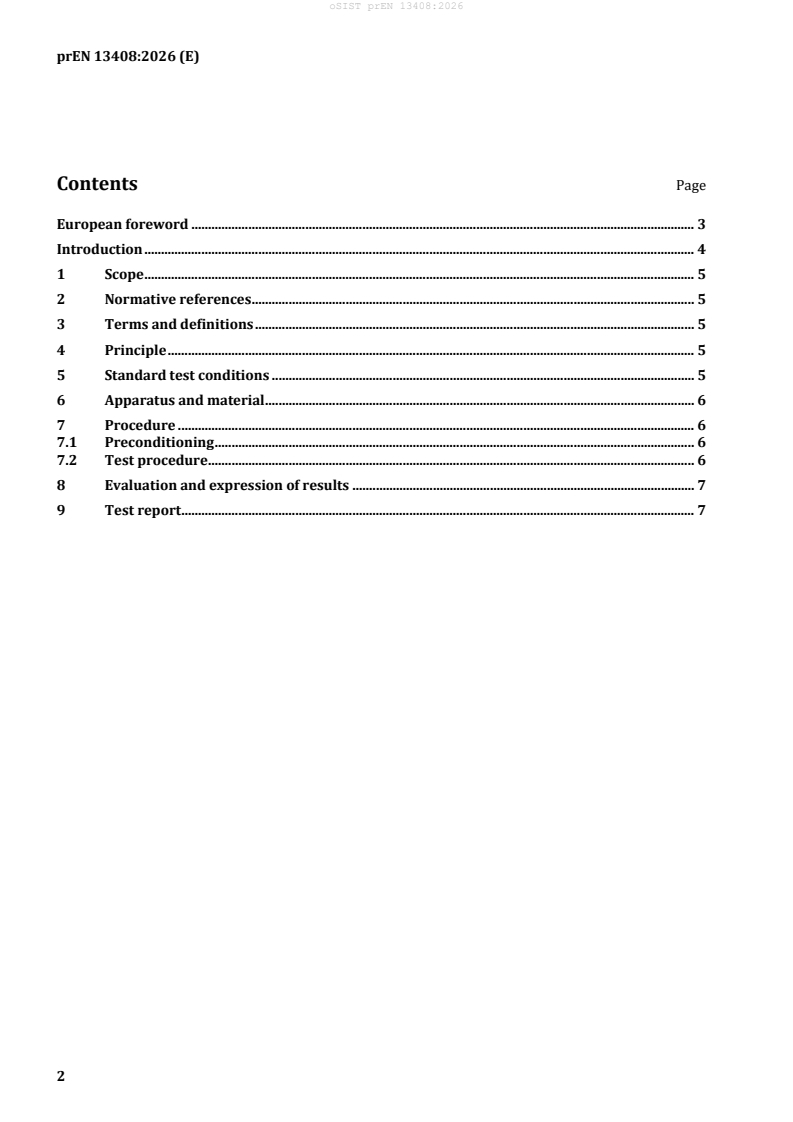
kSIST FprEN 13408:2026 is a draft European Standard, published through SIST, for a laboratory test on bond strength in cementitious and calciumsulfate-based floor levelling compounds. It specifies how to measure the bond between an underlayment made with these compounds and a standard concrete substrate, so laboratories and manufacturers can compare products under the same test conditions.
What does kSIST FprEN 13408:2026 specify?
kSIST FprEN 13408:2026 specifies a test method for determining bond strength between a floor levelling compound underlayment and a standard substrate. The document is organized into clauses 1 to 9: Scope, Normative references, Terms and definitions, Principle, Standard test conditions, Apparatus and material, Procedure, Evaluation and expression of results, and Test report.
Clause 1 places the method on cementitious and calcium sulphate-based floor levelling compounds used to prepare subfloors before floor coverings are installed. In practice, that means the method is for checking whether the levelling layer bonds properly to the support before the floor system goes into service.
What are the key requirements of kSIST FprEN 13408:2026?
kSIST FprEN 13408:2026 is built around a controlled tensile pull-off test on eight test areas. The main requirements are the test setup, the conditioning of specimens, the loading rate, and the way results are calculated and reported.
- Principle, Clause 4 - A set floor levelling compound is applied to a standard concrete test slab, metal plates are bonded to the surface, and a tensile tester pulls them off perpendicularly and centrally. This gives a direct measure of the bond between the compound and the substrate.
- Standard test conditions, Clause 5 - Test conditions are (23 ± 2) °C and (50 ± 5) % relative humidity in accordance with ISO 554, with air circulation below 0,2 m/s. Materials and apparatus are stored under these conditions, so temperature and humidity do not distort the result.
- Apparatus and material, Clause 6 - The method uses a tensile testing machine, a concrete slab in accordance with EN 12004-2, flexible moulding sheets, fast setting reactive resin adhesive, rigid metal plates, the prepared mixture, and primer if specified by the manufacturer. The equipment definition matters because the bonded area, plate size and substrate are fixed for comparable results.
- Specimen preparation, Clause 7.1 - Concrete slabs and moulding sheets are preconditioned for at least 24 h in the standard test conditions. This reduces variation before the test starts.
- Test procedure, Clause 7.2 - Eight test areas are required per floor levelling compound. If a primer is specified, it is applied as recommended by the manufacturer, the moulds are filled immediately after mixing, the moulding sheet is removed within three days, metal plates are bonded within 24 h before testing, and the test is carried out 14 d after mixing.
- Loading and failure reporting, Clause 7.2 - The tensile test is performed at a force increasing rate of (250 ± 50) N/s, and the breaking load and failure mode are reported using EN ISO 10365 terms. This tells the reader not only how strong the bond was, but also how it failed.
- Result calculation, Clause 8 - Bond strength is calculated from breaking load divided by bonded area, with the bonded area fixed at 2 500 mm². The arithmetic mean of eight results is used, with outliers handled by the stated 20 % rule; if fewer than four results remain, the whole test is repeated.
- Test report, Clause 9 - The report records the standard reference, product designation, manufacture date or batch number if known, primer details, mixing proportions and time, thickness used, bond strength, failure mode, deviations, and test date. That gives a complete record for comparison, audit and traceability.
What terms does kSIST FprEN 13408:2026 define?
kSIST FprEN 13408:2026 uses terms from EN 923 and prEN 1937:2026, and it defines the following key term in Clause 3.
- Bond strength - the force per unit area applied perpendicularly and centrally to the bonded area to cause failure.
- Underlayment - the layer formed by the floor levelling compound on the supporting substrate for the test.
- Standard substrate - the standard concrete test slab used as the reference support in the method.
- Floor levelling compound - the cementitious or calcium sulphate-based material used to prepare subfloors.
- Primer - a surface treatment used when the manufacturer specifies it for the levelling compound system.
- Tensile testing machine - the device used to pull the metal plate off the specimen at the specified rate.
- EN ISO 10365 - the failure-pattern designation standard used to describe cohesive and adhesive failure modes.
Who uses kSIST FprEN 13408:2026?
kSIST FprEN 13408:2026 is used by laboratories, manufacturers of floor levelling compounds, and quality or technical staff who need a repeatable bond-strength result. The Introduction says users should be familiar with normal laboratory practice, so the method is aimed at trained personnel rather than site installation crews.
In practice, users apply the standard when they need to:
- compare products or batches under the same test conditions;
- check the bond performance of a levelling compound against a concrete slab;
- document test results in a technical file, report, or quality-control record;
- assess whether a primer and curing sequence are suitable for the system.
What changed in kSIST FprEN 13408:2026 from the previous edition?
kSIST FprEN 13408:2026 will supersede EN 13408:2002. The foreword states these significant technical changes:
- the term “hydraulic setting floor smoothing and/or levelling compounds” was changed to “cementitious and calciumsulfate-based floor levelling compounds”;
- the scope was made more specific;
- the normative references were updated;
- editorial changes were made.
Which standards are used with kSIST FprEN 13408:2026?
kSIST FprEN 13408:2026 refers to several standards that support the test method:
- EN 12004-2 - provides the concrete slab requirement used for the test substrate.
- prEN 1937:2026 - gives the standard mixing procedures for preparing the floor levelling compound.
- EN ISO 10365 - provides the failure-pattern terms used in the test report.
- ISO 554 - specifies the standard atmospheres used for conditioning and testing.
- EN 923 - supplies terms and definitions used in Clause 3.
What does the kSIST FprEN 13408:2026 document contain?
kSIST FprEN 13408:2026 contains a complete laboratory method, from conditioning and specimen preparation through to calculation and reporting. It gives the test equipment, the specimen geometry, the loading rate, the timing of removal and testing, and the way to handle and average results.
The document is written for repeatable laboratory use, so it is suitable for product development, comparative testing, and technical reporting. It also includes the required test report items, which makes the result traceable and easier to review against the stated method.
Relations
- Effective Date
- 08-May-2024
Get Certified
Connect with accredited certification bodies for this standard

DIBt (Deutsches Institut für Bautechnik)
German Institute for Building Technology.

DIN CERTCO
DIN Group product certification.

Aboma Certification B.V.
Specialized in construction, metal, and transport sectors.
Sponsored listings
Frequently Asked Questions
kSIST FprEN 13408:2026 is a draft published by the Slovenian Institute for Standardization (SIST). Its full title is "Adhesives - Test method for cementitious and calciumsulfate-based floor levelling compounds - Determination of bond strength". This standard covers: This document specifies a test method for the determination of bond strength between an underlayment produced with cementitious or calciumsulfate-based floor levelling compounds and a standard substrate. This document applies to cementitious, and calcium sulphate-based floor levelling compounds used for the preparation of subfloors to ensure the suitability of the substrate prior to the installation of floor coverings. By using the floor levelling compound, a homogeneous layer is built up on the load-bearing substrate, to ensure consistent absorbency, evenness and strength.
This document specifies a test method for the determination of bond strength between an underlayment produced with cementitious or calciumsulfate-based floor levelling compounds and a standard substrate. This document applies to cementitious, and calcium sulphate-based floor levelling compounds used for the preparation of subfloors to ensure the suitability of the substrate prior to the installation of floor coverings. By using the floor levelling compound, a homogeneous layer is built up on the load-bearing substrate, to ensure consistent absorbency, evenness and strength.
kSIST FprEN 13408:2026 is classified under the following ICS (International Classification for Standards) categories: 91.100.99 - Other construction materials. The ICS classification helps identify the subject area and facilitates finding related standards.
kSIST FprEN 13408:2026 has the following relationships with other standards: It is inter standard links to SIST EN 13408:2002. Understanding these relationships helps ensure you are using the most current and applicable version of the standard.
kSIST FprEN 13408:2026 is available in PDF format for immediate download after purchase. The document can be added to your cart and obtained through the secure checkout process. Digital delivery ensures instant access to the complete standard document.
Standards Content (Sample)
Contents
- Introduction
- 1 Scope
- 2 Normative references
- 3 Terms and definitions
- 3.1 bond strength
- 4 Principle
- 5 Standard test conditions
- 6 Apparatus and material
- 6.3 Flexible moulding sheets, approx. 400 mm × 400 mm with up to 16 square cavities of
- 7 Procedure
- 7.1 Preconditioning
- 7.2 Test procedure
- 8 Evaluation and expression of results
- 9 Test report
Introduction
Persons using this document are to be familiar with normal laboratory practice. This document does not purport to address all the safety problems, if any, associated with its use. It is the responsibility of the user to establish safety and health practices and to ensure compliance with any European or national regulatory conditions.
oSIST prEN 13408:2026 prEN 13408:2026 (E)
1 Scope
This document specifies a test method for the determination of bond strength between an underlayment produced with cementitious or calciumsulfate-based floor levelling compounds and a standard substrate. This document applies to cementitious, and calcium sulphate-based floor levelling compounds used for the preparation of subfloors to ensure the suitability of the substrate prior to the installation of floor coverings. By using the floor levelling compound, a homogeneous layer is built up on the load-bearing substrate, to ensure consistent absorbency, evenness and strength.
2 Normative references
The following documents are referred to in the text in such a way that some or all of their content constitutes requirements of this document. For dated references, only the edition cited applies. For undated references, the latest edition of the referenced document (including any amendments) applies. EN 12004-2, Adhesives for ceramic tiles — Part 2: Test methods prEN 1937:2026, Adhesives — Test method for cementitious and calciumsulfate-based floor levelling compounds — Standard mixing procedures EN ISO 10365, Adhesives — Designation of main failure patterns (ISO 10365:2022) ISO 554, Standard atmospheres for conditioning and/or testing — Specifications
3 Terms and definitions
For the purposes of this document, the terms and definitions given in EN 923, prEN 1937:2026 and the following apply.
ISO and IEC maintain terminology databases for use in standardization at the following addresses:
- ISO Online browsing platform: available at https://www.iso.org/obp/
- IEC Electropedia: available at https://www.electropedia.org/
3.1 bond strength
force per unit area applied perpendicularly and centrally to the bonded area in order to produce a failure
...