

kSIST FprEN 1937:2026
(Main)Adhesives - Test method for cementitious and calciumsulfate-based floor levelling compounds - Standard mixing procedures
- Abstract
This document specifies the procedure for mixing cementitious and calcium sulfate-based floor levelling compounds with water and/or a liquid component as supplied by the manufacturer.
This document applies to cementitious, and calcium sulfate-based floor levelling compounds used for the preparation of subfloors to ensure the suitability of the substrate prior to the installation of floor coverings. By using the floor levelling compound, a homogeneous layer is built up on the load-bearing substrate, to ensure consistent absorbency, evenness and strength.
- Status
- Not Published
- Public Enquiry End Date
- 29-Apr-2026
- Technical Committee
- IPMA - Polimer materials and products
- Current Stage
- 5020 - Formal vote (FV) (Adopted Project)
- Start Date
- 17-Nov-2026
- Due Date
- 05-Jan-2027
- Completion Date
- 17-Nov-2026

kSIST FprEN 1937:2026 is the SIST publication of the draft European Standard prEN 1937:2026 from CEN. It specifies the standard mixing procedure for cementitious and calcium sulfate-based floor levelling compounds mixed with water and/or a manufacturer-supplied liquid component. Laboratories, manufacturers and test users apply it to prepare a consistent mix before further testing of subfloors and floor covering systems.
What does kSIST FprEN 1937:2026 specify?
kSIST FprEN 1937:2026 specifies how to mix cementitious and calcium sulfate-based floor levelling compounds so that test samples are prepared in a repeatable way. The document is aimed at products used to prepare subfloors before floor coverings are installed, where the mix must form a homogeneous layer with consistent absorbency, evenness and strength.
The document is organized into:
- Scope
- Normative references
- Terms and definitions
- Apparatus
- Materials
- Mixing conditions
- Mixing procedures
- Test report
That structure matters in practice because the standard does not just describe one mixing action. It ties together the mixer, the sample condition, the laboratory environment, the mixing sequence and the reporting of the procedure used.
What are the key requirements of kSIST FprEN 1937:2026?
kSIST FprEN 1937:2026 builds the test mix around a standard laboratory mixer and controlled mixing conditions. The important point for users is that the same preparation path is intended to be used before the later performance tests on the compound.
Apparatus and mixer setup
Clause 4 requires mixing equipment in accordance with EN 196-1, including a stainless steel bowl and blade of the specified general form. The bowl-blade gap is to be checked monthly and adjusted if necessary, and the mixer must run at the defined low and high speeds. In practice, this keeps the mechanical action stable from one test to the next.
Samples and liquids
Clause 5 requires the powder component to be sampled in accordance with EN ISO 15605 and prepared for testing in accordance with EN 1067. The powder is kept in a dry sealed container until use. The liquid component is water and/or a separate liquid component supplied by the manufacturer, with distilled or deionized water as the default. This matters because the mixing result can change if the sample or liquid is not handled consistently.
Conditioning before testing
Clause 6 requires all test materials to be stored for at least 24 h under standard conditions of 23 ± 2 °C and 50 ± 5 % relative humidity, with air circulation not greater than 0,2 m/s during testing. That gives the materials a common starting condition and reduces variation caused by temperature or moisture history.
Mixing procedure without waiting time
Clause 7a sets a mechanical mixing sequence for products that do not require a wait period. The manufacturer-specified amount of water and/or liquid is measured for 2 kg of powder, the powder is added, and the mix is run at low speed, scraped down, and mixed again. The total mixing time is limited, and the mixture must be free from air bubbles before immediate use.
Mixing procedure with waiting time
Clause 7b covers compounds that require a waiting time before use. If the waiting time is not specified exactly, the document sets a default waiting period, followed by a short remixture at low speed and a deaeration period. For users, this means the manufacturer’s instructions govern the method, but the document also gives a fallback sequence.
Test reporting
Clause 8 requires the test report to state whether procedure a) or b) was used and the total time elapsed to the end of mixing. The same mixing procedure should be used for all subsequent tests, which supports comparable results across a test series.
What terms does kSIST FprEN 1937:2026 define?
- underlayment - a thin layer on a load-bearing substrate that provides a smooth and/or flat surface for floorings and a uniformly absorbent surface.
- cementitious-based floor levelling compound - a ready-mixed dry mortar whose binder consists predominantly of cement and/or cementitious binders.
- calcium sulfate-based floor levelling compound - a ready-mixed dry mortar whose binder consists predominantly of calcium sulfate.
- powder component - the dry compound as supplied before liquid is added.
- prepared component mixture - the compound after mixing with a liquid component, such as water.
- set component - the prepared component mixture after it has set.
Who uses kSIST FprEN 1937:2026?
kSIST FprEN 1937:2026 is used by testing laboratories, product development teams, quality control staff and manufacturers of floor levelling compounds. It is also relevant to organizations that compare batches or verify product performance before use in floor preparation.
In practice, these users apply the standard when they need a repeatable specimen preparation step before testing the compound’s behavior. The document is also useful for anyone writing a test report, because the report must identify which mixing procedure was used.
What changed in kSIST FprEN 1937:2026 from the previous edition?
kSIST FprEN 1937:2026 will supersede EN 1937:1999. The foreword states these main technical changes:
- the former term “hydraulic setting floor smoothing and/or levelling compounds” is replaced by “cementitious and calciumsulfate-based floor levelling compounds”
- the scope is made more specific
- the terms “underlayment”, “cementitious-based floor levelling compound” and “calcium sulfate-based floor levelling compound” are added
- the mixing speed in the procedure is updated
- editorial changes are made
Which standards are used with kSIST FprEN 1937:2026?
- EN 196-1 - gives the laboratory mixer arrangement used for the apparatus.
- EN 923 - supplies general adhesive terms and definitions used in the document.
- EN ISO 15605 - covers sampling of the powder component.
- EN 1067 - covers examination and preparation of samples for testing.
- EN 13318:2025 - supplies screed and floor screed definitions used for terminology.
- ISO 554 - specifies standard atmospheres for conditioning and testing.
What does the kSIST FprEN 1937:2026 document contain?
kSIST FprEN 1937:2026 contains a defined apparatus section, including a mixer description, a bowl-and-blade figure and a speed table. It also contains material handling guidance for the powder and liquid components, plus environmental conditioning requirements before testing.
The core of the document is the mixing procedure in Clause 7. It gives two routes - one without a waiting time and one with a waiting time - and explains the sequence of mixing, scraping, deaeration and immediate use.
The document also includes a test report clause so the mixing route and elapsed time are recorded with the subsequent test results. That makes the mixing step traceable when comparing products, batches or laboratory results.
Relations
- Effective Date
- 08-May-2024
Get Certified
Connect with accredited certification bodies for this standard

DIBt (Deutsches Institut für Bautechnik)
German Institute for Building Technology.

DIN CERTCO
DIN Group product certification.

Aboma Certification B.V.
Specialized in construction, metal, and transport sectors.
Sponsored listings
Frequently Asked Questions
kSIST FprEN 1937:2026 is a draft published by the Slovenian Institute for Standardization (SIST). Its full title is "Adhesives - Test method for cementitious and calciumsulfate-based floor levelling compounds - Standard mixing procedures". This standard covers: This document specifies the procedure for mixing cementitious and calcium sulfate-based floor levelling compounds with water and/or a liquid component as supplied by the manufacturer. This document applies to cementitious, and calcium sulfate-based floor levelling compounds used for the preparation of subfloors to ensure the suitability of the substrate prior to the installation of floor coverings. By using the floor levelling compound, a homogeneous layer is built up on the load-bearing substrate, to ensure consistent absorbency, evenness and strength.
This document specifies the procedure for mixing cementitious and calcium sulfate-based floor levelling compounds with water and/or a liquid component as supplied by the manufacturer. This document applies to cementitious, and calcium sulfate-based floor levelling compounds used for the preparation of subfloors to ensure the suitability of the substrate prior to the installation of floor coverings. By using the floor levelling compound, a homogeneous layer is built up on the load-bearing substrate, to ensure consistent absorbency, evenness and strength.
kSIST FprEN 1937:2026 is classified under the following ICS (International Classification for Standards) categories: 91.100.99 - Other construction materials. The ICS classification helps identify the subject area and facilitates finding related standards.
kSIST FprEN 1937:2026 has the following relationships with other standards: It is inter standard links to SIST EN 1937:2000. Understanding these relationships helps ensure you are using the most current and applicable version of the standard.
kSIST FprEN 1937:2026 is available in PDF format for immediate download after purchase. The document can be added to your cart and obtained through the secure checkout process. Digital delivery ensures instant access to the complete standard document.
Standards Content (Sample)
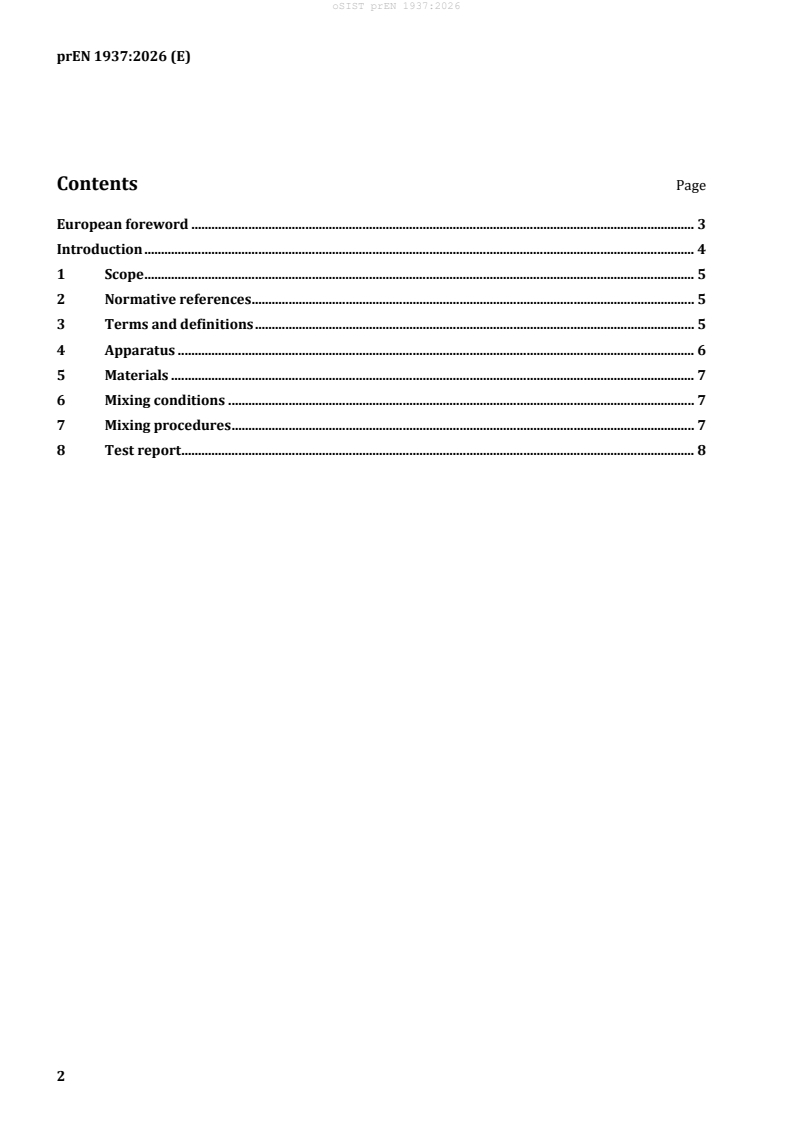
Contents
- Introduction
- 1 Scope
- 2 Normative references
- 3 Terms and definitions
- 3.1 underlayment
- 3.2 cementitious-based floor levelling compound
- 3.3 calcium sulfate-based floor levelling compound
- 4 Apparatus
- 5 Materials
- 6 Mixing conditions
- 7 Mixing procedures
- 8 Test report
Introduction
Persons using this document are to be familiar with normal laboratory practice. This document does not purport to address all the safety problems, if any, associated with its use. It is the responsibility of the user to establish health and safety practices and to ensure compliance with any European and national regulatory conditions.
oSIST prEN 1937:2026 prEN 1937:2026 (E)
1 Scope
This document specifies the procedure for mixing cementitious and calcium sulfate-based floor levelling compounds with water and/or a liquid component as supplied by the manufacturer. This document applies to cementitious, and calcium sulfate-based floor levelling compounds used for the preparation of subfloors to ensure the suitability of the substrate prior to the installation of floor coverings. By using the floor levelling compound, a homogeneous layer is built up on the load-bearing substrate, to ensure consistent absorbency, evenness and strength.
2 Normative references
The following documents are referred to in the text in such a way that some or all of their content constitutes requirements of this document. For dated references, only the edition cited applies. For undated references, the latest edition of the referenced document (including any amendments) applies. EN 196-1, Methods of testing cement — Part 1: Determination of strength EN 923, Adhesives — Terms and definitions EN ISO 15605, Adhesives — Sampling (ISO 15605) EN 1067, Adhesives — Examination and preparation of samples for testing EN 13318:2025, Screed material and floor screeds — Definitions. Trilingual version ISO 554, Standard atmospheres for conditioning and/or testing — Specifications
3 Terms and definitions
For the purposes of this document, the terms and definitions given in EN 923, EN 13318 and the following apply.
ISO and IEC maintain terminology databases for use in standardization at the following addresses:
- ISO Online browsing platform: available at https://www.iso.org/obp/
- IEC Electropedia: available at https://www.electropedia.org/
3.1 underlayment
thin layer applied to a load-bearing substrate to provide a smooth and/or flat surface to receive floorings and which also has a uniformly absorbent surface [SOURCE: EN 13318:2025, 3.75, modified - “and which also has a uniformly absorbent surface” was added and “screed” was changed to “load-bearing substrate”]
...