

kSIST FprEN 13409:2026
(Main)Adhesives - Test method for cementitious and calciumsulfate-based floor levelling compounds - Determination of setting time
- Abstract
This document specifies the measurement of setting time of a prepared cementitious or calcium sulfate-based floor levelling compound, after mixing with the liquid component, e.g. water.
This document applies to cementitious and calcium sulfate-based floor levelling compounds used for the preparation of subfloors to ensure the suitability of the substrate prior to the installation of floor coverings. By using the floor levelling compound, a homogeneous layer is built up on the load-bearing substrate, to ensure consistent absorbency, evenness and strength.
- Status
- Not Published
- Public Enquiry End Date
- 29-Apr-2026
- Technical Committee
- IPMA - Polimer materials and products
- Current Stage
- 5020 - Formal vote (FV) (Adopted Project)
- Start Date
- 17-Nov-2026
- Due Date
- 05-Jan-2027
- Completion Date
- 17-Nov-2026

kSIST FprEN 13409:2026 is the Slovene adoption of prEN 13409:2026 from CEN. It specifies a laboratory method for determining the setting time of cementitious and calcium sulfate-based floor levelling compounds after mixing with the liquid component, such as water. The document is used by laboratories, manufacturers, and quality teams that need to check how quickly a levelling compound starts and finishes setting before it is used on subfloors for floor coverings.
What does kSIST FprEN 13409:2026 specify?
kSIST FprEN 13409:2026 specifies one test method: measuring the setting time of a prepared cementitious or calcium sulfate-based floor levelling compound after it has been mixed with its liquid component. It applies to compounds used to prepare subfloors so the substrate is suitable before floor coverings are installed.
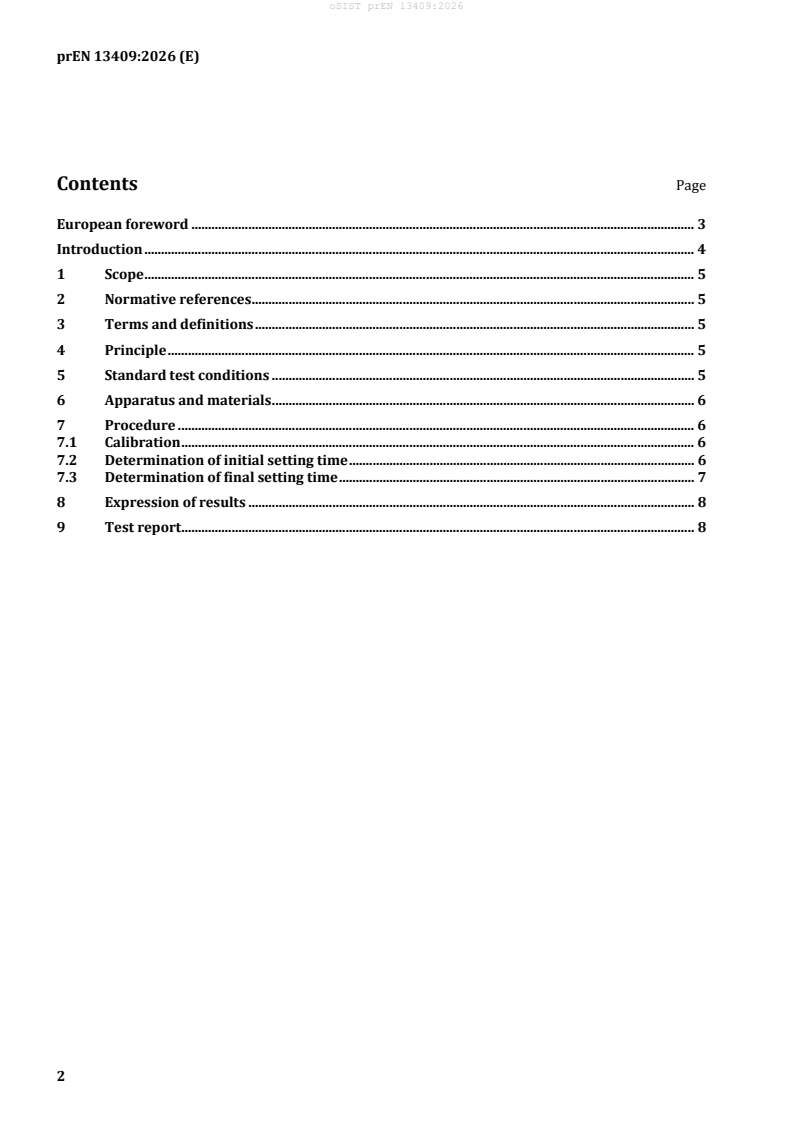
The document is organized into nine main clauses:
- Clause 1 - Scope
- Clause 2 - Normative references
- Clause 3 - Terms and definitions
- Clause 4 - Principle
- Clause 5 - Standard test conditions
- Clause 6 - Apparatus and materials
- Clause 7 - Procedure
- Clause 8 - Expression of results
- Clause 9 - Test report
This structure takes the reader from the test purpose, to the equipment and environment, and then to the measurement and reporting steps.
What are the key requirements of kSIST FprEN 13409:2026?
The standard’s core requirement is a controlled Vicat-needle penetration test. Clause 4 says the setting time is determined by observing how far a needle penetrates the compound after mixing, then recording the time linked to a specified penetration value.
Test conditions and preparation
Clause 5 requires standard test conditions of 23 °C ± 2 °C and 50 % ± 5 % relative humidity, in line with ISO 554. It also requires the test materials and apparatus to be stored under those conditions during the test, and the test area to have air circulation below 0.2 m/s. In practice, this limits environmental effects that could change setting behaviour.
Clause 7 requires the compound to be mixed according to prEN 1937:2026 before the test starts. That matters because the measured setting time depends on a consistent mixing procedure.
Apparatus and calibration
Clause 6 specifies a Vicat apparatus in accordance with EN 196-3, with a steel needle of defined size and a total moving mass of 300 g ± 1 g. It also specifies a mould of hard rubber with a truncated conical shape and a glass plate beneath it. Alternative mould materials or shapes are allowed only if they can be shown to give the same results as the specified mould. This means the test is strict about geometry, because the needle penetration depends on it.
Clause 7.1 requires calibration of the Vicat apparatus before the test. The needle is lowered onto the base plate, the pointer is set to zero, and the needle is returned to the stand-by position. That step verifies that the starting point of the measurement is correct.
Initial and final setting time
Clause 7.2 defines the initial setting time procedure. The mould is filled immediately after mixing, the surface is levelled, and the needle is applied at repeated time intervals until the scale reading reaches 4 mm ± 1 mm. The time is then recorded to the nearest minute. In practice, this marks when the material has progressed far enough in setting that the needle can no longer penetrate to the earlier depth.
Clause 7.3 covers the final setting time. The test continues until the needle penetrates only 0.5 mm, and that time is also recorded to the nearest minute. This gives a second point in the setting process, useful for comparing products or batch performance.
Reporting
Clause 8 requires both setting times to be expressed as elapsed time from the end of mixing, rounded to the nearest minute. Clause 9 requires the test report to identify the material, the liquid proportion, the mixing method and duration, the initial and final setting times, any deviations, and the test date. That gives the result enough context to be traced and compared.
What terms does kSIST FprEN 13409:2026 define?
- Setting - the transition of the material from plastic to solid state.
- Initial setting time - the time point linked to the first specified penetration result, used to show the early stage of stiffening.
- Final setting time - the time point when the needle first penetrates only 0.5 mm, showing the end stage of setting.
- Vicat apparatus - the penetration instrument used in the test, with the specified needle and moving mass.
- Standard test conditions - the controlled temperature, humidity, and air movement required for the test.
- prEN 1937:2026 - the companion draft used for the standard mixing procedure and the floor levelling compound and liquid.
- EN 196-3 - the referenced standard that provides the Vicat apparatus basis used in this method.
- ISO 554 - the reference for the atmosphere conditions used during conditioning and testing.
Who uses kSIST FprEN 13409:2026?
kSIST FprEN 13409:2026 is used by testing laboratories that measure setting time for product characterization or verification. Manufacturers of cementitious and calcium sulfate-based floor levelling compounds use it for development and batch control.
Quality managers and buyers use the results when they need evidence that a product sets within expected limits before floor coverings are installed. It is also relevant to teams preparing subfloors, because the measured setting behaviour affects when the layer can be handled or assessed further.
What changed in kSIST FprEN 13409:2026 from the previous edition?
kSIST FprEN 13409:2026 will supersede EN 13409:2002. The European foreword states three changes:
- the former term “hydraulic setting floor smoothing and/or levelling compounds” has been replaced with “cementitious and calciumsulfate-based floor levelling compounds”
- the scope has been made more specific
- editorial changes have been made
Which standards are used with kSIST FprEN 13409:2026?
- EN 196-3 - provides the Vicat apparatus basis and the setting-time equipment referenced by the method.
- EN 923 - supplies terms and definitions used in the adhesives field.
- prEN 1937:2026 - provides the standard mixing procedures and identifies the floor levelling compound and liquid used in the test.
- ISO 554 - specifies the standard atmospheres used for conditioning and testing.
What does the kSIST FprEN 13409:2026 document contain?
The document contains a principle for measuring setting time by needle penetration, followed by the required test conditions, apparatus, and step-by-step procedure. It includes calibration instructions, the procedure for determining initial setting time, and the procedure for determining final setting time.
It also sets out how to express the results and what must be included in the test report. Figure 1 shows the Vicat apparatus and needle arrangement used for the measurements.
Relations
- Effective Date
- 08-May-2024
Get Certified
Connect with accredited certification bodies for this standard

DIBt (Deutsches Institut für Bautechnik)
German Institute for Building Technology.

DIN CERTCO
DIN Group product certification.

Aboma Certification B.V.
Specialized in construction, metal, and transport sectors.
Sponsored listings
Frequently Asked Questions
kSIST FprEN 13409:2026 is a draft published by the Slovenian Institute for Standardization (SIST). Its full title is "Adhesives - Test method for cementitious and calciumsulfate-based floor levelling compounds - Determination of setting time". This standard covers: This document specifies the measurement of setting time of a prepared cementitious or calcium sulfate-based floor levelling compound, after mixing with the liquid component, e.g. water. This document applies to cementitious and calcium sulfate-based floor levelling compounds used for the preparation of subfloors to ensure the suitability of the substrate prior to the installation of floor coverings. By using the floor levelling compound, a homogeneous layer is built up on the load-bearing substrate, to ensure consistent absorbency, evenness and strength.
This document specifies the measurement of setting time of a prepared cementitious or calcium sulfate-based floor levelling compound, after mixing with the liquid component, e.g. water. This document applies to cementitious and calcium sulfate-based floor levelling compounds used for the preparation of subfloors to ensure the suitability of the substrate prior to the installation of floor coverings. By using the floor levelling compound, a homogeneous layer is built up on the load-bearing substrate, to ensure consistent absorbency, evenness and strength.
kSIST FprEN 13409:2026 is classified under the following ICS (International Classification for Standards) categories: 91.100.99 - Other construction materials. The ICS classification helps identify the subject area and facilitates finding related standards.
kSIST FprEN 13409:2026 has the following relationships with other standards: It is inter standard links to SIST EN 13409:2002. Understanding these relationships helps ensure you are using the most current and applicable version of the standard.
kSIST FprEN 13409:2026 is available in PDF format for immediate download after purchase. The document can be added to your cart and obtained through the secure checkout process. Digital delivery ensures instant access to the complete standard document.
Standards Content (Sample)
Contents
- Introduction
- 1 Scope
- 2 Normative references
- 3 Terms and definitions
- 3.1 setting
- 4 Principle
- 5 Standard test conditions
- 6 Apparatus and materials
- 6.1 Vicat apparatus, in accordance with EN 196-3 (see Figure 1) with a steel needle, length
- 7 Procedure
- 7.1 Calibration
- 7.2 Determination of initial setting time
- 1 Hard rubber mould
- 2 Platform for correcting weights
- 3 Glass plate
- 7.3 Determination of final setting time
- 8 Expression of results
- 9 Test report
Introduction
Persons using this document are to be familiar with normal laboratory practice. This document does not purport to address all the safety problems, if any, associated with its use. It is the responsibility of the user to establish health and safety practices and to ensure compliance with any European and national regulatory conditions.
oSIST prEN 13409:2026 prEN 13409:2026 (E)
1 Scope
This document specifies the measurement of setting time of a prepared cementitious or calcium sulfatebased floor levelling compound, after mixing with the liquid component, e.g. water. This document applies to cementitious and calcium sulfate-based floor levelling compounds used for the preparation of subfloors to ensure the suitability of the substrate prior to the installation of floor coverings. By using the floor levelling compound, a homogeneous layer is built up on the load-bearing substrate, to ensure consistent absorbency, evenness and strength.
2 Normative references
The following documents are referred to in the text in such a way that some or all of their content constitutes requirements of this document. For dated references, only the edition cited applies. For undated references, the latest edition of the referenced document (including any amendments) applies. EN 196-3, Methods of testing cement — Part 3: Determination of setting time and soundness EN 923, Adhesives — Terms and definitions prEN 1937:2026, Adhesives — Test method for cementitious and calciumsulfate-based floor levelling compounds — Standard mixing procedures ISO 554, Standard atmospheres for conditioning and/or testing — Specifications
3 Terms and definitions
For the purposes of this document, the terms and definitions given in EN 923, prEN 1937:2026 and the following apply.
ISO and IEC maintain terminology databases for use in standardization at the following addresses:
- ISO Online browsing platform: available at https://www.iso.org/obp/
- IEC Electropedia: available at https://www.electropedia.org/
3.1 setting
process of transition from plastic to solid state Note to entry 1: The setting time is characterized by the initial and final penetration times.
4 Principle
The setting time is determined by observing the penetration of a needle into floor levelling compound after mixing with water and recording the time for a given penetration value.
5 Standard test conditions
The standard test conditions shall be (23 ± 2) °C and (50 ± 5) % relative humidity in accordance with ISO 554.
...