

SIST EN 12418:2022
(Main)Masonry and stone cutting-off machines for job site - Safety
General Information
- Abstract
This document applies to transportable masonry and stone cutting-off machines stationary during work, principally used on job site building construction for cutting-off stones, other mineral construction materials and composite materials having at least one supporting surface. The power for the tool rotation is supplied by electrical or internal combustion prime motor.
This document deals with all significant hazards, hazardous situations or hazardous events relevant to masonry and stone cutting-off machines for job site (see Annex A), when they are used as intended and under conditions of misuse which are reasonably foreseeable by the manufacturer. This document specifies the appropriate technical measures to eliminate or reduce risks arising from the significant hazards during the lifetime of the machinery as described in EN ISO 12100:2010, 5.4.
These machines are designed for use with rotating diamond cutting-off wheels with a continuous rim and/or segmented rim.
This document does not apply to:
- metal cutting-off machines;
- wood and timber sawing machines;
- machines with a feed or descent mechanism other than manual, or with a pedal;
- mobile machines on a trolley travelling on the ground;
- hand-held portable grinding and cutting-off machines;
- hand-held portable grinding and cutting-off machines mounted on a support to be used in a fixed position.
This document does not cover the operation of transportable masonry and stone cutting-off machines in potential explosive atmospheres.
In this document, the masonry and stone cutting-off machines for job site construction are called: “cutting-off machines” or “machines”, and cutting-off wheels are also called: “tools”.
This document applies to machines which are manufactured after the date of approval of the standard by CEN.
- Status
- Published
- Public Enquiry End Date
- 16-Jan-2019
- Publication Date
- 23-Jan-2022
- Technical Committee
- I13 - Imaginarni 13
- Current Stage
- 6060 - National Implementation/Publication (Adopted Project)
- Start Date
- 22-Dec-2021
- Due Date
- 26-Feb-2022
- Completion Date
- 24-Jan-2022
- Directive
- 2006/42/EC - Directive 2006/42/EC of the European Parliament and of the Council of 17 May 2006 on machinery, and amending Directive 95/16/EC (recast)OJ Ref: OJ L 194, TIP C, 7.9.2026 UMIK 20.1.2027 OJ Date: 02-Aug-2023 Conflicting Date: 20-Jan-2027

Overview
EN 12418:2021 is the CEN European safety standard for transportable masonry and stone cutting-off machines used on job sites. It applies to machines that are stationary while operating and driven by electrical or internal-combustion prime movers, designed for use with rotating diamond cutting-off wheels (continuous or segmented rim). The standard addresses significant hazards during intended use and foreseeable misuse and specifies technical measures to eliminate or reduce risk throughout the machine’s lifetime in line with EN ISO 12100:2010.
The standard is a Type‑C machine-specific document and supersedes EN 12418:2000+A1:2009. It applies to machines manufactured after its approval date (2021).
Key Topics
- Scope & exclusions: covers job-site cutting-off machines; excludes metal or wood cutting machines, hand‑held grinders, mobile trolley machines, and machines with non-manual feed mechanisms or pedal drives.
- Hazard identification: lists significant hazards (mechanical, electrical, thermal, dust/water splashes, exhaust fumes, vibration, noise).
- Mechanical safety: design and strength requirements for guards, flanges, frames, fixing of cutting wheels, transport/handling provisions and control devices.
- Electrical & thermal protection: requirements for electrical safety, water pump protection and surface-temperature verification.
- Emissions & human factors: noise test code and declaration procedures, vibration-test code, exhaust gas considerations, dust suppression measures.
- Maintenance & verification: verification procedures for safeguards, testing methods (noise, vibration, temperature) and inspection guidance.
- Information for use: marking, warnings, operator instructions, instruction handbook, transport/installation/maintenance instructions and required pictograms.
- Normative annexes: detailed test codes, flange dimensions, guard-strength calculation, verification methods and Annex ZA relating the standard to EU directives.
Applications
EN 12418:2021 is used to:
- Guide manufacturers in designing and certifying cutting-off machines for safe job-site use.
- Support CE conformity assessments and documentation for market placement in Europe.
- Inform safety managers, procurement teams, and site supervisors when specifying equipment and safe work procedures.
- Advise maintenance providers and service organizations on test, inspection and repair criteria.
- Assist regulators and market surveillance authorities in evaluating machine compliance.
Related Standards
- EN ISO 12100:2010 - general principles for risk assessment and risk reduction (referenced).
- EN 12418:2000+A1:2009 - superseded by this edition.
- Annex ZA of EN 12418:2021 indicates alignment with the essential requirements of the EU Machinery Directive (2006/42/EC).
Keywords: EN 12418:2021, masonry and stone cutting-off machines, job site safety standard, CEN, diamond cutting-off wheels, machine guards, noise emission, vibration test, CE compliance.
Relations
- Effective Date
- 22-Dec-2021
- Effective Date
- 09-Feb-2026
- Effective Date
- 09-Feb-2026
- Effective Date
- 09-Feb-2026
- Effective Date
- 09-Feb-2026
- Effective Date
- 09-Feb-2026
- Effective Date
- 09-Feb-2026
- Effective Date
- 09-Feb-2026
- Effective Date
- 28-Jan-2026
- Effective Date
- 28-Jan-2026
- Effective Date
- 28-Jan-2026
- Effective Date
- 28-Jan-2026
- Effective Date
- 28-Jan-2026
- Effective Date
- 28-Jan-2026
- Effective Date
- 28-Jan-2026
Get Certified
Connect with accredited certification bodies for this standard

DIBt (Deutsches Institut für Bautechnik)
German Institute for Building Technology.
DIN CERTCO
DIN Group product certification.

Aboma Certification B.V.
Specialized in construction, metal, and transport sectors.
Sponsored listings
Frequently Asked Questions
SIST EN 12418:2022 is a standard published by the Slovenian Institute for Standardization (SIST). Its full title is "Masonry and stone cutting-off machines for job site - Safety". This standard covers: This document applies to transportable masonry and stone cutting-off machines stationary during work, principally used on job site building construction for cutting-off stones, other mineral construction materials and composite materials having at least one supporting surface. The power for the tool rotation is supplied by electrical or internal combustion prime motor. This document deals with all significant hazards, hazardous situations or hazardous events relevant to masonry and stone cutting-off machines for job site (see Annex A), when they are used as intended and under conditions of misuse which are reasonably foreseeable by the manufacturer. This document specifies the appropriate technical measures to eliminate or reduce risks arising from the significant hazards during the lifetime of the machinery as described in EN ISO 12100:2010, 5.4. These machines are designed for use with rotating diamond cutting-off wheels with a continuous rim and/or segmented rim. This document does not apply to: - metal cutting-off machines; - wood and timber sawing machines; - machines with a feed or descent mechanism other than manual, or with a pedal; - mobile machines on a trolley travelling on the ground; - hand-held portable grinding and cutting-off machines; - hand-held portable grinding and cutting-off machines mounted on a support to be used in a fixed position. This document does not cover the operation of transportable masonry and stone cutting-off machines in potential explosive atmospheres. In this document, the masonry and stone cutting-off machines for job site construction are called: “cutting-off machines” or “machines”, and cutting-off wheels are also called: “tools”. This document applies to machines which are manufactured after the date of approval of the standard by CEN.
This document applies to transportable masonry and stone cutting-off machines stationary during work, principally used on job site building construction for cutting-off stones, other mineral construction materials and composite materials having at least one supporting surface. The power for the tool rotation is supplied by electrical or internal combustion prime motor. This document deals with all significant hazards, hazardous situations or hazardous events relevant to masonry and stone cutting-off machines for job site (see Annex A), when they are used as intended and under conditions of misuse which are reasonably foreseeable by the manufacturer. This document specifies the appropriate technical measures to eliminate or reduce risks arising from the significant hazards during the lifetime of the machinery as described in EN ISO 12100:2010, 5.4. These machines are designed for use with rotating diamond cutting-off wheels with a continuous rim and/or segmented rim. This document does not apply to: - metal cutting-off machines; - wood and timber sawing machines; - machines with a feed or descent mechanism other than manual, or with a pedal; - mobile machines on a trolley travelling on the ground; - hand-held portable grinding and cutting-off machines; - hand-held portable grinding and cutting-off machines mounted on a support to be used in a fixed position. This document does not cover the operation of transportable masonry and stone cutting-off machines in potential explosive atmospheres. In this document, the masonry and stone cutting-off machines for job site construction are called: “cutting-off machines” or “machines”, and cutting-off wheels are also called: “tools”. This document applies to machines which are manufactured after the date of approval of the standard by CEN.
SIST EN 12418:2022 is classified under the following ICS (International Classification for Standards) categories: 91.220 - Construction equipment. The ICS classification helps identify the subject area and facilitates finding related standards.
SIST EN 12418:2022 has the following relationships with other standards: It is inter standard links to SIST EN 12418:2000+A1:2009, SIST EN 60529:1997/A1:2000, SIST EN 60529:1997/A2:2014, SIST EN 60204-1:2018, SIST EN 60529:1997, SIST EN 60335-2-41:2003, SIST EN 60335-2-41:2003/A1:2004, SIST EN 60335-2-41:2003/A2:2011, SIST EN ISO 14120:2016, SIST EN ISO 11201:2010, SIST EN ISO 13854:2020, SIST EN ISO 12100:2011, SIST EN 13236:2019, SIST EN ISO 13732-1:2008, SIST EN ISO 4871:2009. Understanding these relationships helps ensure you are using the most current and applicable version of the standard.
SIST EN 12418:2022 is associated with the following European legislation: EU Directives/Regulations: 2006/42/EC; Standardization Mandates: M/396. When a standard is cited in the Official Journal of the European Union, products manufactured in conformity with it benefit from a presumption of conformity with the essential requirements of the corresponding EU directive or regulation.
SIST EN 12418:2022 is available in PDF format for immediate download after purchase. The document can be added to your cart and obtained through the secure checkout process. Digital delivery ensures instant access to the complete standard document.
Standards Content (Sample)
SLOVENSKI STANDARD
01-marec-2022
Nadomešča:
SIST EN 12418:2000+A1:2009
Rezalniki kamenja na gradbiščih - Varnost
Masonry and stone cutting-off machines for job site - Safety
Steintrennmaschinen für den Baustelleneinsatz - Sicherheit
Scies de chantier à tronçonner les matériaux - Sécurité
Ta slovenski standard je istoveten z: EN 12418:2021
ICS:
91.220 Gradbena oprema Construction equipment
2003-01.Slovenski inštitut za standardizacijo. Razmnoževanje celote ali delov tega standarda ni dovoljeno.
EN 12418
EUROPEAN STANDARD
NORME EUROPÉENNE
December 2021
EUROPÄISCHE NORM
ICS 91.220 Supersedes EN 12418:2000+A1:2009
English Version
Masonry and stone cutting-off machines for job site -
Safety
Scies de chantier à tronçonner les matériaux - Sécurité Steintrennmaschinen für den Baustelleneinsatz -
Sicherheit
This European Standard was approved by CEN on 15 November 2021.
CEN members are bound to comply with the CEN/CENELEC Internal Regulations which stipulate the conditions for giving this
European Standard the status of a national standard without any alteration. Up-to-date lists and bibliographical references
concerning such national standards may be obtained on application to the CEN-CENELEC Management Centre or to any CEN
member.
This European Standard exists in three official versions (English, French, German). A version in any other language made by
translation under the responsibility of a CEN member into its own language and notified to the CEN-CENELEC Management
Centre has the same status as the official versions.
CEN members are the national standards bodies of Austria, Belgium, Bulgaria, Croatia, Cyprus, Czech Republic, Denmark, Estonia,
Finland, France, Germany, Greece, Hungary, Iceland, Ireland, Italy, Latvia, Lithuania, Luxembourg, Malta, Netherlands, Norway,
Poland, Portugal, Republic of North Macedonia, Romania, Serbia, Slovakia, Slovenia, Spain, Sweden, Switzerland, Turkey and
United Kingdom.
EUROPEAN COMMITTEE FOR STANDARDIZATION
COMITÉ EUROPÉEN DE NORMALISATION
EUROPÄISCHES KOMITEE FÜR NORMUNG
CEN-CENELEC Management Centre: Rue de la Science 23, B-1040 Brussels
© 2021 CEN All rights of exploitation in any form and by any means reserved Ref. No. EN 12418:2021 E
worldwide for CEN national Members.
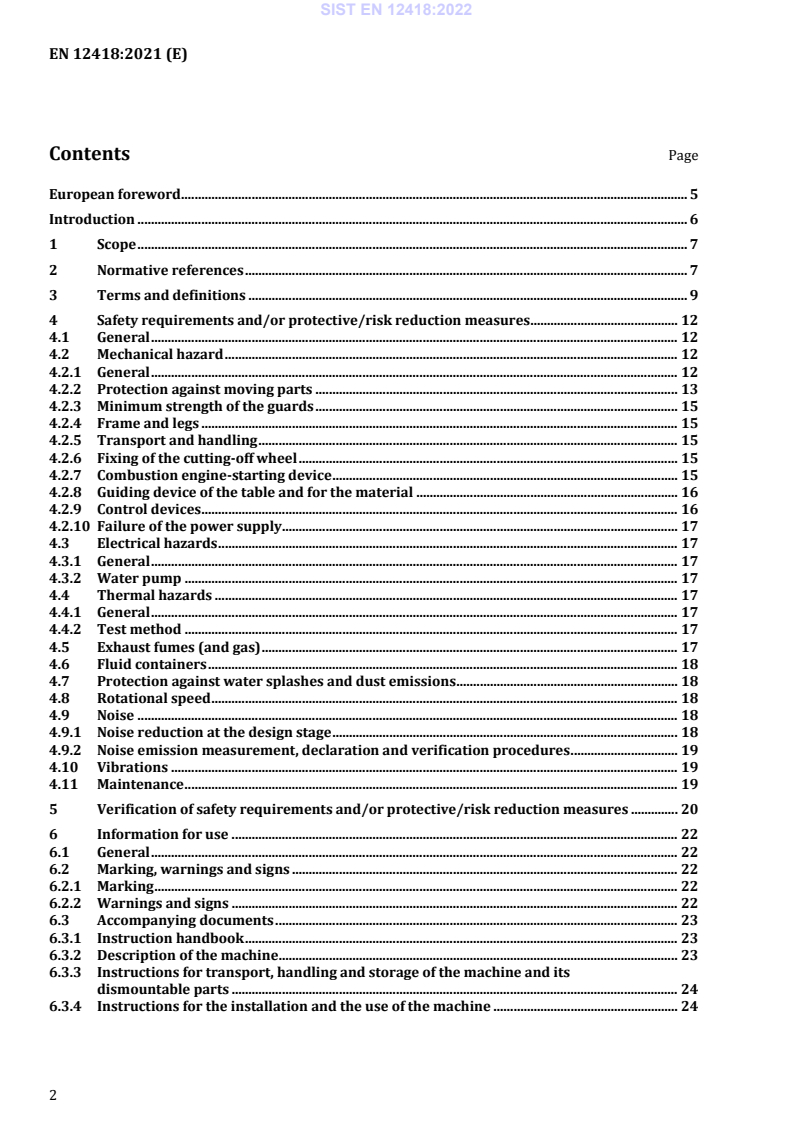
Contents Page
European foreword . 5
Introduction . 6
1 Scope . 7
2 Normative references . 7
3 Terms and definitions . 9
4 Safety requirements and/or protective/risk reduction measures . 12
4.1 General . 12
4.2 Mechanical hazard . 12
4.2.1 General . 12
4.2.2 Protection against moving parts . 13
4.2.3 Minimum strength of the guards . 15
4.2.4 Frame and legs . 15
4.2.5 Transport and handling . 15
4.2.6 Fixing of the cutting-off wheel . 15
4.2.7 Combustion engine-starting device . 15
4.2.8 Guiding device of the table and for the material . 16
4.2.9 Control devices . 16
4.2.10 Failure of the power supply . 17
4.3 Electrical hazards . 17
4.3.1 General . 17
4.3.2 Water pump . 17
4.4 Thermal hazards . 17
4.4.1 General . 17
4.4.2 Test method . 17
4.5 Exhaust fumes (and gas) . 17
4.6 Fluid containers . 18
4.7 Protection against water splashes and dust emissions . 18
4.8 Rotational speed . 18
4.9 Noise . 18
4.9.1 Noise reduction at the design stage . 18
4.9.2 Noise emission measurement, declaration and verification procedures . 19
4.10 Vibrations . 19
4.11 Maintenance . 19
5 Verification of safety requirements and/or protective/risk reduction measures . 20
6 Information for use . 22
6.1 General . 22
6.2 Marking, warnings and signs . 22
6.2.1 Marking . 22
6.2.2 Warnings and signs . 22
6.3 Accompanying documents . 23
6.3.1 Instruction handbook . 23
6.3.2 Description of the machine . 23
6.3.3 Instructions for transport, handling and storage of the machine and its
dismountable parts . 24
6.3.4 Instructions for the installation and the use of the machine . 24
6.3.5 Maintenance instructions . 26
Annex A (informative) List of significant hazards . 27
Annex B (normative) Noise test code - accuracy grade 2 . 29
B.1 General . 29
B.2 Measurement of the A-weighted emission sound pressure level at the workstation of
the operator . 29
B.3 Determination of the sound power level emitted by the machine . 30
B.4 Measurement uncertainties . 30
B.5 Operating conditions . 31
B.6 Information to be recorded . 32
B.7 Information to be reported . 32
B.8 Noise emission declaration by the manufacturer . 32
Annex C (normative) Dimensions of the flanges for cutting-off diamond wheel . 34
C.1 General . 34
C.2 Ratios to the diameters of the cutting-off wheel . 34
C.3 Minimum diameter S of the flange . 35
C.4 Minimum width R of contact surface of the flange with the cutting-off wheel . 35
C.5 Depth of the clearance T . 35
Annex D (normative) Strength of guards - State of the art concerning the characteristics of
guards used with cutting-off wheels . 36
D.1 General . 36
D.2 Guard specifications for type−1 and −2 machines (see 3.2) . 36
D.2.1 Calculation method . 36
D.2.2 Example of a minimum thickness of guards made with E24 grade-2 steel (alternative
to D.2.1) . 39
D.2.3 Other methods for determining the minimum thickness of guards . 40
Annex E (informative) Safety signs. 41
Annex F (normative) Verification of surface temperature . 43
F.1 Test equipment . 43
F.2 Test method . 43
F.3 Test acceptance . 43
Annex G (informative) Vibration-test code . 44
G.1 General . 44
G.2 Terms and definitions . 44
G.3 Vibration parameters to be measured and determined. 44
G.4 Instrumentation . 44
G.4.1 General . 44
G.4.2 Accelerometer . 44
G.4.3 Fastening of accelerometer . 44
G.4.4 Calibration . 45
G.5 Operating conditions, testing and declaration of results . 45
G.6 Uncertainties . 45
G.7 Information . 46
Annex ZA (informative) Relationship between this European Standard and the essential
requirements of EU Directive 2006/42/EC aimed to be covered . 47
Bibliography . 49
European foreword
This document (EN 12418:2021) has been prepared by Technical Committee CEN/TC 151
“Construction equipment and building material machines - Safety”, the secretariat of which is held by
DIN.
This European Standard shall be given the status of a national standard, either by publication of an
identical text or by endorsement, at the latest by June 2022, and conflicting national standards shall be
withdrawn at the latest by June 2022.
Attention is drawn to the possibility that some of the elements of this document may be the subject of
patent rights. CEN shall not be held responsible for identifying any or all such patent rights.
This document supersedes EN 12418:2000+A1:2009.
This document has been prepared under a Standardization Request given to CEN by the European
Commission and the European Free Trade Association, and supports essential requirements of EU
Directive(s).
For relationship with EU Directive(s), see informative Annex ZA, which is an integral part of this
document.
The main differences between this document and EN 12418:2000+A1:2009 are as follows:
a) normative references (Clause 2) revised and updated;
b) list of significant hazards revised and updated;
c) requirements for design of the cutting-off wheel guard;
d) requirements for warnings;
e) requirements for Information for use;
f) requirements for operator's instructions;
g) requirements for noise test code;
h) illustrations and pictograms updated.
Any feedback and questions on this document should be directed to the users’ national standards body.
A complete listing of these bodies can be found on the CEN website.
According to the CEN-CENELEC Internal Regulations, the national standards organisations of the
following countries are bound to implement this European Standard: Austria, Belgium, Bulgaria,
Croatia, Cyprus, Czech Republic, Denmark, Estonia, Finland, France, Germany, Greece, Hungary, Iceland,
Ireland, Italy, Latvia, Lithuania, Luxembourg, Malta, Netherlands, Norway, Poland, Portugal, Republic of
North Macedonia, Romania, Serbia, Slovakia, Slovenia, Spain, Sweden, Switzerland, Turkey and the
United Kingdom.
Introduction
This document is a type-C standard as stated in EN ISO 12100.
This document is of relevance, in particular, for the following stakeholder groups representing the
market players with regard to machinery safety:
— machine manufacturers (small, medium and large enterprises);
— health and safety bodies (regulators, accident prevention organizations, market surveillance, etc.).
Others can be affected by the level of machinery safety achieved with the means of the document by the
above-mentioned stakeholder groups:
— machine users/employers (small, medium and large enterprises);
— machine users/employees (e.g. trade unions, organizations for people with special needs);
— service providers, e.g. for maintenance (small, medium and large enterprises);
— consumers (in case of machinery intended for use by consumers).
The above-mentioned stakeholder groups have been given the possibility to participate in the drafting
process of this document.
The machinery concerned and the extent to which hazards, hazardous situations or hazardous events
are covered are indicated in the Scope of this document.
When requirements of this type-C standard are different from those which are stated in type-A or type-
B standards, the requirements of this type-C standard take precedence over the requirements of the
other standards for machines that have been designed and built according to the requirements of this
type-C standard.
1 Scope
This document applies to transportable masonry and stone cutting-off machines stationary during
work, principally used on job site building construction for cutting-off stones, other mineral
construction materials and composite materials having at least one supporting surface. The power for
the tool rotation is supplied by electrical or internal combustion prime motor.
This document deals with all significant hazards, hazardous situations or hazardous events relevant to
masonry and stone cutting-off machines for job site (see Annex A), when they are used as intended and
under conditions of misuse which are reasonably foreseeable by the manufacturer. This document
specifies the appropriate technical measures to eliminate or reduce risks arising from the significant
hazards during the lifetime of the machinery as described in EN ISO 12100:2010, 5.4.
These machines are designed for use with rotating diamond cutting-off wheels with a continuous rim
and/or segmented rim.
This document does not apply to:
— metal cutting-off machines;
— wood and timber sawing machines;
— machines with a feed or descent mechanism other than manual, or with a pedal;
— mobile machines on a trolley travelling on the ground;
— hand-held portable grinding and cutting-off machines;
— hand-held portable grinding and cutting-off machines mounted on a support to be used in a fixed
position.
This document does not cover the operation of transportable masonry and stone cutting-off machines
in potential explosive atmospheres.
In this document, the masonry and stone cutting-off machines for job site construction are called:
“cutting-off machines” or “machines”, and cutting-off wheels are also called: “tools”.
This document applies to machines which are manufactured after the date of approval of the standard
by CEN.
2 Normative references
The following documents are referred to in the text in such a way that some or all of their content
constitutes requirements of this document. For dated references, only the edition cited applies. For
undated references, the latest edition of the referenced document (including any amendments) applies.
EN 13236:2019, Safety requirements for superabrasive products
EN 60204-1:2018, Safety of machinery — Electrical equipment of machines — Part 1: General
requirements (IEC 60204-1:2016, modified)
EN 60335-2-41:2003, Household and similar electrical appliances — Safety — Part 2-41: Particular
requirements for pumps (IEC 60335-2-41:2002)
As impacted by EN 60335-2-41:2003/A1:2004 and EN 60335-2-41:2003/A2:2010.
EN 60529:1991, Degrees of protection provided by enclosures (IP Code) (IEC 60529:1991)
EN ISO 3744:2010, Acoustics — Determination of sound power levels and sound energy levels of noise
sources using sound pressure — Engineering methods for an essentially free field over a reflecting plane
(ISO 3744:2010)
EN ISO 4871:2009, Acoustics — Declaration and verification of noise emission values of machinery and
equipment (ISO 4871:1996)
EN ISO 11201:2010, Acoustics — Noise emitted by machinery and equipment — Determination of
emission sound pressure levels at a work station and at other specified positions in an essentially free field
over a reflecting plane with negligible environmental corrections (ISO 11201:2010)
EN ISO 11688-1:2009, Acoustics — Recommended practice for the design of low-noise machinery and
equipment — Part 1: Planning (ISO/TR 11688-1:1995)
EN ISO 12100:2010, Safety of machinery — General principles for design — Risk assessment and risk
reduction (ISO 12100:2010)
EN ISO 13732-1:2008, Ergonomics of the thermal environment — Methods for the assessment of human
responses to contact with surfaces — Part 1: Hot surfaces (ISO 13732-1:2006)
EN ISO 13849-1:2015, Safety of machinery — Safety-related parts of control systems — Part 1: General
principles for design (ISO 13849-1:2015)
EN ISO 13854:2019, Safety of machinery —Minimum gaps to avoid crushing of parts of the human body
(ISO 13854:2017)
EN ISO 13857:2019, Safety of machinery — Safety distances to prevent hazard zones being reached by
upper and lower limbs (ISO 13857:2019)
EN ISO 14120:2015, Safety of machinery — Guards — General requirements for the design and
construction of fixed and movable guards (ISO 14120:2015)
As impacted by EN 60529:1991/AC:2006-12, EN 60529:1991/A1:2000, EN 60529:1991/A2:2013 and
EN 60529:1991/A2:2013/AC:2019-02.
3 Terms and definitions
For the purposes of this document, the terms and definitions given in EN ISO 12100:2010 and the
following apply.
ISO and IEC maintain terminological databases for use in standardization at the following addresses:
— IEC Electropedia: available at https://www.electropedia.org/
— ISO Online browsing platform: available at https://www.iso.org/obp
3.1
cutting-off machine
transportable machine used in building and site construction, operating at a stationary position and is
intended for cutting primarily construction material of different weight, shape and dimensions, for
example natural stone, concrete (reinforced or otherwise), bricks, concrete blocks (breeze blocks),
paving slabs or cobblestones, roof tiles and ceramic tiles
Note 1 to entry: The feed of the material, of the table where the material is placed or of the cutting head is made
by hand. The cutting head, if movable for cutting depth, is moved manually or by a pedal.
The power source of a cutting-off machine is an electrical motor or an internal combustion engine with
built-in tank
Note 2 to entry: Cutting-off machine comprising the following parts:
— frame;
— electric motor or an ICE (internal combustion engine) to drive the cutting-off wheel in rotation;
— cutting head;
— rotating cutting-off wheel (see Clause 1);
— material-carrying table (movable and/or tiltable or not);
— cutting-off wheel guard;
— self-containing water tank with an electrical or mechanical water pump or an alternative water supply.
See also Figure 1
a) Cutting-off machine with internal b) Cutting-off machine with electric motor
combustion engine
Key
1 frame (incorporating the water tank)
2 legs (demountable or otherwise)
3 cutting head - see 3.3
4 cutting-off wheel - see 3.7
5 electric motor (or engine)
6 handle for moving the cutting head
7 foot pedal for lowering the cutting head (if any)
8 cutting-off wheel guard
9 movable table including material stop for supporting materials to be cut
10 water splash deflector
11 table-guiding tracks
12 water supply system
13 front stop of the table
14 cutting depth stop (for type-1 and −2 machines)
Figure 1 — Examples of cutting-off machines
3.2
types of cutting-off machines
cutting-off machines can be basically classified in four different types defined below:
— Type-1 machine: Machine with a movable table for feeding, having a fixed (permanently or by
means of clamps) or swinging adjustable cutting head (tiltable or not) which is located over the
table;
Note 1 to entry: During the cutting process, the cutting head is in a fixed position.
— Type-2 machine: Machine with a fixed table having a horizontally moving cutting head for feeding
and, if applicable, vertically adjustable and tiltable cutting head located over the table;
— Type-3 machine: Machine with a fixed table having a vertically moving cutting head for feeding;
— Type-4 machine: Machine with a fixed or movable table having a fixed or tiltable cutting head, and
only intended for use with continuous rim tools having a maximum diameter of 250 mm. The
feeding is done by hand or by movable table. The motor is located under the table.
See also Figure 2
a) Type-1 machine
b) Type-2 machine
c) Type-3 machine d) Type-4 machine
Figure 2 — Types of masonry and stone cutting-off machines
3.3
cutting head
part of the machine where the cutting-off wheel is attached
Note 1 to entry: It can consist of:
— the fixing means for the cutting-off wheel on the spindle;
— the spindle:
— with direct drive from the power unit;
— with power transmission from the power unit;
— the handle;
— the cutting-off wheel guard and the transmission guard (if any) which are movable relative to the
frame.
3.4
rated spindle speed
speed of the drive spindle in revolutions per minute (r/min) at the rated conditions specified by the
machine manufacturer but without cutting-off wheel and under no load
3.5
nominal mass
mass of the cutting-off machine equipped with all its dismountable parts, but without the cutting-off
wheel, the tanks being empty
3.6
maximum operating mass
mass of the cutting-off machine equipped with all its dismountable parts, ready for use, with the
cutting-off wheel mounted and the tanks being full
3.7
cutting-off wheel
rotating abrasive tool which performs the cutting operation
Note 1 to entry: The tool is a rotating (segmented or continuous rim) diamond or boron nitride cutting-off
wheel.
3.8
flange
mounting device including several parts which securely hold and position the cutting-off wheel on the
drive spindle
4 Safety requirements and/or protective/risk reduction measures
4.1 General
Machinery shall comply with the safety requirements and/or protective/risk reduction measures of this
clause. In addition, the machine shall be designed according to the principles of EN ISO 12100:2010 for
relevant but not significant hazards which are not dealt with by this document.
Covering each significant hazard is sufficient for covering combinations of hazards.
4.2 Mechanical hazard
4.2.1 General
Components and parts which shall be manually handled and all the accessible parts, with the exception
of the cutting-off wheel, shall be free of sharp edges and burrs which could generate hazards when
setting, using, handling, and maintaining the machine. Burrs resulting from, for example, manufacturing,
casting or welding shall be eliminated and sharp edges shall be smoothed.
4.2.2 Protection against moving parts
4.2.2.1 Transmission parts
Rotating transmission parts, for example, couplings and belt drives for drive shafts and mechanical
water pumps shall be provided with fixed enclosing guards to prevent contact. These guards shall
comply with EN ISO 14120:2015 and EN ISO 13857:2019, Table 4. Fixed enclosing guards shall be held
in position either by welding or by mounting them in such a way that they can be opened or removed
only with the aid of tools or keys.
Fixed enclosing guards shall have their fixing system permanently attached to the guard and/or the
machine when the guard is removed.
4.2.2.2 Connection between the cutting head and the frame
For type-1 machines (see 3.2) with a swinging adjustable cutting head, the cutting head shall be
lockable. In this case, the area between the cutting head and the frame of the machine shall be protected
to avoid any shearing and crushing hazard. This can be done by taking into account the minimum
distances given in EN ISO 13854:2019, Table 1, “finger” or by fixed guards, complying with
EN ISO 14120:2015, Clause 5, and EN ISO 13857:2019, Table 2 and Table 4.
4.2.2.3 Moving parts involved in the working process (protection against contact with the
cutting-off wheel and its fixing devices)
4.2.2.3.1 General
The safety measures to be taken shall be adapted according to the type of machines (see 3.2).
4.2.2.3.2 Type−1, −2 and −3 machines
The upper part of the cutting-off wheel and its non-smooth fixing device(s) (i.e. spindle nuts or bolts,
see Figure 3) shall be covered with a fixed solid guard complying with EN ISO 14120:2015 to avoid
inadvertent contact and to protect against ejection of fragments from the cutting-off wheel and the
work piece, water, dust and debris. For type-3 machines with a vertically moving cutting head, the
cutting-off wheel shall be completely covered sidewise at the upper position.
The guard shall be designed to allow fitting and removal of the cutting-off wheel.
When the guard is removed or opened, the guard-fixing system shall be permanently attached to the
guard and/or the machine.
The machine shall be so designed that the absence or the opening of the guard creates a projection of
water, dust or debris during operation, which hinders the intended use of the machine.
The following requirements for the design of the cutting-off wheel guard shall be considered:
Both forward (A) and rear (B) edges of the cutting-off wheel guard shall be located below the horizontal
plane passing through the centre of the cutting-off wheel when in cutting position shown in Figure 3 a).
The rear edge (B) of the cutting-off wheel guard shall be located, at least, as low as the horizontal plane
passing by the lowest point of the spindle fixing device. The foregoing condition shall be fulfilled when
the cutting head is in the highest position shown in Figure 3 b).
a) Cutting head in the lowest through cutting position
b) Cutting head in the highest position
Key
1 movable table
A front side (operator's position during work)
B rear side (side of link joint of the cutting head)
X vertical distance of front guard edge to cutting-off wheel centre
Y vertical distance of rear guard edge to non-smooth fixing device lower edge
Figure 3 — Design of the cutting-off wheel guard
4.2.2.3.3 Type-4 machines
These machines are intended to be used only with continuous rim diamond cutting-off wheels.
For this type of machine, the cutting-off wheel fixing device has to be located below the table. The
design shall be such that this fixing device and the part of the cutting-off wheel not involved in the
cutting process is out of reach of the operator during the working procedure. Other moving parts of the
machinery shall be protected with a fixed solid guard complying with EN ISO 14120:2015 and
EN ISO 13857:2019, Table 4.
The working area shall be protected by means of a guard. The guard and the table shall be fixed to the
frame to protect against ejection of fragments from the work piece, water, dust and debris.
4.2.3 Minimum strength of the guards
The guards of the cutting-off wheel (for type−1, −2 and −3 machines) shall be so designed to resist
strains resulting from an accidental projection of a fragment of the cutting-off wheel. Brittleness of the
guard material shall be taken into account. Permanent plastic deformation of the guard resulting from
stresses shall be allowed.
Annex D indicates the characteristics of guards which correctly fulfil their function.
4.2.4 Frame and legs
4.2.4.1 Stability of the machine
The machine shall be stable in order to avoid overturning when operating or during handling the
material to be cut on the table.
This may be verified as follows:
The machine without water (when the tank is located inside the frame of the machine), the cutting head
and the table being secured, shall be inclined at an angle of 10° in all positions with respect to the
vertical. It shall not overturn regardless of the position of the movable parts.
4.2.4.2 Connection of legs to frame
Connection between legs and frame shall be so designed that any loss of the legs in particular when
lifting the machine is prevented. Disconnection shall only be possible by an intentional manual action.
4.2.5 Transport and handling
The movable parts of the machine shall be either lockable or removable to avoid any risk of shearing or
crushing e.g. during handling and carrying.
NOTE For technical requirements relating to transport and lifting of the machine, see EN ISO 12100:2010,
6.3.5.5.
4.2.6 Fixing of the cutting-off wheel
4.2.6.1 Device for mounting the cutting-off wheel
The device for mounting the cutting-off wheel shall be so designed that loosening and untightening shall
be possible only by an intentional manual action (e.g. retaining the cutting-off wheel on the drive
spindle by a threaded nut which, by the direction of the thread, prevents unscrewing during the cutting
operation).
4.2.6.2 Flanges
The flanges intended to mount a diamond cutting-off wheel shall comply with the requirements in
Annex C.
4.2.7 Combustion engine-starting device
The combustion engine-starting device shall be an electric starter or a manual starter. The actuator for
the manual starter shall be permanently attached to the machine and have a recoil device for the rope.
4.2.8 Guiding device of the table and for the material
4.2.8.1 Guiding device of the table
Cutting-off machines with a movable table, shall be equipped with a guiding device of the table which
shall ensure stability of the table during cutting-off and a feed movement parallel to the plane of the
cutting-off wheel.
These requirements are fulfilled when the movable table has the following characteristics:
— it shall be designed to prevent it from leaving the track at each end;
— it shall be designed to prevent it overturning under the weight of the material intended to be cut;
— it shall be designed to avoid any crushing hazard of the operator's hands between the table and the
frame according to EN ISO 13854:2019, Table 1.
4.2.8.2 Guiding device for the material
Cutting-off machines with a movable table shall be equipped with a material stop (see Figure 1, Pos. 9).
For type−1 and −4 machines with movable tables which do not have a guiding device for the material,
the tables shall be covered with an anti-slip surface (e.g. coating with elastomer) and with a material
stop (see Figure 1) to resist the horizontal cutting force.
For type−4 machine with a fixed table, its top surface shall be smooth and regular.
4.2.9 Control devices
4.2.9.1 General
For safety-critical functions, PL values shall be determined using the methods of EN ISO 13849-1:2015.
Table 1 — Required Performance Levels
Type and purpose of Safety Critical Function
Minimum Performance Level (PL)
(SCF)
Power switch - prevent unwanted switch-on b
Power switch - provide desired switch-off c
4.2.9.2 Start and stop control device (rotation of the cutting-off wheel)
Cutting-off machines shall be fitted with a start and stop control device which allows starting and
stopping of the motor, or of the rotation of the cutting-off wheel. Start and stop control devices shall be
easily accessible to the operator.
The stop control device shall be according to EN 60204-1:2018, stop category 0 (stopping by immediate
removal of power to the machine actuators).
The on- and off-control shall be located on the top or on the sides or front of the machine at a maximum
distance of 550 mm from the operator's position during the cutting process specified by the
manufacturer.
4.2.10 Failure of the power supply
Interruption of the power supply and re-establishment after interruption shall not lead to a dangerous
situation, in particular:
— the machine shall not be restarted automatically, an intentional action shall be necessary;
— the machine shall not be prevented from stopping if the stop command has been given.
Type−4 machines are excluded as they are assessed as generating no hazard after restoration of energy
following a failure of the power supply.
4.3 Electrical hazards
4.3.1 General
Machines with an electrical motor shall fulfil the electrical safety requirements of EN 60204-1:2018, in
particular Clauses 4, 5, 6, 14, 15 and 16. In addition to EN 60204-1:2018, 4.4.3, these machines shall
work as intended in an ambient temperature range of 0 °C to 40 °C.
For machines with a three-phase electrical supply, a device enabling phase inversion (to ensure correct
tool rotation) shall be provided.
For machines with an electrical motor, the enclosure of the electric controls shall provide a degree of
protection of at least IP 54 as defined in EN 60529:1991 . Therefore, an inbuilt PRCD is not required.
4.3.2 Water pump
Where water is supplied by an electrical pump for flushing the cutting-tool operating above Safety Extra
Low Voltage (above 50 V), the pump shall fulfil the relevant requirements of EN 60335-2-41:2003 .
4.4 Thermal hazards
4.4.1 General
Handles and other surfaces which require continuous contact shall have a surface temperature not
exceeding 43 °C.
Controls and other parts of the machine which are contacted occasionally shall meet the limits as given
in EN ISO 13732-1:2008 according to the chosen material for a contact period up to 5 s, lowest curve.
Hot areas which may be contacted unintentionally shall meet the levels of EN ISO 13732-1:2008 for a
contact period below 1 s. These areas shall be either located at a distance greater than 120 mm from the
gripping areas, or they shall be protected by shields.
These shields shall be designed to reduce the heat transfer from the surface to the body of the operator,
e.g. by a structured surface, ribs or special coating.
4.4.2 Test method
The test method to verify the surface temperature of the machine is prescribed in Annex F.
The machine parts whose temperatures exceed the permissible limits of EN ISO 13732-1:2008 for a
contact time not exceeding 1 s and whose surface is greater than 10 cm shall not be accessible to the
test cone (see Annex F).
4.5 Exhaust fumes (and gas)
The engine’s exhaust shall not be directed towards the operator when in the operating position
specified by the manufacturer.
This requirement is considered fulfilled when the angle made by the axis of the outlet of the exhaust
device and the lengthways axis of the machine, measured from the position of the operator, is equal to
or greater than 90°.
4.6 Fluid containers
When filled according to the manufacturer's instructions, fluid containers except water tanks and in
particular batteries and the fuel system shall be constructed to prevent spillage when the machine is
tilted as specified in the stability test (see 4.2.4.1).
4.7 Protection against water splashes and dust emissions
Machines intended for wet cutting shall be equipped with a water supply device. The volume of water
supplied to the cutting-off wheel shall be sufficient to provide adequate tool flush and dust suppression.
Type−1 and −2 machines (see 3.2) shall be equipped at the rear of the cutting-off wheel (see Figure 2)
with a water-splash deflector or similar device to protect from water splashes.
The water-splash deflector shall be made from rubber or other flexible material and shall include
grooves, pins or the like to reduce splashing.
The size of the water-splash deflector shall be sufficient to reduce the water ejected backwards by the
rotation of the cutting-off wheel. The retained water shall be collected in a reservoir.
Machines intended for dry cutting shall be equipped with a dust-collector port located at the
appropriate place and of a suitable shape and size. This device when connected to a dust collector as
specified in the instruction handbook (see 6.3.4) shall be capable of controlling the dust.
4.8 Rotational speed
The rotational speed of the spindle but without the cutting-off wheel fitted shall be measured under the
conditions specified by the manufacturer.
Under the rated conditions of power supply specified by the machine manufacturer, the maximum
rotational speed of the spindle in revolutions per minute shall not exceed
...