

SIST EN 13374:2025
(Main)Temporary edge protection systems - Product specification - Test methods
General Information
- Abstract
This document specifies the requirements and test methods for temporary edge protection systems for use during construction or maintenance of buildings and other structures.
This document applies to edge protection systems for flat and inclined surfaces and specifies the requirements for three classes of temporary edge protection.
For edge protection systems with an arrest function (e.g. falling or sliding down a sloping roof) this document specifies requirements for energy absorption.
This document includes edge protection systems, some of which are fixed to the structure and others, which rely on gravity and friction on flat surfaces.
This document does not provide requirements for edge protection systems intended for:
— protection against impact from vehicles or from other mobile equipment,
— protection from sliding down of bulk loose materials, snow etc,
— protection of areas accessible to the public.
This document does not apply to side protection on scaffolds according to EN 12811 1 and EN 1004 1.
NOTE This does not prevent these systems to be used on temporary structures.
- Status
- Published
- Public Enquiry End Date
- 03-May-2022
- Publication Date
- 25-May-2025
- Technical Committee
- I13 - Imaginarni 13
- Current Stage
- 6060 - National Implementation/Publication (Adopted Project)
- Start Date
- 22-May-2025
- Due Date
- 27-Jul-2025
- Completion Date
- 26-May-2025



Overview
EN 13374:2025 - Temporary edge protection systems - Product specification - Test methods is the CEN product standard that sets requirements and test methods for temporary edge protection used during construction and maintenance. It applies to systems for flat and inclined surfaces, covering three classification classes (A, B, C) and including both systems fixed to structures and systems that rely on gravity/friction. Where an edge protection system has an arrest function (e.g., stopping a fall or sliding on a sloping roof), EN 13374:2025 also addresses energy absorption requirements.
Key topics and technical requirements
- Classification: Defines Classes A, B and C for varied site uses and inclinations.
- Dimensional and material requirements: Rules for principal and intermediate guardrails, toeboards and permissible materials (steel, timber, counterweights).
- Static and dynamic design: Serviceability and ultimate limit state considerations, partial safety factors, and accidental load scenarios.
- Test methods: Procedures for static and dynamic tests, load application, sampling, strength and serviceability tests, and test reporting to demonstrate conformity for each class.
- Structural design and verification: Methods for design, load combinations (including wind and point loads), and guidance on the structural capability of the supporting substrate.
- Marking and information: Requirements for product marking, documentation to be provided to site (installation, limitations, maintenance), and assessment procedures.
- Annexes: Informative annexes cover inclinations and falling heights (Annex A), simplified test/evaluation methods (Annex B), and registered national deviations (Annex C).
Practical applications
EN 13374:2025 is used to specify and validate temporary edge protection systems intended to:
- Prevent falls from roofs, edges, stairs and temporary work levels.
- Provide fall-arrest or restraining functions on sloping surfaces where energy absorption is required.
- Protect workers and reduce risk of falling objects (via toeboards), while allowing mobility without lanyards.
Note: the standard explicitly excludes systems designed for vehicle impacts, protection from sliding bulk materials or snow, and areas accessible to the public. It also does not replace scaffold side protection standards (EN 12811-1, EN 1004-1).
Who uses this standard
- Manufacturers and product designers of temporary edge protection systems
- Test laboratories and conformity assessment bodies
- Construction safety managers, site supervisors and principal contractors
- Specifiers, consultants and regulatory bodies ensuring compliance with EU/national work-at-height requirements
Related standards
- EN 12811-1, EN 1004-1 (scaffold side protection - excluded scope)
- Normative references cited in EN 13374:2025 (e.g., EN 74 series, EN 338, EN 596)
Keywords: EN 13374:2025, temporary edge protection systems, test methods, product specification, fall protection, construction safety.
Relations
- Effective Date
- 25-Mar-2026
- Effective Date
- 25-Mar-2026
- Effective Date
- 25-Mar-2026
- Effective Date
- 25-Mar-2026
- Effective Date
- 25-Mar-2026
- Effective Date
- 25-Mar-2026
- Refers
kSIST FprEN 1993-1-11:2025 - Eurocode 3 - Design of steel structures - Part 1-11: Tension components - Effective Date
- 25-Mar-2026
- Effective Date
- 28-Jan-2026
- Effective Date
- 28-Jan-2026
- Effective Date
- 28-Jan-2026
- Effective Date
- 28-Jan-2026
- Effective Date
- 28-Jan-2026
- Effective Date
- 28-Jan-2026
- Effective Date
- 28-Jan-2026
- Effective Date
- 28-Jan-2026
Get Certified
Connect with accredited certification bodies for this standard

DIBt (Deutsches Institut für Bautechnik)
German Institute for Building Technology.
DIN CERTCO
DIN Group product certification.

Kiwa BDA Testing
Building and construction product certification.
Sponsored listings
Frequently Asked Questions
SIST EN 13374:2025 is a standard published by the Slovenian Institute for Standardization (SIST). Its full title is "Temporary edge protection systems - Product specification - Test methods". This standard covers: This document specifies the requirements and test methods for temporary edge protection systems for use during construction or maintenance of buildings and other structures. This document applies to edge protection systems for flat and inclined surfaces and specifies the requirements for three classes of temporary edge protection. For edge protection systems with an arrest function (e.g. falling or sliding down a sloping roof) this document specifies requirements for energy absorption. This document includes edge protection systems, some of which are fixed to the structure and others, which rely on gravity and friction on flat surfaces. This document does not provide requirements for edge protection systems intended for: — protection against impact from vehicles or from other mobile equipment, — protection from sliding down of bulk loose materials, snow etc, — protection of areas accessible to the public. This document does not apply to side protection on scaffolds according to EN 12811 1 and EN 1004 1. NOTE This does not prevent these systems to be used on temporary structures.
This document specifies the requirements and test methods for temporary edge protection systems for use during construction or maintenance of buildings and other structures. This document applies to edge protection systems for flat and inclined surfaces and specifies the requirements for three classes of temporary edge protection. For edge protection systems with an arrest function (e.g. falling or sliding down a sloping roof) this document specifies requirements for energy absorption. This document includes edge protection systems, some of which are fixed to the structure and others, which rely on gravity and friction on flat surfaces. This document does not provide requirements for edge protection systems intended for: — protection against impact from vehicles or from other mobile equipment, — protection from sliding down of bulk loose materials, snow etc, — protection of areas accessible to the public. This document does not apply to side protection on scaffolds according to EN 12811 1 and EN 1004 1. NOTE This does not prevent these systems to be used on temporary structures.
SIST EN 13374:2025 is classified under the following ICS (International Classification for Standards) categories: 13.340.99 - Other protective equipment; 91.220 - Construction equipment. The ICS classification helps identify the subject area and facilitates finding related standards.
SIST EN 13374:2025 has the following relationships with other standards: It is inter standard links to kSIST FprEN 1993-6:2025, kSIST FprEN 1993-2:2025, kSIST FprEN 1995-2:2025, kSIST FprEN 1993-4-2:2025, kSIST FprEN 1993-4-1:2025, kSIST FprEN 1993-3:2025, kSIST FprEN 1993-1-11:2025, kSIST FprEN 1993-1-6:2024, SIST EN 1993-2:2007, kSIST FprEN 1995-1-2:2025, SIST EN 1263-1:2015, SIST EN 1993-3-1:2007, kSIST FprEN 1993-1-1:2022, SIST EN 1993-1-11:2007, kSIST FprEN 1999-1-2:2022. Understanding these relationships helps ensure you are using the most current and applicable version of the standard.
SIST EN 13374:2025 is available in PDF format for immediate download after purchase. The document can be added to your cart and obtained through the secure checkout process. Digital delivery ensures instant access to the complete standard document.
Standards Content (Sample)
SLOVENSKI STANDARD
01-julij-2025
Začasne ograje - Specifikacija proizvoda - Metode preskušanja
Temporary edge protection systems - Product specification - Test methods
Temporäre Seitenschutzsysteme - Produktfestlegungen - Prüfverfahren
Garde-corps périphériques temporaires - Spécification du produit - Méthodes d'éssai
Ta slovenski standard je istoveten z: EN 13374:2025
ICS:
13.340.99 Druga varovalna oprema Other protective equipment
91.220 Gradbena oprema Construction equipment
2003-01.Slovenski inštitut za standardizacijo. Razmnoževanje celote ali delov tega standarda ni dovoljeno.
EN 13374
EUROPEAN STANDARD
NORME EUROPÉENNE
May 2025
EUROPÄISCHE NORM
ICS 13.340.99; 91.220 Supersedes EN 13374:2013+A1:2018
English Version
Temporary edge protection systems - Product
specification - Test methods
Garde-corps périphériques temporaires - Spécification Temporäre Seitenschutzsysteme -
du produit - Méthodes d'éssai Produktfestlegungen - Prüfverfahren
This European Standard was approved by CEN on 7 April 2025.
CEN members are bound to comply with the CEN/CENELEC Internal Regulations which stipulate the conditions for giving this
European Standard the status of a national standard without any alteration. Up-to-date lists and bibliographical references
concerning such national standards may be obtained on application to the CEN-CENELEC Management Centre or to any CEN
member.
This European Standard exists in three official versions (English, French, German). A version in any other language made by
translation under the responsibility of a CEN member into its own language and notified to the CEN-CENELEC Management
Centre has the same status as the official versions.
CEN members are the national standards bodies of Austria, Belgium, Bulgaria, Croatia, Cyprus, Czech Republic, Denmark, Estonia,
Finland, France, Germany, Greece, Hungary, Iceland, Ireland, Italy, Latvia, Lithuania, Luxembourg, Malta, Netherlands, Norway,
Poland, Portugal, Republic of North Macedonia, Romania, Serbia, Slovakia, Slovenia, Spain, Sweden, Switzerland, Türkiye and
United Kingdom.
EUROPEAN COMMITTEE FOR STANDARDIZATION
COMITÉ EUROPÉEN DE NORMALISATION
EUROPÄISCHES KOMITEE FÜR NORMUNG
CEN-CENELEC Management Centre: Rue de la Science 23, B-1040 Brussels
© 2025 CEN All rights of exploitation in any form and by any means reserved Ref. No. EN 13374:2025 E
worldwide for CEN national Members.
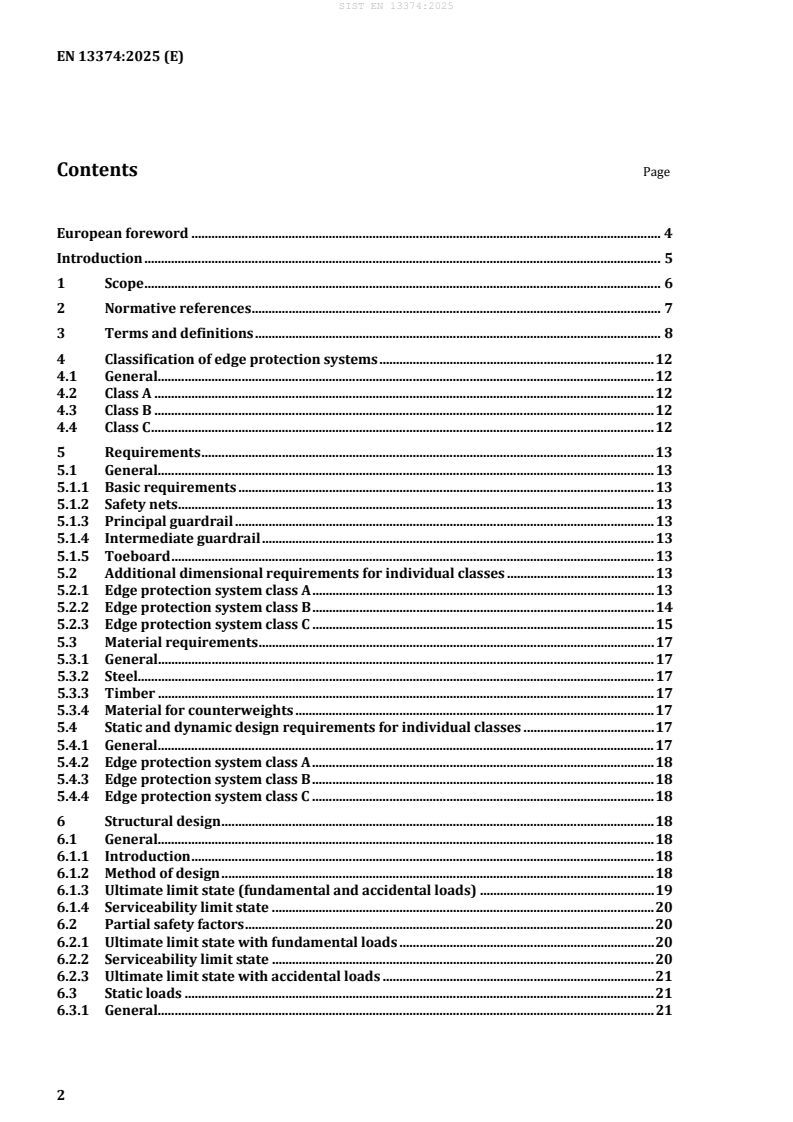
Contents Page
European foreword . 4
Introduction . 5
1 Scope . 6
2 Normative references . 7
3 Terms and definitions . 8
4 Classification of edge protection systems . 12
4.1 General. 12
4.2 Class A . 12
4.3 Class B . 12
4.4 Class C . 12
5 Requirements . 13
5.1 General. 13
5.1.1 Basic requirements . 13
5.1.2 Safety nets . 13
5.1.3 Principal guardrail . 13
5.1.4 Intermediate guardrail . 13
5.1.5 Toeboard . 13
5.2 Additional dimensional requirements for individual classes . 13
5.2.1 Edge protection system class A . 13
5.2.2 Edge protection system class B . 14
5.2.3 Edge protection system class C . 15
5.3 Material requirements . 17
5.3.1 General. 17
5.3.2 Steel. 17
5.3.3 Timber . 17
5.3.4 Material for counterweights . 17
5.4 Static and dynamic design requirements for individual classes . 17
5.4.1 General. 17
5.4.2 Edge protection system class A . 18
5.4.3 Edge protection system class B . 18
5.4.4 Edge protection system class C . 18
6 Structural design . 18
6.1 General. 18
6.1.1 Introduction . 18
6.1.2 Method of design . 18
6.1.3 Ultimate limit state (fundamental and accidental loads) . 19
6.1.4 Serviceability limit state . 20
6.2 Partial safety factors . 20
6.2.1 Ultimate limit state with fundamental loads . 20
6.2.2 Serviceability limit state . 20
6.2.3 Ultimate limit state with accidental loads . 21
6.3 Static loads . 21
6.3.1 General. 21
6.3.2 Serviceability limit state — Point loads . 23
6.3.3 Ultimate limit state — Point loads . 25
6.3.4 Ultimate limit state — Maximum wind load . 26
6.3.5 Ultimate limit state — Load combination . 27
6.3.6 Ultimate limit state — Load parallel to the edge protection system . 28
6.3.7 Ultimate limit state with accidental loads . 28
6.3.8 Accidental removal . 29
7 Test methods . 30
7.1 General . 30
7.2 Load application . 30
7.3 Sample to be tested . 30
7.4 Tests for conformity with static load requirements for classes A and B . 31
7.4.1 General . 31
7.4.2 Tests for serviceability . 31
7.4.3 Test for strength. 32
7.5 Tests for conformity with dynamic load requirements for classes B and C . 34
7.5.1 Test procedure for Class B and Class C . 34
7.5.2 Test procedure for Class C . 37
7.6 Test reports . 40
8 Designation . 40
9 Marking . 41
10 Information to be given to the site . 41
10.1 General requirements . 41
10.2 Principal contents . 41
11 Assessment . 42
Annex A (informative) Inclinations, falling heights and height of edge protection . 43
A.1 Appropriate classes for the use at different inclinations and falling heights . 43
A.2 Height of edge protection on different levels . 48
A.3 Additional protection above the principal guardrail . 48
Annex B (informative) Simplified methods . 51
B.1 Simplified test procedure . 51
B.2 Simplified evaluation of recorded results . 51
Annex C (informative) A-deviations . 52
Bibliography . 54
European foreword
This document (EN 13374:2025) has been prepared by Technical Committee CEN/TC 53 “Temporary
works equipment”, the secretariat of which is held by DIN.
This European Standard shall be given the status of a national standard, either by publication of an
identical text or by endorsement, at the latest by November 2025, and conflicting national standards shall
be withdrawn at the latest by November 2025.
Attention is drawn to the possibility that some of the elements of this document may be the subject of
patent rights. CEN shall not be held responsible for identifying any or all such patent rights.
This document supersedes EN 13374:2013+A1:2018.
This document includes the following significant technical changes with respect to
EN 13374:2013+A1:2018:
— most of the figures have been updated and new figures have been added,
— classification in Clause 4 has been clarified,
— Clause 6 has been clarified and updated and 6.3.8 added,
— Clause 7 has been clarified and updated,
— Annex A has been rewritten and figures added,
— Annex B Simplified methods has been added,
— Annex C with A-deviations from Finland, Italy, Cyprus, United Kingdom and Poland has been added,
— editorial changes and clarifications have been done.
Any feedback and questions on this document should be directed to the users’ national standards body.
A complete listing of these bodies can be found on the CEN website.
According to the CEN-CENELEC Internal Regulations, the national standards organisations of the
following countries are bound to implement this European Standard: Austria, Belgium, Bulgaria, Croatia,
Cyprus, Czech Republic, Denmark, Estonia, Finland, France, Germany, Greece, Hungary, Iceland, Ireland,
Italy, Latvia, Lithuania, Luxembourg, Malta, Netherlands, Norway, Poland, Portugal, Republic of North
Macedonia, Romania, Serbia, Slovakia, Slovenia, Spain, Sweden, Switzerland, Türkiye and the United
Kingdom
Introduction
Temporary edge protection systems are used in construction work, primarily to prevent persons and
objects from falling to a lower level from roofs, edges, stairs and other areas where protection is required.
In most European countries temporary edge protection, or other types of fall protection devices, are
required when a risk assessment identifies a fall risk regardless of height. In contrast to being secured by
a lanyard, greater mobility in the working area is provided when edge protection is in place. The
temporary edge protection can in some situations also act as a handrail for people to hold onto when
working or walking close to an edge. Council Directive 92/57/EEC was taken into consideration when
reviewing this product standard.
While this document also includes requirements to protect people from falling objects, e.g. by the
provision of toeboards, there could be circumstances where this is insufficient and additional measures,
which are beyond the scope of this document, will need to be taken.
Classes specified in this document are intended to cater for the varied requirements appropriate for
different uses.
It is important that the structure to which temporary edge protection is attached can support the load
that the system is designed for.
For this document A-deviations have been registered for Finland, Italy, Cyprus, United Kingdom and
Poland (see Annex C).
1 Scope
This document specifies the requirements and test methods for temporary edge protection systems for
use during construction or maintenance of buildings and other structures.
This document applies to edge protection systems for flat and inclined surfaces and specifies the
requirements for three classes of temporary edge protection.
For edge protection systems with an arrest function (e.g. falling or sliding down a sloping roof) this
document specifies requirements for energy absorption.
This document includes edge protection systems, some of which are fixed to the structure and others,
which rely on gravity and friction on flat surfaces.
This document does not provide requirements for edge protection systems intended for:
— protection against impact from vehicles or from other mobile equipment,
— protection from sliding down of bulk loose materials, snow etc,
— protection of areas accessible to the public.
This document does not apply to side protection on scaffolds according to EN 12811-1 and EN 1004-1.
NOTE This does not prevent these systems to be used on temporary structures.
2 Normative references
The following documents are referred to in the text in such a way that some or all of their content
constitutes requirements of this document. For dated references, only the edition cited applies. For
undated references, the latest edition of the referenced document (including any amendments) applies.
EN 74-1, Couplers, spigot pins and baseplates for use in falsework and scaffolds - Part 1: Couplers for tubes
- Requirements and test procedures
EN 74-2, Couplers, spigot pins and baseplates for use in falsework and scaffolds - Part 2: Special couplers -
Requirements and test procedures
EN 74-3, Couplers, spigot pins and baseplates for use in falsework and scaffolds - Part 3: Plain base plates
and spigot pins - Requirements and test procedures
EN 338, Structural timber - Strength classes
EN 596, Timber structures - Test methods - Soft body impact test of timber framed walls
EN 1263-1, Temporary works equipment - Safety nets - Part 1: Safety requirements, test methods
EN 1990, Eurocode - Basis of structural and geotechnical design
EN 1993-1-1, Eurocode 3 - Design of steel structures - Part 1-1: General rules and rules for buildings
EN 1993-1-2, Eurocode 3 - Design of steel structures - Part 1-2: Structural fire design
EN 1993-1-3, Eurocode 3 - Design of steel structures - Part 1-3: Cold-formed members and sheeting
EN 1993-1-4, Eurocode 3 - Design of steel structures - Part 1-4: Stainless steel structures
EN 1993-1-5, Eurocode 3 - Design of steel structures - Part 1-5: Plated structural elements
EN 1993-1-6, Eurocode 3 - Design of steel structures - Part 1-6: Strength and Stability of Shell Structures
EN 1993-1-7, Eurocode 3 - Design of steel structures - Part 1-7: Plate assemblies with elements under
transverse loads
EN 1993-1-8, Eurocode 3 - Design of steel structures - Part 1-8: Joints
EN 1993-1-9, Eurocode 3: Design of steel structures - Part 1-9: Fatigue
EN 1993-1-10, Eurocode 3: Design of steel structures - Part 1-10: Material toughness and through-thickness
properties
EN 1993-1-11, Eurocode 3 - Design of steel structures - Part 1-11: Design of structures with tension
components
EN 1993-1-12, Eurocode 3 - Design of steel structures - Part 1-12: Additional rules for the extension of EN
1993 up to steel grades S 700
EN 1993-2, Eurocode 3 - Design of steel structures - Part 2: Steel Bridges
EN 1993-3-1, Eurocode 3 - Design of steel structures - Part 3-1: Towers, masts and chimneys - Towers and
masts
EN 1993-3-2, Eurocode 3 - Design of steel structures - Part 3-2: Towers, masts and chimneys - Chimneys
EN 1993-4-1, Eurocode 3 - Design of steel structures - Part 4-1: Silos
EN 1993-4-2, Eurocode 3 - Design of steel structures - Part 4-2: Tanks
EN 1993-4-3, Eurocode 3: Design of steel structures — Part 4-3: Pipelines
EN 1993-5, Eurocode 3 - Design of steel structures - Part 5: Piling
EN 1993-6, Eurocode 3 - Design of steel structures - Part 6: Crane supporting structures
EN 1995-1-1, Eurocode 5: Design of timber structures - Part 1-1: General - Common rules and rules for
buildings
EN 1995-1-2, Eurocode 5: Design of timber structures - Part 1-2: General - Structural fire design
EN 1995-2, Eurocode 5: Design of timber structures - Part 2: Bridges
EN 1999-1-1, Eurocode 9 - Design of aluminium structures - Part 1-1: General rules
EN 1999-1-2, Eurocode 9 - Design of aluminium structures - Part 1-2: Structural fire design
EN 1999-1-3, Eurocode 9 - Design of aluminium structures - Part 1-3: Structures susceptible to fatigue
EN 1999-1-4, Eurocode 9 - Design of aluminium structures - Part 1-4: Cold-formed structural sheeting
EN 1999-1-5, Eurocode 9 - Design of aluminium structures - Part 1-5: Shell structures
EN 12811-3:2002, Temporary works equipment - Part 3: Load testing
3 Terms and definitions
For the purposes of this document, the following terms and definitions apply.
ISO and IEC maintain terminology databases for use in standardization at the following addresses:
— ISO Online browsing platform: available at https://www.iso.org/obp
— IEC Electropedia: available at https://www.electropedia.org/
3.1
edge protection system
set of components intended to protect people from falling to a lower level and to retain materials
Note 1 to entry: see Figure 1.
3.2
principal guardrail
rail or continuous element providing the uppermost handhold for Class A and Class B systems or forming
the uppermost part of the protection for Class C systems
3.3
intermediate guardrail
rail or continuous element between the principal guardrail and the working surface
3.4
intermediate protection
protection barrier formed (e.g. as a fencing structure or a safety net) between the principal guardrail and
the working surface
Note 1 to entry: see Figure 2.
3.5
toeboard
upstanding element provided specifically to prevent materials or persons from falling or sliding off a
surface
3.6
post
principal vertical support of the edge protection system to which the guardrails and toeboards are
attached
Note 1 to entry: Components 3.2 to 3.6 can be manufactured in full or as part of an integrated edge protection
system.
3.7
falling height
H
f
vertical distance between the point on which a person may stand and the lowest point on the protection
intended to arrest any fall
Note 1 to entry: See Figure 3.
3.8
height of the edge protection system
distance between the uppermost point of the principal guardrail and the working surface measured
perpendicular to the working surface
3.9
working surface
surface on which persons stand, walk or work
3.10
counterweight
component to (by its own weight) prevent the edge protection system from sliding or from overturning
3.11
panel
assembly of principal guardrail, intermediate guardrail or intermediate protection and a toeboard when
applicable
3.12
misuse
using the equipment (temporary edge protection system) for any purpose it was not designed for
3.13
collective protection
equipment that provides protection for one or more workers
Key
1 slab edge clamp system 7 column clamp system – sloping roof
2 fixed to floor type system 8 fencing system
3 counterweighted system 9 edge protection on temporary structure
4 beam top flange clamp system 10 temporary structure (not defined in this document)
5 column clamp system – slabs and flat/low sloping roofs 11 floor to soffit system
6 beam bottom flange clamp system
Figure 1 — Diagrammatic examples of different types of temporary edge protection
Figure 2 — Example of an edge protection system with a net as intermediate protection on a
sloping roof
Key
H falling height
f
α angle of inclination of the working surface
1 edge protection system
Figure 3 — Falling height on an inclined surface
4 Classification of edge protection systems
4.1 General
Combination of different classes is possible, e.g. a product can comply to A, B and C.
NOTE More guidance about the use of classes is given in Annex A.
4.2 Class A
Class A protection provides resistance to static loads only, based on the requirements to:
— support a person leaning on the protection or provide a handhold when walking beside it, see
Figure A.2, Key 1;
— provide collective protection to stop a person who is walking or falling towards the protection, see
Figure A.2, Key 2;
— withstand the load from accidental loads (misuse) on the protection, see Figure A.2, Key 4; and
— withstand wind loads, see Figure A.2, Key 3.
4.3 Class B
Class B protection provides resistance to static loads and low dynamic actions only, based on the
requirements to:
— support a person leaning on the protection or provide a handhold when walking beside it, see
Figure A.2, Key 1;
— provide collective protection to stop a person who is walking or falling towards the protection, see
Figure A.2, Key 2;
— withstand the load from accidental loads (misuse) on the protection, see Figure A.2, Key 4;
— withstand wind loads, see Figure A.2, Key 3; and
— provide collective protection to prevent the fall of a person down a sloping surface, see Figure A.2,
Key 6; or
— provide collective protection to arrest the fall of a person sliding down a sloping surface, see
Figure A.2, Key 5.
4.4 Class C
Class C protection provides resistance to high dynamic forces based on the safety requirements to:
— provide collective protection to prevent the fall of a person down a steep sloping surface, see
Figure A.2, Key 6; or
— provide collective protection to arrest the fall of a person sliding down a steep sloping surface, see
Figure A.2, Key 7.1; or
— provide collective protection to arrest the fall of a person who has fallen from a steep sloping surface,
see Figure A.2, Key 7.2.
5 Requirements
5.1 General
5.1.1 Basic requirements
An edge protection system shall consist of a principal guardrail and either an intermediate guardrail or
an intermediate protection. It shall also be possible to attach a toeboard. All components in the system
shall be designed to avoid accidental removal of any component in any direction during use.
The components shall be designed and manufactured so that injury to persons from puncturing or
lacerating of the skin is prevented.
NOTE 1 An edge protection system can be manufactured as an integrated unit.
NOTE 2 In some applications in some countries it is mandatory to use a toeboard.
5.1.2 Safety nets
Safety nets used in edge protection systems shall be in accordance with EN 1263-1.
The fixing of each safety net shall satisfy the load requirements of the intended class or classes.
Safety nets shall be installed according to the manufacturer's instructions.
5.1.3 Principal guardrail
The distance between the uppermost part of the principal guardrail and the working surface shall be at
least 1 000 mm, at any point, measured perpendicular to the working surface, see Figure 4 to Figure 9.
The principal guardrail should be continuous. If the principal guardrail is not continuous, then any
horizontal gap shall not be more than 120 mm.
5.1.4 Intermediate guardrail
Where an intermediate guardrail is in place, it should be continuous. If the intermediate guardrail is not
continuous, then any horizontal gap shall not be more than 120 mm.
5.1.5 Toeboard
The distance between the uppermost part of the toeboard and the working surface shall be at least
150 mm, at any point, measured perpendicular to the working surface, see Figure 4 to Figure 9.
The toeboard shall be designed to avoid gaps between it and the working surface. If there are gaps, a
sphere with a diameter of 20 mm shall not pass through them.
For other situations for example where the working surface is not flat, any gaps should be maintained as
small as practicable.
The toeboard should be continuous. If the toeboard is not continuous, then any horizontal gap shall not
be more than 20 mm. Gaps in the toeboard shall be no more than 20 × 20 mm. The size and number of
gaps should be kept to an absolute minimum.
5.2 Additional dimensional requirements for individual classes
5.2.1 Edge protection system class A
The inclination of edge protection system class A shall not deviate from the vertical by more than 15°,
outwards or inwards.
If an intermediate guardrail is provided, any gap shall be so dimensioned that a sphere of 470 mm
diameter will not pass through the protection, see Figure 4. If there is no intermediate guardrail, the edge
protection system shall be so dimensioned that a sphere with a diameter of 250 mm will not pass through
it, see Figures 6 and 7.
Dimensions in millimetres
Figure 4 — Dimensional height and spacing of edge protection components - Class A
5.2.2 Edge protection system class B
The inclination of edge protection system class B shall not deviate from the vertical by more than 15°,
outwards or inwards. Any gap in a class B edge protection shall be so dimensioned that a sphere of
250 mm diameter will not pass through the protection, see Figures 5 to 7.
Dimensions in millimetres
Figure 5 — Dimensional height and spacing of edge protection components - Class B, guardrails
Dimensions in millimetres
Figure 6 — Dimensional height and spacing of edge protection components - Class A and B,
vertical slats
Dimensions in millimetres
Figure 7 — Dimensional height and spacing of edge protection components - Class A and B,
mesh/netting
5.2.3 Edge protection system class C
The inclination of the edge protection shall be between the vertical line AC of Figure 9, and a line
perpendicular to the surface, line BC. Gaps in class C edge protection shall be dimensioned so that a sphere
with a diameter of 100 mm will not pass through them, see Figure 8.
Dimensions in millimetres
Figure 8 — Dimensional height and spacing of edge protection components - Class C
Dimensions in millimetres
Key
AC vertical line
BC line perpendicular to working surface
α angle of inclination of the working surface
Figure 9 — The inclination of the edge protection system in class C
5.3 Material requirements
5.3.1 General
Materials shall fulfil the requirements given in relevant European Standards, where design data are
provided. Other materials shall be in accordance with appropriate European Standards. If European
Standards do not exist, ISO Standards may be applied.
Materials shall be sufficiently robust and durable to withstand normal working conditions.
Materials shall be free from any impurities and defects, which may affect their satisfactory use.
Information about the most commonly used materials is given in EN 12811-2. Material requirements for
nets are given in EN 1263-1. When materials are used, whose properties in relation to the intended
application (e.g. temperature, ageing, UV-degradation) are not given in any available standard an
adequate assessment is required in order to fulfil the requirements of this document.
Requirements for couplers are given in EN 74-1, EN 74-2 and EN 74-3. Couplers and tubes used shall be
tested and proven for function and compliance with the standard.
5.3.2 Steel
Steels of deoxidation type FU (rimming steels) shall not be used.
It is recommended that products for long term use are protected against corrosion and deterioration
according to Clause 8 of EN 12811-2:2004.
5.3.3 Timber
Timber shall be strength graded in accordance with EN 338 to have a minimum classification of C16.
If a protective coating is used, it shall not impede the visual inspection of the material.
Plywood shall have good strength and durability regarding climatic conditions.
NOTE EN 636 specifies the requirements for structural plywood in dry, humid and exterior conditions.
5.3.4 Material for counterweights
The materials employed shall be solid within the usual range of temperature. Granulated or fluid
materials such as sand or water shall not be used. Each counterweight shall be capable of being positively
secured against accidental displacement.
5.4 Static and dynamic design requirements for individual classes
5.4.1 General
The classes of edge protection systems shall be subject to load types according to Table 1.
Table 1 — Overview of design requirements
Class Type of load
Static load Dynamic
load
A X –
B X X
C – X
5.4.2 Edge protection system class A
Class A edge protection system shall fulfil the design requirements given in Clause 6, considering all load
cases in Table 2.
Class A has no dynamic load requirement.
5.4.3 Edge protection system class B
Class B edge protection system shall fulfil the design requirements given in Clause 6, considering all load
cases in Table 2.
Class B edge protection system shall be capable of absorbing a kinetic energy of 1100 J anywhere along
the protection up to a height of 200 mm above the working surface and 500 J at all higher parts. For
verification of this requirement, the product shall successfully pass the dynamic tests specified in 7.5.1.
5.4.4 Edge protection system class C
Class C has no static load requirement.
Class C edge protection system shall be capable of absorbing a kinetic energy of 3 185 J anywhere along
the protection up to a height of 150 mm above the working surface and 500 J at all higher parts. For
verification of this requirement, the product shall successfully pass the dynamic tests specified in 7.5.1
and 7.5.2.
6 Structural design
6.1 General
6.1.1 Introduction
The structural design shall be such that the structure is in accordance with the requirements in the
following respects:
1a) ultimate limit state with fundamental loads: load bearing capacity and for counterweighted systems,
stability against sliding, overturning and uplift;
1b) ultimate limit state with accidental loads: load bearing capacity for non-intended loads, e.g. misuse;
2) serviceability limit state: elastic deflection of the edge protection.
6.1.2 Method of design
If not specified otherwise the design shall be carried out following the limit state method. All loads
specified in this document shall be treated as characteristic loads.
The edge protection system as a whole, as well as each component, shall fulfil the individual load
requirements separately.
The design shall take into account the combination of the structure, the system and its components and
the fixing method.
Verification of the static load requirements can be done either by calculation or by testing.
Design shall be carried out in accordance with the European Standards for structural engineering. The
standards include:
— For steel: EN 1993 series, Parts 1-2 to 1-12, Part 2, Parts 3-1 and 3-2, Parts 4-1 to 4-3, Part 5 and
Part 6.
— For aluminium: EN 1999 series, Parts 1-1 to 1-5.
— For timber: EN 1995 series, Parts 1-1 to 2.
— For design: EN 1990.
If there are conflicts between provisions in this document and other standards, then the provisions in
this document shall have precedence.
When using EN 1995 series the following characteristics shall be used:
Load duration:
— instantaneous for accidental load;
— short-term duration for other loads.
Service class:
— class 2.
NOTE Service class 2 covers most typical site applications.
For applications where more unfavourable climatic conditions occur, i.e. timber moisture content
exceeding 20 %, Service class 3 shall be adopted.
6.1.3 Ultimate limit state (fundamental and accidental loads)
a) It shall be verified that:
E ≤ R (1)
d d
and
E ≤ E (2)
d,dst d,stb
where
E is the design value of effect of actions, e.g. bending stress, an internal force or moment
d
R is the corresponding design value of resistance
d
E is the design value of the effect of destabilising actions
d,dst
E is the design value of the effect of stabilizing actions
d,stb
The value of E , E and E shall be established from the design values of the actions Q , Q and Q
d d,dst d,stb d d,dst d,stb
respectively.
b) Based on the characteristic value of the action Q , the design value of the action Q shall be calculated
k,i d,i
using:
Q = γ ·Q (3)
d,i F,i k,i
where
Q is the design value of the action i
d,i
Qk,i is the characteristic value of the action i and shall be taken from Table 2
γ is the partial safety factor and shall be taken from Table 2
F,i
c) The design value of the resistance R shall be calculated using:
d,i
For metal
R = R / γ (4)
d,i k,i M,i
For timber
R = R ·k / γ (5)
d,i k,i mod M,i
where
R is the characteristic value of the resistance for material “i”
k,i
kmod is the modification factor for duration of load and moisture content, see
EN 1995-1-1:2004, Table 3.1
γ is the partial factor for material “i”
M,i
6.1.4 Serviceability limit state
It shall be verified that:
elastic deflection ≤ deflection requirement (6)
6.2 Partial safety factors
6.2.1 Ultimate limit state with fundamental loads
— γ = 0,9 for favourable loads (stabilizing loads), for example counterweight when calculating
F,stb
global sliding resistance or overturning or the normal force when considering friction connections;
— γ = γ = 1,5 for all unfavourable permanent and variable loads (destabilizing loads);
F F,dst
— γ = 1,1 for ductile metallic materials (some ductility limits are given in EN 12811-2);
M
— γ = 1,25 for brittle metallic materials;
M
— γ = 1,3 for timber;
M
— γ = 1,5 for concrete;
M
— γ = 1,3 for friction/sliding failure.
μ
For design verification by testing, the applicable value of γ shall be chosen according to the material
M
a
where the most critical identifiable failure occurs at ultimate load, .
r
ui,
NOTE Some friction coefficients can be found in Table B.1 of EN 12812.
6.2.2 Serviceability limit state
— γ = 1,0
F
— γ = 1,0
M
6.2.3 Ultimate limit state with accidental loads
— γ = 1,0
F
— γ = 1,0
M
6.3 Static loads
6.3.1 General
Class A and class B edge protection systems shall be designed for the following loading criteria. All load
cases in Table 2 shall be evaluated and documented.
Point loads can act anywhere along the system, e.g. at the post, between the posts or on cantilevered
parts.
Point loads shall be assumed to be distributed upon a maximum area of (100 × 100) mm. For a net or a
fencing structure, this load shall be assumed to be uniformly distributed upon a maximum area of
(300 × 300) mm.
Static person loads, F , F and F , do not need to be considered at heights above the principal guardrail,
T1 H1 H3
however wind loads shall be considered.
NOTE Further information about higher edge protection is given in A.3.
If nothing else is stated, all loads shall act in the most unfavourable position(s) of the edge protection
system including all of its components.
Table 2 — Overview of static load requirements
Line Clause Load case Desig- Point Wind γ = γ Requirement
F F,stb
No. nation Load velocity
γ
F,dst
[N] pressure
q [N/m ]
1 Serviceability Limit F 200 - 1,0 1,0 max. 55 mm
6.3.2 T2
State Toeboard elastic
level deflection of
the system
Serviceability Limit F 300
T1
State Guardrails
level
2 Ultimate Limit F 200 - 1,5 0,9 E ≤ R
6.3.3 H2 d d
State Toeboard
E ≤ E
d,dst d,stb
level
Ultimate Limit F 300
H1
State
All other parts
3 Ultimate Limit QMW - 600 1,5 0,9 Ed ≤ Rd
6.3.4
State, Maximum
E ≤ E
d,dst d,stb
Wind
4 Ultimate Limit Q + 200 200 1,5 0,9 E ≤ R
6.3.5 WW d d
State, F
H2
E ≤ E
d,dst d,stb
Load Combination
Toeboard level
Ultimate Limit Q + 300
WW
State, F
H1
Load Combination
All other parts
5 Ultimate Limit FH3 200 - 1,5 0,9 Ed ≤ Rd
6.3.6
State,
E ≤ E
d,dst d,stb
Parallel
6 Ultimate Limit F 1250 - 1,0 1,0 E ≤ R
6.3.7 D d d
State with
E ≤ E
d,dst d,stb
accidental loads
max. 300 mm
deflection
during load FD
7 Accidental removal F 300 - 1,0 1,0 No accidental
6.3.8 U
removal or
minimum
100 mm travel
before
accidental
removal
For the test verification, γ is to be used only on stabilizing loads, e.g. self weight whenever the
F,stb
weight is stabilizing. Never apply γ to F , F , F , F , F , F , F or wind loads Q , Q .
T1 T2 H1 H2 H3 D U MW WW
F,stb
NOTE Lines 2 to 5 specify fundamental loads.
Key
1 principal guardrail, intermediate guardrail or toeboard
2 intermediate protection, e.g. net, mesh or fencing structure
3 toeboard if part of the intermediate protection, e.g. net, mesh or fencing structure
4 supporting structure to the edge protection, e.g. post, upright or standard
5 structure to which the edge protection system is mounted, e.g. building structure or
temporary structure forming the walking/working surface
Figure 10 — Legend for figures in 6.3
6.3.2 Serviceability limit state — Point loads
Loads F shall act as follows:
Ti
— perpendicular to the edge protection system in the outward direction, and
— downwards parallel to the edge protection system.
The loads shall act separately and on posts, guardrails and toeboards.
The load shall be applied on the principal and intermediate guardrails, posts, and bottom of the toeboard.
See Figures 10 to 13 and line 1 of Table 2.
For posts and guardrails, F = 300 N.
T1
For toeboards, F = 200 N.
T2
Deflection requirement ≤ 55 mm.
The deflection requirements do not apply to the intermediate protection as shown in Figures 12 and 13.
SI
...