

SIST EN 74-1:2022+A1:2025
(Main + Amendment)Couplers, spigot pins and baseplates for use in falsework and scaffolds - Part 1: Couplers for tubes - Requirements and test procedures
General Information
- Abstract
This document specifies, for right angle couplers, swivel couplers, sleeve couplers and parallel couplers working by friction:
- materials;
- design requirements;
- strength classes with different structural parameters including values for resistance and stiffness;
- test procedures;
- assessment;
and gives:
- recommendations for ongoing production control.
These couplers are intended for use in temporary works equipment for example in scaffolds erected in accordance with EN 12811-1 and falsework erected in accordance with EN 12812.
- Status
- Published
- Publication Date
- 08-May-2025
- Technical Committee
- I13 - Imaginarni 13
- Current Stage
- 6060 - National Implementation/Publication (Adopted Project)
- Start Date
- 22-Apr-2025
- Due Date
- 27-Jun-2025
- Completion Date
- 09-May-2025

Overview
EN 74-1:2022+A1:2025 - published by CEN - specifies requirements and test procedures for friction couplers for tubes used in temporary works (scaffolds and falsework). It covers common coupler types - right angle (RA), swivel (SW), sleeve (SF) and parallel (PA) couplers - and defines materials, design rules, strength classes, stiffness and resistance values, test methods, assessment and recommendations for ongoing production control. The standard targets couplers intended for connecting 48.3 mm outside-diameter steel and aluminium tubes used in scaffolding (EN 12811 series) and falsework (EN 12812).
Key topics and technical requirements
- Types and classes: Defines coupler types and classes (e.g., A, B, AA, BB) with specified structural parameters for resistance and stiffness.
- Materials & design: Requirements for materials, manufacturing drawings and design features for safe clamping by friction (wedge or screw closure).
- Strength & stiffness parameters: Specified values and classes for slipping force, failure force, pull-apart force, bending and cruciform moments, rotational stiffness and indentation resistance.
- Test procedures: Detailed test methods and evaluation for:
- Slipping force and failure force tests
- Pull-apart (separation) tests
- Cruciform bending and rotational stiffness and moment tests
- Indentation tests and bending moment tests for sleeve couplers
- Assessment & documentation: Rules for test reporting, assessment, product manuals, marking and manufacturer’s drawings.
- Production control: Recommendations and normative guidance for ongoing production control and quality assurance (annex informative).
Practical applications
- Ensures consistent safety and performance of couplers used in temporary works on construction sites.
- Used to verify that couplers achieve required load resistance and stiffness for reliable tube connections in scaffolding and falsework.
- Supports manufacturers in product design, testing and CE/national standard compliance.
- Used by testing laboratories, certification bodies, site safety engineers, scaffold designers, specifiers and procurement teams to assess product suitability.
Who should use this standard
- Coupler and temporary works equipment manufacturers
- Test laboratories and conformity assessment bodies
- Scaffold and falsework designers and engineers
- Safety inspectors, site managers and procurement/specification teams
Related standards
- EN 74-2, EN 74-3 (other parts of the couplers series)
- EN 12811-1 / EN 12811-2 / EN 12810-1 (scaffold requirements and materials)
- EN 12812 (falsework design)
- EN ISO standards referenced for fasteners and material testing (e.g., ISO 898, ISO 6892)
Keywords: EN 74-1:2022+A1:2025, couplers for tubes, scaffold couplers standard, coupler test procedures, right angle coupler, swivel coupler, sleeve coupler, parallel coupler, temporary works equipment.
Relations
- Effective Date
- 26-Feb-2025
- Effective Date
- 26-Feb-2025
- Effective Date
- 28-Jan-2026
- Effective Date
- 28-Jan-2026
- Effective Date
- 28-Jan-2026
- Effective Date
- 28-Jan-2026
- Effective Date
- 28-Jan-2026
- Effective Date
- 28-Jan-2026
- Effective Date
- 28-Jan-2026
- Effective Date
- 28-Jan-2026
- Effective Date
- 28-Jan-2026
- Effective Date
- 28-Jan-2026
- Effective Date
- 28-Jan-2026
- Effective Date
- 28-Jan-2026
- Effective Date
- 28-Jan-2026
Get Certified
Connect with accredited certification bodies for this standard

DIBt (Deutsches Institut für Bautechnik)
German Institute for Building Technology.
DIN CERTCO
DIN Group product certification.

Aboma Certification B.V.
Specialized in construction, metal, and transport sectors.
Sponsored listings
Frequently Asked Questions
SIST EN 74-1:2022+A1:2025 is a standard published by the Slovenian Institute for Standardization (SIST). Its full title is "Couplers, spigot pins and baseplates for use in falsework and scaffolds - Part 1: Couplers for tubes - Requirements and test procedures". This standard covers: This document specifies, for right angle couplers, swivel couplers, sleeve couplers and parallel couplers working by friction: - materials; - design requirements; - strength classes with different structural parameters including values for resistance and stiffness; - test procedures; - assessment; and gives: - recommendations for ongoing production control. These couplers are intended for use in temporary works equipment for example in scaffolds erected in accordance with EN 12811-1 and falsework erected in accordance with EN 12812.
This document specifies, for right angle couplers, swivel couplers, sleeve couplers and parallel couplers working by friction: - materials; - design requirements; - strength classes with different structural parameters including values for resistance and stiffness; - test procedures; - assessment; and gives: - recommendations for ongoing production control. These couplers are intended for use in temporary works equipment for example in scaffolds erected in accordance with EN 12811-1 and falsework erected in accordance with EN 12812.
SIST EN 74-1:2022+A1:2025 is classified under the following ICS (International Classification for Standards) categories: 21.120.20 - Couplings; 91.220 - Construction equipment. The ICS classification helps identify the subject area and facilitates finding related standards.
SIST EN 74-1:2022+A1:2025 has the following relationships with other standards: It is inter standard links to SIST EN 74-1:2022, SIST EN 74-1:2022/oprA1:2024, SIST EN ISO 898-1:2013, SIST EN ISO 6892-1:2020, SIST EN ISO 898-2:2022, SIST EN 12811-3:2004, SIST EN 12811-2:2004, SIST EN 13374:2013+A1:2019, SIST EN 12812:2008, SIST EN 12811-4:2014, SIST EN 13200-6:2020, SIST EN 16031:2012, SIST EN 1004:2005, SIST EN 1065:2000, SIST EN 12810-1:2004. Understanding these relationships helps ensure you are using the most current and applicable version of the standard.
SIST EN 74-1:2022+A1:2025 is available in PDF format for immediate download after purchase. The document can be added to your cart and obtained through the secure checkout process. Digital delivery ensures instant access to the complete standard document.
Standards Content (Sample)
SLOVENSKI STANDARD
01-junij-2025
Spojke, vezne centične spojke in podnožne plošče za delovne in nosilne odre - 1.
del: Cevne spojke - Zahteve in preskusni postopki (vključno z dopolnilom A1)
Couplers, spigot pins and baseplates for use in falsework and scaffolds - Part 1:
Couplers for tubes - Requirements and test procedures
Kupplungen, Zentrierbolzen und Fußplatten für Arbeitsgerüste und Traggerüste - Teil 1:
Rohrkupplungen - Anforderungen und Prüfverfahren
Raccords, goujons d’assemblage et semelles pour étaiements et échafaudages - Partie
1 : Raccords de tubes - Exigences et modes opératoires d’essai
Ta slovenski standard je istoveten z: EN 74-1:2022+A1:2025
ICS:
21.120.20 Sklopke Couplings
91.220 Gradbena oprema Construction equipment
2003-01.Slovenski inštitut za standardizacijo. Razmnoževanje celote ali delov tega standarda ni dovoljeno.
EN 74-1:2022+A1
EUROPEAN STANDARD
NORME EUROPÉENNE
April 2025
EUROPÄISCHE NORM
ICS 91.220 Supersedes EN 74-1:2022
English Version
Couplers, spigot pins and baseplates for use in falsework
and scaffolds - Part 1: Couplers for tubes - Requirements
and test procedures
Raccords, goujons d'assemblage et semelles pour Kupplungen, Zentrierbolzen und Fußplatten für
étaiements et échafaudages - Partie 1 : Raccords de Arbeitsgerüste und Traggerüste - Teil 1:
tubes - Exigences et modes opératoires d'essai Rohrkupplungen - Anforderungen und Prüfverfahren
This European Standard was approved by CEN on 14 February 2022 and includes Amendment 1 approved by CEN on 10
February 2025.
CEN members are bound to comply with the CEN/CENELEC Internal Regulations which stipulate the conditions for giving this
European Standard the status of a national standard without any alteration. Up-to-date lists and bibliographical references
concerning such national standards may be obtained on application to the CEN-CENELEC Management Centre or to any CEN
member.
This European Standard exists in three official versions (English, French, German). A version in any other language made by
translation under the responsibility of a CEN member into its own language and notified to the CEN-CENELEC Management
Centre has the same status as the official versions.
CEN members are the national standards bodies of Austria, Belgium, Bulgaria, Croatia, Cyprus, Czech Republic, Denmark, Estonia,
Finland, France, Germany, Greece, Hungary, Iceland, Ireland, Italy, Latvia, Lithuania, Luxembourg, Malta, Netherlands, Norway,
Poland, Portugal, Republic of North Macedonia, Romania, Serbia, Slovakia, Slovenia, Spain, Sweden, Switzerland, Türkiye and
United Kingdom.
EUROPEAN COMMITTEE FOR STANDARDIZATION
COMITÉ EUROPÉEN DE NORMALISATION
EUROPÄISCHES KOMITEE FÜR NORMUNG
CEN-CENELEC Management Centre: Rue de la Science 23, B-1040 Brussels
© 2025 CEN All rights of exploitation in any form and by any means reserved Ref. No. EN 74-1:2022+A1:2025 E
worldwide for CEN national Members.
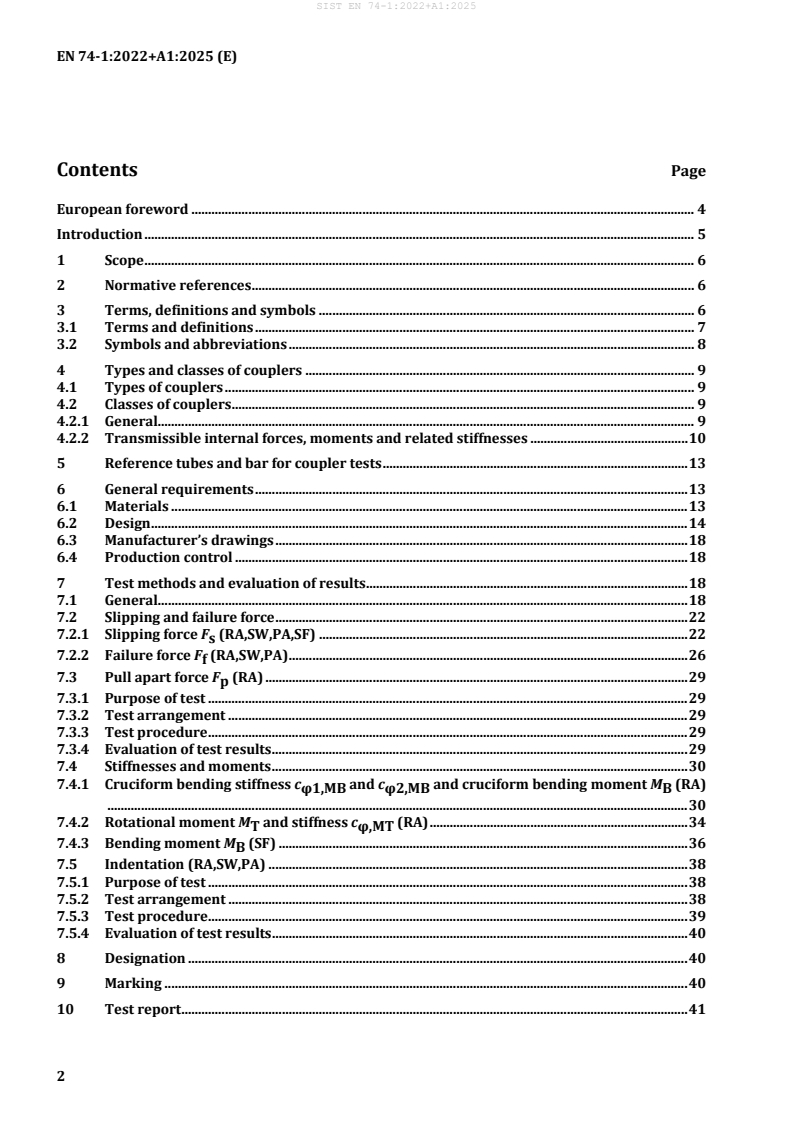
Contents Page
European foreword . 4
Introduction . 5
1 Scope . 6
2 Normative references . 6
3 Terms, definitions and symbols . 6
3.1 Terms and definitions . 7
3.2 Symbols and abbreviations . 8
4 Types and classes of couplers . 9
4.1 Types of couplers . 9
4.2 Classes of couplers . 9
4.2.1 General. 9
4.2.2 Transmissible internal forces, moments and related stiffnesses . 10
5 Reference tubes and bar for coupler tests . 13
6 General requirements . 13
6.1 Materials . 13
6.2 Design . 14
6.3 Manufacturer’s drawings . 18
6.4 Production control . 18
7 Test methods and evaluation of results . 18
7.1 General. 18
7.2 Slipping and failure force . 22
7.2.1 Slipping force F (RA,SW,PA,SF) . 22
s
7.2.2 Failure force F (RA,SW,PA) . 26
f
7.3 Pull apart force F (RA) . 29
p
7.3.1 Purpose of test . 29
7.3.2 Test arrangement . 29
7.3.3 Test procedure . 29
7.3.4 Evaluation of test results . 29
7.4 Stiffnesses and moments . 30
7.4.1 Cruciform bending stiffness c and c and cruciform bending moment M (RA)
φ1,MB φ2,MB B
............................................................................................................................................................................. 30
7.4.2 Rotational moment M and stiffness c (RA) . 34
T φ,MT
7.4.3 Bending moment M (SF) . 36
B
7.5 Indentation (RA,SW,PA) . 38
7.5.1 Purpose of test . 38
7.5.2 Test arrangement . 38
7.5.3 Test procedure . 39
7.5.4 Evaluation of test results . 40
8 Designation . 40
9 Marking . 40
10 Test report . 41
11 Evaluation of test results . 41
12 Assessment . 41
13 Product manual . 41
Annex A (normative) Whitworth thread size 1/2 x 12 Tpi . 42
A.1 Nominal values . 42
A.2 Tolerances and limiting dimensions after coating . 43
Annex B (informative) Ongoing production control . 44
Bibliography . 46
European foreword
This document (EN 74-1:2022+A1:2025) has been prepared by Technical Committee CEN/TC 53
“Temporary works equipment”, the secretariat of which is held by DIN.
This European Standard shall be given the status of a national standard, either by publication of an
identical text or by endorsement, at the latest by October 2025, and conflicting national standards shall
be withdrawn at the latest by October 2025.
Attention is drawn to the possibility that some of the elements of this document may be the subject of
patent rights. CEN shall not be held responsible for identifying any or all such patent rights.
This document includes Amendment 1 approved by CEN on 10 February 2025.
This document supersedes !EN 74-1:2022".
The start and finish of text introduced or altered by amendment is indicated in the text by tags !".
Compared to EN 74-1:2005, the following changes have been made [in EN 74-1:2022]:
1) reference tubes with the specified yield strengths are not procurable, therefore, these requirements
are changed;
2) new test conditions are specified;
3) the requirements for the bending moment of sleeve couplers are changed;
4) in addition, editorial changes are made.
Any feedback and questions on this document should be directed to the users’ national standards body.
A complete listing of these bodies can be found on the CEN website.
According to the CEN-CENELEC Internal Regulations, the national standards organisations of the
following countries are bound to implement this European Standard: Austria, Belgium, Bulgaria, Croatia,
Cyprus, Czech Republic, Denmark, Estonia, Finland, France, Germany, Greece, Hungary, Iceland, Ireland,
Italy, Latvia, Lithuania, Luxembourg, Malta, Netherlands, Norway, Poland, Portugal, Republic of North
Macedonia, Romania, Serbia, Slovakia, Slovenia, Spain, Sweden, Switzerland, Türkiye and the United
Kingdom.
Introduction
This is the first of three parts of a standard for couplers.
This first part, EN 74-1, covers common types of friction couplers.
The second part, EN 74-2, deals with other less common types of couplers.
The third part, EN 74-3, deals with plain base plates and loose spigot pins.
This document defines a set of steel and aluminium reference tubes for the required tests.
This document is not intended to prevent the development of other types of couplers. For example,
couplers can be manufactured in aluminium alloys or other materials or be designed for use with steel or
aluminium tubes other than the normally used 48,3 mm nominal outside diameter. Whilst such couplers
cannot comply with this document, it is recommended that the principles of this document are considered
in their design and assessment.
The couplers in this document are intended for use in scaffolds and falsework for connecting 48,3 mm
outside diameter steel and aluminium tubes which fulfil in other respects (e.g. material grade, thickness
and tolerances) the requirements given in EN 12811-1, EN 12811-2 and EN 12810-1.
1 Scope
This document specifies, for right angle couplers, swivel couplers, sleeve couplers and parallel couplers
working by friction:
— materials;
— design requirements;
— strength classes with different structural parameters including values for resistance and stiffness;
— test procedures;
— assessment;
and gives:
— recommendations for ongoing production control.
These couplers are intended for use in temporary works equipment for example in scaffolds erected in
accordance with EN 12811-1 and falsework erected in accordance with EN 12812.
2 Normative references
The following documents are referred to in the text in such a way that some or all of their content
constitutes requirements of this document. For dated references, only the edition cited applies. For
undated references, the latest edition of the referenced document (including any amendments) applies.
EN 12811-1, Temporary works equipment — Part 1: Scaffolds — Performance requirements and general
design
EN 12811-2:2004, Temporary works equipment — Part 2: Information on materials
EN 12811-3:2002, Temporary works equipment — Part 3: Load testing
EN 12812, Falsework — Performance requirements and general design
EN ISO 898-1, Mechanical properties of fasteners made of carbon steel and alloy steel — Part 1: Bolts,
screws and studs with specified property classes — Coarse thread and fine pitch thread (ISO 898-1)
EN ISO 898-2, Mechanical properties of fasteners made of carbon steel and alloy steel — Part 2: Nuts with
specified property classes — Coarse thread and fine pitch thread (ISO 898-2)
EN ISO 6892-1, Metallic materials — Tensile testing — Part 1: Method of test at room temperature (ISO
6892-1)
3 Terms, definitions and symbols
For the purposes of this document, the terms and definitions given in EN 12811-1 and the following apply.
ISO and IEC maintain terminology databases for use in standardization at the following addresses:
— ISO Online browsing platform: available at https://www.iso.org/obp
— IEC Electropedia: available at https://www.electropedia.org/
3.1 Terms and definitions
3.1.1
coupler
device used for connecting two tubes
EXAMPLE
Key
1 closing flap
2 base
3 centre rivet (for swivel couplers)
4 nut with integrated washer
5 T-bolt
6 rivet
Figure 1 — Designation of components of right angle and swivel coupler
3.1.2
wedge coupler
coupler in which the clamping force is obtained by tightening a closing flap around the tube by means of
hammering home a wedge
3.1.3
screw coupler
coupler in which the clamping force is obtained by tightening a closing flap around the tube by means of
a nut and a bolt
3.1.4
supplementary coupler
right angle coupler positioned touching an identical coupler in order to increase the slip resistance
3.1.5
assessment
checking process to establish compliance with the requirements specified in this document
3.2 Symbols and abbreviations
For the purpose of this document, the following symbols apply:
F slipping force in kN;
s
F failure force in kN;
f
F pull apart force in kN;
p
M bending or cruciform bending moment in kNm;
B
c cruciform bending stiffness in kNm/rad;
φi,MB
M rotational moment in kNm;
T
c rotational stiffness in kNm/rad;
φ,MT
F specified value for slipping force in kN;
s,c
F specified value for failure force in kN;
f,c
F specified value for pull apart force in kN;
p,c
M specified value for bending moment in kNm;
B,c
c specified value for cruciform bending stiffness in kNm/rad;
φi,MB,c
M specified value for rotational moment in kNm;
T,c
c specified value for rotational stiffness in kNm/rad;
φ,MT,c
ν displacement of the transverse tube under load relative to a tube or solid bar in
rotational tests in mm;
Δ displacement of a coupler under load relative to a tube or solid bar in mm;
i
Δ indentation in mm;
P test load in kN;
P test load for indentation in kN;
ind
φ angle of rotation of a coupler in degrees;
P ultimate failure force in kN;
f,ult
P ultimate pull apart force in kN;
p,ult
M ultimate cruciform bending moment in kNm;
ult
R 2
eH yield strength in N/mm ;
R 2
p,0.2 proof stress at elongation of 0,2 % in N/mm ;
R 2
m tensile strength in N/mm ;
(i) number of test sample.
4 Types and classes of couplers
4.1 Types of couplers
The types of couplers are listed in Table 1.
Table 1 — Types of couplers
Type of coupler Identification Arrangement of tubes
Right angle coupler RA Crossing at a right angle
Swivel coupler SW Crossing at any angle
Parallel coupler PA Parallel
Sleeve coupler SF End to end coaxially
4.2 Classes of couplers
4.2.1 General
The classes for each type of coupler are given in Table 2.
Table 2 — Classes of couplers
Class
Type of coupler
A B AA BB
Right angle coupler ■ ■ ■ ■
Swivel coupler ■ ■ – –
Parallel coupler ■ ■ – –
Sleeve coupler friction type ■ ■ – –
■ Specified class
Classes A and B differ in transmissible internal forces and moments and in values of load bearing capacity
and stiffness. Couplers of classes AA and BB, used as single couplers have the same characteristics as
couplers of classes A and B respectively, but they may also be used to increase slipping capacity if two
identical couplers AA+AA or BB+BB are positioned touching each other.
4.2.2 Transmissible internal forces, moments and related stiffnesses
In general, a connection between two tubes is able to transmit three forces and three moments at right
angles to each other with related stiffness.
Tables 3 to 6 show which structural parameters apply. See Table 8 for values for testing purposes.
Longitudinal stiffness may be derived from load — displacement curves for slipping forces.
Table 3 — Structural parameters for right angle couplers (RA)
Class
Structural parameters
A and AA B and BB
Slipping force F
■ ■
s
Rotational moment M *
– ■
T
Force or moment
Pull apart force F
■ ■
p
(Figure 2)
Failure force F
■ ■
f
Cruciform bending moment M *
– ■
B
Rotational stiffness c *
– ■
φ,MT
Connection stiffness
Cruciform bending stiffness c *
– ■
φ,MB
■ Resistance or stiffness specified
* Only for screw couplers
Figure 2 — Forces and moments for a right angle coupler
Table 4 — Structural parameters for swivel couplers (SW)
Class
Structural parameter
A B
Slipping force F (Figure 3)
■ ■
s
Failure force F (Figure 3)
■ ■
f
■ Resistance specified
Figure 3 — Forces for a swivel coupler
Table 5 — Structural parameters for parallel couplers (PA)
Class
Structural parameter
A B
Slipping force F (Figure 4)
■ ■
s
Failure force F (Figure 4)
■ ■
f
■ Resistance specified
Figure 4 — Forces for a parallel coupler
Table 6 — Structural parameters for sleeve couplers (SF)
Class
Structural parameters
A B
Slipping force F (Figure 5)
■ ■
s
Bending moment M (Figure 5)
– ■
B
■ Resistance specified
Figure 5 — Forces and moments for a sleeve coupler
5 Reference tubes and bar for coupler tests
The specified outside diameter of all tubes and bars shall be 48,3 mm with a tolerance for tubes
of ±0,5 mm and for bars of ±0,2 mm.
Reference tubes shall be used that are selected from normal production whose properties lie within the
tolerance bands specified in Table 7.
The tubes shall be unused and steel tubes shall be hot dip galvanized in accordance with EN 12811-2
class C2 of corrosion protection.
Table 7 — Reference tubes and bar for coupler tests
Wall thickness
Structural Wall
tolerance
Reference Material Yield strength or hardness
form thickness
mm
+0,1/−0,2 (including
RT 2
Tube Steel 3,2 mm
S1 R ≥ 235 N/mm
eH
corrosion protection)
+0,1/−0,2 (including
RT 2 2
Tube Steel 2,7 mm
S2 315 N/mm ≤ ReH ≤ 345 N/mm
corrosion protection)
+0,1/−0,2 (including
RT 2
Tube Steel 4,0 mm
S3 ReH ≥ 235 N/mm
corrosion protection)
Aluminium
RT 2
Tube 4,0 mm +0,1/−0,2
A ReH ≥ 195 N/mm
alloy
RB Bar Steel ≥ 250 Brinell - -
6 General requirements
6.1 Materials
All elements of couplers shall be made of steel or cast iron and shall fulfil the requirements given in
European Standards where design data are provided. Some information about those most commonly
used is given in EN 12811-2. Elements shall be protected against atmospheric corrosion in general in
accordance with EN 12811-2. Electrolytical zinc coating with an average thickness of 15 µm conforms to
class C2 of EN 12811-2:2004, 8.1.
For screw and nut connection, other corrosion protection which is specified in EN or ISO standards may
be applied. It shall be shown that they achieve at least equivalent protection.
When tested to EN ISO 6892-1, cast irons shall have a minimum elongation of 5 % on ultimate strength
where l = 3d.
o
6.2 Design
6.2.1 A coupler model of a defined type and class shall conform to all requirements specified in Table 8.
It means for any structural parameter that the evaluated test results shall be equal or exceed the specified
values in this document except for indentation.
The characteristic values and safety coefficients to be applied for use shall be as given in EN 12811-1 and
in EN 12812.
6.2.2 The design of couplers shall be such that after tightening onto any steel or aluminium tube given
in Clause 5 and tightened in accordance with 7.1.7 or 7.1.8, there shall be significant effective travel on
the nut or wedge.
NOTE Experience shows that 2 mm of thread or wedge remaining and a minimum gap of 2 mm between the
closing flap and the body are suitable limits.
The design shall be such that the T-bolt head can only sit at the base of the pocket, see Figure 6.
T-bolt head sits not at the base of the pocket: T-bolt head sits at the base of the pocket
danger of sudden loss of pretension
Figure 6 — Position of T-bolt head at the base of pocket
The design shall ensure that the thread of the bolt will not be damaged by the closing flap when tightened.
6.2.3 A coupler shall be manufactured so that the elements cannot be separated during normal service
condition, except for bolts, nuts and washers.
Only metric and Whitworth threads are covered by this document.
The nominal bolt diameter shall be at least M12. The bolt strength class shall be at least grade 5.6 in
accordance with EN ISO 898-1. The proof load of a bolt shall not be less than 32,2 kN and the R /R
eH m
ratio not greater than 0,8.
The recommended bolt is M14 × 2, with tolerances in accordance with ISO 965.
1/2″ Whitworth threads shall comply with Annex A.
The nut and bolt combination shall be in accordance with EN ISO 898-2. The nut shall be one of the
following:
— plain hexagonal nut with a separate loose washer; or
— special flanged hexagonal nut having an integral fixed washer flange; or
— special hexagonal nut incorporating an integral rotating washer.
The outside diameter of the washers or nut flanges shall be at least equal to the measurement across the
corners of the hexagonal nuts at specified dimensions +2 mm. The washer or nut flange thickness shall
not be less than 2,5 mm. A loose washer shall have a Vickers hardness of between 200 HV and 300 HV.
NOTE Research has shown that the slipping resistance is dependent on the bolt tension. For a given torque this
tension is considerably increased when the integral friction coefficient on the thread is low. This integral friction
coefficient is significantly influenced by the type of corrosion protection and by the lubrication of the bolt and nut
connection.
6.2.4 The correct installation of the tubes in the sleeve couplers shall preferably be achieved
automatically by the design of the coupler, e.g. by a self-centring device; otherwise it shall be very easy to
verify visually that it is correctly assembled.
6.2.5 An AA or BB coupler shall also fulfil the performance requirements of A and B couplers.
6.2.6 A coupler shall not cause an indentation greater than that specified in Table 8 when tested in
accordance with 7.5.
Table 8 — Test parameters and specified values
COUPLER CLASS COUPLER CONFIGURATION
Type of
Property parameter Symbols Clause Test parameter A AA B BB AA+AA BB+BB
coupler
SPECIFIED VALUES
Δ ≤ 7 mm
7,0 kN 10,0 kN 10,0 kN 15,0 kN
F
Slipping force 7.2.1
s,c
1 ≤ Δ ≤ 2 mm
10,0 kN 15,0 kN 15,0 kN 25,0 kN
F P
Failure force 7.2.2 20,0 kN 30,0 kN 30,0 kN 45,0 kN – –
f,c f,ult
c M = ±0,13 kNm
Stiffness * – 7,5 kNm/rad – –
φ,MT,c T
Rotation 7.4.2
M
Moment * 1° ≤ φ ≤ 2° – 0,13 kNm – –
T,c
F P
Pull apart force 7.3 20,0 kN 30,0 kN – –
p,c p,ult
Right
angle
c M /1,65 = 0,48 kNm
– 15,0 kNm/rad – –
φ1,MB,c B
coupler Cruciform bending
(RA) stiffness on steel tube *
c M = 0,8 kNm
– 6,0 kNm/rad – –
φ2,MB,c B
c M /1,65 = 0,48 kNm
– 13,0 kNm/rad – –
φ1,MB,c 7.4.1 B
Cruciform bending
stiffness on aluminium
tube *
c M = 0,8 kNm
– 5,0 kNm/rad – –
φ2,MB,c B
Ultimate cruciform
M 2M
– 1,6 kNm – –
ult,c B
bending moment *
P = 6,67 kN
≤ 1,5 mm – – –
ind
Δ
Indentation 7.5
P = 10,0 kN
– ≤ 1,5 mm – –
ind
COUPLER CLASS COUPLER CONFIGURATION
Type of
Property parameter Symbols Clause Test parameter A AA B BB AA+AA BB+BB
coupler
SPECIFIED VALUES
Δ ≤ 7 mm
7,0 kN 10,0 kN – –
F
Slipping force 7.2.1
s,c
1 ≤ Δ ≤ 2 mm
10,0 kN 15,0 kN – –
Swivel
F P
coupler Failure force 7.2.2 14,0 kN 20,0 kN – –
f,c ult
(SW)
P = 4,7 kN
≤ 1,5 mm – – –
ind
Δ
Indentation 7.5
P = 6,67 kN
– ≤ 1,5 mm – –
ind
Δ ≤ 7 mm
7,0 kN 10,0 kN – –
F
Slipping force 7.2.1
s,c
1 mm ≤ Δ ≤ 2 mm
10,0 kN 15,0 kN – –
Parallel
F P
coupler Failure force 7.2.2 20,0 kN 30,0 kN – –
f,c ult
(PA)
P = 6,67 kN
≤ 1,5 mm – – –
ind
Δ
Indentation 7.5
P = 10,0 kN
– ≤ 1,5 mm – –
ind
Sleeve F 1 ≤ Δ ≤ 2 mm
Slipping force 7.2.1 6,0 kN 9,0 kN – –
s,c 2
coupler
M M
Bending moment 7.4.3 – 1,4 kNm – –
(SF) B,c B
* Only for screw couplers.
6.3 Manufacturer’s drawings
For each coupler model, the manufacturer shall record on the drawings sufficient information for
unambiguous identification and as a reference for subsequent inspection. This includes:
a) geometry;
b) dimensions and tolerances;
c) mass with tolerance;
d) material specification for each element of the coupler;
e) type of surface protection for each element of the coupler.
6.4 Production control
6.4.1 An appropriate method of quality control during a production program shall ensure that couplers
satisfy the performance requirements of this document and that they comply with the manufacturer’s
drawings.
NOTE Annex B gives recommendations for ongoing production control.
When the ongoing production control follows one of the inspection methods set out in Annex B, it can be
assumed that the couplers produced under this regime satisfy the requirements of this clause.
6.4.2 When ongoing production control procedures differ from those recommended in Annex B, they
should be drawn up by a person competent to do so.
Although it is not a requirement of this document, it is recommended that manufacturers submit their
production control procedures periodically to third party inspections.
7 Test methods and evaluation of results
7.1 General
7.1.1 The minimum number of tests carried out on different types and classes of each coupler s
...