

SIST EN 17033:2018
(Main)Plastics - Biodegradable mulch films for use in agriculture and horticulture - Requirements and test methods
General Information
- Abstract
This document specifies the requirements for biodegradable films, manufactured from thermoplastic materials, to be used for mulch applications in agriculture and horticulture.
This document is applicable to films intended to biodegrade in soil without creating any adverse impact on the environment.
It also specifies the test methods to assess these requirements as well as requirements for the packaging, identification and marking of films.
For information, it defines a classification of biodegradable mulch films according to their service life on soil and gives a good practice guide for the use of the films.
NOTE Films intended to be removed after use and not incorporated in the soil are not in the scope of this standard. They are in the scope of EN 13655 [1].
- Status
- Published
- Public Enquiry End Date
- 31-Oct-2016
- Publication Date
- 06-Feb-2018
- Technical Committee
- IPMA - Polimer materials and products
- Current Stage
- 6060 - National Implementation/Publication (Adopted Project)
- Start Date
- 01-Feb-2018
- Due Date
- 08-Apr-2018
- Completion Date
- 07-Feb-2018



Overview
EN 17033:2018 - published by CEN - specifies requirements and test methods for biodegradable mulch films made from thermoplastic materials for use in agriculture and horticulture. The standard covers films intended to biodegrade in soil without adverse environmental impact, and it includes rules for packaging, identification and marking. Films that are designed to be removed after use (not incorporated in soil) are excluded (see EN 13655).
Key Topics
- Scope and definitions: terminology for mulch films, thickness, roll dimensions, longitudinal/transverse directions and related film properties.
- Biodegradation requirements: criteria and test procedures to demonstrate ultimate aerobic biodegradability in soil (referenced methods such as EN ISO 17556).
- Ecotoxicity and control of constituents: tests to ensure no harmful effects on soil organisms and plants (includes plant emergence, earthworm acute and reproduction tests, nitrification activity).
- Dimensional, mechanical and optical properties: verification of film thickness, tensile properties (EN ISO 527 series), impact resistance (EN ISO 7765‑1), and light transmission.
- Test methods and evaluation: prescriptive laboratory procedures and evaluation criteria; annexed methods cover soil preparation, reactors, concentration, duration and evaluation rules.
- Packaging, identification and marking: requirements for labelling, declaration of nominal width/thickness/roll length and optional marking on the film.
- Service life classification and best practices: informative annexes provide classification of films by expected service life in soil and guidance on correct installation, use and end‑of‑life treatment.
Applications and users
- Manufacturers and compounders developing biodegradable mulch films - to ensure products meet European requirements.
- Testing laboratories and certification bodies - to perform standardized biodegradation, ecotoxicity and physical property testing.
- Agronomists, growers and contractors - to select appropriate films based on service life, mechanical performance and environmental safety.
- Procurement teams and regulators - to specify compliant materials in tenders, labeling and environmental assessments.
- R&D teams seeking harmonized test methods for product development and comparative benchmarking.
Related Standards (if applicable)
- EN 13655 - films intended to be removed after use (out of EN 17033 scope)
- Normative references cited by EN 17033 include EN ISO 17556 (biodegradability in soil), EN ISO 527 (tensile), EN ISO 7765‑1 (impact), EN ISO 11268‑1/2 (earthworm tests), ISO 15685 (nitrification) and OECD 208 (plant emergence).
Keywords: EN 17033:2018, biodegradable mulch films, agriculture, horticulture, soil biodegradation, test methods, ecotoxicity, service life, CEN.
Relations
- Effective Date
- 25-Aug-2026
- Effective Date
- 28-Jan-2026
- Effective Date
- 28-Jan-2026
- Effective Date
- 28-Jan-2026
- Effective Date
- 28-Jan-2026
- Effective Date
- 28-Jan-2026
- Effective Date
- 28-Jan-2026
- Effective Date
- 28-Jan-2026
- Effective Date
- 28-Jan-2026
- Effective Date
- 28-Jan-2026
- Effective Date
- 28-Jan-2026
- Effective Date
- 28-Jan-2026
- Effective Date
- 28-Jan-2026
- Effective Date
- 28-Jan-2026
Get Certified
Connect with accredited certification bodies for this standard

Control Union Certifications
Global certification for agriculture and sustainability.

DIN CERTCO
DIN Group product certification.

ECOCERT
Organic and sustainability certification.
Sponsored listings
Frequently Asked Questions
SIST EN 17033:2018 is a standard published by the Slovenian Institute for Standardization (SIST). Its full title is "Plastics - Biodegradable mulch films for use in agriculture and horticulture - Requirements and test methods". This standard covers: This document specifies the requirements for biodegradable films, manufactured from thermoplastic materials, to be used for mulch applications in agriculture and horticulture. This document is applicable to films intended to biodegrade in soil without creating any adverse impact on the environment. It also specifies the test methods to assess these requirements as well as requirements for the packaging, identification and marking of films. For information, it defines a classification of biodegradable mulch films according to their service life on soil and gives a good practice guide for the use of the films. NOTE Films intended to be removed after use and not incorporated in the soil are not in the scope of this standard. They are in the scope of EN 13655 [1].
This document specifies the requirements for biodegradable films, manufactured from thermoplastic materials, to be used for mulch applications in agriculture and horticulture. This document is applicable to films intended to biodegrade in soil without creating any adverse impact on the environment. It also specifies the test methods to assess these requirements as well as requirements for the packaging, identification and marking of films. For information, it defines a classification of biodegradable mulch films according to their service life on soil and gives a good practice guide for the use of the films. NOTE Films intended to be removed after use and not incorporated in the soil are not in the scope of this standard. They are in the scope of EN 13655 [1].
SIST EN 17033:2018 is classified under the following ICS (International Classification for Standards) categories: 65.060.99 - Other agricultural machines and equipment; 83.140.10 - Films and sheets. The ICS classification helps identify the subject area and facilitates finding related standards.
SIST EN 17033:2018 has the following relationships with other standards: It is inter standard links to SIST ISO 10390:2006, SIST EN ISO 527-1:2019, SIST EN 14814:2016, SIST EN ISO 11268-2:2023, SIST EN ISO 11274:2020, SIST EN ISO 527-3:2019, SIST EN ISO 7765-1:2004, SIST EN 4343:2004, SIST EN ISO 11268-1:2015, SIST EN ISO 17294-2:2024, SIST EN ISO 472:2014, SIST EN ISO 12846:2012, SIST EN ISO 17556:2012, SIST-TP CEN/TR 17219:2018. Understanding these relationships helps ensure you are using the most current and applicable version of the standard.
SIST EN 17033:2018 is available in PDF format for immediate download after purchase. The document can be added to your cart and obtained through the secure checkout process. Digital delivery ensures instant access to the complete standard document.
Standards Content (Sample)
2003-01.Slovenski inštitut za standardizacijo. Razmnoževanje celote ali delov tega standarda ni dovoljeno.Kunststoffe - Biologisch abbaubare thermoplastische Mulchfolien für den Einsatz in Landwirtschaft und Gartenbau - Anforderungen und PrüfverfahrenPlastiques - Films de paillage biodégradables pour utilisation en agriculture et horticulture - Exigences et méthodes d’essaiPlastics - Biodegradable mulch films for use in agriculture and horticulture - Requirements and test methods83.140.10Filmi in folijeFilms and sheets65.060.99Drugi kmetijski stroji in opremaOther agricultural machines and equipmentICS:Ta slovenski standard je istoveten z:EN 17033:2018SIST EN 17033:2018en,fr,de01-marec-2018SIST EN 17033:2018SLOVENSKI
STANDARD
EUROPEAN STANDARD NORME EUROPÉENNE EUROPÄISCHE NORM
EN 17033
January
t r s z ICS
z uä s v rä s r English Version
Plastics æ Biodegradable mulch films for use in agriculture and horticulture æ Requirements and test methods Plastiques æ Films de paillage biodégradables thermoplastiques pour utilisation en agriculture et horticulture æ Exigences et méthodes d 5essai
Kunststoffe æ Biologisch abbaubare Mulchfolien für den Einsatz in Landwirtschaft und Gartenbau æ Anforderungen und Prüfverfahren This European Standard was approved by CEN on
s u November
t r s yä
egulations which stipulate the conditions for giving this European Standard the status of a national standard without any alterationä Upætoædate lists and bibliographical references concerning such national standards may be obtained on application to the CENæCENELEC Management Centre or to any CEN memberä
translation under the responsibility of a CEN member into its own language and notified to the CENæCENELEC Management Centre has the same status as the official versionsä
CEN members are the national standards bodies of Austriaá Belgiumá Bulgariaá Croatiaá Cyprusá Czech Republicá Denmarká Estoniaá Finlandá Former Yugoslav Republic of Macedoniaá Franceá Germanyá Greeceá Hungaryá Icelandá Irelandá Italyá Latviaá Lithuaniaá Luxembourgá Maltaá Netherlandsá Norwayá Polandá Portugalá Romaniaá Serbiaá Slovakiaá Sloveniaá Spainá Swedená Switzerlandá Turkey and United Kingdomä
EUROPEAN COMMITTEE FOR STANDARDIZATION COMITÉ EUROPÉEN DE NORMALISATION EUROPÄISCHES KOMITEE FÜR NORMUNG
CEN-CENELEC Management Centre:
Rue de la Science 23,
B-1040 Brussels
t r s z CEN All rights of exploitation in any form and by any means reserved worldwide for CEN national Membersä Refä Noä EN
s y r u uã t r s z ESIST EN 17033:2018
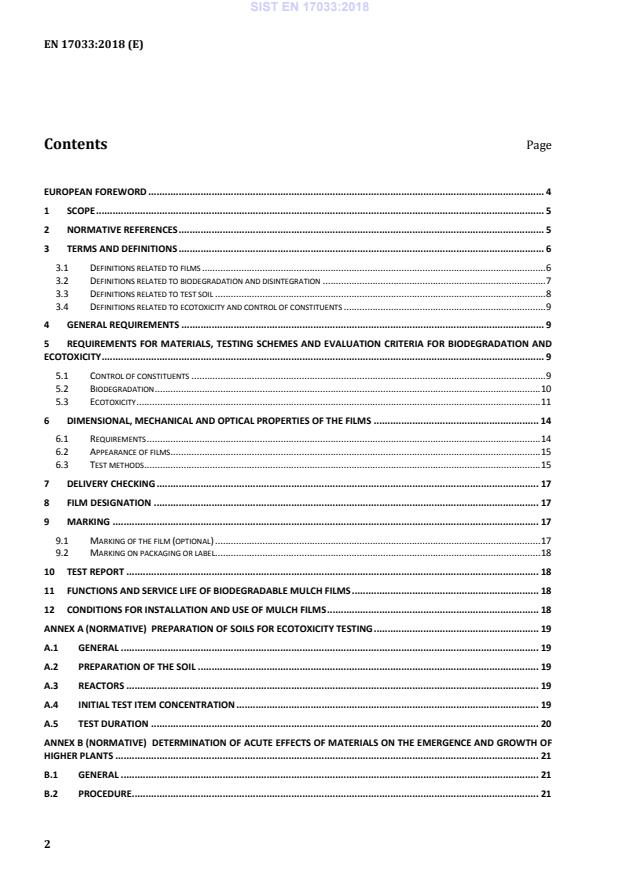
Contents Page
EUROPEAN FOREWORD . 4 1 SCOPE . 5 2 NORMATIVE REFERENCES . 5 3 TERMS AND DEFINITIONS . 6 3.1 DEFINITIONS RELATED TO FILMS . 6 3.2 DEFINITIONS RELATED TO BIODEGRADATION AND DISINTEGRATION . 7 3.3 DEFINITIONS RELATED TO TEST SOIL . 8 3.4 DEFINITIONS RELATED TO ECOTOXICITY AND CONTROL OF CONSTITUENTS . 9 4 GENERAL REQUIREMENTS . 9 5 REQUIREMENTS FOR MATERIALS, TESTING SCHEMES AND EVALUATION CRITERIA FOR BIODEGRADATION AND ECOTOXICITY . 9 5.1 CONTROL OF CONSTITUENTS . 9 5.2 BIODEGRADATION . 10 5.3 ECOTOXICITY . 11 6 DIMENSIONAL, MECHANICAL AND OPTICAL PROPERTIES OF THE FILMS . 14 6.1 REQUIREMENTS . 14 6.2 APPEARANCE OF FILMS . 15 6.3 TEST METHODS . 15 7 DELIVERY CHECKING . 17 8 FILM DESIGNATION . 17 9 MARKING . 17 9.1 MARKING OF THE FILM (OPTIONAL) . 17 9.2 MARKING ON PACKAGING OR LABEL . 18 10 TEST REPORT . 18 11 FUNCTIONS AND SERVICE LIFE OF BIODEGRADABLE MULCH FILMS . 18 12 CONDITIONS FOR INSTALLATION AND USE OF MULCH FILMS . 18 ANNEX A (NORMATIVE)
PREPARATION OF SOILS FOR ECOTOXICITY TESTING . 19 A.1 GENERAL . 19 A.2 PREPARATION OF THE SOIL . 19 A.3 REACTORS . 19 A.4 INITIAL TEST ITEM CONCENTRATION . 19 A.5 TEST DURATION . 20 ANNEX B (NORMATIVE)
DETERMINATION OF ACUTE EFFECTS OF MATERIALS ON THE EMERGENCE AND GROWTH OF HIGHER PLANTS . 21 B.1 GENERAL . 21 B.2 PROCEDURE. 21 SIST EN 17033:2018
DETERMINATION OF ACUTE EFFECTS OF MATERIALS ON EARTHWORMS . 23 C.1 GENERAL . 23 C.2 PROCEDURE . 23 C.3 EVALUATION OF THE RESULTS . 23 ANNEX D (NORMATIVE)
DETERMINATION OF EFFECTS OF MATERIALS ON REPRODUCTION OF EARTHWORMS . 24 D.1 GENERAL . 24 D.2 PROCEDURE . 24 D.3 EVALUATION OF THE RESULTS . 24 ANNEX E (NORMATIVE)
DETERMINATION OF NITRIFICATION ACTIVITY OF SOIL MICROORGANISMS . 25 E.1 GENERAL . 25 E.2 PROCEDURE . 25 E.3 EVALUATION OF THE RESULTS . 25 ANNEX F (NORMATIVE)
DETERMINATION OF RELATIVE LIGHT TRANSMISSION . 26 F.1 PRINCIPLE . 26 F.2 APPARATUS . 26 F.3 PROCEDURE . 26 F.4 EXPRESSION OF RESULTS . 26 ANNEX G (INFORMATIVE)
FUNCTIONS AND SERVICE LIFE OF BIODEGRADABLE MULCH FILMS . 27 G.1 GENERAL . 27 G.2 FACTORS OF DEGRADATION OF BIODEGRADABLE MULCH FILMS . 27 G.3 MAIN FUNCTIONS OF BIODEGRADABLE MULCH FILMS . 27 G.4 SERVICE LIFE ON SOIL OF BIODEGRADABLE MULCH FILMS . 28 ANNEX H (INFORMATIVE)
GOOD PRACTICE GUIDANCE FOR USE OF BIODEGRADABLE MULCH FILMS . 31 H.1 WARNING . 31 H.2 SOIL PREPARATION . 31 H.3 FILM LAYING . 31 H.4 FILM PERFORATION . 31 H.5 CULTIVATION TECHNIQUES AND BIODEGRADABLE FILMS . 32 H.6 FILM LIFETIME . 33 H.7 TREATMENT OF FILMS AT THE END OF CULTIVATION . 33 H.8 STORAGE . 33 ANNEX I (INFORMATIVE)
QUALITATIVE EVALUATION OF THE DISINTEGRATION IN A SLIDE FRAME TEST . 35 BIBLIOGRAPHY . 38 SIST EN 17033:2018
3.1.7 nominal thickness thickness of a film, as declared by the manufacturer Note 1 to entry:
3.1.8 roll length largest dimension of the film corresponding to the length of the unwinded roll Note 1 to entry: It is expressed in metres (m). 3.1.9 nominal roll length roll length, as declared by the manufacturer Note 1 to entry: It is expressed in metres (m). 3.1.10 longitudinal direction MD direction parallel to the roll length, corresponding to the extrusion direction 3.1.11 transverse direction TD direction parallel to the width (at a right angle to the roll length) 3.1.12 radiant exposure H time integral of irradiance, measured in joules per square metre (J·m «2) Note 1 to entry: measured in joules per square metre (J m «2) [SOURCE: ISO 9370:2017, definition 3.27] 3.2 Definitions related to biodegradation and disintegration 3.2.1 ultimate aerobic biodegradation breakdown of an organic compound by microorganisms in the presence of oxygen into carbon dioxide, water and mineral salts of any other elements present (mineralization) plus new biomass SIST EN 17033:2018
Higher plants Primary production Mainly soil pore water (by root uptake) Acute toxicity plant growth test according to OECD 208 with the modifications specified in Annex B Invertebrates:
Earthworms Breakdown of organic matter; formation of soil structure Diverse and multiple uptake routes: soil pore water, ingestion of soil material, soil air Acute toxicity earthworm test according to EN ISO 11268-1 with the modifications specified in Annex C or alternatively chronic earthworm toxicity test according to EN ISO 11268-2 with the modifications specified in Annex D Microorganisms:
Bacteria Recycling of nutrients Mainly soil pore water Nitrification inhibition test with soil microorganisms according to ISO 15685 with the modifications specified in Annex E 5.3.2 Test methods 5.3.2.1 Preparation of soils for ecotoxicity tests The ecotoxicity of the materials of mulch films and remaining degradation products (intermediates) shall be evaluated according to the test methods specified in 5.3.2.2, 5.3.2.3 and 5.3.2.4 using test soils prepared according to Annex A. 5.3.2.2 Acute toxicity plant growth test The test shall be performed according to OECD 208 with the modifications specified in Annex B in order to determine effects of materials on the emergence and growth of plants. Test items that have been already assessed for plant toxicity following EN 13432 [4], EN 14995 [5], ISO 17088 [6], ISO 18606 [7], ASTM D6400 [8], AS 4736 [9] or AS 5810 [10] and fulfilled the pass level for plant toxicity laid down in the standard specifications do not need to be retested. 5.3.2.3 Earthworm test 5.3.2.3.1 Acute toxicity earthworm test Adverse effects of materials on mortality and biomass of adult earthworms shall be determined in an acute earthworm test according to EN ISO 11268-1 with the modifications specified in Annex C. SIST EN 17033:2018
< 10
· 10,
¶ 15 > 15 Appearance - Shall conform to 6.2 6.2 Dimensional characteristics Tolerance of average thickness/nominal thickness % ±10 ±10 ±10 6.3.1 Tolerance of single point thickness/nominal thickness % ±25 6.3.1 Width tolerance/nominal width % ±2a 6.3.2 Roll length tolerance/nominal roll length % ±2 6.3.3 Mechanical characteristics on unexposed film Tensile stress at break
6.3.4
MD MPa
· 16
· 18
· 18
TD MPa
· 16
· 16
· 16
Tensile strain at break
6.3.4
MD %
· 100
· 150
· 200
TD %
· 250
· 300
· 350
Impact resistance g
·
· 80
· 100 6.3.5 Optical characteristic of unexposed film Relative light transmission (for Black or opaque films, only) %
¶ 3 6.3.6 a
mm is recommended. 6.2 Appearance of films The free edges of the roll shall be sealed with adhesive tape or by some other similar means, in order to prevent its unwinding. The edges shall be properly in line and there shall be sufficient tension to prevent the layers of the roll from transversal slipping when it is handled. The film shall be homogeneous for the purpose of the application and check it by unrolling at least 2 m of the film and examining it against the light, holding it tight at arm's length. 6.3 Test methods 6.3.1 Determination of thickness Determine the thickness of the single points of the film in accordance with ISO 4593. Determine the average thickness of the film in accordance with ISO 4591. Testing is performed using one strip of film cut in transverse direction of the roll (TD). SIST EN 17033:2018
Key 1 film roll 2 calibrated reel with a revolution counter 3 collection reel 4 deflection reel d diameter of the calibrated reel Figure 1 — Apparatus for the determination of the film length 6.3.4 Determination of tensile characteristics Determine the tensile characteristics in accordance with EN ISO 527-1 and EN ISO 527-3 on five test pieces type 2, 10 mm wide, cut in each direction of the film, MD and TD, at a testing speed of 50 mm/min. Calculate the arithmetic average value of the five measurements. 6.3.5 Determination of impact resistance Determine the impact resistance in accordance with EN ISO 7765-1:2004, method A. Calculate the impact failure mass mf, in grams, in accordance with EN ISO 7765-1. SIST EN 17033:2018
9 Marking 9.1 Marking of the film (optional) Marking along the edges of the film should include at least the following information: a) a reference to this document, i.e. “FprEN 17033”; b) nominal width of the film in millimetres or metres; c) nominal roll length in metres; d) class of film (see Table G.1) (optional); e) manufacturer's trade mark (optional); SIST EN 17033:2018
Preparation of soils for ecotoxicity testing A.1 General The purpose of this Annex is to give the instructions to prepare soils for ecotoxicity testing. Natural soil shall be used in order to prepare soil for ecotoxicity testing. A.2 Preparation of the soil A.2.1 Collection and sieving of natural soil Use natural soil collected from the surface layer of fields and/or forests. Sieve the soil to give particles of less than 5 mm, preferably less than 2 mm, in size and remove obvious plant material, stones and other inert materials. Record the sampling site, its location, the presence of plants or previous crops, the sampling date, the sampling depth, the soil analysis, if available, and, if possible, the soil history, such as details of fertilizer and pesticide application. A.2.2 Adjustment of the water content and the pH of the soil Adjust the water content of the soil to a suitable value for the test material by adding an appropriate amount of water to the soil, or by drying the soil in the air in a shaded place followed by addition of an appropriate amount of water. The optimum water content of the soil should be between 40 % and 60 % of the total water-holding capacity. The water content shall be determined according to EN ISO 11274. Adjust the pH of the soil to between 6,0 and 8,0 according to ISO 10390 if it is not already within this range. It is recommended that the ratio of organic carbon in the test material to nitrogen in the soil (C:N ratio) be adjusted to at least 40:1, if required, by adding nitrogen, for example, aqueous solution of ammonium chloride as specified in EN ISO 17556. A.3 Reactors Prepare a sufficient number of reactors, each consisting of a box made of polypropylene or other suitable material, with the following dimensions: L = 30 cm; w = 20 cm; h = 10 cm. The box shall be covered with a lid assuring a tight seal to avoid excessive evaporation. In the middles of the two 20 cm wide sides, a hole of 2,5 mm diameter shall be made approximately 6,5 cm from the bottom of the box. These two
...