

SIST IEC 60839-7-3:2002
(Main)Alarm systems - Part 7-3: Message formats and protocols for serial data interfaces in alarm transmission systems - Common data link layer protocol
General Information
- Abstract
Specifies the data link layer message structure, formats and transmission procedures which should be used at standard serial data interfaces in alarm transmission systems where the transmission network employed does not offer a standard protocol. Is necessary in order to ensure compatibility of equipment from different suppliers.
- Status
- Withdrawn
- Publication Date
- 31-May-2002
- Withdrawal Date
- 20-Jun-2024
- Technical Committee
- EAL - Alarm systems
- Current Stage
- 9900 - Withdrawal (Adopted Project)
- Start Date
- 21-Jun-2024
- Due Date
- 14-Jul-2024
- Completion Date
- 21-Jun-2024

Overview
IEC 60839-7-3 - Alarm systems - Part 7-3: Common data link layer protocol - specifies the data link layer message structure, formats and transmission procedures for serial data interfaces in alarm transmission systems when the underlying transmission network does not provide a standard protocol. The objective is to ensure interoperability of alarm equipment (intrusion, fire, access control, social alarm systems) from different suppliers by defining a simple, OSI‑layered poll/response protocol with a single MASTER and one or more SLAVEs.
Key topics and technical requirements
- Message structure: each data link message uses the format STX (02 HEX), LENGTH, SLAVE ADDRESS, control bits (K, S, R), X/Y octet, DATA LINK DATA BLOCK TYPE, up to 248 octets of data, and a 2‑octet CRC.
- CRC: 2‑octet cyclic redundancy check using polynomial generator X^16 + X^12 + X^5 + 1.
- Control bits and fields:
- K bit (bit 7 of 3rd octet): indicates Data Link Layer Authentication (DLLA) active (1) or not (0).
- S bit (sequence bit, bit 6): toggled by MASTER for each new message; SLAVEs mirror the incoming S bit.
- R bit: reserved (should be 0).
- X/Y octet: set to X for MASTER-transmitted messages and Y for SLAVE messages.
- Addressing: unique node addresses in range 01–1F HEX (1–31 decimal).
- Timeouts:
- Message time-out: maximum time between end of sent message and first octet of response (related to IEC 60839-5-1 transmission delay table).
- Restart time-out: used by potential MASTERs to detect inactivity before assuming MASTER role; Time-out = (ADD × 50 ms) + 3000 ms.
- Initialization & operation: general poll / acknowledge, DLLA exchange during initialization using random variables (X, Q) and modular arithmetic Y = (X ADD Q) mod 256, normal poll/response, multipoint scheduling, and procedures for error handling and MASTER/SLAVE re-initialization.
- Multipoint support: point-to-point and point-to-multipoint supported; multipoint-to-multipoint is not supported (MASTER can route SLAVE-to-SLAVE messages).
Applications
- Ensures interoperability of alarm transmitters, central receivers and communicators when using serial interfaces without native network protocols.
- Suitable for designers and integrators of intrusion detection, fire alarm networks, access control systems and social alarm services that require standardized data link behavior.
- Enables reliable, auditable alarm transmission with explicit acknowledgements and basic authentication at the data link layer.
Who should use this standard
- Alarm system manufacturers and hardware vendors
- System integrators and installation engineers
- Network and telecom engineers specifying serial alarm links
- Test laboratories, certifiers and procurement teams seeking supplier interoperability
Related standards
- IEC 60839-7-1: General (message formats and protocols)
- IEC 60839-7-2: Common application layer protocol
- IEC 60839-7-4: Common transport layer protocol
- IEC 60839-5-1: Requirements for alarm transmission systems (relates to timing)
Keywords: IEC 60839-7-3, alarm systems, data link layer, serial data interfaces, alarm transmission systems, common data link layer protocol, MASTER/SLAVE, DLLA, CRC, poll-response.
Get Certified
Connect with accredited certification bodies for this standard

BSI Group
BSI (British Standards Institution) is the business standards company that helps organizations make excellence a habit.

CIS Institut d.o.o.
Personal Protective Equipment (PPE) certification body. Notified Body NB-2890 for EU Regulation 2016/425 PPE.

Kiwa BDA Testing
Building and construction product certification.
Sponsored listings
Frequently Asked Questions
SIST IEC 60839-7-3:2002 is a standard published by the Slovenian Institute for Standardization (SIST). Its full title is "Alarm systems - Part 7-3: Message formats and protocols for serial data interfaces in alarm transmission systems - Common data link layer protocol". This standard covers: Specifies the data link layer message structure, formats and transmission procedures which should be used at standard serial data interfaces in alarm transmission systems where the transmission network employed does not offer a standard protocol. Is necessary in order to ensure compatibility of equipment from different suppliers.
Specifies the data link layer message structure, formats and transmission procedures which should be used at standard serial data interfaces in alarm transmission systems where the transmission network employed does not offer a standard protocol. Is necessary in order to ensure compatibility of equipment from different suppliers.
SIST IEC 60839-7-3:2002 is classified under the following ICS (International Classification for Standards) categories: 13.320 - Alarm and warning systems; 35.200 - Interface and interconnection equipment. The ICS classification helps identify the subject area and facilitates finding related standards.
SIST IEC 60839-7-3:2002 is associated with the following European legislation: EU Directives/Regulations: 2007-01-2231. When a standard is cited in the Official Journal of the European Union, products manufactured in conformity with it benefit from a presumption of conformity with the essential requirements of the corresponding EU directive or regulation.
SIST IEC 60839-7-3:2002 is available in PDF format for immediate download after purchase. The document can be added to your cart and obtained through the secure checkout process. Digital delivery ensures instant access to the complete standard document.
Standards Content (Sample)
SLOVENSKI STANDARD
01-junij-2002
Alarm systems - Part 7-3: Message formats and protocols for serial data interfaces
in alarm transmission systems - Common data link layer protocol
Alarm systems - Part 7-3: Message formats and protocols for serial data interfaces in
alarm transmission systems - Common data link layer protocol
Systèmes d'alarme - Partie 7-3: Formats de message et protocoles pour les interfaces
de données série dans les systèmes de transmission d'alarme - Protocole de la
couche commune de liaison de données
Ta slovenski standard je istoveten z: IEC 60839-7-3
ICS:
13.320 Alarmni in opozorilni sistemi Alarm and warning systems
35.200 Vmesniška in povezovalna Interface and interconnection
oprema equipment
2003-01.Slovenski inštitut za standardizacijo. Razmnoževanje celote ali delov tega standarda ni dovoljeno.
NORME CEI
INTERNATIONALE IEC
60839-7-3
INTERNATIONAL
Première édition
STANDARD
First edition
2001-03
Systèmes d'alarme –
Partie 7-3:
Formats de message et protocoles pour
les interfaces de données série dans
les systèmes de transmission d'alarme –
Protocole de la couche commune
de liaison de données
Alarm systems –
Part 7-3:
Message formats and protocols for serial
data interfaces in alarm transmission systems –
Common data link layer protocol
IEC 2001 Droits de reproduction réservés Copyright - all rights reserved
Aucune partie de cette publication ne peut être reproduite ni No part of this publication may be reproduced or utilized in
utilisée sous quelque forme que ce soit et par aucun procédé, any form or by any means, electronic or mechanical,
électronique ou mécanique, y compris la photocopie et les including photocopying and microfilm, without permission in
microfilms, sans l'accord écrit de l'éditeur. writing from the publisher.
International Electrotechnical Commission 3, rue de Varembé Geneva, Switzerland
Telefax: +41 22 919 0300 e-mail: inmail@iec.ch IEC web site http://www.iec.ch
CODE PRIX
Commission Electrotechnique Internationale
N
PRICE CODE
International Electrotechnical Commission
Pour prix, voir catalogue en vigueur
For price, see current catalogue
60839-7-3 © IEC:2001 – 3 –
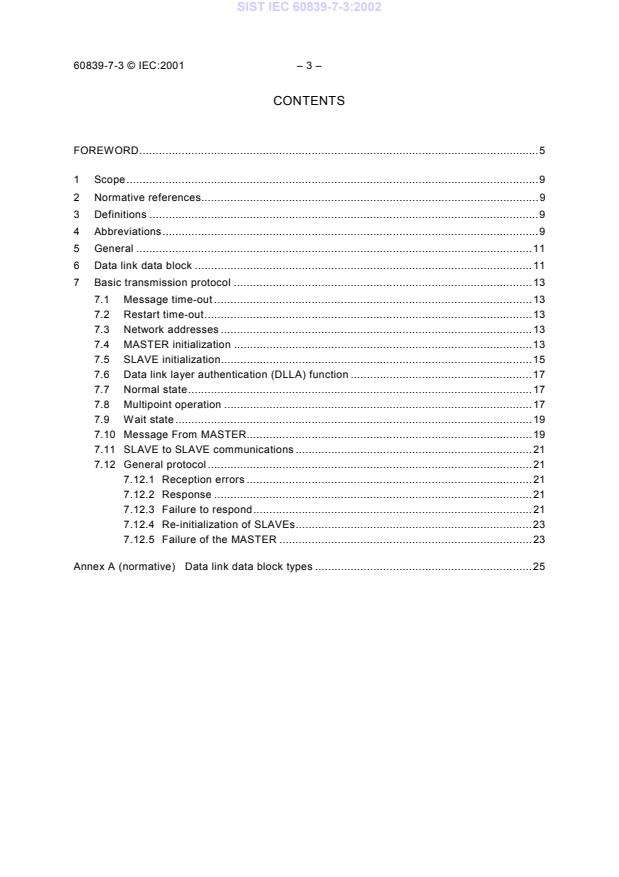
CONTENTS
FOREWORD.5
1 Scope.9
2 Normative references.9
3 Definitions .9
4 Abbreviations.9
5 General .11
6 Data link data block .11
7 Basic transmission protocol .13
7.1 Message time-out .13
7.2 Restart time-out.13
7.3 Network addresses .13
7.4 MASTER initialization .13
7.5 SLAVE initialization.15
7.6 Data link layer authentication (DLLA) function .17
7.7 Normal state.17
7.8 Multipoint operation .17
7.9 Wait state.19
7.10 Message From MASTER.19
7.11 SLAVE to SLAVE communications .21
7.12 General protocol.21
7.12.1 Reception errors .21
7.12.2 Response .21
7.12.3 Failure to respond.21
7.12.4 Re-initialization of SLAVEs.23
7.12.5 Failure of the MASTER .23
Annex A (normative) Data link data block types .25
60839-7-3 © IEC:2001 – 5 –
INTERNATIONAL ELECTROTECHNICAL COMMISSION
____________
ALARM SYSTEMS –
Part 7-3: Message formats and protocols for serial data interfaces
in alarm transmission systems –
Common data link layer protocol
FOREWORD
1) The IEC (International Electrotechnical Commission) is a worldwide organization for standardization comprising
all national electrotechnical committees (IEC National Committees). The object of the IEC is to promote
international co-operation on all questions concerning standardization in the electrical and electronic fields. To
this end and in addition to other activities, the IEC publishes International Standards. Their preparation is
entrusted to technical committees; any IEC National Committee interested in the subject dealt with may
participate in this preparatory work. International, governmental and non-governmental organizations liaising
with the IEC also participate in this preparation. The IEC collaborates closely with the International Organization
for Standardization (ISO) in accordance with conditions determined by agreement between the two
organizations.
2) The formal decisions or agreements of the IEC on technical matters express, as nearly as possible, an
international consensus of opinion on the relevant subjects since each technical committee has representation
from all interested National Committees.
3) The documents produced have the form of recommendations for international use and are published in the form
of standards, technical specifications, technical reports or guides and they are accepted by the National
Committees in that sense.
4) In order to promote international unification, IEC National Committees undertake to apply IEC International
Standards transparently to the maximum extent possible in their national and regional standards. Any
divergence between the IEC Standard and the corresponding national or regional standard shall be clearly
indicated in the latter.
5) The IEC provides no marking procedure to indicate its approval and cannot be rendered responsible for any
equipment declared to be in conformity with one of its standards.
6) Attention is drawn to the possibility that some of the elements of this International Standard may be the subject
of patent rights. The IEC shall not be held responsible for identifying any or all such patent rights.
International Standard IEC 60839-7-3 has been prepared by IEC technical committee 79: Alarm
systems.
This bilingual version (2001-11) replaces the English version.
The text of this standard is based on the following documents:
FDIS Report on voting
79/200/FDIS 79/210/RVD
Full information on the voting for the approval of this standard can be found in the report on
voting indicated in the above table.
This publication has been drafted in accordance with the ISO/IEC Directives, Part 3.
Annex A forms an integral part of this standard.
The committee has decided that the contents of this publication will remain unchanged
until 2004. At this date, the publication will be
• reconfirmed;
• withdrawn;
• replaced by a revised edition, or
• amended.
60839-7-3 © IEC:2001 – 7 –
systems – Part 7: Message formats and protocols for serial data interfaces in alarm
transmission systems.
IEC 60839-7-1: General
IEC 60839-7-2: Common application layer protocol
IEC 60839-7-4: Common transport layer protocol
IEC 60839-7-5: Alarm system interfaces employing a two-wire configuration in accordance
with ISO/IEC 8482
IEC 60839-7-6: Alarm system interfaces employing ITU-T Recommendation V.24/V.28
signals
IEC 60839-7-7: Alarm system interfaces for plug-in alarm system transceivers
IEC 60839-7-11: Serial protocol for use by digital communicator systems using ITU-T
Recommendation V.23 signalling at interfaces with the PSTN
IEC 60839-7-12: PTT interfaces for dedicated communications using ITU-T Recommendation
V.23 signalling
IEC 60839-7-20: Terminal interfaces employing ITU-T Recommendation V.24/V.28 signalling
60839-7-3 © IEC:2001 – 9 –
ALARM SYSTEMS –
Part 7-3: Message formats and protocols for serial data interfaces
in alarm transmission systems –
Common data link layer protocol
1 Scope
This part of IEC 60839 specifies the data link layer message structure, formats and
transmission procedures which should be used at standard serial data interfaces in alarm
transmission systems where the transmission network employed does not offer a standard
protocol. This is necessary in order to ensure compatibility of equipment from different
suppliers.
The standard applies equally to the transmission of alarms and other messages to/from
intrusion, fire, access control and social alarm systems, and to the transmission of information
to/from other similar systems.
The protocol is based on a simple poll response algorithm, with a single MASTER and one or
more SLAVEs. The protocol defined allows for point-point and point-multipoint operation.
Multipoint to multipoint operation is not supported, however the structure does support the
transmission of messages from one SLAVE to another, using the MASTER as a simple router.
The structure follows the OSI recommendations for a layered protocol to allow flexibility in the
use of the physical layer.
2 Normative references
The following referenced documents are indispensable for the application of this document. For
dated references, only the edition cited applies. For undated references, the latest edition of
the referenced document (including any amendments) applies.
IEC 60839-5-1, Alarm systems – Part 5-1: Requirements for alarm transmission systems –
General requirements for systems
IEC 60839-7-1, Alarm systems – Part 7-1: Message formats and protocols for serial data inter-
faces in alarm transmission systems – General
3 Definitions
For the purpose of this part of IEC 60839, the definitions in IEC 60839-7-1 apply.
4 Abbreviations
The abbreviations in IEC 60839-7-1 apply.
60839-7-3 © IEC:2001 – 11 –
5 General
The basic protocol employed is a poll-response, with a single MASTER. Where there is more
than a single SLAVE, the MASTER will normally poll each slave in turn.
Messages requiring transmission shall be formatted into one or more data link data blocks,
which shall be transmitted in order to the intended destination.
Each transmitted data link data block shall be explicitly acknowledged before the transmission
of a subsequent block.
6 Data link data block
The data link shall transmit messages with the following structure:
STX
LENGTH
SLAVE ADDRESS
KS R
(5 bits)
X/Y
DATA LINK DATA BLOCK TYPE
DATA LINK DATA
max. 248 octets
CRC
The STX octet shall be 02 HEX.
The message LENGTH shall be the number of octets following the LENGTH octet up to (and
including) the CRC.
The bit K (bit 7 of 3rd octet) shall be set (=1) to specify a message in which the data link layer
authentication (DLLA) function is active, and unset (=0) where it is not.
The bit R (bit 5 of 3rd octet) is reserved and should be unset (=0).
The bit S (bit 6 of 3rd octet) is a sequence bit, and shall initially be unset (=0). The bit shall be
set (=1) in the INIT DLLA data link data block type and shall be toggled for each new message
transmitted by the MASTER. A SLAVE shall always set the S bit equal to the corresponding bit
in the incoming message.
The X/Y octet is set to X for messages transmitted from the MASTER, and to Y for messages
transmitted from a SLAVE.
...