

SIST EN 1266:2004
(Main)Independent gas-fired convection heaters incorporating a fan to assist transportation of combustion air and/or flue gases
- Abstract
This European standard specifies the requirements and test methods for construction, safety, fitness for purpose, rational use of energy, classification and marking of gas-fired convection heating appliances that are fitted with fan-assisted atmospheric burners, and fully pre-mixed burners. This European standard applies to independent convection heaters, burning gas having a fan to assist the transportation of combustion air and/or flue gases, hereafter referred to as 'appliances'.
- Status
- Published
- Publication Date
- 31-Dec-2003
- Technical Committee
- PLN - Gas appliances for domestic use
- Current Stage
- 6060 - National Implementation/Publication (Adopted Project)
- Start Date
- 01-Jan-2004
- Due Date
- 01-Jan-2004
- Completion Date
- 01-Jan-2004
- Directive
- 2009/142/EC - Appliances burning gaseous fuelsOJ Ref: C 349 OJ Date: 22-Dec-2010
90/396/EEC - Appliances burning gaseous fuelsOJ Ref: C 88 OJ Date: 08-Apr-2004



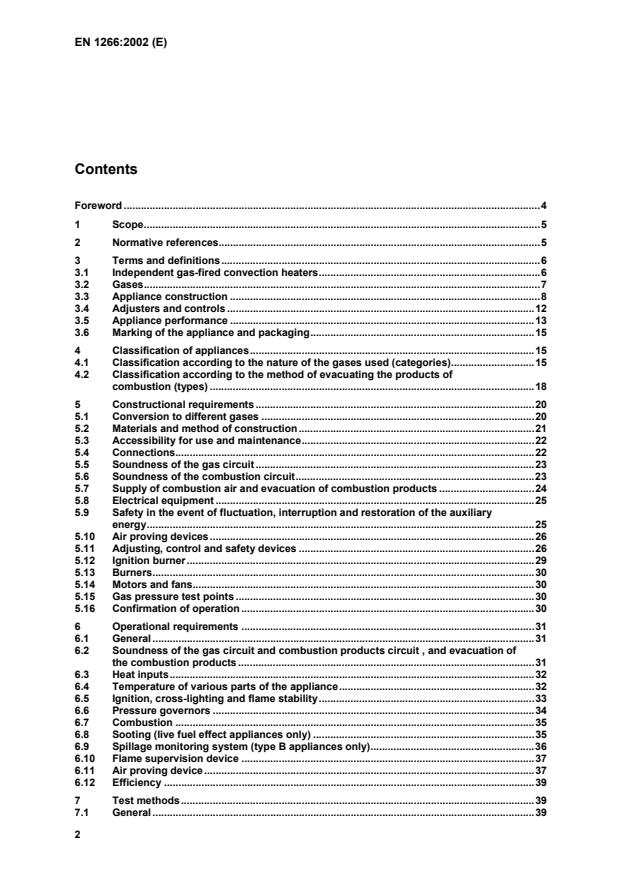
SIST EN 1266:2004 is the Slovenian adoption of EN 1266:2002, published by SIST. It specifies requirements and test methods for independent gas-fired convection heaters that use fan-assisted atmospheric burners or fully pre-mixed burners. The standard is meant for manufacturers, test laboratories, certifiers, installers and buyers who need to identify the right appliance category, test route and marking for a specific gas market.
What does SIST EN 1266:2004 specify?
SIST EN 1266:2004 covers construction, safety, fitness for purpose, rational use of energy, classification and marking for independent gas-fired convection heating appliances. It applies to wall-mounted, free-standing and built-in appliances, including live fuel effect appliances, and it is written for appliances intended to be type tested.
It covers appliances of types B12, B13, B14, B22, B23, C12, C13, C32, C33, C42, C43, C52, C53, C62 and C63. The standard limits the nominal heat input to 20 kW based on the net calorific value.
It excludes open-fronted appliances to prEN 13278:1998, appliances with automatic forced-draught burners to EN 676, ducted-air appliances, and appliances installed by means of a closure plate. It also leaves out quality assurance systems, production testing and certificates of conformity for auxiliary devices.
| Annex | What it covers |
|---|---|
| A | National situations for marketing, supply pressures, gas types and connections |
| B | Examples for appliance classification by type |
| C | Separate air supply and combustion products evacuation ducts |
| D | High voltage ignition circuits |
| E | Gas valve arrangements |
| F | Spillage test methods |
| G | Calculation of NOx conversions |
| H | Apparatus for smoke number determination |
| I | Identification of gas types used in different countries |
| J | Special national conditions |
| K | A-deviations |
| ZA | EU Directive 90/396/EEC mapping |
What are the key requirements of SIST EN 1266:2004?
Classification drives the design and the test route
SIST EN 1266:2004 classifies appliances by gas family and group, and by the way combustion air and combustion products are handled. In practice, this classification determines which gases, pressures, ducts and safety arrangements the appliance is designed and tested for.
Clause 4 defines the gas families and the appliance categories I, II and III, then the appliance types B and C with their subtypes. That matters because a manufacturer must match the appliance to the intended gas distribution conditions and installation arrangement before type testing.
Constructional safety is built into the appliance
Clause 5 covers the gas circuit, burners, combustion products circuit, electrical equipment, controls, safety devices, motors, fans and test points. It also sets rules for conversion to different gases, accessibility for maintenance, soundness of the gas and combustion circuits, and the supply and evacuation of combustion air and products.
For type B12AS, B13AS and B14AS appliances, the atmosphere sensing device may need replacement when gas family or pressure conditions change, if the instructions require it. In practice, this means gas conversion is not a general adjustment exercise - it is controlled by the appliance design and the manufacturer’s instructions.
Operation has to remain safe and stable
Clause 6 covers soundness, heat input, temperatures of parts, ignition, cross-lighting, flame stability, pressure governors, combustion, sooting for live fuel effect appliances, spillage monitoring for type B appliances, flame supervision devices, air proving devices and efficiency. This is the part that shows whether the appliance works safely in normal use and under abnormal draught or air-supply conditions.
Every requirement is paired with a test method
Clause 7 gives the test methods that verify the Clause 6 requirements. The tests cover soundness, heat input, temperatures, ignition performance, pressure governors, combustion quality, sooting, spillage monitoring, flame supervision devices, air proving devices and efficiency. For a buyer or certifier, this links the claim on the appliance to an agreed test route.
Marking and instructions support correct installation and use
Clause 8 covers marking on the appliance and packaging, plus instructions. The standard also distinguishes the direct and indirect country of destination, so the markings and instructions can match the gas supply conditions in the market where the appliance is sold.
What terms does SIST EN 1266:2004 define?
- independent gas-fired convection heater - a convection heater designed to heat a room mainly by convection, and it may also include radiant heating elements.
- forced convection heater - a convection appliance with a fan that speeds up air circulation around the heating body and discharges air directly into the room.
- live fuel effect convection heater - a convection appliance designed to imitate the visual effect of a solid fuel appliance.
- type B appliance - an appliance that takes combustion air from the room and sends combustion products to a flue.
- type C appliance - an appliance with a sealed combustion circuit relative to the room where it is installed.
- flame supervision device - a device that opens or closes the gas supply according to whether the monitored flame is present.
- air proving device - a safety device that causes shut-down if air admission or combustion products evacuation becomes abnormal.
Who uses SIST EN 1266:2004?
Manufacturers and design engineers use SIST EN 1266:2004 to choose the appliance category, burner arrangement, control devices and marking for a target gas market. Test laboratories and certification bodies use it for type testing and for the annex methods that verify combustion, spillage, ignition and duct performance.
Installers, technical sales teams and gas suppliers use it to match appliances to the local gas family, supply pressure and national conditions. Quality managers and buyers use it to check that an appliance is intended for the right destination country and installation type.
Which standards are used with SIST EN 1266:2004?
| Standard | Contribution |
|---|---|
| EN 437 | Test gases, test pressures and appliance categories |
| EN 88 | Pressure governors for gas appliances |
| EN 125 | Thermo-electric flame supervision devices |
| EN 126 | Multifunctional controls for gas burning appliances |
| EN 161 | Automatic shut-off valves |
| EN 257 | Mechanical thermostats |
| EN 298 | Automatic gas burner control systems |
| EN 12067-1 | Gas/air ratio controls, pneumatic types |
| EN 60335-1 | General electrical safety requirements |
| EN 60529 | Degrees of protection of enclosures |
| EN 60730-2-9 | Temperature sensing controls |
| CR 1404 | Emissions from gaseous-fuel appliances during type testing |
| EN ISO 3166-1 | Country codes |
| ISO 7-1 / ISO 228-1 | Pipe thread designations and dimensions |
| ISO 274 | Copper tube dimensions |
| IEC 60479-1 / IEC 60479-2 | Effects of current on the human body |
What does the SIST EN 1266:2004 document contain?
The document contains classification tables for gas families, appliance categories and national marketing situations, plus a full set of construction and performance test clauses. It also includes annex figures for sampling probes, test duct systems, room layout, ignition circuit testing and spillage test arrangements.
Annex C provides test requirements for separate air supply and combustion products evacuation ducts. Annex D sets out high voltage ignition circuit protection and test details, while Annex F gives two spillage test methods and Annex H describes the smoke-number apparatus. Annex G gives NOx conversion tables, and Annex ZA links the standard to the essential requirements of Directive 90/396/EEC.
Relations
- Effective Date
- 25-Aug-2026
- Effective Date
- 25-Aug-2026
- Effective Date
- 09-Feb-2026
- Effective Date
- 09-Feb-2026
- Effective Date
- 09-Feb-2026
- Effective Date
- 28-Jan-2026
- Effective Date
- 28-Jan-2026
- Effective Date
- 28-Jan-2026
- Effective Date
- 28-Jan-2026
- Effective Date
- 28-Jan-2026
- Effective Date
- 28-Jan-2026
- Effective Date
- 28-Jan-2026
- Effective Date
- 28-Jan-2026
- Effective Date
- 28-Jan-2026
- Effective Date
- 28-Jan-2026
Frequently Asked Questions
SIST EN 1266:2004 is a standard published by the Slovenian Institute for Standardization (SIST). Its full title is "Independent gas-fired convection heaters incorporating a fan to assist transportation of combustion air and/or flue gases". This standard covers: This European standard specifies the requirements and test methods for construction, safety, fitness for purpose, rational use of energy, classification and marking of gas-fired convection heating appliances that are fitted with fan-assisted atmospheric burners, and fully pre-mixed burners. This European standard applies to independent convection heaters, burning gas having a fan to assist the transportation of combustion air and/or flue gases, hereafter referred to as 'appliances'.
This European standard specifies the requirements and test methods for construction, safety, fitness for purpose, rational use of energy, classification and marking of gas-fired convection heating appliances that are fitted with fan-assisted atmospheric burners, and fully pre-mixed burners. This European standard applies to independent convection heaters, burning gas having a fan to assist the transportation of combustion air and/or flue gases, hereafter referred to as 'appliances'.
SIST EN 1266:2004 is classified under the following ICS (International Classification for Standards) categories: 97.100.20 - Gas heaters. The ICS classification helps identify the subject area and facilitates finding related standards.
SIST EN 1266:2004 has the following relationships with other standards: It is inter standard links to SIST ISO 7-1:1995, SIST ISO 228-1:1995, SIST EN 60335-1:1998, SIST EN 60529:1997, SIST EN 60730-2-9:1997, SIST EN 12067-1:1999, SIST EN 257:1997, oSIST prEN 15116:2005, SIST EN 88:1997, SIST EN 437:1997, SIST EN 125:1997, SIST EN 14037-2:2004, SIST EN 126:1997, SIST EN 13278:2004, SIST EN 14989-2:2008. Understanding these relationships helps ensure you are using the most current and applicable version of the standard.
SIST EN 1266:2004 is associated with the following European legislation: EU Directives/Regulations: 2009/142/EC, 2015/1185, 2015/1186, 2015/1188, 2016/426, 90/396/EEC; Standardization Mandates: M/BC/CEN/89/6. When a standard is cited in the Official Journal of the European Union, products manufactured in conformity with it benefit from a presumption of conformity with the essential requirements of the corresponding EU directive or regulation.
SIST EN 1266:2004 is available in PDF format for immediate download after purchase. The document can be added to your cart and obtained through the secure checkout process. Digital delivery ensures instant access to the complete standard document.
Standards Content (Sample)
2003-01.Slovenski inštitut za standardizacijo. Razmnoževanje celote ali delov tega standarda ni dovoljeno.Independent gas-fired convection heaters incorporating a fan to assist transportation of combustion air and/or flue gasesAppareils de chauffage indépendants a convection utilisant les combustibles gazeux et intégrant un ventilateur pour faciliter l'alimentation en air comburant et/ou l'évacuation des produits de combustionKonvektions-Raumheizer für gasförmige Brennstoffe mit gebläseunterstützter Verbrennungsluftzu- und/oder AbgasabführungTa slovenski standard je istoveten z:EN 1266:2002SIST EN 1266:2004en,fr,de97.100.20ICS:SLOVENSKI
STANDARDSIST EN 1266:200401-januar-2004
EUROPEAN STANDARDNORME EUROPÉENNEEUROPÄISCHE NORMEN 1266October 2002ICS 97.100.20English versionIndependent gas-fired convection heaters incorporating a fan toassist transportation of combustion air and/or flue gasesAppareils de chauffage indépendants à convection utilisantles combustibles gazeux et intégrant un ventilateur pourfaciliter l'alimentation en air comburant et/ou l'évacuationdes produits de combustionKonvektions-Raumheizer für gasförmige Brennstoffe mitgebläseunterstützter Verbrennungsluftzu- und/oderAbgasabführungThis European Standard was approved by CEN on 11 January 2001.CEN members are bound to comply with the CEN/CENELEC Internal Regulations which stipulate the conditions for giving this EuropeanStandard the status of a national standard without any alteration. Up-to-date lists and bibliographical references concerning such nationalstandards may be obtained on application to the Management Centre or to any CEN member.This European Standard exists in three official versions (English, French, German). A version in any other language made by translationunder the responsibility of a CEN member into its own language and notified to the Management Centre has the same status as the officialversions.CEN members are the national standards bodies of Austria, Belgium, Czech Republic, Denmark, Finland, France, Germany, Greece,Iceland, Ireland, Italy, Luxembourg, Malta, Netherlands, Norway, Portugal, Spain, Sweden, Switzerland and United Kingdom.EUROPEAN COMMITTEE FOR STANDARDIZATIONCOMITÉ EUROPÉEN DE NORMALISATIONEUROPÄISCHES KOMITEE FÜR NORMUNGManagement Centre: rue de Stassart, 36
B-1050 Brussels© 2002 CENAll rights of exploitation in any form and by any means reservedworldwide for CEN national Members.Ref. No. EN 1266:2002 E
National situations.98Annex B (normative)
Classification of appliances.110Annex C (normative)
Requirements and test methods for separate air supply andcombustion products evacuation ducts.115Annex D (normative)
High voltage ignition circuits.120Annex E (informative)
Gas valve arrangements.122Annex F (informative)
Spillage test methods.123Annex G (normative)
Calculation of conversions of NOx.129Annex H (normative)
Apparatus for the determination of the smoke number.130Annex I (informative)
Means of identification of the types of gas in force in the variouscountries.131Annex J (normative)
Special national conditions.132Annex K (informative)
A-deviations.133Annex ZA (informative)
Clauses of this European Standard addressing essentialrequirements or other provisions of EU Directives.134
to create a pressure drop and thusreduce the gas pressure at the burner to a predetermined value for a given supply pressure and rate3.3.1.5gas rate adjustercomponent intended for the manufacturer or installer to set the gas rate to each burner at apredetermined value according to the supply conditionsThe adjustment may be progressive (screw adjuster) or discontinuous (changing restrictors).The adjuster of an adjustable governor is regarded as a gas rate adjuster.The action of setting this device is called 'setting the gas rate'.3.3.1.6gas rate controlcomponent allowing the user to open or close the gas supply to one or more burners. It may also beused to adjust the gas rate of certain burners to a predetermined value, called the 'reduced rate'. Thisdevice may be a 'tap'3.3.1.7injectorcomponent that admits the gas into a burner3.3.1.8start gasinitial quantity of gas ignited to give a flame which is used to ignite the main burner. It may bedischarged through a separate ignition burner or part of the main burner3.3.2 Burner3.3.2.1main burnerburner that assures the thermal function of an appliance. It is usually called simply 'burner'3.3.2.2fully premixed burnerburner in which the gas and a quantity of air at least equal to that theoretically necessary for completecombustion are mixed before the combustion head
according to the value of theWobbe index. Table 1 specifies the families and groups of gas used in this standard.
- Group A22,424,8Second family39,154,7
- Group H45,754,7
- Group L39,144,8
- Group E40,954,7Third family72,987,3
- Group B/P72,987,3
- Group P72,976,8
- Group B81,887,34.1.2 Appliance categories4.1.2.1 GeneralAppliances are classified into categories defined according to the gases and the pressures for whichthey are designed.The definition of categories follows from 4.1.2.2, 4.1.2.3 and 4.1.2.4.In each country, taking account of the local gas distribution conditions (gas composition and supplypressures), only some of the categories defined in 4.1.2.2, 4.1.2.3 and 4.1.2.4 are marketed.The national situations concerning the marketing of these appliance categories in each country, andthe corresponding supply pressures, are given in Tables A.1 and A.2 (see also in Table A.3 thespecial categories marketed locally and nationally or corresponding to special gases and supplypressures indicated in Table A.4; conditions which are particular to a country are given in annex K).4.1.2.2 Category IAppliances of category I are designed exclusively for the use of gases of a single family or of a singlegroup.4.1.2.2.1 Appliances designed for use on first family gases onlyCategory I1a: appliances using only gases of group a of the first family at the prescribed supplypressure. (This category is not used).
1)Annex B gives examples of the various types.
...