


SIST EN 55103-2:2010
(Main)Electromagnetic compatibility - Product family standard for audio, video, audio-visual and entertainment lighting control apparatus for professional use -- Part 2: Immunity
Electromagnetic compatibility - Product family standard for audio, video, audio-visual and entertainment lighting control apparatus for professional use -- Part 2: Immunity
This European Standard for EMC immunity requirements applies to professional audio, video, audio-visual and entertainment lighting control apparatus as defined in 3.6 intended for use in the environments described in Clause 4. This includes the digital apparatus defined in 3.5 and sub-assemblies, see 7.4.
Disturbances in the frequency range 0 Hz to 400 GHz are covered, but requirements are not established over the whole of that range.
NOTE 1 In Annex C, information is included on infra-red radiation in the wavelength range 0,7 µm to 1,6 µm.
The objective of this standard is to define the immunity test requirements, test signals, performance criteria and test methods for apparatus defined in the scope, in relation to electromagnetic immunity to continuous and transient conducted and radiated electromagnetic disturbances including electrostatic discharges. These test requirements represent essential electromagnetic compatibility requirements.
Fault conditions of source or victim apparatus are not taken into account.
Apparatus as defined in 3.4, 3.5 and 3.6 may be operated with any source of power.
NOTE 2 Sources of power may include, for example: the public low-voltage supply; private supplies with similar characteristics; a d.c. source provided specifically for the apparatus; batteries internal to the apparatus; stand-by generators. Some standards may not apply to private low-voltage supplies.
NOTE 3 If it is intended to use a hand-held transmitter in proximity, additional mitigation measures may have to be employed to increase the electromagnetic immunity further, beyond the specified limits.
This European Standard does not apply to
– consumer apparatus,
– apparatus specifically designed for security systems,
– apparatus designed to radiate electromagnetic energy for radio communications purposes.
Elektromagnetische Verträglichkeit - Produktfamiliennorm für Audio-, Video- und audiovisuelle Einrichtungen sowie für Studio-Lichtsteuereinrichtungen für professionellen Einsatz -- Teil 2: Störfestigkeit
Compatibilité électromagnétique - Norme de famille de produits pour les appareils à usage professionnel audio, vidéo, audiovisuels et de commande de lumière pour spectacles -- Partie 2: Immunité
Elektromagnetna združljivost - Standard za družino izdelkov za regulacijo avdio, video, avdiovizualnih in osvetlitvenih zabaviščnih naprav za profesionalno uporabo - 2. del: Odpornost proti motnjam
Ta evropski standard za zahteve glede odpornosti EMC velja za profesionalne avdio, video, avdiovizualne in osvetlitvene zabaviščne naprave, kot so opredeljene v točki 3.6, namenjene za uporabo v okoljih, opisnih v Klavzuli 4. Vključuje digitalne naprave, opredeljene v točki 3.5., in podsklope (glej točko 7.4). Motnje v frekvenčnem razponu od 0 Hz do 400 GHz so zajete, vendar zahteve niso vzpostavljene za ta celotni razpon. OPOMBA 1: V Dodatku C so vključene informacije o infrardečem sevanju v razponu valovnih dolžin od 0,7 do 1,6 µm. Cilj tega standarda je opredeliti zahteve za preskušanje odpornosti, preskusne signale, merila zmogljivosti in preskusne metode za naprave, opredeljene na področju uporabe, glede na elektromagnetno odpornost proti neprekinjenim, začasnim in vodenim ter sevanim elektromagnetnim motnjam, vključno z elektrostatičnimi razelektritvami. Te preskusne zahteve predstavljajo bistvene zahteve za elektromagnetno združljivost. Okvare vira ali prizadete naprave niso upoštevane. Naprave, opredeljene v točkah 3.4, 3.5 in 3.6, lahko napaja kakršen koli vir energije.
General Information
- Status
- Withdrawn
- Publication Date
- 08-Nov-2010
- Withdrawal Date
- 31-Mar-2026
- Technical Committee
- EMC - Electromagnetic compatibility
- Current Stage
- 9900 - Withdrawal (Adopted Project)
- Start Date
- 30-Mar-2026
- Due Date
- 22-Apr-2026
- Completion Date
- 01-Apr-2026
- Directive
- Not Harmonized2004/108/EC - Directive 2004/108/EC of the European Parliament and of the Council of 15 December 2004 on the approximation of the laws of the Member States relating to electromagnetic compatibility and repealing Directive 89/336/EECOJ Ref: C 53/04 OJ Date: 25-Feb-2014
Not Harmonized2014/30/EU - Directive 2014/30/EU of the European Parliament and of the Council of 26 February 2014 on the harmonisation of the laws of the Member States relating to electromagnetic compatibility (recast)OJ Ref: C 17, C 173, Umakne z dnem 28.7.2022 (L 89) OJ Date: 13-May-2016
Not Harmonized89/336/EEC - Electromagnetic compatibility (EMC)
Relations
- Effective Date
- 01-Dec-2010
- Replaced By
SIST EN 55035:2017 - Electromagnetic Compatibility of Multimedia equipment - Immunity Requirements - Effective Date
- 14-Apr-2020
- Effective Date
- 01-Sep-2012
- Effective Date
- 28-Jan-2023

Get Certified
Connect with accredited certification bodies for this standard

TL 9000 QuEST Forum
Telecommunications quality management system.

ANCE
Mexican certification and testing association.

Intertek Slovenia
Intertek testing, inspection, and certification services in Slovenia.
Sponsored listings
Frequently Asked Questions
SIST EN 55103-2:2010 is a standard published by the Slovenian Institute for Standardization (SIST). Its full title is "Electromagnetic compatibility - Product family standard for audio, video, audio-visual and entertainment lighting control apparatus for professional use -- Part 2: Immunity". This standard covers: This European Standard for EMC immunity requirements applies to professional audio, video, audio-visual and entertainment lighting control apparatus as defined in 3.6 intended for use in the environments described in Clause 4. This includes the digital apparatus defined in 3.5 and sub-assemblies, see 7.4. Disturbances in the frequency range 0 Hz to 400 GHz are covered, but requirements are not established over the whole of that range. NOTE 1 In Annex C, information is included on infra-red radiation in the wavelength range 0,7 µm to 1,6 µm. The objective of this standard is to define the immunity test requirements, test signals, performance criteria and test methods for apparatus defined in the scope, in relation to electromagnetic immunity to continuous and transient conducted and radiated electromagnetic disturbances including electrostatic discharges. These test requirements represent essential electromagnetic compatibility requirements. Fault conditions of source or victim apparatus are not taken into account. Apparatus as defined in 3.4, 3.5 and 3.6 may be operated with any source of power. NOTE 2 Sources of power may include, for example: the public low-voltage supply; private supplies with similar characteristics; a d.c. source provided specifically for the apparatus; batteries internal to the apparatus; stand-by generators. Some standards may not apply to private low-voltage supplies. NOTE 3 If it is intended to use a hand-held transmitter in proximity, additional mitigation measures may have to be employed to increase the electromagnetic immunity further, beyond the specified limits. This European Standard does not apply to – consumer apparatus, – apparatus specifically designed for security systems, – apparatus designed to radiate electromagnetic energy for radio communications purposes.
This European Standard for EMC immunity requirements applies to professional audio, video, audio-visual and entertainment lighting control apparatus as defined in 3.6 intended for use in the environments described in Clause 4. This includes the digital apparatus defined in 3.5 and sub-assemblies, see 7.4. Disturbances in the frequency range 0 Hz to 400 GHz are covered, but requirements are not established over the whole of that range. NOTE 1 In Annex C, information is included on infra-red radiation in the wavelength range 0,7 µm to 1,6 µm. The objective of this standard is to define the immunity test requirements, test signals, performance criteria and test methods for apparatus defined in the scope, in relation to electromagnetic immunity to continuous and transient conducted and radiated electromagnetic disturbances including electrostatic discharges. These test requirements represent essential electromagnetic compatibility requirements. Fault conditions of source or victim apparatus are not taken into account. Apparatus as defined in 3.4, 3.5 and 3.6 may be operated with any source of power. NOTE 2 Sources of power may include, for example: the public low-voltage supply; private supplies with similar characteristics; a d.c. source provided specifically for the apparatus; batteries internal to the apparatus; stand-by generators. Some standards may not apply to private low-voltage supplies. NOTE 3 If it is intended to use a hand-held transmitter in proximity, additional mitigation measures may have to be employed to increase the electromagnetic immunity further, beyond the specified limits. This European Standard does not apply to – consumer apparatus, – apparatus specifically designed for security systems, – apparatus designed to radiate electromagnetic energy for radio communications purposes.
SIST EN 55103-2:2010 is classified under the following ICS (International Classification for Standards) categories: 33.100.20 - Immunity; 33.160.01 - Audio, video and audiovisual systems in general. The ICS classification helps identify the subject area and facilitates finding related standards.
SIST EN 55103-2:2010 has the following relationships with other standards: It is inter standard links to SIST EN 55103-2:1998, SIST EN 55035:2017, SIST EN 55103-2:2010/IS1:2012, SIST EN 55103-2:2010/IS1:2012. Understanding these relationships helps ensure you are using the most current and applicable version of the standard.
SIST EN 55103-2:2010 is associated with the following European legislation: EU Directives/Regulations: 2004/108/EC, 2004/108/EU, 2014/30/EU, 89/336/EEC. When a standard is cited in the Official Journal of the European Union, products manufactured in conformity with it benefit from a presumption of conformity with the essential requirements of the corresponding EU directive or regulation.
SIST EN 55103-2:2010 is available in PDF format for immediate download after purchase. The document can be added to your cart and obtained through the secure checkout process. Digital delivery ensures instant access to the complete standard document.
Standards Content (Sample)
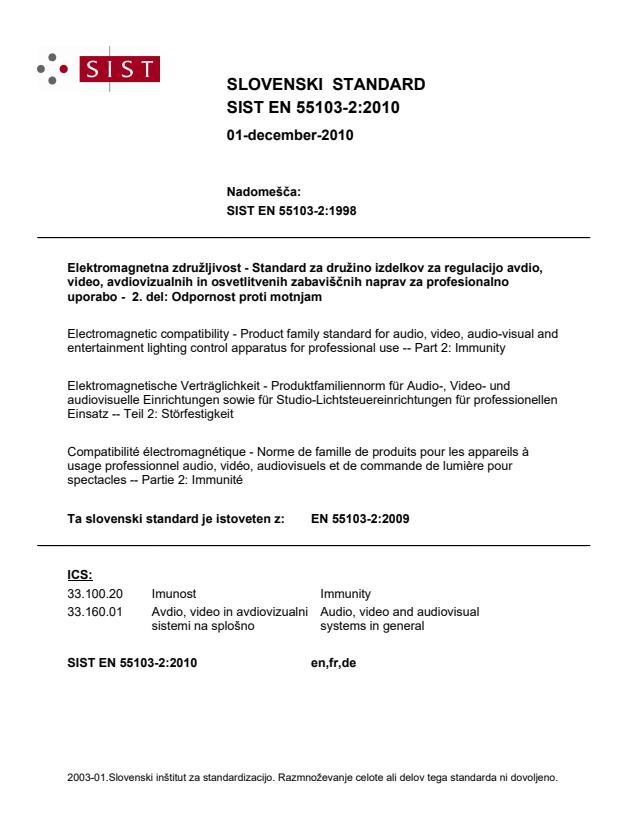
2003-01.Slovenski inštitut za standardizacijo. Razmnoževanje celote ali delov tega standarda ni dovoljeno.HVLRQDOQRElektromagnetische Verträglichkeit - Produktfamiliennorm für Audio-, Video- und audiovisuelle Einrichtungen sowie für Studio-Lichtsteuereinrichtungen für professionellen Einsatz -- Teil 2: StörfestigkeitCompatibilité électromagnétique - Norme de famille de produits pour les appareils à usage professionnel audio, vidéo, audiovisuels et de commande de lumière pour spectacles -- Partie 2: ImmunitéElectromagnetic compatibility - Product family standard for audio, video, audio-visual and entertainment lighting control apparatus for professional use -- Part 2: Immunity33.160.01Avdio, video in avdiovizualni sistemi na splošnoAudio, video and audiovisual systems in general33.100.20ImunostImmunityICS:Ta slovenski standard je istoveten z:EN 55103-2:2009SIST EN 55103-2:2010en,fr,de01-december-2010SIST EN 55103-2:2010SLOVENSKI
STANDARDSIST EN 55103-2:19981DGRPHãþD
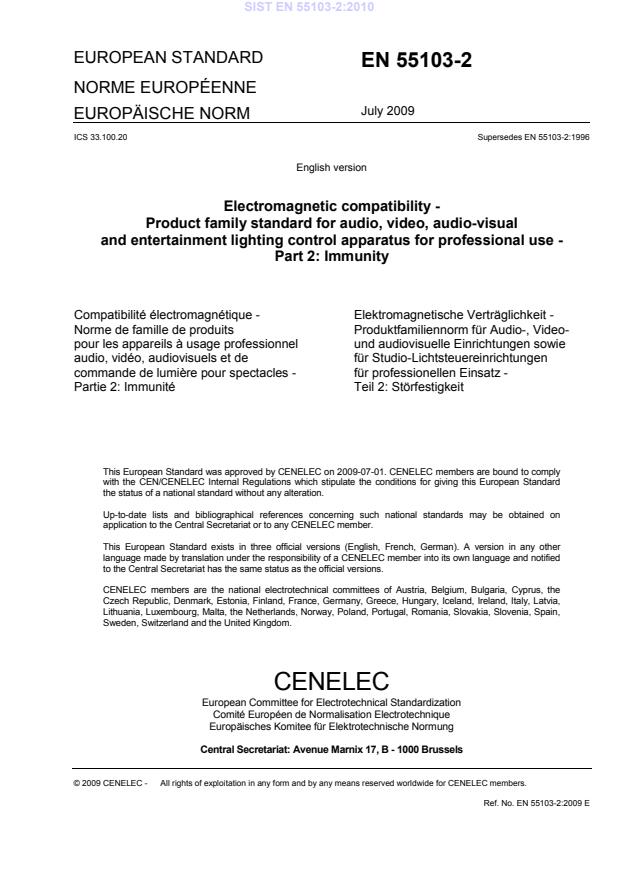
EUROPEAN STANDARD EN 55103-2 NORME EUROPÉENNE
EUROPÄISCHE NORM July 2009
CENELEC European Committee for Electrotechnical Standardization Comité Européen de Normalisation Electrotechnique Europäisches Komitee für Elektrotechnische Normung
Central Secretariat: Avenue Marnix 17, B - 1000 Brussels
© 2009 CENELEC -
All rights of exploitation in any form and by any means reserved worldwide for CENELEC members.
Ref. No. EN 55103-2:2009 E
ICS 33.100.20 Supersedes EN 55103-2:1996
English version
Electromagnetic compatibility -
Product family standard for audio, video, audio-visual
and entertainment lighting control apparatus for professional use -
Part 2: Immunity
Compatibilité électromagnétique -
Norme de famille de produits
pour les appareils à usage professionnel audio, vidéo, audiovisuels et de commande de lumière pour spectacles -
Partie 2: Immunité
Elektromagnetische Verträglichkeit -
Produktfamiliennorm für Audio-, Video- und audiovisuelle Einrichtungen sowie
für Studio-Lichtsteuereinrichtungen
für professionellen Einsatz -
Teil 2: Störfestigkeit
This European Standard was approved by CENELEC on 2009-07-01. CENELEC members are bound to comply with the CEN/CENELEC Internal Regulations which stipulate the conditions for giving this European Standard the status of a national standard without any alteration.
Up-to-date lists and bibliographical references concerning such national standards may be obtained on application to the Central Secretariat or to any CENELEC member.
This European Standard exists in three official versions (English, French, German). A version in any other language made by translation under the responsibility of a CENELEC member into its own language and notified to the Central Secretariat has the same status as the official versions.
CENELEC members are the national electrotechnical committees of Austria, Belgium, Bulgaria, Cyprus, the Czech Republic, Denmark, Estonia, Finland, France, Germany, Greece, Hungary, Iceland, Ireland, Italy, Latvia, Lithuania, Luxembourg, Malta, the Netherlands, Norway, Poland, Portugal, Romania, Slovakia, Slovenia, Spain, Sweden, Switzerland and the United Kingdom.
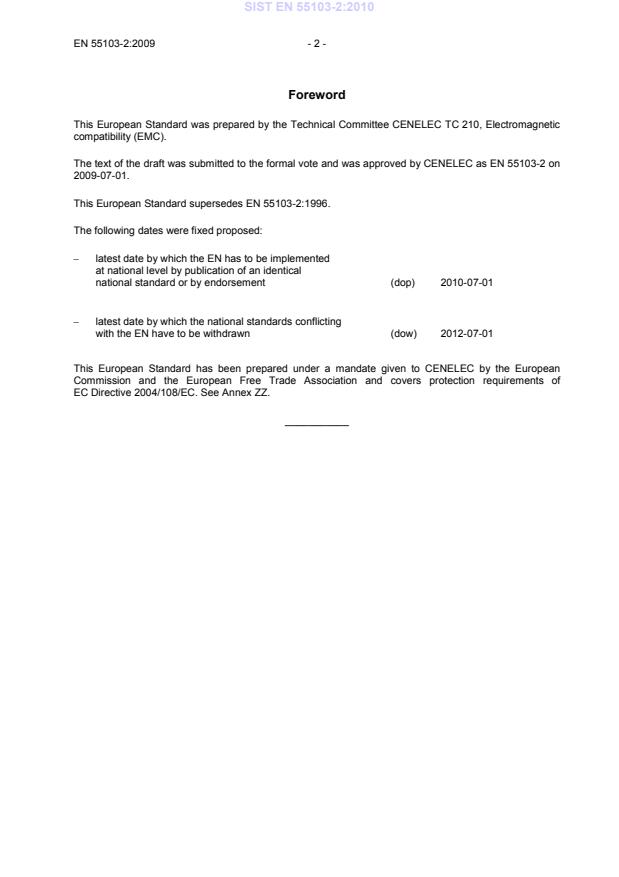
The text of the draft was submitted to the formal vote and was approved by CENELEC as EN 55103-2 on 2009-07-01. This European Standard supersedes EN 55103-2:1996. The following dates were fixed proposed: – latest date by which the EN has to be implemented at national level by publication of an identical national standard or by endorsement
(dop)
2010-07-01 – latest date by which the national standards conflicting with the EN have to be withdrawn
(dow)
2012-07-01 This European Standard has been prepared under a mandate given to CENELEC by the European Commission and the European Free Trade Association and covers protection requirements of EC Directive 2004/108/EC. See Annex ZZ. ___________ SIST EN 55103-2:2010
- 3 - EN 55103-2:2009 Contents 1 Scope .4 2 Normative references .4 3 Definitions .5 4 Electromagnetic environment .6 5 Disturbing phenomena .7 6 Immunity requirements .7 7 Testing . 12 7.1 Performance criteria . 12 7.2 General . 12 7.3 Ports . 13 7.4 Sub-assemblies . 13 7.5 Racks and cabinets . 14 8 Documentation for the purchaser/user . 14 8.1 Documentation which shall be supplied to the purchaser/user . 14 8.2 Documentation which shall be available to the purchaser/user upon request. 14 Annex A (normative) Method of measurement of immunity to radiated magnetic fields, 50 Hz to 10 kHz . 15 Annex B (normative) Methods of measurement of common mode immunity for balanced signal and control ports intended to be connected to cables whose total length according to the manufacturer’s specification may exceed 10 m; 50 Hz to 10 kHz . 20 Annex C (informative) Apparatus using infra-red radiation for open-air transmission purposes . 26 Annex D (informative) Guidance for test houses on immunity testing of audio, video, audio-visual and entertainment lighting control apparatus for professional use . 27 Annex E (informative) Background information about this standard . 31 Annex ZZ (informative) Coverage of Essential Requirements of EC Directives . 32 Bibliography . 33 Figures Figure 1 - Examples of ports . 5 Figure A.1 - Construction of Helmholtz coils for homogeneous fields . 17 Figure A.2 - Construction of the radiating loop for inhomogeneous fields . 18 Figure A.3 - Typical test setup for immunity to inhomogeneous magnetic field . 18 Figure B.1 - Test interface - Test set-up 1 . 20 Figure B.2 - Calibration arrangement for test set-up 1 . 21 Figure B.3 - Test set-ups . 23 Figure B.4 - Equaliser circuit . 23 Tables Table 1 - Immunity requirements . 7 Table B.1 - Test method selection . 19 Table D.1 - Five-point scales for subjective assessment . 29
Some standards may not apply to private low-voltage supplies. NOTE 3 If it is intended to use a hand-held transmitter in proximity, additional mitigation measures may have to be employed to increase the electromagnetic immunity further, beyond the specified limits. This European Standard does not apply to – consumer apparatus, – apparatus specifically designed for security systems, – apparatus designed to radiate electromagnetic energy for radio communications purposes. 2 Normative references The following referenced documents are indispensable for the application of this document. For dated references, only the edition cited applies. For undated references, the latest edition of the referenced document (including any amendments) applies. EN 55020 2007 Sound and television broadcast receivers and associated equipment - Immunity characteristics - Limits and methods of measurement (CISPR 20:2006) EN 61000-3-2 2006 Electromagnetic compatibility (EMC) - Part 3-2: Limits - Limits for harmonic current emissions (equipment input current ≤ 16 A per phase) (IEC 61000-3-2:2005) EN 61000-4-2 + A1 + A2 1995 1998 2001 Electromagnetic compatibility (EMC) - Part 4-2: Testing and measurement techniques - Electrostatic discharge immunity test (IEC 61000-4-2:1995 + A1:1998 + A2:2000) EN 61000-4-3 + A1 2006 2008 Electromagnetic compatibility (EMC) - Part 4-3: Testing and measurement techniques - Radiated, radio-frequency, electromagnetic field immunity test (IEC 61000-4-3:2006 + A1:2007) EN 61000-4-4 2004 Electromagnetic compatibility (EMC) - Part 4-4: Testing and measurement techniques - Electrical fast transient/burst immunity test (IEC 61000-4-4:2004) SIST EN 55103-2:2010
- 5 - EN 55103-2:2009 EN 61000-4-5 2006 Electromagnetic compatibility (EMC) - Part 4-5: Testing and measurement techniques - Surge immunity test (IEC 61000-4-5:2005) EN 61000-4-6 2007 Electromagnetic compatibility (EMC) - Part 4-6: Testing and measurement techniques - Immunity to conducted disturbances, induced by radio-frequency fields (IEC 61000-4-6:2003 + A1:2004 + A2:2006) EN 61000-4-11 2004 Electromagnetic compatibility (EMC) - Part 4-11: Testing and measurement techniques - Voltage dips, short interruptions and voltage variations immunity tests (IEC 61000-4-11:2004) EN 61000-6-2 2005 Electromagnetic compatibility (EMC) - Part 6-2: Generic standards - Immunity for industrial environments (IEC 61000-6-2:2005) HD 483.1 S2 1989 Sound system equipment - Part 1: General (IEC 60268-1:1985 + A1:1988) 3 Definitions For the purposes of this document, the following terms and definitions apply. Definitions related to EMC and to relevant phenomena may be found in the EU Directive on EMC (2004/108/EC), in IEC 60050-161 and in other IEC and CISPR Publications. 3.1 electromagnetic compatibility the ability of a device, unit of equipment or system to function satisfactorily in its electromagnetic environment without introducing intolerable disturbances to anything in that environment 3.2 port particular interface of the specified apparatus with the electromagnetic environment (see Figure 1) 3.3 enclosure port the physical boundary of the apparatus through which electromagnetic fields may radiate or impinge 3.4 professional apparatus apparatus for use in trades, professions or industries and which is not intended for sale to the general public 3.5 professional digital apparatus professional apparatus designed for the purpose of controlling audio, video, audiovisual or entertainment lighting characteristics, by means of periodic pulsed electrical waveforms, or of processing audio, video or lighting control signals in digital form 3.6 professional entertainment lighting control apparatus professional apparatus producing electrical control signals for controlling the intensity, colour, nature or direction of the light from a luminaire, where the intention is to create artistic effects in theatrical, television or musical productions and visual presentations 3.7 test report the documentation of the EMC tests performed, and their results, prepared by the persons who carried out the tests, for example the manufacturer or a test laboratory SIST EN 55103-2:2010
Enclosure port
Figure 1 - Examples of ports 4 Electromagnetic environment Sets of requirements are specified in Clause 6 for the following five environments. The apparatus shall comply with one or more of the sets of requirements. It is the responsibility of the manufacturer to apply the appropriate set or sets of requirements to his apparatus (see 7.1). E1 Residential (including both of the location types class 1 and 2 found in IEC 61000-2-5) E2 Commercial and light industrial (including, for example, theatres, and television studios which are not purpose-built studios) E3 Urban outdoors (based on the definition of location type class 6 in IEC 61000-2-5) E4 Controlled EMC environment (for example purpose-built broadcasting or recording studio), and the rural outdoors environment (far away from railways, transmitters, overhead power lines, etc.) NOTE 1 A controlled EMC environment exists in a building where the installation has been designed having special regard to EMC, and where technical personnel are present with experience of EMC technology. E5 Heavy industrial (see EN 61000-6-2); and environments close to broadcast transmitters NOTE 2 Situations arise where the level of disturbance may exceed the levels specified in this standard for example where an apparatus is installed in proximity to ISM apparatus as defined in EN 55011 or where a hand-held transmitter is used in close proximity to an apparatus. In these instances special mitigation measures may have to be employed. Apparatus a.c. power ports d.c. power ports earth ports signal/control ports SIST EN 55103-2:2010
- 7 - EN 55103-2:2009 5 Disturbing phenomena This standard sets requirements for the following disturbing phenomena (see Table 1): 1) RF electromagnetic field; 2) electrostatic discharge; 3) magnetic fields; NOTE There are two tests, with a homogenous field (3a) and an inhomogenous field (3b). The inhomogeneous field test is specifically intended to test immunity to fields acting on the surface of rack mounted apparatus and investigates poor screening. 4) fast transients, common mode; 5) audio frequency common mode; 6) RF common mode; 7) surges, line-to-line and line-to-earth; 8) voltage dips; 9) voltage interruptions. 6 Immunity requirements Apparatus within the scope of this standard shall comply with the requirements of this standard independently of the nature of its source of power. Some example sources are listed in Clause 1. The immunity requirements are shown in Table 1.
homo-genous 50 Hz to 10 kHz E1 E2 and E30,8 A/m to 0,008 A/m50 Hz to5 kHz 0,008 A/m5 kHz to 10 kHz 10 A/m to 0,1 A/m 50 Hz to5 kHz 0,1 A/m 5 kHz to 10 kHz Annex A A 3 3. Applicable only to apparatus NOT intended for rack-mounted applications. Homogeneous/pseudo-homogeneous magnetic field decreasing linearly with the logarithm of frequency from 50 Hz to 5 kHz and constant from 5 kHz to 10 kHz (see A.3 and A.4 for details of test configuration). CRT disturbance is permitted above 1A/m
1 A/m to 0,01 A/m 50 Hz to 5 kHz 0,01 A/m 5 kHz to 10 kHz 3 A/m to 0,03 A/m50 Hz to 5 kHz 0,03 A/m5 kHz to10 kHz 3b Magnetic field, inhomo-genous 50 Hz to 10 kHz 4 A/m to 0,4 A/m, 50 Hz to 500 Hz 0,4 A/m, 500 Hz to 10 kHz 4 4. Applicable only to apparatus intended for rack-mounted applications. Inhomogeneous magnetic field decreasing linearly with the logarithm of frequency from 50 Hz to 500 Hz and constant from 500 Hz to 10 kHz (see A.5). Apparatus used in close proximity to television monitors shall be tested at 15,625 kHz using the 10 kHz limit. CRT disturbance is permitted above 3 A/m. SIST EN 55103-2:2010
- 9 - EN 55103-2:2009 Table 1 - Immunity requirements (continued) Port Pheno-menon Frequency range Test levels E1 to E 3Test levels E4 Test levels E5 Applicable standard Perform-ance Criterion NotesList of notes Signal and control 4 Fast transientscommon-mode Not applicable 0,5 kV
peak 1 kV
peak EN 61000-4-4B 5 & 6 5. Applicable only to ports interfacing with cables whose total length according to the manufacturer's functional specification may exceed 3 m. 6. Tr/Th: 5 ns/50 ns; repetition frequency 5 kHz. 5 AF common-mode 50 Hz to
10 kHz See Annex B Annex B A 7
7. Applicable only to balanced ports to which may be attached cables whose total length according to the manufacturer's functional specification may exceed 10 m. See Annex B for limits for video, data and control ports. Balanced antenna ports are excluded from this requirement. For balanced signal or control ports intended to be connected to PSTN or similar lines; refer to the appropriate ETSI or CENELEC immunity standard. 6 RF common-mode 0,15 MHz to 80 MHz 3 V 1 V 10 V EN 61000-4-6A 2, 8, 9, 10, 11 & 12 8. Screened-cable ports as defined in 3.8 are deemed to comply with the requirements for this phenomenon without testing. 9. Applicable only to ports interfacing with cables whose total length according to the manufacturer's functional specification may exceed 1 m. 10. For antenna ports, refer to EN 55020. 11. Source impedance = 150 Ω. 12. Apparatus having a single cable port shall be tested with a 150 Ω common-mode impedance network in the cable to the port under test and an artificial hand in contact with the EUT. For all other apparatus two 150 Ω common-mode impedance networks shall be used, one in the cable under test and one in the power connection to the EUT. Where there is no input power port, the second 150 Ω common-mode impedance network shall terminate a second signal or control port. The test setup for screened cables on mains-powered apparatus shall be in accordance with Figure 5b of EN 61000-4-6; any cables other than the mains input and the cable under test (e.g. other cables for monitoring or exercising the EUT) shall be decoupled via networks meeting the requirements of 6.2.4 of EN 61000-4-6. Unscreened signal or control cables shall be tested either with a suitable 150 Ω CDN, or with the combination of a current clamp and a 150 Ω common-mode impedance network. SIST EN 55103-2:2010
4 Fast transients Not applicable 0,5 kV peak -- EN 61000-4-4B 5, 6, 13 & 14 13. Use capacitive clamp; not applicable to input ports intended for connection to d.c. power supplies intended to be used only with the apparatus under test. 14. This test need not be carried out where apparatus is intended to be used with an a.c./d.c. adaptor, with or without rechargeable batteries, provided that phenomenon 6 is tested using the recommended a.c./d.c. adaptor. 15. Not applicable to input ports intended for connection to a battery or rechargeable battery which must be removed or disconnected from the apparatus for recharging.
-- 2 kV
peak 6 & 156 RF common-mode 0,15 MHz to 80 MHz 3 V 10 V EN 61000-4-6A 2, 9, 10, 11 & 12
AC power, input and output 4 Fast transients Not applicable 1 kV
peak 0,5 kV
peak 2 kV
peak EN 61000-4-4B 6 & 1616. CDN for input ports, see EN 61000-4-4, and capacitive clamp for output ports. 6 RF common-mode 0,15 MHz to 80 MHz 3 V 1 V 10 V EN 61000-4-6A 2, 11 & 17 17. The port under test shall be connected to a suitable 150 Ω CDN and one other cable port shall be terminated via a second 150 Ω common-mode impedance network; any other cables (e.g. cables for monitoring or exercising the EUT) shall be decoupled via networks meeting the requirements of 6.2.4 of EN 61000-4-6. The configuration of the cables and EUT with respect to the ground plane shall be as shown in Figure 5b of EN 61000-4-6, except that the dimensions shown in the figure for the position of the injection point shall apply to the CDN connected to the port under test. SIST EN 55103-2:2010
- 11 - EN 55103-2:2009 Table 1 - Immunity requirements (continued) Port Pheno-menon Frequency range Test levels E1 to E 3Test levels E4 Test levels E5 Applicable standard Perform-ance Criterion NotesList of notes AC power, input 7 Surges Not applicable 1 kV
peak, common-mode0,5 kV peak or 4,5 times the rated supply voltage, whichever is less, differential mode. 0,5 kV
peak common-mode 2 kV
peak common-mode EN 61000-4-5B 18 18. Because, in some countries, reversible mains connectors are used, it is not possible to identify a 'neutral', so the mains poles are designated here 'line 1 ' and 'line 2'. The timing of the surges is expressed as the phase relative to the mains sine-wave voltage at line 1 with respect to line 2. The number of pulses applied shall be as follows: Five +ve pulses line 1 to line 2 at 90° phase Five -ve pulses line 1 to line 2 at 270° phase Five +ve pulses line 1 to earth at 90° phase Five -ve pulses line 1 to earth at 270° phase Five +ve pulses line 2 to earth at 270° phase Five -ve pulses line 2 to earth at 90° phase Polyphase AC power ports shall be tested on one phase only, unless the phases are connected to significantly different circuit arrangements. For environments 1, 2 and 3, only the specified level and that specified for E4 shall be tested. For environment E4, only the specified level shall be tested For environment E5, the specified level and all those specified for the other environments shall be tested. 8 Voltage dips 30 % reduction for 0,5 period EN 61000-4-11 B 19 19. Voltage shift at zero crossing. 60 % reduction for 5 periods C 9 Voltage interrupt-ions Greater than 95 % reduction for 5 s Functional earth 4 Fast transients 0,5 kV
peak common-mode 2 kV
peak common-mode EN 61000-4-4B 5 & 2020. Use the capacitive clamp. Functional earth 6 RF common-mode 0,15 MHz to 80 MHz 3 V 1 V 10 V EN 61000-4-6A 5, 6 & 11
- 13 - EN 55103-2:2009 The configuration and mode of operation during testing shall be precisely noted in the test report. It is not always possible to test every function of the apparatus; in such cases the most critical mode of operation shall be selected. Where applicable, test programs and software shall be chosen so as to exercise all normal modes of operation of the apparatus under test. The use of special exercising software is permitted provided that it can be shown that the apparatus under test is being comprehensively exercised in its normal operating modes. Tests shall be performed in well-defined and reproducible conditions for each type of test stimulus. The tests shall be carried out one by one in sequence, the sequence being optional. Each test or series of associated tests of one phenomenon shall be carried out under a single set of environmental conditions within the specified operating environmental range of the apparatus and at its rated supply voltage, unless otherwise specified in this standard or the relevant Basic Standard. NOTE 1 The test methods and stimuli are given in the standards (Basic Standards, where they exist) which are referred to in Table 1. Any necessary modifications or additional information needed for the practical application of the tests are specified in this standard. Audio frequency interference voltages shall be measured using the quasi-peak meter and psophometric weighting specified in HD 483.1 unless the manufacturer's specification states these voltages as A-weighted values or A-weighted levels in decibels (see HD 483.1). NOTE 2 The two methods of measurement may give differences in values which range, when expressed in decibels, from nearly zero to 14 dB or more, depending on the waveform of the voltage. If a magnetic or common mode signal or control port disturbance within the effective frequency range of the apparatus under test can cause the rated output level of the apparatus under test to be exceeded at the test level specified in this standard, the controls of the apparatus under test shall be set, or its operating mode chosen, so as to prevent this overloading (if possible) and the manufacturer shall state these settings or choice. If such a setting or choice is not possible, the manufacturer shall state that special precautions may be necessary to reduce the level of the relevant disturbance impinging on the apparatus, and shall state the highest level of disturbance that the apparatus can tolerate, together with the performance, or degradation from undisturbed performance, which that level produces. 7.3 Ports Tests shall be made on the relevant ports of the apparatus in accordance with Table 1. Tests shall only be carried out if the relevant port exists. If the apparatus has a large number of ports or ports with many similar connections, then a sufficient number shall be selected to simulate actual operating conditions and to ensure that all the different types of termination are covered. Interconnecting cables should be of the type specified in the individual apparatus requirements. The manufacturer should specify a maximum length for cables. Where it is reasonable, this length shall be used for testing. Where there are multiple interface ports all of the same type, connecting a cable to just one of that type of port is sufficient provided it can be shown that additional cables do not significantly affect the results. It is important that where any simulator is used instead of an actual interfacing apparatus, it properly represents the electrical and, if necessary, the mechanical characteristics of the interfacing apparatus, especially in respect of r.f. signals and impedances. 7.4 Sub-assemblies If the apparatus contains sub-assemblies which are provided with connectors so that they can be moved about within it, an attempt shall be made to minimise the immunity by moving the sub
...
Questions, Comments and Discussion
Ask us and Technical Secretary will try to provide an answer. You can facilitate discussion about the standard in here.
Loading comments...