

kSIST FprEN 17765:2026
(Main)Organic and organo-mineral fertilizers - Determination of biuret content by high-performance liquid chromatography (HPLC)
- Abstract
This document specifies a method for the determination of the biuret content by high-performance liquid chromatography (HPLC) with ultraviolet (UV) detector.
This document is applicable to organic and organo-mineral fertilizers containing urea.
This document is applicable to fertilizing products blends where a blend is a mix of at least two of the following products: fertilizers, liming materials, soil improvers, growing media, inhibitors, plant biostimulants and where organic matter is present in at least one of the products in the blend. In case a fertilizing product blend is composed only of inorganic products, the European Standard for inorganic fertilizers applies. Variations in analytical methods for fertilizing product blends can lead to differing results as some components or matrix interactions can affect the outcome. Validation procedures have shown that developed standard methods are robust and reliable across diverse product compositions, but possible interferences and unexpected results when analysing fertilizing product blends are possible.
NOTE 1 This method was tested only for one fertilizing product blend during the inter-laboratory study. The product tested was a liquid organo-mineral mixture of a liquid organic fertilizer, a growing medium and a non-microbial plant biostimulant.
NOTE 2 Nowadays, there is a method standardized as EN 15479 that allows the determination of biuret in urea by spectrophotometric detection. Organic and organo-mineral fertilizers contain organic matter and other compounds apart from urea that would interfere in a spectrophotometric method. HPLC allows an accurate determination of biuret by separating it from possible interfering compounds [2] [5].
- Status
- Not Published
- Public Enquiry End Date
- 01-Apr-2026
- Technical Committee
- KAT - Soil quality
- Current Stage
- 5020 - Formal vote (FV) (Adopted Project)
- Start Date
- 02-Nov-2026
- Due Date
- 21-Dec-2026
- Completion Date
- 17-Nov-2026

kSIST FprEN 17765:2026 is the SIST publication identical to prEN 17765:2026, a draft European Standard from CEN. It specifies an HPLC method with UV detection for determining biuret in organic and organo-mineral fertilizers containing urea, and it also applies to fertilizing product blends with organic matter. It is aimed at laboratories and control teams that need a chromatographic method for matrices where spectrophotometric measurement can be affected by other compounds.
What does kSIST FprEN 17765:2026 specify?
kSIST FprEN 17765:2026 specifies the method, the reagents and apparatus, the sample preparation, the calculation of results, the precision statement, and the test report for biuret determination. The document is organized in clauses 1 to 10, with informative Annex A on interlaboratory precision and informative Annex ZA on the link to EU fertilising-product legislation.
| Annex | What it covers |
|---|---|
| Annex A | Results of the interlaboratory study for precision |
| Annex ZA | Relationship with Regulation (EU) 2019/1009 and the corresponding essential requirements |
The scope covers organic and organo-mineral fertilizers containing urea, plus fertilizing product blends where organic matter is present in at least one component. It also notes that blends made only of inorganic products fall under the European Standard for inorganic fertilizers. Sampling is handled outside the method itself, with references to other sampling standards.
What are the key requirements of kSIST FprEN 17765:2026?
kSIST FprEN 17765:2026 is built around extracting biuret, separating it chromatographically, and quantifying it against external standards. In practice, the user has to control the sample matrix, the calibration, and the chromatographic separation carefully because these factors drive the result.
- Clause 4, principle - The sample is extracted with an aqueous acetonitrile solution, separated by reversed-phase liquid chromatography, and detected with a UV detector. This matters because the chromatographic step isolates biuret from interfering compounds before measurement.
- Clauses 5 and 6, reagents and apparatus - The method uses analytical-grade reagents, HPLC-grade acetonitrile, water of specified conductivity, a biuret reference material, an HPLC system with UV detector, and an amino or amino-propyl column. This means the lab needs suitable solvent quality and a column that gives the required separation.
- Clauses 7.1 to 7.4, sampling and preparation - Sampling is outside the method, but the laboratory sample must be representative, prepared according to EN 1482-2, ground to pass a 0.50 mm sieve, extracted, diluted, and filtered; centrifugation is allowed if the filter loads too quickly. This is the stage where poor handling can distort the result.
- Clauses 7.2, 7.6 and 7.7, calibration and measurement - A six-level calibration set is prepared every day, each calibration solution is measured twice, and the test solution is analysed with the same procedure as the standards. This gives a daily external-standard calibration curve for converting peak area into biuret mass.
- Clause 7.5, HPLC conditions - The document gives recommended operating conditions, including column type, flow rate, injection volume, column temperature, detector wavelength, and run time, while allowing other conditions if they give the same separation effect. This flexibility is useful, but the separation must remain clean enough to avoid overestimation from overlapping compounds.
- Clause 8, calculations - Results are reported as g/kg of biuret, and a dry-matter expression is also provided using the dry matter content from prEN 17773. This lets users compare products on the same basis when moisture content differs.
- Clause 9 and Clause 10, precision and reporting - The method includes repeatability and reproducibility statements from an interlaboratory study, and the report must identify the sample, the method used, the result, sampling details if known, and any relevant deviations. This supports traceable quality control and defensible reporting.
What terms does kSIST FprEN 17765:2026 define?
- Biuret - Imidodicarbonic diamide, a condensed urea formed from two urea molecules.
- HPLC - High-performance liquid chromatography, the separation technique used here to isolate biuret before detection.
- UV detector - The detector used to measure the chromatographic peaks at the specified wavelength.
- Calibration curve - The relationship between known standard amounts and measured peak area, used to calculate biuret in the sample.
- Repeatability - The closeness of two results obtained under the same laboratory, operator, equipment, and short time interval.
- Reproducibility - The closeness of results obtained in different laboratories with different operators and equipment.
- Dry matter content - The sample dry matter used to convert results to a dry-matter basis.
Who uses kSIST FprEN 17765:2026?
kSIST FprEN 17765:2026 is used by fertilizer laboratories, quality-control teams, and manufacturers of organic and organo-mineral fertilizers. It is also relevant to conformity assessment bodies and regulators working on EU fertilising products. The method is especially useful for products containing urea, where biuret has to be measured in complex organic matrices and in product blends.
What changed in kSIST FprEN 17765:2026 from the previous edition?
kSIST FprEN 17765:2026 supersedes CEN/TS 17765:2022. The European foreword states three significant technical changes: the technical specification has been adopted as a European Standard with the addition of Annex ZA, the scope has been updated with clarification on fertilizing product blends, and Clause 9 on precision together with Annex A on interlaboratory results has been added.
Which standards are used with kSIST FprEN 17765:2026?
| Standard | Contribution |
|---|---|
| EN 12944-1:1999 | General fertilizer and liming-material vocabulary |
| EN 12944-2:1999 | Fertilizer-specific vocabulary |
| EN 1482-2:2024 | General sample preparation provisions |
| prEN 17773:2026 | Dry matter content used for dry-matter-based results |
| EN 1482-1:2024 | Recommended general sampling provisions |
| EN 1482-3:2024 | Recommended sampling of static heaps |
| EN 15479 | Spectrophotometric biuret method for urea, noted as less suitable for organic matrices |
| ISO 5725-1 | General principles for precision statistics |
| ISO 5725-2 | Repeatability and reproducibility calculation method |
What does the kSIST FprEN 17765:2026 document contain?
kSIST FprEN 17765:2026 contains a full laboratory method rather than only a definition of the analyte. Clause 7 gives the working procedure for calibration, sample extraction, HPLC analysis, and system washing after the run. Clause 8 gives the formulas for reporting biuret as received and on a dry-matter basis. Clause 9 summarizes precision from an interlaboratory study, while Annex A gives the study design, sample set, and statistical results. Annex ZA maps the method to the essential requirements of Regulation (EU) 2019/1009 for EU fertilising products.
Relations
- Effective Date
- 01-Mar-2026
Get Certified
Connect with accredited certification bodies for this standard

Control Union Certifications
Global certification for agriculture and sustainability.

ECOCERT
Organic and sustainability certification.

FSC International
Forest Stewardship Council certification.
Sponsored listings
Frequently Asked Questions
kSIST FprEN 17765:2026 is a draft published by the Slovenian Institute for Standardization (SIST). Its full title is "Organic and organo-mineral fertilizers - Determination of biuret content by high-performance liquid chromatography (HPLC)". This standard covers: This document specifies a method for the determination of the biuret content by high-performance liquid chromatography (HPLC) with ultraviolet (UV) detector. This document is applicable to organic and organo-mineral fertilizers containing urea. This document is applicable to fertilizing products blends where a blend is a mix of at least two of the following products: fertilizers, liming materials, soil improvers, growing media, inhibitors, plant biostimulants and where organic matter is present in at least one of the products in the blend. In case a fertilizing product blend is composed only of inorganic products, the European Standard for inorganic fertilizers applies. Variations in analytical methods for fertilizing product blends can lead to differing results as some components or matrix interactions can affect the outcome. Validation procedures have shown that developed standard methods are robust and reliable across diverse product compositions, but possible interferences and unexpected results when analysing fertilizing product blends are possible. NOTE 1 This method was tested only for one fertilizing product blend during the inter-laboratory study. The product tested was a liquid organo-mineral mixture of a liquid organic fertilizer, a growing medium and a non-microbial plant biostimulant. NOTE 2 Nowadays, there is a method standardized as EN 15479 that allows the determination of biuret in urea by spectrophotometric detection. Organic and organo-mineral fertilizers contain organic matter and other compounds apart from urea that would interfere in a spectrophotometric method. HPLC allows an accurate determination of biuret by separating it from possible interfering compounds [2] [5].
This document specifies a method for the determination of the biuret content by high-performance liquid chromatography (HPLC) with ultraviolet (UV) detector. This document is applicable to organic and organo-mineral fertilizers containing urea. This document is applicable to fertilizing products blends where a blend is a mix of at least two of the following products: fertilizers, liming materials, soil improvers, growing media, inhibitors, plant biostimulants and where organic matter is present in at least one of the products in the blend. In case a fertilizing product blend is composed only of inorganic products, the European Standard for inorganic fertilizers applies. Variations in analytical methods for fertilizing product blends can lead to differing results as some components or matrix interactions can affect the outcome. Validation procedures have shown that developed standard methods are robust and reliable across diverse product compositions, but possible interferences and unexpected results when analysing fertilizing product blends are possible. NOTE 1 This method was tested only for one fertilizing product blend during the inter-laboratory study. The product tested was a liquid organo-mineral mixture of a liquid organic fertilizer, a growing medium and a non-microbial plant biostimulant. NOTE 2 Nowadays, there is a method standardized as EN 15479 that allows the determination of biuret in urea by spectrophotometric detection. Organic and organo-mineral fertilizers contain organic matter and other compounds apart from urea that would interfere in a spectrophotometric method. HPLC allows an accurate determination of biuret by separating it from possible interfering compounds [2] [5].
kSIST FprEN 17765:2026 is classified under the following ICS (International Classification for Standards) categories: 65.080 - Fertilizers. The ICS classification helps identify the subject area and facilitates finding related standards.
kSIST FprEN 17765:2026 has the following relationships with other standards: It is inter standard links to SIST-TS CEN/TS 17765:2023. Understanding these relationships helps ensure you are using the most current and applicable version of the standard.
kSIST FprEN 17765:2026 is associated with the following European legislation: EU Directives/Regulations: 2019/1009; Standardization Mandates: M/564. When a standard is cited in the Official Journal of the European Union, products manufactured in conformity with it benefit from a presumption of conformity with the essential requirements of the corresponding EU directive or regulation.
kSIST FprEN 17765:2026 is available in PDF format for immediate download after purchase. The document can be added to your cart and obtained through the secure checkout process. Digital delivery ensures instant access to the complete standard document.
Standards Content (Sample)
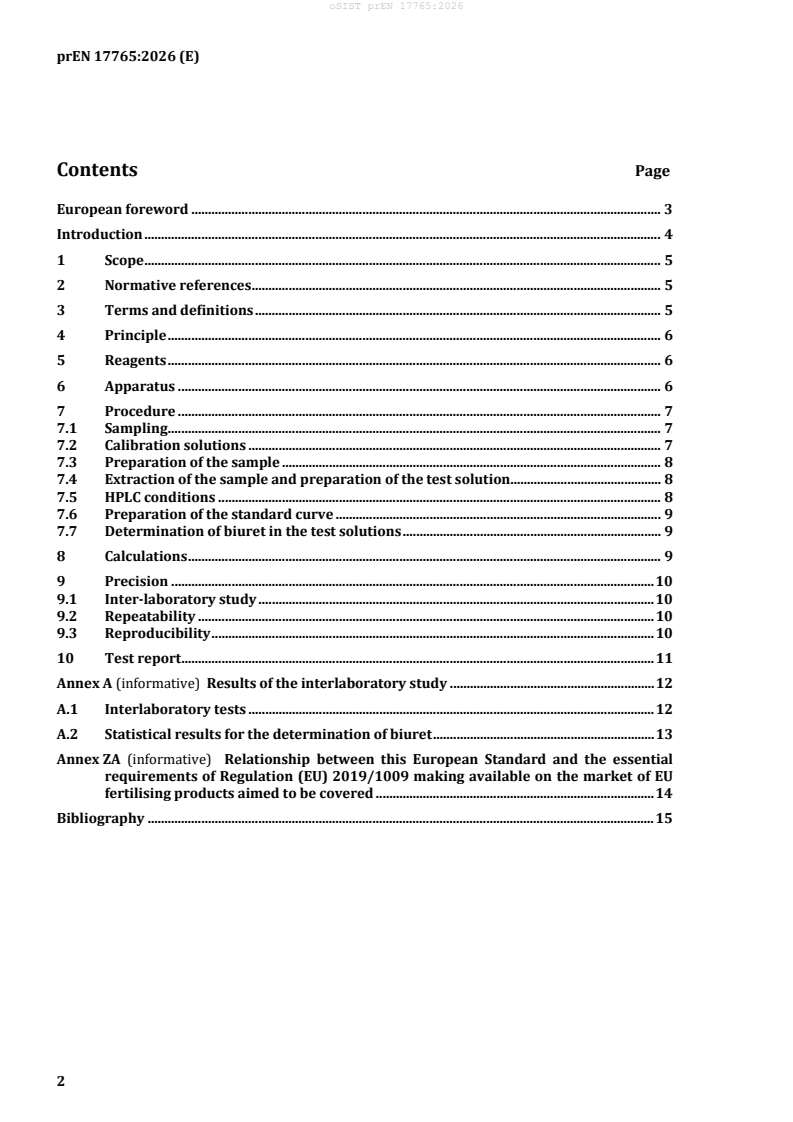
Contents
- Introduction
- 1 Scope
- 2 Normative references
- 3 Terms and definitions
- 3.1 biuret
- 4 Principle
- 5 Reagents
- 6 Apparatus
- 6.7 Syringe-driven filter, syringe with membrane filter for organic solvents (for example
- 7 Procedure
- 7.1 Sampling
- 7.2 Calibration solutions
- 7.3 Preparation of the sample
- 7.4 Extraction of the sample and preparation of the test solution
- 7.5 HPLC conditions
- 7.6 Preparation of the standard curve
- 7.7 Determination of biuret in the test solutions
- 8 Calculations
- 9 Precision
- 9.1 Inter-laboratory study
- 9.2 Repeatability
- 9.3 Reproducibility
- 10 Test report
- Annex A
- Annex ZA
- Annex I part II PFC 1(A) point 8
- Annex I part II PFC 1(B) point 8
- Bibliography
Introduction
This document defines a test method for the determination of the biuret content to be used for organic and organo-mineral fertilizers.
When heating urea near or above its melting point (132 °C) during the manufacturing of urea, ammonia slowly evolves and several different substances, including biuret, are formed. Excessively high concentrations of biuret can have detrimental effects on plants growth.
oSIST prEN 17765:2026 prEN 17765:2026 (E)
1 Scope
This document specifies a method for the determination of the biuret content by high-performance liquid chromatography (HPLC) with ultraviolet (UV) detector.
This document is applicable to organic and organo-mineral fertilizers containing urea. This document is applicable to fertilizing products blends where a blend is a mix of at least two of the following products: fertilizers, liming materials, soil improvers, growing media, inhibitors, plant biostimulants and where organic matter is present in at least one of the products in the blend. In case a fertilizing product blend is composed only of inorganic products, the European Standard for inorganic fertilizers applies. Variations in analytical methods for fertilizing product blends can lead to differing results as some components or matrix interactions can affect the outcome. Validation procedures have shown that developed standard methods are robust and reliable across diverse product compositions, but possible interferences and unexpected results when analysing fertilizing product blends are possible. NOTE 1 This method was tested only for one fertilizing product blend during the inter-laboratory study. The product tested was a liquid organo-mineral mixture of a liquid organic fertilizer, a growing medium and a nonmicrobial plant biostimulant. NOTE 2 Nowadays, there is a method standardized as EN 15479 that allows the determination of biuret in urea by spectrophotometric detection. Organic and organo-mineral fertilizers contain organic matter and other compounds apart from urea that would interfere in a spectrophotometric method. HPLC allows an accurate determination of biuret by separating it from possible interfering compounds [2] [5].
2 Normative references
The following documents are referred to in the text in such a way that some or all of their content constitutes requirements of this document. For dated references, only the edition cited applies. For undated references, the latest edition of the referenced document (including any amendments) applies.
EN 12944-1:1999, Fertilizers and liming materials — Vocabulary — Part 1: General terms
EN 12944-2:1999, Fertilizers and liming materials — Vocabulary — Part 2: Terms relating to fertilizers EN 1482-2:2024, Fertilizers, liming materials and inhibitors — Sampling and sample preparation — Part 2: General sample preparation provisions
prEN 17773:2026, Organic and organo-mineral fertilizers — Determination of the dry matter content
3 Terms and definitions
For the purposes of this document, the terms and definitions given in EN 12944-1:1999 and EN 12944-2:1999 and the following apply.
ISO and IEC maintain terminological databases for use in standardization at the following addresses:
- ISO Online browsing platform: available at https://www.iso.org/obp/
- IEC Electropedia: available at https://www.electropedia.org/
As impacted by EN 12944-1:1999/AC:2000.
As impacted by EN 12944-2:1999/AC:2000.
Under preparation.
oSIST prEN 17765:2026 prEN 17765:2026 (E)
3.1 biuret
imidodicarbonic diamide member of the class of condensed ureas, formed by the condensation of two molecules of urea Note 1 to entry: Condensed ureas are the compounds formed by the condensation of two or more molecules of urea.
4 Principle
The biuret content of the fertilizer sample is extracted with an aqueous acetonitrile solution and separated by reversed-phase liquid chromatography. Detection of peaks is performed using an UV detector. Quantification is performed with calibration curve using external standards.
5 Reagents
All reagents shall be of recognized analytical grade.
5.1 Water.
All water shall have a specific conductivity of not more than 0,2 ms/m at 25 °C and shall be free of the compounds to be detected.
5.2 Acetonitrile, HPLC grade, ≥ 99,9 %.
5.3 Biuret.
The purity of these reagents shall be ≥ 97 %, and the calculation of biuret content within fertilizer should be based on the purity claimed on the label.
5.4 Eluent, used for HPLC (mobile phase), acetonitrile: water 85 : 15 (volume fraction). For the preparation of the eluent, the following tasks shall be performed:
a) mix 150 ml water (5.1) with 850 ml acetonitrile (5.2); b) filter the solution by 0,22 µm membrane filter (6.5) as pretreatment; c) ultrasonic degas (6.4) for 10 min before used, alternatively an in-line degasser can be used. 5.5 Biuret standard solution (0,5 mg/ml).
For the preparation of the biuret standard solution (0,5 mg/ml), the following tasks shall be performed:
a) weigh approximately 0,50 g to the nearest 0,1 mg of biuret (5.3) and dissolve it by mobile phase (5.4); b) transfer it into a 1 l volumetric flask; c) bring to volume with mobile phase (5.4) and mix it thoroughly.
6 Apparatus
6.1 High performance liquid chromatograph, with UV detector.
6.2 Chromatographic column, amino column or amino-propyl column. 6.3 Injection loop.
oSIST prEN 17765:2026 prEN 17765:2026 (E) 6.4 Ultrasonic bath.
6.5 Membrane filter, for organic solvents, pore size of 0,22 µm. 6.6 Micro-syringe, with a volume between 5 µl and 50 µl.
The micro-syringe is only necessary in case of using manual injection.
6.7 Syringe-driven filter, syringe with membrane filter for organic solvents (for example
Polytetrafluoroethylene, PTFE), pore size of 0,22 µm.
6.8 Centrifuge.
6.9 Sieve, aperture size of 0,50 mm.
7 Procedure
7.1 Sampling
Sampling is not part of the method specified in this document. Recommended sampling methods are given in EN 1482-1 [3] and in EN 1482-3 [4].
It is important that the laboratory receives a sample that is representative of both the product under consideration and the given analysis. The sample should not have been damaged or changed during transport or storage.
7.2 Calibration solutions
For the calibration solution, as given in Table 1, the operator shall take 0,00 ml, 0,50 ml, 1,00 ml, 3,00 ml, 5,00 ml and 10,00 ml biuret standard solution (5.5) into six separate 25 ml volumetric flasks, respectively, and bring to volume with the mobile phase (5.4). These solutions shall be filtered with a syringe driven filter (6.7).
Table 1 — Calibration solutions Volume of biuret Concentration of standard Mass of biuret biuret solution ml mg mg/l Standard 1 0,00 0,00 0 Standard 2 0,50 0,25 10 Standard 3 1,00 0,50 20 Standard 4 3,00 1,50 60 Standard 5 5,00 2,50 100 Standard 6 10,00 5,00 200
...