

FprEN 17765
(Main)Organic and organo-mineral fertilizers - Determination of biuret content by high-performance liquid chromatography (HPLC)
- Abstract
This document specifies a method for the determination of the biuret content by high-performance liquid chromatography (HPLC) with ultraviolet (UV) detector.
This document is applicable to organic and organo-mineral fertilizers containing urea.
This document is applicable to fertilizing products blends where a blend is a mix of at least two of the following products: fertilizers, liming materials, soil improvers, growing media, inhibitors, plant biostimulants and where organic matter is present in at least one of the products in the blend. In case a fertilizing product blend is composed only of inorganic products, the European Standard for inorganic fertilizers applies. Variations in analytical methods for fertilizing product blends can lead to differing results as some components or matrix interactions can affect the outcome. Validation procedures have shown that developed standard methods are robust and reliable across diverse product compositions, but possible interferences and unexpected results when analysing fertilizing product blends are possible.
NOTE 1 This method was tested only for one fertilizing product blend during the inter-laboratory study. The product tested was a liquid organo-mineral mixture of a liquid organic fertilizer, a growing medium and a non-microbial plant biostimulant.
NOTE 2 Nowadays, there is a method standardized as EN 15479 that allows the determination of biuret in urea by spectrophotometric detection. Organic and organo-mineral fertilizers contain organic matter and other compounds apart from urea that would interfere in a spectrophotometric method. HPLC allows an accurate determination of biuret by separating it from possible interfering compounds [2] [5].
- Status
- Not Published
- Publication Date
- 03-Feb-2027
- Technical Committee
- CEN/TC 260 - Fertilizers and liming materials
- Drafting Committee
- CEN/TC 260/WG 8 - Organic and organo-mineral fertilizers
- Current Stage
- 4599 - Dispatch of FV draft to CMC - Finalization for Vote
- Start Date
- 10-Aug-2026
- Due Date
- 14-Mar-2027
- Completion Date
- 10-Aug-2026

FprEN 17765 is a CEN draft European Standard for measuring biuret in organic and organo-mineral fertilizers by high-performance liquid chromatography (HPLC) with ultraviolet (UV) detection. It is intended for laboratories that test fertilizers containing urea, including certain fertilizing product blends with organic matter. The method separates biuret from interfering compounds so the result can be used for product control and compliance work.
What does FprEN 17765 specify?
FprEN 17765 specifies a laboratory method for determining biuret content in organic and organo-mineral fertilizers containing urea. It also applies to fertilizing product blends made from at least two listed product types when organic matter is present in at least one component.
The scope notes that a blend made only of inorganic products falls under the European Standard for inorganic fertilizers, and it warns that blends can give different results because of matrix effects. The document is organized into clauses on scope, references, terms, principle, reagents, apparatus, procedure, calculations, precision and the test report, plus Annex A and Annex ZA.
| Annex | What it covers |
|---|---|
| Annex A | Interlaboratory study and precision data |
| Annex ZA | Relationship with Regulation (EU) 2019/1009 |
What are the key requirements of FprEN 17765?
Sample handling and preparation
FprEN 17765 expects the sample to be representative and unchanged during transport or storage, and it leaves sampling itself to other standards. Clause 7 points users to EN 1482-1 and EN 1482-3 for sampling, and to EN 1482-2 for general sample preparation.
The sample is ground before analysis and then extracted into the mobile phase. In practice, this means the lab needs a consistent preparation route so the result reflects the product, not the handling.
HPLC measurement and calibration
FprEN 17765 uses reversed-phase liquid chromatography with a UV detector and quantifies biuret against external standards. Clause 5 and Clause 6 set out the required reagent quality and the main apparatus: HPLC system, amino or amino-propyl column, filters, centrifuge and related labware.
Clause 7 requires calibration solutions and a calibration curve before analysis. Each calibration solution is measured and the biuret peak area is used to build the linear relationship, so the analyst can convert sample peaks into a biuret amount.
Extraction and separation
FprEN 17765 extracts biuret with an aqueous acetonitrile mobile phase, then filters the test solution before injection. If organic matter blocks the filter, the method allows centrifugation first.
Clause 7.5 also warns that column choice matters. In complex samples, poor separation can overlap with other compounds and lead to overestimation, so the chromatographic separation has to be checked carefully.
Calculation and reporting
FprEN 17765 calculates biuret as a mass fraction in g/kg, and Clause 8 also allows reporting on a dry matter basis using the dry matter content from prEN 17773:2026. That matters when users compare products with different moisture levels.
Clause 10 sets the report content: sample identification, method reference, result, sampling details if known, analysis date, repeatability statement and any optional settings or incidents. This makes the result traceable in audits, disputes and quality records.
Precision
FprEN 17765 includes repeatability and reproducibility in Clause 9, with supporting interlaboratory data in Annex A. That gives users a basis for judging whether two results are close enough to be considered the same in routine work.
What terms does FprEN 17765 define?
- Biuret - imidodicarbonic diamide, a condensed urea formed from two molecules of urea.
- HPLC - high-performance liquid chromatography, the separation technique used before detection.
- UV detector - ultraviolet detector, the detector used to observe the chromatographic peaks.
- External standards - reference solutions used to calibrate the measurement before testing samples.
- Repeatability - closeness of results from the same lab, operator and equipment over a short time.
- Reproducibility - closeness of results obtained in different laboratories under different conditions.
- Dry matter content - the dry portion of the sample used to express results on a dry basis.
Who uses FprEN 17765?
FprEN 17765 is used by testing laboratories that analyze organic fertilizers, organo-mineral fertilizers and qualifying fertilizing product blends. It is also used by fertilizer manufacturers and quality teams that monitor biuret formed during urea processing or verify product consistency before release.
The standard is relevant to conformity assessment bodies and other organizations that need comparable analytical results for regulatory or technical checks. Annex ZA also makes it relevant where results are linked to Regulation (EU) 2019/1009.
What changed in FprEN 17765 from the previous edition?
FprEN 17765 supersedes CEN/TS 17765:2022. The foreword states three main changes: the Technical Specification was adopted as a European Standard and Annex ZA was added, the scope was updated to clarify fertilizing product blends, and Clause 9 on precision plus Annex A on interlaboratory results were added.
Which standards are used with FprEN 17765?
- EN 12944-1:1999 - general vocabulary for fertilizers and liming materials.
- EN 12944-2:1999 - fertilizer-specific terms used in the definitions clause.
- EN 1482-1:2024 - recommended sampling provisions cited in the scope note.
- EN 1482-2:2024 - general sample preparation provisions used in Clause 7.
- EN 1482-3:2024 - sampling of static heaps, cited with the other sampling standard.
- prEN 17773:2026 - dry matter content, used when reporting results on a dry matter basis.
- EN 15479 - related spectrophotometric biuret method for urea.
- ISO 5725-1 and ISO 5725-2 - the basis for the repeatability and reproducibility treatment in Clause 9.
- ISO 18643 - related HPLC method for biuret in urea-based fertilizers.
What does the FprEN 17765 document contain?
FprEN 17765 contains the full analytical workflow: principle, reagent preparation, apparatus, sample extraction, HPLC conditions, calibration, quantification, calculation, precision and the test report. It also includes a calibration table, recommended HPLC operating conditions, precision data and the interlaboratory study results in Annex A.
Annex ZA links the method to Regulation (EU) 2019/1009 for EU fertilizing products. For readers, that means the document is not just a lab method - it also supports regulatory conformity work where the standard is cited.
Relations
- Effective Date
- 11-Jun-2025
Get Certified
Connect with accredited certification bodies for this standard

Control Union Certifications
Global certification for agriculture and sustainability.

ECOCERT
Organic and sustainability certification.

FSC International
Forest Stewardship Council certification.
Sponsored listings
Frequently Asked Questions
FprEN 17765 is a draft published by the European Committee for Standardization (CEN). Its full title is "Organic and organo-mineral fertilizers - Determination of biuret content by high-performance liquid chromatography (HPLC)". This standard covers: This document specifies a method for the determination of the biuret content by high-performance liquid chromatography (HPLC) with ultraviolet (UV) detector. This document is applicable to organic and organo-mineral fertilizers containing urea. This document is applicable to fertilizing products blends where a blend is a mix of at least two of the following products: fertilizers, liming materials, soil improvers, growing media, inhibitors, plant biostimulants and where organic matter is present in at least one of the products in the blend. In case a fertilizing product blend is composed only of inorganic products, the European Standard for inorganic fertilizers applies. Variations in analytical methods for fertilizing product blends can lead to differing results as some components or matrix interactions can affect the outcome. Validation procedures have shown that developed standard methods are robust and reliable across diverse product compositions, but possible interferences and unexpected results when analysing fertilizing product blends are possible. NOTE 1 This method was tested only for one fertilizing product blend during the inter-laboratory study. The product tested was a liquid organo-mineral mixture of a liquid organic fertilizer, a growing medium and a non-microbial plant biostimulant. NOTE 2 Nowadays, there is a method standardized as EN 15479 that allows the determination of biuret in urea by spectrophotometric detection. Organic and organo-mineral fertilizers contain organic matter and other compounds apart from urea that would interfere in a spectrophotometric method. HPLC allows an accurate determination of biuret by separating it from possible interfering compounds [2] [5].
This document specifies a method for the determination of the biuret content by high-performance liquid chromatography (HPLC) with ultraviolet (UV) detector. This document is applicable to organic and organo-mineral fertilizers containing urea. This document is applicable to fertilizing products blends where a blend is a mix of at least two of the following products: fertilizers, liming materials, soil improvers, growing media, inhibitors, plant biostimulants and where organic matter is present in at least one of the products in the blend. In case a fertilizing product blend is composed only of inorganic products, the European Standard for inorganic fertilizers applies. Variations in analytical methods for fertilizing product blends can lead to differing results as some components or matrix interactions can affect the outcome. Validation procedures have shown that developed standard methods are robust and reliable across diverse product compositions, but possible interferences and unexpected results when analysing fertilizing product blends are possible. NOTE 1 This method was tested only for one fertilizing product blend during the inter-laboratory study. The product tested was a liquid organo-mineral mixture of a liquid organic fertilizer, a growing medium and a non-microbial plant biostimulant. NOTE 2 Nowadays, there is a method standardized as EN 15479 that allows the determination of biuret in urea by spectrophotometric detection. Organic and organo-mineral fertilizers contain organic matter and other compounds apart from urea that would interfere in a spectrophotometric method. HPLC allows an accurate determination of biuret by separating it from possible interfering compounds [2] [5].
FprEN 17765 is classified under the following ICS (International Classification for Standards) categories: 65.080 - Fertilizers. The ICS classification helps identify the subject area and facilitates finding related standards.
FprEN 17765 has the following relationships with other standards: It is inter standard links to CEN/TS 17765:2022. Understanding these relationships helps ensure you are using the most current and applicable version of the standard.
FprEN 17765 is associated with the following European legislation: EU Directives/Regulations: 2019/1009; Standardization Mandates: M/564, M/564 AMD 1, M/564 AMD 2. When a standard is cited in the Official Journal of the European Union, products manufactured in conformity with it benefit from a presumption of conformity with the essential requirements of the corresponding EU directive or regulation.
FprEN 17765 is available in PDF format for immediate download after purchase. The document can be added to your cart and obtained through the secure checkout process. Digital delivery ensures instant access to the complete standard document.
Standards Content (Sample)
SLOVENSKI STANDARD
01-marec-2026
Organska in organsko-mineralna gnojila - Določanje biureta s tekočinsko
kromatografijo visoke ločljivosti (HPLC)
Organic and organo-mineral fertilizers - Determination of biuret content by high-
performance liquid chromatography (HPLC)
Organische und organisch-mineralische Düngemittel - Bestimmung des Biuretgehalts
mittels Hochleistungs-Flüssigkeitschromatographie (HPLC)
Engrais organiques et organo-minéraux - Détermination de la teneur en biuret par
chromatographie liquide à haute performance (HPLC)
Ta slovenski standard je istoveten z: prEN 17765
ICS:
65.080 Gnojila Fertilizers
2003-01.Slovenski inštitut za standardizacijo. Razmnoževanje celote ali delov tega standarda ni dovoljeno.
DRAFT
EUROPEAN STANDARD
prEN 17765
NORME EUROPÉENNE
EUROPÄISCHE NORM
January 2026
ICS 65.080 Will supersede CEN/TS 17765:2022
English Version
Organic and organo-mineral fertilizers - Determination of
biuret content by high-performance liquid
chromatography (HPLC)
Engrais organiques et organo-minéraux - Organische und organisch-mineralische Düngemittel -
Détermination de la teneur en biuret par Bestimmung des Biuretgehalts mittels Hochleistungs-
chromatographie liquide à haute performance (HPLC) Flüssigkeitschromatographie (HPLC)
This draft European Standard is submitted to CEN members for enquiry. It has been drawn up by the Technical Committee
CEN/TC 260.
If this draft becomes a European Standard, CEN members are bound to comply with the CEN/CENELEC Internal Regulations
which stipulate the conditions for giving this European Standard the status of a national standard without any alteration.
This draft European Standard was established by CEN in three official versions (English, French, German). A version in any other
language made by translation under the responsibility of a CEN member into its own language and notified to the CEN-CENELEC
Management Centre has the same status as the official versions.
CEN members are the national standards bodies of Austria, Belgium, Bulgaria, Croatia, Cyprus, Czech Republic, Denmark, Estonia,
Finland, France, Germany, Greece, Hungary, Iceland, Ireland, Italy, Latvia, Lithuania, Luxembourg, Malta, Netherlands, Norway,
Poland, Portugal, Republic of North Macedonia, Romania, Serbia, Slovakia, Slovenia, Spain, Sweden, Switzerland, Türkiye and
United Kingdom.
Recipients of this draft are invited to submit, with their comments, notification of any relevant patent rights of which they are
aware and to provide supporting documentation.
Warning : This document is not a European Standard. It is distributed for review and comments. It is subject to change without
notice and shall not be referred to as a European Standard.
EUROPEAN COMMITTEE FOR STANDARDIZATION
COMITÉ EUROPÉEN DE NORMALISATION
EUROPÄISCHES KOMITEE FÜR NORMUNG
CEN-CENELEC Management Centre: Rue de la Science 23, B-1040 Brussels
© 2026 CEN All rights of exploitation in any form and by any means reserved Ref. No. prEN 17765:2026 E
worldwide for CEN national Members.
prEN 17765:2026 (E)
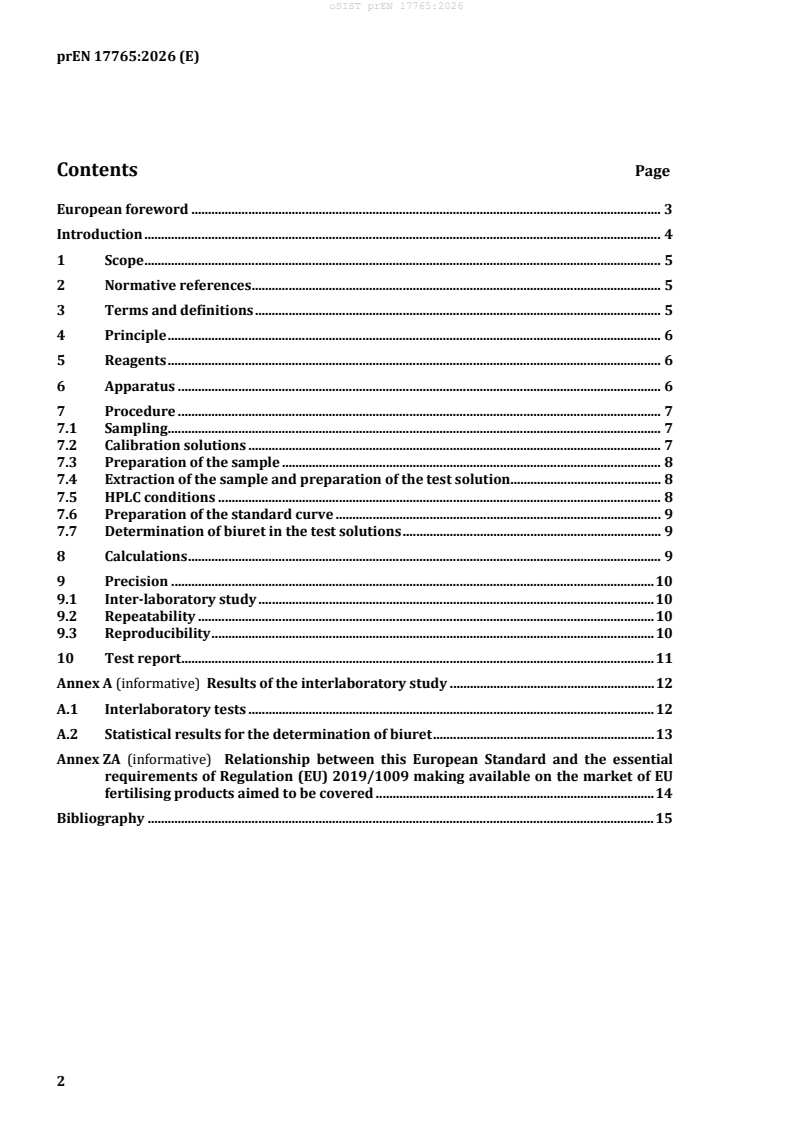
Contents Page
European foreword . 3
Introduction . 4
1 Scope . 5
2 Normative references . 5
3 Terms and definitions . 5
4 Principle . 6
5 Reagents . 6
6 Apparatus . 6
7 Procedure . 7
7.1 Sampling . 7
7.2 Calibration solutions . 7
7.3 Preparation of the sample . 8
7.4 Extraction of the sample and preparation of the test solution. 8
7.5 HPLC conditions . 8
7.6 Preparation of the standard curve . 9
7.7 Determination of biuret in the test solutions . 9
8 Calculations . 9
9 Precision . 10
9.1 Inter-laboratory study . 10
9.2 Repeatability . 10
9.3 Reproducibility . 10
10 Test report . 11
Annex A (informative) Results of the interlaboratory study . 12
A.1 Interlaboratory tests . 12
A.2 Statistical results for the determination of biuret . 13
Annex ZA (informative) Relationship between this European Standard and the essential
requirements of Regulation (EU) 2019/1009 making available on the market of EU
fertilising products aimed to be covered . 14
Bibliography . 15
prEN 17765:2026 (E)
European foreword
This document (prEN 17765:2026) has been prepared by Technical Committee CEN/TC 260 “Fertilizers
and liming materials”, the secretariat of which is held by DIN.
This document is currently submitted to the CEN Enquiry.
This document will supersede CEN/TS 17765:2022.
Compared to the previous edition, prEN 17765:2026 includes the following significant technical changes:
— the CEN Technical Specification has been adopted as a European Standard including the addition of
Annex ZA;
— the Scope (Clause 1) has been updated including a clarification on fertilizing product blends;
— Clause 9 (Precision) and Annex A (Results of the interlaboratory study) have been added.
This document has been prepared under a Standardization Request addressed to CEN by the European
Commission. The Standing Committee of the EFTA States subsequently approves these requests for its
Member States.
For the relationship with EU Legislation, see informative Annex ZA, which is an integral part of this
document.
prEN 17765:2026 (E)
Introduction
This document defines a test method for the determination of the biuret content to be used for organic
and organo-mineral fertilizers.
When heating urea near or above its melting point (132 °C) during the manufacturing of urea, ammonia
slowly evolves and several different substances, including biuret, are formed. Excessively high
concentrations of biuret can have detrimental effects on plants growth.
prEN 17765:2026 (E)
1 Scope
This document specifies a method for the determination of the biuret content by high-performance liquid
chromatography (HPLC) with ultraviolet (UV) detector.
This document is applicable to organic and organo-mineral fertilizers containing urea.
This document is applicable to fertilizing products blends where a blend is a mix of at least two of the
following products: fertilizers, liming materials, soil improvers, growing media, inhibitors, plant
biostimulants and where organic matter is present in at least one of the products in the blend. In case a
fertilizing product blend is composed only of inorganic products, the European Standard for inorganic
fertilizers applies. Variations in analytical methods for fertilizing product blends can lead to differing
results as some components or matrix interactions can affect the outcome. Validation procedures have
shown that developed standard methods are robust and reliable across diverse product compositions,
but possible interferences and unexpected results when analysing fertilizing product blends are possible.
NOTE 1 This method was tested only for one fertilizing product blend during the inter-laboratory study. The
product tested was a liquid organo-mineral mixture of a liquid organic fertilizer, a growing medium and a non-
microbial plant biostimulant.
NOTE 2 Nowadays, there is a method standardized as EN 15479 that allows the determination of biuret in urea
by spectrophotometric detection. Organic and organo-mineral fertilizers contain organic matter and other
compounds apart from urea that would interfere in a spectrophotometric method. HPLC allows an accurate
determination of biuret by separating it from possible interfering compounds [2] [5].
2 Normative references
The following documents are referred to in the text in such a way that some or all of their content
constitutes requirements of this document. For dated references, only the edition cited applies. For
undated references, the latest edition of the referenced document (including any amendments) applies.
EN 12944-1:1999, Fertilizers and liming materials — Vocabulary — Part 1: General terms
EN 12944-2:1999, Fertilizers and liming materials — Vocabulary — Part 2: Terms relating to fertilizers
EN 1482-2:2024, Fertilizers, liming materials and inhibitors — Sampling and sample preparation — Part
2: General sample preparation provisions
prEN 17773:2026, Organic and organo-mineral fertilizers — Determination of the dry matter content
3 Terms and definitions
For the purposes of this document, the terms and definitions given in EN 12944-1:1999 and
EN 12944-2:1999 and the following apply.
ISO and IEC maintain terminological databases for use in standardization at the following addresses:
— ISO Online browsing platform: available at https://www.iso.org/obp/
— IEC Electropedia: available at https://www.electropedia.org/
As impacted by EN 12944-1:1999/AC:2000.
As impacted by EN 12944-2:1999/AC:2000.
Under preparation.
prEN 17765:2026 (E)
3.1
biuret
imidodicarbonic diamide
member of the class of condensed ureas, formed by the condensation of two molecules of urea
Note 1 to entry: Condensed ureas are the compounds formed by the condensation of two or more molecules of
urea.
4 Principle
The biuret content of the fertilizer sample is extracted with an aqueous acetonitrile solution and
separated by reversed-phase liquid chromatography. Detection of peaks is performed using an UV
detector. Quantification is performed with calibration curve using external standards.
5 Reagents
All reagents shall be of recognized analytical grade.
5.1 Water.
All water shall have a specific conductivity of not more than 0,2 ms/m at 25 °C and shall be free of the
compounds to be detected.
5.2 Acetonitrile, HPLC grade, ≥ 99,9 %.
5.3 Biuret.
The purity of these reagents shall be ≥ 97 %, and the calculation of biuret content within fertilizer should
be based on the purity claimed on the label.
5.4 Eluent, used for HPLC (mobile phase), acetonitrile: water 85 : 15 (volume fraction).
For the preparation of the eluent, the following tasks shall be performed:
a) mix 150 ml water (5.1) with 850 ml acetonitrile (5.2);
b) filter the solution by 0,22 µm membrane filter (6.5) as pretreatment;
c) ultrasonic degas (6.4) for 10 min before used, alternatively an in-line degasser can be used.
5.5 Biuret standard solution (0,5 mg/ml).
For the preparation of the biuret standard solution (0,5 mg/ml), the following tasks shall be performed:
a) weigh approximately 0,50 g to the nearest 0,1 mg of biuret (5.3) and dissolve it by mobile phase (5.4);
b) transfer it into a 1 l volumetric flask;
c) bring to volume with mobile phase (5.4) and mix it thoroughly.
6 Apparatus
6.1 High performance liquid chromatograph, with UV detector.
6.2 Chromatographic column, amino column or amino-propyl column.
6.3 Injection loop.
prEN 17765:2026 (E)
6.4 Ultrasonic bath.
6.5 Membrane filter, for organic solvents, pore size of 0,22 µm.
6.6 Micro-syringe, with a volume between 5 µl and 50 µl.
The micro-syringe is only necessary in case of using manual injection.
6.7 Syringe-driven filter, syringe with membrane filter for organic solvents (for example
Polytetrafluoroethylene, PTFE), pore size of 0,22 µm.
6.8 Centrifuge.
6.9 Sieve, aperture size of
...