


SIST EN IEC 62368-1:2024/A11:2024
(Amendment)Audio/video, information and communication technology equipment - Part 1: Safety requirements
Audio/video, information and communication technology equipment - Part 1: Safety requirements
2022-02-21: This prAA covers common mods to prEN IEC 62368-1 - PR=74334
Einrichtungen für Audio/Video-, Informations- und Kommunikationstechnik – Teil 1: Sicherheitsanforderungen
Équipements des technologies de l'audio/vidéo, de l'information et de la communication - Partie 1: Exigences de sécurité
No scope available
Oprema za avdio/video, informacijsko in komunikacijsko tehnologijo - 1. del: Varnostne zahteve - Dopolnilo A11
General Information
- Status
- Published
- Public Enquiry End Date
- 29-Apr-2022
- Publication Date
- 13-Aug-2024
- Technical Committee
- MOV - Measuring equipment for electromagnetic quantities
- Current Stage
- 6060 - National Implementation/Publication (Adopted Project)
- Start Date
- 24-Apr-2024
- Due Date
- 29-Jun-2024
- Completion Date
- 14-Aug-2024
Relations
- Effective Date
- 01-Mar-2022
Overview
EN IEC 62368-1:2024/A11:2024 is a CENELEC amendment to the safety standard for audio/video, information and communication technology (ICT) equipment. Published April 2024 and approved by CENELEC, this amendment (A11) updates EN IEC 62368-1:2024 with Europe‑specific modifications, additional normative references and new informative annexes. It clarifies requirements for mains protection, optical and acoustic hazards, measurement uncertainty and conformity testing for A/V and ICT products.
Keywords: EN IEC 62368-1:2024/A11:2024, audio/video safety standard, ICT equipment safety, personal music players, acoustic safeguards, optical radiation, measurement uncertainty, mains protection, conformity testing.
Key topics and requirements
- Scope and status: Amendment A11 modifies the parent standard and introduces European normative and informative material (ZA–ZD). It is a type‑test standard; routine tests are referenced to EN 62911.
- Mains and protective devices: Clarifies when protective overcurrent devices must be provided inside equipment versus relying on building installation protection (distinction for pluggable equipment Type A and Type B, and permanently connected equipment).
- Measurement uncertainty: Products must be evaluated using appropriate measurement uncertainty; users are referred to ADCO RED guidance on measurement uncertainty in harmonized standards.
- Optical radiation: Provides guidance to consider IEC/TR 62471-2 for photobiological safety; adds measurement rules for radiation (RS1) including dose‑rate limits and monitoring conditions.
- Acoustic safeguards (Clause 10 replacement): New, detailed safeguards for personal music players and listening devices - classification, test methods and transitional encouragement for implementing a dose‑measurement method for long‑term sound exposure.
- Testing and instrumentation: Specifies measurement arrangements for radiation monitoring (e.g., effective detector area and 10 cm measurement distance for RS1), ionizing chamber characteristics and test durations under fault/operational conditions.
- Editorial and national provisions: Deletes certain country notes, adds EU‑specific notes (e.g., Directive 2011/65/EU reference), and provides special national conditions and A‑deviations in annexes.
Practical applications - who uses this standard
- Product designers and R&D teams creating A/V, consumer electronics and ICT devices
- Compliance and regulatory affairs professionals ensuring CE marking and EU conformity
- Test laboratories and conformity assessment bodies performing safety and type tests
- Procurement, quality and safety managers assessing supplier compliance
- Manufacturers of personal music players, headphones/earphones and electronic lighting effects
Related standards and references
- IEC/EN IEC 62368-1 (base standard)
- EN 50332-1/2/3 (headphones and personal music players sound measurement)
- EN 71-1 (toy safety - where products target children)
- EN 62911 (routine tests)
- EN IEC 63044-3 (HBES/BACS interconnection)
- IEC/TR 62471-2 (photobiological safety)
- Relevant EU directives: 2011/65/EU (RoHS) and 2013/59/Euratom (radiation dose guidance)
This amendment is essential for stakeholders who must demonstrate EU-compliant safety for audio/video and ICT equipment and for anyone involved in conformity testing and risk mitigation for acoustic and optical hazards.

Frequently Asked Questions
SIST EN IEC 62368-1:2024/A11:2024 is a amendment published by the Slovenian Institute for Standardization (SIST). Its full title is "Audio/video, information and communication technology equipment - Part 1: Safety requirements". This standard covers: 2022-02-21: This prAA covers common mods to prEN IEC 62368-1 - PR=74334
2022-02-21: This prAA covers common mods to prEN IEC 62368-1 - PR=74334
SIST EN IEC 62368-1:2024/A11:2024 is classified under the following ICS (International Classification for Standards) categories: 33.160.01 - Audio, video and audiovisual systems in general; 35.020 - Information technology (IT) in general. The ICS classification helps identify the subject area and facilitates finding related standards.
SIST EN IEC 62368-1:2024/A11:2024 has the following relationships with other standards: It is inter standard links to SIST EN IEC 62368-1:2024. Understanding these relationships helps ensure you are using the most current and applicable version of the standard.
SIST EN IEC 62368-1:2024/A11:2024 is associated with the following European legislation: EU Directives/Regulations: 2001/95/EC, 2014/35/EU, 2014/53/EU; Standardization Mandates: M/452, M/536, M/552. When a standard is cited in the Official Journal of the European Union, products manufactured in conformity with it benefit from a presumption of conformity with the essential requirements of the corresponding EU directive or regulation.
SIST EN IEC 62368-1:2024/A11:2024 is available in PDF format for immediate download after purchase. The document can be added to your cart and obtained through the secure checkout process. Digital delivery ensures instant access to the complete standard document.
Standards Content (Sample)
SLOVENSKI STANDARD
01-september-2024
Oprema za avdio/video, informacijsko in komunikacijsko tehnologijo - 1. del:
Varnostne zahteve - Dopolnilo A11
Audio/video, information and communication technology equipment - Part 1: Safety
requirements
Einrichtungen für Audio/Video-, Informations- und Kommunikationstechnik – Teil 1:
Sicherheitsanforderungen
Équipements des technologies de l'audio/vidéo, de l'information et de la communication -
Partie 1: Exigences de sécurité
Ta slovenski standard je istoveten z: EN IEC 62368-1:2024/A11:2024
ICS:
33.160.01 Avdio, video in avdiovizualni Audio, video and audiovisual
sistemi na splošno systems in general
35.020 Informacijska tehnika in Information technology (IT) in
tehnologija na splošno general
2003-01.Slovenski inštitut za standardizacijo. Razmnoževanje celote ali delov tega standarda ni dovoljeno.
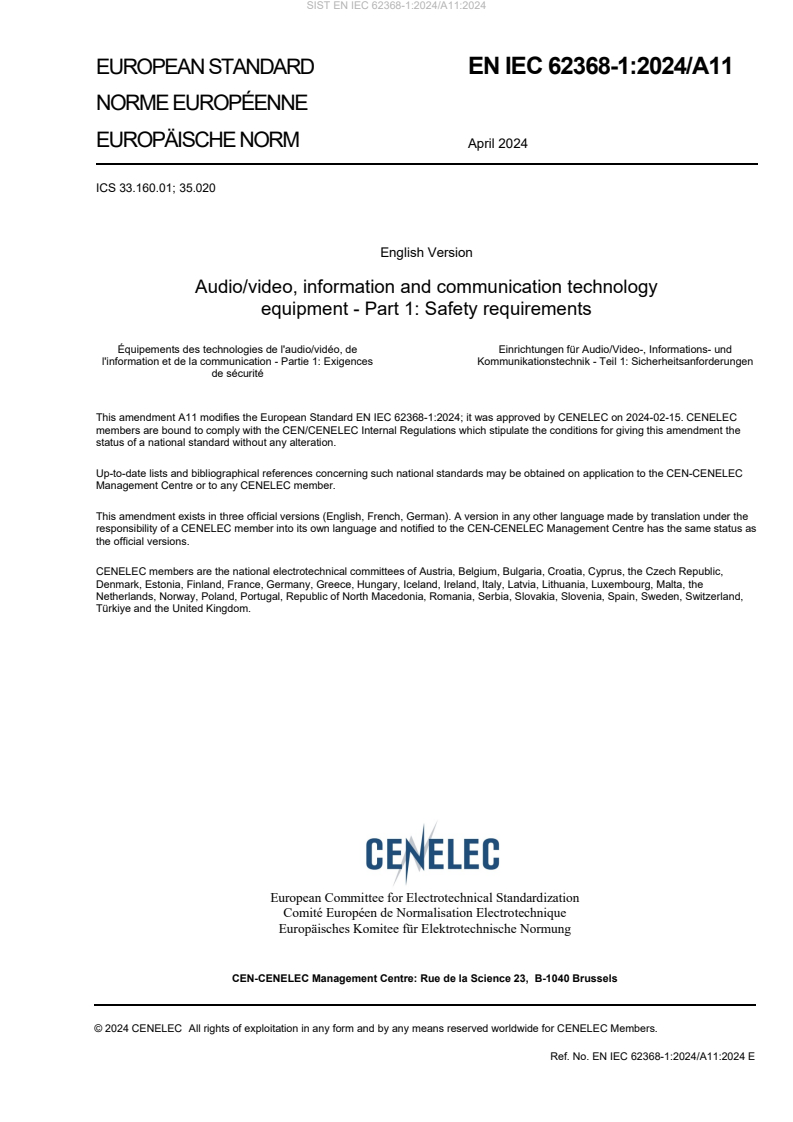
EUROPEAN STANDARD EN IEC 62368-1:2024/A11
NORME EUROPÉENNE
EUROPÄISCHE NORM April 2024
ICS 33.160.01; 35.020
English Version
Audio/video, information and communication technology
equipment - Part 1: Safety requirements
Équipements des technologies de l'audio/vidéo, de Einrichtungen für Audio/Video-, Informations- und
l'information et de la communication - Partie 1: Exigences Kommunikationstechnik - Teil 1: Sicherheitsanforderungen
de sécurité
This amendment A11 modifies the European Standard EN IEC 62368-1:2024; it was approved by CENELEC on 2024-02-15. CENELEC
members are bound to comply with the CEN/CENELEC Internal Regulations which stipulate the conditions for giving this amendment the
status of a national standard without any alteration.
Up-to-date lists and bibliographical references concerning such national standards may be obtained on application to the CEN-CENELEC
Management Centre or to any CENELEC member.
This amendment exists in three official versions (English, French, German). A version in any other language made by translation under the
responsibility of a CENELEC member into its own language and notified to the CEN-CENELEC Management Centre has the same status as
the official versions.
CENELEC members are the national electrotechnical committees of Austria, Belgium, Bulgaria, Croatia, Cyprus, the Czech Republic,
Denmark, Estonia, Finland, France, Germany, Greece, Hungary, Iceland, Ireland, Italy, Latvia, Lithuania, Luxembourg, Malta, the
Netherlands, Norway, Poland, Portugal, Republic of North Macedonia, Romania, Serbia, Slovakia, Slovenia, Spain, Sweden, Switzerland,
Türkiye and the United Kingdom.
European Committee for Electrotechnical Standardization
Comité Européen de Normalisation Electrotechnique
Europäisches Komitee für Elektrotechnische Normung
CEN-CENELEC Management Centre: Rue de la Science 23, B-1040 Brussels
© 2024 CENELEC All rights of exploitation in any form and by any means reserved worldwide for CENELEC Members.
Ref. No. EN IEC 62368-1:2024/A11:2024 E
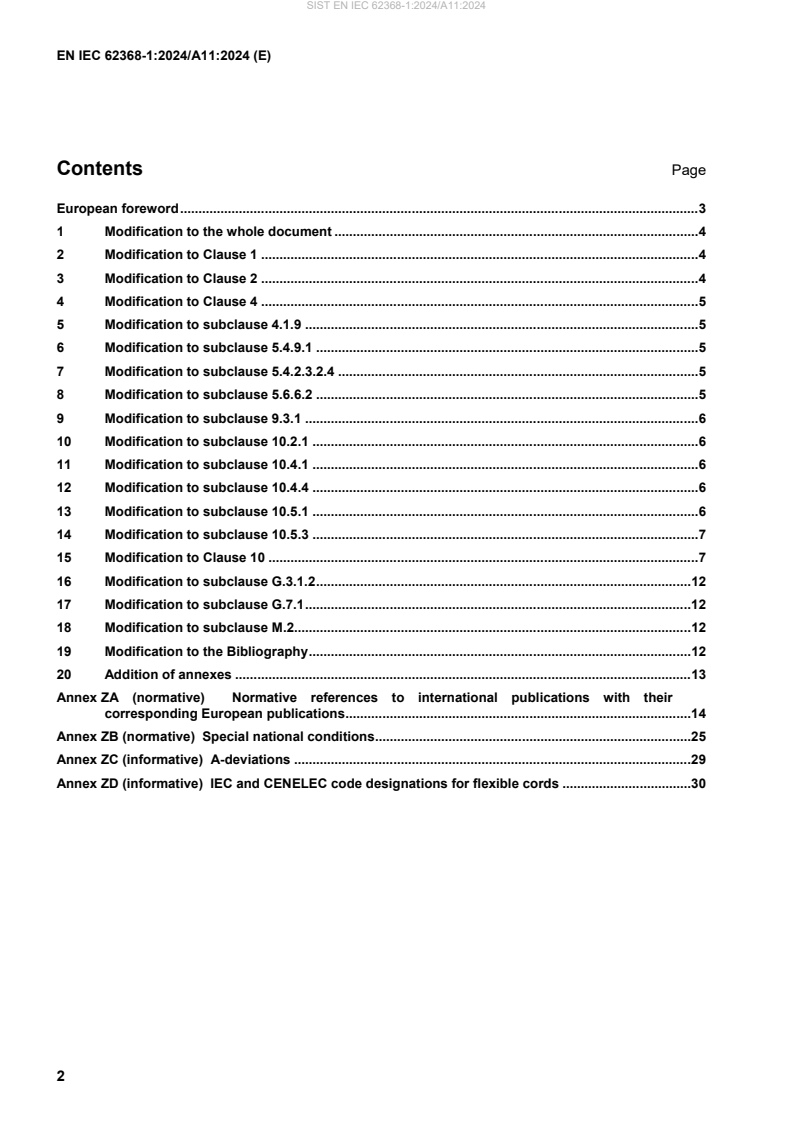
Contents Page
European foreword . 3
1 Modification to the whole document . 4
2 Modification to Clause 1 . 4
3 Modification to Clause 2 . 4
4 Modification to Clause 4 . 5
5 Modification to subclause 4.1.9 . 5
6 Modification to subclause 5.4.9.1 . 5
7 Modification to subclause 5.4.2.3.2.4 . 5
8 Modification to subclause 5.6.6.2 . 5
9 Modification to subclause 9.3.1 . 6
10 Modification to subclause 10.2.1 . 6
11 Modification to subclause 10.4.1 . 6
12 Modification to subclause 10.4.4 . 6
13 Modification to subclause 10.5.1 . 6
14 Modification to subclause 10.5.3 . 7
15 Modification to Clause 10 . 7
16 Modification to subclause G.3.1.2 . 12
17 Modification to subclause G.7.1 . 12
18 Modification to subclause M.2. 12
19 Modification to the Bibliography . 12
20 Addition of annexes . 13
Annex ZA (normative) Normative references to international publications with their
corresponding European publications . 14
Annex ZB (normative) Special national conditions. 25
Annex ZC (informative) A-deviations . 29
Annex ZD (informative) IEC and CENELEC code designations for flexible cords . 30
European foreword
This document (EN IEC 62368-1:2024/A11:2024) has been prepared by CLC/TC 108X “Safety of electronic
equipment within the fields of Audio/Video, Information Technology and Communication Technology”.
The following dates are fixed:
• latest date by which this document has to be (dop) 2025-02-15
implemented at national level by publication of
an identical national standard or by
endorsement
• latest date by which the national standards (dow) 2027-02-15
conflicting with this document have to be
withdrawn
This document modifies EN IEC 62368-1:2024.
Attention is drawn to the possibility that some of the elements of this document may be the subject of patent
rights. CENELEC shall not be held responsible for identifying any or all such patent rights.
Clauses, subclauses, notes, tables, figures and annexes which are additional to those in IEC 62368-1:2023
are prefixed “Z”.
This document has been prepared under a standardization request addressed to CENELEC by the European
Commission. The Standing Committee of the EFTA States subsequently approves these requests for its
Member States.
Any feedback and questions on this document should be directed to the users’ national committee. A
complete listing of these bodies can be found on the CENELEC website.
1 Modification to the whole document
Delete all the “country” notes in the reference document according to the following list:
0.2.1 Note 1 and 1 Note 4 and 3.3.8.1 Note 2
Note 2 Note 5
3.3.8.3 Note 1 4.1.15 Note 4.7.3 Note 1 and
Note 2
5.4.2.3.2.2 Note c 5.4.2.3.2.4 Note 1 and 5.4.2.3.2.4 Note 2
Table 12 Note 3 Table 13
5.4.2.5 Note 2 5.4.5.1 Note 5.4.10.2.1 Note
5.4.10.2.2 Note 5.4.10.2.3 Note
5.5.2.1 Note 5.5.6 Note 5.6.4.2.1 Note 2 and
Note 3 and
Note 4
5.6.8 Note 2 5.7.7.1 Note 1 and 8.5.4.2.3 Note
Note 2
10.2.1 Note 3 and 10.5.3 Note 2 10.6.1 Note 3
Table 39 Note 4 and
Note 5
F.3.3.4 Note 2 F.3.3.6 Note 3 Y.4.1 Note
Y.4.5 Note
2 Modification to Clause 1
Add the following note at the end of Clause 1:
“NOTE Z1 The use of certain substances in electrical and electronic equipment is restricted within the EU: see
Directive 2011/65/EU.”
Add the following paragraph and note after Note 5:
“This document is a type test standard.
NOTE Z2 Routine tests of complete equipment, sub-assemblies or components are covered by EN 62911.”
3 Modification to Clause 2
Add the following references:
EN 71-1:2014+A1:2018, Safety of toys - Part 1: Mechanical and physical properties
EN 50332-1:2013, Sound system equipment: Headphones and earphones associated with personal music
players - Maximum sound pressure level measurement methodology - Part 1: General method for "one
package equipment"
EN 50332-2:2013, Sound system equipment: Headphones and earphones associated with personal music
players - Maximum sound pressure level measurement methodology - Part 2: Matching of sets with
headphones if either or both are offered separately, or are offered as one package equipment but with
standardised connectors between the two allowing to combine components of different manufacturers or
different design
EN 50332-3:2017, Sound system equipment: headphones and earphones associated with personal music
players - Maximum sound pressure level measurement methodology - Part 3: Measurement method for sound
dose management
IEC/TR 62471-2, Photobiological safety of lamps and lamp systems - Part 2: Guidance on manufacturing
requirements relating to non-laser optical radiation safety
4 Modification to Clause 4
Add the following new subclause 4.Z1 after subclause 4.9:
“For compliance with B.3 and B.4 in circuits connected to an AC mains, protective devices shall be provided,
subject to the following:
— for pluggable equipment type A, the protective devices shall be included as parts of the equipment,
with the exception of components in series with the mains input to the equipment such as the supply
cord, appliance coupler, r.f.i. filter and switch, for which the building installation shall be regarded as
providing protection in accordance with the rating of the wall socket outlet;
— for pluggable equipment type B or permanently connected equipment, the protection may be the
dedicated overcurrent and short-circuit protection in the building installation, provided that the means of
protection, for example a fuse or circuit breaker, is fully specified in the installation instructions.
Where protective devices are required within the equipment, the protective devices within the equipment
shall operate before or at the same time the expected building installation protection will operate.
For earth faults in single-phase equipment, it is not necessary to provide 2 protective devices. It is expected
that the building installation will protect against earth faults. This applies also in countries where an IT power
distribution system is used.”
5 Modification to subclause 4.1.9
Add the following paragraph at the end of this subclause:
“Products need to comply with the requirements of this document with appropriate measurement uncertainty.
NOTE Z1 See also the ADCO RED position on ‘Measurement uncertainty in published harmonized standards’.”
6 Modification to subclause 5.4.9.1
Add the following note after the 5th paragraph:
“NOTE Z1 For guidance on the use of high voltage source, see IEC 60060-1, Clause 8 of IEC 60243-1 and IEC 61180.”
7 Modification to subclause 5.4.2.3.2.4
Add the following at the end of this subclause:
“The requirement for interconnection with external circuit in a HBES/BACS network is in addition given in
EN IEC 63044-3:2018.”
8 Modification to subclause 5.6.6.2
Replace item d) with the following:
“d) For equipment powered from a DC mains, if the protective current rating of the circuit under test
exceeds 25 A, the test current shall be minimum as required in item a), unless the manufacturer specifies a
higher value.”
9 Modification to subclause 9.3.1
Replace the second paragraph with the following:
“An accessible part that, while in contact with the body, is likely to drop in temperature upon touch can be
evaluated under the limits of Annex A of IEC Guide 117:2010 using the test method of 4.5 of IEC Guide 117.”
10 Modification to subclause 10.2.1
c) d)
Add the following to and in Table 38:
“For additional requirements, see 10.5.1.”
11 Modification to subclause 10.4.1
Replace the second paragraph of 10.4.1 with:
“Electronic light effect equipment does not have to comply with the requirements of 10.4. However,
IEC/TR 62471-2 shall be considered and proper installation instructions shall be provided.”
Replace the ninth paragraph of 10.4.1 with:
“The following information shall be provided in the user manual for safe operation and installation. This
information shall also be provided for safe operation by a skilled person who may be exposed to Risk
Group 3 energy levels.
Adequate instructions for proper assembly, installation, maintenance and safe use, including clear warnings
concerning precautions to avoid possible exposure to hazardous optical radiation; and
Advice on safe operating procedures and warnings concerning reasonably foreseeable misuse,
malfunctions and hazardous failure modes. Where servicing and maintenance procedures are detailed, they
shall include explicit instructions on safe procedures to be followed; and
The marking on the equipment shall be reproduced in the user manual. A yellow background is not required in
the user manual.”
12 Modification to subclause 10.4.4
Replace the last paragraph of 10.4.4 with:
“Compliance against material degradation from UV radiation is checked by the applicable tests of Annex C.”
13 Modification to subclause 10.5.1
Add the following after the first paragraph:
“For RS1 compliance is checked by measurement under the following conditions:
In addition to the normal operating conditions, all controls adjustable from the outside of the equipment by
hand, by any object such as a tool or a coin, and those internal adjustments or pre-sets which are not locked
in a reliable manner, are adjusted so as to give maximum radiation whilst maintaining an intelligible picture for
1 h, at the end of which the measurement is made.
NOTE Z1 Soldered joints and paint lockings are examples of adequate locking.
The dose-rate is determined by means of a radiation monitor with an effective area of 10 cm , at any point at a
distance of 10 cm from the outer surface of the equipment.
Moreover, the measurement shall be made under fault conditions causing an increase of the high-voltage,
provided an intelligible picture is maintained for 1 h, at the end of which the measurement is made.
For RS1, the dose-rate shall not exceed 1 μSv/h taking account of the background level.
NOTE Z2 These values appear in Directive 2013/59/Euratom of 5 December 2013.”
14 Modification to subclause 10.5.3
Replace the second paragraph of 10.5.3 with:
“The amount of radiation is determined by means of a radiation monitor of the ionizing chamber type with an
2 2
effective area of 1 000 mm ± 10 mm or by measuring equipment of other types giving equivalent results.”
15 Modification to Clause 10
Replace 10.6 with the following:
“
10.6 Safeguards against acoustic energy sources
10.6.1 General
10.6.1.1 Introduction
Safeguard requirements for protection against long-term exposure to excessive sound pressure levels from
personal music players closely coupled to the ear are specified below. Requirements for earphones and
headphones intended for use with personal music players are also covered.
A personal music player is a portable equipment intended for use by an ordinary person, that:
— is designed to allow the user to listen to audio or audiovisual content / material; and
— uses a listening device, such as headphones or earphones that can be worn in or on or around the ears;
and
— has a player that can be body worn (of a size suitable to be carried in a clothing pocket) and is intended
for the user to walk around with while in continuous use (for example, on a street, in a subway, at an
airport, etc.).
EXAMPLES Portable CD players, MP3 audio players, mobile phones with MP3 type features, PDAs or similar
equipment.
Personal music players shall comply with the requirements of either 10.6.2 or 10.6.3.
NOTE 1 Protection against acoustic energy sources from telecom applications is referenced to ITU-T P.360.
NOTE 2 It is the intention of the Committee to allow the alternative methods for now, but to only use the dose
measurement method as given in 10.6.5 in future. Therefore, manufacturers are encouraged to implement 10.6.5 as soon
as possible.
Listening devices sold separately shall comply with the requirements of 10.6.6.
These requirements are valid for music or video mode only.
The requirements do not apply to:
— professional equipment;
NOTE 3 Professional equipment is equipment sold through special sales channels. All products sold through
normal electronics stores or general public sales channels are considered not to be professional equipment.
— hearing aid equipment and other devices for assistive listening;
— the following type of analogue personal music players:
— long distance radio receiver (for example, a multiband radio receiver or world band radio receiver, an
AM radio receiver), and
— cassette player/recorder;
NOTE 4 This exemption has been allowed because this technology is falling out of use and it is expected that
within a few years it will no longer exist. This exemption will not be extended to other technologies.
— a player while connected to an external amplifier that does not allow the user to walk around while in use;
— hearing protection devices (HPD) that comply with EN 352-8
For equipment that is clearly designed or intended primarily for use by children, the limits of the relevant toy
standards may apply.
The relevant requirements are given in EN 71-1:2014+A1:2018, 4.20 and the related tests methods and
measurement distances apply.
10.6.2 Classification of devices without the capacity to estimate sound dose
10.6.2.1 General
This standard is transitioning from short-term based (30 s) requirements to long-term based (40 h)
requirements. These clauses remain in effect only for devices that do not comply with sound dose estimation
as stipulated in EN 50332-3:2017.
For classifying the acoustic output L , , measurements are based on the A-weighted equivalent sound
T
Aeq
pressure level over a 30 s period.
For music where the average sound pressure (long term L , ) measured over the duration of the song is
T
Aeq
lower than the average produced by the programme simulation noise, measurements may be done over the
duration of the complete song. In this case, T becomes the duration of the song.
NOTE Classical music, acoustic music and broadcast typically has an average sound pressure (long term L , ) which
T
Aeq
is much lower than the average programme simulation noise. Therefore, if the player is capable to analyse the content and
compare it with the programme simulation noise, the warning does not need to be given as long as the average sound
pressure of the song does not exceed the required limit.
For example, if the player is set with the programme simulation noise to 85 dB, but the average music level of
the song is only 65 dB, there is no need to give a warning or ask an acknowledgement as long as the average
sound level of the song is not above the basic limit of 85 dB.
10.6.2.2 RS1 limits (to be superseded, see 10.6.3.2)
RS1 is a class 1 acoustic energy source that does not exceed the following:
— for equipment provided as a package (player with its listening device), and with a proprietary connector
between the player and its listening device, or where the combination of player and listening device is
known by other means such as setting or automatic detection, the L , acoustic output shall be ≤ 85 dB
T
Aeq
when playing the fixed “programme simulation noise” described in EN 50332-1:2013;
— for equipment provided with a standardized connector (for example, a 3,5 mm headphone/earphone jack)
that allows connection to a listening device for general use, the unweighted r.m.s. output voltage shall
be ≤ 27 mV (analogue interface) or −25 dBFS (digital interface) when playing the fixed “programme
simulation noise” described in EN 50332-1:2013.
The RS1 limits will be updated for all devices as per 10.6.3.2.
10.6.2.3 RS2 limits (to be superseded, see 10.6.3.3)
RS2 is a class 2 acoustic energy source that does not exceed the following:
— for equipment provided as a package (player with its listening device), and with a proprietary connector
between the player and its listening device, or when the combination of player and listening device is
known by other means such as setting or automatic detection, the L , acoustic output shall
T
Aeq
be ≤ 100 dB(A) when playing the fixed “programme simulation noise” as described in EN 50332-1:2013;
— for equipment provided with a standardized connector (for example, a 3,5 phone jack) that allows
connection to a listening device for general use, the unweighted r.m.s. output voltage shall be ≤ 150 mV
(analogue interface) or −10 dBFS (digital interface) when playing the fixed “programme simulation noise”
as described in EN 50332-1:2013.
10.6.2.4 RS3 limits
RS3 is a class 3 acoustic energy source that exceeds RS2 limits.
10.6.3 Classification of devices (new)
10.6.3.1 General
Previous limits (10.6.2) created abundant false negative and false positive PMP sound level warnings. New
limits, compliant with The Commission Decision 2009/490/EC of 23 June 2009, are given below.
10.6.3.2 RS1 limits (new)
RS1 is a class 1 acoustic energy source that does not exceed the following:
— for equipment provided as a package (player with its listening device), and with a proprietary connector
between the player and its listening device, or where the combination of player and listening device is
known by other means such as setting or automatic detection, the L , acoustic output shall be ≤ 80 dB
T
Aeq
when playing the fixed “programme simulation noise” described in EN 50332-1:2013;
— for equipment provided with a standardized connector (for example, a 3,5 phone jack) that allows
connection to a listening device for general use, the unweighted r.m.s. output voltage shall be ≤ 15 mV
(analogue interface) or −30 dBFS (digital interface) when playing the fixed “programme simulation noise”
described in EN 50332-1:2013.
10.6.3.3 RS2 limits (new)
RS2 is a class 2 acoustic energy source that does not exceed the following:
— for equipment provided as a package (player with its listening device), and with a proprietary connector
between the player and its listening device, or where the combination of player and listening device is
known by other means such as setting or automatic detection, the weekly sound exposure level, as
described in EN 50332-3:2017, shall be ≤ 80 dB when playing the fixed “programme simulation noise”
described in EN 50332-1:2013;
— for equipment provided with a standardized connector (for example, a 3,5 phone jack) that allows
connection to a listening device for general use, the unweighted r.m.s. output level, integrated over one
week, as described in EN 50332-3:2017, shall be ≤ 15 mV (analogue interface) or −30 dBFS (digital
interface) when playing the fixed “programme simulation noise” described in EN 50332-1:2013.
10.6.4 Requirements for maximum sound exposure
10.6.4.1 Measurement methods
All volume controls shall be turned to maximum during tests.
Measurements shall be made in accordance with EN 50332-1:2013 or EN 50332-2:2013 as applicable.
10.6.4.2 Protection of persons
Except as given below, protection requirements for parts accessible to ordinary persons, instructed
persons and skilled persons are given in 4.3.
NOTE 1 Volume control is not considered to be a safeguard.
Between RS2 and an ordinary person, the basic safeguard may be replaced by an instructional
safeguard in accordance with Clause F.5, except that the instructional safeguard shall be placed on the
equipment, or on the packaging, or in the instruction manual. Alternatively, the instructional safeguard may
be given through the equipment display during use.
The elements of the instructional safeguard shall be as follows:
— element 1a:
the symbol , IEC 60417-6044 (2011–01)
— element 2: “High sound pressure” or equivalent text
— element 3: “Hearing damage risk” or equivalent text
— element 4: “Do not listen at high volume levels for long periods.” or equivalent text
An equipment safeguard shall prevent exposure of an ordinary person to an RS2 source without intentional
physical action from the ordinary person and shall automatically return to an output level not exceeding what
is specified for an RS1 source when the power is switched off.
The equipment shall provide a means to actively inform the user of the increased sound level when the
equipment is operated with an output level exceeding RS1 limits. Any means used shall be acknowledged by
the user before activating a mode of operation which allows for an output level exceeding RS1 limits. The
acknowledgement does not need to be repeated more than once every 20 h of cumulative listening time.
NOTE 2 Examples of means include visual or audible signals. Action from the user is always needed.
NOTE 3 The 20 h listening time is the accumulative listening time, independent of how often and how long the personal
music player has been switched off.
A skilled person shall not be unintentionally exposed to RS3.
10.6.5 Requirements for dose-based systems
10.6.5.1 General requirements
Personal music players shall give the warnings as provided below when tested according to
EN 50332-3:2017, using the limits from this clause.
The manufacturer may offer optional settings to allow the users to modify when and how they wish to receive
the notifications and warnings to promote a better user experience without defeating the safeguards. This
allows the users to be informed in a method that best meets their physical capabilities and device usage
needs. If such optional settings are offered, an administrator (for example, parental restrictions,
business/educational administrators, etc.) shall be able to lock any optional settings into a specific
configuration.
The personal music player shall be supplied with easy to understand explanation to the user of the dose
management system, the risks involved, and how to use the system safely. The user shall be made aware
that other sources may significantly contribute to their sound exposure, for example work, transportation,
concerts, clubs, cinema, car races, etc.
10.6.5.2 Dose-based warning and requirements
When a dose of 100 % CSD is reached, and at least at every 100 % further increase of CSD, the device shall
warn the user and require an acknowledgement. In case the user does not acknowledge, the output level shall
automatically decrease to a level in compliance with class RS1 limits.
The warning shall at least clearly indicate that listening above 100 % CSD leads to the risk of hearing damage
or loss.
10.6.5.3 Exposure-based requirements
With only dose-based requirements, cause and effect could be far separated in time, defying the purpose of
educating users about safe listening practice. In addition to dose-based requirements, a PMP shall therefore
also put a limit to the short-term sound level a user can listen at.
The exposure-based limiter (EL) shall automatically reduce the sound level not to exceed 100 dB(A) or
150 mV integrated over the past 180 s, based on methodology defined in EN 50332-3:2017. The EL settling
time (time from starting level reduction to reaching target output level) shall be 10 s or less.
Test of EL functionality is conducted according to EN 50332-3:2017, using the limits from this clause. For
equipment provided as a package (player with its listening device), the level integrated over 180 s shall be
100 dB or lower. For equipment provided with a standardized connector, the un-weighted level integrated over
180 s shall be no more than 150 mV for an analogue interface and no more than −10 dBFS for a digital
interface.
In case the source is known not to be music (or test signal), the EL may be disabled.
10.6.6 Requirements for listening devices (headphones, earphones, etc.)
10.6.6.1 Corded listening devices with analogue input
With 94 dB L acoustic pressure output of the listening device, and with the volume and sound settings in
Aeq
the listening device (for example, built-in volume level control, additional sound features like equalization, etc.)
set to the combination of positions that maximizes the measured acoustic output level, the input voltage of the
listening device when playing the fixed “programme simulation noise” as described in EN 50332-1:2013 shall
be ≥ 75 mV.
NOTE The values of 94 dB and 75 mV correspond with 85 dB and 27 mV in 10.6.2.2. or 100 dB and 150 mV in
10.6.2.3.
10.6.6.2 Corded listening devices with digital input
With any playing device playing the fixed “programme simulation noise” described in EN 50332-1:2013, and
with the volume and sound settings in the listening device (for example, built-in volume level control, additional
sound features like equalization, etc.) set to the combination of positions that maximize the measured acoustic
output, the L , acoustic output of the listening device shall be ≤ 100 dB with an input signal of −10 dBFS.
T
Aeq
10.6.6.3 Cordless listening devices
In cordless mode,
with any playing and transmitting device playing the fixed programme simulation noise described in
EN 50332-1:2013; and
respecting the cordless transmission standards, where an air interface standard exists that specifies the
equivalent acoustic level; and
with volume and sound settings in the receiving device (for example, built-in volume level control, additional
sound features like equalization, etc.) set to the combination of positions that maximize the measured acoustic
output for the above mentioned programme simulation noise, the L , acoustic output of the listening device
T
Aeq
shall be ≤ 100 dB with an input signal of −10 dBFS.
10.6.6.4 Measurement method
Measurements shall be made in accordance with EN 50332-2:2013 as applicable.”
16 Modification to subclause G.3.1.2
Add the following note after the first paragraph:
“NOTE Z1 An IEC 60730 series standard is considered relevant if the component in question falls within its scope.”
17 Modification to subclause G.7.1
Add the following note at the end of the subclause:
“NOTE Z1 The harmonized code designations corresponding to the IEC cable types are given in Annex ZD.”
18 Modification to subclause M.2
Add the following paragraph after the first paragraph:
“The size of the battery compartment shall be designed taking into account the battery compartment
recommendations of the relevant battery standard.
NOTE For general guidance on the design of the battery compartment, see Clause 8 of IEC 62485-4.”
19 Modification to the Bibliography
Add the following references:
EN 60060-1, High-voltage test techniques - Part 1: General definitions and test requirements
EN 60898-1, Electrical accessories - Circuit-breakers for overcurrent protection for household and similar
installations - Part 1: Circuit-breakers for a.c. operation
EN 62911, Audio, video and information technology equipment - Routine electrical safety testing in production
ADCO RED Position on ‘Measurement uncertainty in published harmonized standards’ -
https://ec.europa.eu/docsroom/documents/32381
Add the following notes for the standards indicated:
IEC 60060-1 NOTE Harmonized as EN 60060-1
IEC 60065:2014 NOTE Harmonized as EN IEC 60065:2014 + A11:2017
IEC 60130-9 NOTE Harmonized as EN 60130-9
IEC 60204-1 NOTE Harmonized as EN IEC 60204-1
IEC 60204-11 NOTE Harmonized as EN IEC 60204-11
IEC 60243-1 NOTE Harmonized as EN 60243-1
IEC 60269-2 NOTE Harmonized as HD 60269-2
IEC 60268-3:2018 NOTE Harmonized as EN IEC 60268-3:2018
IEC 60268-5:2003 NOTE Harmonized as EN IEC 60268-5:2003
IEC 60268-5:2003/AMD1:2007 NOTE Harmonized as EN IEC 60268-5:2003/AMD1:2009
IEC 60309-1 NOTE Harmonized as EN 60309-1
IEC 60364 series NOTE some parts harmonized in HD 384/HD 60364 series
IEC 60601-2-4 NOTE Harmonized as EN 60601-2-4
IEC 60664-5:2005 NOTE Harmonized as EN 60664-5:2007
IEC 60721-3-4 NOTE Harmonized as EN IEC 60721-3-4
IEC 60950-1:2005 NOTE Harmonized as EN 60950-1:2006 + A11:2009 + A1:2010
+ A12:2011 + A2:2013
IEC 61032:1997 NOTE Harmonized as EN 61032:1998 (not modified).
IEC 61180 NOTE Harmonized as EN 61180
IEC 61508-1 NOTE Harmonized as EN 61508-1
IEC 61558-2-1 NOTE Harmonized as EN 61558-2-1
IEC 61558-2-4 NOTE Harmonized as EN 61558-2-4
IEC 61558-2-6 NOTE Harmonized as EN 61558-2-6
IEC 61643-21 NOTE Harmonized as EN 61643-21
IEC 61643-311 NOTE Harmonized as EN 61643-311
IEC 61643-321 NOTE Harmonized as EN 61643-321
IEC 61643-331 NOTE Harmonized as EN IEC 61643-331
IEC 61140:2016 NOTE Harmonized as EN 61140:2016
IEC 61439-5:2014 NOTE Harmonized as EN 61439-5:2015
IEC 61969-3 NOTE Harmonized as EN 61969-3
IEC 62040:2017 NOTE Harmonized as EN IEC 62040:2019
IEC 62305-1 NOTE Harmonized as EN 62305-1
IEC 62368-3 NOTE Harmonized as EN 62368-3
IEC 62485-4 NOTE Harmonized as EN IEC 62485-4
ISO 10218-1 NOTE Harmonized as EN ISO 10218-1
ISO 10218-2 NOTE Harmonized as EN ISO 10218-2
ISO 13482 NOTE Harmonized as EN ISO 13482
ISO 13850 NOTE Harmonized as EN ISO 13850
20 Addition of annexes
Add the following annexes:
“
Annex ZA
(normative)
Normative references to international publications
with their corresponding European publications
The following documents are referred to in the text in such a way that some or all of their content constitutes
requirements of this document. For dated references, only the edition cited applies. For undated references,
the latest edition of the referenced document (including any amendments) applies.
NOTE 1 Where an International Publication has been modified by common modifications, indicated by (mod), the
relevant EN/HD applies.
NOTE 2 Up-to-date information on the latest versions of the European Standards listed in this annex is available here:
www.cencenelec.eu.
Publication Year Title EN/HD Year
IEC 60027-1 - Letters symbols to be used in electrical EN 60027-1 2006
technology - Part 1: General
+ A2 2007
IEC 60038 (mod) - IEC standard voltages EN 60038 2011
CENELEC standard voltages
IEC 60068-2-6 - Environmental testing - Part 2–6: Tests - Test EN 60068-2-6 2008
Fc: Vibration (sinusoidal)
IEC 60068-2-11 - Basic environmental testing procedures - EN IEC 60068-2-11 2021
Part 2–11: Tests - Test Ka: Salt mist
IEC 60068-2-78 - Environmental testing - Part 2–78: Tests - EN 60068-2-78 2013
Test Cab: Damp heat, steady-state
IEC 60073 - Basic and safety principles for man-machine EN 60073 2002
interface, marking and identification - Coding
principles for indicators and actuators
IEC 60076-14 - Power transformers - Part 14: Liquid- EN 60076-14 2013
immersed power transformers using high-
temperature insulation materials
IEC/TR 60083 - Plugs and socket-outlets for domestic and - -
similar general use standardized in member
countries of IEC
IEC 60085 - Electrical insulation - Thermal evaluation and EN 60085 2008
designation
IEC 60086-4 - Primary batteries - Part 4: Safety of lithium EN IEC 60086-4 2019
batteries
IEC 60086-5 - Primary batteries - Part 5: Safety of batteries EN IEC 60086-5 2021
with aqueous electrolyte
IEC 60107-1 1997 Methods of measurement on receivers for EN 60107-1 1997
television broadcast transmissions - Part 1:
General considerations - Measurements at
radio and video frequencies
Publication Year Title EN/HD Year
IEC 60112 - Method for the determination of the proof and EN IEC 60112 2020
the comparative tracking indices of solid
insulating materials
IEC 60127 series Miniature fuses
Miniature fuses - Part 1: Definitions for EN 60127-1 2006
miniature fuses and general requirements for
+ A1 2011
miniature fuse-links
+ A2 2015
Miniature fuses - Part 2: Cartridge fuse-links EN 60127-2 2014
+ A1 2023
Miniature fuses - Part 3: Sub-miniature fuse- EN 60127-3 2015
links
+A1 2020
Miniature fuses - Part 4: Universal modular EN 60127-4 2005
fuse-links (UMF) - Through-hole and surface
+ A1 2009
mount types
+ A2 2013
Miniature fuses - Part 5: Guidelines for EN 60127-5 2017
quality assessment of miniature fuse-links
Miniature fuses - Part 6: Fuse-holders for EN 60127-6 2014
miniature fuse-links
Miniature fuses - Part 7: Miniature fuse-links EN 60127-7 2016
for special applications
Miniature fuses - Part 8: Fuse resistors with EN IEC 60127-8 2018
particular overcurrent protection
Miniature fuses - Part 10: User guide for EN 60127-10 2002
miniature fuses
IEC 60227-1 2007 Polyvinyl chloride insulated cables of rated -
voltages up to and including 450/750 V - Part
1: General requirements
IEC 60227-2 1997 Polyvinyl chloride insulated cables of rated -
+ A1 2003 voltages up to and including 450/750 V - Part
2: Test methods
IEC 60245-1 2003 Rubber insulated cables - Rated voltages up -
to and including 450/750 V – Part 1: General
requirements
IEC 60268-1 1985 Sound system equipment - Part 1: General -
+ A1 1988
+ A2 1988
IEC 60309 series Plugs, socket-outlets and couplers for
industrial purposes
Plugs, socket-outlets and couplers for EN 60309-1 1999
industrial purposes - Part 1: General
+ A1 2007
requirements
+ A2 2012
The EN 50525 series is related to, but not directly equivalent with the IEC 60227 series and IEC 60245-1.
Also EN 50525-1, EN 50525-2-11, EN 50363, EN 50395 and EN 50396 are to be taken into account.
Publication Year Title EN/HD Year
Plugs, socket-outlets and couplers for EN 60309-2 1999
industrial purposes - Part 2: Dimensional
+ A1 2007
interchangeability requirements for pin and
+ A2 2012
contact-tube accessories
Plugs, socket-outlets and couplers for EN 60309-4 2007
industrial purposes - Part 4: Switched socket-
+ A1 2012
outlets and connectors with or without
interlock
Plugs, socket-outlets and couplers for EN IEC 60309-5 2019
industrial purposes - Part 5: Dimensional
compatibility and interchangeability
requirements for plugs, socket-outlets, ship
connectors and ship inlets for low-voltage
shore connection systems (LVSC)
IEC 60317-0-7 2017 Specifications for particular types of winding EN 60317-0-7 2017
wires - Part 0–7: General requirements -
Fully insulated (FIW) zero-defect enamelled
round copper wire
IEC 60317-43 - Specifications for particular types of winding EN 60317-43 1997
wires - Part 43: Aromatic polyimide tape
+ A1 2010
wrapped round copper wire, class 240
IEC 60317-56 - Specifications for particular types of winding EN 60317-56 2017
wires - Part 56: Solderable fully insulated
(FIW) zero-defect polyurethane enamelled
round copper wire, class 180
IEC 60320 series Appliance couplers for household and similar
general purposes
Appliance couplers for household and similar EN IEC 60320-1 2021
general purposes - Part 1: General
requirements
Appliance couplers for household and similar EN IEC 60320-2-1 2021
general purposes - Part 2–1: Sewing
machine couplers
Appliance couplers for household and similar EN 60320-2-2 1998
general purposes - Part 2–2: Interconnection
couplers for household and similar equipment
Appliance couplers for household and similar EN IEC 60320-2-3 2021
general purposes - Part 2–3: Appliance
coupler with a degree of protection higher
than IPX0
Appliance couplers for household and similar EN IEC 60320-2-4 2021
general purposes - Part 2–4: Couplers
dependent on appliance weight for
engagement
Appliance couplers for household and similar EN 60320-3 2014
general purposes - Part 3: Standard sheets
+ A1 2021
and gauges
+ A2 2022
IEC 60320-1 - Appliance couplers for household and similar EN IEC 60320-1 2021
general purposes - Part 1: General
requirements
Publication Year Title EN/HD Year
IEC 60332-1-2 - Tests on electric and optical fibre cables EN 60332-1-2 2004
(mod) under fire conditions - Part 1–2: Test for
+ A1 2015
vertical flame propagation for a single
+ A11 2016
insulated wire or cable - Procedure for 1 kW
+ A12 2020
pre-mixed flame
IEC 60332-1-3 - Tests on electric and optical fibre cables EN 60332-1-3 2004
under fire conditions - Part 1–3: Test for
+ A1 2015
vertical flame propagation for a single
insulated wire or cable - Procedure for
determination of flaming droplets/particles
IEC 60332-2-2 - Tests on electric and optical fibre cables EN 60332-2-2 2004
under fire conditions - Part 2–2: Test for
vertical flame propagation for a single small
insulated wire or cable - Procedure for
diffusion flame
IEC 60384-14 2013 Fixed capacitors for use in electronic EN 60384-14 2013
equipment - Part 14: Sectional specification -
+ A1 2016 + A1 2016
Fixed capacitors for electromagnetic
interference suppression and connection to
the supply mains
IEC 60417 Datab Graphical symbols for use on equipment - -
ase
IEC 60529 - Degrees of protection provided by enclosures EN 60529 1991
(IP Code)
+ A1 2000
+ A2 2013
IEC 60664-1 2020 Insulation coordination for equipment within EN IEC 60664-1 2020
low-voltage systems - Part 1: Principles,
requirements and tests
IEC 60664-3 - Insulation coordination for equipment within EN 60664-3 2017
low-voltage systems - Part 3: Use of coating,
potting or moulding for protection against
pollution
IEC 60691 2015 Therma
...
Questions, Comments and Discussion
Ask us and Technical Secretary will try to provide an answer. You can facilitate discussion about the standard in here.
Loading comments...