

SIST EN 16603-35-06:2022
(Main)Space engineering - Cleanliness requirements for spacecraft propulsion hardware
General Information
- Abstract
EN 16603-35-06 (equivalent of ECSS-E-ST-35-06) belongs to the Propulsion field of the mechanical discipline, and concerns itself with the cleanliness of propulsion components, sub-systems and systems
The standard
- defines design requirements which allow for cleaning of propulsion components sub-systems and systems and which avoid generation or unwanted collection of contamination,
- identifies cleanliness requirements (e.g. which particle / impurity / wetness level can be tolerated),
- defines requirements on cleaning to comply with the cleanliness level requirements, and the requirements on verification,
- identifies the cleanliness approach, cleaning requirements, (e.g. what needs to be done to ensure the tolerable level is not exceeded, compatibility requirements),
- identifies, specifies and defines the requirements regarding conditions under which cleaning or cleanliness verification takes place (e.g. compatibility, check after environmental test).
The standard is applicable to the most commonly used propulsion systems and their related storable propellant combinations: Hydrazine (N2H4), Mono Methyl Hydrazine (CH3N2H3), MON (Mixed Oxides of Nitrogen), Nitrogen (N2), Helium (He), Propane (C3H8), Butane (C4H10) and Xenon (Xe).
This standard is the basis for the European spacecraft and spacecraft propulsion industry to define, achieve and verify the required cleanliness levels in spacecraft propulsion systems.
This standard is particularly applicable to spacecraft propulsion as used for satellites and (manned) spacecraft and any of such projects including its ground support equipment.
External cleanliness requirements, e.g. outside of tanks, piping and aspects such as fungus and outgassing are covered by ECSS-Q-ST-70-01.
This standard may be tailored for the specific characteristic and constraints of a space project in conformance with ECSS-S-ST-00.
- Status
- Published
- Public Enquiry End Date
- 08-Sep-2021
- Publication Date
- 17-Jul-2022
- Technical Committee
- I13 - Imaginarni 13
- Current Stage
- 6060 - National Implementation/Publication (Adopted Project)
- Start Date
- 13-Jul-2022
- Due Date
- 17-Sep-2022
- Completion Date
- 18-Jul-2022



Overview - EN 16603-35-06:2022 (Space engineering)
EN 16603-35-06:2022 (equivalent to ECSS‑E‑ST‑35‑06) is a CEN European standard that defines cleanliness requirements for spacecraft propulsion hardware. It sets design, manufacturing, cleaning and verification requirements to prevent, remove and control contamination in propulsion components, subsystems and systems. The standard is the European baseline for defining, achieving and verifying acceptable cleanliness for common storable propellant combinations and covers satellite and manned-spacecraft propulsion and related ground support equipment (GSE).
Key keywords: EN 16603-35-06:2022, cleanliness requirements, spacecraft propulsion, propulsion hardware, propellant cleanliness, ECSS‑E‑ST‑35‑06.
Key topics and technical requirements
- Design for cleanability: Requirements that components and systems be designed to enable effective cleaning and to avoid generation or trapping of contaminants.
- Cleanliness classes and limits: Definitions and classification of allowable contamination by particulates, non‑volatile residues (NVR) and liquid/wetness-including criteria and test methods.
- Cleaning processes: Requirements for pre‑cleaning, precision cleaning, drying (purge and vacuum), acceptable cleaning fluids and process controls.
- Verification and acceptance: Test and inspection methods (e.g., liquid flush, liquid flow, gas flow tests), sampling, microscopic particle counting, gravimetric NVR analysis, visual/UV inspection and dryness verification.
- Environmental and procedural controls: Controlled environments, safety, packaging, protection, labeling and maintenance of cleanliness during assembly, transport and storage.
- Scope of propellants: Applicable to Hydrazine (N2H4), MMH, MON, N2, He, Propane, Butane and Xenon.
- Supporting documentation: Normative annexes include Cleanliness Requirements Analysis (CRA), Cleaning Technique Selection (CTS), Cleanliness Certificate (CC), lists of test/cleaning liquids and pre‑cleaning sequences.
Applications - who uses this standard
- Spacecraft propulsion engineers and system designers (design-for-cleaning, material selection)
- Manufacturing and production engineers (process controls, machining, tubing/manifolds)
- Cleaning technicians and precision‑cleaning facilities (methods, fluids, drying)
- Quality assurance, verification and test teams (sampling plans, acceptance criteria)
- Ground Support Equipment (GSE) designers and operations teams
- Project managers and procurements specifying contractual cleanliness deliverables
Related standards
- ECSS‑Q‑ST‑70‑01: covers external cleanliness aspects (fungus, outgassing) outside tanks and piping.
- ECSS‑S‑ST‑00: guidance for tailoring the standard to specific project constraints.
- EN 16603‑35‑06:2022 supersedes the 2014 edition.
This standard provides practical, auditable requirements and test methods to ensure reliable propulsion performance by controlling particulate, chemical and liquid contamination across the propulsion lifecycle.
Relations
- Effective Date
- 13-Jul-2022
- Effective Date
- 28-Jan-2026
- Effective Date
- 28-Jan-2026
- Refers
SIST EN 15286:2013 - Agglomerated stone - Slabs and tiles for wall finishes (internal and external) - Effective Date
- 28-Jan-2026
- Effective Date
- 28-Jan-2026
- Effective Date
- 28-Jan-2026
- Effective Date
- 28-Jan-2026
- Effective Date
- 02-Dec-2020
Get Certified
Connect with accredited certification bodies for this standard

BUREAU VERITAS Certification Germany
Bureau Veritas certification in Germany.

Element Materials Technology
Materials testing and product certification.

AQMS Ltd.
AQMS provides ISO certification to SMEs across the UK.
Sponsored listings
Frequently Asked Questions
SIST EN 16603-35-06:2022 is a standard published by the Slovenian Institute for Standardization (SIST). Its full title is "Space engineering - Cleanliness requirements for spacecraft propulsion hardware". This standard covers: EN 16603-35-06 (equivalent of ECSS-E-ST-35-06) belongs to the Propulsion field of the mechanical discipline, and concerns itself with the cleanliness of propulsion components, sub-systems and systems The standard - defines design requirements which allow for cleaning of propulsion components sub-systems and systems and which avoid generation or unwanted collection of contamination, - identifies cleanliness requirements (e.g. which particle / impurity / wetness level can be tolerated), - defines requirements on cleaning to comply with the cleanliness level requirements, and the requirements on verification, - identifies the cleanliness approach, cleaning requirements, (e.g. what needs to be done to ensure the tolerable level is not exceeded, compatibility requirements), - identifies, specifies and defines the requirements regarding conditions under which cleaning or cleanliness verification takes place (e.g. compatibility, check after environmental test). The standard is applicable to the most commonly used propulsion systems and their related storable propellant combinations: Hydrazine (N2H4), Mono Methyl Hydrazine (CH3N2H3), MON (Mixed Oxides of Nitrogen), Nitrogen (N2), Helium (He), Propane (C3H8), Butane (C4H10) and Xenon (Xe). This standard is the basis for the European spacecraft and spacecraft propulsion industry to define, achieve and verify the required cleanliness levels in spacecraft propulsion systems. This standard is particularly applicable to spacecraft propulsion as used for satellites and (manned) spacecraft and any of such projects including its ground support equipment. External cleanliness requirements, e.g. outside of tanks, piping and aspects such as fungus and outgassing are covered by ECSS-Q-ST-70-01. This standard may be tailored for the specific characteristic and constraints of a space project in conformance with ECSS-S-ST-00.
EN 16603-35-06 (equivalent of ECSS-E-ST-35-06) belongs to the Propulsion field of the mechanical discipline, and concerns itself with the cleanliness of propulsion components, sub-systems and systems The standard - defines design requirements which allow for cleaning of propulsion components sub-systems and systems and which avoid generation or unwanted collection of contamination, - identifies cleanliness requirements (e.g. which particle / impurity / wetness level can be tolerated), - defines requirements on cleaning to comply with the cleanliness level requirements, and the requirements on verification, - identifies the cleanliness approach, cleaning requirements, (e.g. what needs to be done to ensure the tolerable level is not exceeded, compatibility requirements), - identifies, specifies and defines the requirements regarding conditions under which cleaning or cleanliness verification takes place (e.g. compatibility, check after environmental test). The standard is applicable to the most commonly used propulsion systems and their related storable propellant combinations: Hydrazine (N2H4), Mono Methyl Hydrazine (CH3N2H3), MON (Mixed Oxides of Nitrogen), Nitrogen (N2), Helium (He), Propane (C3H8), Butane (C4H10) and Xenon (Xe). This standard is the basis for the European spacecraft and spacecraft propulsion industry to define, achieve and verify the required cleanliness levels in spacecraft propulsion systems. This standard is particularly applicable to spacecraft propulsion as used for satellites and (manned) spacecraft and any of such projects including its ground support equipment. External cleanliness requirements, e.g. outside of tanks, piping and aspects such as fungus and outgassing are covered by ECSS-Q-ST-70-01. This standard may be tailored for the specific characteristic and constraints of a space project in conformance with ECSS-S-ST-00.
SIST EN 16603-35-06:2022 is classified under the following ICS (International Classification for Standards) categories: 49.140 - Space systems and operations. The ICS classification helps identify the subject area and facilitates finding related standards.
SIST EN 16603-35-06:2022 has the following relationships with other standards: It is inter standard links to SIST EN 16603-35-06:2014, SIST EN 2947:2009, SIST EN 3114-001:2009, SIST EN 15286:2013, SIST EN 3969:2009, SIST EN 12729:2003, SIST EN ISO 10724-1:2002, SIST EN 16603-35-06:2014. Understanding these relationships helps ensure you are using the most current and applicable version of the standard.
SIST EN 16603-35-06:2022 is associated with the following European legislation: Standardization Mandates: M/496. When a standard is cited in the Official Journal of the European Union, products manufactured in conformity with it benefit from a presumption of conformity with the essential requirements of the corresponding EU directive or regulation.
SIST EN 16603-35-06:2022 is available in PDF format for immediate download after purchase. The document can be added to your cart and obtained through the secure checkout process. Digital delivery ensures instant access to the complete standard document.
Standards Content (Sample)
SLOVENSKI STANDARD
01-september-2022
Nadomešča:
SIST EN 16603-35-06:2014
Vesoljska tehnika - Zahteve za čistočo pogonske tehnike vesoljskih plovil
Space engineering - Cleanliness requirements for spacecraft propulsion hardware
Raumfahrttechnik - Sauberkeitsanforderungen für die Antriebstechnik von
Raumfahrzeugen
Ingénierie spatiale - Exigences de propreté du matériel de propulsion des engins
spatiaux
Ta slovenski standard je istoveten z: EN 16603-35-06:2022
ICS:
49.140 Vesoljski sistemi in operacije Space systems and
operations
2003-01.Slovenski inštitut za standardizacijo. Razmnoževanje celote ali delov tega standarda ni dovoljeno.
EUROPEAN STANDARD EN 16603-35-06
NORME EUROPÉENNE
EUROPÄISCHE NORM
July 2022
ICS 49.140
Supersedes EN 16603-35-06:2014
English version
Space engineering - Cleanliness requirements for
spacecraft propulsion hardware
Ingénierie spatiale - Exigences de propreté du matériel Raumfahrttechnik - Sauberkeitsanforderungen für die
de propulsion des engins spatiaux Antriebstechnik von Raumfahrzeugen
This European Standard was approved by CEN on 20 April 2022.
CEN and CENELEC members are bound to comply with the CEN/CENELEC Internal Regulations which stipulate the conditions for
giving this European Standard the status of a national standard without any alteration. Up-to-date lists and bibliographical
references concerning such national standards may be obtained on application to the CEN-CENELEC Management Centre or to
any CEN and CENELEC member.
This European Standard exists in three official versions (English, French, German). A version in any other language made by
translation under the responsibility of a CEN and CENELEC member into its own language and notified to the CEN-CENELEC
Management Centre has the same status as the official versions.
CEN and CENELEC members are the national standards bodies and national electrotechnical committees of Austria, Belgium,
Bulgaria, Croatia, Cyprus, Czech Republic, Denmark, Estonia, Finland, France, Germany, Greece, Hungary, Iceland, Ireland, Italy,
Latvia, Lithuania, Luxembourg, Malta, Netherlands, Norway, Poland, Portugal, Republic of North Macedonia, Romania, Serbia,
Slovakia, Slovenia, Spain, Sweden, Switzerland, Turkey and United Kingdom.
CEN-CENELEC Management Centre:
Rue de la Science 23, B-1040 Brussels
© 2022 CEN/CENELEC All rights of exploitation in any form and by any means
Ref. No. EN 16603-35-06:2022 E
reserved worldwide for CEN national Members and for
CENELEC Members.
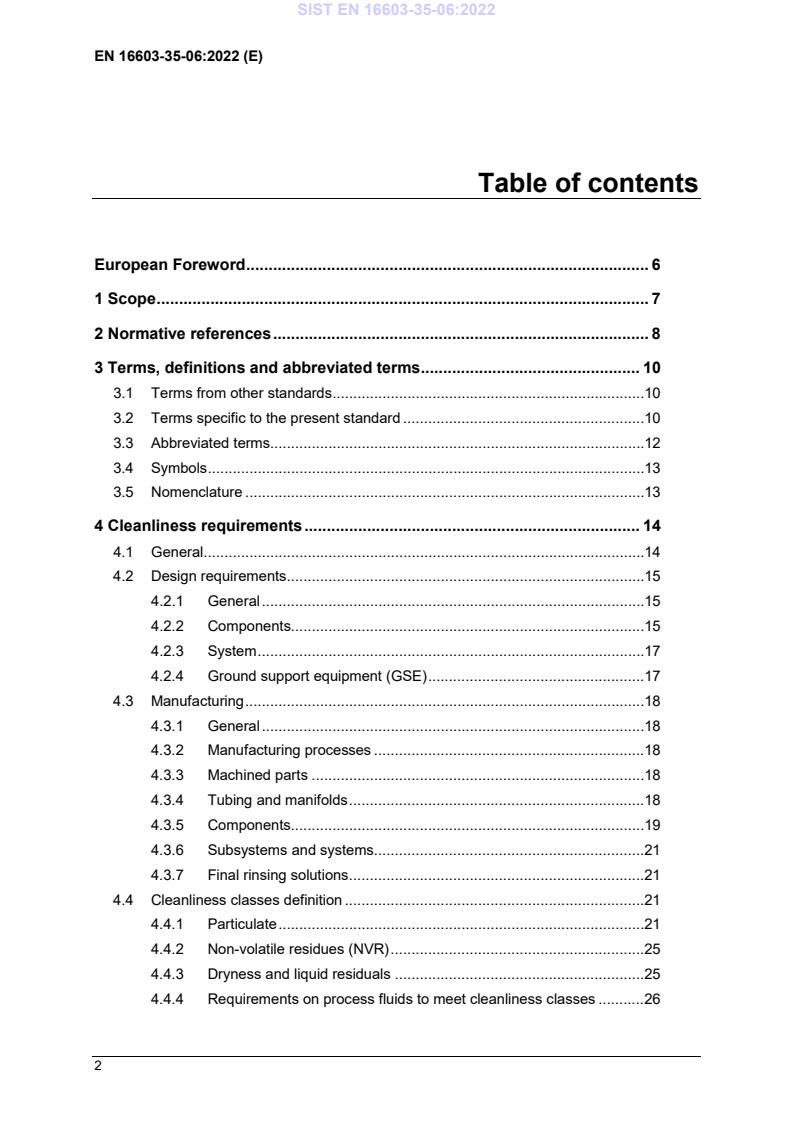
Table of contents
European Foreword . 6
1 Scope . 7
2 Normative references . 8
3 Terms, definitions and abbreviated terms . 10
3.1 Terms from other standards .10
3.2 Terms specific to the present standard .10
3.3 Abbreviated terms. 12
3.4 Symbols .13
3.5 Nomenclature .13
4 Cleanliness requirements . 14
4.1 General .14
4.2 Design requirements .15
4.2.1 General . 15
4.2.2 Components.15
4.2.3 System .17
4.2.4 Ground support equipment (GSE) . 17
4.3 Manufacturing .18
4.3.1 General . 18
4.3.2 Manufacturing processes . 18
4.3.3 Machined parts .18
4.3.4 Tubing and manifolds .18
4.3.5 Components.19
4.3.6 Subsystems and systems. 21
4.3.7 Final rinsing solutions .21
4.4 Cleanliness classes definition .21
4.4.1 Particulate .21
4.4.2 Non-volatile residues (NVR) .25
4.4.3 Dryness and liquid residuals .25
4.4.4 Requirements on process fluids to meet cleanliness classes . 26
4.5 Test methods . 27
4.6 Code usage .27
5 Cleaning techniques . 28
5.1 General .28
5.2 Environment, health and safety.29
5.2.1 General . 29
5.2.2 Hardware configuration requirements. 29
5.2.3 Cleaning process approval .30
5.3 Pre-cleaning .30
5.3.1 General . 30
5.3.2 Mechanical pre-cleaning .30
5.3.3 Chemical pre-cleaning .31
5.4 Precision cleaning.32
5.4.1 General . 32
5.4.2 Re-cleaning operational systems . 32
5.5 Drying methods .33
5.5.1 General . 33
5.5.2 Gaseous purge-drying .33
5.5.3 Drying sample .34
5.5.4 Flow rates during purging . 35
5.5.5 Vacuum drying procedure .35
5.6 Excepted components, subsystems and systems . 36
6 Cleanliness verification requirements . 37
6.1 Surface .37
6.1.1 Visual and UV inspection . 37
6.1.2 pH-test .37
6.2 Acceptance inspection of items cleaned in a controlled environment . 38
6.2.1 General . 38
6.2.2 Test fluids .38
6.2.3 Test fluid volume for analysis .38
6.2.4 Analysis of test fluid-flush sample (solvent) . 39
6.2.5 Analysis of aqueous-based, liquid-flush sample . 40
6.2.6 Drying .41
6.2.7 Vacuum drying .41
6.3 Maintaining cleanliness .42
6.3.1 Pressurant gas purge .42
6.3.2 Installation and marking of temporary hardware . 42
6.3.3 Temporary hardware replacement . 42
6.3.4 Component replacement .43
6.4 Dryness verification .43
6.4.1 General . 43
6.4.2 Purge dryness .43
6.4.3 Vacuum dryness .43
6.4.4 Sample test and qualified procedure . 44
7 Acceptance inspection of packaging materials . 45
7.1 Environmental control .45
7.2 Sampling .45
7.3 Thickness of packaging film .45
7.4 Static electricity .46
7.5 Verification of cleanliness level .46
7.5.1 General . 46
7.5.2 Minimum surface area for test .46
7.5.3 Sample preparation .46
7.5.4 Rinsing procedures .47
8 Packaging and protection . 48
8.1 Approved coverings .48
8.2 Packaging operations .48
8.3 Certification labels .48
9 Deliverables . 50
10 Test procedures . 51
10.1 Test liquid-flush procedure (solvent) .51
10.2 Gas flow test procedure .51
11 Sampling and analytical practices . 52
11.1 Cleanliness level test methods.52
11.1.1 General . 52
11.1.2 Method I “Liquid Flush Test” .52
11.1.3 Method II “Liquid Flow Test” .53
11.1.4 Method III “Gas Flow Test” .53
11.1.5 Method IV “Liquid flow test under operating conditions” . 53
12 Determination of particle population and NVR analysis . 55
12.1 Microscopic particle population .55
12.2 Gravimetric NVR analysis method . 56
Annex A (normative) Cleanliness Requirements Analysis (CRA) for
spacecraft propulsion components, subsystems and systems - DRD . 57
Annex B (normative) Cleaning Technique Selection (CTS) for spacecraft
propulsion components, subsystems and systems - DRD . 59
Annex C (normative) Cleanliness Certificate (CC) for spacecraft
propulsion components, subsystems and systems - DRD . 61
Annex D (normative) Typical test and cleaning liquids. 64
Annex E (informative) Pre-cleaning sequences . 67
Annex F (informative) Cleanliness certificate . 69
Bibliography . 71
Figures
Figure F-1 : Example of a cleanliness certificate.70
Tables
Table 4-1: Cleanliness classes .24
Table 4-2: NVR contamination levels .25
Table 4-3: Visible contamination levels .27
Table 7-1: Packaging materials .46
Table D-1 : Typical test and cleaning fluids . 64
Table E-1 : Typical pre-cleaning sequence for common materials . 67
European Foreword
This document (EN 16602-20-07:2016) has been prepared by Technical Committee CEN-CENELEC/TC 5
“Space”, the secretariat of which is held by DIN.
This standard (EN 16602-20-07:2016) originates from ECSS-Q-ST-20-07C.
This European Standard shall be given the status of a national standard, either by publication of an
identical text or by endorsement, at the latest by January 2023, and conflicting national standards shall
be withdrawn at the latest by January 2023.
Attention is drawn to the possibility that some of the elements of this document may be the subject of
patent rights. CEN shall not be held responsible for identifying any or all such patent rights.
This document supersedes EN 16603-35-06:2014.
The main changes with respect to EN 16603-35-06:2014 are listed below:
• Implementation of Change Requests received to the ECSS equivalent standard
• Addition of the Nomenclature in clause 3.5
• Definition of “accuracy” deleted in 3.2 and reference to ECSS-S-ST-00-01 made in 3.1
• Definition “condensable hydrocarbon” and “dewar” deleted in clause 3.2 as they were not used in
the standard
• Added requirements 6.4.3d.
• Modifed requirements: 4.1h Note 2 (reference to Figure of other ECSS Standard corrected); 6.2.6.2a;
6.4.3a; 6.4.3c; 12.1a; 12.2c Note to item 10 moved to the end of the requirement.
• Interleaved Notes in requirement 12.1a move to the end of the requirement
• Cross-reference in Annex B.1.1 to added requirement 6.4.3d created
• Caption of Table in Annex D corrected from “Table A-1” to “Table D-1”.
This document has been prepared under a standardization request given to CEN by the European
Commission and the European Free Trade Association.
This document has been developed to cover specifically space systems and has therefore precedence
over any EN covering the same scope but with a wider domain of applicability (e.g. : aerospace).
According to the CEN-CENELEC Internal Regulations, the national standards organizations of the
following countries are bound to implement this European Standard: Austria, Belgium, Bulgaria,
Croatia, Cyprus, Czech Republic, Denmark, Estonia, Finland, Former Yugoslav Republic of Macedonia,
France, Germany, Greece, Hungary, Iceland, Ireland, Italy, Latvia, Lithuania, Luxembourg, Malta,
Netherlands, Norway, Poland, Portugal, Romania, Serbia, Slovakia, Slovenia, Spain, Sweden,
Switzerland, Turkey and the United Kingdom.
Scope
ECSS-E-ST-35-06 belongs to the Propulsion field of the mechanical discipline, and
concerns itself with the cleanliness of propulsion components, sub-systems and
systems
The standard
• defines design requirements which allow for cleaning of propulsion
components sub-systems and systems and which avoid generation or
unwanted collection of contamination,
• identifies cleanliness requirements (e.g. which particle / impurity / wetness
level can be tolerated),
• defines requirements on cleaning to comply with the cleanliness level
requirements, and the requirements on verification,
• identifies the cleanliness approach, cleaning requirements, (e.g. what
needs to be done to ensure the tolerable level is not exceeded, compatibility
requirements),
• identifies, specifies and defines the requirements regarding conditions
under which cleaning or cleanliness verification takes place (e.g.
compatibility, check after environmental test).
The standard is applicable to the most commonly used propulsion systems and
their related storable propellant combinations: Hydrazine (N2H4), Mono Methyl
Hydrazine (CH3N2H3), MON (Mixed Oxides of Nitrogen), Nitrogen (N2), Helium
(He), Propane (C3H8), Butane (C4H10) and Xenon (Xe).
This standard is the basis for the European spacecraft and spacecraft propulsion
industry to define, achieve and verify the required cleanliness levels in spacecraft
propulsion systems.
This standard is particularly applicable to spacecraft propulsion as used for
satellites and (manned) spacecraft and any of such projects including its ground
support equipment.
External cleanliness requirements, e.g. outside of tanks, piping and aspects such
as fungus and outgassing are covered by ECSS-Q-ST-70-01.
This standard may be tailored for the specific characteristic and constraints of a
space project in conformance with ECSS-S-ST-00.
Normative references
The following normative documents contain provisions which, through
reference in this text, constitute provisions of this ECSS Standard. For dated
references, subsequent amendments to, or revisions of any of these publications,
do not apply. However, parties to agreements based on this ECSS Standard are
encouraged to investigate the possibility of applying the most recent editions of
the normative documents indicated below. For undated references the latest
edition of the publication referred to applies.
EN reference Reference in text Title
EN 16601-00 ECSS-S-ST-00-01 ECSS system — Glossary of terms
EN 16603-35 ECSS-E-ST-35 Space engineering — Propulsion general
requirements
EN 16602-40 ECSS-Q-ST-40 Space product assurance — Safety
EN 16602-70-01 ECSS-Q-ST-70-01 Space product assurance — Cleanliness and
contamination control.
EN 16602-70 ECSS-Q-ST-70 Space product assurance — Materials, mechanical
parts and processes
ISO 2210:1972 Liquid halogenated hydrocarbons for industrial use-
Determination of residue on evaporation
ISO 5789:1979 Fluorinated hydrocarbons for industrial use —
Determination of non-volatile residue
ISO 5884:1987 Aerospace — Fluid systems and components —
Methods for system sampling and measuring the
solid particle contamination of hydraulic fluids
ISO 14951-3:2000 Space systems —Fluid characteristics —Part 3:
Nitrogen
ISO 14951-4:2000 Space systems — Fluid characteristics —Part 4:
Helium
ISO 14951-10:2000 Space systems — Fluid characteristics —Part 10:
Water
ISO 14952-3:2003 Space systems — Surface cleanliness of fluid systems
— Part 3: Analytical procedures for the
determination of non-volatile residues and
particulate contamination
ASTM D257(99) 2005 Standard Test Method for DC Resistance or
Conductance of Insulating Materials
ASTM D329 10 Dec Standard specification for Acetone
EN reference Reference in text Title
ASTM D740 Standard specification for Methyl Ethyl Ketone
15 May 2005
ASTM D770-05 Standard specification for Isopropyl Alcohol
15 May 2005
ASTM D1152 Standard specification for Methanol (Methyl
1 Apr 2006 Alcohol)
ASTM D1293 10 Dec Standard test methods for pH of water
ASTM D4376 Standard specification for vapor-degreasing grade
Perchloroethylene
MIL-PRF-27415B Performance specification, propellant pressurizing
8 Feb 2007 agent, Argon
O-E-760D Federal specification
28 May 1987
SEMI C47-0699 Guideline for Trans 1,2 Dichloroethylene
May 1999
Terms, definitions and abbreviated terms
3.1 Terms from other standards
a. For the purpose of this Standard, the terms and definitions from ECSS-S-
ST-00-01 apply, in particular for the following term:
1. accuracy
b. For the purpose of this Standard, the terms and definitions from ECSS-E-
ST-35 apply.
3.2 Terms specific to the present standard
3.2.1 blank
result for an analytical sample of the virgin test fluid prior to use in performing
a cleanliness verification test
3.2.2 cleanliness verification
activity intended to verify that the actual cleanliness conditions of an item are in
conformance with the applicable specification
3.2.3 crazing
creating microvoids in glassy thermoplastic polymers preceding the formation of
cracks
3.2.4 critical surface
any surface of an item that contacts the service medium
NOTE Examples of service media are propellants and
pressurants.
3.2.5 dew point
temperature at which condensation of water vapour takes place at prevailing
pressure
NOTE The prevailing pressure is usually atmospheric
pressure.
3.2.6 fibre
flexible structure having a length-to-width ratio of 10 to 1 or greater
NOTE 1 A fibre is considered to be a particle, see clause
3.2.11.
NOTE 2 The size of a fibre is its maximum length.
3.2.7 field cleaning
processes of pre-cleaning and precision cleaning of components, subsystems and
systems which cannot be processed in a controlled environment such as a clean
room
3.2.8 generally clean
free from manufacturing residue, dirt, oil, grease, processing debris, or other
extraneous contamination based on visual examination
3.2.9 high-efficiency particulate air filter
filter that is at least 99,97 % efficient by volume on 0,3 μm particles
3.2.10 non-volatile residue
soluble or suspended material and insoluble particulate matter remaining after
temperature-controlled evaporation of a volatile liquid
NOTE See also clause 6.2.4.3
3.2.11 particle
unit of solid matter with observable size
NOTE 1 Various methods for defining its size may be
used and are dependant upon the measurement
technique.
NOTE 2 For the manual method the apparent maximum
linear dimension of a particle in the plane of
observation as observed with instruments such
as optical, electron, or atomic force microscopes
is the particle size.
NOTE 3 For the automatic method, the equivalent
diameter of a particle detected by automatic
instrumentation is the particle size.
NOTE 4 The equivalent diameter is the diameter of a
reference sphere having known properties and
producing the same response in the sensing
instrument as the particle being measured.
NOTE 5 A fibre is considered a particle, see clause 3.2.6.
3.2.12 passivation
process by which a corrosion-resistant layer is formed on a metal surface by
submersing the surface in an acid solution
3.2.13 pickling
chemical or electrochemical process by which surface oxides are removed from
metals
3.2.14 precision cleaning
cleaning process used to achieve cleanliness levels more stringent than visibly
clean
3.2.15 pre-cleaning
cleaning process normally used to achieve the visibly clean cleanliness level
3.2.16 reversion
decrease in viscosity, strength, or in rubber modulus due to heating or
overworking, resulting in a tacky and soft material
3.2.17 silting
accumulation of particles of sufficient quantity to cause a haze or obscuring of
any portion of a filter membrane when viewed visually or under 40-power
maximum magnification
3.2.18 test fluid
specified fluid that is utilized to determine the fluid system wetted-surface
cleanliness level
3.2.19 threshold limit value
maximum average daily dosage, based on an 8-h day, 5-day week, to which an
average worker may be exposed to hazardous chemicals without harmful effect
NOTE 1 The TLV is a time-weighted average
concentration.
NOTE 2 The TLV is normally expressed in parts of the
gas or vapour in micro litres per litre.
3.2.20 visibly clean
absence of surface contamination when examined with a specific light source,
angle of incidence, and viewing distance using normal or magnified vision up to
×20
3.2.21 visibly clean plus ultraviolet
cleaning level that is visibly clean and also meets the requirements for inspection
with the aid of an ultraviolet light of wavelength 250 nm to 395 nm
3.2.22 volatile hydrocarbon
hydrocarbon capable of going from liquid or solid to a gaseous state at ambient
temperature and pressure
3.3 Abbreviated terms
For the purpose of this Standard, the abbreviated terms from ECSS-S-ST-00-01
and the following apply:
Abbreviation Meaning
CC cleanliness certificate
CRA cleaning requirement analysis
CTS cleaning technique selection
GC generally clean
HEPA high-efficiency particulate air filter
HFE hydro fluor ether (Per fluoro-n-butyl methyl ether)
IPA isopropanol
MAIT manufacturing, assembly, integration and test
MEK methyl ethyl keton
MS mass spectroscopy
NVR non-volatile residue
ppmv parts per million, volumetric
TLV threshold limit value
US ultra sonic
VC visibly clean
VC + UV visibly clean plus ultraviolet
3.4 Symbols
Symbol
Meaning
dp mean pore diameter of a filter
3.5 Nomenclature
The following nomenclature applies throughout this document:
c. The word “shall” is used in this Standard to express requirements. All the
requirements are expressed with the word “shall”.
d. The word “should” is used in this Standard to express recommendations.
All the recommendations are expressed with the word “should”.
NOTE It is expected that, during tailoring,
recommendations in this document are either
converted into requirements or tailored out.
e. The words “may” and “need not” are used in this Standard to express
positive and negative permissions, respectively. All the positive
permissions are expressed with the word “may”. All the negative
permissions are expressed with the words “need not”.
f. The word “can” is used in this Standard to express capabilities or
possibilities, and therefore, if not accompanied by one of the previous
words, it implies descriptive text.
NOTE In ECSS “may” and “can” have completely
different meanings: “may” is normative
(permission), and “can” is descriptive.
g. The present and past tenses are used in this Standard to express statements
of fact, and therefore they imply descriptive text.
Cleanliness requirements
4.1 General
a. This standard shall only apply to propulsion systems using Hydrazines,
MON, Propane, Butane, Nitrogen, Helium, Xenon as propellants.
b. Cleanliness assurance precautions and features shall be specified and
incorporated in the hardware at the design phase.
NOTE In propulsion systems cleanliness is a major
requirement to avoid loss of function and
performance.
c. Cleanliness verification shall be applied at progressive MAIT stages in the
process.
d. The hardware shall be designed to enable post-build cleaning and
cleanliness verification.
e. Operation and use shall not generate or release contamination.
f. A cleanliness verification should be performed successively at component,
sub-system and system level prior to a blind-end close-out.
g. Cleanliness Particle Count levels shall be to a lower required class or
subclass at the early hardware build and verification stages, than the final
product.
NOTE 1 This allows final system-level cleanliness to be
achieved.
NOTE 2 See Table 4-1 for cleanliness classes and
subclasses.
h. During the design phase the necessity of cleanliness verification shall be
assessed.
NOTE 1 This applies from components to the design of
systems, and to operations as not to generate
contamination and to enable cleaning.
NOTE 2 Figure C-1 of ECSS-Q-ST-70-01 gives an
overview of space system cleanliness
requirements organized in a cleanliness control
flow chart.
i. Compatibility of cleaning fluids with the propulsion system materials and
propellants shall be established in conformance with Annex A.
NOTE 1 For efficient cleaning chemical compounds like
alkaline and acid cleaners are required.
NOTE 2 Related requirements are specified in ECSS-E-
ST-35-10, ‘Known incompatibilities’ concerning
compatibility testing for liquid propulsion
components, subsystems and systems.
j. All components, subsystems, systems or related equipment for use in
ground support equipment and spacecraft requiring cleaning shall be
1. cleaned to the specified cleanliness level, in conformance with the
CRA produced in conformance with Annex A,
2. inspected in conformance with Annex B.
k. The results of 4.1j shall be reported in conformance with Annex C.
l. Any component, subsystem or system that can be damaged during
cleaning shall be:
1. protected or removed before cleaning;
2. cleaned as a separate item in conformance with the CTS produced
in conformance with Annex B.
m. Cleaning or disassembly operations on precision components shall be
performed only by personnel who have been trained and certified to
perform these functions.
4.2 Design requirements
4.2.1 General
a. Designs shall be such that the product
1. avoids contamination and
2. allows for cleaning and drying.
b. Cleanliness classes shall be established in conformance with Annex A, to
apply to propulsion components, subsystems and systems.
4.2.2 Components
4.2.2.1 Tanks
a. Tank internal structures shall not shed particles during operation.
b. Tank internal structures shall allow for draining and cleaning.
NOTE Examples of such structures are diaphragms,
bladders, baffles, and surface tension screens.
4.2.2.2 Tubing and manifolds
a. Tubings and manifolds should avoid stepped diameter transitions that
create turbulence or flow separation.
NOTE Turbulent flows and wakes can cause particle
deposition.
b. Tubings and manifolds should avoid blind holes and dead ends,
c. Tubings and manifolds shall avoid internal threads.
NOTE The risk of contamination is increased with the
number of screw joints.
4.2.2.3 Valves and regulators
a. Solenoid valves should use flexure guided armatures.
NOTE Sliding surfaces can jam or generate particles.
b. Valve or regulator function and performance shall be independent from
lubrication on critical surfaces.
c. Fluid paths should be smooth, avoiding stepped transitions.
NOTE This is to avoid entrapment of contamination.
d. Valve or regulator parts and assembled parts should allow for ultrasonic
cleaning, in conformance with the CTS produced in conformance with
Annex B.
e. Protective filters shall be dimensioned in conformance with the CRA
produced in conformance with Annex A, such that the selected filtration
rate does not allow particles exceeding a specified size, to pass, thereby
degrading function and performance.
f. Reference ports on regulators shall be protected by filters.
g. In conformance with the CRA produced in conformance with Annex A,
protective filters shall be dimensioned such that the specified accumulated
contamination causes no pressure drop exceeding the requirement.
h. Valve- or regulator-poppet design shall avoid entrapment of
contamination.
i. A valve or regulator assembly should allow for the integration of
protective filters after the final cleaning of the unit has been performed and
verified in conformance with the CTS produced in conformance with
Annex B.
j. Valves and regulators subject to reverse flow shall incorporate an outlet
filter.
k. Valves and regulators shall avoid cavities, if not functionally required.
l. Valves and regulators shall not generate contamination, exceeding the
specified level, when exposed to the specified environmental and
functional tests.
NOTE 1 E.g. during dry cycles.
NOTE 2 Sliding armatures can generate contamination.
NOTE 3 Sliding armatures are susceptible to jamming
and wear.
4.2.2.4 Filters
a. Filters shall not shed particles, exceeding the specified level, during
operation and environmental testing.
4.2.2.5 Instrumentation
a. Sensors introducing cavities shall allow for cleaning by a flushing lance.
NOTE See Annex B.
b. Cavities or dead end tubing shall allow for thermal and vacuum drying.
NOTE See Annex B.
4.2.2.6 Injectors
a. The deposition of NVR in capillary tubes and injector bores during
operation shall be analysed and reported.
NOTE 1 E.g. during pulse mode.
NOTE 2 See Annex A.
4.2.2.7 Thrust chambers
a. The deposition of NVR on catalyst beds shall be analysed and reported.
NOTE See Annex A.
4.2.3 System
a. The system shall allow for ground draining of simulation fluids and of
propellants.
b. Systems requiring cleaning and cleanliness verification shall have no
protective filters at fill and drain valves or test ports.
c. Filtration rate and capacity requirements shall include the flight operation
and the contamination introduced by integration and testing at higher
build level.
NOTE See Annex A.
d. The integration of filters should be performed after final cleaning and
verification of the related subsystems.
NOTE See Annex B.
e. Line replaceable components shall be protected by built-in filters.
f. The system design should enable flow-down cleanliness verification (see clause
4.1g).
4.2.4 Ground support equipment (GSE)
a. Connect/disconnect interfaces shall be protected from contamination by
filters or by procedures
NOTE E.g. purge flow during connection / disconnection.
b. GSE protective filters shall be at the interfacing point to the flight
hardware.
c. The GSE shall provide for draining and drying interfaces
NOTE E.g. back flush.
d. The GSE shall provide sampling interfaces and sampling equipment to
verify cleanliness.
e. Filtration of simulation fluids or propellants shall be performed to a
cleanliness class equal or better than the propulsion system requirements.
NOTE See Annex A.
4.3 Manufacturing
4.3.1 General
a. Manufacturing aspects that affect the selection of cleaning techniques shall
be reported in conformance with Annex B.
4.3.2 Manufacturing processes
a. ECSS-Q-ST-70-01 requirements for ‘Manufacturing’ and ‘Assembly and
integration’ shall apply.
b. The required proof pressure testing shall be performed after cleaning
processes that affect material properties
NOTE E.g. after acid treatment.
4.3.3 Machined parts
a. Machined parts shall be cleaned as specified for the subsequent
manufacturing operations.
NOTE This is also to achieve the final cleanliness level.
b. Machined parts shall be free of burrs.
NOTE For large items such as diaphragms and
bladders, special cleaning procedures can be
necessary.
4.3.4 Tubing and manifolds
a. Tubing, manifolds and transition joints shall be free of burrs, maintaining
sharp edges for welding.
b. Tubing, manifolds and transition joints shall have passed all
contaminating handling steps before final cleaning, e.g. bending, flaring,
cutting to length and contaminating inspections.
c. Light oxide films, shall be removed by validated processes, e.g. brushing
with a clean stainless steel wire brush, glass blasting (except for flow
paths), draw filing, acid pickling.
d. Grinding shall not be performed on tube end interface surfaces that are
subject to welding.
NOTE Debris from the grinding wheel can get
embedded in the metal surface. This has been
known to cause weld problems due to
contamination embedded at the interface during
welding.
e. The area to be treated by acid pickling shall be degreased with non-
halogenated solvents.
f. Component interiors shall be protected by internally plugging the tubing
stud in case of acid pickling.
NOTE For example, valves.
g. Water flushing shall be used to neutralize the pickling solution.
h. Tubing and manifolds shall be dried by gas purging.
i. Tubing shall be protected from contamination by oxidation during
welding.
j. Welding shall avoid generating weld sputter in components, subsystems
and system.
k. To protect stainless steel against external corrosion (e.g. after welding)
pickling and passivation shall be performed.
NOTE Titanium tubing and manifolds can be pickled in
a suitable acid and flushed with de-mineralised
water to allow surface natural re-passivation.
l. Installation of a seal shall not introduce contamination into the system.
NOTE E.g. installation of O-rings.
m. Abrasion and surface damage of a seal during integration shall be avoided.
NOTE E.g. by using application compatible lubricants,
masking of sharp edges.
n. The lubricant of mechanical joints shall not be introduced into the critical
surface area or come into contact with propellants, pressurants or simulation
fluids.
o. The joining process shall not introduce contamination into the critical
surface area or bring contaminants into contact with propellants,
pressurants or simulation fluids.
p. For repair and trimming-to-length clause 6.3.4 shall apply
4.3.5 Components
a. Components with liquid retaining cavities or capillary structures used for
gas applications shall be
1. flushed with liquids only at component level,
2. verified to be dry.
NOTE E.g. pressure regulators, non return and relief
valves.
b. Joining components to cleaning facilities shall not cause damage to
interfaces.
c. Assembly of components (e.g. orifices, valve seats) shall be performed under
a controlled environment in conformance with the requirements for
“Cleanrooms” in ECSS-Q-ST-70-01F, and the cleanliness requirements of the
component.
d. Hardware shall not be exposed to environments causing chemical
contamination.
NOTE This can give rise to corrosion or chemical
reactions in a later stage of life.
e. If not protected by specific means to avoid internal contamination,
assembled components shall be tested in a controlled environment in
conformance with the requirements for cleanrooms in ECSS-Q-ST-70-01
and the cleanliness requirements of the component.
f. It shall be determined which environmental classes apply to 4.3.5c and
4.3.5e.
NOTE See Annex A.
g. Procedures shall ensure that components that can be damaged or
contaminated by reverse flow are not flushed or purged in opposite
direction, neither during component operation, nor during subsystem or
system operation.
h. For filters, procedures shall ensure that the last flushing operation at
component level is performed in the nominal direction.
i. Tanks with built in propellant management devices shall have undergone
all individually required precision cleaning processes and verification
prior to final welding.
j. No introduction or formation of contaminants during subsequent
assembly and operations shall take place.
NOTE E.g. introduction or formation of weld sputter.
k. Valves and regulators that cannot be dried after liquid flushing shall be
cleaned with either:
1. Nitrogen in conformance with ISO 14951-3 Type A, filtered through
a filter with dp ≤ 2 μm, or
2. Helium in conformance with ISO 14951-4 Type A, filtered through
a filter with dp ≤ 2 μm, or
3. Argon in conformance with MIL-PRF-27415B grade B, filtered
through a filter with dp ≤ 2 μm.
l. For the purpose of cleaning, the non-single-use valve or regulator shall be
operated during flushing or purging.
m. Purging or flushing of thrusters shall take the thrusters characteristics into
account.
NOTE 1 Monopropellant thrusters with catalytic beds
have limitations regarding flushing liquids, gas
flow rates and pressure differentials.
NOTE 2 Actuation of a flow control valve with gas flow
is subject to limitations to avoid overheating of
the valve.
4.3.6 Subsystems and systems
a. Subsystems incorporating components that constrain flushing or purging
shall be built up allowing for in-process cleaning in accordance with clause
4.1c.
b. Subsystems with limited access and requiring flushing or purging shall be
fitted with test ports.
c. Closed or protected subsystems and systems shall be handled in
conformance with the ECSS-Q-ST-70-01, class M6.5 environment.
d. Open subsystems and systems shall be handled in a specified environment
equal to or better than ECSS-Q-ST-70-01 class M6.5.
e. It shall be determined which environmental class applies to requirement
4.3.6d.
NOTE See Annex A.
f. Procedures shall be established to avoid contamination of the subsystem
or system in case of component exchange.
4.3.7 Final rinsing solutions
a. The final rinsing solution shall meet or exceed the cleanliness requirements
for which they are intended.
b. The rinsing liquid shall meet the requirements of clauses 4.4.4a, 4.4.4b,
4.4.4c, and 4.4
...