

SIST EN 71-2:2021+A1:2025
(Main)Safety of toys - Part 2: Flammability
General Information
- Abstract
This European Standard specifies the categories of flammable materials which are prohibited in all toys, and requirements concerning flammability of certain toys when they are subjected to a small source of ignition.
The test methods described in Clause 5 are used for the purposes of determining the flammability of toys under the particular test conditions specified. The test results thus obtained cannot be considered as providing an overall indication of the potential fire hazard of toys or materials when subjected to other sources of ignition.
This European Standard includes general requirements relating to all toys and specific requirements and methods of test relating to the following toys, which are considered as being those presenting the greatest hazard:
- toys to be worn on the head: beards, moustaches, wigs, etc. made from hair, pile or material with similar features; masks; hoods, head-dresses, etc.; flowing elements of toys to be worn on the head, but excluding paper novelty hats of the type usually supplied in party crackers;
- toy disguise costumes and toys intended to be worn by a child in play;
- toys intended to be entered by a child;
- soft-filled toys.
NOTE Additional requirements for flammability of electric toys are specified in EN IEC 62115.
- Status
- Published
- Publication Date
- 09-Jun-2025
- Technical Committee
- OTR - Child use and care article
- Current Stage
- 6060 - National Implementation/Publication (Adopted Project)
- Start Date
- 07-May-2025
- Due Date
- 12-Jul-2025
- Completion Date
- 10-Jun-2025

Overview
EN 71-2:2020+A1:2025 - Safety of toys - Part 2: Flammability (CEN) defines flammability limits and test methods for toys placed on the European market. The consolidated standard (including Amendment 1 approved April 2025) updates the EN 71 flammability requirements and test procedures and will be implemented as a national standard across CEN members by late 2025.
Key points:
- Specifies categories of prohibited flammable materials in all toys.
- Sets flammability requirements for toys when exposed to a small source of ignition.
- Test methods are given in Clause 5; results apply only to the specified test conditions and do not represent overall fire hazard under different ignition scenarios.
Key topics and requirements
- Prohibited materials: Identifies material categories that must not be used due to high flammability (applies to all toys).
- Target toy categories with specific requirements:
- Toys to be worn on the head (wigs, beards, masks, hoods); includes criteria for protruding pile/flowing elements (thresholds such as 50 mm).
- Toy disguise costumes and other garments intended to be worn by children.
- Toys intended to be entered by a child (e.g., playhouses, tunnels).
- Soft-filled toys (requirements and specific test methods for fillings and coverings).
- Test methods (Clause 5): Procedures for preparing specimens, burner setup, flame position and performance for different toy categories. Results are limited to the specific standardized conditions.
- Informative annexes: Annex A (background and rationale), Annex B (risk assessment guidance for costumes and head-worn toys), Annex ZA (relation to Directive 2009/48/EC).
- Note: Flammability of electric toys is covered additionally by EN IEC 62115.
Practical applications
- Product design: integrate non‑flammable materials and design features to meet flammability limits.
- Risk assessment: use test procedures to evaluate whether a toy meets regulatory flammability requirements.
- Conformity and CE marking: supports compliance with EU Toy Safety Directive (2009/48/EC).
- Testing and quality control: standardized methods for laboratories to verify compliance during development and production.
- Procurement and retail: specification and acceptance testing for suppliers and buyers.
Who should use this standard
- Toy manufacturers and designers
- Test laboratories and conformity assessment bodies
- Regulatory authorities and market surveillance teams
- Importers, distributors and retailers
- Safety engineers and product compliance managers
Related standards and keywords
- Related: EN IEC 62115 (electrical toy flammability aspects), other parts of the EN 71 series.
- SEO keywords: EN 71-2:2020+A1:2025, toy flammability, safety of toys, CEN standard, flammability test methods, CE marking, toy safety regulation, testing laboratories.
Relations
- Effective Date
- 01-Jul-2025
- Effective Date
- 28-Jan-2026
- Effective Date
- 28-Jan-2026
- Effective Date
- 08-Apr-2026
- Effective Date
- 10-Feb-2026
- Effective Date
- 28-Jan-2026
- Effective Date
- 28-Jan-2026
- Effective Date
- 28-Jan-2026
- Effective Date
- 28-Jan-2026
- Referred By
SIST EN 71-5:1995 - Safety of toys - Part 5: Chemical toys (sets) other than experimental sets - Effective Date
- 28-Jan-2026
- Effective Date
- 01-Jul-2025
Get Certified
Connect with accredited certification bodies for this standard

CIS Institut d.o.o.
Personal Protective Equipment (PPE) certification body. Notified Body NB-2890 for EU Regulation 2016/425 PPE.

Kiwa BDA Testing
Building and construction product certification.
Kmetijski inštitut Slovenije
Agricultural Institute of Slovenia. Soil testing, plant health, agricultural product analysis.
Sponsored listings
Frequently Asked Questions
SIST EN 71-2:2021+A1:2025 is a standard published by the Slovenian Institute for Standardization (SIST). Its full title is "Safety of toys - Part 2: Flammability". This standard covers: This European Standard specifies the categories of flammable materials which are prohibited in all toys, and requirements concerning flammability of certain toys when they are subjected to a small source of ignition. The test methods described in Clause 5 are used for the purposes of determining the flammability of toys under the particular test conditions specified. The test results thus obtained cannot be considered as providing an overall indication of the potential fire hazard of toys or materials when subjected to other sources of ignition. This European Standard includes general requirements relating to all toys and specific requirements and methods of test relating to the following toys, which are considered as being those presenting the greatest hazard: - toys to be worn on the head: beards, moustaches, wigs, etc. made from hair, pile or material with similar features; masks; hoods, head-dresses, etc.; flowing elements of toys to be worn on the head, but excluding paper novelty hats of the type usually supplied in party crackers; - toy disguise costumes and toys intended to be worn by a child in play; - toys intended to be entered by a child; - soft-filled toys. NOTE Additional requirements for flammability of electric toys are specified in EN IEC 62115.
This European Standard specifies the categories of flammable materials which are prohibited in all toys, and requirements concerning flammability of certain toys when they are subjected to a small source of ignition. The test methods described in Clause 5 are used for the purposes of determining the flammability of toys under the particular test conditions specified. The test results thus obtained cannot be considered as providing an overall indication of the potential fire hazard of toys or materials when subjected to other sources of ignition. This European Standard includes general requirements relating to all toys and specific requirements and methods of test relating to the following toys, which are considered as being those presenting the greatest hazard: - toys to be worn on the head: beards, moustaches, wigs, etc. made from hair, pile or material with similar features; masks; hoods, head-dresses, etc.; flowing elements of toys to be worn on the head, but excluding paper novelty hats of the type usually supplied in party crackers; - toy disguise costumes and toys intended to be worn by a child in play; - toys intended to be entered by a child; - soft-filled toys. NOTE Additional requirements for flammability of electric toys are specified in EN IEC 62115.
SIST EN 71-2:2021+A1:2025 is classified under the following ICS (International Classification for Standards) categories: 13.220.40 - Ignitability and burning behaviour of materials and products; 97.200.50 - Toys. The ICS classification helps identify the subject area and facilitates finding related standards.
SIST EN 71-2:2021+A1:2025 has the following relationships with other standards: It is inter standard links to SIST EN 71-2:2021, SIST EN ISO 6941:2004, SIST EN ISO 2431:2019, SIST EN 12221:2026, SIST-V CEN/CLC Guide 14:2009, SIST EN 14036:2003, SIST EN 12227:2011, SIST EN 13209-1:2005, SIST EN 1930:2012, SIST EN 71-5:1995, SIST EN 71-2:2021/kFprA1:2025. Understanding these relationships helps ensure you are using the most current and applicable version of the standard.
SIST EN 71-2:2021+A1:2025 is associated with the following European legislation: EU Directives/Regulations: 2009/48/EC; Standardization Mandates: M/589. When a standard is cited in the Official Journal of the European Union, products manufactured in conformity with it benefit from a presumption of conformity with the essential requirements of the corresponding EU directive or regulation.
SIST EN 71-2:2021+A1:2025 is available in PDF format for immediate download after purchase. The document can be added to your cart and obtained through the secure checkout process. Digital delivery ensures instant access to the complete standard document.
Standards Content (Sample)
SLOVENSKI STANDARD
01-julij-2025
Nadomešča:
SIST EN 71-2:2021
Varnost igrač - 2. del: Vnetljivost (vključno z dopolnilom A1)
Safety of toys - Part 2: Flammability
Sicherheit von Spielzeug - Teil 2: Entflammbarkeit
Sécurité des jouets - Partie 2: Inflammabilité
Ta slovenski standard je istoveten z: EN 71-2:2020+A1:2025
ICS:
13.220.40 Sposobnost vžiga in Ignitability and burning
obnašanje materialov in behaviour of materials and
proizvodov pri gorenju products
97.200.50 Igrače Toys
2003-01.Slovenski inštitut za standardizacijo. Razmnoževanje celote ali delov tega standarda ni dovoljeno.
EN 71-2:2020+A1
EUROPEAN STANDARD
NORME EUROPÉENNE
June 2025
EUROPÄISCHE NORM
ICS 13.220.40; 97.200.50 Supersedes EN 71-2:2020
English Version
Safety of toys - Part 2: Flammability
Sécurité des jouets - Partie 2: Inflammabilité Sicherheit von Spielzeug - Teil 2: Entflammbarkeit
This European Standard was approved by CEN on 28 September 2020 and includes Amendment 1 approved by CEN on 7 April
2025.
CEN members are bound to comply with the CEN/CENELEC Internal Regulations which stipulate the conditions for giving this
European Standard the status of a national standard without any alteration. Up-to-date lists and bibliographical references
concerning such national standards may be obtained on application to the CEN-CENELEC Management Centre or to any CEN
member.
This European Standard exists in three official versions (English, French, German). A version in any other language made by
translation under the responsibility of a CEN member into its own language and notified to the CEN-CENELEC Management
Centre has the same status as the official versions.
CEN members are the national standards bodies of Austria, Belgium, Bulgaria, Croatia, Cyprus, Czech Republic, Denmark, Estonia,
Finland, France, Germany, Greece, Hungary, Iceland, Ireland, Italy, Latvia, Lithuania, Luxembourg, Malta, Netherlands, Norway,
Poland, Portugal, Republic of North Macedonia, Romania, Serbia, Slovakia, Slovenia, Spain, Sweden, Switzerland, Türkiye and
United Kingdom.
EUROPEAN COMMITTEE FOR STANDARDIZATION
COMITÉ EUROPÉEN DE NORMALISATION
EUROPÄISCHES KOMITEE FÜR NORMUNG
CEN-CENELEC Management Centre: Rue de la Science 23, B-1040 Brussels
© 2025 CEN All rights of exploitation in any form and by any means reserved Ref. No. EN 71-2:2020+A1:2025 E
worldwide for CEN national Members.
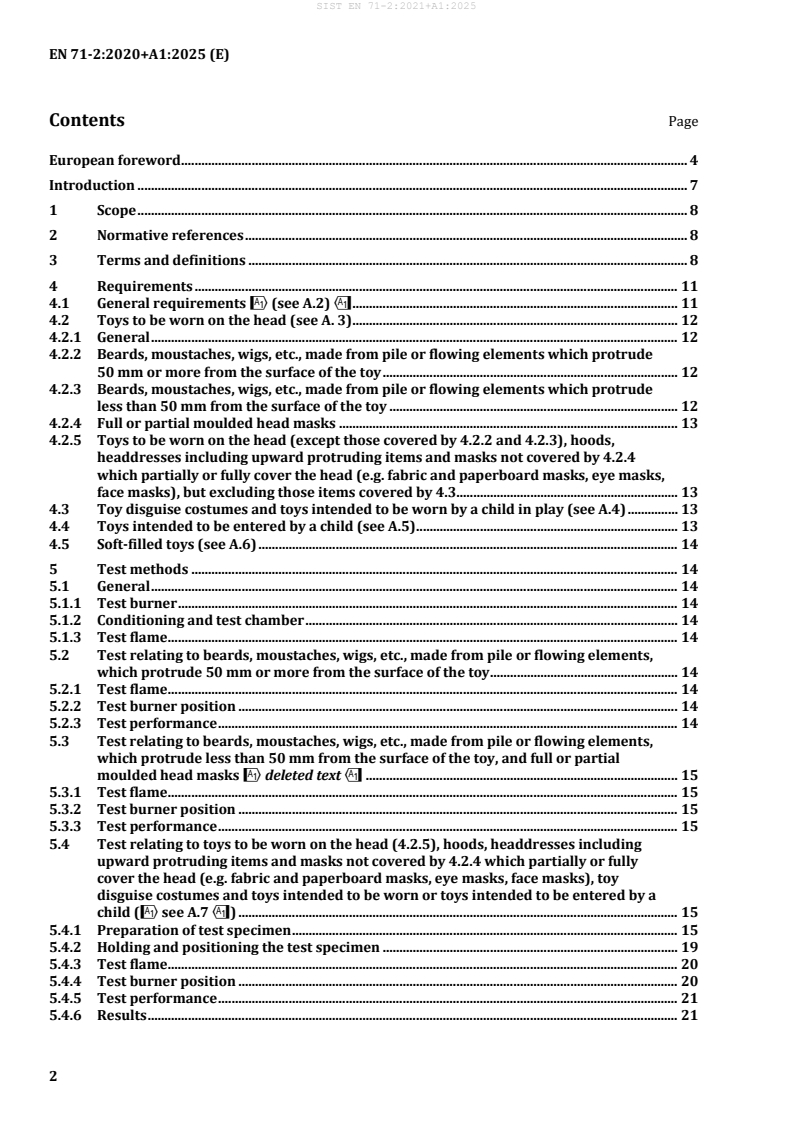
Contents Page
European foreword . 4
Introduction . 7
1 Scope . 8
2 Normative references . 8
3 Terms and definitions . 8
4 Requirements . 11
4.1 General requirements !(see A.2)" . 11
4.2 Toys to be worn on the head (see A. 3) . 12
4.2.1 General . 12
4.2.2 Beards, moustaches, wigs, etc., made from pile or flowing elements which protrude
50 mm or more from the surface of the toy . 12
4.2.3 Beards, moustaches, wigs, etc., made from pile or flowing elements which protrude
less than 50 mm from the surface of the toy . 12
4.2.4 Full or partial moulded head masks . 13
4.2.5 Toys to be worn on the head (except those covered by 4.2.2 and 4.2.3), hoods,
headdresses including upward protruding items and masks not covered by 4.2.4
which partially or fully cover the head (e.g. fabric and paperboard masks, eye masks,
face masks), but excluding those items covered by 4.3. 13
4.3 Toy disguise costumes and toys intended to be worn by a child in play (see A.4) . 13
4.4 Toys intended to be entered by a child (see A.5) . 13
4.5 Soft-filled toys (see A.6) . 14
5 Test methods . 14
5.1 General . 14
5.1.1 Test burner . 14
5.1.2 Conditioning and test chamber . 14
5.1.3 Test flame . 14
5.2 Test relating to beards, moustaches, wigs, etc., made from pile or flowing elements,
which protrude 50 mm or more from the surface of the toy . 14
5.2.1 Test flame . 14
5.2.2 Test burner position . 14
5.2.3 Test performance . 14
5.3 Test relating to beards, moustaches, wigs, etc., made from pile or flowing elements,
which protrude less than 50 mm from the surface of the toy, and full or partial
moulded head masks !deleted text" . 15
5.3.1 Test flame . 15
5.3.2 Test burner position . 15
5.3.3 Test performance . 15
5.4 Test relating to toys to be worn on the head (4.2.5), hoods, headdresses including
upward protruding items and masks not covered by 4.2.4 which partially or fully
cover the head (e.g. fabric and paperboard masks, eye masks, face masks), toy
disguise costumes and toys intended to be worn or toys intended to be entered by a
child (!see A.7") . 15
5.4.1 Preparation of test specimen . 15
5.4.2 Holding and positioning the test specimen . 19
5.4.3 Test flame . 20
5.4.4 Test burner position . 20
5.4.5 Test performance . 21
5.4.6 Results . 21
5.5 Test for soft-filled toys and certain soft-filled parts of toy disguise costumes. 22
5.5.1 Test flame . 22
5.5.2 Test burner position . 22
5.5.3 Test performance . 22
Annex A (informative) Background and rationale for this document . 23
A.1 General . 23
A.2 General requirements (see 4.1) . 23
A.3 Toys to be worn on the head (see 4.2) . 24
A.4 Toy disguise costumes and toys intended to be worn by a child in play (see 4.3) . 29
A.5 Toys intended to be entered by a child (see 4.4) . 31
A.6 Soft-filled toys (see 4.5) . 31
A.7 Test relating to toy disguise costumes and toys intended to be entered by a child
(see 5.4) . 31
A.8 Suggestions to help reduce rate of spread of flames for toy disguise costumes. . 32
A.9 Flowcharts showing how to obtain test specimens from toy disguise costumes . 33
Annex B (informative) !Risk Assessment Guidance: Toy disguise costumes and toys to be
worn on the head . 37
Annex ZA (informative) Relationship between this European Standard and the essential
Requirements of EU Directive 2009/48/EC aimed to be covered. 39
Bibliography . 40
European foreword
This document (EN 71-2:2020+A1:2025) has been prepared by Technical Committee CEN/TC 52 “Safety
of toys”, the secretariat of which is held by DS.
This European Standard shall be given the status of a national standard, either by publication of an
identical text or by endorsement, at the latest by December 2025, and conflicting national standards shall
be withdrawn at the latest by June 2026.
Attention is drawn to the possibility that some of the elements of this document may be the subject of
patent rights. CEN shall not be held responsible for identifying any or all such patent rights.
This document includes Amendment 1, approved by CEN on 7 April 2025.
This document supersedes !EN 71-2:2020".
The start and finish of text introduced or altered by amendment is indicated in the text by tags !".
Additional information on the background and rationale for various requirements are given in Annex A.
!deleted text"
!This document has been prepared under a standardization request addressed to CEN by the European
Commission. The Standing Committee of the EFTA States subsequently approves these requests for its
Member States.
For the relationship with EU Legislation, see informative Annex ZA, which is an integral part of this
document."
This document constitutes the second part of the EN 71 series of standards on safety of toys.
EN 71, Safety of toys, consists of the following parts:
— Part 1: Mechanical and physical properties
— Part 2: Flammability
— Part 3: Migration of certain elements
— Part 4: Experimental sets for chemistry and related activities
— Part 5: Chemical toys (sets) other than experimental sets
— Part 7: Finger paints — Requirements and test methods
— Part 8: Activity toys for domestic use
— !deleted text"
— Part 10: Organic chemical compounds — Sample preparation and extraction
— Part 11: Organic chemical compounds — Methods of analysis
— Part 12: N-Nitrosamines and N-nitrosatable substances
— Part 13: Olfactory board games, cosmetic kits and gustative games
— Part 14: Trampolines for domestic use
— !Part 15: Formamide in foam toy materials (content)
— Part 16: Certain chlorinated phosphorus flame retardants (TCEP, TCPP, TDCP) in toy materials
— Part 17: Certain isothiazolinones (MIT, CIT, BIT) in aqueous toy materials
— Part 18: Phenol in aqueous (content) and polymeric (migration) toy materials
— Part 19: Migration of bisphenol A from toy materials
— Part 20: Safety of toys — Part 20: Microbiological safety of toys containing accessible aqueous media"
NOTE 1 In addition to the above parts of EN 71, the following !deliverables" have been published:
— CEN/TR 15071, Safety of toys — National translations of warnings and instructions for use in the EN 71 series
— CEN/TR 15371 (all parts), Safety of toys — Interpretations
— CEN/TR 16918, Safety of toys — Children’s mouthing behaviour in contact with toys
— CEN ISO/TR 8124-8, !Safety of toys — Part 8: Age determination — First age grade for the appropriate play
of toys (ISO/TR 8124-8)"
— !CEN/TS 17973, Safety of toys — Categorization of slime type materials
— CEN/TR 17695, Safety of toys — Mechanical and physical properties — Guidance on categorisation of projectile
toys within EN 71-1"
NOTE 2 Words in italics are defined in Clause 3 (Terms and definitions).
!The following significant changes have been implemented in this consolidated version:
Clause/paragraph/table/figure Change
3.3, 3.10 and 3.15 Inclusion of definitions for cosmetic kit, gustative game and
olfactory board game to support clarification at 4.1
4.1 Clarification regarding highly flammable and flammable liquids
in chemical toy(s) and alignment with EN 71-5:2015 and
EN 71-13:2021+A1:2022
5.3 Clarification on how to test masks to ensure test flame is not
affected by openings.
5.3 and 5.4 Correction of error in referencing A.7 and A.8
5.4.1.1 c) Increase in the range of allowable water hardness
5.4.1.2.1 Improvements to Figure 1 and associated text for clarity
A.2 Additional information regarding washing of toy disguise
costumes
Clause/paragraph/table/figure Change
A.3 Correction of the text in example 15
A.7 Additional information to explain change in permitted water
hardness
Annex B Original Annex B deleted and new Annex B added
NOTE The technical changes referred to include the significant technical changes from the EN revised, but
is not an exhaustive list of all modifications from the previous version.
In addition, the following clauses were edited to align with ISO 8124-2:2023 without technical change:
3.15 4.3 5.4.1.2.1 c) 5.4.2 Table A.1, row 8 A.7
3.16 4.5 5.4.1.2.5 5.4.6 A.4 A.8
4.22 5.4.1.1 5.4.1.2.7 A.2 A.5
"
Any feedback and questions on this document should be directed to the users’ national standards body.
A complete listing of these bodies can be found on the CEN website.
According to the CEN-CENELEC Internal Regulations, the national standards organizations of the
following countries are bound to implement this European Standard: Austria, Belgium, Bulgaria, Croatia,
Cyprus, Czech Republic, Denmark, Estonia, Finland, France, Germany, Greece, Hungary, Iceland, Ireland,
Italy, Latvia, Lithuania, Luxembourg, Malta, Netherlands, Norway, Poland, Portugal, Republic of North
Macedonia, Romania, Serbia, Slovakia, Slovenia, Spain, Sweden, Switzerland, Türkiye and the United
Kingdom.
Introduction
This document aims at reducing, as far as possible, those hazards which are not evident to users; it does
not cover inherent hazards that are obvious to children or the persons in charge of them. Assuming that
the toys are used in the intended manner, they should not present any further hazard to children for
whom they are intended (according to the Directive 2009/48/EC “intended for use by” means that a
parent or supervisor shall reasonably be able to assume by virtue of the functions, dimensions and
characteristics of a toy that it is intended for use by children of the stated age group). Allowance should
also be made for foreseeable use, bearing in mind the behaviour of children who do not generally share
the same degree of care as the average adult user.
As a general rule, toys are designed and manufactured for particular ages of children. Their
characteristics are related to the age and stage of development of the children, and their use presupposes
certain aptitudes.
Accidents are frequently due to a toy either being given to a child for whom it is not intended or being
used for a purpose other than that for which it was designed. Great care should therefore be taken when
choosing a toy; account should be taken of the mental and physical development of the child who will be
using it.
The requirements of this document do not release parents or carers from their responsibility of
supervising the child while he or she is playing.
1 Scope
This document specifies the categories of flammable materials which are prohibited in all toys, and
requirements concerning flammability of certain toys when they are subjected to a small source of
ignition.
The test methods described in Clause 5 are used for the purposes of determining the flammability of toys
under the particular test conditions specified. The test results thus obtained are not considered as
providing an overall indication of the potential fire hazard of toys or materials when subjected to other
sources of ignition.
This document includes general requirements relating to all toys and specific requirements and methods
of test relating to the following toys, which are considered as being those presenting the greatest hazard:
— toys to be worn on the head: beards, moustaches, wigs, etc. made from pile or flowing elements;
masks; hoods, headdresses, etc.; However, paper and paperboard hats without embellishments or
attachments are excluded;
— toy disguise costumes and toys intended to be worn by a child in play;
— toys intended to be entered by a child and constructed from textiles and/or polymer sheets and films;
— soft-filled toys.
NOTE Additional requirements for flammability of electric toys are specified in !EN IEC 62115 [2]".
2 Normative references
The following documents are referred to in the text in such a way that some or all of their content
constitutes requirements of this document. For dated references, only the edition cited applies. For
undated references, the latest edition of the referenced document (including any amendments) applies.
EN ISO 2431:2019, Paints and varnishes - Determination of flow time by use of flow cups (ISO 2431:2019)
EN ISO 6941:2003, Textile fabrics - Burning behaviour - Measurement of flame spread properties of
vertically oriented specimens (ISO 6941:2003)
3 Terms and definitions
For the purposes of this document, the following terms and definitions apply:
ISO and IEC maintain terminological databases for use in standardization at the following addresses:
— IEC Electropedia. available at http://www.electropedia.org/
— ISO Online browsing platform: available at http://www.iso.org/obp/
3.1
chemical toy
toy intended for the direct handling of chemical substances and mixtures and which is used in a manner
appropriate to a given age-group and under the supervision of an adult
!Note 1 to entry: An experimental set for chemistry and related activities is an example of a chemical toy."
[SOURCE: !EN 71-4:2020 [3], 3.1, modified – Added Note 1 to entry."]
3.2
cleansing
wipe with dry or damp cloth to remove surface soiling
!
3.3
cosmetic kit
toy, the purpose of which is to assist a child to learn to make products such as fragrances, soaps, creams,
shampoos, bath foams, glosses, lipsticks, other make-up, toothpaste and conditioners
[SOURCE: EN 71-13 :2021+A1 :2022, 3.2]"
3.4
extremely flammable liquid
liquid having a flash point < 23 °C and initial boiling point ≤35 °C
[SOURCE: REGULATION (EC) No 1272/2008[4]]
3.5
flaming debris
material that becomes detached from the specimen during the test procedure and continues to flame as
it falls
3.6
flammability
ability of a material or a product to burn with a flame under specified test conditions
3.7
flammable gas
gas or gas mixture having a flammable range with air at 20 °C and a standard pressure of 101,3 kPa
[SOURCE: REGULATION (EC) No 1272/2008[4]]
3.8
flammable liquid
liquid having a flash point ≥ 23 °C and ≤ 60 °C
[SOURCE: REGULATION (EC) No 1272/2008[4]]
3.9
flowing elements
loosely hanging elements having the ability to flow like hair, to hang closely to the shape of the head and
continue to move on their own after the head is rotated then stopped
Note 1 to entry: Imitation hair, free hanging ribbons, paper or cloth strands are examples of flowing elements.
!
3.10
gustative game
toy, the purpose of which is to allow children to make sweets or dishes which involve the use of food
ingredients such as sweets, liquids, powders and aromas
Note 1 to entry: Commonly used terms for gustative game are “gustative kit” and “food kit”.
[SOURCE: EN 71-13:2021+A1:2022, 3.3]"
3.11
highly flammable liquid
liquid having a flash point < 23 °C and initial boiling point > 35 °C
[SOURCE: REGULATION (EC) No 1272/2008[4]]
3.12
highly flammable solid
material with similar behaviour in fire as celluloid (cellulose nitrate), i.e. ignites instantaneously as a
result of a brief contact with a flame and proceeds to burn very rapidly
Note 1 to entry: Further information is provided in A.2.
3.13
molten drips
falling droplets of molten material
3.14
moulded head mask
mask that is moulded to the contours of the head or face
!
3.15
olfactory board game
toy, the purpose of which is to assist a child to learn to recognize different odours or flavours
Note 1 to entry: Olfactory board games include activities of smelling and/or tasting as olfactive recognition can
be done by retro-olfaction.
[SOURCE: EN 71-13:2021+A1:2022, 3.1]"
3.16
soft-filled toy
toy, with soft body surfaces and filled with soft material, readily allowing compression of the main part
of the toy with the hand
3.17
surface flash
rapid spread of flame over the surface of a material without ignition of its base structure at the same time
3.18
toy disguise costume
costume intended to be worn by a child to facilitate imaginative play where the child pretends to be a
character
Note 1 to entry: Costumes and garments for children less than 12 months old are not regarded as toy disguise
costumes since such children are unable to engage in character role-play (see A.4).
Note 2 to entry: A toy disguise costume can be a single article or a clothing ensemble with multiple articles. A
wizard’s cloak or a princess’s dress are examples of single article toy disguise costumes. A superhero’s cape and
bodice and gloves are examples of a clothing ensemble with multiple articles.
3.19
toys intended to be entered by a child
toys constructed from fabric and/or polymer sheets and films that are intended to fully or almost fully
enclose a child on all sides
Note 1 to entry: Tents, puppet theatres, wigwams, tepees and play tunnels are examples of toys intended to be
entered by a child.
3.20
washing
process designed to clean textile articles in an aqueous bath
Note 1 to entry: Washing includes all or some of the following operations in relevant combinations:
— soaking, pre-washing and main washing - carried out usually with heating, mechanical action and in the
presence of detergents or other products - and rinsing;
— water extraction, i.e. spinning or wringing performed during and/or at the end of the operations mentioned
above.
These operations may be carried out by machine or by hand.
[SOURCE: EN ISO 3758 [5]]
4 Requirements
4.1 General requirements !(see A.2)"
The following materials shall not be present in toys:
— celluloid (cellulose nitrate), except when used in varnish, paint or glue, or in balls of the type used
for table tennis or similar games;
— highly flammable solids !deleted text";
— materials with a piled surface which produce surface flash when a flame is applied to the tested
material under the conditions described in 5.5. Piled surfaces showing no momentary area of flame
over the area of the piled surface remote from the test flame are considered to meet this requirement.
Specific materials to which the test flame is applied in order to check compliance of the toy with
requirements in 4.2 to 4.5 are considered to comply with the above requirements if the toy meets its
appropriate requirements in 4.2 to 4.5.
In addition, toys shall not contain flammable gases, extremely flammable liquids, highly flammable liquids,
flammable liquids and flammable gels except as provided for below:
— flammable liquids and flammable gels supplied in sealed containers having a maximum volume of
15 ml per container;
— highly flammable liquids and flammable liquids being entirely retained within a porous material in
capillary channels of writing instruments;
−6 2
— flammable liquids with a viscosity greater than 260 × 10 m /s corresponding to a flow time of more
than 38 s when determined in accordance with EN ISO 2431:2019 using cup No. 6;
!
— highly flammable liquids and flammable liquids contained in a chemical toy, provided that the
maximum content of the container is limited to 15 ml for highly flammable liquids and to 50 ml for
flammable liquids;
— highly flammable liquids and flammable liquids contained in olfactory board games, cosmetic kits and
gustative games provided the maximum content of the container is limited to 10 ml for highly
flammable liquids and to 30 ml for flammable liquids."
4.2 Toys to be worn on the head (see A. 3)
4.2.1 General
The requirements of 4.2 apply to:
— beards, moustaches, wigs, made from pile or flowing elements;
— masks;
— hats, hoods, headdresses, etc.,
but not to paper or paperboard hats unless they have embellishments or attachments that form flowing
elements.
When a product incorporates several features, for example a hat with an attached mask and hair, each
part shall be tested separately to the applicable clause relevant to that particular part of the toy.
Attachments which are used for the purpose of securing a mask, hat, etc., on the head (e.g. string, elastic,
plastic strap) shall not be tested (see A.3).
4.2.2 Beards, moustaches, wigs, etc., made from pile or flowing elements which protrude 50 mm
or more from the surface of the toy
When tested in accordance with 5.2, the duration of flaming shall not be more than 2 s after the removal
of the test flame.
In addition, if ignition occurs, the maximum-burnt length of pile, or flowing elements shall not be:
a) more than 50 % of the greatest initial length, when the initial length was 150 mm or more, or;
b) more than 75 % of the greatest initial length, when the initial length was less than 150 mm.
When determining whether materials are required to be tested under 4.2.2, the distance by which the
material protrudes shall be measured without applying tension to the protruding part, e.g. curly hair is
not straightened. Plaits or braided hair shall be fully released and combed, where possible, before testing.
4.2.3 Beards, moustaches, wigs, etc., made from pile or flowing elements which protrude less
than 50 mm from the surface of the toy
Beards, moustaches, wigs, etc. made from pile or flowing elements which protrude 5 mm or less from the
surface of the toy are regarded as headdresses and are covered by 4.2.5.
When tested in accordance with 5.3 the duration of flaming shall not be more than 2 s after the removal
of the test flame, and the maximum distance between the upper edge of the burnt area and the point of
application of the test flame shall not be more than 70 mm.
4.2.4 Full or partial moulded head masks
When tested in accordance with 5.3, the duration of flaming shall not be more than 2 s after the removal
of the test flame. The maximum distance between the upper edge of the burnt area and the point of
application of the test flame shall not be more than 70 mm.
This requirement does not apply to moulded eye masks that neither cover the chin nor a cheek as they
are covered by 4.2.5.
4.2.5 Toys to be worn on the head (except those covered by 4.2.2 and 4.2.3), hoods, headdresses
including upward protruding items and masks not covered by 4.2.4 which partially or fully cover
the head (e.g. fabric and paperboard masks, eye masks, face masks), but excluding those items
covered by 4.3
When tested in accordance with 5.4, the rate of spread of flame of the test specimen shall not exceed
10 mm/s or the test specimen shall self-extinguish.
4.3 Toy disguise costumes and toys intended to be worn by a child in play (see A.4)
This requirement does not apply to separate toys to be worn on the head, which are supplied with a toy
disguise costume.
!Toy disguise costumes and toys intended to be worn by a child in play (and parts thereof), which
contain loose stuffing which would fall out if prepared in accordance with 5.4.1.2 shall be tested in
accordance with 5.5, and the rate of spread of flame of the test specimen shall not exceed 30 mm/s or the
test specimen shall self-extinguish."
This requirement does not apply to soft-filled parts which, when positioned in accordance with 5.5.3,
present a maximum unhindered vertical soft-filled height of 150 mm or less.
!All other toy disguise costumes and toys intended to be worn by a child in play (and parts thereof)
shall be tested in accordance with 5.4, and the rate of spread of flame of the test specimen shall not exceed
30 mm/s or the test specimen shall self-extinguish."
In all cases if the rate of spread of flame is between 10 mm/s and 30 mm/s, the appropriate component(s)
of the toy and the packaging shall be permanently marked with the following warning: “Warning. Keep
away from fire”.
!NOTE Suggestions to help reduce the rate of spread of flames for toy disguise costumes are provided in A.8."
4.4 Toys intended to be entered by a child (see A.5)
These include for example toy tents, puppet theatres, wigwams, tepees and play tunnels.
When tested in accordance with 5.4, the rate of spread of flame of the test specimen shall not exceed
30 mm/s or the test specimen shall self-extinguish.
If the test specimen has a rate of spread of flame greater than 20 mm/s when tested in accordance with
5.4, there shall be no flaming debris or molten drips.
If the material has non-identical surfaces, both sides shall be tested.
If the rate of spread of flame is between 10 mm/s and 30 mm/s, the appropriate components(s) of the
toy and the packaging shall be permanently marked with the following warning: “Warning. Keep away
from fire”.
4.5 Soft-filled toys (see A.6)
!This requirement does not apply to":
— soft-filled toys or soft-filled parts of a toy that cannot be cuddled or hugged by a child during play;
— toys which, when positioned in accordance with 5.5.3, present a maximum unhindered vertical soft-
filled height of 150 mm or less.
!When tested in accordance with 5.5, the rate of spread of flame on the surface of the toy shall not be
more than 30 mm/s or the toy shall be self-extinguishing."
5 Test methods
5.1 General
5.1.1 Test burner
The test flame shall be obtained from a burner as described in EN ISO 6941:2003, Annex A and shall be
operated with butane or propane gas.
5.1.2 Conditioning and test chamber
Before each test, the toys or test specimens shall be conditioned for at least 7 h in an atmosphere having
a temperature of (20 ± 5) °C and a relative humidity of (65 ± 5) %.
Carry out the tests in a test chamber in which the movement of air is less than 0,2 m/s at the start of the
test and is not affected by operation of mechanical apparatus during the test. It is essential that the
volume of air in the test chamber is not affected by a reduction in the level of oxygen concentration. When
an open fronted chamber is used for the test, ensure that the test specimen is at least 300 mm from the
walls of the chamber. Maintain the chamber at 10 °C to 30 °C and at a relative humidity of 15 % to 80 %
prior to the test being carried out.
The toys or test specimens shall be tested within 5 min of removal from the conditioning atmosphere.
5.1.3 Test flame
Light the burner described in 5.1.1 and pre-heat for a minimum of 2 min.
The required height of the flame shall be measured from the end of the burner tube to the top of the flame
with the burner in the vertical position.
5.2 Test relating to beards, moustaches, wigs, etc., made from pile or flowing elements,
which protrude 50 mm or more from the surface of the toy
5.2.1 Test flame
Adjust the flame height to (20 ± 2) mm.
5.2.2 Test burner position
Position the burner at (90 ± 2) ° to the horizontal.
5.2.3 Test performance
Measure the length of the pile or flowing elements and position the toy so that the largest dimension of
the pile or flowing elements hangs vertically or as near vertically as possible.
Apply the test flame for (2 ± 0,5) s to the lower edge or ends of the specimen material so that the flame
penetrates the element by approximately 10 mm.
If ignition occurs, measure the duration of flaming and the maximum burnt length, i.e. the maximum
length of the pile or flowing elements that has been burnt.
5.3 Test relating to beards, moustaches, wigs, etc., made from pile or flowing elements,
which protrude less than 50 mm from the surface of the toy, and full or partial moulded
head masks !deleted text"
5.3.1 Test flame
Adjust the flame height to (20 ± 2) mm.
5.3.2 Test burner position
Position the burner at an angle of (45 ± 2) ° to the horizontal.
5.3.3 Test performance
Position the toy vertically.
Apply the test flame to the toy for (5 ± 0,5) s, so that the test flame makes contact between 20 mm and
30 mm above the lower edge of the toy and/or attachment and at a distance of (5 ± 2) mm measured
horizontally from the closest point of the burner tube, to the surface of the toy.
NOTE The lower edge of the toy is considered to be the bottom of the toy when placed on the head.
!If the position of the test flame makes contact with an opening in a mask (such as a mouth hole) then
the burner is moved horizontally such that the flame is applied to the mask at least 15 mm from any such
opening."
If ignition occurs, measure the duration of flaming and the maximum distance between the upper edge of
the burnt area and the point of application of the flame.
5.4 Test relating to toys to be worn on the head (4.2.5), hoods, headdresses including
upward protruding items and masks not covered by 4.2.4 which partially or fully cover
the head (e.g. fabric and paperboard masks, eye masks, face masks), toy disguise
costumes and toys intended to be worn or toys intended to be entered by a child (!see
A.7")
5.4.1 Preparation of test specimen
5.4.1.1 General
Each test shall be carried out on material taken from a new toy, prepared as described below. It is
acceptable to wash test specimens prepared in accordance with 5.4.1.2 rather than the whole toy.
!Toy disguise costumes shall be subjected to testing before and after one cycle of washing. Washing shall
be in accordance with any care instructions provided from the manufacturer. If the care instructions state
not to wash or state to only cleanse the surface of the toy or if no care instructions are provided the toy
disguise costume shall be treated in accordance with 5.4.1.1 c)."
For other toys, if the advice given to the consumer (for example a care label on the toy or its packaging):
a) indicates that the toy is not intended to be washed or cleansed, it shall not be washed or cleansed
before testing;
b) recommends a method of washing or cleansing the toy shall be treated once in accordance with these
recommendations;
c) gives no information relating to washing or cleansing the toy, and if it is likely to be washed during
its life, the test specimens(s) shall be treated, before testing, in accordance with the following
instructions:
!Immerse the test specimen(s) in water under the following conditions:
— Water temperature (20 ± 3) °C
— Water calcium hardness <14 dH (equivalent to <140 mg/L CaO)
— Water volume at least 20 times the mass of the test specimen(s)
Allow the test specimen(s) to stand for (10 ± 1) min. Drain and repeat twice. Rinse by immersing the
test specimen(s) in demineralized water for (2 ± 0,5) min. Drain and dry by a method appropriate to
the test specimen(s) and, where appropriate, restore the pile to as near as possible its original
condition."
5.4.1.2 Test specimens from toy disguise costumes (see A.9)
5.4.1.2.1 General
Take a test specimen or a combined test specimen from each different material and where possible,
ensure the lower edge of the test specimen includes the lower edge of the costume material.
NOTE Textile materials of the same fabric but a different colour are regarded as the same material.
Where there is sufficient material, cut the test specimen with the length corresponding to the vertical
direction when the toy is worn. In case of insufficient material, priority shall be given to making combined
test specimens taken in the vertical direction, rather than full-size or half-size test specimens taken in the
horizontal direction.
When preparing pieces for a combined test specimen, ensure the longer piece is taken in the vertical
direction if this is possible, and in any case, locate the longer piece in the lower half of the combined test
specimen. If a combined test specimen is formed from 2 pieces of similar size and cut in different
directions, the piece from the vertical direction shall be located in the lower half of the combined test
specimen.
When forming a combined test specimen, in order to ensure that there is no gap at the overlap, the
2 pieces shall be overlapped by (10± 2) mm and joined using vertically orientated metal staples of
sufficient gauge to maintain the integrity of the joint when handing the test specimen (e.g. 22/6) spaced
at 5 equidistant points from the edge of the test specimen holder specified in 5.4.2.
!Figure 1 shows the correct orientation of combined test specimen pieces when there is insufficient
material to take two samples in a vertical orientation."
!
Key
Piece taken in vertical orientation from the toy
Piece taken in horizontal orientation from the toy
Overlap join using 5 vertical staples
Correct orientation
Incorrect orientation
A Preferred option with longer piece taken in the vertical direction
B Acceptable as the longer piece is at the bottom, even though taken in the horizontal direction
C Correct for two pieces of similar size
The piece taken in the vertical direction is at the bottom.
D Incorrect as the longer piece is at the top
Figure 1 —Orientation of combined test specimen pieces when there is insufficient material to
take two samples in a vertical orientation"
Filling materials (e.g. fibre wadding, foam fillings) which do not drop out of the test specimen shall be
regarded as a single material for the purpose of test specimen preparation (i.e. fabric plus filling). Test
specimens that include filling materials shall be prepared in accordance with 5.4.1.2.6 or 5.4.1.2.7.
Seams, decorative trims, embellishments etc. with the exception of finished lowest edges of the costume
or the cuff edges of sleeves, shall not be included in test specimens that are prepared in accordance with
5.4.1.2.2 to 5.4.1.2.5.
Obtain test specimens in the following order:
a) where possible take a full-size test specimen (5.4.1.2.2) but if there is insufficient material, make up
a combined full-size test specimen (5.4.1.2.3). Where there is insufficient material to make up a
combined full-size test specimen take a half-size test specimen (5.4.1.2.4) and if that is not possible,
make up a combined half-size test specimen (5.4.1.2.5);
b) when all test specimens have been taken in accordance with 5.4.1.2.1 a), further test specimens are
taken in accordance with 5.4.1.2.6, provided there is sufficient material;
c) when all test specimens have been taken in accordance with 5.4.1.2.1 b), further test specimens are
taken in accordance with 5.4.1.2.7, provided there is sufficient material and the material was not
previously prepared in accordance with 5.4.1.2.1 a) and b);
d) where there is insufficient material to make up a test specimen in accordance with 5.4.1.2.1 a) to c)
no test is performed.
5.4.1.2.2 Full-size test specimen
Take a single piece test specimen with dimensions of at least 610 mm × 100 mm.
5.4.1.2.3 Combined full-size test specimen
Where there is insufficient material to prepare a test specimen in accordance with 5.4.1.2.2, make up a
test specimen with dimensions of at least 610 mm × 100 mm from two separate piece
...