

oSIST prEN 14726:2026
(Main)Aluminium and aluminium alloys - Determination of the chemical composition of aluminium and aluminium alloys by spark optical emission spectrometry
General Information
- Abstract
This document describes the criteria and the procedure for analysing aluminium and aluminium alloys with spark optical emission spectrometry (S-OES). This document specifies the following:
— sample preparation;
— operational guidelines for an optical emission spectrometer (including maintenance);
— traceability of the analytical results to the International System of units: mass (kg);
— assessing the uncertainty associated with each analytical result.
This document refers to simultaneous spark emission spectrometers for the analysis of solid samples.
This document applies to the determination of silicon, iron, copper, manganese, magnesium, chromium, nickel, zinc, titanium, boron, gallium, vanadium, beryllium, bismuth, calcium, cadmium, cobalt, lithium, sodium, phosphorus, lead, antimony, tin, strontium and zirconium in aluminium and aluminium alloys.
This document is applicable to the determination of elements other than those listed above with the following conditions:
a) suitable reference materials are available; and
b) the instrument is suitably calibrated and equipped.
The test result obtained from a spark optical emission spectrometer generally concerns an amount of less than one milligram per spark spot. The result can be used to refer to the laboratory test sample, to the aluminium or aluminium alloy melt or to the cast product.
- Status
- Not Published
- Public Enquiry End Date
- 14-Apr-2026
- Technical Committee
- INEK - Nonferrous metals
- Current Stage
- 4020 - Public enquire (PE) (Adopted Project)
- Start Date
- 20-Feb-2026
- Due Date
- 10-Jul-2026
- Completion Date
- 17-Apr-2026

Overview
oSIST prEN 14726:2026: Aluminium and aluminium alloys – Determination of chemical composition by spark optical emission spectrometry (S-OES) is a draft European standard developed by CEN/TC 132. This standard details the essential criteria and procedures for the precise analysis of aluminium and aluminium alloys using spark optical emission spectrometry (S-OES). It establishes a comprehensive framework for sample preparation, instrument operation, calibration, result traceability to the International System of Units (SI), and assessment of analytical uncertainty.
Spark OES is a widely adopted technique in the aluminium industry for its reliable multi-element detection capability and rapid analysis, making it fundamental for quality control and product certification in various stages of metal processing and manufacturing.
Key Topics
Sample Preparation
The standard specifies requirements for preparing representative samples, including the machining of a flat surface free from contamination. Correct and consistent sample preparation ensures accurate and comparable S-OES results.Operational Guidelines for S-OES
The document provides guidelines for handling and maintaining spark optical emission spectrometers. Topics include startup, shutdown, instrument operation, and maintenance practices crucial for sustained analytical performance.Calibration and Traceability
EN 14726 mandates the use of certified reference materials (CRM), regular calibration routines, and drift correction procedures. Calibration must cover concentrations relevant to product standards, ensuring traceability of results to SI units (kg).Elemental Scope
The standard applies to the determination of elements such as silicon, iron, copper, manganese, magnesium, chromium, nickel, zinc, titanium, and twenty others. Analysis of additional elements is permitted given appropriate reference materials and calibration.Assessment of Uncertainty
Laboratories must quantify and report measurement uncertainties, encompassing both precision and trueness, consistent with quality assurance requirements.
Applications
oSIST prEN 14726:2026 is essential for:
Metallurgical Laboratories:
Ensures consistent assessment of chemical composition for production, certification, and research in primary and secondary aluminium processing.Quality Control in Manufacturing:
Applied throughout the aluminium supply chain to verify batch compliance with specified alloy compositions-including casting, rolling, extrusion, and finishing.Product Certification & Traceability:
Provides a standardized approach crucial for fulfilling regulatory and customer requirements regarding the declared composition of aluminium products.Research & Development:
Supports alloy development, process optimization, and failure analysis by delivering accurate multi-element composition data.Sampling of Finished and Semi-Finished Goods:
Offers methodologies for sampling and preparing test specimens from various product forms, ensuring that analytical results accurately reflect bulk material properties.
Related Standards
For comprehensive chemical analysis and quality assurance in aluminium and aluminium alloys, consider these related standards:
EN 12258-2: Aluminium and aluminium alloys - Terms and definitions - Part 2: Chemical analysis
Establishes essential vocabulary for understanding compositional analysis.EN 14361: Aluminium and aluminium alloys - Chemical analysis - Sampling from metal melts
Details procedures for representative sampling from molten metal, integral to the reliability of S-OES.EN ISO/IEC 17025: General requirements for the competence of testing and calibration laboratories
Sets quality management frameworks for laboratory procedures referenced throughout oSIST prEN 14726:2026.
Relevant keywords: aluminium chemical composition standard, spark optical emission spectrometry, S-OES, aluminium alloy analysis, reference materials, calibration, measurement uncertainty, CEN, aluminium industry standards.
Adhering to oSIST prEN 14726:2026 ensures uniformity, accuracy, and credibility in the determination of chemical composition of aluminium and aluminium alloys, supporting robust material quality and trust across the manufacturing supply chain.
Relations
- Effective Date
- 05-Nov-2025
Get Certified
Connect with accredited certification bodies for this standard

Element Materials Technology
Materials testing and product certification.

Inštitut za kovinske materiale in tehnologije
Institute of Metals and Technology. Materials testing, metallurgical analysis, NDT.
Sponsored listings
Frequently Asked Questions
oSIST prEN 14726:2026 is a draft published by the Slovenian Institute for Standardization (SIST). Its full title is "Aluminium and aluminium alloys - Determination of the chemical composition of aluminium and aluminium alloys by spark optical emission spectrometry". This standard covers: This document describes the criteria and the procedure for analysing aluminium and aluminium alloys with spark optical emission spectrometry (S-OES). This document specifies the following: — sample preparation; — operational guidelines for an optical emission spectrometer (including maintenance); — traceability of the analytical results to the International System of units: mass (kg); — assessing the uncertainty associated with each analytical result. This document refers to simultaneous spark emission spectrometers for the analysis of solid samples. This document applies to the determination of silicon, iron, copper, manganese, magnesium, chromium, nickel, zinc, titanium, boron, gallium, vanadium, beryllium, bismuth, calcium, cadmium, cobalt, lithium, sodium, phosphorus, lead, antimony, tin, strontium and zirconium in aluminium and aluminium alloys. This document is applicable to the determination of elements other than those listed above with the following conditions: a) suitable reference materials are available; and b) the instrument is suitably calibrated and equipped. The test result obtained from a spark optical emission spectrometer generally concerns an amount of less than one milligram per spark spot. The result can be used to refer to the laboratory test sample, to the aluminium or aluminium alloy melt or to the cast product.
This document describes the criteria and the procedure for analysing aluminium and aluminium alloys with spark optical emission spectrometry (S-OES). This document specifies the following: — sample preparation; — operational guidelines for an optical emission spectrometer (including maintenance); — traceability of the analytical results to the International System of units: mass (kg); — assessing the uncertainty associated with each analytical result. This document refers to simultaneous spark emission spectrometers for the analysis of solid samples. This document applies to the determination of silicon, iron, copper, manganese, magnesium, chromium, nickel, zinc, titanium, boron, gallium, vanadium, beryllium, bismuth, calcium, cadmium, cobalt, lithium, sodium, phosphorus, lead, antimony, tin, strontium and zirconium in aluminium and aluminium alloys. This document is applicable to the determination of elements other than those listed above with the following conditions: a) suitable reference materials are available; and b) the instrument is suitably calibrated and equipped. The test result obtained from a spark optical emission spectrometer generally concerns an amount of less than one milligram per spark spot. The result can be used to refer to the laboratory test sample, to the aluminium or aluminium alloy melt or to the cast product.
oSIST prEN 14726:2026 is classified under the following ICS (International Classification for Standards) categories: 77.040.30 - Chemical analysis of metals; 77.120.10 - Aluminium and aluminium alloys. The ICS classification helps identify the subject area and facilitates finding related standards.
oSIST prEN 14726:2026 has the following relationships with other standards: It is inter standard links to SIST EN 14726:2019. Understanding these relationships helps ensure you are using the most current and applicable version of the standard.
oSIST prEN 14726:2026 is available in PDF format for immediate download after purchase. The document can be added to your cart and obtained through the secure checkout process. Digital delivery ensures instant access to the complete standard document.
Standards Content (Sample)
SLOVENSKI STANDARD
01-april-2026
Aluminij in aluminijeve zlitine - Ugotavljanje kemijske sestave aluminija in
aluminijevih zlitin z optično emisijsko spektrometrijo z iskro
Aluminium and aluminium alloys - Determination of the chemical composition of
aluminium and aluminium alloys by spark optical emission spectrometry
Aluminium und Aluminiumlegierungen - Bestimmung der chemischen Zusammensetzung
von Aluminium und Aluminiumlegierungen durch optische Emissionsspektrometrie mit
Funkenanregung
Aluminium et alliages d’aluminium - Détermination de la composition chimique de
l’aluminium et des alliages d’aluminium par spectrométrie d’émission optique à étincelles
Ta slovenski standard je istoveten z: prEN 14726
ICS:
77.040.30 Kemijska analiza kovin Chemical analysis of metals
77.120.10 Aluminij in aluminijeve zlitine Aluminium and aluminium
alloys
2003-01.Slovenski inštitut za standardizacijo. Razmnoževanje celote ali delov tega standarda ni dovoljeno.
DRAFT
EUROPEAN STANDARD
NORME EUROPÉENNE
EUROPÄISCHE NORM
January 2026
ICS 77.040.30 Will supersede EN 14726:2019
English Version
Aluminium and aluminium alloys - Determination of the
chemical composition of aluminium and aluminium alloys
by spark optical emission spectrometry
Aluminium et alliages d'aluminium - Détermination de Aluminium und Aluminiumlegierungen - Bestimmung
la composition chimique de l'aluminium et des alliages der chemischen Zusammensetzung von Aluminium
d'aluminium par spectrométrie d'émission optique à und Aluminiumlegierungen durch optische
étincelles Emissionsspektrometrie mit Funkenanregung
This draft European Standard is submitted to CEN members for enquiry. It has been drawn up by the Technical Committee
CEN/TC 132.
If this draft becomes a European Standard, CEN members are bound to comply with the CEN/CENELEC Internal Regulations
which stipulate the conditions for giving this European Standard the status of a national standard without any alteration.
This draft European Standard was established by CEN in three official versions (English, French, German). A version in any other
language made by translation under the responsibility of a CEN member into its own language and notified to the CEN-CENELEC
Management Centre has the same status as the official versions.
CEN members are the national standards bodies of Austria, Belgium, Bulgaria, Croatia, Cyprus, Czech Republic, Denmark, Estonia,
Finland, France, Germany, Greece, Hungary, Iceland, Ireland, Italy, Latvia, Lithuania, Luxembourg, Malta, Netherlands, Norway,
Poland, Portugal, Republic of North Macedonia, Romania, Serbia, Slovakia, Slovenia, Spain, Sweden, Switzerland, Türkiye and
United Kingdom.
Recipients of this draft are invited to submit, with their comments, notification of any relevant patent rights of which they are
aware and to provide supporting documentation.
Warning : This document is not a European Standard. It is distributed for review and comments. It is subject to change without
notice and shall not be referred to as a European Standard.
EUROPEAN COMMITTEE FOR STANDARDIZATION
COMITÉ EUROPÉEN DE NORMALISATION
EUROPÄISCHES KOMITEE FÜR NORMUNG
CEN-CENELEC Management Centre: Rue de la Science 23, B-1040 Brussels
© 2026 CEN All rights of exploitation in any form and by any means reserved Ref. No. prEN 14726:2026 E
worldwide for CEN national Members.
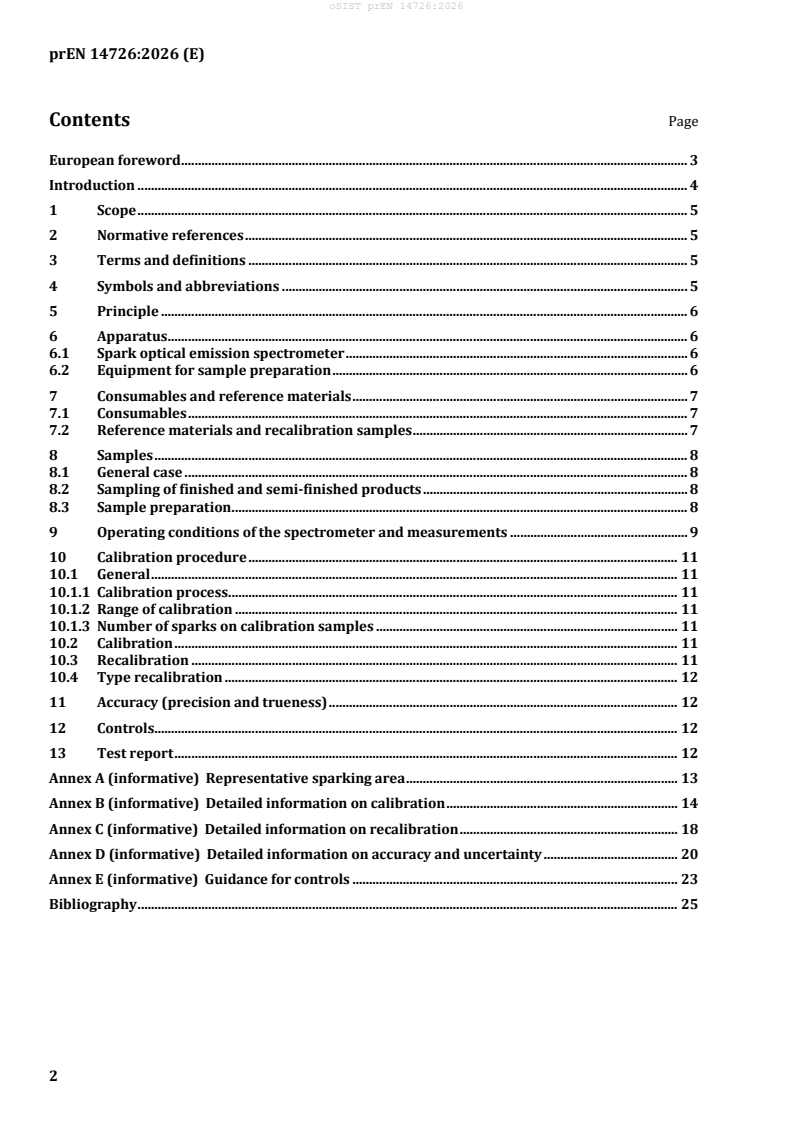
Contents Page
European foreword . 3
Introduction . 4
1 Scope . 5
2 Normative references . 5
3 Terms and definitions . 5
4 Symbols and abbreviations . 5
5 Principle . 6
6 Apparatus . 6
6.1 Spark optical emission spectrometer . 6
6.2 Equipment for sample preparation . 6
7 Consumables and reference materials . 7
7.1 Consumables . 7
7.2 Reference materials and recalibration samples . 7
8 Samples . 8
8.1 General case . 8
8.2 Sampling of finished and semi-finished products . 8
8.3 Sample preparation . 8
9 Operating conditions of the spectrometer and measurements . 9
10 Calibration procedure . 11
10.1 General . 11
10.1.1 Calibration process . 11
10.1.2 Range of calibration . 11
10.1.3 Number of sparks on calibration samples . 11
10.2 Calibration . 11
10.3 Recalibration . 11
10.4 Type recalibration . 12
11 Accuracy (precision and trueness) . 12
12 Controls . 12
13 Test report . 12
Annex A (informative) Representative sparking area . 13
Annex B (informative) Detailed information on calibration . 14
Annex C (informative) Detailed information on recalibration . 18
Annex D (informative) Detailed information on accuracy and uncertainty . 20
Annex E (informative) Guidance for controls . 23
Bibliography . 25
European foreword
This document (prEN 14726:2026) has been prepared by Technical Committee CEN/TC 132 “Aluminium
and aluminium alloys”, the secretariat of which is held by AFNOR.
This document is currently submitted to the CEN Enquiry.
This document will supersede EN 14726:2019.
— deletion of the sentence about the determination of mercury content from Scope as being a
recommendation;
— rewording of Subclause 10.2;
— rewording of Subclause 10.3;
— deletion of Subclause 10.5;
— minor text updates in Clauses 7.2, 9 and 13;
— introduction of requirements regarding reference materials in Table B.1;
— rewording of Subclause B.3.1;
— rewording of last paragraph, Subclause C.1;
— deletion of Subclause C.3;
— updated Bibliography.
Introduction
In spark optical emission spectrometry (S-OES), a small portion of the sample is thermally vaporized
through the erosion of an electric spark. In the spark discharge, the aerosol is vaporized, partially ionized
and excited to emit optical radiation. The characteristic radiation of each element is used in spark optical
emission spectrometry for its detection and for its quantitative determination.
Optical emission spectrometry (OES): A technique that measures the emission characteristic of a
material in the ultraviolet, visible, or infrared wavelength regions of the electromagnetic spectrum.
Atomised particles are excited, and each element emits a characteristic radiant energy. This characteristic
radiation is detected using either a photomultiplier tube or a solid state detector; appropriate software
is used to record the presence of elements and to quantitatively determine elemental content.
Spark optical emission spectrometry (S-OES): A technique that utilizes a high voltage capacitor
discharge to ablate and atomise a section of the tested material in an inert atmosphere. The excited atoms
and ions emit electromagnetic radiation, which is detected and analysed by an optical emission
spectrometer.
Spark optical emission spectrometry is suitable for determining the chemical composition of alloys before
the manufacturing and casting processes: in these cases, samples are taken from the liquid metal at
different stages of the casting process. Spark optical emission spectrometry is also used to determine the
chemical composition of final products.
The method covered by this document is primarily for the analysis of aluminium or aluminium alloy chill
cast solid samples, as described in EN 14361, although other samples forms are acceptable.
1 Scope
This document describes the criteria and the procedure for analysing aluminium and aluminium alloys
with spark optical emission spectrometry (S-OES). This document specifies the following:
— sample preparation;
— operational guidelines for an optical emission spectrometer (including maintenance);
— traceability of the analytical results to the International System of units: mass (kg);
— assessing the uncertainty associated with each analytical result.
This document refers to simultaneous spark emission spectrometers for the analysis of solid samples.
This document applies to the determination of silicon, iron, copper, manganese, magnesium, chromium,
nickel, zinc, titanium, boron, gallium, vanadium, beryllium, bismuth, calcium, cadmium, cobalt, lithium,
sodium, phosphorus, lead, antimony, tin, strontium and zirconium in aluminium and aluminium alloys.
This document is applicable to the determination of elements other than those listed above with the
following conditions:
a) suitable reference materials are available; and
b) the instrument is suitably calibrated and equipped.
The test result obtained from a spark optical emission spectrometer generally concerns an amount of less
than one milligram per spark spot. The result can be used to refer to the laboratory test sample, to the
aluminium or aluminium alloy melt or to the cast product.
2 Normative references
The following documents are referred to in the text in such a way that some or all of their content
constitutes requirements of this document. For dated references, only the edition cited applies. For
undated references, the latest edition of the referenced document (including any amendments) applies.
EN 12258-2, Aluminium and aluminium alloys - Terms and definitions - Part 2: Chemical analysis
EN 14361, Aluminium and aluminium alloys - Chemical analysis - Sampling from metal melts
3 Terms and definitions
For the purposes of this document, the terms and definitions given in EN 12258-2 apply.
ISO and IEC maintain terminology databases for use in standardization at the following addresses:
— ISO Online browsing platform: available at https://www.iso.org/obp
— IEC Electropedia: available at https://www.electropedia.org/
4 Symbols and abbreviations
Symbols are defined for each formula. Abbreviations are put in brackets immediately after a term first
appears in the text (e.g. S-OES).
5 Principle
Measurement of the intensity of the radiation, whose wavelength is characteristic of each element,
generated by a spark resulting from the application of an electrical discharge between the sample, as one
electrode, and an inert counter-electrode, after mechanical preparation of the surface of the sample,
which is in general taken from the metal melt.
The content of each element is determined by relating the measured intensities of the samples to
calibration curves.
Signals are evaluated using:
— alloy calibration and universal calibration: reference materials with similar chemical compositions
are used to prepare evaluation functions;
— master curve calibration: reference materials with known chemical compositions are measured, and
evaluation functions are recalculated.
Evaluation of the accuracy of the results, in accordance with quality assurance procedures, to be defined
by each laboratory.
6 Apparatus
6.1 Spark optical emission spectrometer
The optical emission spectrometer shall utilize excitation by spark discharge and be suitable for the
determination of the chemical composition of aluminium and aluminium alloys.
Spark optical emission spectrometers are composed of the following main functional devices:
a) system for atomization and excitation:
1) spark generator (spark source);
2) spark stand with counter electrode.
b) optical system (system for spectral radiation splitting);
c) system for radiation intensity measurement (radiation detectors);
d) system for acquisition of the measured values, data processing and evaluation.
The documentation of spark optical emission spectrometers should be in accordance with the
requirements of EN ISO/IEC 17025.
6.2 Equipment for sample preparation
Lathes, milling machines, circular and band saws, grinders or any other suitable device can be used for
the preparation of the samples. Equipment used for the surface final preparation stage shall be capable
of machining both reference samples and test samples to the same condition.
NOTE Adjustable cutting speeds are advantageous for alloys of different hardnesses.
7 Consumables and reference materials
7.1 Consumables
Consumables are generally specified:
— in the laboratory analytical procedures,
— in the manufacturer equipment instructions, or
— according to preliminary tests.
Consumables include, but are not restricted to the following:
— feed gas of specified purity (argon for spectrometry, high purity; see instrument manufacturer
recommendation);
— gas purification cartridge for the feed gas (if required to meet the instrument manufacturer
specifications);
— cleaning brushes for the counter-electrode, if needed (the filaments should not contaminate the
electrode);
— particle trap for filtering the metal condensate out of the waste-gas stream;
— spare and expendable parts for the spark optical emission spectrometer in accordance with the
manufacturer's instructions (e.g. counter electrode, insert for sample table, etc.).
7.2 Reference materials and recalibration samples
The certified reference materials, the reference materials (see ISO Guide 30) and the recalibration
samples should be listed and documented in a laboratory procedure and/or in the validation or
verification report:
— certified reference materials for calibration (see Clause 10);
— blank sample: high-purity aluminium or aluminium alloy prepared from high-purity constituents
(e.g. Al Sn30) (see Clause 10);
— binary samples (if required e.g. for line interference correction (see Clause 10));
— control samples for checking the accuracy of the calibration; they shall not be included in the
calibration functions (see Clauses 10 and 11);
— samples for the control of the spectrometer drift (see Clause 12);
— recalibration samples for drift correction (see Clause 10).
8 Samples
8.1 General case
Sampling plays an essential role in the accuracy of the analytical results. Sampling allows obtaining
laboratory samples whose dimensions are suitable for the preparation of test samples for S-OES and
whose chemical composition shall represent that of the material to be tested.
Sampling of molten metal shall be carried out according to EN 14361.
Test samples, shall present a defined area which represents their average chemical composition. This
area shall be sufficiently homogeneous across the test section. The position and size of the representative
sample area varies with the sampling conditions, as well as with the type of alloy and the analytes.
NOTE 1 The test result only refers to the effective test area which is the vaporized fraction of the sample.
For the simultaneous multi-element analysis of different alloys, a mean analysis zone should be defined.
For S-OES, there is an additional requirement: as far as possible, the metallographic structure in the test
sample and in reference materials should be similar.
NOTE 2 Cylindrical samples with ∅ 40 mm × 30 mm (∅ 55 mm × 30 mm) and disc samples with a central sprue,
e.g. ∅ 50 mm × 10 mm or ∅ 55 mm × 4,5 mm (also called plate or mushroom sample) are frequently used.
8.2 Sampling of finished and semi-finished products
A piece, suitable for use on the spark stand, is mechanically separated (e.g. by sawing) from the part to
be analysed (see NOTE). Such piece shall have a minimum thickness of approximately 1 mm, cut in such
a way that allows the plane surface to be machined or otherwise prepared. Additionally, it should be large
enough for a sealing edge to protrude over the opening of the sample table (exception: air stand). When
using small samples, care should be taken to ensure that no overheating occurs due to sparking.
NOTE A small piece of any finished or semi-finished product can never truly represent the whole and a sample
of this type cannot be used to certify a cast.
To check the homogeneity of a sample using spark spectrometry, the piece of metal or ingot can be
analysed at various locations (e.g. along the diagonal through the part); special attention should therefore
be given to areas susceptible to segregation.
Attention should be given to possible systematic deviations due to structural differences to the reference
materials during evaluation.
A compromise for samples of sufficient size is to re-melt them in a suitable furnace under inert gas to
produce a sample similar to those normally used for S-OES. However, volatile elements, such as sodium,
magnesium can be partially lost during a re-melting operation.
8.3 Sample preparation
For spark optical emission spectral analysis, a plane, flat surface in the representative area is produced
on the sample by machining. Lathes and milling machines are used.
During final machining, the cutting speed, cutting angle and cutting tool should be chosen in such a way
that no sample material is raised above the machined surfaces and that no single hard grains are torn
from a soft microstructure. A certain residual roughness promotes the formation of electric sparks (see
manufacturer's instructions). The machined surface shall not be touched directly with the fingers or
otherwise contaminated, especially for the determination of sodium, calcium and phosphorous.
For the sample preparation of reference materials, check the homogeneity of a sample using the same
technique with the same machining parameters shall be used so that a similar surface condition is
achieved.
A compromise for samples of sufficient size is to re-melt them in a suitable furnace under inert gas to
produce a sample similar to those normally.
9 Operating conditions of the spectrometer and measurements
The operating conditions of the spectrometer shall be optimized.
NOTE 1 For simultaneous spectrometers equipped with photomultipliers, the detector channels for the
individual elements are pre-set on the base of the spectral line table, which is generally fixed by the apparatus
manufacturer according to each task definition (system requirements/specifications). Changes and expansions are
only possible by modifying the spectrometer. The space requirement for a detector channel does not allow the
combination of just any lines in a spectrometer of a given design. As a result, several optical spectrometer units are
sometimes used in one instrument.
NOTE 2 Information about possible interferences due to line overlap can be deemed from the spectral line
reference table, whereby interferences as a result of lines being in a different order can also be considered. In
general, the measuring signal of an analytical line is related to a line of the matrix element taken as a reference line.
For trace analyses, sometimes the intensity of a background position is used as reference.
NOTE 3 Other measuring conditions, such as spark parameters for pre-sparking and measurement sparking,
flush time, pre-spark time, delay time, measurement period, time-resolved intensity measurement, masking-out of
the radiation from the plasma, high-voltage adjustment of the photomultiplier tubes, are as a rule adjusted by the
manufacturer of the apparatus according to the measuring task or are optimized in accordance with the
manufacturer's instructions.
As instrument and computer software design differ, information on measurements, spectrometer
controls, the auxiliary equipment and maintenance operations shall be carried out in accordance with the
manufacturer's instructions and other relevant documents.
These instructions should be transposed into laboratory procedures describing individual analytical
programs and operational processes. To that, the following items should be taken into account:
a) start-up (restart):
1) check before start-up (e.g. argon feed, exhaust-gas duct, cooling water, vacuum pump oil);
2) switch on the spectrometer and all units generally in the following order: cooling water pump,
vacuum pump (if any), instrument electronics and high voltage power supply;
3) start computer and analytical program;
4) check the instrument status stability (e.g. vacuum, temperature, instrument profile);
5) check the analysis stability (e.g. measurement of suitable spectrometer control samples).
b) switching off:
1) back-up of data;
2) close vacuum valve or purge spectrometer with inert gas, if necessary;
3) switch off the instrument units in the following order: high voltage power supply, instrument
electronics, vacuum pump (if any), cooling water pump;
4) switch off the instrument power supply;
5) shut off gas feed.
c) sparking (independent of sample type):
1) in case of manual operation: place sample, start measuring cycle, exclude bad sparking (e.g.
intensity of the reference line < 90 %; memory effect), clean counter electrode and spark stand,
number of sparkings (may vary according to sample type), method of averaging;
2) in case of instruments with sample handling systems (robots): position sample, start.
d) drift correction or recalibration:
1) list of recalibration samples (setting-up samples);
2) procedure, criteria of decision for outliers, maximum allowable deviations;
3) responsibilities.
e) carrying out an analysis or checking control analysis:
1) selection of the analytical program (according to alloy or alloy group);
2) sample identification;
3) validation of the results (criteria, responsibilities);
4) test report.
f) fault detection and backdated corrective actions in the event of instrument malfunction:
1) spectrometer failures;
2) computer and software failures;
3) analytical failures (certified control samples);
4) rejecting (suspensions) of released analytical results (backdated before the recognition of the
discrepancies).
g) tests on spectrometer system:
1) status measured values (voltage stability, temperature, vacuum, gas flow);
2) spark parameters (electrode gap);
3) intensity during drift correction;
4) line profiles;
5) light transmittance of the entrance window;
6) limits of detection and background equivalent contents;
7) short and long term precision.
h) maintenance and cleaning:
1) at fixed intervals in relation to the consumables, depending on usage
2) by external service technician;
3) data back-up.
10 Calibration procedure
10.1 General
10.1.1 Calibration process
The calibration process is subdivided into calibration and drift compensation by recalibration.
10.1.2 Range of calibration
The range of calibration for an element shall extend well below the minimum content reported in the
relevant products standards and above the maximum content reported in the same products standards,
taking into account that the lowest limit should be at least three times the detection limit.
10.1.3 Number of sparks on calibration samples
The number of sparks carried out on each reference material for calibration shall be not less than four.
The spark areas shall be distributed over the prepared surface. Centre and border of the sample shall be
avoided. All measurements shall be examined; if any measurement is obviously defective, further sparks
shall be carried out to obtain the minimum four acceptable measurements. The intensity average of the
four acceptable measurements is used for calibration provided that the related relative standard
deviation is < 5 %. For further information on representative sparking area, see Annex A.
10.2 Calibration
The calibration of the spectrometer is performed by using a series of suitable materials of known
composition (preferably RM and CRM), which shall have the same or at least a similar matrix and
metallurgical structure as the samples to be analysed, in order to calculate the calibration functions from
which the analysis of the analytical samples can be obtained. The content range of the materials used
shall cover that of all the samples to be analysed within each specific analytical program. For each element
in each reference material, the mean intensity is correlated to the corresponding certified content and a
regression is calculated.
Calibration is usually performed when the device is installed. Calibration shall be carried out in
accordance with the spectrometer manufacturer's operating manual.
The trueness of the analytical procedure is checked by measuring a set of certified reference materials or
- if not available - a set of reference materials not used in the calibration. These reference materials shall
cover at least the low, mid and high points of the calibration range for each element.
NOTE For further information on calibration, see Annex B.
10.3 Recalibration
Drifts of the spectrometer readings shall be corrected using a recalibration procedure (often described
in the manufacturer's instruction manual). Recalibrations can be done either for all analytical channels
(global recalibration), or only for individual analytical channels (selective recalibration).
Recalibration can either be done periodically or due to a deviation from statistical process control (SPC)
limits (see Annex C). When a periodical recalibration procedure is used, the period depends on the
stability of the spectrometer and has to be established after stability tests of the spectrometer. The
stability check shall be repeated at appropriate intervals.
NOTE 1 The same set of check samples can be used both for
...