

SIST-TP CEN/TR 17965:2023
(Main)Construction products - Assessment of release of dangerous substances - Guidance for a broader application of the CEN/TC 351 reference room
General Information
- Abstract
To provide a concise overview of the following aspects of the application of reference rooms for the evaluation of emissions from products in indoor environments;
European dimension of the scope (regulations and schemes)
Evaluation of VOC emissions from building products: principles
Background history
Implementation in national regulations
Implementation in voluntary schemes
Broader application of the reference room (in addition to construction products)
Other possible dimensions of a reference room
Conclusion and references
- Status
- Published
- Public Enquiry End Date
- 24-Apr-2023
- Publication Date
- 16-Aug-2023
- Technical Committee
- NES - Dangerous substances
- Current Stage
- 6060 - National Implementation/Publication (Adopted Project)
- Start Date
- 22-Jun-2023
- Due Date
- 27-Aug-2023
- Completion Date
- 17-Aug-2023

Overview - CEN/TR 17965:2023 (reference room guidance)
CEN/TR 17965:2023 provides guidance on a broader application of the CEN/TC 351 reference room used to assess release of dangerous substances into indoor air. It explains the European context (regulations and labelling schemes), gives the principles for evaluating VOC emissions from building products, summarizes the background history, and describes how the EN 16516 model/reference room concept has been - and can be - implemented in national regulations and voluntary schemes. The technical report also explores extending the reference room method beyond construction products (e.g., paints, furniture, air fresheners) and alternative reference-room dimensions and exposure scenarios.
Key topics and technical requirements
- Reference room concept: Uses the EN 16516 model room as a common exposure scenario to translate laboratory emission data into indoor air concentrations for health evaluation.
- Standard reference room parameters: EN 16516 defines a typical residential reference room of 30 m3 with an air change rate of 0.5 h−1 (AC = 0.5) and prescribed emitting surface areas and loading factors for floors, walls, ceilings, doors, windows and small surfaces.
- Emission characterization (SER): Emissions are expressed as an area-specific emission rate (SER). SER calculation depends on measured chamber concentration (c), chamber air change rate (AC), and chamber loading factor (LA). The concept of area-specific air flow rate (q = AC/LA) is used to convert SER to expected room concentrations.
- Exposure and health evaluation: Calculated exposure concentrations for the reference room are compared with health-based benchmarks (e.g., EU-LCI values) using the LCI concept and other evaluation tools.
- Scope for broader application: Practical examples in the report include using the 30 m3 room for other product types and defining other room sizes/ventilation rates to represent different indoor scenarios.
Practical applications - who uses this standard
- Manufacturers and product developers of construction materials, paints, furniture and consumer indoor products - to quantify emissions and demonstrate compliance.
- Test laboratories - to report SERs and convert chamber results into exposure concentrations using the reference room approach.
- Regulators and certification/label schemes - to harmonize health-based assessment and compare products.
- Building designers, specifiers and indoor-air-quality professionals - to assess potential indoor exposures and select low-emission products.
- Researchers - to develop alternative exposure scenarios and validate model rooms for non-construction products.
Related standards and references
- EN 16516:2017+A1:2020 - Determination of emissions into indoor air (normative reference for SER and reference room calculations).
- EN ISO 16000 series - foundational test methods referenced by EN 16516.
- EU-LCI (harmonized limit values) used for health-based evaluation.
CEN/TR 17965:2023 is a practical, harmonizing resource for converting laboratory emission data into comparable indoor exposure estimates and for extending the model-room methodology to a wider set of indoor products and scenarios.
Relations
- Effective Date
- 28-Jan-2026
Get Certified
Connect with accredited certification bodies for this standard

BSI Group
BSI (British Standards Institution) is the business standards company that helps organizations make excellence a habit.

Bureau Veritas
Bureau Veritas is a world leader in laboratory testing, inspection and certification services.

DNV
DNV is an independent assurance and risk management provider.
Sponsored listings
Frequently Asked Questions
SIST-TP CEN/TR 17965:2023 is a technical report published by the Slovenian Institute for Standardization (SIST). Its full title is "Construction products - Assessment of release of dangerous substances - Guidance for a broader application of the CEN/TC 351 reference room". This standard covers: To provide a concise overview of the following aspects of the application of reference rooms for the evaluation of emissions from products in indoor environments; European dimension of the scope (regulations and schemes) Evaluation of VOC emissions from building products: principles Background history Implementation in national regulations Implementation in voluntary schemes Broader application of the reference room (in addition to construction products) Other possible dimensions of a reference room Conclusion and references
To provide a concise overview of the following aspects of the application of reference rooms for the evaluation of emissions from products in indoor environments; European dimension of the scope (regulations and schemes) Evaluation of VOC emissions from building products: principles Background history Implementation in national regulations Implementation in voluntary schemes Broader application of the reference room (in addition to construction products) Other possible dimensions of a reference room Conclusion and references
SIST-TP CEN/TR 17965:2023 is classified under the following ICS (International Classification for Standards) categories: 13.020.99 - Other standards related to environmental protection; 13.040.20 - Ambient atmospheres; 91.100.01 - Construction materials in general. The ICS classification helps identify the subject area and facilitates finding related standards.
SIST-TP CEN/TR 17965:2023 has the following relationships with other standards: It is inter standard links to SIST EN 16516:2018+A1:2020. Understanding these relationships helps ensure you are using the most current and applicable version of the standard.
SIST-TP CEN/TR 17965:2023 is associated with the following European legislation: EU Directives/Regulations: 305/2011; Standardization Mandates: M/366. When a standard is cited in the Official Journal of the European Union, products manufactured in conformity with it benefit from a presumption of conformity with the essential requirements of the corresponding EU directive or regulation.
SIST-TP CEN/TR 17965:2023 is available in PDF format for immediate download after purchase. The document can be added to your cart and obtained through the secure checkout process. Digital delivery ensures instant access to the complete standard document.
Standards Content (Sample)
SLOVENSKI STANDARD
01-september-2023
Gradbeni proizvodi - Ocenjevanje sproščanja nevarnih snovi - Navodilo za širšo
uporabo referenčne komore CEN/TC 351
Construction products - Assessment of release of dangerous substances - Guidance for
a broader application of the CEN/TC 351 reference room
Bauprodukte - Bewertung der Freisetzung von gefährlichen Stoffen - Leitfaden für eine
weiterführende Anwendung des CEN/TC 351 Referenzraums
Produits de construction - Evaluation de l'émission de substances dangereuses Guide
pour une application à dautres domaines de la chambre de référence du CEN/TC 351
Ta slovenski standard je istoveten z: CEN/TR 17965:2023
ICS:
13.020.99 Drugi standardi v zvezi z Other standards related to
varstvom okolja environmental protection
13.040.20 Kakovost okoljskega zraka Ambient atmospheres
91.100.01 Gradbeni materiali na Construction materials in
splošno general
2003-01.Slovenski inštitut za standardizacijo. Razmnoževanje celote ali delov tega standarda ni dovoljeno.
CEN/TR 17965
TECHNICAL REPORT
RAPPORT TECHNIQUE
June 2023
TECHNISCHER REPORT
ICS 13.040.20; 91.100.01
English Version
Construction products: Assessment of release of
dangerous substances - Guidance for a broader application
of the CEN/TC 351 reference room
Produits de construction : Évaluation de l'émission de Bauprodukte: Bewertung der Freisetzung von
substances dangereuses - Possibilités d'extension du gefährlichen Stoffen - Leitfaden für eine
champ d'application de la pièce de référence du weiterführende Anwendung des CEN/TC 351
CEN/TC 351 Referenzraums
This Technical Report was approved by CEN on 28 May 2023. It has been drawn up by the Technical Committee CEN/TC 351.
CEN members are the national standards bodies of Austria, Belgium, Bulgaria, Croatia, Cyprus, Czech Republic, Denmark, Estonia,
Finland, France, Germany, Greece, Hungary, Iceland, Ireland, Italy, Latvia, Lithuania, Luxembourg, Malta, Netherlands, Norway,
Poland, Portugal, Republic of North Macedonia, Romania, Serbia, Slovakia, Slovenia, Spain, Sweden, Switzerland, Türkiye and
United Kingdom.
EUROPEAN COMMITTEE FOR STANDARDIZATION
COMITÉ EUROPÉEN DE NORMALISATION
EUROPÄISCHES KOMITEE FÜR NORMUNG
CEN-CENELEC Management Centre: Rue de la Science 23, B-1040 Brussels
© 2023 CEN All rights of exploitation in any form and by any means reserved Ref. No. CEN/TR 17965:2023 E
worldwide for CEN national Members.
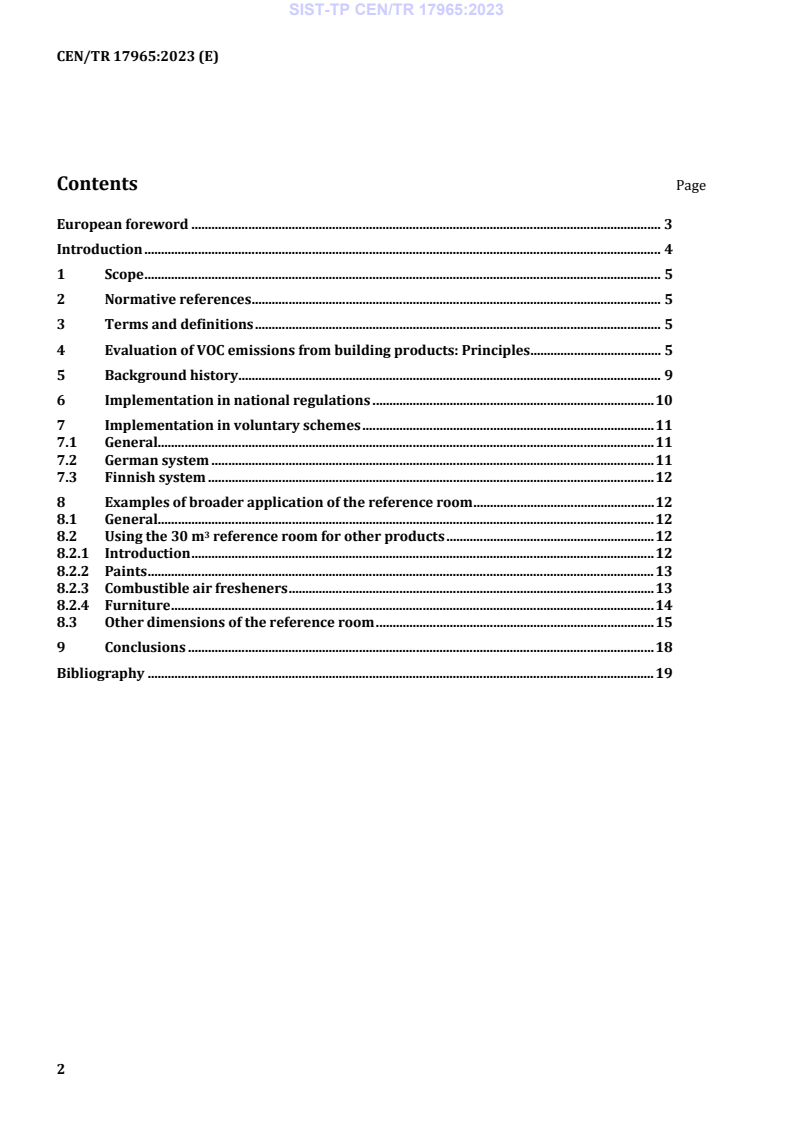
Contents Page
European foreword . 3
Introduction . 4
1 Scope . 5
2 Normative references . 5
3 Terms and definitions . 5
4 Evaluation of VOC emissions from building products: Principles . 5
5 Background history . 9
6 Implementation in national regulations . 10
7 Implementation in voluntary schemes . 11
7.1 General. 11
7.2 German system . 11
7.3 Finnish system . 12
8 Examples of broader application of the reference room . 12
8.1 General. 12
8.2 Using the 30 m reference room for other products . 12
8.2.1 Introduction . 12
8.2.2 Paints . 13
8.2.3 Combustible air fresheners . 13
8.2.4 Furniture . 14
8.3 Other dimensions of the reference room . 15
9 Conclusions . 18
Bibliography . 19
European foreword
This document (CEN/TR 17965:2023) has been prepared by Technical Committee CEN/TC 351
“Construction products: Assessment of release of dangerous substances”, the secretariat of which is held
by NEN.
Attention is drawn to the possibility that some of the elements of this document may be the subject of
patent rights. CEN shall not be held responsible for identifying any or all such patent rights.
This document has been prepared under a mandate given to CEN by the European Commission and the
European Free Trade Association.
CEN/TC 351 prepared the European Standard EN 16516:2017+A1:2020 for the determination of
emissions of volatile compounds from building products into indoor air. EN 16516:2017+A1:2020 also
describes the method for the health-related evaluation of emissions using the concept of the so-called
model room.
This document illustrates the potential use of the model room for the evaluation of emissions from indoor
sources other than building products and/or for their intended use in reference indoor environments
different from the reference room described in EN 16516:2017+A1:2020.
Any feedback and questions on this document should be directed to the users’ national standards body.
A complete listing of these bodies can be found on the CEN website.
Introduction
Determination of emissions of dangerous substances from building products into indoor air is carried out
under their intended conditions of use. The intended condition of use of a construction product is
generally specified in the corresponding harmonized product standard. The specific emission rates
determined using EN 16516:2017+A1:2020 are associated with application of the product in a European
Reference Room, under specified climate (temperature, relative humidity) and ventilation conditions.
Converting the test results (Specific Emission Rates: SER) into concentrations in the air of a reference
room is essential because it enables the comparison of those concentrations with reference values and
facilitates the classification of product emissions on the basis of its potential impact on indoor air.
From a technical perspective the SER, as a product characteristic parameter, allows the calculation of the
indoor exposure concentration deriving from any component (construction product, furniture, air
fresheners, etc.) for any room scenario.
The intended conditions of use describe the purpose, place and circumstances of typical applications of a
construction product as defined in a product standard. This includes the intended use (e.g. for what
purpose, how is the product typically installed, etc.) and an emission scenario.
When determining emissions into indoor air, the emission scenario specifies the climate and ventilation
conditions of the air surrounding the product in the reference room. The actual conditions of use in reality
may be different, but it is not possible to evaluate emissions under all possible use scenarios. EN 16516
specifies a set of conditions that are generally agreed to be representative of the use of the product in
“normal” indoor environments, such that all construction products can be evaluated under comparable
conditions.
These defined conditions assume a standardized installation of the product in the reference room with
standardized dimensions, climate and ventilation.
1 Scope
This document describes the concept of a reference room with respect to its application in the health-
related evaluation of dangerous substance emissions from indoor products. The evolution of the
reference room concept with respect to mandatory and voluntary labelling schemes for building products
is outlined. The current limited application to other product types is described as well as the potential for
broader application, either to additional products or for other exposure scenarios that may apply
reference room/s with different characteristics.
2 Normative references
The following documents are referred to in the text in such a way that some or all of their content
constitutes requirements of this document. For dated references, only the edition cited applies. For
undated references, the latest edition of the referenced document (including any amendments) applies.
EN 16516:2017+A1:2020, Construction products: Assessment of release of dangerous substances -
Determination of emissions into indoor air
3 Terms and definitions
For the purposes of this document, the terms and definitions given in EN 16516:2017+A1:2020 apply.
ISO and IEC maintain terminological databases for use in standardization at the following addresses:
• IEC Electropedia: available at https://www.electropedia.org/
• ISO Online browsing platform: available at https://www.iso.org/obp
4 Evaluation of VOC emissions from building products: Principles
The evaluation of volatile organic compounds (VOC) emissions from any indoor source with respect to
their potential effects on health and comfort may be broken down into three main steps (adapted from
JRC, ECA Report 18):
1) Characterization of VOC emissions from indoor sources into indoor air according to a standardized
method,
2) Estimation of the exposure an individual may experience indoors due to emissions from a specific
source (e.g. building products),
3) Evaluation of the effect of indoor exposure on human health.
This simplified risk assessment evaluation scheme is specified for the evaluation of VOC emissions from
building materials using the following tools:
a) Characterization of VOC emissions from building products is performed using
EN 16516:2017+A1:2020 which is based on parts of EN ISO 16000 and former ENV 13419
standards,
b) Estimation of the exposure to VOC emitted by building products is performed using the reference
room concept,
c) Evaluation of the potential health effect of exposure to VOC emitted by building products is
performed using the LCI concept .
NOTE As well as to VOC, EN 16516:2017+A1:2020 can be applied to determine other vapour phase organic
compound emissions (very volatile and semi-volatile organic compounds) and can also be used to determine
ammonia emissions.
EN 16516:2017+A1:2020 details calculation of specific emission rates and expression of results in
a reference room.
Relevant test parameters are the following:
— c , the mass concentration of compound i sampled at the test chamber outlet (µg/m );
i
— S , the emitting surface of the specimen placed in the emission test chamber (m );
t,
— VR , the ventilation rate of the test chamber (m /h);
t
— V , the volume of the test chamber (m ).
t
The following definitions apply.
The air change rate in the test chamber, AC , is calculated according to Formula (1).
t
VR
t
AC = (1)
t
V
t
where
AC is the air change rate of the test chamber, in air changes/h;
t
VR is the ventilation rate of the test chamber, in m /h;
t
V is the volume of the test chamber, in m .
t
, is calculated according to Formula (2).
The loading factor in the test chamber, LAt
S
t
LA=
(2)
t
V
t
where
2 3
LA is the loading factor in the test chamber, in m /m ;
t
S is the emitting surface of the specimen placed in the emission test chamber, in m ;
t
V is the volume of the test chamber, in m .
t
For the characterization of VOC emissions from building products, test results are generally expressed as
area specific emission rates, SER . These are calculated according to Formula (3).
A
Harmonized EU-LCI have been derived (https://ec.europa.eu/growth/sectors/construction/eu-lci/values_en)
c× AC
i t
SER = (3)
A
LA
t
where
SER is the area specific emission rate, in µg/m⋅h;
A
c is the mass concentration of compound i sampled at the test chamber outlet, in
i
µg/m ;
is the air change rate of the test chamber, in air changes/h;
ACt
2 3
LA is the loading factor in the test chamber, in m /m .
t
The ratio AC /LA is called area specific air flow rate, q . Hence SER can also be expressed as Formula (4).
t t A A
SER c×q (4)
AAi
where
SER is the area specific emission rate, in µg/m⋅h;
A
c is the mass concentration of compound i sampled at the test chamber outlet, in
i
µg/m ;
3 2
q is the area specific air flow rate, in m /m⋅h.
A
with
AC
t
q =
A
LA
t
where
AC is the air change rate of the test chamber, in air changes/h;
t
2 3
LA is the loading factor in the test chamber, in m /m .
t
Using the same calculation principle, one can calculate concentrations resulting from emissions from
a building product, with a SER experimentally determined, placed in any room provided that the
A
following room parameters are known:
— Air change rate in the room, AC (air changes/h);
R
— Volume of the room, V (m );
R
— Surface of the considered building product in the room, S (m ).
R
Then the loading factor in the room, LA , is calculated according to Formula (5).
R
S
R
LA = (5)
R
V
R
where
2 3
LA is the loading factor in the room, in m /m ;
R
S is the emitting surface of the considered building product in the room, in m ;
R
V is the volume of the room, in m .
R
=
The resulting concentrations in the room, c , also called exposure concentrations, can be calculated
R
according to Formulae (6) to (8).
SER × LA
A R
c = (6)
R
AC
R
where
c is the concentration in the room, in µg/m ;
R
NOTE This parameter is also known as exposure concentration.
SER is the area specific emission rate, in µg/m⋅h;
A
2 3
LA is the loading factor in the room, in m /m ;
R
AC is the air change rate of the room, in air changes/h.
R
Or
SER
A
c = (7)
R
q
R
where
c is the concentration in the room, in µg/m ;
R
NOTE This parameter is also known as exposure concentration.
SER is the area specific emission rate, in µg/m⋅h;
A
3 2
q is the specific air flow rate in the room, in m /m⋅h;
R
with
AC
R
q = (8)
R
LA
R
where
AC is the air change rate of the room, in air changes/h;
R
2 3
LA is the loading factor in the room, in m /m .
R
As a convention, EN 16516:2017+A1:2020 specified characteristics of a typical residential room,
3 3
thereafter referred to as the reference room, with a 30 m volume (V = 30 m ) and a 0,5 air change per
R
hour (AC = 0,5 air changes/h). Emitting surfaces (S ) in the EN 16516:2017+A1:2020 reference room
R R
and corresponding loading factors (LA ) and area specific air flow rates (q ) are presented in Table 1.
R R
Table 1 — Surfaces (S ), loading factors (LA ) and area specific air flow rates (q ) for different
R R R
indoor surfaces of the 30 m reference room
S LA q
R R R
Indoor surfaces
2 2 3 3 2
m m /m m /m⋅h
Floor 12 0,4 1,25
Ceiling 12 0,4 1,25
Walls (minus door and window) 31,4 1,0 0,5
1 door 1,6 0,05 10
1 window 2 0,07 7
Small surfaces (e.g. sealants) 0,2 0,007 70
NOTE These values are taken from EN 16516:2017+A1:2020.
Calculation of exposure concentrations can be performed as soon as an area specific air flow rate (q )
R
representative of the potential use of the considered product in an indoor environment has been defined.
5 Background history
The implementation of Essential Requirement (ER) N° 3 concerning Hygiene, Health and Environment
within the Construction Product Directive (CPD) in 1989 was a legislative response at the European level
to concerns about indoor air contamination in buildings, especially due to volatile organic compounds
(VOC) emissions from building products.
Already in 1982, a “standard reference room“ had been defined, this being a room with a volume of 17 m ,
a floor and ceiling surface of 7 m and a height of 2,4 m (Mølhave et al.), and this was subsequently applied
in national standards concerning determination and evaluation of VOC emissions from building products
(DS/INF 90:1994) and Nordtest method (NT BUILD 358, 1990).
The European Concerted action on Indoor Air Quality and its Impact on Man (COST Project 613) and the
subsequent European Collaborative Action over the time period of 1988-2013, documented in the “ECA
Reports”, summarizes the state of research in the EU in the field of health related substances in interiors
and provided the basis for the development of the harmonized test standard EN 16516:2017+A1:2020
for the assessment and evaluation of the emission of volatile organic compounds from construction
products.
In the ECA-IAQ Report N° 18 (1997), the standard room is not explicitly described, but the ventilation
(i.e. air exchange rate) within specifically used indoor rooms for three different exposure scenarios and
area specific ventilation rates were described to be used for the toxicological and sensory evaluation of
VOC emissions. The medium class scenario defines a ventilation rate of 0,5/h with an area specific
3 2
ventilation rate of 1,25 m /m⋅h.
A European reference room first appeared in 1999 in ENV 13419-1 which was transposed in 2006 into
EN ISO 16000-9:2006. Informative Annex B of EN ISO 16000-9:2006 presents examples of area specific
3 3
air flow rates in a 17,4 m reference room (V = 17,4 m ) with a 0,5 air change per hour (AC = 0,5 air
R R
changes/h) (see Table 2).
Table 2 — Surfaces (S ), loading factors (LA ) and area specific air flow rates (q ) for different
R R R
indoor surfaces of the 17,4 m reference room
Indoor surfaces S LA q
R R R
2 2 3 3 2
m m /m m /m⋅h
Floor 7 0,4 1,25
Ceiling 7 0,4 1,25
Walls 24 1,4 0,4
Small surfaces (e.g. sealants) 0,2 0,012 44
NOTE These values are taken from EN ISO 16000-9:2006, Annex B.
Considering individually used rooms in dwellings, a bedroom containing a double bed needs a minimum
floor area of 3 m × 4 m (12 m ), which equals the standard room in the German AgBB scheme for the
health-related evaluation of volatile organic compounds emissions (VVOC, VOC and SVOC) from building
products (see AgBB, 2021). The minimum ceiling height in dwellings in many European countries today
is 2,4 m, but practically mostly not below 2,5 m.
As an outcome of discussions in the CEN committee preparing the technical specification
CEN/TS 16516:2013 that formed the basis for EN 16516:2017+A1:2020, it was decided in 2008 to apply
a normative 30 m reference room with 3 m × 4 m floor and ceiling dimensions, a 2,5 m height and an air
exchange rate of 0,5/h (see Table 1).
6 Implementation in national regulations
In 2003, the first version of the AgBB Evaluation procedure for VOC emissions from building products
was issued in Germany (AgBB, 2003). The reference room described in the 2003 AgBB evaluation scheme
had an air exchange rate of 0,5 air changes/hour, a 2,7 m height and 3 m × 4 m floor surface. This was
updated in the 2010 AgBB evaluation scheme (AgBB, 2010), where the reference room is mentioned with
a base area of 3 m × 4 m, a height of 2,5 m and an air exchange rate of 0,5 air changes/hour. The reference
room remains unchanged but more detailed loading factors have been presented in the most recent
version of the AgBB evaluation scheme (AgBB, 2021), in accordance with EN 16516:2017+A1:2020:
2 3
— 1,0 m /m for walls;
2 3
— 0,4 m /m for floor or ceiling;
2 3
— 0,05 m /m for small surfaces, e.g. a door;
2 3
— 0,007 m /m for very small surfaces, e.g. sealants.
Labelling of VOC emissions from building products is mandatory in France since 2012. The Order of April
19, 2011 (Arrêté du 19 avril 2011) related to t
...