

SIST-TS CEN/TS 18044:2024
(Main)Ambient air - Determination of the concentration of levoglucosan - Chromatographic method
General Information
- Abstract
This document specifies a chromatographic method for the determination of levoglucosan in aqueous or organic extracts of filter samples collected in accordance with EN 12341:2023 [5]. The method has been tested for concentrations of ca. 10 ng/m3 up to ca. 3 000 ng/m3 with a sampling duration of 24 h. The procedure is also suitable for the determination of galactosan and mannosan.
Depending on the analysis instrumentation used, the carbohydrates inositol, glycerol, threitol/erythritol, xylitol, arabitol, sorbitol, mannitol, threalose, mannose, glucose, galactose and fructose can also be determined. However, no performance characteristics are given for these compounds in this document.
- Status
- Published
- Public Enquiry End Date
- 02-Apr-2024
- Publication Date
- 18-Aug-2024
- Technical Committee
- KAZ - Air quality
- Current Stage
- 6060 - National Implementation/Publication (Adopted Project)
- Start Date
- 12-Aug-2024
- Due Date
- 17-Oct-2024
- Completion Date
- 19-Aug-2024

Overview
CEN/TS 18044:2024 specifies a chromatographic method for determining the concentration of levoglucosan in ambient air particulate matter. Intended for aqueous or organic extracts of filter samples collected in accordance with EN 12341:2023, the Technical Specification covers analysis using Ion Chromatography with Pulsed Amperometric Detection (IC‑PAD) and Gas Chromatography–Mass Spectrometry (GC‑MS). The method has been tested for concentrations from about 10 ng/m3 to 3 000 ng/m3 with a 24 h sampling period. The procedure is also suitable for determining galactosan and mannosan; other carbohydrates (e.g., arabitol, mannitol, glucose) can be measured depending on instrumentation, but performance data are not provided for these.
Key topics and technical requirements
- Scope and purpose: Measurement of levoglucosan as a tracer for biomass combustion in PM10/PM2.5.
- Sampling: Filter-based sampling per EN 12341:2023 using quartz or glass fibre filters with ≥99.5% separation efficiency at 0.3 µm.
- Extraction:
- Water extracts for IC‑PAD analysis.
- Organic solvent extracts (e.g., methanol or methanol/dichloromethane) for GC‑MS, with silylation prior to GC‑MS.
- Analytical methods:
- IC‑PAD: carbohydrate column with pulsed amperometric detection (gold electrode).
- GC‑MS: derivatization (e.g., silylation) and standard GC‑MS operating parameters (see Annex B).
- HPLC‑MS is noted as possible but not validated in this TS.
- Quality aspects: calibration, limits of detection/quantification, measurement uncertainty (ISO 5725-2, ISO/IEC Guide 98-3 referenced), interferences, and QA/QC procedures are included.
- Validation range: tested concentration range and sampling duration are specified; no performance claims for non‑validated carbohydrates.
Applications and users
- Environmental laboratories monitoring ambient air and particulate matter (PM10/PM2.5).
- Air quality authorities assessing the contribution of biomass combustion (wood burning) to particulate pollution.
- Researchers performing source apportionment studies using levoglucosan as a tracer for residential or agricultural biomass burning.
- Public health and policy analysts quantifying exposure to combustion-derived organic aerosols.
Related standards
- EN 12341:2023 - filter sampling for PM10/PM2.5 (referenced for sample collection).
- EN 15549:2008 - definitions for internal and surrogate standards (terms cited).
- ISO 5725-2, ISO/IEC Guide 98-3, ISO 13528 - methods for uncertainty and intercomparison evaluation (referenced in annexes).
Keywords: levoglucosan, ambient air, chromatographic method, IC‑PAD, GC‑MS, biomass combustion tracer, particulate matter, PM2.5, PM10, filter samples, EN 12341:2023, CEN/TS 18044:2024.
Get Certified
Connect with accredited certification bodies for this standard

ECOCERT
Organic and sustainability certification.

CIS Institut d.o.o.
Personal Protective Equipment (PPE) certification body. Notified Body NB-2890 for EU Regulation 2016/425 PPE.

Eurofins Food Testing Global
Global leader in food, environment, and pharmaceutical product testing.
Sponsored listings
Frequently Asked Questions
SIST-TS CEN/TS 18044:2024 is a technical specification published by the Slovenian Institute for Standardization (SIST). Its full title is "Ambient air - Determination of the concentration of levoglucosan - Chromatographic method". This standard covers: This document specifies a chromatographic method for the determination of levoglucosan in aqueous or organic extracts of filter samples collected in accordance with EN 12341:2023 [5]. The method has been tested for concentrations of ca. 10 ng/m3 up to ca. 3 000 ng/m3 with a sampling duration of 24 h. The procedure is also suitable for the determination of galactosan and mannosan. Depending on the analysis instrumentation used, the carbohydrates inositol, glycerol, threitol/erythritol, xylitol, arabitol, sorbitol, mannitol, threalose, mannose, glucose, galactose and fructose can also be determined. However, no performance characteristics are given for these compounds in this document.
This document specifies a chromatographic method for the determination of levoglucosan in aqueous or organic extracts of filter samples collected in accordance with EN 12341:2023 [5]. The method has been tested for concentrations of ca. 10 ng/m3 up to ca. 3 000 ng/m3 with a sampling duration of 24 h. The procedure is also suitable for the determination of galactosan and mannosan. Depending on the analysis instrumentation used, the carbohydrates inositol, glycerol, threitol/erythritol, xylitol, arabitol, sorbitol, mannitol, threalose, mannose, glucose, galactose and fructose can also be determined. However, no performance characteristics are given for these compounds in this document.
SIST-TS CEN/TS 18044:2024 is classified under the following ICS (International Classification for Standards) categories: 13.040.20 - Ambient atmospheres; 71.040.50 - Physicochemical methods of analysis. The ICS classification helps identify the subject area and facilitates finding related standards.
SIST-TS CEN/TS 18044:2024 is available in PDF format for immediate download after purchase. The document can be added to your cart and obtained through the secure checkout process. Digital delivery ensures instant access to the complete standard document.
Standards Content (Sample)
SLOVENSKI STANDARD
01-september-2024
Zunanji zrak - Določanje koncentracije levoglukozana - Kromatografska metoda
Ambient air - Determination of the concentration of levoglucosan - Chromatographic
method
Außenluft - Bestimmung der Konzentration von Levoglucosan - Chromatographisches
Verfahren
Air ambiant - Détermination de la concentration de lévoglucosan - Méthode
chromatographique
Ta slovenski standard je istoveten z: CEN/TS 18044:2024
ICS:
13.040.20 Kakovost okoljskega zraka Ambient atmospheres
71.040.50 Fizikalnokemijske analitske Physicochemical methods of
metode analysis
2003-01.Slovenski inštitut za standardizacijo. Razmnoževanje celote ali delov tega standarda ni dovoljeno.
CEN/TS 18044
TECHNICAL SPECIFICATION
SPÉCIFICATION TECHNIQUE
July 2024
TECHNISCHE SPEZIFIKATION
ICS 13.040.20
English Version
Ambient air - Determination of the concentration of
levoglucosan - Chromatographic method
Air ambiant - Détermination de la concentration de Außenluft - Bestimmung der Konzentration von
lévoglucosan - Méthode chromatographique Levoglucosan - Chromatographisches Verfahren
This Technical Specification (CEN/TS) was approved by CEN on 12 May 2024 for provisional application.
The period of validity of this CEN/TS is limited initially to three years. After two years the members of CEN will be requested to
submit their comments, particularly on the question whether the CEN/TS can be converted into a European Standard.
CEN members are required to announce the existence of this CEN/TS in the same way as for an EN and to make the CEN/TS
available promptly at national level in an appropriate form. It is permissible to keep conflicting national standards in force (in
parallel to the CEN/TS) until the final decision about the possible conversion of the CEN/TS into an EN is reached.
CEN members are the national standards bodies of Austria, Belgium, Bulgaria, Croatia, Cyprus, Czech Republic, Denmark, Estonia,
Finland, France, Germany, Greece, Hungary, Iceland, Ireland, Italy, Latvia, Lithuania, Luxembourg, Malta, Netherlands, Norway,
Poland, Portugal, Republic of North Macedonia, Romania, Serbia, Slovakia, Slovenia, Spain, Sweden, Switzerland, Türkiye and
United Kingdom.
EUROPEAN COMMITTEE FOR STANDARDIZATION
COMITÉ EUROPÉEN DE NORMALISATION
EUROPÄISCHES KOMITEE FÜR NORMUNG
CEN-CENELEC Management Centre: Rue de la Science 23, B-1040 Brussels
© 2024 CEN All rights of exploitation in any form and by any means reserved Ref. No. CEN/TS 18044:2024 E
worldwide for CEN national Members.
Contents Page
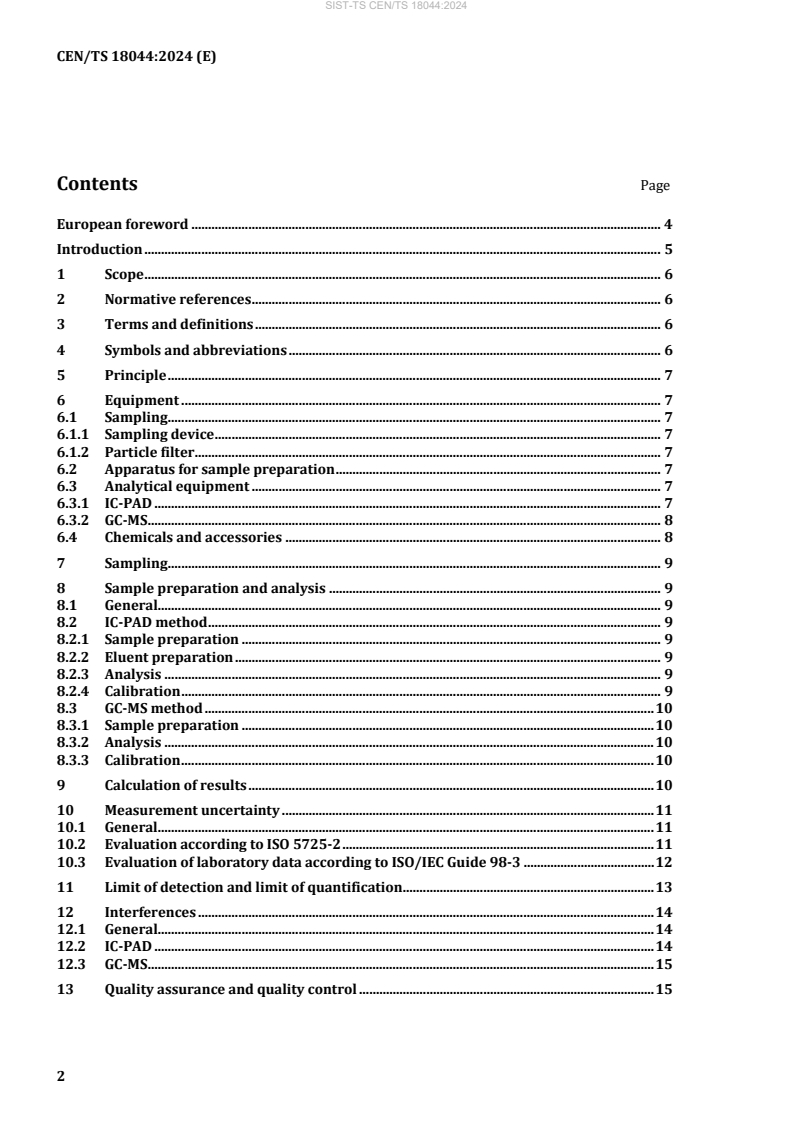
European foreword . 4
Introduction . 5
1 Scope . 6
2 Normative references . 6
3 Terms and definitions . 6
4 Symbols and abbreviations . 6
5 Principle . 7
6 Equipment . 7
6.1 Sampling . 7
6.1.1 Sampling device . 7
6.1.2 Particle filter . 7
6.2 Apparatus for sample preparation . 7
6.3 Analytical equipment . 7
6.3.1 IC-PAD . 7
6.3.2 GC-MS . 8
6.4 Chemicals and accessories . 8
7 Sampling . 9
8 Sample preparation and analysis . 9
8.1 General. 9
8.2 IC-PAD method . 9
8.2.1 Sample preparation . 9
8.2.2 Eluent preparation . 9
8.2.3 Analysis . 9
8.2.4 Calibration . 9
8.3 GC-MS method . 10
8.3.1 Sample preparation . 10
8.3.2 Analysis . 10
8.3.3 Calibration . 10
9 Calculation of results . 10
10 Measurement uncertainty . 11
10.1 General. 11
10.2 Evaluation according to ISO 5725-2 . 11
10.3 Evaluation of laboratory data according to ISO/IEC Guide 98-3 . 12
11 Limit of detection and limit of quantification . 13
12 Interferences . 14
12.1 General. 14
12.2 IC-PAD . 14
12.3 GC-MS . 15
13 Quality assurance and quality control . 15
Annex A (informative) Application examples of the IC-PAD method . 16
A.1 Example 1 . 16
A.1.1 Apparatus . 16
A.1.2 Operating parameters. 16
A.1.3 Chemicals and accessories . 17
A.1.4 Procedure . 18
A.2 Example 2 . 21
A.2.1 Apparatus . 21
A.2.2 Operating parameters. 22
A.2.3 Chemicals and accessories . 22
A.2.4 Procedure . 23
Annex B (informative) Application example of the GC-MS method . 28
B.1 Apparatus . 28
B.2 GC/MS operating parameters . 28
B.3 Chemicals . 28
B.4 Procedure . 29
B.4.1 Calibration standards . 29
B.4.2 Sample preparation . 30
Annex C (informative) Calculation of the measurement uncertainty using results of a
laboratory intercomparison . 32
C.1 General . 32
C.2 Calculations according to ISO 5725-2. 32
C.3 Calculation of uncertainty parameters according to ISO 13528 (Q/Hampel method)
................................................................................................................................................................... 33
C.4 Comparison of the two calculation methods . 34
Annex D (informative) Possible requirements for the uncertainty of single steps in work up
and analysis for an overall uncertainty of 40 % . 37
Annex E (informative) Calculation of the limit of detection from the calibration function . 39
Annex F (informative) Illustrative chromatograms . 40
Bibliography . 42
European foreword
This document (CEN/TS 18044:2024) has been prepared by Technical Committee CEN/TC 264 “Air
quality”, the secretariat of which is held by DIN.
Attention is drawn to the possibility that some of the elements of this document may be the subject of
patent rights. CEN shall not be held responsible for identifying any or all such patent rights.
Any feedback and questions on this document should be directed to the users’ national standards body.
A complete listing of these bodies can be found on the CEN website.
According to the CEN/CENELEC Internal Regulations, the national standards organisations of the
following countries are bound to announce this Technical Specification: Austria, Belgium, Bulgaria,
Croatia, Cyprus, Czech Republic, Denmark, Estonia, Finland, France, Germany, Greece, Hungary, Iceland,
Ireland, Italy, Latvia, Lithuania, Luxembourg, Malta, Netherlands, Norway, Poland, Portugal, Republic of
North Macedonia, Romania, Serbia, Slovakia, Slovenia, Spain, Sweden, Switzerland, Türkiye and the
United Kingdom.
Introduction
Emissions from the combustion of biomass (e.g. wood firing) contribute to particulate air pollution (PM ,
PM ). Under inversion weather conditions in winter, the contribution of biomass combustion to the
2,5
particulate load can increase up to 50 % of the PM average daily value. As levoglucosan originates by
pyrolysis of materials containing cellulose, it is a suitable tracer for biomass combustion [1 to 4].
The formation of levoglucosan from cellulose proceeds as follows: The cellulose polymer is thermally
split into oligomers. Conformation change of β-D-glucose units, followed by dehydration leads to
levoglucosan as shown in Figure 1.
Key
1 Conformation change
2 Levoglucosan
3 β-D-Glucose
Figure 1 — Formation of levoglucosan from β-D-glucose
In a similar way, units of galactose and mannose, which also occur in hemicellulose, can be converted to
galactosan and mannosan.
Laboratory-scale wood combustion studies and also estimates derived from ambient air measurements,
can be used to estimate the contribution of biomass combustion to the fine particulate load on the basis
of the levoglucosan concentration. Conversion factors of 8 to 20 were obtained for calculation of the PM
concentration attributable to wood combustion from the levoglucosan concentration.
1 Scope
This document specifies a chromatographic method for the determination of levoglucosan in aqueous or
organic extracts of filter samples collected in accordance with EN 12341:2023 [5]. The method has been
3 3
tested for concentrations of ca. 10 ng/m up to ca. 3 000 ng/m with a sampling duration of 24 h. The
procedure is also suitable for the determination of galactosan and mannosan.
Depending on the analysis instrumentation used, the carbohydrates inositol, glycerol, threitol/erythritol,
xylitol, arabitol, sorbitol, mannitol, threalose, mannose, glucose, galactose and fructose can also be
determined. However, no performance characteristics are given for these compounds in this document.
2 Normative references
There are no normative references in this document.
3 Terms and definitions
For the purposes of this document, the following terms and definitions apply.
ISO and IEC maintain terminology databases for use in standardization at the following addresses:
— IEC Electropedia: available at https://www.electropedia.org/
— ISO Online browsing platform: available at https://www.iso.org/obp/
3.1
internal standard solution
solution of a known substance of known concentration, added to the sample before chromatographic
analysis
[SOURCE: EN 15549:2008, 3.5 [6]]
3.2
surrogate standard solution
solution of a known substance and of known concentration, used to spike filters before extraction in order
to check the recovery efficiency
[SOURCE: EN 15549:2008, 3.10]
4 Symbols and abbreviations
GC-MS Gas Chromatography – Mass Spectrometry
HPLC-MS High Performance Liquid Chromatography – Mass Spectrometry
IC-PAD Ion Chromatography – Pulsed Amperometric Detection
BSTFA N,O-Bis(trimethylsilyl)trifluoroacetamide
5 Principle
Fine particulate samples are collected on filters in accordance with EN 12341:2023. Subsamples are
extracted with water (for IC-PAD analysis) or with an organic solvent (e.g. methanol or
methanol/dichloromethane mixtures, for GC-MS analysis). After a method-specific sample preparation
the extract is analysed by IC-PAD or by GC-MS after silylation.
NOTE Levoglucosan can also be analysed by HPLC-MS [7; 8; 9]. This method is not validated.
6 Equipment
6.1 Sampling
6.1.1 Sampling device
A particle sampler equipped with a particle selective sampling head (e.g. for PM and PM ), a filter
10 2,5
holder and a volume regulated pump. Appropriate sampler types are specified in EN 12341:2023. High
volume samplers (sampling volume 700 m /d, filter diameter 150 mm) and low volume samplers
(sampling volume 55 m /d, filter diameter 47 mm) may be used (see [5]).
6.1.2 Particle filter
Quartz fibre or glass fibre filter with a diameter suitable for the sampler with a separation efficiency of at
least 99,5 % at an aerodynamic diameter of 0,3 µm.
6.2 Apparatus for sample preparation
The following apparatus is required:
— filter punch with support (optional);
— extractions vessels: e.g. conical polypropylene centrifuge tubes with leakproof caps (for IC-PAD);
glass centrifuge tubes with PTFE caps (for GC-MS)
— accelerated solvent extraction apparatus, laboratory shaker, ultrasonic bath or Soxhlet extraction
apparatus;
— centrifuge (optional);
— filtering equipment.
6.3 Analytical equipment
6.3.1 IC-PAD
Liquid chromatograph with:
— pump;
— autosampler (optional);
— vacuum degasser or eluants under N bubbling;
— precolumn (optional);
— carbohydrate column;
— pulsed amperometric detector (with gold electrode).
6.3.2 GC-MS
GC-MS system with:
— autosampler (optional);
— split/splitless injection system;
— column: e.g. 95 % dimethyl-, 5 % diphenylpolysiloxane, 30 m length, 0,25 mm internal diameter,
0,25 µm film thickness;
— mass selective detector.
6.4 Chemicals and accessories
Pure substances (with CAS No.):
— levoglucosan (498-07-7).
Real samples can contain the following components; adequate chromatographic separation of
levoglucosan from these components shall be ensured:
— D(–)-fructose (57-48-7);
— D(+)-glucose (50-99-7);
— mannosan (14168-65-1);
— galactosan (644-76-8).
The following components are suitable for checking the separation performance of the analytical column
used, depending upon the chromatographic conditions:
— D(+)-arabitol (488-82-4) or L(–)-arabitol (7643-75-6);
— sedoheptulosan (469-90-9);
— mannosan (14168-65-1);
— D-mannitol (69-65-8).
Internal standard (required for GC-MS, optional for IC-PAD), e.g.:
— D-threitol (2418-52-2);
— methyl-ß-arabinopyranoside;
— sedoheptulosan.
The internal standard for GC-MS checks shall be silylated. Contact with protic solvents (water, methanol,
etc.) shall be avoided.
Surrogate standard (required for GC-MS):
— deuterated or C13-labelled anhydrosugars (e.g. levoglucosan, sedoheptulosan);
— sedoheptulosan.
7 Sampling
Ambient air particles are collected on filters using the devices specified in 6.1.1. The samples may be
stored at room temperature for a maximum of 3 weeks [7]. Cooled storage is recommended. For longer
periods (up to 12 months) storage at ≤ –10 °C is required.
8 Sample preparation and analysis
8.1 General
Work-up and analysis differ depending on the chosen analysis method. In the following text, the work-up
and analysis steps are described separately for the methods IC-PAD (see 8.2) and GC-MS (see 8.3). More
detailed descriptions are given in Annex A and Annex B.
8.2 IC-PAD method
8.2.1 Sample preparation
The filter or an aliquot portion of its area is introduced into the extraction vessel and a defined volume of
ultrapure water is added. Extraction is performed with the aid of a laboratory shaker or in an ultrasonic
bath. The extract is centrifuged or filtered as required.
8.2.2 Eluent preparation
The eluent is prepared by mixing a carbonate-free 50 % sodium hydroxide solution with degassed
ultrapure water. Chromatographic separation can be improved by addition of sodium acetate. The
concentrations of NaOH and, if applicable, of sodium acetate for achieving optimum separation
performance shall be determined experimentally.
The maximum permissible eluent concentrations depend upon the column. The manufacturer’s
instructions are to be observed. The retention time generally increases at low eluent concentrations. Low
eluent concentrations can no longer displace carbonate ions from the column, leading more rapidly to a
reduction of the column capacity. Too low an eluent concentration can also influence the electrochemical
reaction at the gold electrode of the detector and lead to deposits.
The separation performance of a column contaminated by carbonate can be improved by conditioning
with a more highly concentrated sodium hydroxide solution to which sodium acetate has been added.
It is necessary to ensure that no carbon dioxide from the ambient air is taken up by the sodium hydroxide
solution during eluent preparation. Degassing under N bubbling is a way to prevent this.
8.2.3 Analysis
The instrument is set up and operated according to the manufacturer’s instructions.
An aliquot of the solution is analysed by IC-PAD. Application examples are given in Annex A.
8.2.4 Calibration
Prepare solutions of different concentrations of levoglucosan, mannosan and galactosan by dissolving the
substances in water. The peak areas of the analytes shall show a linear relation with the amount of analyte
added.
8.3 GC-MS method
8.3.1 Sample preparation
A known amount of surrogate standard solution is added to the filter or a filter piece, the filter is dried.
The dried filter is extracted with methanol or a methanol/dichloromethane mixture, e.g. in an ultrasonic
bath for 30 min in total (or by using ASE or Soxhlet extraction). The extract is evaporated to a small
volume, transferred into a small vial and evaporated to complete dryness.
NOTE 1 Any moisture can interfere with the subsequent silylation reaction.
A silylation reagent is added, the vial is closed and kept at room temperature for e.g. two hours.
NOTE 2 The most common silylation reagent is a mixture of BSTFA and TMCS (trimethylchlorosilane) and/or
pyridine. Acetone or other non-protic solvents can also be used.
Then a known amount of silylated internal standard solution is added to the extract before analysis.
8.3.2 Analysis
The instrument is set up and operated according to the manufacturer’s instructions.
Samples shall be analysed within 24 h after derivatization, as the stability of derivatives may fluctuate by
humidity and side reactions. An aliquot of the solution is analysed by GC-MS.
Examples for a GC temperature program and a list of ions of the compounds are given in Annex B.
8.3.3 Calibration
Prepare solutions of different concentrations of levoglucosan, mannosan and galactosan by dissolving the
substances in methanol or a mixture of methanol and dichloromethane. Add constant amounts of internal
standard solution. Evaporate the solvent and carry out the derivatization with e.g. BSTFA/pyridine as
described in 8.3.1.
The quotient of the peak areas of the analytes and the internal standard shall show a linear relation with
the amount of analyte added.
9 Calculation of results
The peak areas of the substances (for IC-PAD), or the quotient of the peak areas of the internal standard
and the substances (for GC-MS) of the samples are converted by the analytical software using the
pertinent calibration function into concentrations of the solutions expressed as ng/g or ng/ml. The
concentration (e.g. in ng/m ) of the measured component in ambient air is calculated from these values
and the sampling volume (Formula (1)).
cv⋅
xx
C = (1)
x
VR⋅
s x
where
C is the concentration of substance x in ambient air in ng/m ;
x
c is the concentration of substance x in the solution after work up in ng/l;
x
v is the volume of the work up solution in l;
x
V is the volume of sampled air in m ;
s
R is the work up or extraction efficiency of substance x.
x
NOTE Rx usually is approximately one. If quantification is performed using a surrogate standard, Rx
corresponds to the recovery of the surrogate standard.
10 Measurement uncertainty
10.1 General
The measurement uncertainty can be determined from the results of an interlaboratory comparison
study according to ISO 5725-2 [10] (see 10.2) or from laboratory data according to ISO/IEC Guide 98-3
[11] (see 10.3).
10.2 Evaluation according to ISO 5725-2
The following parameters are determined in a comparative study. The standard deviation within a
laboratory is calculated according to Formula (2):
n
cc−
∑ ( )
ij i
j=1
s = (2)
ni
n− 1
where
s is the standard deviation within laboratory i;
ni
c is the concentration of measurement j by laboratory i;
ij
c̅ is the mean value of the concentration for laboratory i.
i
The individual standard deviations determined for a given laboratory according to Formula (2) can be
combined to give a within-laboratory standard deviation according to Formula (3):
p
s
∑
ni
i=1
s = (3)
r
p
where
s is the repeatability standard deviation;
r
p is the number of participating laboratories.
The standard deviation between laboratories is calculated from the concentration mean values of the
individual laboratories according to Formula (4):
p
cc−
( )
∑
i
p=1
s = (4)
L
p
where
S is the between-laboratory standard deviation;
L
c̅ is the mean value of all laboratories.
The reproducibility standard deviation according to Formula (5) results from the quadratic error
propagation of the within-laboratory standard deviation and the between-laboratory standard deviation:
2 2
s ss+ (5)
R rL
where
=
s is the reproducibility standard deviation.
R
The expanded uncertainty is calculated according to Formula (6):
U k⋅ s (6)
95 R
where
k is the coverage factor for a confidence level of 95 %.
The laboratory intercomparison showed that the expanded uncertainty (95 % confidence interval) is in
the range between approx. 30 % and approx. 65 %. Detailed results are given in Annex D.
10.3 Evaluation of laboratory data according to ISO/IEC Guide 98-3
Using Formula (1), the uncertainty of the concentration of substance x can be estimated according to the
rules of ISO/IEC Guide 98-3:
2 2
v c cv⋅⋅cv
2 x 2 x 2 xx 2 xx 2
u= ⋅ u+⋅ u+ ⋅ uu+⋅ (7)
c c v VR
22
x VR⋅⋅xxVR s s
V ⋅⋅R VR
sx sx
s x sx
or in its relative form (Formula 8):
22 2 2
uu u u
cv V R
xx s x
= ++ (8)
2 2 22
c vV R
x xs x
c is further defined according to Formula (9):
x
I
x
cc⋅ (9)
x st
I
st
where
cst is the concentration of substance x in the standard solution in ng/l;
I is the peak area of the substance x in the work-up solution in arbitrary units;
x
I is the peak area of the substance x in the standard solution in arbitrary units.
st
These descriptions are valid for the external standard method. If the internal standard method is used, I
x
is the relation of the peak area of substance x to the peak area of the internal standard, and I is the
st
relation of the peak area of substance x in the standard solution to the peak area of the internal standard
in the standard solution. The concentrations of the internal standard shall be the same in both solutions.
The combination of Formulae (1) and (9) yields Formula (10):
c ⋅ vI⋅
st x x
c = (10)
x
VI⋅ ⋅ R
s st x
The uncertainty of c according to ISO/IEC Guide 98-3 is (Formula (11)):
x
=
=
2 2
vI⋅ cI⋅ c ⋅ vI⋅
2 2 st x 2 2
xx x xx
uu⋅+⋅+u ⋅ u
cc v V
2
x VI⋅ ⋅ R st VI⋅ ⋅ R x s
V ⋅ I ⋅ R
s st x s st x
s st x
(11)
2 2
cv⋅ cv⋅ ⋅ I cv⋅ ⋅ I
st x 2 st x x 2 st x x 2
+ ⋅ uu+ ⋅ + ⋅ u
II R
2 2
VI⋅ ⋅ R x st x
VI⋅ ⋅ R VI⋅ ⋅ R
s st x
s st x s st x
or in its relative form (Formula (12)):
2 2 2 2 2 2 2
u u uuuu u
c c v VII R
st s st
x xx x
= + + ++ + (12)
2 2 2 22 2 2
c c vV I I R
x st x s x st x
An example for requirements for uncertainties is given in Annex D.
Extraction and work-up efficiency is no major source of uncertainty in this specific case (anhydrosugars)
as it is usually close to 100 %. Extraction and work-up efficiency can be checked using reference materials
(currently, suitable CRM are not available).
11 Limit of detection and limit of quantification
The detection limit of a substance is the concentration above which it can be unequivocally identified. A
suitable criterion for unequivocal detection can be:
— The concentration of the compound is greater than three times the blank value scatter or the blank
value scatter multiplied by a statistically calculated factor (e.g. Student’s t-test).
— The concentration of the compound is such that the peak is higher than three times the signal-to-
noise ratio or the signal-to-noise ratio multiplied by a statistically calculated factor (e.g. Student’s t-
test).
— Calculation of the critical value of the measurand from the calibration function according to
DIN 32645 [12], see Annex E.
The first two criteria are not applicable to the determination of levoglucosan by ion chromatographic
methods because no blank values are found for levoglucosan and the signal-to-noise ratio cannot be
determined because of the relatively slow scanning rate with subsequent signal smoothing.
Determination from the calibration function is permitted only if homogeneity of the variances over the
entire calibration range is ensured.
The detection limit is therefore estimated as follows: An ambient air sample is repeatedly diluted and
analysed until the levoglucosan peak can no longer be reliably integrated. The smallest peak which can
still be reliably integrated in routine work corresponds to the detection limit. Conversion into
concentration units is accomplished with the respective analysis function of the component together with
the aliquot proportions and sampling volume.
The following procedure can be adopted to estimate the smallest concentration that can be reliably
detected: A sample extract with a very low levoglucosan content is repeatedly analysed (e.g. ten times).
The standard deviation of the peak area of levoglucosan is calculated. The smallest reliably detectable
peak area is calculated according to Formula (13):
x = ts⋅⋅ 1+ (13)
NG f F
n
where
=
x is the smallest peak area that can be reliably integrated;
NG
t is the quantile of t-distribution for one-sided consideration (1,812 for n = 10);
f
s is the standard deviation of the peak area for levoglucosan;
F
n is the number of repeated measurements.
The concentration in ng/m can be calculated from the data of sample extraction and, where appropriate,
from the dilution and sampling volume.
The limit of quantification of a compound is regarded as the concentration above which a compound can
be reliably quantified. As a rule, this concentration corresponds to three times the detection limit or the
detection limit multiplied by a factor calculated by a statistical procedure (e.g. Student’s t-test).
A limit of quantification of 10 ng/m should be reached.
12 Interferences
12.1 General
Possible interferences and other difficulties possibly causing problems in analysis and quantification are
listed separately for the different work up and analysis methods. Possible interferents occurring in
ambient air are given in Annex A (A.1, A.2), Annex B and Annex E.
12.2 IC-PAD
— Separation of the substances has to be ensured by selection of a suitable separation column. The
composition of the eluent may have to be adjusted accordingly.
— Atmospheric carbon dioxide reacts with the concentrated sodium hydroxide to form sodium
carbonate. It is essential to prevent any sodium carbonate from forming on the neck of the bottle, on
the cap, or on the pipetter and falling into the sodium hydroxide solution. Any carbonate in the
system dramatically reduces the separation performance.
— If the separation performance is impaired by formation or introduction of carbonate, the column can
be conditioned by several hours’ flushing (e.g. for 8 h) with sodium acetate (e.g. 13 g of 50 % sodium
hydroxide and 41 g of anhydrous sodium acetate in 1 l of degassed ultrapure water). After
conditioning, the column should be flushed for at least one hour with normal eluent.
— To prevent entry of CO into the vessel containing the eluent and ensuing formation of carbonate in
the eluent, the vessel shall be fitted with a drying tube containing, e.g. soda lime; or the eluent
constantly degassed under N bubbling and flushing.
— No glass apparatus shall be used for the alkaline solutions because borate and silicate will interfere.
— On standing for a prolonged time (ca. 1 week), CO can diffuse through the PTFE eluent line and
contaminate the eluent. To prevent contaminated eluent from reaching the separation column the
line should be flushed via the pump bypass.
— Recording the pressure course on start-up of the instrument can help in troubleshooting. For
example, the presence of air in the system leads to a pressure drop, and contamination of prefilter or
the column leads to a pressure increase.
— If used for many analyses (ca. 500 runs), peristaltic tubing and cannula are to be cleaned in an
ultrasonic bath prior to use.
— The filter material (e.g. glass fibre) used can cause interference in the chromatogram. This should be
checked before performing analyses by determination of blank values.
12.3 GC-MS
— After derivatization, contact with water and acids shall be avoided.
— Use of levoglucosan-d7 as internal standard may cause co-elution with levoglucosan. Separation of
the two silylated compounds requires the extraction of specific m/z signal in mass spectrometry for
peak integration.
— For derivatization reaction, use of protic solvent should be avoided. In addition, sample with high
moisture content may disturb the silylation reaction.
13 Quality assurance and quality control
— Studies have shown that levoglucosan is evenly distributed over the filters in ambient air
measurements, when using reference methods of sampling.
— Blank values (laboratory, field) are to be determined on a regular basis. The minimum number of
field blank samples shall correspond to 5 % of the number of ambient air samples. At least one
laboratory blank sample is to be analysed for each set of sample extracts.
— Since no suitable reference material is currently available, the following procedures are
recommended for verification of the method:
A solution of levoglucosan sourced from a different manufacturer from the one providing the
calibration solution can be used as a procedure verification standard to check the calibration.
Extraction is usually complete after a single extraction cycle. The recovery rate/extraction efficiency
can be checked by multiple extraction of filters. This is done after each extraction step by determining
the amount of extraction agent remaining on the filters by reweighing and calculating the theoretical
levoglucosan concentration therein on the basis of the concentration found in the first extract. The
residual volume of the preceding extraction step shall be added to the extraction volume for each
further extraction. The theoretical concentration of each extraction step is compared with the
concentration determined analytically in this extraction step.
— Use of standards for verifying the analytical procedure. The compound used should exhibit a stable
retention behaviour and not be present in real-world samples. D-threitol has proved to be effective.
Annex F shows chromatograms of individual component standards, which all contain D-threitol as
internal standard.
— Check the calibration parameters through time to verify the inter-day stability of the analysis.
— Any deviation of the performance of the analysis and the instrument should be monitored by running
a quality control standard every 20 samples and verifying the stability of the determined
concentration (about 90 % to 110 % deviation allowed around the expected concentration).
— Monitoring the sensitivity of the electrode using a standard solution, in order to check if the electrode
needs maintenance (resurfacing or replacement).
— Where necessary (IC-PAD method, unfiltered aqueous solutions), the retained samples/solutions
shall be protected against microbiological degradation either by freezing of the samples or mixing
them with sufficient 1 % sodium azide solution to ensure a content of 0,01 % in the sample.
Annex A
(informative)
Application examples of the IC-PAD method
A.1 Example 1
A.1.1 Apparatus
Metrohm Ion Chromatograph:
— Advanced IC Pump 818
— Advanced Bioscan 871 with pulsed amperometric detection on a gold electrode
— Professional Sample Processor 858 with peristaltic pump (autosampler) sample rack for
56 ml × 50 ml
— IC precolumn Metrosep Carb 2 Guard or Hamilton® RCX-30 Analytical Guard Column
— IC carbohydrate separation column Metrosep Carb 2-250 or separation column Hamilton RCX-30,
7 µm, 4,6 × 250 mm PEEK for ion chromatography
— Inline filtration/ultrafiltration
— PAL Ultipor® Nylon N6.6, 47 mm, 0,2 µm pore size membrane filter for inline filtration
— Barcode reader for sample changer (optional)
— PC with Metrohm MagicNet software
A.1.2 Operating parameters
— Oven temperature 25 °C
— Sample rack: Calibration solutions position 1 – 4
— Sample rack: Flushing solutions position 29 – 32
— Depth of immersion: Calibration and flushing solutions 125 mm
— Depth of immersion: Samples 80 mm to 90 mm
— Peristaltic pump speed setting 5
Hamilton® is the trademark of a product supplied by Hamilton Company. This information is given for the
convenience of users of this document and does not constitute an endorsement by CEN of the product named.
Equivalent products may be used if they can be shown to lead to the same results.
Ultipor® is the trademark of a product supplied by Pall Corporation. This information is given for the convenience
of users of this document and does not constitute an endorsement by CEN of the product named. Equivalent
products may be used if they can be shown to lead to the same results.
— Flow rate of peristaltic pump for samples 2,5 ml/min
— Flow rate of peristaltic pump for filtrate 0,5 ml/min
— Peristaltic pump running time 2 min
— Sample consumption per analysis 6 ml
— Sample loop 100 µl
— Eluent flow rate 0,7 ml/min
— Duration of chromatogram 10 min
— Total analysis time 14 min
— PAD pulse settings see Figure A.1 (screenshot)
— Separation column RCX-30, 7 µm, 4,6 × 250
Figure A.1 — Detector settings (screenshot)
A.1.3 Chemicals and accessories
— For sampling: glass or quartz fibre filter, diameter 150 mm
— Centrifuge tubes, 50 ml, PP, conical, up to 20 000 g, with leak-proof caps
–1
— Centrifuge with 8000 min and slow discharge for 50 ml PP centrifuge tubes
–1
— Orbital shaker, 100 min
— Filter punch, ca. 22 mm diameter
— Punch support (e.g. 5 mm PVC support)
— Soda lime pellets
— Helium, passed through soda lime for degassing and surface flushing of the eluent
— Ultrapure water > 18 MΩ·cm
— Bottle top dispenser, 40 ml (40 g) for dispensing ultrapure water
— Sodium hydroxide solution, 50 % to 52 % in water, eluent for IC, carbonate-free
— Anhydrous sodium acetate
— Sodium azide solution (1 %)
— Single channel pipette with single use tips, 10 ml
— 2 l chemical bottle (narrow neck, HDPE) with a GL45 screw cap
— balance, up to 5 kg
— D(+)-arabitol, D-mannitol, levoglucosan, mannosan
A.1.4 Procedure
A.1.4.1 Calibration standards
Four calibration standards of concentrations between 200 ng/g and 2 000 ng/g are prepared by dilution
of the pure substances in water. Working solutions are kept in 500-ml PE bottles. Stock solutions are
stored in a refrigerator where they remain stable for about a year. The solutions shall be tested at regular
intervals, e.g. by use of independent retained samples or by checking the parameters of the calibration
functions.
A.1.4.2 Eluent preparation
2 l of ultrapure water is degassed for about 60 min in 2-l narrow-necked bottle (HDPE) with a fine-bubble
stream of helium over a metal frit. An empty 2-l vessel (HDPE) is placed on a balance and tared. 2 000 g
of the degassed ultrapure water is weighed in. Using a single channel pipette, 15,5 g of a 50 % sodium
hydroxide solution is pipetted into the ultrapure water. Sodium acetate (6,5 g) is then added. The finished
solution is quickly connected to the Advanced IC pump. Here inert gas which has been passed over a soda
lime trap is passed over the eluent to prevent contamination with carbonate from the air. The excess is
also discharged via soda lime trap. After displacement of the air, the solution can be mixed by swirling.
The eluent for conditioning of the column is prepared with 26 g of 50 % NaOH and 82 g sodium acetate
in 2 l of degassed ultrapure water.
A.1.4.3 Sample preparation
The centrifuge tubes are unequivocally labelled (e.g. with the sample number). A printed-on barcode can
be read by the instrument software and serves for identification and for data transfer.
Three to six round pieces of 22,5 mm diameter are punched out of the loaded filter and placed in the
centrifuge tube. Ultrapure water (40 g) is added to the centrifuge tubes with the filter punches. The
–1
centrifuge tubes are shaken in the orbital shaker for 30 min to 60 min at ca. 100 min . The solutions are
–1
then centrifuged for 5 min at 8 000 min
...