

SIST-TS CEN/TS 18078:2025
(Main)Electronic fee collection - Measurement of interferences on tolling and tachograph devices from radio local area network devices operating in the 5,8 GHz frequency range - Test suite structure and test purposes
General Information
- Abstract
This document specifies the set-up of a testing system and the test suite structure and test purposes, i.e. tests to be used to assess the level of interference from RLAN devices operating in the 5,8 GHz range on tolling and tachograph devices operating in the same frequency range.
To obtain generalized results that can subsequently be used to design appropriate mitigation techniques, the test environment and the test cases are designed to:
1. acquire a large number of transactions on devices of different makes and characteristics;
2. ensure anonymity of results.
The test results ensure calculation of averages as well as standard deviations.
The tests specified in this document are for the sole purpose of investigating RLAN interference over DSRC communications. Other factors that can impact the performance of DSRC and also the level of interference in a test scenario are not subject to test specifications and out of the scope of this document.
- Status
- Published
- Public Enquiry End Date
- 10-Jul-2024
- Publication Date
- 07-Jan-2025
- Technical Committee
- ITC - Information technology
- Current Stage
- 6060 - National Implementation/Publication (Adopted Project)
- Start Date
- 10-Dec-2024
- Due Date
- 14-Feb-2025
- Completion Date
- 08-Jan-2025

Overview
CEN/TS 18078:2024 defines a standardized test system and a test‑suite structure to measure radio interference from RLAN devices operating in the 5,8 GHz band on incumbent Dedicated Short‑Range Communication (DSRC) services used for electronic fee collection (tolling) and remote tachograph interrogation. The Technical Specification prescribes a controlled test environment (typically an anechoic chamber) and test purposes designed to collect a large, anonymized set of transactions so that averages and standard deviations can be calculated and used to design mitigation techniques.
Key topics and technical requirements
- Test setup and environment
- Standardized physical layout for victim devices and interferers to ensure repeatable measurements.
- Use of anechoic chambers to minimize external influences (weather, vehicle mounting, other RF sources are out of scope).
- Victim devices and functions
- Tolling on‑board equipment (OBE) and roadside equipment (RSE).
- Remote tachograph interrogation that uses CEN DSRC technology.
- Interferers
- Radio Local Area Network (RLAN) devices operating in the 5,8 GHz range; test cases focus on RLAN-to-DSRC interference.
- Test suite structure
- Definition of transaction‑based test applications, logfile formats and interfaces (OBE and RSE interfaces).
- Tests designed to acquire a large number of transactions across devices of different makes and characteristics while maintaining anonymity of results.
- Measurement and metrics
- Criteria for acceptable interference, procedures to measure interference toward OBE and RSE, and requirements to log results enabling statistical analysis (mean, standard deviation).
- Scope limits
- Tests focus solely on RLAN interference over DSRC; other influences (mounting errors, environmental conditions, V2V/V2I communications) are explicitly excluded.
Applications and who should use it
- Intelligent Transport Systems (ITS) engineers and test laboratories validating coexistence of tolling and tachograph systems with 5,8 GHz RLAN devices.
- Toll operators, vehicle OEMs, and tachograph manufacturers assessing susceptibility and designing mitigation.
- Regulators and certification bodies developing policy or requirements for coexistence and interference mitigation.
- Research organizations studying DSRC/RLAN coexistence and mitigation strategies.
Related standards
- CEN DSRC specifications (used by tolling and tachographs)
- ETSI ITS‑G5 (relevant DSRC/ITS communications standards)
- Standards and guidance on RF measurement and chamber testing
Keywords: CEN/TS 18078:2024, electronic fee collection, DSRC, RLAN, 5.8 GHz, tolling, tachograph, interference testing, test suite, anechoic chamber, OBE, RSE.
Get Certified
Connect with accredited certification bodies for this standard

BSI Group
BSI (British Standards Institution) is the business standards company that helps organizations make excellence a habit.

NYCE
Mexican standards and certification body.

ANCE
Mexican certification and testing association.
Sponsored listings
Frequently Asked Questions
SIST-TS CEN/TS 18078:2025 is a technical specification published by the Slovenian Institute for Standardization (SIST). Its full title is "Electronic fee collection - Measurement of interferences on tolling and tachograph devices from radio local area network devices operating in the 5,8 GHz frequency range - Test suite structure and test purposes". This standard covers: This document specifies the set-up of a testing system and the test suite structure and test purposes, i.e. tests to be used to assess the level of interference from RLAN devices operating in the 5,8 GHz range on tolling and tachograph devices operating in the same frequency range. To obtain generalized results that can subsequently be used to design appropriate mitigation techniques, the test environment and the test cases are designed to: 1. acquire a large number of transactions on devices of different makes and characteristics; 2. ensure anonymity of results. The test results ensure calculation of averages as well as standard deviations. The tests specified in this document are for the sole purpose of investigating RLAN interference over DSRC communications. Other factors that can impact the performance of DSRC and also the level of interference in a test scenario are not subject to test specifications and out of the scope of this document.
This document specifies the set-up of a testing system and the test suite structure and test purposes, i.e. tests to be used to assess the level of interference from RLAN devices operating in the 5,8 GHz range on tolling and tachograph devices operating in the same frequency range. To obtain generalized results that can subsequently be used to design appropriate mitigation techniques, the test environment and the test cases are designed to: 1. acquire a large number of transactions on devices of different makes and characteristics; 2. ensure anonymity of results. The test results ensure calculation of averages as well as standard deviations. The tests specified in this document are for the sole purpose of investigating RLAN interference over DSRC communications. Other factors that can impact the performance of DSRC and also the level of interference in a test scenario are not subject to test specifications and out of the scope of this document.
SIST-TS CEN/TS 18078:2025 is classified under the following ICS (International Classification for Standards) categories: 33.070.30 - Digital Enhanced Cordless Telecommunications (DECT); 35.240.60 - IT applications in transport. The ICS classification helps identify the subject area and facilitates finding related standards.
SIST-TS CEN/TS 18078:2025 is associated with the following European legislation: EU Directives/Regulations: 2019/520. When a standard is cited in the Official Journal of the European Union, products manufactured in conformity with it benefit from a presumption of conformity with the essential requirements of the corresponding EU directive or regulation.
SIST-TS CEN/TS 18078:2025 is available in PDF format for immediate download after purchase. The document can be added to your cart and obtained through the secure checkout process. Digital delivery ensures instant access to the complete standard document.
Standards Content (Sample)
SLOVENSKI STANDARD
01-februar-2025
Elektronsko pobiranje pristojbin - Merjenje motenj na napravah za cestninjenje in
tahografih, ki jih povzročajo naprave lokalnega radijskega omrežja, delujoče v
frekvenčnem območju 5,8 GHz - Zgradba preskuševalnega niza in namen
preskušanja
Electronic fee collection - Measurement of interferences on tolling and tachograph
devices from radio local area network devices operating in the 5,8 GHz frequency range
- Test suite structure and test purposes
Elektronische Gebührenerhebung - Messungen von Interferenzen an Maut- und
Tachografgeräten von drahtlosen Nahbereichsnetzwerk-Geräten im Frequenzbereich
von 5,8 Ghz - Struktur der Prüffolge und Prüfabsicht
Perception de télépéage - Mesure des interférences sur des dispositifs de péage et de
tachygraphe provenant de dispositifs de réseaux locaux sans fil fonctionnant dans la
gamme de fréquences de 5,8 GHz - Structure de la suite d’essais et objectifs des essais
Ta slovenski standard je istoveten z: CEN/TS 18078:2024
ICS:
33.070.30 Digitalne izboljšane Digital Enhanced Cordless
brezvrvične telekomunikacije Telecommunications (DECT)
(DECT)
35.240.60 Uporabniške rešitve IT v IT applications in transport
prometu
2003-01.Slovenski inštitut za standardizacijo. Razmnoževanje celote ali delov tega standarda ni dovoljeno.
CEN/TS 18078
TECHNICAL SPECIFICATION
SPÉCIFICATION TECHNIQUE
October 2024
TECHNISCHE SPEZIFIKATION
ICS 35.240.60; 33.070.30
English Version
Electronic fee collection - Measurement of interferences on
tolling and tachograph devices from radio local area
network devices operating in the 5,8 GHz frequency range
- Test suite structure and test purposes
Perception de télépéage - Mesure des interférences sur Elektronische Gebührenerhebung - Messungen von
des dispositifs de péage et de tachygraphe provenant Interferenzen an Maut- und Tachografgeräten von
de dispositifs de réseaux locaux sans fil fonctionnant drahtlosen Nahbereichsnetzwerk-Geräten im
dans la gamme de fréquences de 5,8 GHz - Structure de Frequenzbereich von 5,8 Ghz - Struktur der Prüffolge
la suite d'essais et objectifs des essais und Prüfabsicht
This Technical Specification (CEN/TS) was approved by CEN on 12 August 2024 for provisional application.
The period of validity of this CEN/TS is limited initially to three years. After two years the members of CEN will be requested to
submit their comments, particularly on the question whether the CEN/TS can be converted into a European Standard.
CEN members are required to announce the existence of this CEN/TS in the same way as for an EN and to make the CEN/TS
available promptly at national level in an appropriate form. It is permissible to keep conflicting national standards in force (in
parallel to the CEN/TS) until the final decision about the possible conversion of the CEN/TS into an EN is reached.
CEN members are the national standards bodies of Austria, Belgium, Bulgaria, Croatia, Cyprus, Czech Republic, Denmark, Estonia,
Finland, France, Germany, Greece, Hungary, Iceland, Ireland, Italy, Latvia, Lithuania, Luxembourg, Malta, Netherlands, Norway,
Poland, Portugal, Republic of North Macedonia, Romania, Serbia, Slovakia, Slovenia, Spain, Sweden, Switzerland, Türkiye and
United Kingdom.
EUROPEAN COMMITTEE FOR STANDARDIZATION
COMITÉ EUROPÉEN DE NORMALISATION
EUROPÄISCHES KOMITEE FÜR NORMUNG
CEN-CENELEC Management Centre: Rue de la Science 23, B-1040 Brussels
© 2024 CEN All rights of exploitation in any form and by any means reserved Ref. No. CEN/TS 18078:2024 E
worldwide for CEN national Members.
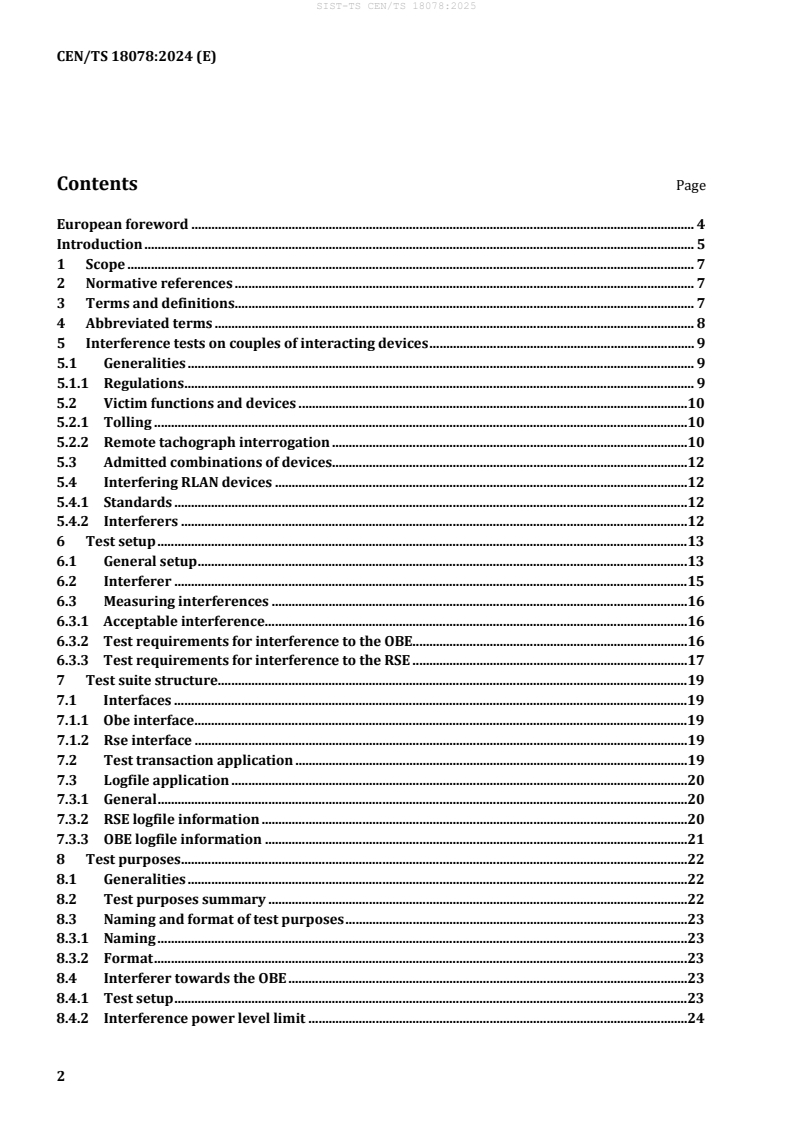
Contents Page
European foreword . 4
Introduction . 5
1 Scope . 7
2 Normative references . 7
3 Terms and definitions . 7
4 Abbreviated terms . 8
5 Interference tests on couples of interacting devices . 9
5.1 Generalities . 9
5.1.1 Regulations . 9
5.2 Victim functions and devices .10
5.2.1 Tolling .10
5.2.2 Remote tachograph interrogation .10
5.3 Admitted combinations of devices.12
5.4 Interfering RLAN devices .12
5.4.1 Standards .12
5.4.2 Interferers .12
6 Test setup .13
6.1 General setup .13
6.2 Interferer .15
6.3 Measuring interferences .16
6.3.1 Acceptable interference .16
6.3.2 Test requirements for interference to the OBE.16
6.3.3 Test requirements for interference to the RSE .17
7 Test suite structure .19
7.1 Interfaces .19
7.1.1 Obe interface .19
7.1.2 Rse interface .19
7.2 Test transaction application .19
7.3 Logfile application .20
7.3.1 General .20
7.3.2 RSE logfile information .20
7.3.3 OBE logfile information .21
8 Test purposes .22
8.1 Generalities .22
8.2 Test purposes summary .22
8.3 Naming and format of test purposes .23
8.3.1 Naming .23
8.3.2 Format .23
8.4 Interferer towards the OBE .23
8.4.1 Test setup .23
8.4.2 Interference power level limit .24
8.4.3 Interferer timing . 28
8.5 Interferer towards the RSE . 30
8.5.1 Test setup. 30
8.5.2 Interference power level limit . 30
8.5.3 Interferer timing . 31
Bibliography . 32
European foreword
This document (CEN/TS 18078:2024) has been prepared by Technical Committee CEN/TC 278
“Intelligent transport systems”, the secretariat of which is held by NEN.
Attention is drawn to the possibility that some of the elements of this document may be the subject of
patent rights. CEN shall not be held responsible for identifying any or all such patent rights.
Any feedback and questions on this document should be directed to the users’ national standards body.
A complete listing of these bodies can be found on the CEN website.
According to the CEN/CENELEC Internal Regulations, the national standards organisations of the
following countries are bound to announce this Technical Specification: Austria, Belgium, Bulgaria,
Croatia, Cyprus, Czech Republic, Denmark, Estonia, Finland, France, Germany, Greece, Hungary, Iceland,
Ireland, Italy, Latvia, Lithuania, Luxembourg, Malta, Netherlands, Norway, Poland, Portugal, Republic of
North Macedonia, Romania, Serbia, Slovakia, Slovenia, Spain, Sweden, Switzerland, Türkiye and the
United Kingdom.
Introduction
It is well known that the dedicated short-range communication (DSRC) band of frequencies around
5,8 GHz used in Europe and Japan for tolling is increasingly subject to interferences by other radio
frequency (RF) technologies. In the past, extensive analysis, theoretical studies, and tests of real systems
have been conducted that led to the specification of measures to prevent detrimental interferences
between tolling devices and ITS devices operating in the 5,9 GHz band (ETSI ITS-G5) and ensure their co-
existence. The recent development in radio LAN (RLAN) technologies have brought portable RLAN
devices operating in the 5,8 GHz band, so that harmful interferences with tolling devices are to be
expected. It is to be noted that other important European services operating in the same band other than
tolling are impacted, such as the regulated European smart tachograph, which exchanges data with
roadside units using CEN DSRC technology and a protocol similar to that used for tolling.
Mitigation techniques to reduce or eliminate harmful interferences can be determined based on analytical
models. However, the characteristics of radio transmissions at this range of frequencies are such that it
is impossible to consider all factors that impact interference phenomena. Theoretical assumptions need
to be verified by field tests.
It is essential that such tests, which may lead to regulated mitigation techniques, are standardized
together with the physical setup in which the tests are performed.
The present document specifies a standardized test setup and a test suite structure and test purposes
(TSS and TP) to measure interferences on incumbent road tolling and tachograph devices from RLANs
operating in the 5,8 GHz range.
The tests are designed to be run in a controlled environment (anechoic chamber) in order to minimize
other factors that may have an impact on measurements with the DSRC communication. Among these
factors, but not limited to the following list, are:
• weather condition: influence of moisture, rain and snow;
• (wrong) mounting of a device (inside a vehicle): on the side window, built into the dashboard, behind
or under the seat, …;
• damaged devices: defect due to incorrect handling of the equipment (falling, …);
• defect beacon/antenna;
• use of obstructive materials, like (metal) holders (or other mounting aids) and cables;
• shielding (in partial or full) caused by the composition of the windscreen;
• positioning of other components in and around the vehicle, including rear view mirrors, exterior
mirrors, vehicle seats and others that can cause deviations in (the quality of) the signal, even when a
device has been correctly installed;
• sun visor, typically mounted on trucks, can block the signal if the OBE is mounted behind it (partial
or full);
• windscreen wipers (covering the equipment, also related to wrong mounting position);
• glass constructed for windscreen heating;
• armoured vehicles;
• safety glass (in heavy duty or armoured vehicles);
• use of multiple OBE devices inside the same vehicle;
• stone chipping protection;
• use of other equipment or cabling, around the device;
• angle of the device: the angle can be different among types of vehicles, but angle can also be affected
by an OBE lying on a dashboard;
• distance between the device’s antenna and the windscreen.
Additionally, possible interferences that are caused by communications with devices other than RLAN
are also out of the scope of this document, such as Vehicle to Vehicle (V2V) communication or Vehicle to
Infrastructure (V2I) communication.
1 Scope
This document specifies the set-up of a testing system and the test suite structure and test purposes, i.e.
tests to be used to assess the level of interference from RLAN devices operating in the 5,8 GHz range on
tolling and tachograph devices operating in the same frequency range.
To obtain generalized results that can subsequently be used to design appropriate mitigation techniques,
the test environment and the test cases are designed to:
1. acquire a large number of transactions on devices of different makes and characteristics;
2. ensure anonymity of results.
The test results ensure calculation of averages as well as standard deviations.
The tests specified in this document are for the sole purpose of investigating RLAN interference over
DSRC communications. Other factors that can impact the performance of DSRC and also the level of
interference in a test scenario are not subject to test specifications and out of the scope of this document.
2 Normative references
There are no normative references in this document.
3 Terms and definitions
For the purposes of this document, the following terms and definitions apply.
ISO and IEC maintain terminology databases for use in standardization at the following addresses:
— ISO Online browsing platform: available at https://www.iso.org/obp/
— IEC Electropedia: available at https://www.electropedia.org/
3.1
modulation and coding scheme
MCS
specification of the high-throughput (HT) physical layer (PHY) parameters that consists of modulation
order (e.g. BPSK, QPSK, 16-QAM, 64-QAM) and forward error correction (FEC) coding rate (e.g. ½, ⅔, ¾,
⅚)
[SOURCE: IEEE 802.11-2012. definition: modulation and coding scheme]
3.2
radio frequency interference
RFI
effect of unwanted energy due to one or a combination of emissions, radiations, or inductions upon
reception in a radiocommunication system, manifested by any performance degradation,
misinterpretation, or loss of information which could be extracted in the absence of such unwanted
energy
[SOURCE: ITU Radio Regulations, Section VII. Frequency sharing – Article 1.166, definition: interference]
3.3
interferer
device that causes RFI (3.2)
3.4
victim
device whose operation is negatively affected by RFI (3.2)
3.5
duty cycle
fraction of one period in which a signal or system is active
4 Abbreviated terms
For the purposes of this document, the following abbreviated terms apply.
16-QAM 16 quadrature amplitude modulation
64-QAM 64 quadrature amplitude modulation
ADU application data unit
AINT azimuth interferer
BPSK binary phase shift keying
CS carrier sense
dBm decibels relative to a milliwatt
DSRC dedicated short range communication
OBE on-board equipment
EFC electronic fee collection
EIRP equivalent isotropically radiated power
FEC forward error correction
HT high throughput
LHCP left hand circular polarisation
MCS modulation and coding scheme
ms millisecond
OFDM orthogonal frequency-division multiplexing
OFDMA orthogonal frequency-division multiple access
PC personal computer
PHY physical layer
QPSK quadrature phase shift keying
REDCR remote early detection communication reader
RLAN radio local area network
RF radio frequency
RFI radio frequency interference
RSE roadside equipment
RTM remote tachograph monitoring
SAC shielded anechoic chamber
TC toll charger
TPC transmitter power control
TX Transmitter
VU vehicle unit
VU-OWS vehicle unit onboard weighting system
VE-RTM vehicle unit remote tachograph monitoring
VUPM vehicle unit payload memory
VUSM vehicle unit security module
5 Interference tests on couples of interacting devices
5.1 Generalities
5.1.1 Regulations
The European Commission has enacted a number of Directives and Regulations related to radio
equipment. General requirements are set out in the Radio equipment directive (2014/53/EU). For RLAN
and road tolling applications, specific EU legislation exists with corresponding CEPT deliverables.
CEPT regulation on RLAN in the 5 GHz frequency band is based on the following decision: ECC Decision
(04)08 designates 5150-5350 MHz and 5470-5725 MHz for WAS/RLANs in the 5 GHz range.
Corresponding EU legislation was given in Decision 2005/513/EC complemented by EC Decision
2007/90/EC. CEPT Report 79 in response to the EC Mandate on RLAN at 5 GHz investigated possibilities
for the usage of WAS/RLAN on board vehicles, aircraft, road vehicles. Subsequently, ECC Decision (04)08
has been amended, and the new Commission Implementing Decision (EU) 2022/17 has been published.
CEPT conducted several compatibility studies that investigate sharing conditions and interference
mitigation. CEPT Report 79 and ECC Report 330 (chapter 4) contain an overview of the studies conducted.
CEPT performed compatibility studies related to RLANs in the 5725-5925 MHz band in ECC Report 244,
showing a “need for significant separation distances” for the compatibility of RLAN with road tolling in the
band 5795-5815 MHz. As of today, the use of the 5725-5850 MHz band by WAS/RLAN equipment is not
harmonized under CEPT regulation nor under EU regulation. However, there may be national regulations
and “RLAN technology” can operate under short range device (SRD) regulation. The usage under SRD
regulation in cars has been studied in ECC Report 277.
CEPT regulation introduced road tolling in ECC Decision (02)02 on the coordinated introduction of Road
Transport Telematic Systems, identifying the frequencies for road tolling applications in the band 5
795 MHz to 5 815 MHz. It was replaced by ECC Decision (02)01 and later repealed by ECC Decision (12)04
when applicable EU legislation (Directive 2004/52/EC) was available. The name changed to Road
Transport and Traffic Telematic (RTTT) and later to “Transport and Traffic Telematics” (TTT). RTTT was
th
included in the EC Decision on short range devices (2006/771/EC) within its 5 update. Commission
Implementing Decision (EU) 2019/1345 on the usage of short range devices sets the harmonized
technical conditions for TTT within 5 795 MHz to 5 815 MHz for “road tolling applications and smart
tachograph, weight and dimension applications”.
5.2 Victim functions and devices
5.2.1 Tolling
5.2.1.1 Tolling transactions
[7]
Directive (EU) 2019/520 of the European Parliament and of the Council of 19 March 2019 lays down
the conditions for the interoperability of electronic road toll systems in the European union, by means of
one or more technologies among satellite positioning (GNSS), mobile communications (GSM-GPRS) or
microwave technology (DSRC).
The overall engineering view of EFC transactions is well represented in Figure 1, where the interaction
between RSE and OBE via a DSRC radio link is the part subject to interferences from other radio sources.
Figure 1 — Engineering view of EFC transactions
Backend EFC transactions (illustrated in the right part of Figure 1) can be performed by using different
communication media and are not considered in this document.
For the scope of the present document, only the transactions that use DSRC technologies are considered.
Technical characteristics of the DSRC equipment used for electronic tolling are defined in either:
• EN ISO 14906 [8] for EFC transactions and ETSI EN 300 674-2-1 [9] and ETSI EN 300 674-2-2 [10]
for test specification for road side units and on-board units, respectively;
• ETSI ES 200674-1 [11], for both EFC transactions and test specifications.
5.2.2 Remote tachograph interrogation
5.2.2.1 General
The function of remote tachograph interrogation is described in the Commission Implementing
[6]
Regulation (EU) 2016/799 of 18 March 2016 , laying down the requirements for the construction,
testing, installation, operation and repair of tachographs and their components, which was later amended
on 17/04/2018 and 26/02/2020.
In particular, the technical specifications of the remote communication function (as it is named in the
regulation) are mostly defined in Annex of the regulation and the Appendix 14, where two main
communication profiles are defined:
• profile 1a, which features a hand aimed or temporary roadside mounted and aimed Remote Early
Detection Communication Reader (REDCR), which is used to interrogate the on-board DSRC
equipment in the approaching commercial vehicle;
• profile 1.b, via a vehicle mounted and directed REDCR, which is used to interrogate the on-board
DSRC equipment in the commercial vehicle just behind the enforcement vehicle.
In both cases, the enforcement will activate the interrogation function to retrieve the information
described in Appendix 14 of Commission Implementing Regulation (EU) 2016/799.
The interrogation is made using 5,8 GHz DSRC interfaces operating within ERC Recommendation 70-03
[5] , and tested against the appropriate parameters of ETSI EN 300 674-1. The detailed specifications of
the interrogation for the equipment installed in the vehicle are described in Section 5 of Appendix 14,
which also provides information on the correct placement of the on-board equipment antenna, the uplink
and downlink parameters of the communication link and the variations from the standard EN 12253 on
which the remote interrogation is based.
5.2.2.2 Tachograph on-board equipment
The tachograph on-board equipment consists of a CEN-DSRC module, which is connected to the Vehicle
Unit of the Smart Tachograph equipment in the vehicle as described in Figure 2.
Figure 2 — Functional architecture of the remote communication function (extracted from
Appendix 14 of Regulation (EU) 2016/799)
Interferences or physical obstacles can hamper the DSRC radio link, and they would not allow the
enforcement agents to collect the data from the vehicle. If the enforcement agents are not able to retrieve
the information from the vehicle via the remote communication function, they will stop the vehicle for
manual inspection, which impacts negatively their operations (e.g. they will not be able to interrogate
other vehicles).
For this reason, the on-board unit antenna is expected to be placed in accordance with Appendix 14,
Section 5 of the Regulation and validated before operation (with the initial test and the workshop periodic
tests) according to the test defined in Appendix 9 of the Regulation.
5.2.2.3 Tachograph roadside equipment
The tachograph roadside equipment (Profile 1a) is the instrument used by the law enforcers to
interrogate the Vehicle Unit of the tachograph in the commercial vehicle. There are not specific technical
requirements for the remote interrogator (called DSRC-REDCR in the regulation) apart from what
described in Appendix 14 (i.e. support to EN 12253,) which is mostly related to the on-board vehicle
equipment. This means that the form factor of the antenna and other features of the DSRC-REDCR are
defined by the DSRC-REDCR manufacturer.
The DSRC-REDCR is supposed to operate in a range from few meters up to 30 m, but it depends on the
environment and the operational context (e.g. presence of other vehicles in the propagation path,
commercial vehicles in the far distant lane on the highway and so on). The DSRC-REDCR is supposed to
keep sending challenges to the on-board equipment (e.g. called DSRC VU in the regulation) continuously
until a response is successfully received and processed.
5.3 Admitted combinations of devices
Any couple of RSE-OBE that has been effectively verified as working in real conditions can be used as
victim to measure the interferences in their communications caused by RLAN transmission. However, to
obtain a good set of test results, different combinations of devices from different manufacturers should
be used.
5.4 Interfering RLAN devices
5.4.1 Standards
RLAN transmission is standardized in e.g. IEEE 802.11ax-2021 [14], which was approved on February 9,
2021, and in IEEE P802.11be [15] which is in preparation.
Then, the test suite takes in consideration both the potential interference from 802.11ac devices and
802.11ax devices operating in different channels, bandwidths, and modulation schemes. It is highlighted
that both 802.11 versions use OFDM modulation, 802.11ax introduces OFDMA, meaning that not all
frequency resources are allocated to a single user. In addition, the subcarrier separation is different.
5.4.2 Interferers
A signal generator with carrier frequency up to 6 GHz and at least 80 MHz bandwidth shall be used. The
testing scenarios specified hereinafter are envisaged regarding the settings of the 802.11ac and 802.11ax
transmitters by using the following parameters:
1. bandwidth of the WiFi signal. The following bandwidths are considered: 20 MHz, 40 MHz, and
80 MHz. Bandwidths used depend on the WiFi channel used, as shown in Table 1;
2. size of the packets (Average Packet Error Probability – APEP – length in Bytes): 4 095 + other values
like 2 300;
3. packet repetition time (ms): 0 – 5 – 7 – 11 – 17 – 23 – 41 – 61 – 83 (five values out of this list, plus
optionally additional values);
4. number of transmitted packets: continuous;
5. modulation and coding scheme (MCS): QPSK ½ rate, 64 QAM ¾ rate.
6 Test setup
6.1 General setup
The physical setup of the test bed in the Shielded Anechoic Chamber (SAC) is exemplified in the following
figures. Figure 3 shows the case of measuring interference to the RSE, since the antenna of the interferer
is pointed towards the RSE. A different configuration, as shown in Figure 4, will be used to measure
interference to the OBE. In both setups the interferer can be moved around while pointing to the centre
of the receive antenna of the interfered equipment and keeping a fixed distance to it. The equipment list
shown in Figure 3 and Figure 4 is just an example of potential equipment devices which could be used.
Figure 3 — Schematic test setup for measuring interferences to the RSE
Key
A Signal Generator
A – B Cable −2,5 dB
B – C Double ridged horn antenna
D – E Microwave log periodic antenna
E – F Cable −2,6 dB
F Signal analyser
Figure 4 — Schematic test setup for measuring the interference to the OBE
With reference to Figure 3 and Figure 4, to interconnect the various electronic devices needed for a test,
a wired LAN is suggested to be used, because any kind of wireless LAN would interfere with the intended
tests. On the other hand, without LAN interconnection, the various electronic devices will need to be
programmed manually, although a suitable data link would anyway be needed between the test PC and
the DSRC test devices.
Also, it is assumed that the OBE is directly connected to the test PC via a wired interface. This connection
is only one method to retrieve data from the OBE, to e.g. correlate sent data frames from the RSE with
received data frames in the OBE. Other methods that do not imply a wired connection may be used, as
long as they ensure the required functionality (see 6.3.2.1 and 6.3.3.1).
To determine the DSRC down link power level at the OBE, the substitution test setup as shown in Figure 5
can be used. The incident power level at the phase centre of the OBE antenna should be measured without
windscreen with a LHCP antenna.
Figure 5 — Substitution measurement to determine the DSRC power level at the OBE
6.2 Interferer
The interferer will repeat the generation of the test execution with combinations of the parameters listed
in 5.4.2. These scenarios will be repeated for the channels listed in Table 1 and for the two 802.11X Types:
802.11ac and 802.11ax.
The number of scenarios can be reduced based on the following considerations:
• Interfering signals to the OBE with the same bandwidth might have similar impact.
• Different in-band interference signals to the RSE might have similar impact.
• Only the worst case MCS is used in most tests.
For each test execution, the resulting statistical data will be collected and recorded.
Most of the WiFi channels and centre frequencies listed in Table 1 are identified for the test from
ERC Recommendation 70-03 [5].
Table 1 — RLAN and WIFI channels proposed to be tested as they are relevant for CEN-DSRC
interference
WiFi channel Centre Bandwidth In-band/Out-band
Frequency
(802.11ac and (DSRC 5795-5815 MHz)
(MHz)
802.11ax)
Channel 42 5210 5170–5250 (80 MHz) Out-band
Channel 106 5530 5490–5570 (80 MHz) Out-band
Channel 155 5775 5735–5815 (80 MHz) In-band
Channel 157 5785 5775–5795 (20 MHz) Out-band
Channel 159 5795 5775–5815 (40 MHz) In-band
Channel 161 5805 5795–5815 (20 MHz) In-band
Channel 165 5825 5815–5835 (20 MHz) Out-band
Channel 167 5835 5815–5855 (40 MHz) Out-band
6.3 Measuring interferences
6.3.1 Acceptable interference
For all couples OBE/RSE used in the tests, an acceptable transaction error rate is given. That number,
expressed as a percentage of the executed transactions, sets the acceptable limit of errors under which
damages due to interferences shall not be considered.
6.3.2 Test requirements for interference to the OBE
6.3.2.1 OBE setup and requirements
The OBE may be an off-the-shelf device with software that provides the functionality for its indented use,
and offering the following features:
• a test application; see Clause 7.2;
• to enable the distinction of interference on uplink and downlink, the OBE may either:
o provide a logfile application, see Clause 7.3;
o optionally offer a data interface, see Clause 7.1.1.
The OBE shall be mounted on a windscreen as described by the mounting instruction for this OBE. The
size of the windscreen shall exceed the OBE width and height by at least 10 cm (around two times the
free space wavelength of the DSRC signal). The windscreen shall be the same for all measurements.
6.3.2.2 RSE setup and requirements
The RSE may be an off-the-shelf device of any make and brand, provided that the same model has been
previously verified to interoperate with the OBE chosen for the test. In addition to that, the RSE shall offer
the following features:
• a test application; see Clause 7.2;
• provide a logfile application; see Clause 7.3;
• offer a data interface, see Clause 7.1.2;
• offer an application for at least one of these transaction types:
o a tolling transaction according to EN ISO 14906 and EN 15509;
o a tolling transaction according to ETSI ES 200674-1 and EN 15509;
o a digital tachograph transaction according to ISO 15638-9;
o a test transaction that uses frames with full size (see Clause 7.2).
The RSE shall be mounted as described by the mounting instruction for this RSE. The angle between OBE
and RSE boresight as well as the RSE transmit power level shall be adjusted to meet typical scenarios for
the incident wave at the OBE. Such a scenario can be for example the centre of the communication zone.
6.3.2.3 Interferer setup
The interfering equipment shall be installed at a distance that is the same for all tested OBE devices.
The interfering equipment shall be able to transmit an RLAN signal with adjustable transmit power levels,
packet durations and idle times. It also shall support different modulation and coding schemes in
different RLAN channels within the 5,2 GHz to 5,8 GHz band.
Concerning the direction between the OBE and the interferer boresights, at least following azimuth angles
for interference coming from outside of the vehicle shall be tested: 0°, 30°, 60° and 90° which is an
interference coming from inside the vehicle. Optionally other interference directions coming from inside
the vehicle can be tested by using the angles of 135°, and 180° or any other reasonable direction given by
the typical OBE mounting position and angle.
The interfering signal shall be transmitted with a directional antenna towards the OBE as can be seen in
Figure 4. The intended isolation towards the RSE should be so high that the noise level increase at the
RSE receiver exhibits not more than 1 dB. The attained isolation shall be measured and reported. For the
interferer azimuth angle 90° and more this requirement might be only met for out of band interferers. In
this case the measurements with an in-band interferer can be omitted.
The noise level of the RSE receiver can be improved by locating the interferer antenna closer to the OBE
than to the RSE, by positioning it outside of the main lobe of the RSE antenna, and by use of shielding
material between interferer antenna and RSE.
It is expected that for in-band interference the carrier sense (CS) mechanism of the interfering RLAN
device will defer any transmission from inside the vehicle. But it will not reliably avoid interfering
transmissions from outside the DSRC communication zone outside of the vehicle. On the other hand, out
of band interference to the OBE can happen from any position inside or outside of the vehicle, since in
this case the CS mechanism will not detect the DSRC installation and not defer the RLAN transmissions.
6.3.3 Test requirements for interference to the RSE
6.3.3.1 OBE setup and requirements
The OBE may be an off-the-shelf device with software that provides the functionality for its indented use,
and offering the following features:
• a test application; see Clause 7.2;
• to enable the distinction of interference on uplink and downlink, the OBE may either:
o provide a logfile application, see Clause 7.3,
o optionally offer a data interface, see Clause 7.1.1.
The OBE shall be mounted on a windscreen as described by the mounting instructions for this OBE. The
size of the windscreen shall exceed the OBE width and height by at least 10 cm (around two times the
free space wavelength of the DSRC signal). The windscreen shall be the same for all measurements.
6.3.3.2 RSE setup and requirements
The RSE may be an off-the-shelf device of any make and brand, provided that the same model has been
previously verified to interoperate with the OBE chosen for the test. In addition to that, the RSE shall offer
the following features:
• a test application, see Clause 7.2;
• provide a logfile application, see Clause 7.3;
• offer a data interface, see Clause 7.1.2;
• offer an application for at least one of these transaction types:
o a tolling transaction according to EN ISO 14906 and EN 15509;
o a tolling transaction according to ETSI ES 200674-1 and EN 15509;
o a digital tachograph transaction according to ISO 15638-9;
o a test transaction that uses frames with full size (see Clause 7.2).
The RSE shall be mounted as described by the mounting instruction for this RSE. The angle between OBE
and RSE boresight as well as the RSE transmit power level shall be adjusted to meet typical scenarios for
the incident wave at the OBE. Such a scenario can be for example the centre of the DSRC communication
zone.
6.3.3.3 Interferer setup
The interfering equipment shall be installed at a distance that is the same for all tested RSE devices.
The interfering equipment shall be able to transmit an RLAN signal with adjustable transmit power levels,
packet durations and idle times. It also shall support different modulation and coding schemes in
different RLAN channels within the 5,2 to 5,8 GHz band.
Concerning the direction between the RSE and the interferer boresights, at least following angles shall be
tested: 0°, 30° and 60°. Optionally interference coming from the side or the back of the RSE can be tested
(e.g. 90°, 135°, and 180°), or any other reasonable direction given by the typical RSE mounting position
and angle.
The interfering signal shall be transmitted with a directional antenna towards the RSE as can be seen in
Figure 3. The isolation towards the OBE shall be maximized as far as possible. It shall be measured and
reported.
The isolation towards the OBE can be improved by locating the interferer antenna closer to the RSE than
to the OBE, by positioning it outside of the main lobe of the OBE antenna, and by use of shielding material
between interferer antenna and OBE.
It is expected that for in-band interference the carrier sense (CS) mechanism of the interfering RLAN
device will defer any transmission from inside the DSRC communication zone. But it will not reliably
avoid interfering transmissions from outside the DSRC communication zone. Harmful out of band
interference to the RSE caused by the RLAN signal is unlikely because of the high blocking power levels
needed. Still, interference can happen caused by out of band emissions of the RLAN devices.
This results in following interference scenarios:
• in-band interference from distances greater than 10 m outside the RSE main lobe;
• out of band interference by out of band emissions of the RLAN device.
7 Test suite structure
7.1 Interfaces
7.1.1 OBE interface
To facilitate test execution and data collections, it is suggested that the OBE offers an interface to:
• parameterize the “logfile” application;
• start and stop the execution of the “logfile” application;
• transfer logfiles to a personal computer;
• delete logfiles (if stored in the OBE).
7.1.2 RSE interface
The RSE shall offer an interface to:
• parameterize the test application;
• parameterize the “logfile” application;
• start and stop the execution of the test application;
• start and stop the execution of the “logfile” application;
• transfer logfiles to a personal computer;
• delete logfiles (if stored in the RSE).
7.2 Test transaction application
The test transaction application shall be able to let the RSE to periodically send messages, which, upon
proper reception by the OBE, cause the OBE to return an acknowledgement.
No specific characteristics are requested for the test transactions. As an example, transactions can be
built upon an ECHO facility, if available, or they may be implemented as dedicated test messages.
However, to maximize the probability of interferences (worst case), and to have a balanced risk of
interference in both links, it is necessary that:
1. messages contain data up to the maximum capacity of the transmission frames;
2. downlink and uplink messages are of similar, if not identical, length (this does not imply that the
frame duration is identical, since DSRC uses different data rates and modulation for downlink and
uplink).
The repetition period for the transactions is a parameter to be configured, indicated as Tp1. Tp1 shall be
greater than the device specific guard time to allow the device to reset to its dormant condition in absence
of RSE generated interactions.
A test run is uniquely identified by the TestRunI
...