

oSIST prEN 17998:2024
(Main)Earth-moving machinery - Safety - Demolition machinery
General Information
- Abstract
This document specifies safety requirements for earth-moving machinery when used for demolition applications.
This document is only applicable to the following earth-moving machinery types as described in EN ISO 6165:2022:
- hydraulic excavators;
- cable excavators.
This document does not provide safety requirements for machinery used in conjunction with explosives for the demolition application.
This document does not provide requirements for main electrical circuits and drives of machinery
when the primary source of energy is an external electrical supply.
This document does not provide performance requirements for safety related functions of control
system(s).
This document deals with significant hazards, hazardous situations and events relevant to earth-moving
machinery, when used for demolition application and under conditions foreseen but also taking into account any reasonably foreseeable misuse thereof (see Annex A).
The following significant and relevant hazards are not covered in this document:
- laser;
- lightning.
This document is not applicable to earth-moving machinery which are manufactured before the date of publication of this document by CEN.
NOTE For travelling on public roads, national traffic regulations apply (e.g. braking, steering, lighting, towing, etc.) until harmonized requirements are available.
- Status
- Not Published
- Public Enquiry End Date
- 29-Oct-2024
- Technical Committee
- I13 - Imaginarni 13
- Current Stage
- 4020 - Public enquire (PE) (Adopted Project)
- Start Date
- 19-Aug-2024
- Due Date
- 06-Jan-2025
- Completion Date
- 30-Oct-2024

Overview
The draft European Standard oSIST prEN 17998:2024:2024, developed by CEN/TC 151, specifies important safety requirements for earth-moving machinery used in demolition applications. Targeted specifically at hydraulic excavators and cable excavators as defined in EN ISO 6165:2022, this standard ensures that demolition machinery meets rigorous safety criteria tailored to the unique challenges of demolition work. It excludes machinery used in conjunction with explosives and does not address main electrical circuits when powered by external electricity sources.
This standard establishes a comprehensive framework for the safety of earth-moving machinery during demolition, addressing hazards, risks, and protective measures based on international safety principles such as those in EN ISO 12100:2010.
Key Topics
Scope and Applicability
Applies only to hydraulic and cable excavators used for demolition tasks, excluding pre-2024 manufactured machines, explosives-related machinery, and electrical system performance.Risk Assessment and Hazards
Focuses on significant hazards and hazardous situations reasonably foreseeable in demolition operations, while excluding hazards such as laser and lightning. Annex A details a full list of significant hazards applicable.Operator’s Station Safety
Requires ride-on demolition machines to have cabs equipped with contamination protective systems and specifies tilting cabs for machines fitted with high-reach equipment to improve operator comfort and visibility.Protective Structures and Guards
Includes updated requirements for Operator Protective Guards (OPG) to safeguard operators from debris and structural damage during demolition.Visibility and Stability
Addresses the need for adequate visibility aids, especially for high-reach equipment deployed at heights above 15 meters, and mandates stability measures to prevent machine tipping.Hydraulic Systems and Lifting Operations
Outlines safety protocols to control risks inherent in hydraulic operation and lifting, including guidelines for equipment attachment and demountable fittings.Demolition Tools
Provides specific safety requirements for demolition balls and wire ropes, ensuring secure and safe usage during demolition tasks.Information for Use
Demands comprehensive operator manuals including instructions on transport, installation, operation, and specific safety precautions.Standards Integration and Compliance
Aligns with EN 474 series standards for earth-moving machinery general and specific safety requirements and is influenced by ISO standards on related machinery safety technologies.
Applications
The oSIST prEN 17998:2024:2024 standard is crucial for multiple stakeholders engaged in demolition using earth-moving machinery, including:
Machine Manufacturers:
Guideline for designing and manufacturing demolition excavators that comply with liability and safety legislation, ensuring enhanced operator protection and operational safety.Safety Regulators and Health Authorities:
Framework for market surveillance and accident prevention in the demolition machinery sector by establishing harmonized safety requirements.Construction and Demolition Companies:
Enhances workplace safety by ensuring equipment complies with the latest European safety standards for demolition, reducing onsite accidents and equipment-related risks.Maintenance and Service Providers:
Informs safe handling and upkeep protocols for demolition machinery attachments and safety-related components.
This standard ultimately supports safer demolition practices by improving machinery design quality, operator protection, and risk management.
Related Standards
oSIST prEN 17998:2024:2024 references and complements several key European and International Standards, including:
- EN 474-1:2022 - Earth-moving machinery - General safety requirements
- EN 474-5:2022 - Safety requirements for hydraulic excavators
- EN 474-12:2022 - Safety requirements for cable excavators
- EN ISO 12100:2010 - General principles for risk assessment and risk reduction in machinery design
- EN ISO 6165:2022 - Identification and vocabulary for earth-moving machinery types
- EN ISO 14120:2015 - Requirements for guards on machinery
- ISO 8643:2024 - Requirements for lowering control devices on hydraulic excavators
- ISO 13031:2016 - Safety for quick couplers on earth-moving machinery
These standards collectively provide a robust safety framework, ensuring the machinery meets comprehensive risk control and performance criteria throughout its lifecycle.
By adopting oSIST prEN 17998:2024:2024, manufacturers and users of demolition earth-moving machinery not only comply with European safety directives but also foster safer demolition environments through advanced safety design, risk mitigation, and operator protection strategies. This standard represents a critical step forward in harmonizing demolition machinery safety across Europe.
Frequently Asked Questions
oSIST prEN 17998:2024 is a draft published by the Slovenian Institute for Standardization (SIST). Its full title is "Earth-moving machinery - Safety - Demolition machinery". This standard covers: This document specifies safety requirements for earth-moving machinery when used for demolition applications. This document is only applicable to the following earth-moving machinery types as described in EN ISO 6165:2022: - hydraulic excavators; - cable excavators. This document does not provide safety requirements for machinery used in conjunction with explosives for the demolition application. This document does not provide requirements for main electrical circuits and drives of machinery when the primary source of energy is an external electrical supply. This document does not provide performance requirements for safety related functions of control system(s). This document deals with significant hazards, hazardous situations and events relevant to earth-moving machinery, when used for demolition application and under conditions foreseen but also taking into account any reasonably foreseeable misuse thereof (see Annex A). The following significant and relevant hazards are not covered in this document: - laser; - lightning. This document is not applicable to earth-moving machinery which are manufactured before the date of publication of this document by CEN. NOTE For travelling on public roads, national traffic regulations apply (e.g. braking, steering, lighting, towing, etc.) until harmonized requirements are available.
This document specifies safety requirements for earth-moving machinery when used for demolition applications. This document is only applicable to the following earth-moving machinery types as described in EN ISO 6165:2022: - hydraulic excavators; - cable excavators. This document does not provide safety requirements for machinery used in conjunction with explosives for the demolition application. This document does not provide requirements for main electrical circuits and drives of machinery when the primary source of energy is an external electrical supply. This document does not provide performance requirements for safety related functions of control system(s). This document deals with significant hazards, hazardous situations and events relevant to earth-moving machinery, when used for demolition application and under conditions foreseen but also taking into account any reasonably foreseeable misuse thereof (see Annex A). The following significant and relevant hazards are not covered in this document: - laser; - lightning. This document is not applicable to earth-moving machinery which are manufactured before the date of publication of this document by CEN. NOTE For travelling on public roads, national traffic regulations apply (e.g. braking, steering, lighting, towing, etc.) until harmonized requirements are available.
oSIST prEN 17998:2024 is classified under the following ICS (International Classification for Standards) categories: 53.100 - Earth-moving machinery. The ICS classification helps identify the subject area and facilitates finding related standards.
oSIST prEN 17998:2024 is associated with the following European legislation: EU Directives/Regulations: 2006/42/EC, 2023/1230; Standardization Mandates: M/396, M/605. When a standard is cited in the Official Journal of the European Union, products manufactured in conformity with it benefit from a presumption of conformity with the essential requirements of the corresponding EU directive or regulation.
oSIST prEN 17998:2024 is available in PDF format for immediate download after purchase. The document can be added to your cart and obtained through the secure checkout process. Digital delivery ensures instant access to the complete standard document.
Standards Content (Sample)
SLOVENSKI STANDARD
01-oktober-2024
Stroji za zemeljska dela - Varnost - Stroji za rušenje
Earth-moving machinery - Safety - Demolition machinery
Erdbaumaschinen - Sicherheit - Abrissmaschinen
Engins de terrassement - Sécurité - Engins de démolition
Ta slovenski standard je istoveten z: prEN 17998
ICS:
53.100 Stroji za zemeljska dela Earth-moving machinery
2003-01.Slovenski inštitut za standardizacijo. Razmnoževanje celote ali delov tega standarda ni dovoljeno.
DRAFT
EUROPEAN STANDARD
NORME EUROPÉENNE
EUROPÄISCHE NORM
August 2024
ICS 53.100
English Version
Earth-moving machinery - Safety - Demolition machinery
Engins de terrassement - Sécurité - Engins de Erdbaumaschinen - Sicherheit - Abrissmaschinen
démolition
This draft European Standard is submitted to CEN members for enquiry. It has been drawn up by the Technical Committee
CEN/TC 151.
If this draft becomes a European Standard, CEN members are bound to comply with the CEN/CENELEC Internal Regulations
which stipulate the conditions for giving this European Standard the status of a national standard without any alteration.
This draft European Standard was established by CEN in three official versions (English, French, German). A version in any other
language made by translation under the responsibility of a CEN member into its own language and notified to the CEN-CENELEC
Management Centre has the same status as the official versions.
CEN members are the national standards bodies of Austria, Belgium, Bulgaria, Croatia, Cyprus, Czech Republic, Denmark, Estonia,
Finland, France, Germany, Greece, Hungary, Iceland, Ireland, Italy, Latvia, Lithuania, Luxembourg, Malta, Netherlands, Norway,
Poland, Portugal, Republic of North Macedonia, Romania, Serbia, Slovakia, Slovenia, Spain, Sweden, Switzerland, Türkiye and
United Kingdom.
Recipients of this draft are invited to submit, with their comments, notification of any relevant patent rights of which they are
aware and to provide supporting documentation.
Warning : This document is not a European Standard. It is distributed for review and comments. It is subject to change without
notice and shall not be referred to as a European Standard.
EUROPEAN COMMITTEE FOR STANDARDIZATION
COMITÉ EUROPÉEN DE NORMALISATION
EUROPÄISCHES KOMITEE FÜR NORMUNG
CEN-CENELEC Management Centre: Rue de la Science 23, B-1040 Brussels
© 2024 CEN All rights of exploitation in any form and by any means reserved Ref. No. prEN 17998:2024 E
worldwide for CEN national Members.
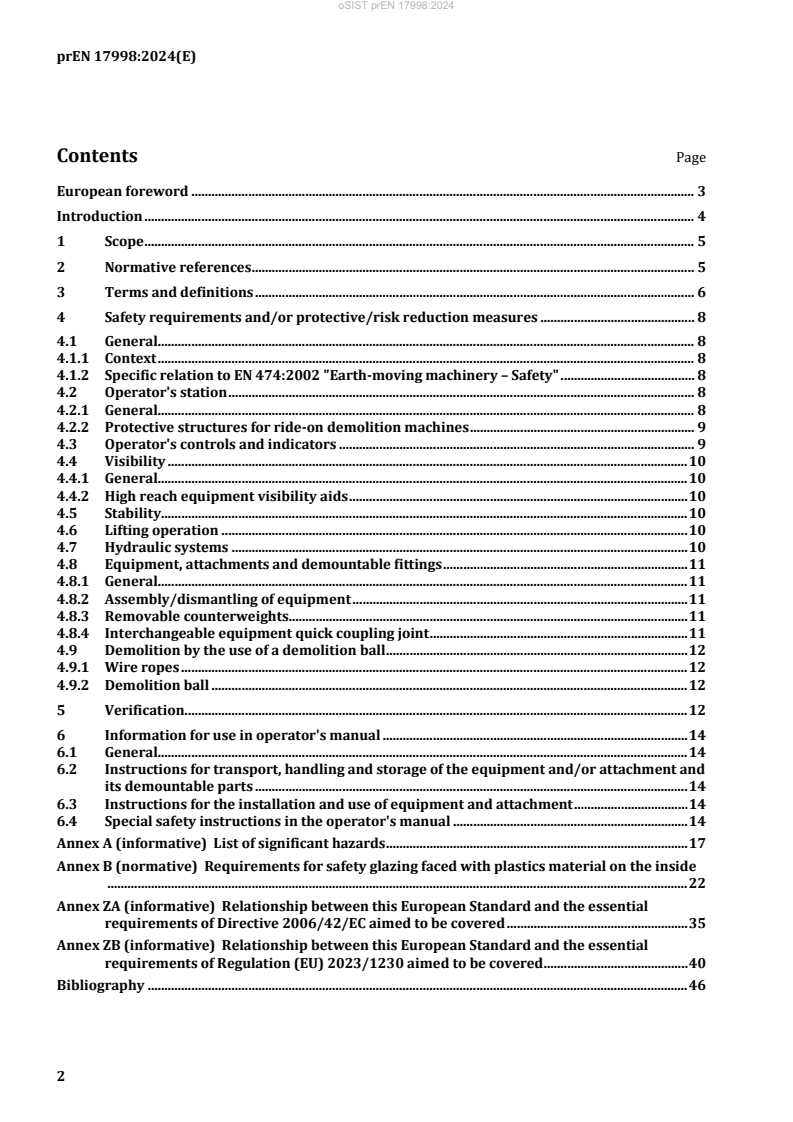
Contents Page
European foreword . 3
Introduction . 4
1 Scope . 5
2 Normative references . 5
3 Terms and definitions . 6
4 Safety requirements and/or protective/risk reduction measures . 8
4.1 General. 8
4.1.1 Context . 8
4.1.2 Specific relation to EN 474:2002 "Earth-moving machinery – Safety" . 8
4.2 Operator's station . 8
4.2.1 General. 8
4.2.2 Protective structures for ride-on demolition machines . 9
4.3 Operator's controls and indicators . 9
4.4 Visibility . 10
4.4.1 General. 10
4.4.2 High reach equipment visibility aids . 10
4.5 Stability . 10
4.6 Lifting operation . 10
4.7 Hydraulic systems . 10
4.8 Equipment, attachments and demountable fittings . 11
4.8.1 General. 11
4.8.2 Assembly/dismantling of equipment . 11
4.8.3 Removable counterweights . 11
4.8.4 Interchangeable equipment quick coupling joint . 11
4.9 Demolition by the use of a demolition ball . 12
4.9.1 Wire ropes . 12
4.9.2 Demolition ball . 12
5 Verification . 12
6 Information for use in operator's manual . 14
6.1 General. 14
6.2 Instructions for transport, handling and storage of the equipment and/or attachment and
its demountable parts . 14
6.3 Instructions for the installation and use of equipment and attachment . 14
6.4 Special safety instructions in the operator's manual . 14
Annex A (informative) List of significant hazards . 17
Annex B (normative) Requirements for safety glazing faced with plastics material on the inside
............................................................................................................................................................................. 22
Annex ZA (informative) Relationship between this European Standard and the essential
requirements of Directive 2006/42/EC aimed to be covered . 35
Annex ZB (informative) Relationship between this European Standard and the essential
requirements of Regulation (EU) 2023/1230 aimed to be covered . 40
Bibliography . 46
European foreword
This document (prEN 17998:2024) has been prepared by Technical Committee CEN/TC 151
“Construction equipment and building material machines – Safety”, the secretariat of which is held by
DIN.
This document is currently submitted to the CEN Enquiry.
This document has been prepared under a standardization request addressed to CEN by the European
Commission. The Standing Committee of the EFTA States subsequently approves these requests for its
Member States.
For the relationship with EU Legislation, see informative Annex ZA, which is an integral part of this
document
Introduction
This document is a type C standard as stated in EN ISO 12100:2010.
This document is of relevance in particular for the following stakeholder groups representing the market
players with regard to machinery safety:
— machine manufacturers (small, medium and large enterprises);
— health and safety bodies (regulators, accident prevention organizations, market surveillance, etc.)
Others can be affected by the level of machinery safety achieved with the means of the document by the
above-mentioned stakeholder groups:
— machine users/employers (small, medium and large enterprises);
— machine users/employees (e.g. trade unions, organizations for people with special needs);
— service providers, e.g. for maintenance (small, medium and large enterprises);
— consumers (in case of machinery intended for use by consumers).
The above-mentioned stakeholder groups have been given the possibility to participate at the drafting
process of this document.
The machinery concerned and the extent to which hazards, hazardous situations and events are covered
is indicated in the Scope of this document.
When requirements of this type C standard are different from those which are stated in type-A or type-B
standards, the requirements of this type-C standard take precedence over the requirements of the other
standards for machines that have been designed and built according to the requirements of this type C
standard.
1 Scope
This document specifies safety requirements for earth-moving machinery when used for demolition
applications.
This document is only applicable to the following earth-moving machinery types as described in
EN ISO 6165:2022:
— hydraulic excavators;
— cable excavators.
This document does not provide safety requirements for machinery used in conjunction with explosives
for the demolition application.
This document does not provide requirements for main electrical circuits and drives of machinery
when the primary source of energy is an external electrical supply.
This document does not provide performance requirements for safety related functions of control
system(s).
This document deals with significant hazards, hazardous situations and events relevant to earth-moving
machinery, when used for demolition application and under conditions foreseen but also taking into
account any reasonably foreseeable misuse thereof (see Annex A).
The following significant and relevant hazards are not covered in this document:
— laser;
— lightning.
This document is not applicable to earth-moving machinery which are manufactured before the date of
publication of this document by CEN.
NOTE For travelling on public roads, national traffic regulations apply (e.g. braking, steering, lighting, towing,
etc.) until harmonized requirements are available.
2 Normative references
The following documents are referred to in the text in such a way that some or all of their content
constitutes requirements of this document. For dated references, only the edition cited applies. For
undated references, the latest edition of the referenced document (including any amendments) applies.
EN 356:1999, Glass in building - Security glazing - Testing and classification of resistance against manual
attack
EN 474-1:2022, Earth-moving machinery - Safety - Part 1: General requirements
EN 474-5:2022, Earth-moving machinery - Safety - Part 5: Requirements for hydraulic excavators
EN 474-12:2022, Earth-moving machinery - Safety - Part 12: Requirements for cable excavators
EN ISO 12100:2010, Safety of machinery - General principles for design - Risk assessment and risk reduction
(ISO 12100:2010)
EN ISO 6165:2022, Earth-moving machinery - Basic types - Identification and vocabulary (ISO 6165:2022)
EN ISO 14120:2015, Safety of machinery - Guards - General requirements for the design and construction
of fixed and movable guards (ISO 14120:2015)
EN ISO 14122-1:2016, Safety of machinery - Permanent means of access to machinery - Part 1: Choice of
fixed means and general requirements of access (ISO 14122-1:2016)
EN ISO 14122-2:2016, Safety of machinery - Permanent means of access to machinery - Part 2: Working
platforms and walkways (ISO 14122-2:2016)
EN ISO 14122-3:2016, Safety of machinery - Permanent means of access to machinery - Part 3: Stairs,
stepladders and guard-rails (ISO 14122-3:2016)
EN ISO 14122-4:2016, Safety of machinery - Permanent means of access to machinery - Part 4: Fixed ladders
(ISO 14122-4:2016)
EN ISO 16001:2017, Earth-moving machinery - Object detection systems and visibility aids - Performance
requirements and tests (ISO 16001:2017)
ISO 8643:2024, Earth-moving machinery - Hydraulic excavator and backhoe loader lowering control device
- Requirements and tests
ISO 10262:1998, Earth-moving machinery - Hydraulic excavators - Laboratory tests and performance
requirements for operator protective guards
ISO 13031:2016, Earth-moving machinery - Quick couplers - Safety
3 Terms and definitions
For the purposes of this document, the terms and definitions given in EN 474-1:2022, EN 474-5:2022,
EN 474-12:2022, EN ISO 6165:2022 and EN ISO 12100:2010 and the following apply.
Earth-moving machinery and their families are defined in EN ISO 6165:2022.
ISO and IEC maintain terminology databases for use in standardization at the following addresses:
— IEC Electropedia: available at http://www.electropedia.org
— ISO Online browsing platform: available at https://www.iso.org/obp/
3.1
demolition application
demolishing by pushing or pulling or fragmenting by crushing or shearing buildings and/or other civil
engineering structures and their component parts and/or separating the resultant debris
[SOURCE: ISO 20474-5:2017, 3.5, modified]
3.2
demolition machine
machine based on earth-moving machinery and including equipment and attachment (working tool – e.g.
processor or breaker) specifically designed for use in demolition application
3.3
base machine
demolition machine without equipment or attachments but possessing the necessary mountings for such
equipment and attachments
Note 1 to entry: See Figure 1.
[SOURCE: EN ISO 6165:2022, 3.1.11, modified]
Figure 1 — Base machine
3.4
high reach equipment
multi piece rigid or telescopic equipment with the primary function of operating specialized attachments
for the demolition of structures at working heights of 15 m and above, measured from the ground on
which the machine is sitting
3.5
front guard
device intended to provide object protection to the front of the operator station of ride-on demolition
machines
[SOURCE: ISO 10262:1998, 3.2, modified]
3.6
counterweight
any additional weight and its support added to increase tipping load
[SOURCE: ISO 8811:2000, 3.1.8, modified]
3.7
interchangeable equipment quick coupling joint
connector which enables coupling and uncoupling of interchangeable equipment
Note 1 to entry: See Figure 2.
Key
a interchangeable equipment quick coupling joint, base machine side
b interchangeable equipment quick coupling joint, interchangeable equipment side
Figure 2 — Interchangeable equipment quick coupling joint
3.8
automatic interchangeable equipment quick coupling joint
connector system which enables the operator to couple and uncouple interchangeable equipment
without having to leave the operator’s station or employ additional operators to assist coupling and/or
uncoupling
4 Safety requirements and/or protective/risk reduction measures
4.1 General
4.1.1 Context
Demolition machines shall comply with the safety requirements and/or protective/risk reduction
measures of this clause. They shall be designed according to the principles of EN ISO 12100:2010 for
relevant hazards which are not dealt with by this document.
4.1.2 Specific relation to EN 474:2002 “Earth-moving machinery – Safety”
Demolition machines shall comply with the requirements of EN 474-1:2022 “General requirements” and
EN 474-5:2022 “Requirements for hydraulic excavators” for demolition hydraulic excavators, and
EN 474-12:2022 “Requirements for cable excavators” for demolition cable excavators, as far as not
modified or replaced by the requirements of this standard.
For demolition hydraulic excavators there are general requirements specified in EN 474-1:2022 that are
not applicable because the risk assessment has shown that for demolition hydraulic excavators the
corresponding hazard does not exist. For demolition hydraulic excavators, 4.4.2.2 and 4.14.2.3 in
EN 474-1:2022 are not applicable.
4.2 Operator's station
4.2.1 General
EN 474-1:2022, 4.3 applies with the following modifications:
For ride-on demolition hydraulic excavators EN 474-5:2022, 4.2 shall apply.
For ride-on demolition cable excavators EN 474-12:2022, 4.3.2 shall apply.
All ride-on demolition machines shall be equipped with a cab and a contamination protective system.
NOTE The following standard is being developed and could apply - NWIP TC_151_WI00151491 (Safety –
Protective Ventilation systems).
For ride-on demolition machines fitted with high-reach equipment, provision shall be made for tilting the
operator's position (e.g. tilting cab) to provide operator comfort and adequate visibility of the attachment
within the intended working range.
4.2.2 Protective structures for ride-on demolition machines
4.2.2.1 Operator's protective guards (OPG)
EN 474-1:2022, 4.3.4 shall be replaced by the following:
For ride-on demolition machines with an operating mass equal or less than 6 000 kg, the minimum
requirement for operator's protective guards is level I protection as per ISO 10262:1998.
For ride-on demolition machines with an operating mass greater than 6 000 kg, the minimum
requirement for operator's protective guards is Level II as per ISO 10262:1998.
For demolition machines with a tilting cab, the front guard shall, in addition, be tested in accordance with
ISO 10262:1998 Level II top guard test with the cab in a tilted position where the impact has the greatest
effect.
4.2.2.2 Window protection
To protect the operator against small flying or falling debris, the front window(s) and roof window (when
fitted) shall be equipped with impact-resistant glass or any other material or arrangement providing
equivalent protection according to EN 356:1999 class P5A. In addition, to protect the operator from glass
spalling during impact of debris, the inside surface of the front window(s) and roof window (when fitted)
shall be fitted with a plastic material. The performance shall meet the requirements set out in Annex B.
4.2.2.3 Cab floor protection
The bottom part of the cab shall be able to protect the operator against penetrating material.
This protection shall be established by armouring the floor plates of the cabin or similar structural
elements of the machine-frame that are located beneath the cabin, such that the total floor-area of the
cabin is covered.
The resistibility of this protection shall be equal or higher to a comparable system established by a fine
grain steel-plate, if clamped in from all sides. The representative thickness of the fine-grain construction
steel-plate, or steel-structure of this comparable system shall have a total work piece thickness of > 6 mm.
NOTE The design of the protective device is not limited to a special material. However, the reference level for
the comparable system is based on the material properties of sheet metal EN 10149-2:2013 (S355MC) with material
characteristic according to steel key 1.0976 under consideration of the related assembly situation.
Alternative materials shall have at least the same protection characteristics as the system described
above.
Irrespective of the material used and the various cabin-designs applied, the protection shall meet at least
the requirements of a fixed guard as defined in EN ISO 14120:2015, 3.2.
4.3 Operator's controls and indicators
EN 474-1:2022, 4.5 applies with the following addition:
The controls for operating the tilting cab shall be located in front of the seat backrest, to be determined
with the backrest in the vertical position and the seat in its mid position.
For demolition cable excavators, EN 474-12:2022, 4.5 shall also apply.
4.4 Visibility
4.4.1 General
EN 474-1:2022, 4.8 applies with the following additions:
If a roof window is used to provide visibility to the working area, then it shall be equipped with motorized
windscreen wiper(s) and washer(s).
4.4.2 High reach equipment visibility aids
For demolition machines fitted with high reach equipment and capable of working at heights above 30 m
from the SIP, the operator visibility of the work area shall be enhanced by the use of a CCTV system with
a camera mounted on the equipment sufficiently close to the attachment to provide adequate view of the
work area. The system should be automatically in operation while the machine is running.
For demolition hydraulic excavators, EN 474-5:2022, 4.6.2 does not apply to high reach equipment
visibility aids.
The CCTV system shall comply with EN ISO 16001:2017, Annex B.
4.5 Stability
EN 474-1:2022, 4.11 applies with the additions below.
For machines with high-reach equipment, to maintain stability, an integrated automatic device shall warn
the operator (visual and/or audible) during operation when approaching the stability limit as specified
by the manufacturer. The warning shall remain in place whilst the stability limit hazard exists.
For demolition hydraulic excavators with interchangeable equipment quick coupling joints, the
manufacturer shall protect against risks of machine tip over arising from equipment configurations
whereby machine stability is compromised, e.g. through physical limitation of the machine and/or visible
warnings in the operator's station.
4.6 Lifting operation
For demolition hydraulic excavators, EN 474-5:2022, 4.8 applies with the following modification:
For demolition machines fitted with high reach equipment, EN 474-1:2022, 4.12 shall be replaced by the
following clause.
A lowering control device on each raising boom and arm cylinder shall be fitted in order to maintain
machine stability. For arm cylinders, the device(s) shall be installed at the end which is pressured in order
to raise the arm away from the base machine. Lowering control devices for boom and arm cylinders shall
be tested in accordance with ISO 8643:2024.
4.7 Hydraulic systems
EN 474-1:2022, 4.18 applies with the following modifications:
Pipes and hoses which have to be disconnected/reconnected during dismounting/mounting of
equipment shall be fitted with self-sealing couplings or shut-off valves. Couplings/valves shall be marked
to ensure correct reconnection.
4.8 Equipment, attachments and demountable fittings
4.8.1 General
All equipment or attachments intended to be used on the demolition machine shall be designed to ensure
safe handling, assembly and disassembly.
Where tools and accessories are specially designed for the machine, and are supplied by the
manufacturer, a lockable compartment shall be provided on the machine to store them.
4.8.2 Assembly/dismantling of equipment
For interchangeable equipment, a safe method for access to hydraulic connectors, isolating valves and
attachment securing mechanisms shall be provided, e.g. an integrated/removable working platform.
Selection of the means of access and general requirements for its design shall be determined in
accordance with EN ISO 14122-1:2016.
The individual elements of the means of access system shall be in accordance with:
— EN ISO 14122-2:2016 – for working platforms and walkways;
— EN ISO 14122-3:2016 – for stairs, stepladders and guard-rails;
— EN ISO 14122-4:2016 – for fixed ladders.
4.8.3 Removable counterweights
EN 474-1:2022, 4.15 applies with the following addition:
Removable counterweights shall be designed against uncontrolled movement during the process of
removing and reattaching to the demolition machine.
4.8.4 Interchangeable equipment quick coupling joint
Demolition hydraulic excavators with quick coupling joints to aid connection and disconnection of
interchangeable equipment, shall comply with the requirements of this clause, in addition they shall be
designed according to the principles of EN ISO 12100:2010 for relevant hazards which are not dealt with
by this standard.
The interchangeable equipment quick coupling joint shall meet the following requirements:
— the design of the interchangeable equipment quick coupling joint shall ensure that the
interchangeable equipment is retained in the working position even when the machine is switched
off or being transported;
— the interchangeable equipment quick coupling joint shall be able to withstand the working forces
applied to the equipment;
— the interchangeable equipment quick coupling joint design shall prevent inadvertent release of the
equipment by the working forces (e.g. mechanical device, hydraulic lock/positive pressure). If a
mechanical device is not used, a loss of locking force shall not result in a reduction of equipment
retention;
— the interchangeable equipment quick coupling joint design shall not solely rely on friction or gravity
to retain the equipment;
— it shall be possible to verify (e.g. by sensing, visual verification, confirmation of mechanical device
fitment) that the interchangeable equipment quick coupling joint is fully locked in the working
position. Testing by machine operation (e.g. by the application of working forces to the equipment)
as the sole means of verification is not acceptable;
— controls shall be designed to prevent the risk of inadvertent operation. Where more than one
interchangeable equipment quick coupling joint is installed, the controls/operational procedures
shall be so designed to minimize the risk of accidently operating a quick coupling joint;
— for automatic interchangeable equipment quick coupling joint systems, the safety requirements and
protective measures of ISO 13031:2016 shall apply with the following modification: 4.2 Object
handling does not apply;
— for automatic interchangeable equipment quick coupling joint systems, machines shall have a means
to minimize the possibility of equipment being inadvertently dropped to the ground prior to correct
engagement of the coupling system (i.e. fully engaged with the equipment in its working position).
This means it shall either:
— prevent the lifting of the equipment beyond what is required for correct engagement to be
achieved, or
— provide an acoustic and a visual signal, at the operator’s station if the engagement is not
complete with the equipment in its working position.
4.9 Demolition by the use of a demolition ball
4.9.1 Wire ropes
Cable-operated demolition machines using a ball for demolition work shall meet the requirements for
wire ropes and its devices as specified in EN 474-12:2022, 4.9.5.2.
4.9.2 Demolition ball
For demolition by the use of a demolition ball, a load-hooking system shall be provided which can either
be fixed or removable. The system may be located on an attachment, or on the equipment, or any other
part of the machine and shall:
— be so located or designed that the risk of being damaged during the demolition operation is
minimized;
— be designed so that uncontrolled movement is minimized, e.g. a rope which can be fastened to the
demolition ball to control movement of the demolition ball;
— have the capacity of at least the maximum rated lift capacity of the machine;
— be able to withstand a test load of 2 times the maximum rated lift capacity of the machine. This test
load shall be applied with the load-hooking system in the position exerting maximum stress on the
load-hooking system. No permanent deformation of the hooking system is acceptable.
5 Verification
Safety requirements and/or protective measures of Clauses 4 and 5 of this document shall be verified
according to Table 1.
Table 1 sets out verification methods which shall be applied for each safety requirement in this document.
Where X(s) is indicated in the table, the corresponding verification method(s) shall be applied.
Table 1 shall be read in conjunction with the corresponding clauses.
Table 1 includes the following verification methods:
a) calculation: to establish that the requirements of this document have been met;
b) visual verification: to establish that something is present (e.g. a guard, a marking, a document);
c) measurement: to show that the required numerical values have been met (e.g. geometric dimensions,
safety distances, resistance of insulation of the electric circuits, results of physical tests);
d) functional tests: to show that the adequate signals intended to be forwarded to the main control
system of the complete machine are available and comply with the requirements and with the
technical documentation;
e) special verification: by reference to a standard which is mentioned in the corresponding clause.
Table 1 — Verification of safety requirements and/or protective measures
4.2.1 Operator’s station - General X X X
4.2.2.1 Operator's protective guards (OPG) X
4.2.2.2 Window protection X
4.2.2.3 Cab floor protection X
4.3 Operator's controls and indicators X X
4.4 Visibility X X
4.5 Stability X X
4.6 Lifting operation X
4.7 Hydraulic systems X X
4.8.1 Equipment, attachments and demountable fittings - General X
4.8.2 Assembly/dismantling of equipment X
4.8.3 Removable Counterweights X
4.8.4 Interchangeable equipment quick coupling joint X X
4.9.1 Demolition by the use of a demolition ball - Wire ropes X
4.9.2 Demolition by the use of a demolition ball - Demolition ball X X X
Clause number
Title
a) Calculation
b) Visual verification
c) Measurement
d) Functional test
e) Special verification
6 Information for use in operator's manual
6.1 General
Information for use shall be provided in accordance with EN ISO 12100:2010, 6.4.
EN 474-1:2022, Clause 6 applies with the additions in 6.2, 6.3 and 6.4 below.
6.2 Instructions for transport, handling and storage of the equipment and/or
attachment and its demountable parts
EN 474-1:2022, 4.15 applies with the following additions:
The instructions for transport, handling and storage of the equipment and/or attachment and their
demountable parts shall contain information on modular assembly and disassembly of the equipment
and/or attachment.
6.3 Instructions for the installation and use of equipment and attachment
EN 474-1:2022, 6.3 applies with the following additions:
The instructions for the installation and use of the equipment and attachment shall be included in the
operator’s manual and contain at least the following items:
— instructions for setting up the equipment or attachment safely;
— the power source, where applicable;
— the selection of the equipment and/or attachment, together with their conditions of use according to
the type of work they have to perform;
— precautions to be taken when mounting the equipment or attachment;
— information on the correct mounting of guards;
— information regarding the working zone of the equipment or attachment;
— information on operating machines in confined spaces;
— information about wire ropes.
6.4 Special safety instructions in the operator's manual
The following safety instructions shall be given in a separate section in the operator's manual:
— it shall be made clear to the operator where the major risks are and what measures he shall take to
make the operation safe;
— special warnings against potential risk to bystanders from the demolition operation;
— the need to lower the equipment and/or attachment to the ground at the end of the work;
— for machines with high-reach equipment, information shall be provided how to ensure machine
stability during expected working- and travel positions;
— for remote controlled machinery with an unprotected operator the following shall be included:
— instructions for the use of personal protective equipment (PPE), which includes:
— helmet;
— hearing protection;
— eye protection;
— gloves;
— heavy duty clothing;
— boots with steel toecaps and non-slip soles;
— respiratory protection in location where the air can be harmful;
— information about the risk of crush injury during operation on slopes and that the operator shall
always be positioned above the machine if there is a risk that it can fall;
— information about the risk of falling when operating near edges:
— make sure that the surface has satisfactory load-bearing capacity;
— make sure the machine is stable and does not move to the edge during operation;
— do not operate by cable connection if the product is near an edge, only use radio connected
operation;
— information about the risk of crush injury during demolition work from falling material.
Depending on the demolition task the safety distance will vary, and the operator shall keep an
appropriate distance;
— information about the about risk of crush injury from contact with the machine and falling
material. During operation, no persons are permitted in the work areas (X) or (Y) shown in
Figure 3. This applies to bystanders and the operator. The area (X) is the range of the machine.
Different work methods, working tools and demolition applications can change the dimension of
the work area (Y), where demolished material can fall down.
Figure 3 — Exclusion zone for persons in proximity to remote controlled demolition machinery
Annex A
(informative)
List of significant hazards
Table A.1 contains common hazards, hazardous situations and events identified by risk assessment as
significant for earth moving machines when used for demolition applications as defined in the scope of
this document and which require action to eliminate or reduce the risk.
Table A.1 — List of additional significant hazards
Relevant clauses of this
Hazard
document
Hazards, hazardous situations and hazardous events
Mechanical hazards
Due to machine parts or workpieces, e.g. 4.1, 4.2, 4.3, 4.8
by potential energy (falling objects, height from the ground,
gravity)
by kinetic energy (acceleration, deceleration, moving/rotating 4.1, 4.8
elements)
— mechanical strength
4.1, 4.5, 4.8
by stored energy, e.g.: 4.1
— elastic elements (springs)
Crushing hazard 4.1, 4.2.2.1, 4.6, 4.8
Shearing hazard 4.1
Cutting or severing hazard 4.1
Entanglement 4.1
Drawing-in or trapping hazard 4.1
Impact hazard 4.1
Stabbing or puncture hazard 4.1, 4.2.2.3
Friction or abrasion hazard 4.1
Injection 4.1, 4.7
Slipping, tripping and falling 4.1, 4.8
Instability 4.1, 4.3, 4.5, 4.6
Electrical hazards
Touching live parts 4.1
Electromagnetic phenomena 4.1
Short-circuit 4.1
Relevant clauses of this
Hazard
document
Overload 4.1
Thermal hazards
Burns, scalds 4.1
Radiation of heat sources 4.1
Noise hazards
Permanent hearing loss, tinnitus 4.1
As a consequence of an interference with speech communication 4.1
or with acoustic signals
Physiological impairment (e.g. loss of balance, loss of awareness) 4.1
Vibration hazards
Vibrations transmitted to the operator when sitting during 4.1, 4.4
operation
Portable hand-held and/or hand-guided machinery (e.g. vascular 4.1
disorder, neurological disorder)
In conjunction with a rigid position (e.g. trauma of the spine, 4.1
osteo-articular disorder, low-back morbidity)
Radiation hazards
Radio frequency electromagnetic radiation 4.1
Laser Not covered
Material/substance hazards
Hazards from contact with/or inhalation of harmful fluids, gases, 4.1, 4.2.1
mists, fumes and dusts
Fire 4.1
Explosion 4.1
Ergonomic hazards
Unhealthy postures or excessive effort 4.1, 4.2.1
Inadequate consideration of anatomy 4.1
Insufficient means for evacuation/emergency exit 4.1
Inadequate local lighting 4.1
Inadequate design or location of visual display units 4.1, 4.4
Design, location or identification of control devices 4.1, 4.3
Flicker, dazzling, shadow, stroboscopic effect 4.1
Human error during operation 4.1, 4.8.4
Relevant clauses of this
Hazard
document
Hazards associated with the environment in which the
machine is used
Lightning Not covered
Pollution 4.1
Snow, water, wind, temperature 4.1
Exhaust gas/ lack of oxygen at workplace 4.1
Dust and fog 4.1
Unexpected start up, unexpected overrun/overspeed (or
similar malfunction)
Failure/disorder of the control system and control circuits 4.1
Restoration of energy supply after an interruption 4.1
Software error Not covered
Failure of the power supply 4.1
Hazards due to: 4.1, 4.8
— assembly and installation
— setting
— cleaning
— fault-finding
— maintenance
Maintenance 4.1
Insufficient means of access during use, setting and maintenance 4.1
Hazards due to portable machinery — hand-held and/or
hand-guided machinery
Instability 4.1, 6.4
Accidental starting/or continued operation 4.1
Hazards relating to travelling function
Movement when starting the engine 4.1
Movement without a driver at the driving position 4.1
Movement without all parts in a safe position 4.1
Excessive speed of pedestrian controlled machinery 4.1
Insufficient ability of machinery to be slowed down, stopped and 4.1, 4.6
immobilised
Relevant clauses of this
Hazard
document
Hazards linked to work position (including driving station)
on the machine
Fall of persons during access to (or at/from) the drive/work 4.1
position(s)
Fire (flammability of the cab, lack of extinguishing means) 4.1
Mechanical hazards at the work position: 4.1, 4.2.2
contact with the wheels; rollover and overturning; fall of objects,
penetration by objects; slipping during access; contact of
persons with machine parts or tools (pedestrian controlled
machines
Insufficient visibility from the drive/work position(s) 4.1, 4.4
Inadequate seating 4.1
Hazards due to the control system
Inadequate location of manual controls 4.1, 4.3
Inadequate design of manual controls and their mode of 4.1
operation
Hazards due to the power source and to the transmission of
power
Engine and batteries 4.1
Transmission of power between machines Not covered
Couplings and towings 4.1
From/to third persons
Unauthorised start-up/use 4.1
Drift of a part away from its stopping position 4.1, 4.8.4
Lack or inadequacy of visual or acoustic warning means 4.1, 4.5, 4.8.4
Insufficient instructions for the driver/operator (operation 4.1, 6
manual, signs, warnings, and markings)
Additional hazards, hazardous situations and hazardous 4.1, 4.6
events due to lifting
Mechanical hazards caused by load falls, collisions, machine
tipping
Lack of stability 4.1, 4.5, 4.6
Uncontrolled loading, overloading, overturning moments 4.1, 4.5, 4.9, 6.4
exceeded
Unexpected/unintended movement of loads 4.1, 4.8
Inadequate holding devices/accessories 4.1, 4.8.4
Access of persons to load support 4.1
Relevant clauses of this
Hazard
document
From insufficient mechanical strength of parts 4.1, 4.5
From inadequate selection of chain, ropes, lifting and accessories 4.1, 4.9
and their inadequate integration into the machine
Abnormal conditions of assembly/use/maintenance 4.1, 4.8
Hazards linked to driver/operator position
Insufficient visibility from driver position 4.1, 4.4
Supplementary, for machinery intended for underground
work
Mechanical hazards and hazardous events due to:
Fire and explosion 4.1
Emission of dust, gases, etc. Not covered
Supplementary, for machinery presenting particular
hazards due to the lifting of persons
Mechanical hazards due to
inadequate mechanical strength, failing of loading control 4.1
inadequate working coefficients
Failing of controls in person carrier (function, priority) 4.1
Overspeed of person carrier 4.1
Falling of persons from person carrier 4.1
Annex B
(normative)
Requirements for safety glazing faced with plastics material on the inside
NOTE The content of this annex is taken from UN ECE R43.
B.1 Definition of type
Safety glazing materials, as defined in 4.2.2.2, if coated on the inner face, with a layer of plastics material,
shall conform to the following requirements in B.2, B.3, B.4, B.5, B.6.
B.2 Test of resistance to abrasion
B.2.1 Indices of difficulty and test method
The plastics coating shall be subjected to a test for 100 cycles as per B.2.5.
B.2.2 Apparatus
B.2.2.1 Abrading instrument (1) shown diagrammatically in Figure B.1 and consisting of: A
horizontal turntable, with centre clamp, which revolves counterclockwise at 65 to 75 rev/min.;
Figure B.1 — Diagram of abrading instrument
Two weighted parallel arms each carrying a special abrasive wheel freely rotating on a ball-bearing
horizontal spindle; each wheel rests on the test specimen under the pressure exerted by a mass of 500 g.
The turntable of the abrading instrument shall rotate regularly, substantially in one plane (the deviation
from this plane shall
...