

SIST-TS CEN/TS 17182:2019
(Main)Intelligent transport systems - eSafety - eCall via an ITS-station
General Information
- Abstract
In respect of 112-eCall (3.1) (operating requirements defined in EN 16072:2015), this Technical Specification defines the high level application protocols (3.10), procedures and processes required to provide the eCall service via an ISO 21217 compliant “ITS station unit”
NOTE 1 The objective of implementing the pan-European in-vehicle emergency call system (eCall) is to automate the notification of a traffic accident, wherever in Europe, with the same technical standards and the same quality of services objectives by using a 'Public Land Mobile Network' (PLMN) (such as ETSI prime medium) which supports the European harmonized 112/E112 emergency number and to provide a means of manually triggering the notification of an emergency incident.
NOTE 2 Requirements for third party services supporting eCall can be found in EN 16102 [6], and have been developed in conjunction with the development of EN 16072:2015 and EN 16072:2015, and are consistent in respect of the interface to the PSAP. This technical specification applies only to 112-eCall (3.1) service provision and makes no specifications in respect of third party eCall service provision, and the reader is referred to EN 16102 [6] for any third party eCall specifications.
- Status
- Published
- Publication Date
- 09-Dec-2018
- Technical Committee
- ITC - Information technology
- Current Stage
- 6060 - National Implementation/Publication (Adopted Project)
- Start Date
- 20-Nov-2018
- Due Date
- 25-Jan-2019
- Completion Date
- 10-Dec-2018

Overview
CEN/TS 17182:2018 - "Intelligent transport systems - eSafety - eCall via an ITS‑station" specifies how the pan‑European 112‑eCall service is provided via an ISO 21217 (CALM) compliant ITS station unit (ITS‑SU). The Technical Specification focuses on high‑level application protocols, procedures and processes needed to establish automated or manual emergency calls from vehicles using ITS station architecture and hybrid communications. It applies to the regulated 112‑eCall service (not third‑party eCall providers).
Key topics and technical requirements
- Scope and intent: Enables automated notification of traffic accidents across Europe using Public Land Mobile Networks (PLMN) and harmonized emergency number 112/E112.
- ITS station integration: Defines how an eCall application is implemented, securely installed and registered inside an ITS‑station unit per ISO 21217 architecture.
- Call setup and session management: Procedures for establishing eCall sessions over circuit‑switched (GSM/UMTS) and packet‑switched (IMS/SIP) networks, including Minimum Set of Data (MSD) delivery mechanisms.
- Hybrid communications: Support for simultaneous availability of multiple radio access technologies (e.g., cellular, 5.8/5.9 GHz ITS radios) and fall‑back/mandatory operational modes.
- SIP/IMS support: Requirements for IMS‑based eCall (IMS‑eCall), SIP protocol stack behaviours and MSD inclusion in SIP headers for packet networks.
- Security & management: Secure installation and activation of the eCall ITS‑S application process, flow and path management within ITS station domains.
- Voice interface: Specifications for establishing voice connections to the Public Safety Answering Point (PSAP).
- Annexes & timings: Normative and informative annexes cover communication requirements (EN ISO 17423), localized communications, timing tables and extracts from EU Regulation 2015/758.
Applications and who uses it
- Vehicle manufacturers and telematics suppliers integrating 112‑eCall into vehicle ITS architecture.
- ITS system integrators implementing ISO 21217‑based ITS station units.
- Telematics service providers and OEM software teams designing secure in‑vehicle eCall applications.
- Public Safety Answering Points (PSAPs), regulators and testing laboratories verifying interoperability and conformance.
- Road authorities and ITS planners deploying cooperative ITS solutions that must interoperate with regulated eCall services.
Related standards (selected)
- ISO 21217:2014 - ITS station architecture (CALM)
- EN 16072:2015 / EN 16062:2015 - eCall operating & HLAP requirements (circuit switched)
- EN 15722:2015 - eCall Minimum Set of Data (MSD)
- CEN/TS 17184:2018 - eCall HLAP using IMS (packet switched)
- EN ISO 17423:2018 - ITS application requirements
CEN/TS 17182:2018 is essential reading for professionals implementing compliant, secure and interoperable in‑vehicle eCall services within ITS station architectures.
Relations
- Effective Date
- 28-Jan-2026
- Effective Date
- 28-Jan-2026
- Effective Date
- 28-Jan-2026
- Refers
SIST EN 16454:2015 - Intelligent transport systems - ESafety - ECall end to end conformance testing - Effective Date
- 28-Jan-2026
- Effective Date
- 28-Jan-2026
- Effective Date
- 28-Jan-2026
- Effective Date
- 28-Jan-2026
- Effective Date
- 28-Jan-2026
- Effective Date
- 28-Jan-2026
- Effective Date
- 28-Jan-2026
- Effective Date
- 28-Jan-2026
Get Certified
Connect with accredited certification bodies for this standard

BSI Group
BSI (British Standards Institution) is the business standards company that helps organizations make excellence a habit.

NYCE
Mexican standards and certification body.
Sponsored listings
Frequently Asked Questions
SIST-TS CEN/TS 17182:2019 is a technical specification published by the Slovenian Institute for Standardization (SIST). Its full title is "Intelligent transport systems - eSafety - eCall via an ITS-station". This standard covers: In respect of 112-eCall (3.1) (operating requirements defined in EN 16072:2015), this Technical Specification defines the high level application protocols (3.10), procedures and processes required to provide the eCall service via an ISO 21217 compliant “ITS station unit” NOTE 1 The objective of implementing the pan-European in-vehicle emergency call system (eCall) is to automate the notification of a traffic accident, wherever in Europe, with the same technical standards and the same quality of services objectives by using a 'Public Land Mobile Network' (PLMN) (such as ETSI prime medium) which supports the European harmonized 112/E112 emergency number and to provide a means of manually triggering the notification of an emergency incident. NOTE 2 Requirements for third party services supporting eCall can be found in EN 16102 [6], and have been developed in conjunction with the development of EN 16072:2015 and EN 16072:2015, and are consistent in respect of the interface to the PSAP. This technical specification applies only to 112-eCall (3.1) service provision and makes no specifications in respect of third party eCall service provision, and the reader is referred to EN 16102 [6] for any third party eCall specifications.
In respect of 112-eCall (3.1) (operating requirements defined in EN 16072:2015), this Technical Specification defines the high level application protocols (3.10), procedures and processes required to provide the eCall service via an ISO 21217 compliant “ITS station unit” NOTE 1 The objective of implementing the pan-European in-vehicle emergency call system (eCall) is to automate the notification of a traffic accident, wherever in Europe, with the same technical standards and the same quality of services objectives by using a 'Public Land Mobile Network' (PLMN) (such as ETSI prime medium) which supports the European harmonized 112/E112 emergency number and to provide a means of manually triggering the notification of an emergency incident. NOTE 2 Requirements for third party services supporting eCall can be found in EN 16102 [6], and have been developed in conjunction with the development of EN 16072:2015 and EN 16072:2015, and are consistent in respect of the interface to the PSAP. This technical specification applies only to 112-eCall (3.1) service provision and makes no specifications in respect of third party eCall service provision, and the reader is referred to EN 16102 [6] for any third party eCall specifications.
SIST-TS CEN/TS 17182:2019 is classified under the following ICS (International Classification for Standards) categories: 35.240.60 - IT applications in transport. The ICS classification helps identify the subject area and facilitates finding related standards.
SIST-TS CEN/TS 17182:2019 has the following relationships with other standards: It is inter standard links to SIST EN 17240:2025+A1:2026, SIST EN ISO 13140-2:2017, oSIST prEN 378-1:2025, SIST EN 16454:2015, SIST-TS CEN ISO/TS 21176:2020, SIST EN 16072:2015, SIST-TS CEN/TS 17184:2018, SIST EN ISO 17423:2018, SIST EN 16062:2015, SIST EN ISO 17419:2018, SIST EN 15722:2015. Understanding these relationships helps ensure you are using the most current and applicable version of the standard.
SIST-TS CEN/TS 17182:2019 is associated with the following European legislation: EU Directives/Regulations: 2010/40/EU. When a standard is cited in the Official Journal of the European Union, products manufactured in conformity with it benefit from a presumption of conformity with the essential requirements of the corresponding EU directive or regulation.
SIST-TS CEN/TS 17182:2019 is available in PDF format for immediate download after purchase. The document can be added to your cart and obtained through the secure checkout process. Digital delivery ensures instant access to the complete standard document.
Standards Content (Sample)
SLOVENSKI STANDARD
01-januar-2019
Inteligentni transportni sistemi - e-Varnost - e-Klic prek postaje ITS
Intelligent transport systems - eSafety - eCall via an ITS-station
Intelligente Verkehrssysteme - eSicherheit - eCall über eine ITS-Station
Systèmes de transport intelligents - ESafety - eCall via une station ITS
Ta slovenski standard je istoveten z: CEN/TS 17182:2018
ICS:
35.240.60 Uporabniške rešitve IT v IT applications in transport
prometu
2003-01.Slovenski inštitut za standardizacijo. Razmnoževanje celote ali delov tega standarda ni dovoljeno.
CEN/TS 17182
TECHNICAL SPECIFICATION
SPÉCIFICATION TECHNIQUE
October 2018
TECHNISCHE SPEZIFIKATION
ICS 35.240.60
English Version
Intelligent transport systems - eSafety - eCall via an ITS-
station
Systèmes de transport intelligents - ESafety - eCall via Intelligente Verkehrssysteme - eSicherheit - eCall über
une station ITS eine ITS-Station
This Technical Specification (CEN/TS) was approved by CEN on 16 March 2018 for provisional application.
The period of validity of this CEN/TS is limited initially to three years. After two years the members of CEN will be requested to
submit their comments, particularly on the question whether the CEN/TS can be converted into a European Standard.
CEN members are required to announce the existence of this CEN/TS in the same way as for an EN and to make the CEN/TS
available promptly at national level in an appropriate form. It is permissible to keep conflicting national standards in force (in
parallel to the CEN/TS) until the final decision about the possible conversion of the CEN/TS into an EN is reached.
CEN members are the national standards bodies of Austria, Belgium, Bulgaria, Croatia, Cyprus, Czech Republic, Denmark, Estonia,
Finland, Former Yugoslav Republic of Macedonia, France, Germany, Greece, Hungary, Iceland, Ireland, Italy, Latvia, Lithuania,
Luxembourg, Malta, Netherlands, Norway, Poland, Portugal, Romania, Serbia, Slovakia, Slovenia, Spain, Sweden, Switzerland,
Turkey and United Kingdom.
EUROPEAN COMMITTEE FOR STANDARDIZATION
COMITÉ EUROPÉEN DE NORMALISATION
EUROPÄISCHES KOMITEE FÜR NORMUNG
CEN-CENELEC Management Centre: Rue de la Science 23, B-1040 Brussels
© 2018 CEN All rights of exploitation in any form and by any means reserved Ref. No. CEN/TS 17182:2018 E
worldwide for CEN national Members.
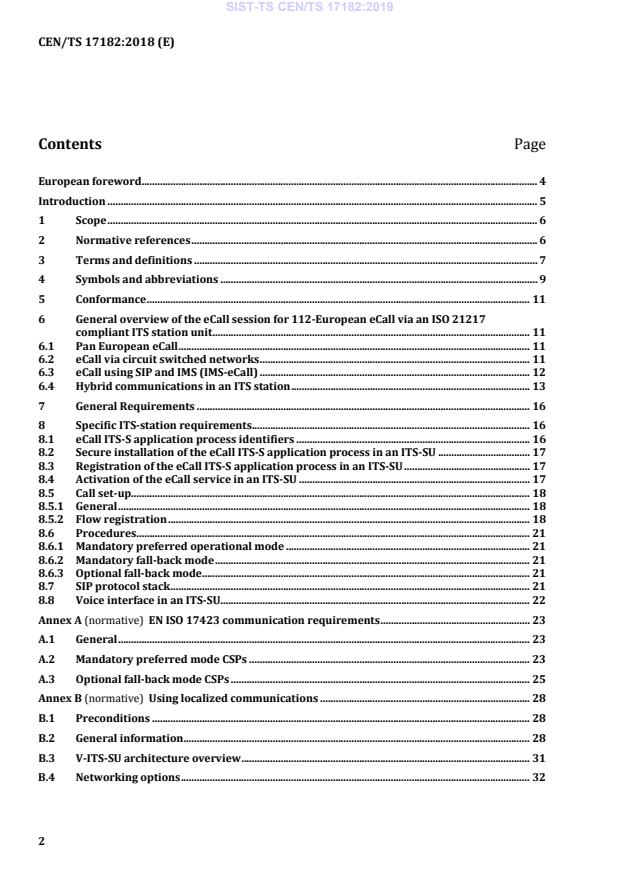
Contents Page
European foreword . 4
Introduction . 5
1 Scope . 6
2 Normative references . 6
3 Terms and definitions . 7
4 Symbols and abbreviations . 9
5 Conformance . 11
6 General overview of the eCall session for 112-European eCall via an ISO 21217
compliant ITS station unit . 11
6.1 Pan European eCall . 11
6.2 eCall via circuit switched networks . 11
6.3 eCall using SIP and IMS (IMS-eCall) . 12
6.4 Hybrid communications in an ITS station . 13
7 General Requirements . 16
8 Specific ITS-station requirements. 16
8.1 eCall ITS-S application process identifiers . 16
8.2 Secure installation of the eCall ITS-S application process in an ITS-SU . 17
8.3 Registration of the eCall ITS-S application process in an ITS-SU . 17
8.4 Activation of the eCall service in an ITS-SU . 17
8.5 Call set-up. 18
8.5.1 General . 18
8.5.2 Flow registration . 18
8.6 Procedures. 21
8.6.1 Mandatory preferred operational mode . 21
8.6.2 Mandatory fall-back mode . 21
8.6.3 Optional fall-back mode. 21
8.7 SIP protocol stack . 21
8.8 Voice interface in an ITS-SU. 22
Annex A (normative) EN ISO 17423 communication requirements . 23
A.1 General . 23
A.2 Mandatory preferred mode CSPs . 23
A.3 Optional fall-back mode CSPs . 25
Annex B (normative) Using localized communications . 28
B.1 Preconditions . 28
B.2 General information . 28
B.3 V-ITS-SU architecture overview . 31
B.4 Networking options . 32
B.5 Requirements . 34
B.5.1 Pre-conditions . 34
B.5.2 General requirements for service advertisement . 34
B.5.3 Requirements for service advertisement specific to eCall . 35
Annex C (informative) Table of timings . 36
Annex D (informative) Extracts from REGULATION (EU) 2015/758 OF THE EUROPEAN
PARLIAMENT AND OF THE COUNCIL . 39
Bibliography . 40
European foreword
This document (CEN/TS 17182:2018) has been prepared by Technical Committee CEN/TC 278
“Intelligent transport systems”, the secretariat of which is held by NEN.
Attention is drawn to the possibility that some of the elements of this document may be the subject of
patent rights. CEN shall not be held responsible for identifying any or all such patent rights.
According to the CEN/CENELEC Internal Regulations, the national standards organisations of the
following countries are bound to announce this Technical Specification: Austria, Belgium, Bulgaria,
Croatia, Cyprus, Czech Republic, Denmark, Estonia, Finland, Former Yugoslav Republic of Macedonia,
France, Germany, Greece, Hungary, Iceland, Ireland, Italy, Latvia, Lithuania, Luxembourg, Malta,
Netherlands, Norway, Poland, Portugal, Romania, Serbia, Slovakia, Slovenia, Spain, Sweden, Switzerland,
Turkey and the United Kingdom.
Introduction
As a result of European Regulation, from 2018, all new model Class M1/N1 vehicles (3.13) will be
equipped with112-eCall (3.1). Other model class M1/N1 vehicles may be voluntarily equipped with
112-eCall (3.1), and work is underway to provide the benefit of eCall to other classes of vehicle,
including commercial vehicles (3.5), busses and coaches.
In the event of an incident, in-vehicle sensors will automatically trigger a 112-eCall (3.1), or it may be
manually triggered by the vehicle occupants. A voice connection is established with the European
emergency number 112 and routed to the most appropriate Public Safety Answering Point (3.15)
(PSAP). As soon as the connection is established, in the case of a GSM/UMTS connection, using circuit
switched networks, a “Minimum set of data” (3.14) (as defined in EN 15722), providing information
such as the time, location, vehicle VIN number, and driving direction, is sent as data via the voice
channel. With the advent of packet switched, IP addressed, networks, a variant has been developed, that
establishes an IMS connection (IMS supports IP multimedia applications (3.4) via IP multimedia
sessions over a multitude of IP Connectivity Access Networks, such as E-UTRAN, UTRAN, GERAN, LAN,
DOCSIS®, WiMAX™, cdma2000® and DVB-RCS2 access) in which the MSD is part of the SIP message
header, so is already available to the PSAP as soon as the communication link is established.
The cooperative ITS (C-ITS) environment is one where ITS station units (ITS-SUs) (e.g. in vehicles, at the
roadside,.) securely cooperate to exchange data with other ITS-SUs using wireless communications
technologies. The C-ITS approach provides for hybrid communications (3.11), i.e. simultaneous
availability of multiple wireless communications technologies. There is already provision for such
networks at 5,8 GHz (widely already used for road tolling and soon to be used for tachograph
monitoring and weigh in motion monitoring), 5,9 GHz for road safety applications (3.4), and of course
the packet switched cellular networks mentioned above. In the future, 60 GHz and other wireless
networks may be employed.
The key to managing these cooperative systems is an ITS station and communications architecture
which enables operation of ITS applications (3.4) in a managed, secure, and prioritized way. This is
support of a functionality rather than a specification of a single black box, and may be achieved in
different ways within e.g. vehicle ITS-SUs. The common functionality is defined in ISO 21217:2014
(Intelligent transport systems – Communications access for land mobiles (CALM) – Architecture) whose
abstract defines “ISO 21217:2014 describes the communications reference architecture of nodes called
“ITS station units” designed for deployment in intelligent transport systems (ITS) communication
networks. The ITS station reference architecture is described in an abstract way. While ISO 21217:2014
describes a number of ITS station elements, whether or not a particular element is implemented in an ITS
station unit depends on the specific communication requirements of the implementation.
ISO 21217:2014 also describes the various communication modes for peer-to-peer communications over
various networks between ITS communication nodes. These nodes may be ITS station units as described in
ISO 21217:2014 or any other reachable nodes.
ISO 21217:2014 also specifies the minimum set of normative requirements for a physical instantiation of
the ITS station based on the principles of a bounded secured managed domain.”
Within vehicles equipped to support this context, it is appropriate to consider eCall as a priority ITS
application (3.4) that can use this in-vehicle functionality, rather than duplicate the in-vehicle
equipment.
This Technical Specification provides the specifications enabling 112-eCall (3.1) to function via an
ISO 21217 complaint “ITS-station unit”. (ITS-SU).
1 Scope
In respect of 112-eCall (3.1) (operating requirements defined in EN 16072:2015), this Technical
Specification defines the high level application protocols (3.10), procedures and processes required to
provide the eCall service via an ISO 21217 compliant “ITS station unit”
NOTE 1 The objective of implementing the pan-European in-vehicle emergency call system (eCall) is to
automate the notification of a traffic accident, wherever in Europe, with the same technical standards and the
same quality of services objectives by using a 'Public Land Mobile Network' (PLMN) (such as ETSI prime medium)
which supports the European harmonized 112/E112 emergency number and to provide a means of manually
triggering the notification of an emergency incident.
NOTE 2 Requirements for third party services supporting eCall can be found in EN 16102 [6], and have been
developed in conjunction with the development of EN 16072:2015 and EN 16072:2015, and are consistent in
respect of the interface to the PSAP. This technical specification applies only to 112-eCall (3.1) service provision
and makes no specifications in respect of third party eCall service provision, and the reader is referred to
EN 16102 [6] for any third party eCall specifications.
2 Normative references
The following documents are referred to in the text in such a way that some or all of their content
constitutes requirements of this document. For dated references, only the edition cited applies. For
undated references, the latest edition of the referenced document (including any amendments) applies.
CEN/TS 17184:2018, Intelligent transport systems — eSafety — eCall High level application Protocols
(HLAP) using IMS packet switched networks
CEN/TS 17240 , Intelligent transport systems - ESafety - ECall end to end conformance testing for IMS
packet switched based systems
EN 15722:2015, Intelligent transport systems ― ESafety ― ECall minimum set of data
EN 16062:2015, Intelligent transport systems ― eSafety ― eCall high level application requirements
(HLAP) using GSM/UMTS circuit switched networks
EN 16072:2015, Intelligent transport systems - ESafety - Pan-European eCall operating requirements
EN 16454:2015, Intelligent transport systems ― ESafety ― ECall end to end conformance testing
EN ISO 17419:2018, Intelligent transport systems — Cooperative systems — Globally unique
identification (ISO 17419)
EN ISO 17423:2018, Intelligent transport systems — Cooperative systems — Application requirements
and objectives (ISO 17423)
CEN ISO/TS 21176, Intelligent transport systems ― Cooperative ITS ― Position, velocity and time
functionality in the ITS station
ISO/TS 16460:2016, Intelligent transport systems ― Communications access for land mobiles (CALM) ―
Communication protocol messages for global usage
Under preparation. Stage at the time of publication: FprCEN/TS 17240:2018.
ISO 21217:2014, Intelligent transport systems — Communications access for land mobiles (CALM) —
Architecture
ISO 22418:2018, Intelligent transport systems — Fast service announcement protocol (FSAP)
ISO 24102-6:2018, Intelligent transport systems — ITS station management — Part 6: Path and flow
management
ETSI TS 122 101, Universal Mobile Telecommunications System (UMTS); LTE; Service aspects; Service
principles (3GPP TS 22.101) [Release 14 or later]
ETSI TS 122 003, Digital cellular communications system (Phase 2+); Universal Mobile
Telecommunications System (UMTS); LTE; Circuit Teleservices supported by a Public Land Mobile Network
(PLMN) (Teleservice 12/TC12) /E12) [Release 8 or later]
3 Terms and definitions
For the purposes of this document, the terms and definitions given in ISO 21217:2014, ISO 22418:2018,
EN ISO 17419:2018, EN ISO 17423:2018, ISO 24102-6:2018, CEN/TS 17184:2018 and the following
apply.
ISO and IEC maintain terminological databases for use in standardization at the following addresses:
• IEC Electropedia: available at http://www.electropedia.org/
• ISO Online browsing platform: available at http://www.iso.org/obp
3.1
112-eCall
pan-European eCall regulated by the European Union as a required service provision for all M1/N1
class new model vehicles from 2018, and provided using circuit switched cellular wireless networks
(GSM/UMTS)
3.2
112 emergency voice call
voice telephone call between a caller who dials a recognised emergency services telephone number (e.g.
112) and a PSAP emergency services responder
3.3
112 IMS-eCall
pan-European eCall provided using IMS over packet switched cellular wireless networks (e.g.
E_UTRAN/LTE etc.)
3.4
application
instantiation of a service, typically provided by one or several software modules
3.5
commercial vehicle
classes of vehicles such as heavy goods vehicles used for the transportation of goods and subject to
additional requirements and controls, especially in respect to movement (Typically UNECE classes N, O
and in some cases N6)
3.6
eCall
emergency call generated either automatically via activation of in-vehicle sensors or manually by the
vehicle occupants (the eCall generator)
Note 1 to entry: when activated, it provides notification and relevant location information to the most
appropriate Public Safety Answering Point (PSAP) (3.15), by means of mobile wireless communications networks
and carries a defined standardized Minimum set of data (3.14), notifying that there has been an incident that
requires response from the emergency services and establishes an audio channel between the occupants of the
vehicle and the most appropriate Public Safety Answering Point
3.7
engine control activation
vehicle is in use (previously and commonly referred to as “ignition on”) this term embraces a similar
condition for electric, hybrid, and stop/start vehicles)
3.8
first ITS relay station unit
roadside ITS station unit acting as an eCall forwarding service advertiser
Note 1 to entry: The first ITS relay station unit may also be the last ITS relay station unit (3.12)
3.9
Flow ID
(ITS-S flow identifier)
identifier, unique within an ITS station unit, that identifies an ITS-S flow
[SOURCE: ISO 24102-6]
3.10
high level application protocols
set form and sequence in which data must be presented for handling by a particular computer
application (3.4), especially in the transmission of information between different computer systems, in
order to accurately effect the transactions of an application
3.11
hybrid communications
approach for communications using simultaneously a variety of access technologies according to the
communication needs of ITS-S application processes
3.12
last ITS relay station unit
roadside or central ITS station unit directly accessing a cellular network for connecting to a PSAP
Note 1 to entry: The last ITS relay station unit may also be the first ITS relay station unit (3.8)
3.13
M1/N1 vehicles
vehicles of the UNECE classification M1 (Power-driven vehicles having at least four wheels and used for
the carriage of passengers/Vehicles used for the carriage of passengers and comprising not more than
eight seats in addition to the driver's seat. (Passenger car)) and N1 (Power-driven vehicles having at
least four wheels and used for the carriage of goods/ Vehicles used for the carriage of goods and having
a maximum mass not exceeding 3.5 tonnes. (Pick-up Truck, Van))
3.14
minimum set of data
standardized data concept comprising data elements of relevant vehicle generated data essential for the
performance of the eCall service
[SOURCE: EN 15722:2015]
3.15
Public Safety Answering Point
PSAP
physical location working on behalf of the national authorities where emergency calls are first received
under the responsibility of a public authority or a private organization recognized by the national
government
3.16
SIP header
component of a SIP message that conveys information about the message
4 Symbols and abbreviations
3GPP 3rd Generation Partnership Project
APDU Application Protocol Data Unit
API Application Program Interface
CCH Control Channel
CDMA 2000 code-division multiple access version of IMT-2000 standard
CI Communication Interface, (see ISO 21218)
C-ITS-SU Central Intelligent Transport System-Station Unit
CN Communication Network
CS Circuit Switched
CSP Communication Service Parameters
DOCSYS Data Over Cable Service Interface Specification
DVB-RCS2 Digital Video Broadcasting - Return Channel via Satellite or (Return channel over
system)
EN European Norm
ETSI European Telecommunications Standards Institut
E-UTRAN Evolved Universal Terrestrial Radio Access Network
FA-SAP Service access point between ITS-S facilities layer and ITS-S application entity
FNTP Fast Networking and Transport-layer Protocol
FSAM Fast Service Advertisement Message
FSAP Fast Service Advertisement Protocol
FSRM Fast Service Response Message
GERAN GSM EDGE Radio Access Network
GNSS Global Navigation Satellite System
GSM Global System Mobile
HLAP High Level Application Protocols
IETF Internet Engineering Task Force
IMS Internet Protocol Multimedia Subsystem
IN-SAP Service access point between ITS-S access layer and ITS-S networking and transport
layer
IP Internet Protocol
ITS Intelligent Transport Systems
ITS-AID ITS Application Identifier
ITS-SAPID ITS S application process identifer
ITS-SAPIID ITS-S application process instance identifer
ITS-SAPSSID ITS-S application process sink source identifier
ITS-SCU-ID ITS station communication unit identifier
ITS-SU Intelligent Transport Systems-Station Unit
LTE Long Term Evolution
MF-SAP Service access point between ITS-S management entity and ITS-S networking and
transport layer
MI-SAP Service access point between ITS-S management entity and ITS-S access layer
MNO Mobile Network Operator
MN-SAP Service access point between ITS-S management entity and ITS-S networking and
transport layer
MSD Minimum Set of Data
n.a. not applicable
NF-SAP Service access point between ITS-S networking and transport layer and ITS-S
facilities layer
PARES Public Authority responsible for Emergency Services
PLMN Public Land Mobile Network
PS Packet Switched
PSAP Public Safety Answering Point
R-ITS-SU Roadside ITS Station Unit
Rx Receive
SAM Service Advertisement Message
SIP Session Initiation Protocol
SIP-BYE SIP- BYE is a request used to terminate a specific session or attempted session
TCP Transmission Control Protocol
TS Technical Specification
Tx Transmit
UMTS Universal Mobile Telecommunications Service
UNECE United Nations Economic Commission for Europe
URI Uniform Resource Identifier
URL Uniform Resource Locator
URN Uniform Resource Name
UTRAN Universal Terrestrial Radio Access Network
V-ITS-SU Vehicle-Intelligent Transport System-System Unit
VoIP Voice over Internet Protocol
V-to-x Vehicle-to-any compatible transceiver
WiFi “Wireless Fidelity”; wireless networking technology that allows computers and
other devices to communicate over a wireless signal
WIMAX Worldwide Interoperability for Microwave Access
5 Conformance
This Technical Specification makes no conformance specifications or requirements in respect of TPS
eCall operating requirements which can be found in EN 16102 [6]. Conformance requirements for eCall
applicable for this Technical Specification are to be found in CEN/TS 17240 in respect of packet
switched eCall, and in EN 16454:2015 in respect of circuit switched eCall.
6 General overview of the eCall session for 112-European eCall via an ISO 21217
compliant ITS station unit
6.1 Pan European eCall
In the introduction to EN 16072:2015, eCall is described as:
“an emergency call generated either automatically via activation of in-vehicle sensors or manually by the
vehicle occupants (the eCall generator); when activated, it provides notification and relevant location
information to the most appropriate Public Safety Answering Point, by means of mobile wireless
communications networks and carries a defined standardized minimum set of data, notifying that there
has been an incident that requires response from the emergency services and establishes an audio channel
between the occupants of the vehicle and the most appropriate Public Safety Answering Point (PSAP).”
A Minimum set of data (3.14) (MSD) to be provided to the PSAP in the eCall message is specified in
EN 15722:2015.
6.2 eCall via circuit switched networks
In ETSI/3GPP circuit switched networks the eCall is identified as ‘an emergency call with a specific
service category’. The long number is not dialled as the teleservice identifiers inform the mobile
network operator (MNO) that the call is an emergency call/eCall and the MNO has procedures to direct
these calls to “the most appropriate” PSAP. Having established a voice channel, GSM/UMTS eCall then
mutes microphones and speakers and uses a modem to transfer the MSD to the PSAP by sending
acoustic data down the voice channel, before opening up the line to enable conversation between the
PSAP operator and the occupants of the vehicle (see EN 16062:2015)
The high level paradigm for eCall via an ITS-station remains unchanged, and the provision of this
service using a circuit teleservice supported by a Public Land Mobile Network (PLMN) (Teleservice
12/TS12) ETSI TS 122 003, will remain operational and viable for many years – indeed for as long as
GSM/UMTS PLMNs are available.
6.3 eCall using SIP and IMS (IMS-eCall)
Technology advances, and subsequent to the development of the eCall application (3.4) suite
EN 16072:2015, EN 16062:2015 and EN 16454:2015 standards, packet switched networks have
become available, and over the course of time, these packet switched networks (such as LTE/4G/E-
UTRAN) are expected to provide new PLMNs to complement and eventually replace the circuit switched
GSM/UMTS networks.
In a packet switched IMS environment, the eCall is established as an internet protocol based session
with the exchange of packets of data (which in this case, are largely packets of voice data), and the MSD
is provided as part of the session establishment, i.e. included in a header of the session initiation
protocol (SIP).
The SIP was selected as the signalling mechanism for IMS, thereby allowing voice, text and multimedia
services to traverse all connected networks. SIP is aligned with IETF internet protocols to ensure
maximum re-usability of internet standards, preventing fragmentation of IMS standards.
IMS is an all-IP (Internet Protocol) system designed to assist mobile operators deliver next generation
interactive and interoperable services, cost-effectively, over an architecture providing the flexibility of
the Internet. IMS supports IP multimedia applications (3.4) via IP multimedia sessions over a multitude
of IP connectivity access networks, such as E-UTRAN, UTRAN, GERAN, LAN, DOCSIS®, WiMAX™,
cdma2000® and DVB-RCS2 access.
IMS has a further advantage in that it can also be used over fixed lines. This makes the forwarding of
eCalls from 1st level PSAP responder to 2nd level PSAP responders and responding emergency services
via fixed lines, an easier and more simple process; and even enabling the call to then be subsequently
diverted to a handset of a responding ambulance, fire truck or police responder.
Figure 1 from CEN/TS 17184:2018 illustrates and compares the 112-eCall (3.1) service using packet
switched networks (IMS-eCall) and circuit switched networks (112-eCall (3.1)).
Figure 1 — 112-eCall (3.1) service using IMS compared to CS 112-eCall (3.1)
6.4 Hybrid communications in an ITS station
The eCall in-vehicle system part of the eCall service, implemented in an ITS-S application process
(ISO 21217:2014) in a vehicle ITS station unit, is relying on an architecture for hybrid communications
, i.e. offering usage of different communication technologies (protocol stacks / communication
(3.11)
profiles). Consequently this architecture enables a dynamic choice (see Figure 2 extracted from
EN ISO 17419:2018/ISO 21217:2014 and amended for eCall) of the most appropriate communications
network (technology and protocols) according to local availability performances, cost and other
criteria.
Figure 2 — Example of communication profile selection for eCall
The communication profile selection is achieved according to communication protocols' status
(availability, performances and price) based on communication requirements and rules.
Communication requirements are presented by the eCall ITS-S application process to the ITS-S
management as specified in EN ISO 17423:2018.
Operational modes considered for eCall in an ITS station unit are listed below:
— Mandatory default mode: SIP via packet-switched cellular networks with IMS support (e.g. 4G); see
6.3 and 8.6.1.
— Mandatory fall-back solution: analogue modem via circuit-switched cellular networks (e.g. 3G); see
6.2 and 8.6.2.
— Optional fall-back solution: SIP via localized communications applying service advertisement (e.g.
IEEE 802.11 OCB @ 5,9 GHz [8] - ITS-M5 profile): see 8.6.3.
NOTE LTE V-to-x communications is being standardized in ISO 17515-3 [1]. At time of publication, the
standard is at stage ISO/DIS 17515-3:2018.
The general set up of eCall is illustrated in Figure 3. Upon start of the vehicle ITS station unit, typically
upon engine control activation (3.7) of the vehicle, the eCall application (3.4) registers (within the
vehicle) with the ITS station management indicating that it is installed. The eCall application is then
ready and waiting for an eCall trigger event (but, as with CS based eCall, not at this stage connecting to
any wireless communications network [although other applications (3.4) hosted via the ITS-station may
cause connection]).
Upon an eCall trigger event, access to a communication network is performed, either by requesting the
ITS station management to connect to an available network, or by accepting a network that is already in
use by another ITS application (3.4). As a result, the ITS eCall vehicle process illustrated in Figure 4 is
launched.
Figure 3 — General set up of eCall
The ITS eCall vehicle process illustrated in Figure 4 is repetitively trying to connect to the most
appropriate PSAP, applying the operational modes presented above in the required sequence order
until either the eCall is successfully finalized, or the repetitive attempts are terminated and the call
defaults to a 112 emergency voice call (3.2). Details are specified in 8.3, 8.4, 8.5, and 8.6.
Figure 4 — Logical sequence of general process
7 General Requirements
An implementation of eCall in an ITS station unit shall be compliant with EN 16072:2015,
EN 15722:2015, EN 16062:2015, and EN 16454:2015; or CEN/TS 17184:2018 and CEN/TS 17240; i.e.
the basic eCall service enabled in an ITS station unit is identical to the pan-European 112-eCall (3.1)
service provided by a dedicated eCall device with respect of the MSD delivered to the most appropriate
PSAP, and the voice connection to the same most appropriate PSAP.
An ITS station unit supporting the eCall service shall:
— provide accurate position and time information as specified in CEN ISO/TS 21176;
— provide access to all data required in the MSD, and in the appropriate format as specified in
EN 15722:2015;
— comply with applicable privacy regulations.
8 Specific ITS-station requirements
8.1 eCall ITS-S application process identifiers
The eCall ITS application (3.4) is identified by a globally unique value of ITS-AID. ITS-AID is specified in
EN ISO 17419:2018. Registered values are published on the ISO standards maintenance portal
in the folder of EN ISO 17419 .
http://standards.iso.org/iso/
NOTE 1 The value registered for eCall is 1,617 decimal, which equals 0p89.db in the p-encoded format
specified in EN ISO 17419:2018.
The eCall ITS application (3.4) consists of several complementary ITS-S application processes
distinguished by the “ITS-S application process identifier” (ITS-SAPID) of ASN.1 type ITSsapid specified
in EN ISO 17419:2018.
On instantiation of an eCall the ITS-S application process in an ITS-SU is identified by an “ITS-S
application process instance identifier” (ITS-SAPIID) of ASN.1 type ITSsapiid specified in
EN ISO 17419:2018. ITS-SAPIID is the concatenation of
1) ITS-AID; assigned by ISO registrar;
2) ITS-SAPID; assigned in this International Standard;
3) ITS station communication unit identifier ITS-SCU-ID (>4, < 65535) specified in ISO 24102-4 for ITS
station-internal management communications with ASN.1 type ITS-scuId specified in
EN ISO 17419:2018; dynamically assigned by ITS station management, or hard coded by
implementation;
4) Instance identifier; defined by implementation. (0: default, as there is only a single instance)
Every sink and source of an instance of the eCall ITS-S application process installed in an ITS-SU is
uniquely identified by a value of the “ITS-S application process sink source identifier” (ITS-SAPSSID).
ITS-SAPSSIDs are mapped to ITS port numbers as specified in EN ISO 17419:2018 Clause 6.9.6.
NOTE 2 ITS port numbers are used by transport protocols in the ITS-S networking and transport layer (e.g.
FNTP specified in ISO 29281-1 [3], UDP and TCP for IP communications), and by the Fast Service Advertisement
Protocol (FSAP) specified in ISO 22418:2018.
ITS-S application processes and related interfaces of the eCall ITS application (3.4) identified so far are
presented in Table 1.
NOTE 3 The mandatory fall-back solution is to use an analogue voice channel for communications which is not
yet explicitly covered by the ITS station and communication architecture specified in ISO 21217:2014.
Consequently, there is no communication interface (CI) specified in ISO 21218 [2] providing an analogue voice
channel. Provision of this solution in an ITS-SU thus is implementation specific.
Table 1 — eCall ITS-S application processes
ITS-SAPID Description Location ITS-SapSsId.
ITSappProcSinkSourceNo
1 Issuer of eCall Vehicle ITS-SU 1: RX / TX interface for mandatory
(eCall in-vehicle preferred solution
system)
2: RX / TX interface (towards roadside
ITS-SU) for optional fall-back solution
(RX / TX interface for mandatory fall-
back solution; implementation-specific)
2 Advertiser of eCall routing Roadside ITS-SU 1: RX / TX interface (towards vehicle
ITS-SU) for optional fall-back solution
2: RX / TX interface (towards central
station of road operator for routing
towards PSAP) for optional fall-back
solution
8.2 Secure installation of the eCall ITS-S application process in an ITS-SU
The eCall ITS-S application processes shall be securely installed in ITS-SUs as specified in
EN ISO 17419:2018 Clause 7.2.1.
8.3 Registration of the eCall ITS-S application process in an ITS-SU
Upon engine control activation (3.7) and upon power-on of the ITS-SU, the eCall ITS-S application
processes shall register themselves to the on-board ITS-S management process as specified in
EN ISO 17419:2018 Clause 7.2.4, e.g.
a) For every applicable ITS-SapSsId.ITSappProcSinkSourceNo presenting requirements for
communications by means of “Communication Service Parameters” (CSP) specified in
EN ISO 17423:2018;
b) Optionally prepare for support by the service advertisement protocol FSAP specified in
ISO 22418:2018.
Registration at the service advertisement protocol FSAP in a vehicle ITS-SU shall not be performed upon
engine control activation (3.7) and power-on of the ITS-SU, but only upon triggering of the eCall service.
Details on the mandatory registration a) shall be as specified in A.2.
Details on the optional registration b) shall be as specified in A.3 and in Annex B.
8.4 Activation of the eCall service in an ITS-SU
Upon the event of the triggering of an eCall as defined in EN 16072:2015, the eCall ITS-S application
process shall be activated in an implementation specific way compliant with regulatory requirements.
8.5 Call set-up
8.5.1 General
Call set-up covers activities in preparation of connecting the eCall application (3.4) to a network and
performing the eCall.
Upon an eCall trigger event, the eCall application (3.4) in the vehicle ITS station unit shall
1) identify whether the eCall was triggered manually or automatically (this selects the eCall URN used
in the SIP Request-URI: urn:service:sos.eCall.automatic or urn:service:sos.ecall.manual);
2) obtain or calculate the actual position of the vehicle and the actual time (to the format specified in
EN 15722:2015;
3) create the Minimum set of data (3.14) (MSD);
4) provide the MSD to the ITS station management for usage in the SIP request header (the eCall URN
will be provided as part of the request for a Flow ID (3.9));
5) try applying the operational modes introduced in 6.1 and illustrated in Figure 4 in the following
sequence:
a) Register flow for SIP via cellular networks with IMS support (mandatory primary solution). In
case of success, registration is confirmed by providing a Flow ID (3.9).
b) Try the mandatory fall-back solution; registration of a flow is not applicable.
c) Register flow for SIP via localized communications, e.g. IEEE 802.11 OCB @ 5,9 GHz [8] - ITS-G5
/ ITS-M5 profiles applying service advertisement (optional fall-back solution applicable to the
extentextend allowed by regulation). In the event of success, registration is confirmed by
providing a Flow ID (3.9).
NOTE In case of applying service advertisement, flow registration is performed after notification of the
advertised eCall service.
As soon as a FlowID is assigned, or the mandatory fall-back solution is selected, the eCall ITS-S
application process can start an attempt to perform the appropriate session as specified in 8.6 for the
sequence of attempting to connect via one of these three different modes.
8.5.2 Flow registration
Upon activation of the eCall service in an ITS-SU specified in 8.4, the eCall ITS-S application process with
ITS-SAPID = 1 shall register a flow. Registration of flows shall use the parameters of the service
primitive of ASN.1 code RegisterFlow presented in Table 2 as specified in ISO 24102-6:2018, or in an
implementation specific way.
Table 2 — Parameters for registration of a flow at the path and flow management
Parameter ASN.1 type of Value Description
name / component
component of
Register
Flow
ITS-SAPIID / a {0p89.db, ITS-SAPID, Specified in EN ISO 17419:2018
ITSsapiid
itss-app ITS-SCU-ID, 0}
TX interface ITSappProcSink defined by Specified in EN ISO 17419:2018.
number / SourceNo implementation Same as contained in ITS-
txInterface SAPSSID. Possible values:
No
0 - 255
Destination ID / DestinationID {destinationIdUrn, Specified in ISO 24102-6:2018
destID destination ID value}
Possible values of destination ID:
urn:service:sos.ecall.automatic,
urn:service:sos.ecall.manual
Destination DestinationType 4: unicast Specified in EN ISO 17423:2018
Type / destInfo
Credentials / OCTET STRING tbd Used to check whether the
credentials requesting ITS-S application
process is authorized. So far no
methods to do so are specified,
see7.4 in ISO 24102-6:2018.
a
DIS 24102-6 contained a typo, i.e. “ITSsapid” instead of “ITSsapiid”. At time of writing this standard it is not
obvious whether the typo will be corrected in the published version ISO 24102–6:2017.
Requests for registration of a flow shall be confirmed with parameters of the service primitive of ASN.1
code RegisterFlowConf presented in Table 3 as specified in ISO 24102-6:2018, or in an implementation
specific way.
Upon successful registration of a flow, the assigned FlowID is used in subsequent transmissions of
application protocol data units (APDU), i.e. the eCall MSD.
Table 3 — Parameters for confirmation of a registration
Parameter name / ASN.1 type of component Value Description
component of
RegisterFlowConf
ITS-SAPIID / a same as in Specified in
ITSsapiid
itss-app corresponding EN ISO 17419:2018
request
Flow ID / flowID FlowID as dynamically Identifies uniquely a flow
assigned in an ITS-SU
TX interface number / ITSappProcSinkSourceNo same as in Specified in
txInterfaceNo corresponding EN ISO 17419:2018.
request Same as contained in
ITS-SAPSSID. Value
defined by
implementation
TX parameters / TXparameters as dynamically Opt
...