

SIST-TS CEN/TS 16157-11:2025
(Main)Intelligent transport systems - DATEX II data exchange specifications for traffic management and information - Part 11: Publication of machine interpretable traffic regulations
General Information
- Abstract
This document specifies a publication sub-model within the DATEX II model that supports the publication of electronic traffic regulations and controlled zones.
This publication is intended to support the exchange of informational content from road traffic authorities issuing traffic regulation orders and organizations implementing these orders to other organizations providing ITS services or onward information exchange.
- Status
- Published
- Publication Date
- 16-Oct-2025
- Technical Committee
- ITC - Information technology
- Current Stage
- 6060 - National Implementation/Publication (Adopted Project)
- Start Date
- 13-Oct-2025
- Due Date
- 18-Dec-2025
- Completion Date
- 17-Oct-2025

Overview
CEN/TS 16157-11:2025 (part of the EN 16157 DATEX II series) specifies a publication sub-model for the exchange of machine interpretable traffic regulations and controlled zones within Intelligent Transport Systems (ITS). The Technical Specification defines two DATEX II namespaces - TrafficRegulation and ControlledZone - and provides normative data dictionaries and XML schemas to enable interoperable, machine-readable publication of traffic regulation orders, controlled zones (e.g., UVAR, LEZ, LTZ) and related warnings or predefined conditions.
Keywords: DATEX II, traffic regulations, controlled zone, machine interpretable, ITS, traffic management, traffic regulation order, XML schema
Key topics and technical requirements
- Scope and purpose: Supports exchange of electronic traffic regulation orders from issuing authorities and implementation organizations to ITS service providers and onward information sharing.
- Namespaces & publication models: Defines models and packages such as TrafficRegulationPublication, ControlledZonePublication, PredefinedConditionPublication, and WarningPublication to structure published content.
- Data dictionaries and XML schemas: Normative annexes provide detailed data dictionaries (Annex A–C) and referenced XML schemas (Annex D) for serialisation and validation.
- Location and common elements: Location referencing and common shared elements are handled via the wider EN 16157 family (see Related standards).
- Modelling and notation: Uses UML modelling conventions and standard datatypes (ISO 8601 for date/time) to ensure consistent definitions.
- Extensions and interoperability: Includes extension namespaces (CommonExtension, LocationExtension) for extensibility and integration with other DATEX II parts.
- Conformance: Specifies what parts of the publication model are normative and highlights dependencies on other DATEX II parts for full conformance.
Practical applications
- Publish machine-readable traffic regulation orders (legal restrictions, temporary/ad hoc regulations).
- Distribute controlled-zone definitions for Urban Vehicle Access Regulations (UVAR), Low Emission Zones (LEZ) and Limited Traffic Zones (LTZ).
- Feed ITS services (route planners, navigation, traffic management centres) with authoritative regulation data to enable dynamic routing, access control and compliance checks.
- Support cross-border and multi-stakeholder interoperability for transport authorities, service providers, and data aggregators.
Who should use this standard
- National and local road traffic authorities issuing traffic regulation orders
- Traffic management organisations and infrastructure operators
- ITS service providers, navigation and mobility platform developers
- Data integrators and system architects implementing DATEX II exchanges
Related standards
- EN 16157-1:2018 (Context & framework)
- EN 16157-2:2019 (Location referencing)
- EN 16157-7:2018 (Common data elements)
- CEN/TS 16157-12 (Facility information)
- ISO 8601 (date/time representations)
CEN/TS 16157-11:2025 promotes consistent, machine-interpretable publication of traffic rules and controlled zones to improve interoperability, safety and smart mobility services across ITS ecosystems.
Relations
- Effective Date
- 28-Jan-2026
- Effective Date
- 28-Jan-2026
- Effective Date
- 28-Jan-2026
- Effective Date
- 28-Jan-2026
- Effective Date
- 28-Jan-2026
- Effective Date
- 28-Jan-2026
- Effective Date
- 28-Jan-2026
- Effective Date
- 22-Jul-2026
- Effective Date
- 28-Jan-2026
- Effective Date
- 30-Mar-2022
Get Certified
Connect with accredited certification bodies for this standard

BSI Group
BSI (British Standards Institution) is the business standards company that helps organizations make excellence a habit.

NYCE
Mexican standards and certification body.
Sponsored listings
Frequently Asked Questions
SIST-TS CEN/TS 16157-11:2025 is a technical specification published by the Slovenian Institute for Standardization (SIST). Its full title is "Intelligent transport systems - DATEX II data exchange specifications for traffic management and information - Part 11: Publication of machine interpretable traffic regulations". This standard covers: This document specifies a publication sub-model within the DATEX II model that supports the publication of electronic traffic regulations and controlled zones. This publication is intended to support the exchange of informational content from road traffic authorities issuing traffic regulation orders and organizations implementing these orders to other organizations providing ITS services or onward information exchange.
This document specifies a publication sub-model within the DATEX II model that supports the publication of electronic traffic regulations and controlled zones. This publication is intended to support the exchange of informational content from road traffic authorities issuing traffic regulation orders and organizations implementing these orders to other organizations providing ITS services or onward information exchange.
SIST-TS CEN/TS 16157-11:2025 is classified under the following ICS (International Classification for Standards) categories: 35.240.60 - IT applications in transport. The ICS classification helps identify the subject area and facilitates finding related standards.
SIST-TS CEN/TS 16157-11:2025 has the following relationships with other standards: It is inter standard links to SIST EN 16157-2:2019, SIST EN 16157-7:2019, SIST EN 1846-2:2002+A3:2009, SIST EN ISO 15877-3:2009/A2:2021, SIST EN 16157-1:2019, SIST EN ISO 14823-1:2024, SIST EN 16157-4:2021, SIST-TS CEN/TS 16157-8:2026, SIST-TS CEN/TS 17402:2020, SIST-TS CEN/TS 16157-11:2022. Understanding these relationships helps ensure you are using the most current and applicable version of the standard.
SIST-TS CEN/TS 16157-11:2025 is associated with the following European legislation: EU Directives/Regulations: 2010/40/EU. When a standard is cited in the Official Journal of the European Union, products manufactured in conformity with it benefit from a presumption of conformity with the essential requirements of the corresponding EU directive or regulation.
SIST-TS CEN/TS 16157-11:2025 is available in PDF format for immediate download after purchase. The document can be added to your cart and obtained through the secure checkout process. Digital delivery ensures instant access to the complete standard document.
Standards Content (Sample)
SLOVENSKI STANDARD
01-december-2025
Inteligentni transportni sistemi - Specifikacije za izmenjavo podatkov DATEX II pri
upravljanju prometa in informiranju - 11. del: Objava strojno interpretiranih
prometnih predpisov
Intelligent transport systems - DATEX II data exchange specifications for traffic
management and information - Part 11: Publication of machine interpretable traffic
regulations
Intelligente Verkehrssysteme - DATEX II Datenaustauschspezifikation für
Verkehrsmanagement und Verkehrsinformation - Teil 11: Publikation von
maschineninterpretierbaren Verkehrsregeln
Systèmes de transport intelligents — Spécifications Datex II d'échange de données pour
la gestion du trafic et l'information routière — Partie 11 : Publication des arrêtés de
circulation sous forme exploitable par ordinateur
Ta slovenski standard je istoveten z: CEN/TS 16157-11:2025
ICS:
35.240.60 Uporabniške rešitve IT v IT applications in transport
prometu
2003-01.Slovenski inštitut za standardizacijo. Razmnoževanje celote ali delov tega standarda ni dovoljeno.
CEN/TS 16157-11
TECHNICAL SPECIFICATION
SPÉCIFICATION TECHNIQUE
October 2025
TECHNISCHE SPEZIFIKATION
ICS 35.240.60 Supersedes CEN/TS 16157-11:2022
English Version
ntelligent transport systems - DATEX II data exchange
specifications for traffic management and information -
Part 11: Publication of machine interpretable traffic
regulations
Systèmes de transport intelligents - Spécifications Intelligente Verkehrssysteme - DATEX II
Datex II d'échange de données pour la gestion du trafic Datenaustauschspezifikation für Verkehrsmanagement
et l'information routière - Partie 11 : Publication des und Verkehrsinformation - Teil 11: Publikation von
arrêtés de circulation sous forme exploitable par maschineninterpretierbaren Verkehrsregeln
ordinateur
This Technical Specification (CEN/TS) was approved by CEN on 15 September 2025 for provisional application.
The period of validity of this CEN/TS is limited initially to three years. After two years the members of CEN will be requested to
submit their comments, particularly on the question whether the CEN/TS can be converted into a European Standard.
CEN members are required to announce the existence of this CEN/TS in the same way as for an EN and to make the CEN/TS
available promptly at national level in an appropriate form. It is permissible to keep conflicting national standards in force (in
parallel to the CEN/TS) until the final decision about the possible conversion of the CEN/TS into an EN is reached.
CEN members are the national standards bodies of Austria, Belgium, Bulgaria, Croatia, Cyprus, Czech Republic, Denmark, Estonia,
Finland, France, Germany, Greece, Hungary, Iceland, Ireland, Italy, Latvia, Lithuania, Luxembourg, Malta, Netherlands, Norway,
Poland, Portugal, Republic of North Macedonia, Romania, Serbia, Slovakia, Slovenia, Spain, Sweden, Switzerland, Türkiye and
United Kingdom.
EUROPEAN COMMITTEE FOR STANDARDIZATION
COMITÉ EUROPÉEN DE NORMALISATION
EUROPÄISCHES KOMITEE FÜR NORMUNG
CEN-CENELEC Management Centre: Rue de la Science 23, B-1040 Brussels
© 2025 CEN All rights of exploitation in any form and by any means reserved Ref. No. CEN/TS 16157-11:2025 E
worldwide for CEN national Members.
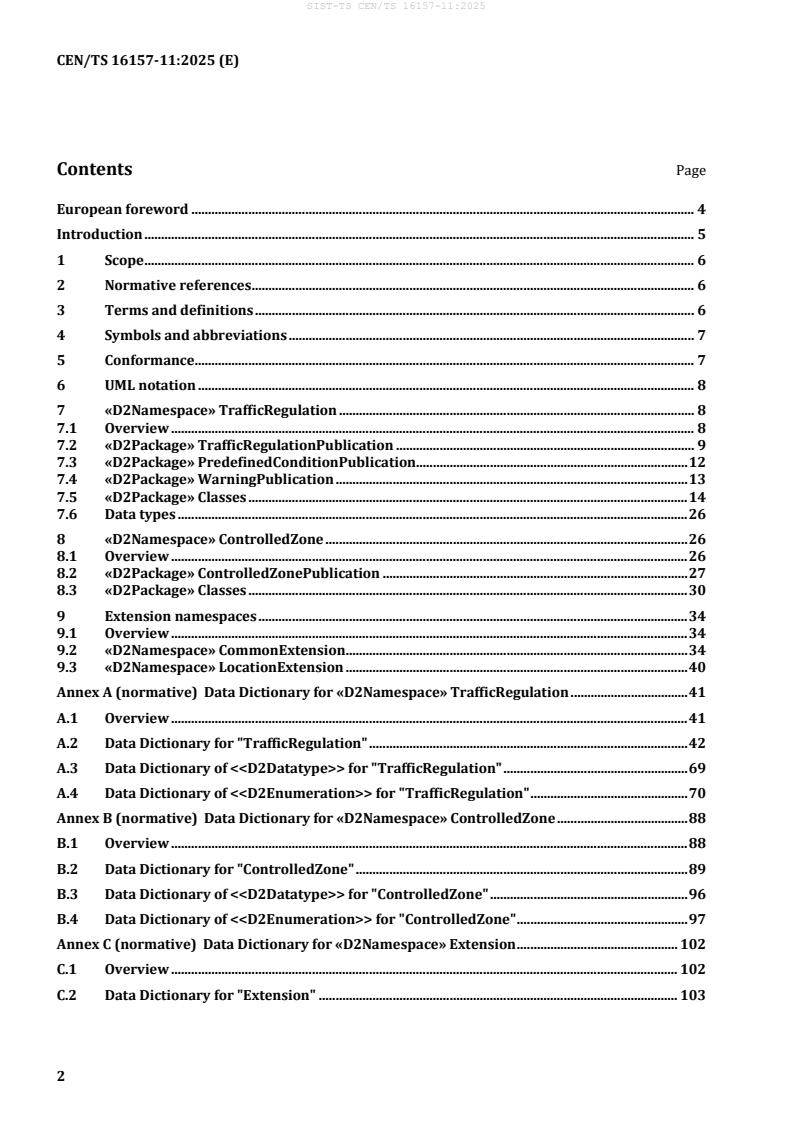
Contents Page
European foreword . 4
Introduction . 5
1 Scope . 6
2 Normative references . 6
3 Terms and definitions . 6
4 Symbols and abbreviations . 7
5 Conformance . 7
6 UML notation . 8
7 «D2Namespace» TrafficRegulation . 8
7.1 Overview . 8
7.2 «D2Package» TrafficRegulationPublication . 9
7.3 «D2Package» PredefinedConditionPublication . 12
7.4 «D2Package» WarningPublication . 13
7.5 «D2Package» Classes . 14
7.6 Data types . 26
8 «D2Namespace» ControlledZone . 26
8.1 Overview . 26
8.2 «D2Package» ControlledZonePublication . 27
8.3 «D2Package» Classes . 30
9 Extension namespaces . 34
9.1 Overview . 34
9.2 «D2Namespace» CommonExtension . 34
9.3 «D2Namespace» LocationExtension . 40
Annex A (normative) Data Dictionary for «D2Namespace» TrafficRegulation . 41
A.1 Overview . 41
A.2 Data Dictionary for "TrafficRegulation" . 42
A.3 Data Dictionary of <> for "TrafficRegulation" . 69
A.4 Data Dictionary of <> for "TrafficRegulation" . 70
Annex B (normative) Data Dictionary for «D2Namespace» ControlledZone . 88
B.1 Overview . 88
B.2 Data Dictionary for "ControlledZone" . 89
B.3 Data Dictionary of <> for "ControlledZone" . 96
B.4 Data Dictionary of <> for "ControlledZone" . 97
Annex C (normative) Data Dictionary for «D2Namespace» Extension . 102
C.1 Overview . 102
C.2 Data Dictionary for "Extension" . 103
C.3 Data Dictionary of <> for "Extension" . 111
C.4 Data Dictionary of <> for "Extension" . 111
Annex D (normative) Referenced XML schema . 132
D.1 Overview . 132
D.2 Schema for «D2Namespace» TrafficRegulation . 132
D.3 Schema for «D2Namespace» ControlledZone . 154
D.4 Schema for «D2Namespace» CommonExtension . 160
D.5 Schema for «D2Namespace» LocationExtension . 168
Bibliography . 169
European foreword
This document (CEN/TS 16157-11:2025) has been prepared by Technical Committee CEN/TC 278
“Intelligent transport systems”, the secretariat of which is held by NEN.
Attention is drawn to the possibility that some of the elements of this document may be the subject of
patent rights. CEN shall not be held responsible for identifying any or all such patent rights.
This document supersedes CEN/TS 16157-11:2022.
CEN/TS 16157-11:2022:
— introduction of a new model for controlled zones;
— remodelling of some classes from the traffic regulation model for the use in the controlled zone
model;
— addition of a publication model for predefined conditions;
— addition of a publication model for warnings that are not subject to traffic regulations;
— correction of different bugs.
The EN 16157 series consists of several parts under the general title “Intelligent transport systems
— DATEX II data exchange specifications for traffic management and information”. Other parts may
be developed in the future.
A list of all parts in a series can be found on the CEN website: www.cencenelec.eu.
Attention is drawn to the resources of www.datex2.eu. This web site contains related software
tools and software resources that aid the implementation of EN 16157 DATEX II.
Any feedback and questions on this document should be directed to the users’ national standards body.
A complete listing of these bodies can be found on the CEN website.
According to the CEN-CENELEC Internal Regulations, the national standards organizations of the
following countries are bound to announce this Technical Specification: Austria, Belgium, Bulgaria,
Croatia, Cyprus, Czech Republic, Denmark, Estonia, Finland, France, Germany, Greece, Hungary, Iceland,
Ireland, Italy, Latvia, Lithuania, Luxembourg, Malta, Netherlands, Norway, Poland, Portugal, Republic of
North Macedonia, Romania, Serbia, Slovakia, Slovenia, Spain, Sweden, Switzerland, Türkiye and the
United Kingdom.
Introduction
This document defines a common set of data exchange specifications to support the vision of a seamless
interoperable exchange of road traffic and travel information across boundaries, including national,
urban, interurban, road administrations, infrastructure providers and service providers.
Standardization in this context is a vital constituent to ensure interoperability, reduction of risk,
reduction of the cost base, promotion of open marketplaces and many social, economic and community
benefits to be gained from more informed travellers, network managers and transport operators.
Deploying intelligent transport systems in line with European Sustainable and Smart Mobility Strategy
as issued by the European Commission requires co-ordination of traffic management operation and
development of seamless pan-European information services. These jointly aim at contributing to the
transformation of the European transport system for the objectives of efficient, safe, sustainable, smart
and resilient mobility.
In this context the European Commission has been supporting the development of information
exchange between the actors of road traffic management and related services for several years. In the
road sector, DATEX II has been long in fruition, with the European Commission being fundamental to its
development through an initial contract and subsequent co-funding of the further evolution of the
standard and user support ecosystem. With this standardization of DATEX II, there is a real basis for
common exchange between the actors of the traffic and travel information sector both in the
collaboration between traffic management organisations and their systems, as well as in coherent
information provision to service providers. DATEX II supports the requirements of the stakeholder
organisations involved in the road traffic and travel domain in compliance with the EU policy and legal
frameworks aimed at the sector.
Attention is drawn to the possibility that some of the elements of this document may be the subject of
patent rights. CEN shall not be held responsible for identifying any or all such patent rights.
This European Standard includes the framework and context for exchanges, the modelling approach,
data content, data structure and relationships.
This European Standard supports a methodology that is extensible.
The 11th part of the CEN/TS 16157- EN 16157 series (this Technical Specification) deals with
information on traffic regulations and controlled zones. It defines two DATEX II namespaces
“TrafficRegulation” and "ControlledZone".
In normative Annex A, the data dictionary for the «D2Namespace» TrafficRegulation is specified.
In normative Annex B, the data dictionary for the «D2Namespace» ControlledZone is specified.
In normative Annex C, the data dictionary for the «D2Namespace» Extension is specified.
In normative Annex D, the referenced XML schemas for the «D2Namespace» TrafficRegulation and the
«D2Namespace» ControlledZone are specified.
1 Scope
This document specifies a publication sub-model within the DATEX II model that supports the
publication of electronic traffic regulations and controlled zones.
This publication is intended to support the exchange of informational content from road traffic
authorities issuing traffic regulation orders and organizations implementing these orders to other
organizations providing ITS services or onward information exchange.
2 Normative references
The following documents are referred to in the text in such a way that some or all of their content
constitutes requirements of this document. For dated references, only the edition cited applies. For
undated references, the latest edition of the referenced document (including any amendments) applies.
EN 16157-1:2018, Intelligent transport systems — DATEX II data exchange specifications for traffic
management and information — Part 1: Context and framework
EN 16157-2:2019, Intelligent transport systems — DATEX II data exchange specifications for traffic
management and information — Part 2: Location referencing
CEN/TS 16157-4:2021, Intelligent transport systems — DATEX II data exchange specifications for traffic
management and information — Part 4: VMS publication
EN 16157-7:2018, Intelligent transport systems — DATEX II data exchange specifications for traffic
management and information — Part 7: Common data elements
EN ISO 14823-1, Intelligent transport systems — Graphic data dictionary — Part 1: Specification (ISO
14823-1)
ISO 8601-1, Date and time — Representations for information interchange — Part 1: Basic rules
ISO/IEC 19505-1, Information Technology — Object Management Group Unified Modeling Language
(OMG UML) – Part 1: Infrastructure
3 Terms and definitions
For the purposes of this document, the terms and definitions given in EN 16157-1, EN 16157-2,
EN 16157-7 and the following apply.
ISO and IEC maintain terminology databases for use in standardization at the following addresses:
— ISO Online browsing platform: available at https://www.iso.org/obp/
— IEC Electropedia: available at https://www.electropedia.org/
3.1
traffic regulation
legal agreement or order that restricts or prohibits the use of the road network
3.2
traffic regulation order
legally recognized document or publication issued to enact a specific traffic regulation or regulations by
a competent authority
3.3
issuing authority
competent authority that issued the traffic regulation order
3.4
ad hoc traffic regulation
traffic regulations implemented by road operators without formal order due to urgent safety
requirements
3.5
planned dynamic traffic regulation
traffic regulation, often dynamically changeable, implemented by means of an automated or
controllable technical system
3.6
controlled zone
geographic zone together with an applicable set of regulations, e.g., usable for UVARS (Urban Vehicle
Access Regulations)
3.7
low emission zone
area where access by some polluting vehicles is restricted or deterred with the aim of improving air
quality
3.8
limited traffic zone
defined area in which access is only permitted for authorized vehicles
4 Symbols and abbreviations
UML Unified Modeling Language
XML eXtensible Markup Language
URL Uniform Resource Locator
EU European Union
GDD Graphic Data Dictionary
UVAR Urban Vehicle Access Regulation
LEZ Low Emission Zone
LTZ Limited Traffic Zone
ADR Agreement of 30 September 1957 concerning the International Carriage of Dangerous Goods by
Road
5 Conformance
This document specifies DATEX II traffic regulation and controlled zone publications, except for the
elements that relate to location information which are specified in EN 16157-2:2019, the common
elements (i.e., shared between several publications) which are defined in EN 16157-7:2018 and facility
information which is specified in CEN/TS 16157-12:2022 [3].
The DATEX II platform independent data model, of which this publication sub-model is a part,
corresponds to the level A model as defined in EN 16157-1.
Conformance with this Part shall require platform independent models from which platform specific
models are generated to comply with the UML modelling rules defined in EN 16157-1 and with the
following requirements of the models which are expressed in this part.
6 UML notation
The UML notation used in this document shall be as described in ISO/IEC 19505-1.
NOTE Some introductory guides to UML 2 are provided in the Bibliography of EN 16157-1:2018.
7 «D2Namespace» TrafficRegulation
7.1 Overview
This namespace gathers packages and classes related to traffic regulations. Figure 1 represents the
different packages and classes belonging to the "TrafficRegulation" namespace, which uses the
namespace prefix "tro".
Figure 1 — The "TrafficRegulation" model
The "TrafficRegulation" namespace shall include the following five packages:
— TrafficRegulationPublication,
— PredefinedConditionPublication,
— WarningPublication,
— Classes,
— Enumerations,
— DataTypes.
The traffic regulation publication model comprises three top-level packages,
"TrafficRegulationPublication" (see 7.2), “PredefinedConditionPublication” (see 7.3) and
“WarningPublication” (see 7.4), each containing a class of the same name as the package. The classes
"TrafficRegulationPublication", “PredefinedConditionPublication” and “WarningPublication” are
specialisations of the "PayloadPublication" class and hence form the top of the hierarchy of the traffic
regulation sub-model.
The classes, attributes, data types and enumerations that are specific to the “TrafficRegulation”
namespace are defined in Annex A.
The XML schema corresponding to this document is provided in Annex D.
7.2 «D2Package» TrafficRegulationPublication
7.2.1 Overview of «D2Package» TrafficRegulationPublication
The "TrafficRegulationPublication" package shall comprise a sub-model for defining traffic regulations.
The class "TrafficRegulationPublication" may include the following classes specifying different ways of
publishing traffic regulations (see Figure 2):
— “TrafficRegulationsFromCompetentAuthorities”,
— “AdHocTrafficRegulations”,
— “TrafficRegulationsByAuthorisedActors”,
— “DynamicTrafficRegulations”,
— “TrafficRegulationsWithoutTrafficRegulationOrder”.
The “TrafficRegulationsWithoutTrafficRegulationOrder” class is a container for traffic regulations that
are not issued by a traffic regulation order, whereas the “AdHocTrafficRegulations” container shall only
contain traffic regulations that are issued in urgent (usually safety relevant) situations.
The following Figure 2 represents the sub-model including the relationship between classes.
Figure 2 — The "TrafficRegulationPublication" package class model
7.2.2 Semantics of «D2Package» TrafficRegulationPublication
7.2.2.1 «D2Identifiable» TrafficRegulationPublication
The "TrafficRegulationPublication" class is a specific instantiable case of the "PayloadPublication" class.
Each "TrafficRegulationPublication" class instance may be composed of one of the following classes:
— TrafficRegulationsFromCompetentAuthorities,
— AdHocTrafficRegulations,
— TrafficRegulationsByAuthorisedActors,
— DynamicTrafficRegulations,
— TrafficRegulationsWithoutTrafficRegulationOrder.
The "TrafficRegulationPublication" class is the root class containing the published traffic regulations.
7.2.2.2 «D2Class» TrafficRegulationsFromCompetentAuthorities
The "TrafficRegulationsFromCompetentAuthorities" class is a container for traffic regulation orders.
7.2.2.3 «D2Class» AdHocTrafficRegulations
The "AdHocTrafficRegulations" class is a container for ad hoc traffic regulations.
7.2.2.4 «D2Class» AdHocTrafficRegulation
The "AdHocTrafficRegulation" class describes an ad hoc traffic regulation in urgent (usually safety
relevant) situations without a traffic regulation order. It may include one or more instances of the
"TrafficRegulation" class (see 7.5.3.2.1).
7.2.2.5 «D2Class» TrafficRegulationsByAuthorisedActors
The "TrafficRegulationsByAuthorisedActors" class is a container for activated regulations.
7.2.2.6 «D2Class» ActivatedRegulation
The "ActivatedRegulation" class describes a traffic regulation currently active according to a traffic
regulation by authorised actor. Each instance may include one or more instances of the
"TrafficRegulation" class (see 7.5.3.2.1).
7.2.2.7 «D2Class» DynamicTrafficRegulations
The "DynamicTrafficRegulations" class is a container for dynamic traffic regulations.
7.2.2.8 «D2Class» DynamicTrafficRegulation
The "DynamicTrafficRegulation" class describes a traffic regulation which is often dynamically
changeable and implemented by means of an automated or controllable technical system.
7.2.2.9 «D2Class» DynamicTrafficManagement
The "DynamicTrafficManagement" class is a specialisation of the "DynamicTrafficRegulation" class and
describes technical systems that perform traffic regulations automatically to manage traffic. Each
instance of this class may be associated with zero or more traffic regulations (see 7.5.3.2.1).
7.2.2.10 «D2Class» TrafficSignals
The abstract "TrafficSignals" class is empty and may be extended by a dedicated model for traffic signal
state and timing if this class is to be used.
7.2.2.11 «D2Class» TrafficRegulationsWithoutTrafficRegulationOrder
The “TrafficRegulationsWithoutTrafficRegulationOrder” class is a container for traffic regulations that
are not issued by a traffic regulation order.
7.3 «D2Package» PredefinedConditionPublication
7.3.1 Overview of «D2Package» PredefinedConditionPublication
The "PredefinedConditionPublication" package shall comprise a sub-model for defining predefined
conditions.
The following Figure 3 represents the sub-model including the relationship between classes.
Figure 3 — The “PredefinedConditionPublication” package class model
7.3.2 Semantics of «D2Package» PredefinedConditionPublication
7.3.2.1 «D2Identifiable» PredefinedConditionPublication
The "PredefinedConditionPublication" class is a specific instantiable case of the "PayloadPublication"
class.
Each "PredefinedConditionPublication" class instance shall be composed of at least one instance of the
“PredefinedCondition” class.
7.3.2.2 «D2VersionedIdentifiable» PredefinedCondition
The "PredefinedCondition" class shall be used to specify predefined conditions that are published in a
"PredefinedConditionPublication". Each instance of the “PredefinedCondition” class shall include
exactly one condition defined by the “Condition” class in 7.5.5.2.1.
7.4 «D2Package» WarningPublication
7.4.1 Overview of «D2Package» WarningPublication
The "WarningPublication" package shall comprise a sub-model for defining warnings that are not
subject to traffic regulations.
The following Figure 4 represents the sub-model including the relationship between classes.
Figure 4— The “WarningPublication” package class model
7.4.2 Semantics of «D2Package» WarningPublication
7.4.2.1 «D2Identifiable» WarningPublication
The "WarningPublication" class is a specific instantiable case of the "PayloadPublication" class.
Each "WarningPublication" class instance shall be composed of one to many instances of the
“WarningWithoutRegulation” class.
7.4.2.2 «D2Class» WarningWithoutRegulation
The "WarningWithoutRegulation" class shall be used to specify warnings that are not subject to traffic
regulations. Each instance of the “WarningWithoutRegulation” class shall include at least one instance
of the “Warning” class (see 7.5.6.2.1) specifying the type of warning without regulation. Optionally,
conditions for the applicability of the warning may be specified using the “Condition” class (see
7.5.5.2.1) and road signs using the “RoadSign” class (see 7.5.3.2.3).
7.5 «D2Package» Classes
7.5.1 Introduction
This package contains a collection of packages and classes used by the traffic regulation namespace
defined in this document (see Figure 5).
Figure 5 — The “Classes” package
7.5.2 «D2Package» TrafficRegulationOrder
7.5.2.1 Overview of «D2Package» TrafficRegulationOrder
This package describes data relating to the publication of traffic regulation orders.
Traffic regulations may be issued by a traffic regulation order, which can also be a temporary traffic
regulation order.
The following Figure 6 represents the sub-model including the relationship between classes.
Figure 6 — The "TrafficRegulationOrder" class model
7.5.2.2 Semantics of «D2Package» TrafficRegulationOrder
7.5.2.2.1 «D2VersionedIdentifiable» TrafficRegulationOrder
The "TrafficRegulationOrder" class describes a regulation ordered by a competent authority. It may
include the following components:
— at least one traffic regulation(s) defined by the "TrafficRegulation" class (see 7.5.3.2.1),
— optional "implementedLocation" and/or "locationByOrder" defined by the "LocationReference"
class, which belongs to the "LocationReferencing" package specified in EN 16157-2:2019,
— optional "implementedValidity" and/or "validityByOrder" defined by the "Validity" class, which
belongs to the "Validity" package specified in EN 16157-7:2018,
— optional legal basis defined by the "LegalBasis" class.
There is an attribute "validityStatus" in Validity, which is mandatory but not sufficient for traffic
regulation orders. Since the attribute is mandatory, it should be set to the following values. If the
"status" of the class “TrafficRegulationOrder” is "madeAndImplemented", "madeButNotImplemented"
or "madeAndPartiallyImplemented" use "active" as the value of the "validityStatus" attribute. If the
"status" of the class “TrafficRegulationOrder” is "planned" use "planned" as the value of "validityStatus".
If the "status" of the class “TrafficRegulationOrder” is "partiallyWithdrawn" or "withdrawn" use
"suspended".
7.5.2.2.2 «D2Class» TemporaryTrafficRegulationOrder
The "TemporaryTrafficRegulationOrder" defines traffic regulation orders that are temporary. The
attribute "overruledTrafficRegulationOrder" may be used to reference a traffic regulation order defined
by the “TrafficRegulationOrder” class that is overruled by the temporary traffic regulation order.
7.5.3 «D2Package» TrafficRegulation
7.5.3.1 Overview of «D2Package» TrafficRegulation
This package describes data relating to the publication of traffic regulation information.
Each traffic regulation is defined by a type of regulation (e.g. a prohibition of overtaking or a speed
limit) and conditions for the applicability of the regulation.
It is represented including the relationships between classes in Figure 7.
Figure 7 — The "TrafficRegulation" class model
7.5.3.2 Semantics of «D2Package» TrafficRegulation
7.5.3.2.1 «D2VersionedIdentifiable» TrafficRegulation
The "TrafficRegulation" class describes any kinds of traffic regulations, defined by the type of regulation
via the "TypeOfRegulation" class (see 7.5.4.2.1) and conditions for applicability via the "Condition" class
(see 7.5.5.2.1). A traffic regulation may also be composed of road signs (class “RoadSign”) and
information on permits (class “PermitInformation”).
The implementation status of the traffic regulation may be described by the "status" attribute.
There is an attribute "validityStatus" in Validity, which is mandatory but not sufficient for traffic
regulations. Since the attribute is mandatory, it should be set to the following values. If the "status" of
the class “TrafficRegulation” is "active", "beingSetUp" or "beingShutDown" use "active" as the value of
the "validityStatus" attribute. If the "status" of the class “TrafficRegulation” is "scheduled" use "planned"
as the value of "validityStatus". If the "status" of the class “TrafficRegulation” is "inactive" use
"suspended" as the value of "validityStatus".
7.5.3.2.2 «D2Class» LegalBasis
The "LegalBasis" class defines a legal text which is e.g. referenced in a traffic regulation order.
7.5.3.2.3 «D2Class» RoadSign
The abstract class "RoadSign" specifies a road sign as a Base64Binary or by giving the GDD pictogram
and service categories or via a URL to a picture of the road sign. It shall be specialised by the class
“MainSign” and if applicable also by the class “SupplementaryPanel”. The class may include an optional
point location indicating the location of the road sign. In case one traffic regulation is issued by multiple
road signs, all locations may be specified for one road sign.
7.5.3.2.4 «D2Class» MainSign
The class “MainSign” is a specific instantiable case of the “RoadSign” class. It shall be used to specify
main signs.
7.5.3.2.5 «D2Class» SupplementaryPanel
The class “SupplementaryPanel” is a specific instantiable case of the “RoadSign” class. It shall be used to
specify supplementary panels. The order of multiple supplementary panels associated with a main sign
is significant. Thus, the order of the supplementary panels is determined by the sequence in which they
are defined.
7.5.3.2.6 «D2Class» GddPictogramIdentification
The “GddPictogramIdentification” class shall be used to encode the structured GDD code information
provided by country, service and pictogram category as defined in EN ISO 14823-1.
7.5.3.2.7 «D2VersionedIdentifiable» PermitInformation
The "PermitInformation" class specifies all relevant information for permits (e.g. information on the
application process, a description, type of permit, information on the owner of the permit, etc.). It may
include the "PermitSubjectToFee" class that specifies fees for permits.
7.5.3.2.8 «D2Class» PermitSubjectToFee
The "PermitSubjectToFee" class describes permits for which a payment is required. The attributes of
this class shall be used to define information about the amount of the fee, the maximum access duration,
the minimum time to the next entry and a link to the information on the payment.
7.5.4 «D2Package» TypeOfRegulation
7.5.4.1 Overview of «D2Package» TypeOfRegulation
The "TypeOfRegulations" package shall comprise a sub-model for defining types of traffic regulations.
It is represented including the relationships between the classes in Figure 8.
Figure 8 — The “TypeOfRegulation” package class model
7.5.4.2 Semantics of «D2Package» TypeOfRegulation
7.5.4.2.1 «D2Class» TypeOfRegulation
The "TypeOfRegulation" class is an abstract class, i.e. it shall be specialized in one of the possible types
given below:
— Warning (see 7.5.6.2.1),
— MinimumDistanceRestriction,
— RushHourLaneRestriction,
— HardShoulderRunningRestriction,
— DirectionRestriction,
— AccessRestriction,
— Rerouting,
— SpeedLimit,
— AlternateRoadOrCarriagewayOrLaneLayout,
— StandingOrParkingControl,
— PriorityRule,
— ProhibitionOfOvertaking,
— MandatoryRoadOrCarriagewayOrLaneUsage.
7.5.4.2.2 «D2Class» MinimumDistanceRestriction
The "MinimumDistanceRestriction" class describes the restriction of the minimum distance between
vehicles.
7.5.4.2.3 «D2Class» RushHourLaneRestriction
The "RushHourLaneRestriction" class describes restrictions of the rush hour lane (e.g. traffic to clear
rush hour lane).
7.5.4.2.4 «D2Class» HardShoulderRunningRestriction
The "HardShoulderRunningRestriction" class describes restrictions of the usage of the hard shoulder
(e.g. traffic to clear hard shoulder or hard shoulder open to traffic).
7.5.4.2.5 «D2Class» DirectionRestriction
The "DirectionRestriction" class describes restrictions of the direction of the traffic flow (e.g. turn left).
7.5.4.2.6 «D2Class» AccessRestriction
The "AccessRestriction" class describes access restrictions (e.g. no entry or restricted access).
Conditions for the access restrictions may be specified via the condition model (see 7.5.5).
7.5.4.2.7 «D2Class» Rerouting
The "Rerouting" class may describe regulated rerouting of traffic.
NOTE If detailed rerouting information is required, this class can aggregate an appropriate rerouting class
such as the DATEX II classes ReroutingManagement or ReroutingManagementEnhanced.
7.5.4.2.8 «D2Class» SpeedLimit
The abstract class "SpeedLimit" describes traffic speed limits. It shall be specialised by either
“NumericSpeedValue” or “WalkingSpeed”.
7.5.4.2.9 «D2Class» NumericalSpeedValue
The class “NumericalSpeedValue” is an abstract class describing numerical speed values. It shall be
specialised by one of the following classes: “MaxSpeedLimit”, “CompulsoryMinSpeed” or
“AdvisorySpeed”.
7.5.4.2.10 «D2Class» MaxSpeedLimit
The class “MaxSpeedLimit” is a specific instantiable case of the “NumericalSpeedValue” class. It shall be
used to specify a maximum speed limit.
7.5.4.2.11 «D2Class» CompulsoryMinSpeed
The class “CompulsoryMinSpeed” is a specific instantiable case of the “NumericalSpeedValue” class. It
shall be used to specify a compulsory minimum speed.
7.5.4.2.12 «D2Class» AdvisorySpeed
The class “AdvisorySpeed” is a specific instantiable case of the “NumericalSpeedValue” class. It shall be
used to specify an advisory speed.
7.5.4.2.13 «D2Class» WalkingSpeed
The class “WalkingSpeed” is a specific instantiable case of the “SpeedLimit” class. It shall be used to
specify walking speed.
7.5.4.2.14 «D2Class» AlternateRoadOrCarriagewayOrLaneLayout
The "AlternateRoadOrCarriagewayOrLaneLayout" class describes the alternate layout of a road or
carriageway or lane. Further information on the layout and markings of the road or carriageway or lane
may be specified using the attributes of this class.
The new layout of the road or carriageway or lane shall be specified with the "NetworkLocation" class.
This class belongs to the "LocationReferencing" package specified in EN 16157-2:2019.
7.5.4.2.15 «D2Class» StandingOrParkingControl
The "StandingOrParkingControl" class describes restrictions/controls of standing or parking
permissions on roads, verge, or footway.
7.5.4.2.16 «D2Class» PriorityRule
The "PriorityRule" class describes priority rules (e.g. priority at next junction). Characteristics on the
prioritised vehicles may be specified via the “VehicleCharacteristics” class, which belongs to the
"VehicleCharacteristics" package specified in EN 16157-7:2018.
7.5.4.2.17 «D2Class» ProhibitionOfOvertaking
The "ProhibitionOfOvertaking" class indicates a zone where overtaking of other vehicles is prohibited.
It may be specified which vehicles are permitted to be overtaken and for which vehicles it is prohibited.
If this is not defined, it means that it is prohibited to overtake vehicles of any type.
7.5.4.2.18 «D2Class» MandatoryRoadOrCarriagewayOrLaneUsage
The "MandatoryRoadOrCarriagewayOrLaneUsage" class describes a mandatory road or carriageway or
lane for different types of traffic (e.g. mandatory bus lanes).
7.5.5 «D2Package» Condition
7.5.5.1 Overview of «D2Package» Condition
This package describes classes that may be used to specify conditions for the applicability of a traffic
regulation. The structure of the condition model is based on the condition model defined in
CEN/TS 17268:2018 [1].
It is represented including the relationships between classes in Figure 9.
Figure 9 — The "Condition" class model
7.5.5.2 Semantics of «D2Package» Condition
7.5.5.2.1 «D2Class» Condition
The abstract "Condition" class describes conditions for the applicability of traffic regulations. It shall be
specialised in one of the possible types given below:
— RoadCondition,
— RequiredPermitCondition,
— TunnelCategoryCondition,
— StandingOrParkingCondition,
— AccessCondition,
— LocationCondition,
— TimeValidityCondition,
— DriverCondition,
— OccupantCondition,
— VehicleCondition,
— NonVehicleRoadUserCondition,
— WeatherCondition,
— ConditionReference,
— ConditionSet.
A specialisation of the "Condition" class may have an optional legal basis defined by the "LegalBasis"
class, which belongs to the "TrafficRegulation" package (see 7.5.3).
7.5.5.2.2 «D2Class» RoadCondition
The "RoadCondition" class describes different types of roads (e.g. motorway, express road).
7.5.5.2.3 «D2Class» RequiredPermitCondition
The "RequiredPermitCondition" class describes conditions for required permits (e.g., the type of permit,
the issuing authority, and an identifier). The attribute "permitCharacteristics" is a reference to the
"PermitInformation" class, which may give additional information about the permit.
7.5.5.2.4 «D2Class» TunnelCategoryCondition
The "TunnelCategoryCondition" class may be used to specify tunnel categories according to ADR
(European Agreement for transport of Dangerous Goods by Road).
7.5.5.2.5 «D2Class» StandingOrParkingCondition
The "StandingOrParkingCondition" may be used to specify conditions for standing or parking
restrictions/controls.
7.5.5.2.6 «D2Class» AccessCondition
The "AccessCondition" class describes conditions for the access to a road or carriageway or lane (e.g.
access only for loading and unloading or source traffic). It may include an optional "applicableLocation"
defined by the "LocationReference" class, which belongs to the "LocationReferencing" package specified
in EN 16157-2:2019. The "applicableLocation" shall be used to specify the location, where the access
condition applies.
7.5.5.2.7 «D2Class» LocationCondition
The "LocationCondition" class specifies location conditions. It may include an optional
"implementedLocation", "locationByOrder" and/or "trafficImpactLocation" defined by the
"LocationReferencing" class, which belongs to the "LocationReferencing" package specified in
EN 16157-2:2019.
If there is no "implementedLocation" or "locationByOrder" defined for the "TrafficRegulationOrder"
class (see 7.5.2.2.1) at least one of "implementedLocation" or "locationByOrder" shall be specified for
the "TrafficRegulation" class.
7.5.5.2.8 «D2Class» ValidityCondition
The "ValidityCondition" class specifies validity conditions. It may include an optional
"implementedValidity" and/or "validityByOrder" defined by the "Validity" class, which belongs to the
"Validity" package specified in EN 16157-7:2018.
If there is no "implementedValidity" or "validityByOrder" defined for the "TrafficRegulationOrder" class
(see 7.5.2.2.1) at least one of "implementedValidity" or "validityByOrder" shall be specified for the
"TrafficRegulation" class.
7.5.5.2.9 «D2Class» DriverCondition
The "DriverCondition" class describes conditions for the driver of a vehicle (e.g., disability, information
on the driver's licence, age of driver).
7.5.5.2.10 «D2Class» TimeDriversLicenceHeld
The "TimeDriversLicenceHeld" class specifies the numerical value of the time for which the driver has
held a driving licence.
NOTE Since the multiplicity of this class is 0.1, it is only possible to define one numerical threshold (upper or
lower) at a time. To specify an upper and a lower limit for numerical values, a condition set shall be defined (see
7.5.5.2.16) using the operator "and" and defining one condition as the upper limit and one condition as the lower
limit. In each of the condition instances, the "comparisonOperator" attribute shall be us
...