

SIST EN 419:2020
(Main)Gas-fired overhead luminous radiant heaters for non-domestic use - Safety and energy efficiency
General Information
- Abstract
This European Standard specifies the requirements and test methods for the construction, safety, rational use of energy, classification and marking of non-domestic gas-fired overhead luminous radiant heaters for environmental comfort, referred to in the body of the text as "appliances".
This European Standard is applicable to Type A1 and Type A3 appliances only (see 4.2.2) intended for use in other than residential dwellings:
a) low gas pressure appliances operating at pressures up to and including 50 mbar;
b) medium gas pressure appliances operating at pressures above 50 mbar and up to 2 bar.
This European Standard is not applicable to:
- appliances designed for use in domestic dwellings;
- outdoor appliances;
- appliances of heat input in excess of 120 kW (based on the net calorific value of the appropriate reference gas);
This standard is applicable to appliances which are intended to be type tested.
- Status
- Published
- Public Enquiry End Date
- 04-Jan-2017
- Publication Date
- 09-Dec-2019
- Technical Committee
- PLN - Gas appliances for domestic use
- Current Stage
- 6060 - National Implementation/Publication (Adopted Project)
- Start Date
- 04-Dec-2019
- Due Date
- 08-Feb-2020
- Completion Date
- 10-Dec-2019


Overview
SIST EN 419:2020 (EN 419:2019) sets safety and energy‑efficiency requirements and test methods for gas‑fired overhead luminous radiant heaters intended for non‑domestic use. The standard covers construction, operation, classification, marking and performance verification of appliances that are type‑tested and fall into Type A1 and Type A3 categories (see clause 4.2.2 of the standard). It applies to:
- Low‑pressure gas appliances (operating up to and including 50 mbar) and
- Medium‑pressure gas appliances (above 50 mbar and up to 2 bar).
The standard is not applicable to domestic dwellings, outdoor appliances, or units with heat input in excess of 120 kW (net calorific value).
Key topics and technical requirements
The document provides a comprehensive set of technical topics, including:
- Construction and safety requirements for burners, ignition, control and safety devices, pressure test points and injectors.
- Operational test methods: soundness of gas circuit, ignition and flame stability, combustion and emission testing.
- Radiant performance: measurement and calculation of the radiant factor (radiant efficiency), including test‑room arrangements, radiometer design, calibration and correction for absorption by combustion products.
- Energy efficiency (rational use of energy): seasonal energy efficiency metrics and calculation schemes aligned with ecodesign requirements.
- Classification, marking and instructions: appliance categories, required markings, user/installation instructions and product information.
- Risk assessment and guidance on allowable tolerances, measurement uncertainty and recording of radiant heat output data.
Practical applications and who uses this standard
SIST EN 419:2020 is intended for stakeholders involved in the design, manufacture, testing, selection and regulation of commercial/industrial gas radiant heaters. Typical users include:
- Manufacturer R&D and compliance teams - to design appliances that meet EU safety and ecodesign expectations.
- Independent test laboratories - for type testing, radiant output measurement and radiometer calibration procedures.
- Specifiers, installers and building services engineers - to select compliant heaters for warehouses, factories, workshops, sports halls and other non‑domestic spaces.
- Regulators and procurement officers - to verify conformity, marking and product information during certification and procurement.
Related standards and regulatory links
- EN 437 (test gases, pressures and appliance categories) - referenced for test gases and pressures.
- Commission Regulation (EU) No 2015/1188 (Ecodesign) - the standard incorporates terms and calculation schemes to support ecodesign compliance.
- Supersedes EN 419‑1:2009 and EN 419‑2:2006.
Keywords: SIST EN 419:2020, EN 419, gas‑fired overhead luminous radiant heaters, safety, energy efficiency, radiant factor, ecodesign, non‑domestic heaters, Type A1, Type A3, test methods, marking.
Relations
- Effective Date
- 01-Jan-2020
- Replaces
SIST EN 419-1:2009 - Non-domestic gas-fired overhead luminous radiant heaters - Part 1: Safety - Effective Date
- 01-Jan-2020
- Effective Date
- 25-Aug-2026
- Effective Date
- 09-Feb-2026
- Effective Date
- 09-Feb-2026
- Effective Date
- 09-Feb-2026
- Effective Date
- 28-Jan-2026
- Effective Date
- 28-Jan-2026
- Effective Date
- 28-Jan-2026
- Effective Date
- 28-Jan-2026
- Effective Date
- 28-Jan-2026
- Effective Date
- 28-Jan-2026
- Effective Date
- 28-Jan-2026
- Effective Date
- 28-Jan-2026
- Effective Date
- 28-Jan-2026
Frequently Asked Questions
SIST EN 419:2020 is a standard published by the Slovenian Institute for Standardization (SIST). Its full title is "Gas-fired overhead luminous radiant heaters for non-domestic use - Safety and energy efficiency". This standard covers: This European Standard specifies the requirements and test methods for the construction, safety, rational use of energy, classification and marking of non-domestic gas-fired overhead luminous radiant heaters for environmental comfort, referred to in the body of the text as "appliances". This European Standard is applicable to Type A1 and Type A3 appliances only (see 4.2.2) intended for use in other than residential dwellings: a) low gas pressure appliances operating at pressures up to and including 50 mbar; b) medium gas pressure appliances operating at pressures above 50 mbar and up to 2 bar. This European Standard is not applicable to: - appliances designed for use in domestic dwellings; - outdoor appliances; - appliances of heat input in excess of 120 kW (based on the net calorific value of the appropriate reference gas); This standard is applicable to appliances which are intended to be type tested.
This European Standard specifies the requirements and test methods for the construction, safety, rational use of energy, classification and marking of non-domestic gas-fired overhead luminous radiant heaters for environmental comfort, referred to in the body of the text as "appliances". This European Standard is applicable to Type A1 and Type A3 appliances only (see 4.2.2) intended for use in other than residential dwellings: a) low gas pressure appliances operating at pressures up to and including 50 mbar; b) medium gas pressure appliances operating at pressures above 50 mbar and up to 2 bar. This European Standard is not applicable to: - appliances designed for use in domestic dwellings; - outdoor appliances; - appliances of heat input in excess of 120 kW (based on the net calorific value of the appropriate reference gas); This standard is applicable to appliances which are intended to be type tested.
SIST EN 419:2020 is classified under the following ICS (International Classification for Standards) categories: 97.100.20 - Gas heaters. The ICS classification helps identify the subject area and facilitates finding related standards.
SIST EN 419:2020 has the following relationships with other standards: It is inter standard links to SIST EN 419-2:2006, SIST EN 419-1:2009, SIST ISO 7-1:1995, SIST EN 60529:1997, SIST EN 60335-1:2012, SIST EN 60335-2-102:2016, SIST EN 10226-2:2005, SIST EN 298:2012, SIST EN ISO 228-1:2003, SIST EN 88-1:2011+A1:2016, oSIST prEN 15116:2005, SIST EN 12067-2:2004, SIST EN 14800:2007, SIST EN 88-2:2008, SIST EN ISO 3166-1:2014. Understanding these relationships helps ensure you are using the most current and applicable version of the standard.
SIST EN 419:2020 is associated with the following European legislation: EU Directives/Regulations: 2015/1188, 2016/426; Standardization Mandates: M/550, M/BC/CEN/89/6. When a standard is cited in the Official Journal of the European Union, products manufactured in conformity with it benefit from a presumption of conformity with the essential requirements of the corresponding EU directive or regulation.
SIST EN 419:2020 is available in PDF format for immediate download after purchase. The document can be added to your cart and obtained through the secure checkout process. Digital delivery ensures instant access to the complete standard document.
Standards Content (Sample)
SLOVENSKI STANDARD
01-januar-2020
Nadomešča:
SIST EN 419-1:2009
SIST EN 419-2:2006
Stropna plinska sevala z zgorevanjem na površini za gretje nestanovanjskih
prostorov - Varnost in energijska učinkovitost
Gas-fired overhead luminous radiant heaters for non-domestic use - Safety and energy
efficiency
Sicherheit und Energieeffizienz gasbefeuerter Hellstrahlungsheizgeräte für
nichthäusliche Einsatzbereiche
Appareils surélevés de chauffage à rayonnement lumineux au gaz à usage non
domestique - Sécurité et efficacité énergétique
Ta slovenski standard je istoveten z: EN 419:2019
ICS:
97.100.20 Plinski grelniki Gas heaters
2003-01.Slovenski inštitut za standardizacijo. Razmnoževanje celote ali delov tega standarda ni dovoljeno.
EN 419
EUROPEAN STANDARD
NORME EUROPÉENNE
October 2019
EUROPÄISCHE NORM
ICS 97.100.20 Supersedes EN 419-1:2009, EN 419-2:2006
English Version
Gas-fired overhead luminous radiant heaters for non-
domestic use - Safety and energy efficiency
Appareils surélevés de chauffage à rayonnement Gasbefeuerte Hellstrahlerheizgeräte für gewerbliche
lumineux au gaz à usage non domestique - Sécurité et und industrielle Anwendungen - Sicherheit und
efficacité énergétique Energieeffizienz
This European Standard was approved by CEN on 26 August 2019.
CEN members are bound to comply with the CEN/CENELEC Internal Regulations which stipulate the conditions for giving this
European Standard the status of a national standard without any alteration. Up-to-date lists and bibliographical references
concerning such national standards may be obtained on application to the CEN-CENELEC Management Centre or to any CEN
member.
This European Standard exists in three official versions (English, French, German). A version in any other language made by
translation under the responsibility of a CEN member into its own language and notified to the CEN-CENELEC Management
Centre has the same status as the official versions.
CEN members are the national standards bodies of Austria, Belgium, Bulgaria, Croatia, Cyprus, Czech Republic, Denmark, Estonia,
Finland, France, Germany, Greece, Hungary, Iceland, Ireland, Italy, Latvia, Lithuania, Luxembourg, Malta, Netherlands, Norway,
Poland, Portugal, Republic of North Macedonia, Romania, Serbia, Slovakia, Slovenia, Spain, Sweden, Switzerland, Turkey and
United Kingdom.
EUROPEAN COMMITTEE FOR STANDARDIZATION
COMITÉ EUROPÉEN DE NORMALISATION
EUROPÄISCHES KOMITEE FÜR NORMUNG
CEN-CENELEC Management Centre: Rue de la Science 23, B-1040 Brussels
© 2019 CEN All rights of exploitation in any form and by any means reserved Ref. No. EN 419:2019 E
worldwide for CEN national Members.
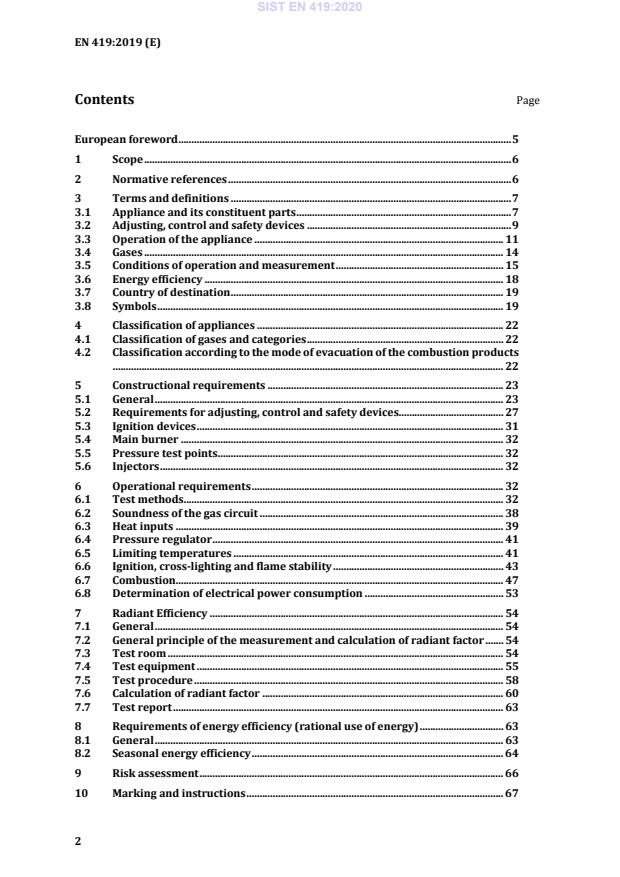
Contents Page
European foreword . 5
1 Scope . 6
2 Normative references . 6
3 Terms and definitions . 7
3.1 Appliance and its constituent parts . 7
3.2 Adjusting, control and safety devices . 9
3.3 Operation of the appliance . 11
3.4 Gases . 14
3.5 Conditions of operation and measurement . 15
3.6 Energy efficiency . 18
3.7 Country of destination . 19
3.8 Symbols . 19
4 Classification of appliances . 22
4.1 Classification of gases and categories . 22
4.2 Classification according to the mode of evacuation of the combustion products
..................................................................................................................................................... 22
5 Constructional requirements . 23
5.1 General . 23
5.2 Requirements for adjusting, control and safety devices. 27
5.3 Ignition devices . 31
5.4 Main burner . 32
5.5 Pressure test points . 32
5.6 Injectors . 32
6 Operational requirements . 32
6.1 Test methods. 32
6.2 Soundness of the gas circuit . 38
6.3 Heat inputs . 39
6.4 Pressure regulator . 41
6.5 Limiting temperatures . 41
6.6 Ignition, cross-lighting and flame stability . 43
6.7 Combustion. 47
6.8 Determination of electrical power consumption . 53
7 Radiant Efficiency . 54
7.1 General . 54
7.2 General principle of the measurement and calculation of radiant factor . 54
7.3 Test room . 54
7.4 Test equipment . 55
7.5 Test procedure . 58
7.6 Calculation of radiant factor . 60
7.7 Test report . 63
8 Requirements of energy efficiency (rational use of energy) . 63
8.1 General . 63
8.2 Seasonal energy efficiency . 64
9 Risk assessment . 66
10 Marking and instructions . 67
10.1 Marking of the appliance and the packaging . 67
10.2 Instructions . 69
10.3 Presentation . 73
10.4 Information Requirements of Local Space Heaters . 73
Annex A (informative) National situations . 74
A.1 General . 74
A.2 Gas rate adjusters, aeration adjusters and regulators . 74
A.3 Conversion to different gases . 74
A.4 Gas connections in the various countries . 74
Annex B (informative) Equivalence rules . 76
B.1 Conversion to categories within a restricted Wobbe index range . 76
B.2 Conversion to categories within an identical Wobbe index range . 76
B.3 Conversion to categories within a wider Wobbe index range . 77
Annex C (informative) Identification of the types of gas in use in the various countries
..................................................................................................................................................... 78
Annex D (normative) Special national conditions . 80
Annex E (normative) Calculation of conversions of NO . 81
x
E.1 NO emission conversion factors . 81
x
E.2 NO conversion calculation . 82
x
Annex F (informative) National situations of countries whose national bodies are CEN
associate members . 84
Annex G (informative) Radiometer design . 85
G.1 Principle radiometer design features . 85
G.2 Radiometer technical design . 86
G.3 Pyro-electric detector . 86
G.4 Ulbricht Sphere . 86
Annex H (informative) Radiometer calibration . 89
H.1 Radiometer calibration procedure . 89
H.2 Black body calibration equipment and procedure . 89
H.2.1 General . 89
H.2.2 Temperature calibration at reference condition . 90
H.2.3 Temperature calibration at higher temperatures . 91
H.2.4 Calibration calculation . 92
H.3 Calibration procedure in detail, presented as a worked example . 93
H.3.1 Calibration Measurements . 93
H.3.2 Selecting the average readings . 94
H.3.3 Determination of the 1/S sensitivity per temperature . 94
H.3.4 Determining the 1/S sensitivity of the radiometer . 95
H.3.5 Documentation of calibration results . 95
Annex I (normative) Correction of measured radiant output for absorption by H O
and CO . 99
I.1 General . 99
I.2 Calculation method .101
Annex J (informative) Radiant heat output data - Recording of results .102
J.1 General information to be recorded .102
J.1.1 Test and appliance data .102
J.1.2 Radiometer technical data .102
J.1.3 Measuring plane technical data .102
J.1.4 Measurement results .103
J.1.5 Test information .103
J.1.6 Test ambient conditions .103
J.1.7 Gas/heat input data .103
J.1.8 Flue gas data .104
J.1.9 Absorption of water vapour and CO .104
J.1.10 Irradiation measurement data .104
Annex K (informative) Worked example .105
K.1 General information .105
K.2 Radiometer technical data .105
K.3 Measuring plane technical data .105
K.4 Measurement results .106
K.4.1 Test information .106
K.4.2 Test ambient conditions .106
K.4.3 Gas/heat input data .106
K.4.4 Flue gas data .107
K.4.5 Absorption of water vapour and CO data .107
K.4.6 Irradiation measurement data .107
Annex L (normative) Product information required .108
Annex M (normative) Accepted heat input deviation .109
M.1 General .109
Annex N (normative) Uncertainty of measurements .110
Annex O (informative) Different types of heat input control .112
Annex ZA (informative) Relationship between this European Standard and the
ecodesign requirements of Commission Regulation (EU) No 2015/1188 aimed
to be covered .113
Bibliography .114
European foreword
This document (EN 419:2019) has been prepared by Technical Committee CEN/TC 180
“Decentralized gas heating”, the secretariat of which is held by AFNOR.
This European Standard shall be given the status of a national standard, either by publication of
an identical text or by endorsement, at the latest by April 2020, and conflicting national standards
shall be withdrawn at the latest by April 2020.
Attention is drawn to the possibility that some of the elements of this document may be the
subject of patent rights. CEN shall not be held responsible for identifying any or all such patent
rights.
This document supersedes EN 419-1:2009 and EN 419-2:2006.
Aspects of safety and energy efficiency of appliances are brought together. Significant changes of
the new document compared to the earlier standards are: incorporation recent state of the art of
luminous heaters, incorporation of medium gas pressure appliances for industrial use, unique
and more detailed description of method to determine radiant factor, incorporating terms and
calculation scheme of Ecodesign Regulation (EU) No. 2015/1188.
The test gases, test pressures and appliance categories given in this European Standard are in
accordance with those specified in EN 437:2018.
This document has been prepared under a mandate given to CEN by the European Commission
and the European Free Trade Association, and supports essential requirements of
EC Directive(s).
For relationship with EC Directive(s), see informative Annex ZA, which is an integral part of this
document.
According to the CEN-CENELEC Internal Regulations, the national standards organisations of the
following countries are bound to implement this European Standard: Austria, Belgium, Bulgaria,
Croatia, Cyprus, Czech Republic, Denmark, Estonia, Finland, France, Germany, Greece, Hungary,
Iceland, Ireland, Italy, Latvia, Lithuania, Luxembourg, Malta, Netherlands, Norway, Poland,
Portugal, Republic of North Macedonia, Romania, Serbia, Slovakia, Slovenia, Spain, Sweden,
Switzerland, Turkey and the United Kingdom.
1 Scope
This document specifies the requirements and test methods for the construction, safety, rational
use of energy, classification and marking of non-domestic gas-fired overhead luminous radiant
heaters for environmental comfort, referred to in the body of the text as “appliances”.
This document is applicable to Type A and Type A appliances only (see 4.2.2) intended for use
1 3
in other than residential dwellings:
a) low gas pressure appliances operating at pressures up to and including 50 mbar;
b) medium gas pressure appliances operating at pressures above 50 mbar and up to 2 bar.
This document is not applicable to:
— appliances designed for use in domestic dwellings;
— outdoor appliances;
— appliances of heat input in excess of 120 kW (based on the net calorific value of the
appropriate reference gas);
This document is applicable to appliances which are intended to be type tested.
2 Normative references
The following documents are referred to in the text in such a way that some or all of their content
constitutes requirements of this document. For dated references, only the edition cited applies.
For undated references, the latest edition of the referenced document (including any
amendments) applies.
EN 88-1:2011+A1:2016, Pressure regulators and associated safety devices for gas appliances - Part
1: Pressure regulators for inlet pressures up to and including 50 kPa
EN 88-2:2007, Pressure regulators and associated safety devices for gas appliances - Part 2:
Pressure regulators for inlet pressures above 500 mbar up to and including 5 bar
EN 125:2010+A1:2015, Flame supervision devices for gas burning appliances - Thermoelectric
flame supervision devices
EN 126:2012, Multifunctional controls for gas burning appliances
EN 161:2011+A3:2013, Automatic shut-off valves for gas burners and gas appliances
EN 298:2012, Automatic burner control systems for burners and appliances burning gaseous or
liquid fuels
EN 437:2018, Test gases - Test pressures - Appliance categories
EN 1057:2006+A1:2010, Copper and copper alloys - Seamless, round copper tubes for water and
gas in sanitary and heating applications
EN 1106:2010, Manually operated taps for gas burning appliances
EN 10226-1:2004, Pipe threads where pressure tight joints are made on the threads - Part 1: Taper
external threads and parallel internal threads - Dimensions, tolerances and designation
EN 10226-2:2005, Pipe threads where pressure tight joints are made on the threads - Part 2: Taper
external threads and taper internal threads - Dimensions, tolerances and designation
EN 12067-2:2004, Gas/air ratio controls for gas burners and gas burning appliances - Part 2:
Electronic types
EN 13410:2001, Gas-fired overhead radiant heaters - Ventilation requirements for non-domestic
premises
EN 13611:2019, Safety and control devices for burners and appliances burning gaseous and/or
liquid fuels - General requirements
EN 14459:2015, Safety and control devices for burners and appliances burning gaseous or liquid
fuels - Control functions in electronic systems - Methods for classification and assessment
EN 14800:2007, Corrugated safety metal hose assemblies for the connection of domestic appliances
using gaseous fuels
EN 60335-1:2012, Household and similar electrical appliances - Safety - Part 1: General
requirements
EN 60335-2-102:2016, Household and similar electrical appliances - Safety - Part 2-102: Particular
requirements for gas, oil and solid-fuel burning appliances having electrical connections
EN 60529:1991, Degrees of protection provided by enclosures (IP Code)
ISO 7-1:1994, Pipe threads where pressure-tight joints are made on the threads — Part 1:
Dimensions, tolerances and designation
EN ISO 228-1:2003, Pipe threads where pressure-tight joints are not made on the threads - Part 1:
Dimensions, tolerances and designation (ISO 228-1:2000)
EN ISO 3166-1:2014, Codes for the representation of names of countries and their subdivisions -
Part 1: Country codes (ISO 3166-1:2013)
EN ISO/IEC 17025:2005, General requirements for the competence of testing and calibration
laboratories (ISO/IEC 17025:2005)
3 Terms and definitions
For the purposes of this document, the following terms and definitions apply.
ISO and IEC maintain terminological databases for use in standardization at the following
addresses:
• IEC Electropedia: available at http://www.electropedia.org/
• ISO Online browsing platform: available at http://www.iso.org/obp
3.1 Appliance and its constituent parts
3.1.1
overhead luminous radiant heater
gas-fired appliance intended for installation at a height above head level, which is designed to
heat the space beneath by radiation and in which the heat is produced by means of burning the
fuel at or near the outer surface of a material such as a ceramic plaque or gauze, or by means of a
burner heating a gauze or similar material
3.1.2
atmospheric burner
aerated burner in which the air for combustion is entrained at atmospheric pressure
3.1.3
inlet connection
part of the appliance intended to be connected to the gas supply
3.1.4
mechanical joint
means of ensuring the soundness of an assembly of several (generally metallic) parts without the
use of liquids, pastes, tapes, etc
Note 1 to entry: For example the following:
a) metal to metal joints;
b) conical joints;
c) toroidal sealing rings (“O” rings);
d) flat joints.
3.1.5
gas circuit
part of the appliance that conveys or contains the gas between the appliance gas inlet connection
and the burner(s)
3.1.6
restrictor
device with an orifice, which is placed in the gas circuit so as to create a pressure drop and thus
reduce the gas pressure at the burner to a predetermined value for a given supply pressure and
rate
3.1.7
gas rate adjuster
component allowing to set the gas rate of the burner to a predetermined value according to the
supply conditions
Note 1 to entry: Adjustment can be progressive (screw adjuster) or in discrete steps (by changing
restrictors).
Note 2 to entry: The adjusting screw of an adjustable regulator is regarded as a gas rate adjuster.
Note 3 to entry: The action of adjusting this device is called “adjusting the gas rate”.
Note 4 to entry: A factory sealed gas rate adjuster is considered to be non-existent.
Note 5 to entry: Immobilizing a gas rate adjuster by means as e.g. a screw is called “setting an adjuster”.
Note 6 to entry: Arrangement in respect of the adjuster such that any attempt to change the adjustment
breaks the sealing device or sealing material and makes this interference apparent is called “sealing an
adjuster”.
Note 7 to entry: A gas rate adjuster is considered to be non-existent if it has been factory sealed in a
position such that it is not operational in the range of supply pressures corresponding to the appliance
category.
Note 8 to entry: Putting an adjuster or a control (of temperature, pressure, etc.) out of action and sealing
it in this position is called “putting an adjuster or a control out of service”; the appliance functions as if the
adjuster or control had been removed.
3.1.8
injector
component that admits the gas into a burner
3.1.9
main burner
burner that is intended to ensure the thermal function of the appliance
Note 1 to entry: Main burner is generally called “the burner”
3.1.10
ignition burner
burner whose flame is intended to ignite another burner
3.1.11
ignition device
means (e.g. flame, electrical ignition device or other device) used to ignite the gas at the ignition
burner or at the main burner
3.1.12
primary aeration adjuster
device enabling the primary air to be set at the necessary value according to the supply conditions
3.1.13
low gas pressure appliance
appliance operating at gas pressures up to and including 50 mbar
3.1.14
medium gas pressure appliance
appliance operating at gas pressures above 50 mbar and up to 2 bar
3.2 Adjusting, control and safety devices
3.2.1
automatic burner control system
system comprising a programming unit and all the elements of a flame detector device
Note 1 to entry: The various functions of an automatic burner control system may be in one or more
housings.
3.2.2
programming unit
device which executes the programme reacting to signals from control and safety devices, gives
control commands, controls the start-up sequence, supervises the burner operation and causes
controlled shut-down, and, if necessary, safety shut-down and lock-out
Note 1 to entry: The programming unit follows a predetermined sequence of actions and always
operates in conjunction with a flame detector. Such a sequence of operations involving switching on,
starting up, supervising and switching off the burner is called “programme”.
3.2.3
flame detector
device by which the presence of a flame is detected and signalled
Note 1 to entry: The flame detector can consist of a flame sensor, an amplifier and a relay for signal
transmission. These parts, with the possible exception of the actual flame sensor, may be assembled in a
single housing for use in conjunction with a programming unit.
3.2.4
flame signal
signal given by the flame detector, normally when the flame sensor senses a flame
3.2.5
flame supervision device
device that, in response to a signal from the flame detector, keeps the gas supply open and shuts
it off in the absence of the supervised flame
3.2.6
pressure regulator
device which maintains the outlet pressure constant independent of the variations in inlet
pressure within defined limits
3.2.7
adjustable pressure regulator
regulator provided with means for changing the outlet pressure setting
3.2.8
volume regulator
device which maintains the gas rate constant within a given tolerance, independent of the
upstream pressure
3.2.9
range-rating device
component on the appliance intended to be used by the installer to adjust the heat input of the
appliance within a range of heat inputs stated by the manufacturer, to suit the actual heat
requirements of the installation
Note 1 to entry: This adjustment may be progressive (e.g. by use of a screw adjuster) or in discrete steps
(e.g. by changing restrictors).
3.2.10
automatic shut-off valve
valve designed to open when energized and to close automatically when de-energized
3.2.11
gas/air ratio control
device that automatically adapts the combustion air rate to the gas rate or vice versa
3.3 Operation of the appliance
3.3.1
heat input
Q
quantity of energy used in unit time corresponding to the volumetric and mass flow rates, the
calorific value to be used being the net or gross calorific value
Note 1 to entry: The heat input is expressed in kilowatts (kW).
[SOURCE: EN 437:2018]
3.3.2
nominal heat input
Qn
value of the heat input (kW) declared by the manufacturer
3.3.3
volume flow rate
V
volume of gas consumed by the appliance in unit time during continuous operation
3 3 3
Note 1 to entry: The volume flow rate is expressed in m /h, l/min, dm /h or dm /s.
[SOURCE: EN 437:2018]
3.3.4
mass flow rate
M
mass of gas consumed by the appliance in unit time during continuous operation
Note 1 to entry: The mass flow rate is expressed in kg/h or g/h.
[SOURCE: EN 437:2018]
3.3.5
start gas
gas that is supplied at the start gas rate either at the main burner or at a separate ignition burner
3.3.6
start gas rate
restricted gas flow rate admitted either to a separate ignition burner or to the main burner during
start up
3.3.7
start gas flame
flame established at the start gas rate either at the main burner or at a separate ignition burner
3.3.8
flame stability
characteristic of flames which remain on the burner ports or in the flame reception zone intended
by the construction
3.3.9
flame lift
total or partial lifting of the base of the flame away from the burner port or the flame reception
zone provided by the design
Note 1 to entry: Flame lift may cause the flame to blow out, i.e. extinction of the air-gas mixture.
3.3.10
light-back
entry of a flame into the body of the burner
3.3.11
light-back at the injector
ignition of the gas at the injector, either as a result of light-back into the burner or by the
propagation of the flame outside the burner
3.3.12
sooting
phenomenon appearing during incomplete combustion and characterized by deposits of soot on
the surfaces or parts in contact with the combustion products or with the flame
3.3.13
first safety time
interval between the ignition burner valve, start gas valve or main gas valve, as applicable, being
energized and the ignition burner valve, start gas valve or main gas valve, as applicable, being de-
energized if the flame detector signals the absence of a flame at the end of this interval
Note 1 to entry: Where there is no second safety time, this is called the safety time.
3.3.14
second safety time
being a first safety time applicable to either an ignition burner or to a start gas flame only, the
second safety time is the interval between the main gas valve being energized and the main gas
valve being de-energized if the flame detector signals the absence of a flame at the end of this
interval
3.3.15
running condition of the system
condition in which the burner is in normal operation under the supervision of the programming
unit and its flame detector
3.3.16
controlled shut-down
process by which the power to the automatic shut-off valve(s) is removed immediately as a result
of the action of a controlling function
3.3.17
safety shut-down
process which is effected immediately following the response of a safety control or sensor or the
detection of a fault in the burner control system and which puts the burner out of operation by
immediately removing the power from the automatic shut-off valve(s) and the ignition device
3.3.18
non-volatile lock-out
safety shut-down condition of the system such that a restart can only be accomplished by a
manual reset of the system and by no other means
3.3.19
volatile lock-out
safety shut-down condition of the system such that a restart can only be accomplished by either
the manual reset of the system, or an interruption of the mains electrical supply and its
subsequent restoration
3.3.20
spark restoration
process by which, following loss of the flame signal, the ignition device will be switched on again
without total interruption of the gas supply
Note 1 to entry: This process ends with the restoration of the running condition or, if there is no flame
signal at the end of the safety time, with volatile or non-volatile lock-out.
3.3.21
automatic recycling
process by which, after loss of flame during the running condition or accidental interruption of
the operation of the appliance, the gas supply is interrupted and the complete start sequence is
automatically re-initiated
NOTE This process ends with the restoration of the running condition or, if there is no flame signal at
the end of the safety time, or if the cause of the accidental interruption has not disappeared, with volatile
or non- volatile lock-out.
3.3.22
ignition opening time
time interval between ignition of the supervised flame and the moment when the valve is held
open
3.3.23
extinction safety time
time which elapses between the moment when the supervised flame is extinguished and the
moment when:
a) for an appliance without an automatic burner control system, the gas supply is shut-off:
1) to the main burner;
2) and/or to the ignition burner;
b) or for an appliance with an automatic burner control system, the control system initiates
shut- down of the burner by removing power to the automatic gas shut-off valves
3.4 Gases
3.4.1
Calorific value
CV
quantity of heat produced by the complete combustion, at a constant pressure equal to
1 013,25 mbar and a constant temperature of 15°C, of unit volume or mass of gas, the constituents
of the combustible mixture being taken at reference conditions and the products of combustion
being brought back to the same conditions, for which a distinction is made between:
a) the gross calorific value H in which the water produced by combustion is assumed to be
s
condensed (GCV);
b) the net calorific value H in which the water produced by combustion is assumed to be in the
i
vapour state (NCV)
Note 1 to entry: The calorific value is expressed either in MJ/m of dry gas at the reference conditions or
in MJ/kg of dry gas.
[SOURCE: EN 437:2018]
3.4.2
relative density
d
ratio of densities of dry gas and dry air measured under the same conditions of temperature and
pressure
3.4.3
Wobbe index
and net Wobbe index: W
gross Wobbe index: Ws i
ratio of the calorific value of a gas per unit volume and the square root of its relative density under
the same reference conditions
Note 1 to entry: The Wobbe index is said to be gross or net according to whether the calorific value used
is the gross or net calorific value.
Note 2 to entry: The Wobbe index is expressed in MJ/m of dry gas at the reference conditions or in
MJ/kg of dry gas.
[SOURCE: EN 437:2018]
3.4.4
test pressures
gas pressures used to verify the operational characteristics of appliances using combustible
gases, consisting of normal and limit pressures
Note 1 to entry: Test pressures are expressed in mbar; 1 mbar = 10 Pa.
[SOURCE: EN 437:2018]
3.4.5
normal pressure
pn
pressure under which the appliances operate in nominal conditions when they are supplied with
the corresponding reference gas
Note 1 to entry: Pressures are expressed in mbar; 1 mbar = 10 Pa.
[SOURCE: EN 437:2018]
3.4.6
limit pressures
maximum limit pressure p and minimum limit pressure p
max min
pressures representative of the extreme variations in the appliance supply conditions
Note 1 to entry: Pressures are expressed in mbar; 1 mbar = 10 Pa.
[SOURCE: EN 437:2018]
3.4.7
pressure couple
combination of two distinct gas distribution pressures applied by reason of the significant
difference existing between the Wobbe indices within a single family or group in which:
Note 1 to entry: The higher pressure corresponds to gases of low Wobbe index.
Note 2 to entry: The lower pressure corresponds to gases of high Wobbe index.
Note 3 to entry: Pressures are expressed in mbar; 1 mbar = 10 Pa.
[SOURCE: EN 437:2018]
3.5 Conditions of operation and measurement
3.5.1
reference conditions
reference conditions applying in this standard, which are:
a) for calorific values, temperature 15 °C;
b) for gas and air volumes, dry, brought to 15 °C and to an absolute pressure of 1 013,25 mbar
3.5.2
cold condition
condition of the appliance required for some tests and obtained by allowing the unlit appliance
to attain thermal equilibrium at room temperature
3.5.3
hot condition
condition of the appliance required for some tests and obtained by heating to thermal equilibrium
at the nominal heat input, any thermostat remaining fully open
3.5.4
thermal equilibrium
operating state of the appliance, corresponding to a particular setting of the input, reached after
40 minutes from a cold start, or earlier when:
a) the radiant output does not change by more than 1 % per 10 min, or:
b) when the surface temperatures of the radiant parts of the appliance do not change by more
than 2°C in 10 min.
3.5.5
radiant output
radiant power that is passing the measuring plane parallel to and 100 mm under the radiation
reference plane of the heater
Note 1 to entry: See Figure 1.
Key
1 heater under test
2 radiometer with thermal protection housing
3 distance of measuring plane under the heater to radiation reference plane
4 grid size measuring grid
5 measuring plane
6 nodal point
Figure 1 — Measuring plane (MP)
3.5.6
radiation reference plane
flat horizontal surface bound by the lower edge of the reflector or, in the case where radiant parts
project below this lower edge of the reflector, the flat horizontal surface touching the lowest
radiant part
Note 1 to entry: See Figure 2.
Key
1 heater under test
2 infrared emitter
REP radiation emitter plane
RRP radiation reference plane
MP measuring plane
d vertical distance sensor to emitter plane (see Annex I)
Figure 2 — Radiation reference plane (RRP) and radiation emitter plane (REP)
3.5.7
radiation emitter plane
flat horizontal surface defined by the lower edge of the radiant surface of the burner of the radiant
heater
Note 1 to entry: See Figure 2.
3.5.8
measuring plane
plane parallel to the radiation reference plane and 100 mm below it; the top surface of the
radiometer is moved on the measuring plane on the measuring grid
Note 1 to entry: See Figures 1 and 2.
3.5.9
measuring grid
regular arrangement in the measuring plane of straight lines running parallel and perpendicular
to the longitudinal axis of the appliance, the nodal points of the measuring grid being located at
the points of intersection of these line (see Figure 3), the distances between these points being
determined by the requirements in Clause 7
Key
1 heater
2 nodal point
3 measuring cell Fij
Figure 3 — Measuring grid
3.5.10
irradiance
E
radiant power per unit area (W/m ) incident upon a surface
3.6 Energy efficiency
3.6.1
radiant factor
RF
ratio of the radiant heat output emitted by the appliance through the radiation reference plane
compared to the net heat input of the appliance based on the reference test gas
3.6.2
seasonal radiant factor
RF
s
annually weighted radiant factor, calculated as proportion of the radiant factor of the appliance
at nominal net heat input and the radiant factor of the appliance at minimum net heat input (in
case of appliances with heat input adaptation)
3.6.3
seasonal heat emission efficiency
η
s,RF
annually weighted efficiency of the heat emission performance of the appliance, taking into
account the impact of the radiant output resp. radiant factor on the demanded room temperature
3.6.4
thermal efficiency NCV
η
th,NCV
ratio of the thermal heat output of the combustion system of the appliance compared to the heat
input of the appliance based on the net caloric value of the relevant test gas – also called
combustion efficiency NCV
3.6.5
thermal efficiency GCV
η
th,GCV
ratio of the thermal heat output of the combustion system of the appliance compared to the heat
input of the appliance based on the gross caloric value of the relevant test gas – also called
combustion efficiency GCV
3.6.6
seasonal thermal efficiency GCV
η
s,th
annually weighted thermal efficiency GCV, calculated as proportion of the thermal efficiency of
the appliance at nominal gross heat input and the thermal efficiency of the appliance at minimum
gross heat input (in case of appliances with heat input adaptation)
3.6.7
seasonal space heating energy efficiency GCV
η
s
annually weighted combined thermal and heat emission ef
...