


SIST EN 14360:2004
(Main)Protective clothing against rain - Test method for ready made garments - Impact from above with high energy droplets
Protective clothing against rain - Test method for ready made garments - Impact from above with high energy droplets
This European Standard specifies a test method for determining the rain tightness of clothing for protection against rain, using a static manikin exposed to artificial rain. It is applicable to the testing of jackets, trousers, coats and one or two piece suits.
This standard is not applicable to the testing of garments for resistance to other weather conditions, e.g. snow,
hail-, or strong winds.
Schutzkleidung gegen Regen - Prüfverfahren für fertige Bekleidungsteile - Beaufschlagung von oben mit Tropfen von hoher Energie
Diese Europäische Norm legt ein Verfahren fest zur Prüfung der Dichtheit von Regenschutzkleidung unter Verwendung einer statischen Prüfpuppe, die künstlichem Regen ausgesetzt wird. Sie gilt für die Prüfung von Jacken, Hosen, Mänteln sowie ein- oder zweiteiligen Anzügen.
Diese Norm gilt nicht für die Prüfung der Wetterbeständigkeit von Kleidungsstücken unter besonderen Wetterbedingungen, z. B. Schnee, Eisregen, starker Wind.
Vetements de protection contre les intempéries - Méthode d'essai pour les vetements pret a porter - Impact de fortes précipitations
La présente Norme européenne spécifie une méthode d'essai utilisant un mannequin statique exposé à une pluie artificielle pour déterminer l'étanchéité à la pluie d'un vêtement de protection. Elle s'applique pour l'essai de vestes, pantalons, manteaux et de combinaisons une ou deux pièces.
Les essais réalisés dans d'autres conditions météorologiques comme par exemple, sous la neige, la grêle ou par vent fort, ne sont pas traités dans la présente norme.
Obleka za varovanje pred dežjem - Preskusna metoda za že izdelana oblačila - Učinek od zgoraj padajočih kapelj z veliko energijo
General Information
- Status
- Withdrawn
- Publication Date
- 30-Sep-2004
- Withdrawal Date
- 11-Jun-2024
- Technical Committee
- OVP - Personal protecting equipment
- Current Stage
- 9900 - Withdrawal (Adopted Project)
- Start Date
- 14-May-2024
- Due Date
- 06-Jun-2024
- Completion Date
- 12-Jun-2024
Relations
- Effective Date
- 01-Jul-2024

Frequently Asked Questions
SIST EN 14360:2004 is a standard published by the Slovenian Institute for Standardization (SIST). Its full title is "Protective clothing against rain - Test method for ready made garments - Impact from above with high energy droplets". This standard covers: This European Standard specifies a test method for determining the rain tightness of clothing for protection against rain, using a static manikin exposed to artificial rain. It is applicable to the testing of jackets, trousers, coats and one or two piece suits. This standard is not applicable to the testing of garments for resistance to other weather conditions, e.g. snow, hail-, or strong winds.
This European Standard specifies a test method for determining the rain tightness of clothing for protection against rain, using a static manikin exposed to artificial rain. It is applicable to the testing of jackets, trousers, coats and one or two piece suits. This standard is not applicable to the testing of garments for resistance to other weather conditions, e.g. snow, hail-, or strong winds.
SIST EN 14360:2004 is classified under the following ICS (International Classification for Standards) categories: 13.340.10 - Protective clothing; 59.080.01 - Textiles in general. The ICS classification helps identify the subject area and facilitates finding related standards.
SIST EN 14360:2004 has the following relationships with other standards: It is inter standard links to SIST EN ISO 24231:2024. Understanding these relationships helps ensure you are using the most current and applicable version of the standard.
SIST EN 14360:2004 is associated with the following European legislation: EU Directives/Regulations: 2016/425, 89/686/EEC, 93/68/EEC, 93/95/EEC, 96/58/EC; Standardization Mandates: M/031. When a standard is cited in the Official Journal of the European Union, products manufactured in conformity with it benefit from a presumption of conformity with the essential requirements of the corresponding EU directive or regulation.
SIST EN 14360:2004 is available in PDF format for immediate download after purchase. The document can be added to your cart and obtained through the secure checkout process. Digital delivery ensures instant access to the complete standard document.
Standards Content (Sample)
2003-01.Slovenski inštitut za standardizacijo. Razmnoževanje celote ali delov tega standarda ni dovoljeno.Protective clothing against rain - Test method for ready made garments - Impact from above with high energy dropletsVetements de protection contre les intempéries - Méthode d'essai pour les vetements pret a porter - Impact de fortes précipitationsSchutzkleidung gegen Regen - Prüfverfahren für fertige Bekleidungsteile - Beaufschlagung von oben mit Tropfen von hoher Energie59.080.01Tekstilije na splošnoTextiles in general13.340.10Varovalna oblekaProtective clothingICS:SIST EN 14360:2004enTa slovenski standard je istoveten z:EN 14360:200401-oktober-2004SIST EN 14360:2004SLOVENSKI
STANDARD
EUROPEAN STANDARDNORME EUROPÉENNEEUROPÄISCHE NORMEN 14360July 2004ICS 13.340.10; 59.080.01English versionProtective clothing against rain - Test method for ready madegarments - Impact from above with high energy dropletsVêtements de protection contre les intempéries - Méthoded'essai pour les vêtements prêt à porter - Impact de fortesprécipitationsSchutzkleidung gegen Regen - Prüfverfahren für fertigeBekleidungsteile - Beaufschlagung von oben mit Tropfenvon hoher EnergieThis European Standard was approved by CEN on 16 April 2004.CEN members are bound to comply with the CEN/CENELEC Internal Regulations which stipulate the conditions for giving this EuropeanStandard the status of a national standard without any alteration. Up-to-date lists and bibliographical references concerning such nationalstandards may be obtained on application to the Central Secretariat or to any CEN member.This European Standard exists in three official versions (English, French, German). A version in any other language made by translationunder the responsibility of a CEN member into its own language and notified to the Central Secretariat has the same status as the officialversions.CEN members are the national standards bodies of Austria, Belgium, Cyprus, Czech Republic, Denmark, Estonia, Finland, France,Germany, Greece, Hungary, Iceland, Ireland, Italy, Latvia, Lithuania, Luxembourg, Malta, Netherlands, Norway, Poland, Portugal, Slovakia,Slovenia, Spain, Sweden, Switzerland and United Kingdom.EUROPEAN COMMITTEE FOR STANDARDIZATIONCOMITÉ EUROPÉEN DE NORMALISATIONEUROPÄISCHES KOMITEE FÜR NORMUNGManagement Centre: rue de Stassart, 36
B-1050 Brussels© 2004 CENAll rights of exploitation in any form and by any means reservedworldwide for CEN national Members.Ref. No. EN 14360:2004: E
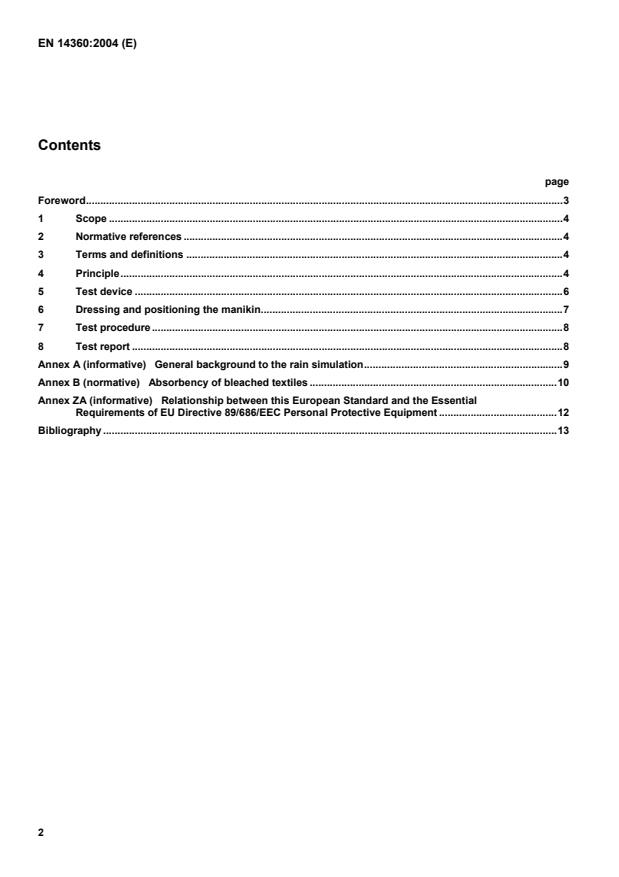
General background to the rain simulation.9 Annex B (normative)
Absorbency of bleached textiles.10 Annex ZA (informative)
Relationship between this European Standard and the Essential Requirements of EU Directive 89/686/EEC Personal Protective Equipment.12 Bibliography.13
1 Scope This European Standard specifies a test method for determining the rain tightness of clothing for protection against rain, using a static manikin exposed to artificial rain. It is applicable to the testing of jackets, trousers, coats and one or two piece suits. This standard is not applicable to the testing of garments for resistance to other weather conditions, e.g. snow,
hail-, or strong winds. 2 Normative references Not applicable. 3 Terms and definitions For the purposes of this European Standard, the following term and definition apply. garment individual component of a clothing ensemble, the wearing of which provides protection to the part of the body that it covers 4 Principle A manikin with the shape and size of an adult person wearing long underwear made of absorbent fabric is dressed in the garments to be tested and exposed to artificial rain for a specific period. After the exposure the underwear and the inner side of the garment are visually inspected for wet areas. In addition, sensors on the manikin may be used in order to detect the timing of water ingress at individual sites.
Key 1 Water filling pipe 2 Droplets 3 Manikin 4 Sensors 5 Protection wall 6 Nozzles 7 Movable tub 8 Rain water tub Figure 1 — Example of a rain tower device
NOTE 2 To prevent water from the atmosphere condensing inside the garment the water temperature should be the same as the air temperature in the room in which the test is conducted within ± 5 °C. NOTE 3 To prevent a blockage of the nozzles, water with low calcium content should be used. 5.2 Thermometers, one in the room in which the test is to be carried out to measure the air temperature and one immersed in the tub to measure the temperature of the water. 5.3 Manikin, with the shape of an adult person, (1 820 ± 40) mm tall and with a chest girth of (1 000 ± 60) mm, comprising a head, torso, abdomen, buttocks, arms, hands, straight legs and feet. The arms shall be moveable to make putting on the garment easier. NOTE It is possible to use alternative manikin sizes (children or female) with the appropriate garment size. 5.4 Underwear to fit manikin, comprising a undershirt with long sleeves and underpants with long legs. For testing of jackets with a hood, the undershirt shall have a hood. The underwear shall be made of water absorbent fabric (e.g. washed cotton). When the underwear is tested in accordance with Annex B, the mean time for the drops to be wicked into the fabric shall be not greater than 2 s. 5.5 Optionally humidity sensors, connected to a recording system. The humidity sensors shall be placed either on the manikin at convex places or on the underwear. Figure 2 shows a possible position of the sensors. The most critical locations are: shoulders, chest, wrist, back, abdomen (zipper) and shoulder blade.
Key a
Front view b
Rear view Figure 2 — Positions of humidity sensors on the manikin 6 Dressing and positioning the manikin If only a single piece is to be tested, the manikin has to be fully dressed: a)
Jacket testing in combination with any appropriate water tight trousers. b)
Trousers testing in combination with any appropriate water tight jacket. The manikin shall be dressed with the underwear (5.4) and the garments of a size adequate to the manikin. Any zippers, fastening elements and pockets shall be closed. The draw-cord at the hem of the jacket, if fitted, shall be pulled tight. If the jacket has a hood this shall be put on the manikin’s head in the normal wearing position, with any draw-cord pulled tight. If the jacket does not have a hood, the head of the manikin shall be covered with a plastic bag in order to prevent water wicking through the collar i
...
Questions, Comments and Discussion
Ask us and Technical Secretary will try to provide an answer. You can facilitate discussion about the standard in here.
Loading comments...