

SIST EN 50125-1:2014
(Main)Railway applications - Environmental conditions for equipment - Part 1: Equipment on board rolling stock
General Information
- Abstract
This European Standard intends to define environmental conditions within Europe. NOTE 1 It can also be applied elsewhere by agreement. The scope of this European Standard covers the definitions and ranges of the following parameters: Altitude, temperature, humidity, air movement, rain, snow and hail, ice, solar radiation, lightning, pollution for rolling stock and on-board equipment (mechanical, electromechanical, electrical, electronic). In particular, this European Standard defines interface conditions between the vehicle and its environment. The defined environmental conditions are considered as normal in service. NOTE 2 Further guidance on severe conditions can be found within prEN 16251. Rolling stock or parts of it can also be used outside the specification with reduced performance. NOTE 3 In these cases, relevant operating rules could be necessary to ensure the technical compatibility between the rolling stock and environmental conditions. Microclimates surrounding components may be defined by relevant product standards or by special requirements. Passenger effects on the equipment and equipment effects on the passengers are not considered in this European Standard. This European Standard does not apply to cranes, mining vehicles, cable cars. This European Standard also does not apply to natural disaster (e.g. earthquake).
- Status
- Published
- Public Enquiry End Date
- 30-Aug-2012
- Publication Date
- 11-May-2014
- Technical Committee
- ŽEN - Electrical applications for railways
- Current Stage
- 6060 - National Implementation/Publication (Adopted Project)
- Start Date
- 09-May-2014
- Due Date
- 14-Jul-2014
- Completion Date
- 12-May-2014

Overview
EN 50125-1:2014 - "Railway applications - Environmental conditions for equipment - Part 1: Rolling stock and on-board equipment" is a CLC (CENELEC) European standard that defines the normal environmental conditions to which rolling stock and on-board mechanical, electromechanical, electrical and electronic equipment must be designed to operate. It specifies interface conditions between vehicle and environment for Europe (and can be applied elsewhere by agreement), and covers parameters such as altitude, temperature, humidity, air movement, rain, snow/hail, ice, solar radiation, lightning and pollution.
Key topics and technical requirements
- Scope & exclusions: Applies to equipment on rolling stock; excludes cranes, mining vehicles, cable cars and natural disasters (e.g. earthquake). Defines normal in-service conditions; severe conditions are addressed in complementary guidance (prEN 16251).
- Altitude classes: Defines classes (A1, A2, A3, AX) with altitude ranges relative to sea level to account for air pressure effects on cooling, engines and clearances.
- Temperature classes: Defines air and inside-vehicle temperature classes (T1, T2, T3, TX) with specified minimum/maximum limits used for design, derating and thermal qualification.
- Humidity: Yearly average ≤ 75% RH; up to 75–95% RH for 30 days/year; occasional 95–100% RH; maximum absolute humidity up to 30 g/m3 (tunnels). Condensation and rapid temperature change rates are considered.
- Air movement & wind: Design wind speed assumption 35 m/s at standstill (up to 50 m/s exceptional). Includes surrounding air movement, pressure pulses and cross-wind assessment references.
- Precipitation & precipitation effects: Rain rate considered 6 mm/min; hailstone diameter up to 15 mm (exceptional larger stones); snow level classes (S1–S3) and snow ingress/accumulation effects.
- Other factors: Ice formation/fall, solar radiation, lightning and pollution are addressed; microclimates and passenger-equipment interactions are out of scope but may be specified separately.
- Practical test/interface implications: Values are limiting (not permanent); frequency of occurrence should be specified where relevant. Allows equipment derating or controlled environments when necessary.
Applications - who uses this standard
- Rolling stock designers and manufacturers for environmental design margins and component selection
- Subsystem and equipment suppliers (HVAC, traction, control electronics) for qualification and testing
- Railway systems engineers and specifiers drafting procurement and interoperability requirements
- Test laboratories and compliance teams for environmental testing and verification
- Maintenance planners assessing operational limits and derating strategies
Related standards
- EN 50125-2 (fixed installations), EN 50125-3 (signalling & telecom)
- EN 50155 (rolling stock electronic equipment reliability/thermal guidance)
- EN 14067-6 (cross-wind assessment), EN 50124-2, EN 60529 (IP Code), EN 60721-3-5
Keywords: EN 50125-1:2014, railway environmental conditions, rolling stock, on-board equipment, temperature classes, humidity, altitude, rail standards.
Relations
- Effective Date
- 28-Jan-2023
- Effective Date
- 03-Mar-2026
- Effective Date
- 09-Feb-2026
- Effective Date
- 03-Feb-2026
- Effective Date
- 03-Feb-2026
- Effective Date
- 03-Feb-2026
- Effective Date
- 03-Feb-2026
- Effective Date
- 20-May-2026
- Referred By
SIST EN 15329:2019 - Railway applications - Braking - Brake block holder and brake block key - Effective Date
- 09-Feb-2026
- Effective Date
- 09-Feb-2026
- Effective Date
- 09-Feb-2026
- Effective Date
- 09-Feb-2026
- Effective Date
- 09-Feb-2026
- Referred By
SIST EN 15612:2009+A1:2011 - Railway applications - Braking - Brake pipe accelerator valve - Effective Date
- 09-Feb-2026
- Effective Date
- 09-Feb-2026
Get Certified
Connect with accredited certification bodies for this standard

BSI Group
BSI (British Standards Institution) is the business standards company that helps organizations make excellence a habit.

Bureau Veritas
Bureau Veritas is a world leader in laboratory testing, inspection and certification services.

DNV
DNV is an independent assurance and risk management provider.
Sponsored listings
Frequently Asked Questions
SIST EN 50125-1:2014 is a standard published by the Slovenian Institute for Standardization (SIST). Its full title is "Railway applications - Environmental conditions for equipment - Part 1: Equipment on board rolling stock". This standard covers: This European Standard intends to define environmental conditions within Europe. NOTE 1 It can also be applied elsewhere by agreement. The scope of this European Standard covers the definitions and ranges of the following parameters: Altitude, temperature, humidity, air movement, rain, snow and hail, ice, solar radiation, lightning, pollution for rolling stock and on-board equipment (mechanical, electromechanical, electrical, electronic). In particular, this European Standard defines interface conditions between the vehicle and its environment. The defined environmental conditions are considered as normal in service. NOTE 2 Further guidance on severe conditions can be found within prEN 16251. Rolling stock or parts of it can also be used outside the specification with reduced performance. NOTE 3 In these cases, relevant operating rules could be necessary to ensure the technical compatibility between the rolling stock and environmental conditions. Microclimates surrounding components may be defined by relevant product standards or by special requirements. Passenger effects on the equipment and equipment effects on the passengers are not considered in this European Standard. This European Standard does not apply to cranes, mining vehicles, cable cars. This European Standard also does not apply to natural disaster (e.g. earthquake).
This European Standard intends to define environmental conditions within Europe. NOTE 1 It can also be applied elsewhere by agreement. The scope of this European Standard covers the definitions and ranges of the following parameters: Altitude, temperature, humidity, air movement, rain, snow and hail, ice, solar radiation, lightning, pollution for rolling stock and on-board equipment (mechanical, electromechanical, electrical, electronic). In particular, this European Standard defines interface conditions between the vehicle and its environment. The defined environmental conditions are considered as normal in service. NOTE 2 Further guidance on severe conditions can be found within prEN 16251. Rolling stock or parts of it can also be used outside the specification with reduced performance. NOTE 3 In these cases, relevant operating rules could be necessary to ensure the technical compatibility between the rolling stock and environmental conditions. Microclimates surrounding components may be defined by relevant product standards or by special requirements. Passenger effects on the equipment and equipment effects on the passengers are not considered in this European Standard. This European Standard does not apply to cranes, mining vehicles, cable cars. This European Standard also does not apply to natural disaster (e.g. earthquake).
SIST EN 50125-1:2014 is classified under the following ICS (International Classification for Standards) categories: 13.020.99 - Other standards related to environmental protection; 45.060.01 - Railway rolling stock in general. The ICS classification helps identify the subject area and facilitates finding related standards.
SIST EN 50125-1:2014 has the following relationships with other standards: It is inter standard links to SIST EN 50125-1:2001, SIST EN IEC 60721-3-5:2026, SIST EN 14067-6:2018+A1:2022, SIST EN 60721-3-5:2001, SIST EN 50124-2:2017, SIST EN 60529:1997, SIST EN 60721-2-3:2016, SIST EN 14198:2026, SIST EN 15329:2019, SIST EN 14033-1:2017, SIST EN 16286-1:2024, SIST EN 16451:2015, SIST EN 15427:2008+A1:2011, SIST EN 15612:2009+A1:2011, SIST EN 16451:2024. Understanding these relationships helps ensure you are using the most current and applicable version of the standard.
SIST EN 50125-1:2014 is associated with the following European legislation: EU Directives/Regulations: 2008/57/EC, 2011-01-2104; Standardization Mandates: M/334, M/483. When a standard is cited in the Official Journal of the European Union, products manufactured in conformity with it benefit from a presumption of conformity with the essential requirements of the corresponding EU directive or regulation.
SIST EN 50125-1:2014 is available in PDF format for immediate download after purchase. The document can be added to your cart and obtained through the secure checkout process. Digital delivery ensures instant access to the complete standard document.
Standards Content (Sample)
SLOVENSKI STANDARD
01-junij-2014
Železniške naprave - Okoljski pogoji za opremo - 1. del: Oprema na voznih
sredstvih
Railway applications - Environmental conditions for equipment - Part 1: Equipment on
board rolling stock
Bahnanwendungen - Umweltbedingungen für Betriebsmittel - Teil 1: Betriebsmittel auf
Bahnfahrzeugen
Applications ferroviaires - Conditions d'environnement pour le matériel - Partie 1:
Equipement embarqué du matériel roulant
Ta slovenski standard je istoveten z: EN 50125-1:2014
ICS:
13.020.99 Drugi standardi v zvezi z Other standards related to
varstvom okolja environmental protection
45.060.01 Železniška vozila na splošno Railway rolling stock in
general
2003-01.Slovenski inštitut za standardizacijo. Razmnoževanje celote ali delov tega standarda ni dovoljeno.
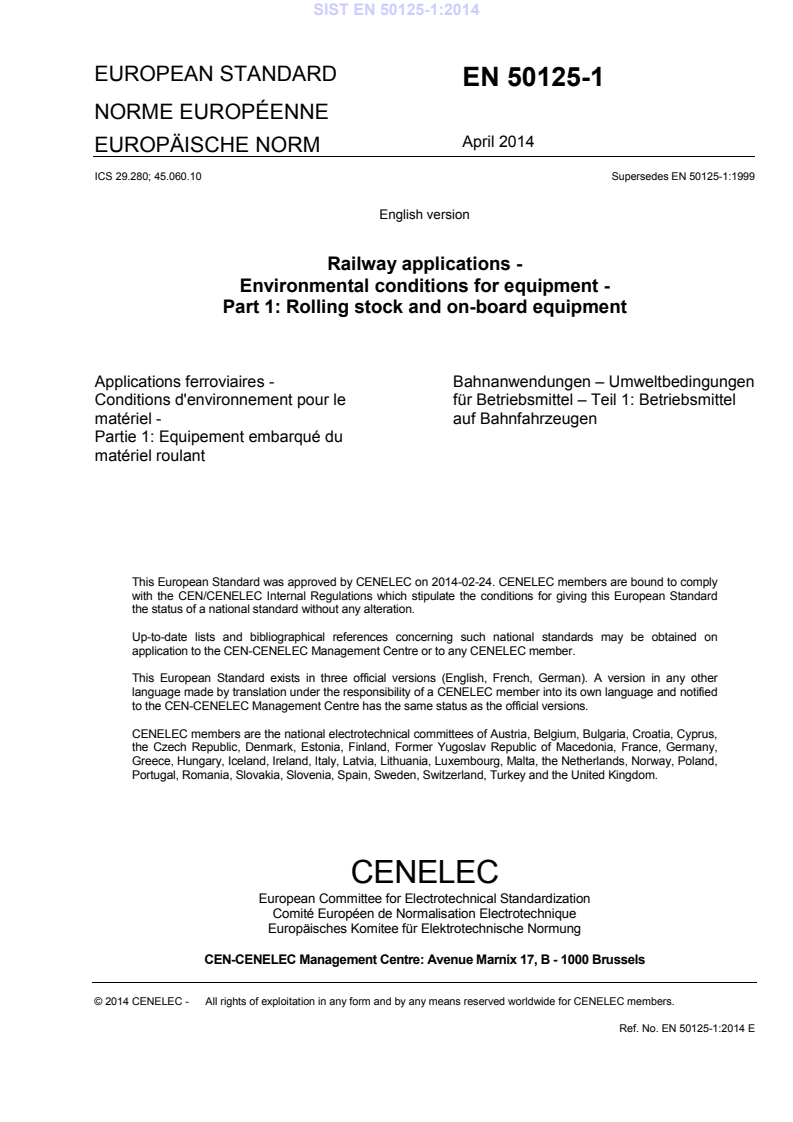
EUROPEAN STANDARD
EN 50125-1
NORME EUROPÉENNE
April 2014
EUROPÄISCHE NORM
ICS 29.280; 45.060.10 Supersedes EN 50125-1:1999
English version
Railway applications -
Environmental conditions for equipment -
Part 1: Rolling stock and on-board equipment
Applications ferroviaires - Bahnanwendungen – Umweltbedingungen
Conditions d'environnement pour le für Betriebsmittel – Teil 1: Betriebsmittel
matériel - auf Bahnfahrzeugen
Partie 1: Equipement embarqué du
matériel roulant
This European Standard was approved by CENELEC on 2014-02-24. CENELEC members are bound to comply
with the CEN/CENELEC Internal Regulations which stipulate the conditions for giving this European Standard
the status of a national standard without any alteration.
Up-to-date lists and bibliographical references concerning such national standards may be obtained on
application to the CEN-CENELEC Management Centre or to any CENELEC member.
This European Standard exists in three official versions (English, French, German). A version in any other
language made by translation under the responsibility of a CENELEC member into its own language and notified
to the CEN-CENELEC Management Centre has the same status as the official versions.
CENELEC members are the national electrotechnical committees of Austria, Belgium, Bulgaria, Croatia, Cyprus,
the Czech Republic, Denmark, Estonia, Finland, Former Yugoslav Republic of Macedonia, France, Germany,
Greece, Hungary, Iceland, Ireland, Italy, Latvia, Lithuania, Luxembourg, Malta, the Netherlands, Norway, Poland,
Portugal, Romania, Slovakia, Slovenia, Spain, Sweden, Switzerland, Turkey and the United Kingdom.
CENELEC
European Committee for Electrotechnical Standardization
Comité Européen de Normalisation Electrotechnique
Europäisches Komitee für Elektrotechnische Normung
CEN-CENELEC Management Centre: Avenue Marnix 17, B - 1000 Brussels
© 2014 CENELEC - All rights of exploitation in any form and by any means reserved worldwide for CENELEC members.
Ref. No. EN 50125-1:2014 E
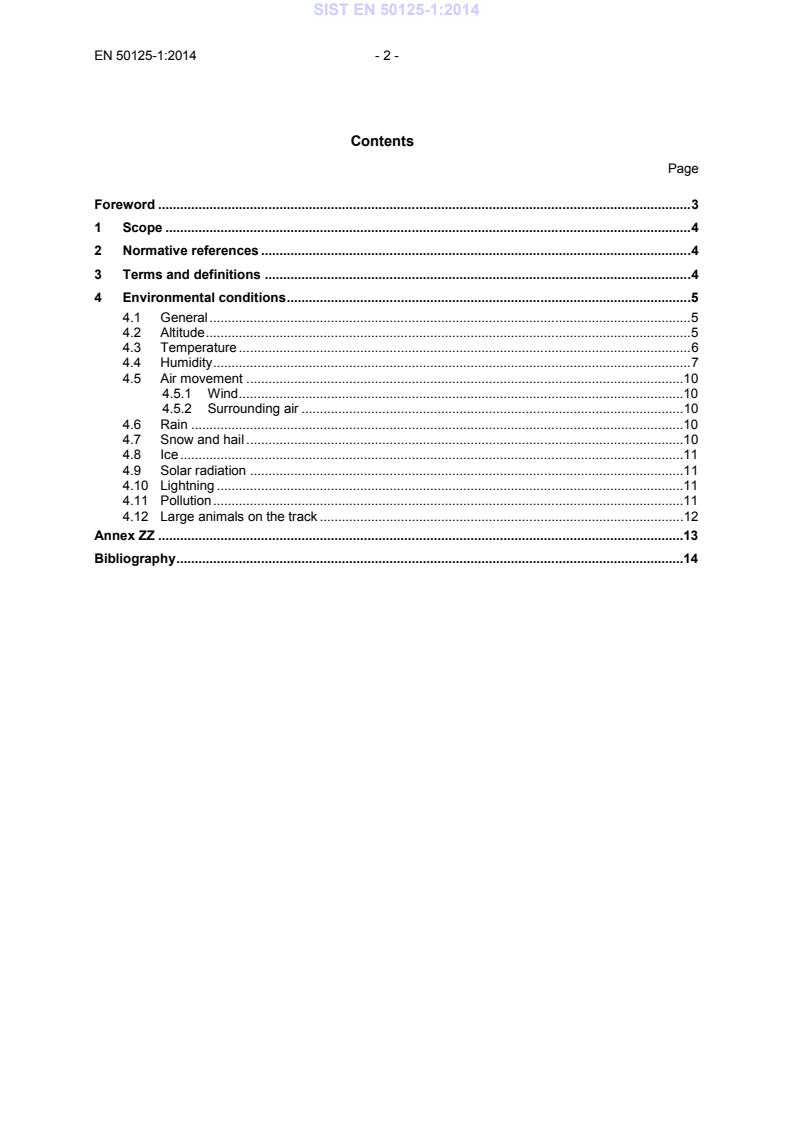
Contents
Page
Foreword . 3
1 Scope . 4
2 Normative references . 4
3 Terms and definitions . 4
4 Environmental conditions . 5
4.1 General . 5
4.2 Altitude . 5
4.3 Temperature . 6
4.4 Humidity . 7
4.5 Air movement .10
4.5.1 Wind .10
4.5.2 Surrounding air .10
4.6 Rain .10
4.7 Snow and hail .10
4.8 Ice .11
4.9 Solar radiation .11
4.10 Lightning .11
4.11 Pollution .11
4.12 Large animals on the track .12
Annex ZZ .13
Bibliography .14
- 3 - EN 50125-1:2014
Foreword
This document (EN 50125-1:2014) has been prepared by CLC/SC 9XB "Electromechanical material
on board rolling stock" of CLC/TC 9X "Electrical and electronic applications for railways".
The following dates are fixed:
• latest date by which this document has to be
(dop) 2015-02-24
implemented at national level by publication of
an identical national standard or by
endorsement
• latest date by which the national standards
(dow) 2017-02-24
conflicting with this document have to
be withdrawn
This document supersedes EN 50125-1:1999.
requirements, as requested by the European Railway Agency (ERA).
EN 50125 is divided into the following parts:
- EN 50125-1, Railway applications — Environmental conditions for equipment — Part 1: Rolling
stock and on-board equipment (the present document).
- EN 50125-2 Railway applications — Environmental conditions for equipment — Part 2: Fixed
electrical installations.
- EN 50125-3 Railway applications — Environmental conditions for equipment — Part 3: Equipment
for signalling and telecommunications.
Attention is drawn to the possibility that some of the elements of this document may be the subject of
patent rights. CENELEC [and/or CEN] shall not be held responsible for identifying any or all such
patent rights.
This document has been prepared under a mandate given to CENELEC by the European Commission
and the European Free Trade Association, and supports essential requirements of EU Directive(s).
For the relationship with EU Directive(s) see informative Annex ZZ, which is an integral part of this
document.
1 Scope
This European Standard intends to define environmental conditions within Europe.
NOTE 1 It can also be applied elsewhere by agreement.
The scope of this European Standard covers the definitions and ranges of the following parameters:
Altitude, temperature, humidity, air movement, rain, snow and hail, ice, solar radiation, lightning,
pollution for rolling stock and on-board equipment (mechanical, electromechanical, electrical,
electronic).
In particular, this European Standard defines interface conditions between the vehicle and its
environment. The defined environmental conditions are considered as normal in service.
NOTE 2 Further guidance on severe conditions can be found within prCEN/TR 16251.
Rolling stock or parts of it can also be used outside the specification with reduced performance.
NOTE 3 In these cases, relevant operating rules could be necessary to ensure the technical compatibility between the rolling
stock and environmental conditions.
Microclimates surrounding components may be defined by relevant product standards or by special
requirements. Passenger effects on the equipment and equipment effects on the passengers are not
considered in this European Standard.
This European Standard does not apply to cranes, mining vehicles, cable cars. This European
Standard also does not apply to natural disaster (e.g. earthquake).
2 Normative references
The following documents, in whole or in part, are normatively referenced in this document and are
indispensable for its application. For dated references, only the edition cited applies. For undated
references, the latest edition of the referenced document (including any amendments) applies.
EN 14067-6, Railway applications — Aerodynamics — Part 6: Requirements and test procedures for
cross wind assessment
EN 50124-2, Railway applications — Insulation coordination — Part 2: Overvoltages and related
protection
EN 60529, Degrees of protection provided by enclosures (IP Code) (IEC 60529)
EN 60721-3-5, Classification of environmental conditions — Part 3: Classification of groups of
environmental parameters and their severities — Section 5: Ground vehicle installations (IEC 60721-3-5)
HD 478.2.3 S1, Classification of environmental conditions — Part 2: Environmental conditions appearing
in nature — Air pressure (IEC 60721-2-3)
3 Terms and definitions
For the purposes of this document, the following terms and definitions apply.
- 5 - EN 50125-1:2014
3.1
environmental condition
physical, chemical or biological condition, external to a product to which it is subjected at a certain
time
3.2
vehicle compartment
enclosure for housing of mechanical, electrical and/or electronic equipment
3.3
environmental parameters
one or more physical, chemical or biological properties characterising an environmental factor (e.g.
temperature, humidity)
EXAMPLE The environmental factor “snow and hail” is characterised by the parameters: snow level above top of rail and
diameter of the hailstones.
3.4
severity of environmental parameters
value of each quantity characterising the environmental parameter
EXAMPLE The severity of snow is defined by values of snow level above top of rail (in mm).
4 Environmental conditions
4.1 General
In the following clauses the environmental parameters are given at which the vehicle and its
equipment shall function as specified.
In the text, normal environmental conditions are considered as being those of Europe. They are
classified with a suffix 1, 2, 3, etc. and special conditions with a suffix X.
The class shall be required in the specification, otherwise the class with suffix 1 shall be assumed.
NOTE Except otherwise stated in this document, general information is given by EN 60721-3-5, HD 478.2.1 S1,
HD 478.2.2 S1, HD 478.2.3 S1 and HD 478.2.7 S1.
The severities specified are those which will have a low probability of being exceeded. All specified
values are maximum or limiting values. These values may be reached, but do not occur permanently.
Depending on the situation there may be different frequencies of occurrence related to a certain period
of time. Such frequencies of occurrence have not been included in this European Standard, but should
be considered for any environmental parameter. They should be additionally specified if applicable.
4.2 Altitude
The vehicle and its equipment shall perform as specified for the different classes of altitude range
relative to sea level given in Table 1.
Table 1 — Classes of altitude range
Classes Altitude range relative
to sea level
m
A1 Up to1 400
A2 Up to 1 000
A3 Up to 1 200
AX More than 1 400
NOTE 1 The mainline railway lines with the highest altitudes are
– Gotthard (Switzerland): 1 151 m,
– Brenner (Italy): 1 371 m,
– Semmering (Austria): 985 m,
– Finse: (Norway): 1 222 m.
NOTE 2 Altitude is relevant, in particular for air pressure level and its consequence on cooling systems, air conditioning
systems, diesel engines and electrical clearances.
W
...