

SIST EN 16623:2015
(Main)Paints and varnishes - Reactive coatings for fire protection of metallic substrates - Definitions, requirements, characteristics and marking
General Information
- Abstract
This European Standard relates to reactive coating systems intended to provide fire protection to metallic based structural members, including various grades and types of steel. Reactive coating systems may comprise the reactive coating component alone and/or that component used in conjunction with associated primers, topcoats and, if applicable, reinforcement. It covers the characterization of such systems in end use conditions.
NOTE Fundamental to proving the suitability of any reactive coating system to provide fire protection to any metallic substrate is its fire resistance performance determined in accordance with CEN fire resistance test methods, which are currently EN 13381-6, EN 13381-8 and prEN 13381-9. Consequently, the scope of application and fire performance of any reactive protection system is limited by the scope of available and applicable published CEN fire test methods.
The European Standard sets out the performance criteria, the verification methods used to examine the various aspects of performance, the assessment criteria used to judge the performance for the intended use and the presumed conditions for the design and execution of the reactive coating system in the works.
It deals with the compatibility of the reactive coating component with various primers and topcoats, and a reactive coating system's durability in a number of different service and end use conditions. Specifically, it provides a process for establishing 'generic' primer compatibility and acceptable topcoats for use with a given reactive component layer without prejudicing the reactive coating systems fire performance.
The European Standard also provides guidelines for the manufacture, storage, application, maintenance and repair of the reactive coating system and the final inspection of its installation in end use.
This European Standard does not specify the required level ) of a given property to be achieved by a product to demonstrate fitness for purpose in a particular application. This European Standard establishes the route for generic primer approval and the use of specific top-coats with which the reactive coating may carry the CE mark.
This European Standard provides guidelines for the manufacture, storage, application, maintenance and repair of the reactive coating system and final inspection of works.
- Status
- Published
- Public Enquiry End Date
- 27-Nov-2014
- Publication Date
- 30-Mar-2015
- Technical Committee
- IBLP - Paints and varnishes
- Current Stage
- 6060 - National Implementation/Publication (Adopted Project)
- Start Date
- 17-Mar-2015
- Due Date
- 22-May-2015
- Completion Date
- 31-Mar-2015

Overview
EN 16623:2015 - Paints and varnishes: Reactive coatings for fire protection of metallic substrates - defines terminology, requirements, characteristics and marking for reactive coating systems used to protect steel and other ferrous structural members against fire. The standard covers reactive coating components alone and systems combining primers, topcoats and reinforcements, and sets out verification routes, durability classifications and guidance for manufacture, storage, application, maintenance, repair and final inspection.
Key topics and requirements
- Scope and definitions: Clear terms and classification for reactive coatings intended for metallic substrates (beams, columns, composite deck support, concrete-filled hollow sections).
- Performance criteria: Procedures for assessing reaction-to-fire, resistance-to-fire and durability in end-use conditions; the standard does not prescribe specific property levels but establishes test and assessment routes.
- Verification methods: Characterization tests (analytical and physical), initial type testing and factory production control procedures to demonstrate conformity.
- Primer compatibility and topcoat use: Process for establishing generic primer compatibility and acceptable topcoats without prejudicing fire performance.
- Durability classifications: Exposure condition categories for service environments and verification methods (see normative annexes).
- Marking and CE route: Guidance on marking and on routes to CE marking under Construction Products Regulation (CPR) via European Technical Assessment (ETA) and EAD processes.
- Practical guidance: Normative and informative annexes covering reaction-to-fire test guidance (EN 13823, EN ISO 11925‑2, EN ISO 1716, EN ISO 1182), insulating efficiency tests, factory production control, audit testing, and manufacture/application best practices.
Applications
EN 16623:2015 is intended for use where reactive coatings are specified to provide fire protection to metallic structural elements in buildings and civil structures. Typical applications include:
- Structural steel beams and columns
- Steel elements in composite floors and concrete-filled sections
- Coating system development, pre-qualification and production control for fire protection products
Who should use this standard
- Coating manufacturers and formulators developing reactive fire-protection systems
- Testing laboratories and product certifiers assessing fire resistance and durability
- Specifiers, structural engineers, architects and contractors selecting and applying fire-protection coatings
- Regulatory bodies and compliance teams managing CE marking and ETA documentation
Related standards
- EN 13381 series (fire resistance test methods for applied protection to steel) - currently EN 13381-6, EN 13381-8 and prEN 13381-9 referenced in EN 16623
- EN 13823, EN ISO 11925‑2, EN ISO 1716, EN ISO 1182 - normative test guidance referenced in annexes
Keywords: EN 16623:2015, reactive coatings, fire protection of metallic substrates, fire-resistant coatings, primer compatibility, CE marking, durability, fire testing.
Relations
- Effective Date
- 05-Aug-2026
- Effective Date
- 04-Feb-2026
- Effective Date
- 28-Jan-2026
- Effective Date
- 28-Jan-2026
- Effective Date
- 28-Jan-2026
- Effective Date
- 28-Jan-2026
- Effective Date
- 28-Jan-2026
- Effective Date
- 28-Jan-2026
- Effective Date
- 28-Jan-2026
- Effective Date
- 28-Jan-2026
- Effective Date
- 28-Jan-2026
- Effective Date
- 28-Jan-2026
- Effective Date
- 28-Jan-2026
- Effective Date
- 28-Jan-2026
- Effective Date
- 28-Jan-2026
Get Certified
Connect with accredited certification bodies for this standard

CIS Institut d.o.o.
Personal Protective Equipment (PPE) certification body. Notified Body NB-2890 for EU Regulation 2016/425 PPE.

Kiwa BDA Testing
Building and construction product certification.
Kmetijski inštitut Slovenije
Agricultural Institute of Slovenia. Soil testing, plant health, agricultural product analysis.
Sponsored listings
Frequently Asked Questions
SIST EN 16623:2015 is a standard published by the Slovenian Institute for Standardization (SIST). Its full title is "Paints and varnishes - Reactive coatings for fire protection of metallic substrates - Definitions, requirements, characteristics and marking". This standard covers: This European Standard relates to reactive coating systems intended to provide fire protection to metallic based structural members, including various grades and types of steel. Reactive coating systems may comprise the reactive coating component alone and/or that component used in conjunction with associated primers, topcoats and, if applicable, reinforcement. It covers the characterization of such systems in end use conditions. NOTE Fundamental to proving the suitability of any reactive coating system to provide fire protection to any metallic substrate is its fire resistance performance determined in accordance with CEN fire resistance test methods, which are currently EN 13381-6, EN 13381-8 and prEN 13381-9. Consequently, the scope of application and fire performance of any reactive protection system is limited by the scope of available and applicable published CEN fire test methods. The European Standard sets out the performance criteria, the verification methods used to examine the various aspects of performance, the assessment criteria used to judge the performance for the intended use and the presumed conditions for the design and execution of the reactive coating system in the works. It deals with the compatibility of the reactive coating component with various primers and topcoats, and a reactive coating system's durability in a number of different service and end use conditions. Specifically, it provides a process for establishing 'generic' primer compatibility and acceptable topcoats for use with a given reactive component layer without prejudicing the reactive coating systems fire performance. The European Standard also provides guidelines for the manufacture, storage, application, maintenance and repair of the reactive coating system and the final inspection of its installation in end use. This European Standard does not specify the required level ) of a given property to be achieved by a product to demonstrate fitness for purpose in a particular application. This European Standard establishes the route for generic primer approval and the use of specific top-coats with which the reactive coating may carry the CE mark. This European Standard provides guidelines for the manufacture, storage, application, maintenance and repair of the reactive coating system and final inspection of works.
This European Standard relates to reactive coating systems intended to provide fire protection to metallic based structural members, including various grades and types of steel. Reactive coating systems may comprise the reactive coating component alone and/or that component used in conjunction with associated primers, topcoats and, if applicable, reinforcement. It covers the characterization of such systems in end use conditions. NOTE Fundamental to proving the suitability of any reactive coating system to provide fire protection to any metallic substrate is its fire resistance performance determined in accordance with CEN fire resistance test methods, which are currently EN 13381-6, EN 13381-8 and prEN 13381-9. Consequently, the scope of application and fire performance of any reactive protection system is limited by the scope of available and applicable published CEN fire test methods. The European Standard sets out the performance criteria, the verification methods used to examine the various aspects of performance, the assessment criteria used to judge the performance for the intended use and the presumed conditions for the design and execution of the reactive coating system in the works. It deals with the compatibility of the reactive coating component with various primers and topcoats, and a reactive coating system's durability in a number of different service and end use conditions. Specifically, it provides a process for establishing 'generic' primer compatibility and acceptable topcoats for use with a given reactive component layer without prejudicing the reactive coating systems fire performance. The European Standard also provides guidelines for the manufacture, storage, application, maintenance and repair of the reactive coating system and the final inspection of its installation in end use. This European Standard does not specify the required level ) of a given property to be achieved by a product to demonstrate fitness for purpose in a particular application. This European Standard establishes the route for generic primer approval and the use of specific top-coats with which the reactive coating may carry the CE mark. This European Standard provides guidelines for the manufacture, storage, application, maintenance and repair of the reactive coating system and final inspection of works.
SIST EN 16623:2015 is classified under the following ICS (International Classification for Standards) categories: 13.220.50 - Fire-resistance of building materials and elements; 87.040 - Paints and varnishes. The ICS classification helps identify the subject area and facilitates finding related standards.
SIST EN 16623:2015 has the following relationships with other standards: It is inter standard links to SIST EN 13238:2026, SIST EN ISO 11925-2:2026, SIST EN 13381-9:2015, SIST EN ISO 4618:2015, SIST EN 13381-6:2012, SIST EN ISO 16474-3:2014, SIST EN 13501-2:2008+A1:2009, SIST EN ISO 1716:2018, SIST EN 13501-1:2019, SIST EN ISO 1182:2020, SIST EN ISO/CIE 11664-4:2019, SIST EN 1363-1:2012, SIST EN 13238:2010, SIST EN 13823:2020+A1:2022, SIST EN ISO 13788:2013. Understanding these relationships helps ensure you are using the most current and applicable version of the standard.
SIST EN 16623:2015 is available in PDF format for immediate download after purchase. The document can be added to your cart and obtained through the secure checkout process. Digital delivery ensures instant access to the complete standard document.
Standards Content (Sample)
2003-01.Slovenski inštitut za standardizacijo. Razmnoževanje celote ali delov tega standarda ni dovoljeno.Beschichtungsstoffe - Reaktive Beschichtungen für den Brandschutz metallischer Substrate - Begriffe, Einteilung, Eigenschaften und BezeichnungPeintures et vernis - Revêtements réactifs pour la protection contre l'incendie des subjectiles métalliques - Partie 1: Définitions, classification, caractéristiques et marquagePaints and varnishes - Reactive coatings for fire protection of metallic substrates - Definitions, requirements, characteristics and marking87.040Barve in lakiPaints and varnishes13.220.50Požarna odpornost gradbenih materialov in elementovFire-resistance of building materials and elementsICS:Ta slovenski standard je istoveten z:EN 16623:2015SIST EN 16623:2015en,fr,de01-maj-2015SIST EN 16623:2015SLOVENSKI
STANDARD
EUROPEAN STANDARD NORME EUROPÉENNE EUROPÄISCHE NORM
EN 16623
February 2015 ICS 13.220.50; 87.040 English Version
Paints and varnishes - Reactive coatings for fire protection of metallic substrates - Definitions, requirements, characteristics and marking
Peintures et vernis - Revêtements réactifs pour la protectioncontre l'incendie des subjectiles métalliques - Définitions, classification, caractéristiques et marquage
Beschichtungsstoffe - Reaktive Beschichtungen für den Brandschutz metallischer Substrate - Begriffe, Einteilung, Eigenschaften und Bezeichnung This European Standard was approved by CEN on 12 December 2014.
CEN members are bound to comply with the CEN/CENELEC Internal Regulations which stipulate the conditions for giving this European Standard the status of a national standard without any alteration. Up-to-date lists and bibliographical references concerning such national standards may be obtained on application to the CEN-CENELEC Management Centre or to any CEN member.
This European Standard exists in three official versions (English, French, German). A version in any other language made by translation under the responsibility of a CEN member into its own language and notified to the CEN-CENELEC Management Centre has the same status as the official versions.
CEN members are the national standards bodies of Austria, Belgium, Bulgaria, Croatia, Cyprus, Czech Republic, Denmark, Estonia, Finland, Former Yugoslav Republic of Macedonia, France, Germany, Greece, Hungary, Iceland, Ireland, Italy, Latvia, Lithuania, Luxembourg, Malta, Netherlands, Norway, Poland, Portugal, Romania, Slovakia, Slovenia, Spain, Sweden, Switzerland, Turkey and United Kingdom.
EUROPEAN COMMITTEE FOR STANDARDIZATION
COMITÉ EUROPÉEN DE NORMALISATION EUROPÄISCHES KOMITEE FÜR NORMUNG
CEN-CENELEC Management Centre:
Avenue Marnix 17,
B-1000 Brussels © 2015 CEN All rights of exploitation in any form and by any means reserved worldwide for CEN national Members. Ref. No. EN 16623:2015 ESIST EN 16623:2015
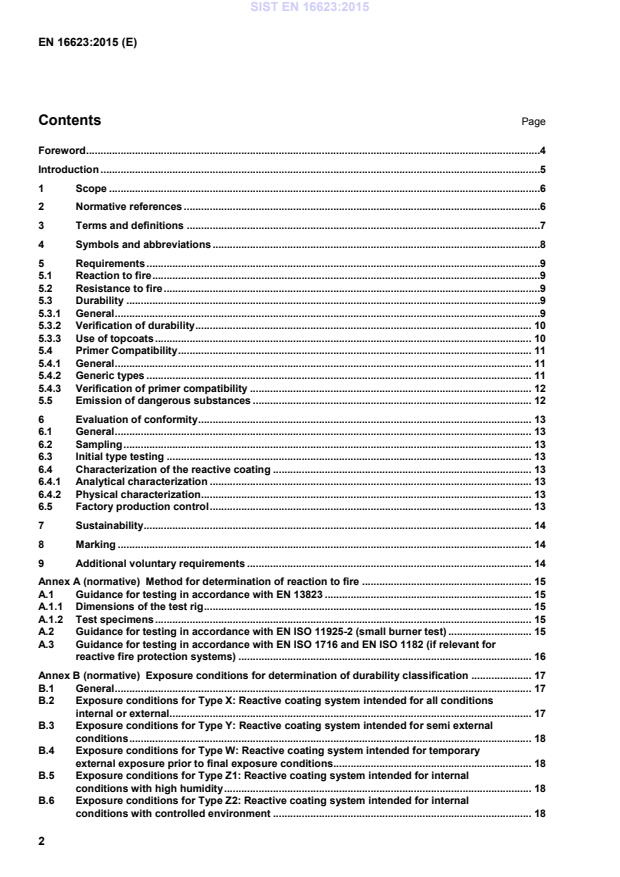
Method for determination of reaction to fire . 15 A.1 Guidance for testing in accordance with EN 13823 . 15 A.1.1 Dimensions of the test rig . 15 A.1.2 Test specimens . 15 A.2 Guidance for testing in accordance with EN ISO 11925-2 (small burner test) . 15 A.3 Guidance for testing in accordance with EN ISO 1716 and EN ISO 1182 (if relevant for reactive fire protection systems) . 16 Annex B (normative)
Exposure conditions for determination of durability classification . 17 B.1 General . 17 B.2 Exposure conditions for Type X: Reactive coating system intended for all conditions internal or external. 17 B.3 Exposure conditions for Type Y: Reactive coating system intended for semi external conditions . 18 B.4 Exposure conditions for Type W: Reactive coating system intended for temporary external exposure prior to final exposure conditions . 18 B.5 Exposure conditions for Type Z1: Reactive coating system intended for internal conditions with high humidity . 18 B.6 Exposure conditions for Type Z2: Reactive coating system intended for internal conditions with controlled environment . 18 SIST EN 16623:2015
Insulating Efficiency — Test Procedure . 20 C.1 General . 20 C.2 Test specimens . 20 C.3 Test Procedure . 20 C.4 Test Report . 21 Annex D (normative)
Determination of identification characteristics . 25 D.1 General . 25 D.2 Reporting of Specific Methodology for determination of identification characteristics . 25 Annex E (normative)
Factory production control . 26 E.1 General . 26 E.2 Quality control testing . 26 E.3 Initial factory inspection . 27 Annex F (normative)
Alternative raw materials, formulation and process changes . 28 F.1 General . 28 F.2 Formulation tolerances . 28 F.3 Formulation change . 28 F.4 Raw material approval of an alternative . 28 F.5 Process and equipment change . 31 F.6 Managing multiple production sites . 31 Annex G (normative)
Audit testing . 32 G.1 General . 32 G.2 Selection of product and preparation of test specimens . 32 G.3 Choice of test specimens . 32 G.4 Illustrative testing pattern. 33 G.5 Audit test procedure . 33 G.6 Audit test results . 33 G.7 Non-compliance . 34 Annex H (normative)
Levels of fire testing . 35 H.1 General . 35 H.2 Level 1 fire testing . 35 H.3 Level 2 fire testing . 35 H.4 Level 3 fire testing . 36 H.5 Level 4 independent fire testing . 37 H.6 Level 5 independent fire testing . 37 Annex I (informative)
Guidance for manufacture, storage, application, inspection and repair . 38 I.1 Manufacture . 38 I.1.1 Manufacturing equipment. 38 I.1.2 Temperature during manufacture . 38 I.1.3 Manufacturing blending time . 38 I.1.4 Raw material quality and traceability . 38 I.2 Storage of raw materials . 38 I.3 Storage of finished product. 38 I.4 Application . 39 I.4.1 General . 39 I.4.2 Application schedule . 39 I.4.3 Compatibility . 39 I.4.4 Application requirements and environmental conditions . 39 I.4.5 Application controls . 40 I.5 Inspection . 40 I.5.1 General . 40 I.5.2 Inspection criteria . 40 I.6 Maintenance and repair . 41 Bibliography . 42
1) The performance levels or classes required for a given application can be found in regulations. SIST EN 16623:2015
2) “Commission International de l’Éclairage” (CIE) system of colour space defines lightness/darkness (L) scale in CIELAB units. White is defined as L* = 100 and black as L* = 0. SIST EN 16623:2015
...