

SIST IEC 60255-21-1:1995
(Main)Electrical relays - Part 21: Vibration, shock, bump and seismic tests on measuring relays and protection equipment - Section One: Vibration tests (sinusoidal)
General Information
- Abstract
This part includes two types of vibration tests: the vibration response test and the vibration endurance test, and is generally based upon IEC 68-2-6. The requirements are applicable only to measuring relays and protection equipment in a new condition. The tests specified are type tests.
- Status
- Published
- Publication Date
- 31-Jul-1995
- Technical Committee
- ISS EIT.ERE - All-or-nothing electrical relays
- Current Stage
- 6060 - National Implementation/Publication (Adopted Project)
- Start Date
- 01-Aug-1995
- Due Date
- 01-Aug-1995
- Completion Date
- 01-Aug-1995

Overview
SIST IEC 60255-21-1:1995 is a Slovenian adoption of the international standard IEC 60255-21-1. This standard specifies the vibration testing requirements for measuring relays and protection equipment in new condition. It focuses specifically on sinusoidal vibration tests, comprising vibration response and vibration endurance tests. The objective is to ensure that electrical relays and protection devices maintain functionality and reliability when exposed to vibrations typically encountered during operation and transportation.
This standard forms a vital part of broader assessments that also include shock, seismic, and bump tests, providing a comprehensive approach to the mechanical testing of relays used in electrical protection systems.
Key Topics
- Scope of Application: The standard applies to measuring relays and protection equipment in a new, unused condition and specifies type tests rather than routine or acceptance tests.
- Test Types:
- Vibration Response Test: Evaluates the performance of energized relays under simulated operational vibrations.
- Vibration Endurance Test: Subjects non-energized equipment to increased vibration levels as an accelerated aging or transport simulation.
- Testing Methodology: Based primarily on IEC 68-2-6 for sinusoidal vibrations, including:
- Definitions of test terms and parameters
- Requirements for vibration apparatus and mounting
- Severity classes for different vibration levels
- Details of sweep cycles and acceptance criteria
- Acceptance Criteria: Defines maximum allowable functional changes and physical tolerances, ensuring that:
- Relays do not maloperate during tests
- No permanent change occurs in flags, indicators, or relay settings beyond specified tolerances
- Equipment remains compliant with performance specifications post-test
Applications
- Quality Assurance in Power Systems: Ensures that relays and protection devices used in power plants, substations, and industrial facilities withstand vibration environments without functional degradation.
- Product Certification and Type Testing: Provides a benchmark for manufacturers to demonstrate that equipment designs meet required durability and reliability before entering commercial production or deployment.
- Transport and Handling Assessment: Facilitates the safe movement of sensitive electronic protection devices, confirming resilience to the mechanical stresses encountered during shipping and handling.
- Customizable Severity Classes: Allows manufacturers and end users to specify the test severity (from standard operation to extreme environments like shipboard applications) based on actual deployment needs.
Related Standards
- IEC 60255 Series: Comprehensive standards covering various aspects of relays, including type testing, measurement procedures, and product requirements.
- IEC 68-2-6: The foundational reference for sinusoidal vibration testing methods, detailing environmental testing procedures applicable across electronic equipment.
- ISO 2041: Standardized vocabulary on vibration and shock, ensuring consistent terminology in testing and communication.
- IEC 60255-21-2 / 21-3: Address shock, bump, and seismic tests for measuring relays and protection equipment, complementing vibration-focused assessment.
Practical Value
By adhering to SIST IEC 60255-21-1:1995, manufacturers and operators of electrical protection equipment can:
- Verify product resilience against realistic mechanical stresses
- Reduce risk of unexpected failures, safeguarding critical electrical infrastructure
- Align with international best practices for quality assurance and compliance, aiding in market access both in Slovenia and globally.
Keywords: Sinusoidal vibration test, measuring relays, protection equipment, electrical relays, type test, IEC 60255, vibration response, vibration endurance, mechanical reliability, industrial standards.
Relations
- Effective Date
- 05-Sep-2023
Get Certified
Connect with accredited certification bodies for this standard

IMQ S.p.A. (Certification)
Italian electrical product certification.

SLG Prüf- und Zertifizierungs GmbH
German testing and certification body.

UL Solutions
Global safety science company with testing, inspection and certification.
Sponsored listings
Frequently Asked Questions
SIST IEC 60255-21-1:1995 is a standard published by the Slovenian Institute for Standardization (SIST). Its full title is "Electrical relays - Part 21: Vibration, shock, bump and seismic tests on measuring relays and protection equipment - Section One: Vibration tests (sinusoidal)". This standard covers: This part includes two types of vibration tests: the vibration response test and the vibration endurance test, and is generally based upon IEC 68-2-6. The requirements are applicable only to measuring relays and protection equipment in a new condition. The tests specified are type tests.
This part includes two types of vibration tests: the vibration response test and the vibration endurance test, and is generally based upon IEC 68-2-6. The requirements are applicable only to measuring relays and protection equipment in a new condition. The tests specified are type tests.
SIST IEC 60255-21-1:1995 is classified under the following ICS (International Classification for Standards) categories: 29.120.40 - Switches; 29.120.70 - Relays. The ICS classification helps identify the subject area and facilitates finding related standards.
SIST IEC 60255-21-1:1995 has the following relationships with other standards: It is inter standard links to SIST IEC 60255-21-2:1995. Understanding these relationships helps ensure you are using the most current and applicable version of the standard.
SIST IEC 60255-21-1:1995 is available in PDF format for immediate download after purchase. The document can be added to your cart and obtained through the secure checkout process. Digital delivery ensures instant access to the complete standard document.
Standards Content (Sample)
SLOVENSKI STANDARD
01-avgust-1995
Electrical relays - Part 21: Vibration, shock, bump and seismic tests on measuring
relays and protection equipment - Section 1: Vibration tests (sinusoidal)
Electrical relays - Part 21: Vibration, shock, bump and seismic tests on measuring relays
and protection equipment - Section One: Vibration tests (sinusoidal)
Relais électriques - Vingt et unième partie: Essais de vibrations, de chocs, de secousses
et de tenue aux séismes applicables aux relais de mesure et aux dispositifs de protection
- Section un: Essais de vibrations (sinusoïdales)
Ta slovenski standard je istoveten z: IEC 60255-21-1
ICS:
29.120.70 Releji Relays
2003-01.Slovenski inštitut za standardizacijo. Razmnoževanje celote ali delov tega standarda ni dovoljeno.
NORME CEI
INTERNATIONALE IEC
255-21-1
INTERNATIONAL
Première édition
STAN DARD
First edition
Relais électriques
Vingt et unième partie:
Essais de vibrations, de chocs, de secousses et de
tenue aux séismes applicables aux relais de mesure
et aux dispositifs de protection
Section un — Essais de vibrations (sinusoïdales)
Electrical relays
Part 21:
Vibration, shock, bump and seismic test on
measuring relays and protection equipment
Section One — Vibration tests (sinusoidal)
de reproduction réservés —Copyright - all rights reserved
© CEI 1988 Droits
ne peut être reproduite ni No part of this publication may be reproduced or utilized
Aucune partie de cette publication
que ce soit et par aucun procédé, in any form or by any means, electronic or mechanical,
utilisée sous quelque forme
photocopie et les including photocopying and microfilm, without permission
électronique ou mécanique, y compris la
in writing from the publisher
microfilms, sans l'accord écrit de l'éditeur.
rnationale 3, rue de Varembé Genève Suisse
Bureau central de la Commission Electrotechnique Inte
Commission Electrotechnique Internationale CODE PRIX
L
International Electrotechnical Commission PRICE CODE
IEC
HOMHCCHN
MemayHapoiaHae 3nettTpoTexuH4ecnaR
• Pour prix, voir catalogue en vigueur
For price, see current catalogue
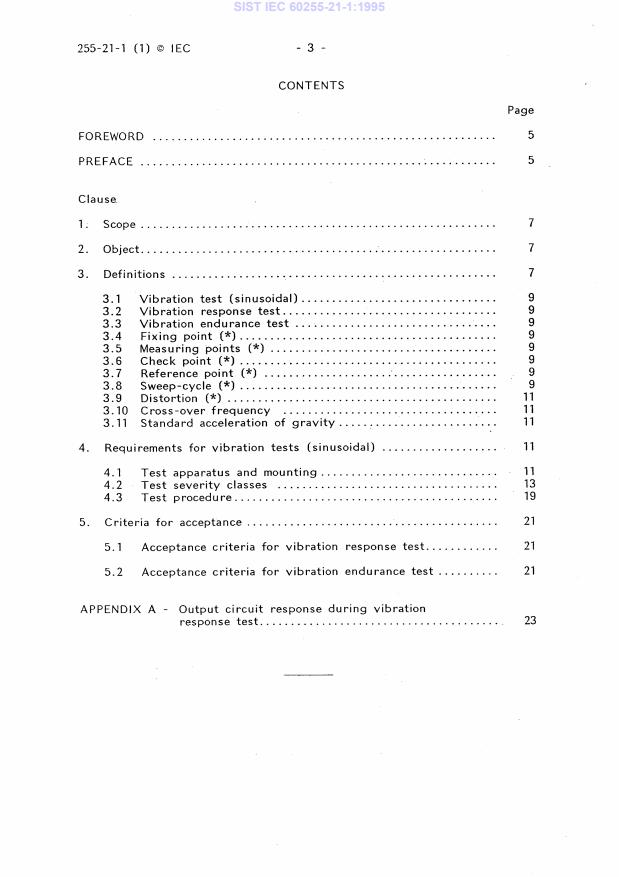
255-21-1 (1) © IEC - 3
CONTENTS
Page
FOREWORD 5
PREFACE 5
Clause _
1. Scope 7
2. Object 7
3 Definitions
3.1 Vibration test (sinusoidal)
3.2 Vibration response test
3.3 Vibration endurance test
3.4 Fixing point (*) 9
9 3.5 Measuring points (*)
3.6 Check point (*)
Reference point (*) 3.7
3.8 Sweep-cycle (*) 9
3.9 Distortion (*)
3.10 Cross-over frequency
3.11 Standard acceleration of gravity
4. Requirements for vibration tests (sinusoidal)
Test apparatus and mounting 4.1
13 4.2 Test severity classes
19 4.3 Test procedure
5. Criteria for acceptance
5.1 Acceptance criteria for vibration response test
5.2 Acceptance criteria for vibration endurance test
APPENDIX A - Output circuit response during vibration
response test
255-21-1 (1) © IEC - 5 -
INTERNATIONAL ELECTROTECHNICAL COMMISSION
ELECTRICAL RELAYS
Part 21: Vibration, shock, bump and seismic tests on
measuring relays and protection equipment
Section One: Vibration tests (sinusoidal)
FOREWORD
1) The formal decisions or agreements of the IEC on technical matters, prepared by Technical
Committees on which all the National Committees having a special interest therein are
represented, express, as nearly as possible, an international consensus of opinion on the
subjects dealt with.
2) They have the form of recommendations for international use and they are accepted by the
National Committees in that sense.
3)
In order to promote international unification, the IEC expresses the wish that all
National Committees should adopt the text of the IEC recommendation for their national
rules in so far as national conditions will permit. Any divergence between the IEC
recommendation and the corresponding national rules should, as far as possible, be clearly
indicated in the latter.
PREFACE
This standard has been prepared by Sub-Committee 41B: Measuring
Relays and Protection Equipment, of IEC Technical Committee No. 41:
Electrical relays.
The text of this standard is based on the following documents:
Six Months' Rule Report on Voting
41B(C0)35 41B(CO)37
Full information on the voting for the approval of this standard can be
found in the Voting Report indicated in the above table.
The following IEC publications are quoted in this standard:
Publications Nos. 50: International Electrotechnical Vocabulary (IEV).
68-2-6 (1982): Basic environmental testing procedures, Part 2: Tests. Test Fc and
guidance: Vibration (sinusoidal).
255: Electrical relays.
255-7 (1978): Part 7: Test and measurement procedures for electromechanical
all-or-nothing relays.
Other publication quoted:
ISO 2041-1975: Vibration and shock - Vocabulary.
©
255-21-1 (1) IEC - 7 -
ELECTRICAL RELAYS
Vibration, shock, bump and seismic tests on
Part 21:
measuring relays and protection equipment
Section One: Vibration tests (sinusoidal)
1. Scope
This standard is part of a series specifying the vibration, shock,
bump and seismic requirements applicable to measuring relays and
protection equipment (with or without contacts).
This standard includes two types of vibration tests: the vibration
response test and the vibration endurance test, and is generally based
upon IEC 68-2-6.
The requirements of this standard are applicable only to measuring
relays and protection equipment in a new condition.
The tests specified in this standard are type tests.
2. Object
The object of this standard is to state:
- definitions of terms used;
- test conditions;
- standard test severity classes;
- test procedure;
- criteria for acceptance.
3. Definitions
For definitions of general terms not defined in this standard,
reference should be made to:
- International Electrotechnical Vocabulary (IEV) [IEC 50];
- IEC 68-2 -6;
- relay standards published in the IEC 255 series;
- ISO 2041
For the purpose of this standard the following definitions shall
apply.
Note.- Definitions marked with (*) are derived from IEC 68-2-6.
255-21-1 (1) © IEC - 9
3.1 Vibration test (sinusoidal)
A test during which a specimen is submitted to sweeps of sinusoidal
vibration in the three different axes of the specimen in turn, in terms
of constant displacement and/or constant acceleration, within a stan-
dard frequency range.
The term "specimen" includes any auxiliary part which is an
Note. -
integral functional feature of the measuring relay or protection
equipment under test.
3.2 Vibration response test
A vibration test carried out on a measuring relay or protection
equipment, energized under specified conditions, to determine its
response to normal service conditions.
3.3 Vibration endurance test
A vibration test carried out on a non-energized measuring relay or
protection equipment, with higher vibration levels than in normal
service conditions, as an accelerated life test to simulate long-term
vibration. This test also simulates some transportation conditions.
3.4 Fixing point (*)
Part of the specimen in contact with the fixture or vibration table at
a point where the specimen is normally fastened in service.
If a part of the real mounting structure is used as the fixture, the
fixing points shall be taken as those of the mounting structure and not
of the specimen.
3.5 Measuring points (*)
The specific points at which data are obtained during the tests.
They are of two main types: check point and reference point.
3.6 Check point (*)
A measuring point located on the fixture, on the vibration table or
on the specimen as close as possible and rigidly connected to one of
its fixing points.
3.7 Reference point (*)
A measuring point chosen from the check points whose signal is used
to control the test so that the requirements of this standard are
satisfied.
3.8 Sweep-cycle (*)
A traverse of the specified frequency range once in each direction,
150 Hz to 10 Hz.
for example 10 Hz to 150 Hz and
255-21-1 (1) © IEC - 11 -
3.9 Distortion (*)
2 2
a
tot - ai
V
x 100 (percentage)
Distortion d =
ai
where:
a^ r.m.s. value of the acceleration at the driving frequency
total r.m.s. value of the applied acceleration
a tot
(including the value of al)
3.10 Cross-over frequency
That frequency at which the characteristic of a vibration changes
from a constant displacement value versus frequency to a constant'
acceleration value versus frequency.
3.11 Standard acceleration of gravity
The standard acceleration of gravity g n , where "n" indicates normal,
having the value of 9.81 m/s 2 . In practice this value may be rounded
to 10 m/s2.
4. Requirements for vibration tests (sinusoidal)
The main parameters of the vibration tests are the following:
- frequency range;
- acceleration;
- displacement amplitude below the cross-over frequency, if any,
sweep rate and number of sweep cycles.
4.1 Test apparatus and mounting
The required characteristics of the vibration generator and fixture
together with the mounting requirements shall be as follows. The
characteristics apply when the specimen is mounted on the generator.
4.1 .1
Basic motion
The basic motion shall be a sinusoidal function of time and such that
the fixing points of the specimen move substantially in phase and in
straight parallel lines along a specified axis, subjected to the
limitations of Sub-clauses 4.1.2 and 4.1.3.
4.1.2
Transverse motion
The maximum vibration amplitude at the check points in any axis
perpendicular to the specified axis shall not exceed 50% of the speci-
fied amplitude for basis motion.
255-21-1 (1) © IEC - 13 -
4.1.3
Distortion
The acceleration distortion measurement shall be carried out at the
reference point, which shall be declared by the manufacturer, and
shall cover the frequencies up
...