


SIST EN 61800-4:2004
(Main)Adjustable speed electrical power drive systems -- Part 4: General requirements - Rating specifications for a.c. power drive systems above 1 000 V a.c. and not exceeding 35 kV
Adjustable speed electrical power drive systems -- Part 4: General requirements - Rating specifications for a.c. power drive systems above 1 000 V a.c. and not exceeding 35 kV
Applies to adjustable speed a.c. drive systems that include power conversion, control equipment and a motor. Excluded are traction for railway applications and electrical vehicle drives. Applies to power drive systems with converter voltages (line-to-line voltage), between 1 kV a.c. and 35 kV a.c., input side 50 Hz or 60 Hz, and load side frequencies up to 600 Hz. Requirements for voltages above 15 kV are not included and are defined by agreement between the manufacturer and the system supplier. For power drive systems, with voltages above 1 kV, using a step-down input transformer and/or a step-up output transformer in connection with a low voltage converter (below 1 000 V), EN 61800-2 applies. Gives the characteristics of the converters, their topologies and their relationship with the complete a.c. drive system. It also states their performance requirements with respect to ratings, normal operating conditions, overload conditions, surge withstand capabilities, stability, protection, a.c. line earthing, topologies and testing. Furthermore, it deals with application guidelines, such as control strategies, torsion analysis, recommendations for earthing and drive system component integration.
Drehzahlveränderbare elektrische Antriebe -- Teil 4: Allgemeine Anforderungen - Festlegungen für die Bemessung von Wechselstrom-Antriebssystemen über 1 000 V AC und höchstens 35 kV
Entraînements électriques de puissance à vitesse variable -- Partie 4: Exigences générales - Spécifications de dimensionnement pour systèmes d'entraînements de puissance en courant alternatif de tension supérieure à 1 000 V alternatif et ne dépassant pas 35 kV
Električni pogonski sistemi z nastavljivo hitrostjo - 4. del: Splošne zahteve - Specifikacije naznačenih vrednosti za pogonske sisteme na izmenično napetost nad 1000 V in do 35 kV (IEC 61800-4:2002)
General Information
- Status
- Withdrawn
- Publication Date
- 31-Aug-2004
- Withdrawal Date
- 10-Sep-2024
- Technical Committee
- I11 - Imaginarni 11
- Current Stage
- 9900 - Withdrawal (Adopted Project)
- Start Date
- 10-Sep-2024
- Due Date
- 03-Oct-2024
- Completion Date
- 11-Sep-2024



Frequently Asked Questions
SIST EN 61800-4:2004 is a standard published by the Slovenian Institute for Standardization (SIST). Its full title is "Adjustable speed electrical power drive systems -- Part 4: General requirements - Rating specifications for a.c. power drive systems above 1 000 V a.c. and not exceeding 35 kV". This standard covers: Applies to adjustable speed a.c. drive systems that include power conversion, control equipment and a motor. Excluded are traction for railway applications and electrical vehicle drives. Applies to power drive systems with converter voltages (line-to-line voltage), between 1 kV a.c. and 35 kV a.c., input side 50 Hz or 60 Hz, and load side frequencies up to 600 Hz. Requirements for voltages above 15 kV are not included and are defined by agreement between the manufacturer and the system supplier. For power drive systems, with voltages above 1 kV, using a step-down input transformer and/or a step-up output transformer in connection with a low voltage converter (below 1 000 V), EN 61800-2 applies. Gives the characteristics of the converters, their topologies and their relationship with the complete a.c. drive system. It also states their performance requirements with respect to ratings, normal operating conditions, overload conditions, surge withstand capabilities, stability, protection, a.c. line earthing, topologies and testing. Furthermore, it deals with application guidelines, such as control strategies, torsion analysis, recommendations for earthing and drive system component integration.
Applies to adjustable speed a.c. drive systems that include power conversion, control equipment and a motor. Excluded are traction for railway applications and electrical vehicle drives. Applies to power drive systems with converter voltages (line-to-line voltage), between 1 kV a.c. and 35 kV a.c., input side 50 Hz or 60 Hz, and load side frequencies up to 600 Hz. Requirements for voltages above 15 kV are not included and are defined by agreement between the manufacturer and the system supplier. For power drive systems, with voltages above 1 kV, using a step-down input transformer and/or a step-up output transformer in connection with a low voltage converter (below 1 000 V), EN 61800-2 applies. Gives the characteristics of the converters, their topologies and their relationship with the complete a.c. drive system. It also states their performance requirements with respect to ratings, normal operating conditions, overload conditions, surge withstand capabilities, stability, protection, a.c. line earthing, topologies and testing. Furthermore, it deals with application guidelines, such as control strategies, torsion analysis, recommendations for earthing and drive system component integration.
SIST EN 61800-4:2004 is classified under the following ICS (International Classification for Standards) categories: 29.160.30 - Motors; 29.200 - Rectifiers. Convertors. Stabilized power supply. The ICS classification helps identify the subject area and facilitates finding related standards.
You can purchase SIST EN 61800-4:2004 directly from iTeh Standards. The document is available in PDF format and is delivered instantly after payment. Add the standard to your cart and complete the secure checkout process. iTeh Standards is an authorized distributor of SIST standards.
Standards Content (Sample)
STANDARDElektrični pogonski sistemi z nastavljivo hitrostjo - 4. del: Splošne zahteve - Specifikacije naznačenih vrednosti za pogonske sisteme na izmenično napetost nad 1000 V in do 35 kV (IEC 61800-4:2002)Adjustable speed electrical power drive systems - Part 4: General requirements - Rating specifications for a.c. power drive systems above 1000 V a.c. and not exceeding 35 kV (IEC 61800-4:2002)©
Standard je založil in izdal Slovenski inštitut za standardizacijo. Razmnoževanje ali kopiranje celote ali delov tega dokumenta ni dovoljenoReferenčna številkaSIST EN 61800-4:2004(en)ICS29.160.30; 29.200
EUROPEAN STANDARD
EN 61800-4 NORME EUROPÉENNE EUROPÄISCHE NORM
January 2003 CENELEC European Committee for Electrotechnical Standardization Comité Européen de Normalisation Electrotechnique Europäisches Komitee für Elektrotechnische Normung
Central Secretariat: rue de Stassart 35, B - 1050 Brussels
© 2003 CENELEC - All rights of exploitation in any form and by any means reserved worldwide for CENELEC members.
Ref. No. EN 61800-4:2003 E
ICS 29.160.30; 29.200
English version
Adjustable speed electrical power drive systems Part 4: General requirements -
Rating specifications for a.c. power drive
systems above 1 000 V a.c. and not exceeding 35 kV (IEC 61800-4:2002)
Entraînements électriques de puissance
à vitesse variable Partie 4: Exigences générales - Spécifications de dimensionnement
pour systèmes d'entraînements
de puissance en courant alternatif
de tension supérieure à 1 000 V alternatif et ne dépassant pas 35 kV (CEI 61800-4:2002)
Drehzahlveränderbare elektrische Antriebe Teil 4: Allgemeine Anforderungen - Festlegungen für die Bemessung
von Wechselstrom-Antriebssystemen
über 1 000 V AC und höchstens 35 kV (IEC 61800-4:2002)
This European Standard was approved by CENELEC on 2002-11-01. CENELEC members are bound to comply with the CEN/CENELEC Internal Regulations which stipulate the conditions for giving this European Standard the status of a national standard without any alteration.
Up-to-date lists and bibliographical references concerning such national standards may be obtained on application to the Central Secretariat or to any CENELEC member.
This European Standard exists in three official versions (English, French, German). A version in any other language made by translation under the responsibility of a CENELEC member into its own language and notified to the Central Secretariat has the same status as the official versions.
CENELEC members are the national electrotechnical committees of Austria, Belgium, Czech Republic, Denmark, Finland, France, Germany, Greece, Hungary, Iceland, Ireland, Italy, Luxembourg, Malta, Netherlands, Norway, Portugal, Slovakia, Spain, Sweden, Switzerland and United Kingdom.
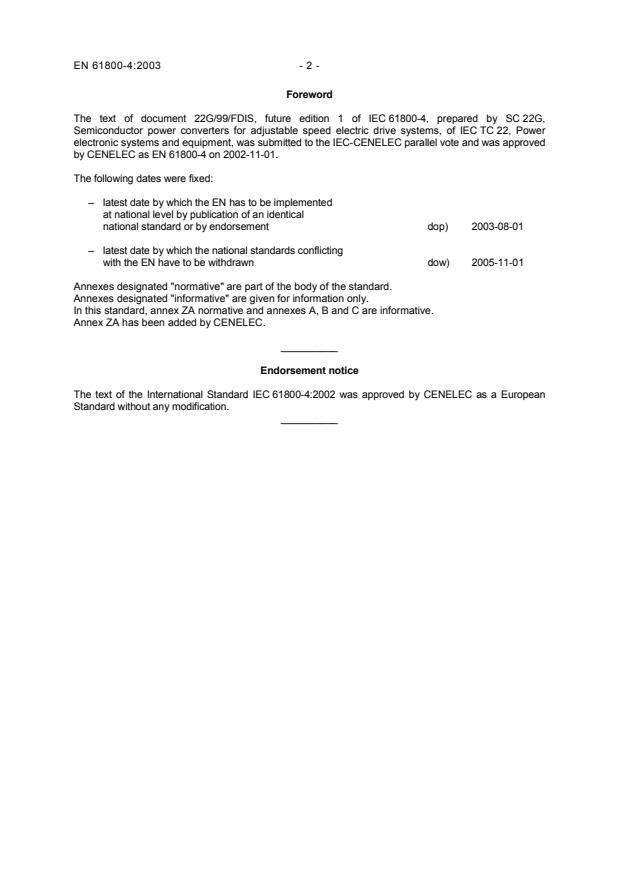
The text of document 22G/99/FDIS, future edition 1 of IEC 61800-4, prepared by SC 22G, Semiconductor power converters for adjustable speed electric drive systems, of IEC TC 22, Power electronic systems and equipment, was submitted to the IEC-CENELEC parallel vote and was approved by CENELEC as EN 61800-4 on 2002-11-01.
The following dates were fixed:
– latest date by which the EN has to be implemented
at national level by publication of an identical
national standard or by endorsement
dop) 2003-08-01
– latest date by which the national standards conflicting
with the EN have to be withdrawn
dow) 2005-11-01
Annexes designated "normative" are part of the body of the standard.
Annexes designated "informative" are given for information only.
In this standard, annex ZA normative and annexes A, B and C are informative. Annex ZA has been added by CENELEC.
__________
Endorsement notice
The text of the International Standard IEC 61800-4:2002 was approved by CENELEC as a European Standard without any modification. __________
- 3 - EN 61800-4:2003
Annex ZA
(normative)
Normative references to international publications
with their corresponding European publications This European Standard incorporates by dated or undated reference, provisions from other publications. These normative references are cited at the appropriate places in the text and the publications are listed hereafter. For dated references, subsequent amendments to or revisions of any of these publications apply to this European Standard only when incorporated in it by amendment or revision. For undated references the latest edition of the publication referred to applies (including amendments). NOTE When an international publication has been modified by common modifications, indicated by (mod), the relevant EN/HD applies. Publication Year Title EN/HD Year IEC 60034-1 (mod) - 1) Rotating electrical machines Part 1: Rating and performance
EN 60034-1 + corr. February A 11 1998 2) 2000 2002
IEC 60034-2 1972 Part 2: Methods for determining losses and efficiency of rotating electrical machinery from tests (excluding machines for traction vehicles)
EN 60034-2 1996 A1 1995
A1 1996 A2 1996
A2 1996
IEC 60034-2A 1974 Part 2: Methods for determining losses and efficiency of rotating electrical machinery from tests (excluding machines for traction vehicles) - First supplement: Measurement of losses by the calorimetric method
EN 60034-2 1996 IEC 60034-5 - 1) Part 5: Degrees of protection provided by the integral design of rotating electrical machines (IP code) - Classification
EN 60034-5 2001 2) IEC 60034-6 1991 Part 6: Methods of cooling (IC Code)
EN 60034-6 1993 IEC 60034-7 - 1) Part 7: Classification of types of construction, mounting arrangements and terminal box position (IM Code)
EN 60034-7 1993 2) IEC 60034-9 1997 Part 9: Noise limits
EN 60034-9 1997 IEC 60034-14 1996 Part 14: Mechanical vibration of certain machines with shaft heights 56 mm and higher - Measurement, evaluation and limits of vibration
EN 60034-14 1996
1) Undated reference. 2) Valid edition at date of issue.
- - IEC 60034-18-31 1992 Part 18: Functional evaluation of insulation systems - Section 31: Test procedures for form-wound windings -Thermal evaluation and classification of insulation systems used in machines up to and including 50 MVA and 15 kV EN 60034-18-31 1994 A1 1996
A1 1996 IEC 60038 (mod) 1983 IEC standard voltages 3) HD 472 S1 + corr. February
1989 2002 A1 1994
- - A2 1997
- - IEC 60050-111 1996 International Electrotechnical Vocabulary (IEV) Chapter 111: Physics and chemistry
- - IEC 60050-151 2001 Part 151: Electrical and magnetic devices - - IEC 60050-351 1998 Part 351: Automatic control
- - IEC 60050-441 1984 Chapter 441: Switchgear, controlgear and fuses - - A1 2000
- - IEC 60050-551 1998 Part 551: Power electronics
- - IEC 60050-601 1985 Chapter 601: Generation, transmission and distribution of electricity - General - - A1 1998
- - IEC 60076-1 (mod) A1 1993
1999 Power transformers Part 1: General
EN 60076-1 A11 A1 A12 1997 1997 2000 2002
IEC 60076-2 (mod) 1993 Part 2: Temperature rise
EN 60076-2 1997 IEC 60076-3 + Corr. December 2000 2000 Power transformers Part 3: Insulation levels, dielectric tests and external clearances in air
EN 60076-3
2001 IEC 60076-5 2000 Part 5: Ability to withstand short circuit
EN 60076-5 2000 IEC 60076-8 1997 Part 8: Application guide
- -
3) The title of HD 472 S1 is: “Nominal voltages for low voltage public electricity sypply systems”.
- 5 - EN 61800-4:2003
Publication Year Title EN/HD Year IEC 60146-1-1 1991 Semiconductor convertors - General requirements and line commutated convertors Part 1-1: Specifications of basic requirements EN 60146-1-1 1993 A1 1996
A1 1997 IEC 60146-1-2 1991 Part 1-2: Application guide
- - IEC 60146-1-3 1991 Part 1-3: Transformers and reactors
EN 60146-1-3 1993 IEC 60146-2 1999 Part 2: Self-commutated semiconductor converters including direct d.c. converters
EN 60146-2 2000 IEC 60146-6 1992 Part 6: Application guide for the protection of semiconductor convertors against overcurrent by fuses
- - IEC 60204-11 2000 Safety of machinery - Electrical equipment of machines Part 11: Requirements for HV equipment for voltages above 1 000 V a.c. or 1 500 V d.c.
and not exceeding 36 kV
EN 60204-11 2000 IEC 60417 Series Graphical symbols for use on equipment EN 60417 Series IEC 60529 1989 Degrees of protection provided by enclosures (IP Code) EN 60529 + corr. May 1991 1993 A1 1999
A1 2000 IEC 60664-1 (mod)
A1 1992
2000 Insulation coordination for equipment within low-voltage systems Part 1: Principles, requirements and tests
HD 625.1 S1 + corr. november
-
1996 1996
-
IEC 60721-3-1 1997 Classification of environmental conditionsPart 3: Classification of groups of environmental parameters and their severities - Section 1: Storage
EN 60721-3-1 1997 IEC 60721-3-2 1997 Part 3: Classification of groups of environmental parameters and their severities - Section 2: Transportation
EN 60721-3-2 1997 IEC 60721-3-3 1994 Part 3: Classification of groups of environmental parameters and their severities - Section 3: Stationary use at weatherprotected locations EN 60721-3-3 1995 A1 1995
- - A2 1996
A2 1997
+ A1 (mod) 1986
EN 60726 2003 IEC 61000-2-4 + corr. August 1994 1994 Electromagnetic compatibility (EMC) Part 2-4: Environment - Compatibility levels in industrial plants for low-frequency conducted disturbances
EN 61000-2-4 1994 4) IEC 61000-4-7 1991 Part 4-7: Testing and measurement techniques - General guide on harmonics and interharmonics measurements and instrumentation, for power supply systems and equipment connected thereto
EN 61000-4-7 1993 5) IEC 61136-1 (mod) 1992 Semiconductor power convertors - Adjustable speed electric drive systems - General requirements Part 1: Rating specifications, particularly for d.c. motor drives
EN 61136-1 1995 IEC 61378-1 1997 Convertor transformers
Part 1: Transformers for industrial applications
EN 61378-1 + corr. November 1998 1998 IEC 61800-2 1998 Adjustable speed electrical power drive systems Part 2: General requirements - Rating specifications for low voltage adjustable frequency a.c. power drive systems
EN 61800-2 1998 IEC 61800-3 1996 Part 3: EMC product standard including specific test methods
EN 61800-3 A11 1996 2000 ISO 1680 1999 Acoustics - Test code for the measurement of airborne noise emitted by rotating electrical machines
EN ISO 1680 1999
4) EN 61000-2-4:1994 is superseded by EN 61000-2-4:2002, which is based on IEC 61000-2-4:2002. 5) EN 61000-4-7:1993 is superseded by EN 61000-4-7:2002, which is based on IEC 61000-4-7:2002.
NORMEINTERNATIONALECEIIECINTERNATIONALSTANDARD61800-4Première éditionFirst edition2002-09Entraînements électriques de puissanceà vitesse variable –Partie 4:Exigences générales – Spécifications dedimensionnement pour systèmes d'entraînementsde puissance en courant alternatif de tensionsupérieure à 1 000 V alternatif et ne dépassantpas 35 kVAdjustable speed electrical power drive systems –Part 4:General requirements – Rating specificationsfor a.c. power drive systems above 1 000 V a.c.and not exceeding 35 kVPour prix, voir catalogue en vigueurFor price, see current catalogue© IEC 2002
Droits de reproduction réservés
⎯
Copyright - all rights reservedAucune partie de cette publication ne peut être reproduite niutilisée sous quelque forme que ce soit et par aucun procédé,électronique ou mécanique, y compris la photocopie et lesmicrofilms, sans l'accord écrit de l'éditeur.No part of this publication may be reproduced or utilized in anyform or by any means, electronic or mechanical, includingphotocopying and microfilm, without permission in writing fromthe publisher.International Electrotechnical Commission,
3, rue de Varembé, PO Box 131, CH-1211 Geneva 20, SwitzerlandTelephone: +41 22 919 02 11
Telefax: +41 22 919 03 00
E-mail: inmail@iec.ch
Web: www.iec.chCODE PRIXPRICE CODEXECommission Electrotechnique InternationaleInternational Electrotechnical Commission
61800-4 © IEC:2002– 3 –CONTENTSFOREWORD.111Scope.132Normative references.133Definitions.193.1System.193.2PDS input parameters.313.3Converter.333.4PDS output parameters.353.5Control.353.6Tests.373.7Symbols.394Overview of drive system topologies.434.1Topologies classification.434.2Converter configuration.434.3Motor type.454.4By-pass and redundant configurations.474.5Regenerative and dynamic braking.495Service conditions.515.1Installation and operation.515.2Transportation.575.3Storage of equipment.596Ratings.616.1Power drive system (PDS).616.2Converter.676.3Transformer.716.4Motor.717Control performance requirements.737.1Steady state performance.737.2Dynamic performance.757.3Process control interface performance.878PDS main components.918.1Responsibilities.918.2Transformer.918.3Converter and associated controls.998.4Motor.1019PDS integration requirements.1139.1General conditions.1139.2Integration of components with voltages above 1 000 V.1199.3Protection interface.1279.4Driven equipment interface.13110Tests.13310.1Performance of tests.13310.2Items of individual PDS component tests.13310.3Drive system tests.141
61800-4 © IEC:2002– 5 –11Efficiency determination.15311.1General.15311.2Segregated loss method.15711.3Full load system test.165Annex A (informative)
Most commonly used drive system topologies.171A.1Object.171A.2Drive system topologies with indirect converters.171A.3Drive system topologies with direct converters.187Annex B (informative)
Speed control performance and the mechanical system.193B.1General.193B.2Basic speed control types.193B.3Effect of torsion elasticity on speed control performance.195B.4Effects of backlash.199B.5Selection criteria for the speed control system.201B.6Specification of the speed control performance.203Annex C (informative)
Power semiconductor losses.205C.1Thyristor.205C.2GTO/GCT thyristor (gate turn-off, gate commutated turn-off).207C.3IGBT.211C.4Snubber losses.215Figure 1 – Functional diagram of an a.c. adjustable speed power drive system (PDS) –Voltage above 1 kV.21Figure 2 – Example of load envelope.35Figure 3 – General structure of a drive system with an indirect converter.43Figure 4 – General structure of a drive system with direct converter.45Figure 5 – Example of multiple converter modules
and separate stator winding systemsmotor.47Figure 6 – Bypass configuration for system with indirect converter.47Figure 7 – LCI-synchronous motor in a partly redundant configuration.49Figure 8 – Example of dynamic braking.49Figure 9 – Typical curves for efficiency and losses of a PDS at constant flux operation.65Figure 10 – Overload cycle example.67Figure 11 – Deviation band.75Figure 12 – Time response following a step change of reference input – no change inoperating variables.81Figure 13 – Time response following a change in an operating variable –
no referencechange.83Figure 14 – Time response following a reference change at specified rate.83
61800-4 © IEC:2002– 7 –Figure 15 – Frequency response of the control – reference value as stimulus.85Figure 16 – Responsibilities of the system supplier.91Figure 17 – Insulation stressing types.107Figure 18 – Definition of the transient voltage at the terminals of the motor.109Figure 19 – Admissible pulse voltage (including voltage reflection and damping) at themotor terminals as a function of the peak rise time ta.109Figure 20 – Power drive system (PDS) – voltage above 1 000 V.115Figure 21 – PDS integration.119Figure 22 – Example of protective earthing and interconnection of main components.123Figure 23 – Reference measuring points for drive system tests.143Figure 24 – Back-to-back test.151Figure 25 – PDS hardware configuration and individual component efficiency.155Figure A.1 – Basic structure of an LCI synchronous motor drive system.171Figure A.2 – Basic structure of an LCI induction motor drive system.173Figure A.3 – Basic structure of a self-commutated PWM-CSI inverter for an inductionmotor drive system.173Figure A.4 – Dual CSI-PWM converter topology for induction motor drive system.175Figure A.5 – Three-phase VSI drive systems.177Figure A.6 – Voltage source NPC inverter drive system.177Figure A.7 – NPC structure.179Figure A.8 – Voltage source multi-level inverter drive system.179Figure A.9 – Multi-level inverter structure.181Figure A.10 – Three-phase VSI inverter with a bi-directional line-side converter.183Figure A.11 – Dual voltage source inverter (VSI) drive system.183Figure A.12 – Voltage source multilevel inverter drive system.185Figure A.13 – Power module (PM) for each level.187Figure A.14 – Three-phase six-pulse connection cycloconverterwith a four-winding transformer.189Figure A.15 – Circulating current cycloconverter.189Figure B.1 – Block diagram of the feedback control systemcontaining all the basic elements.193Figure B.2 – Mechanical diagram of a two moment inertia system.195Figure C.1 – GTO/GCT switching waveform.209Figure C.2 – IGBT switching waveform.213Figure C.3 – Three-phase thyristor bridge circuit.217Figure C.4 – Common RCD clamp.217
61800-4 © IEC:2002– 9 –Table 1 – Symbols.41Table 2 – Service conditions for the voltage supply at the PDS terminals (main andauxiliary).51Table 3 – Installation vibration limits.55Table 4 – Transportation vibration limits (see class 2M1 IEC 60721-3-2).59Table 5 – Example of reduced maximum continuous load as a function of an overload.67Table 6 – Maximum deviation bands (percent).75Table 7 – Limiting parts and typical voltage stress capability of the motor insulation system.111Table 8 – PDS protection functions.129Table 9 – Standard tests for PDS components.133Table 10 – Standard tests of the converter as component.137Table 11 – Drive system tests.141
61800-4 © IEC:2002– 11 –INTERNATIONAL ELECTROTECHNICAL COMMISSION____________ADJUSTABLE SPEED ELECTRICAL POWER DRIVE SYSTEMS –Part 4: General requirements – Rating specifications for a.c. power drivesystems above 1 000 V a.c and not exceeding 35 kVFOREWORD1)The IEC (International Electrotechnical Commission) is a worldwide organization for standardization comprisingall national electrotechnical committees (IEC National Committees). The object of the IEC is to promoteinternational co-operation on all questions concerning standardization in the electrical and electronic fields. Tothis end and in addition to other activities, the IEC publishes International Standards. Their preparation isentrusted to technical committees; any IEC National Committee interested in the subject dealt with mayparticipate in this preparatory work. International, governmental and non-governmental organizations liaisingwith the IEC also participate in this preparation. The IEC collaborates closely with the International Organizationfor Standardization (ISO) in accordance with conditions determined by agreement between the twoorganizations.2)The formal decisions or agreements of the IEC on technical matters express, as nearly as possible, aninternational consensus of opinion on the relevant subjects since each technical committee has representationfrom all interested National Committees.3)The documents produced have the form of recommendations for international use and are published in the formof standards, technical specifications, technical reports or guides and they are accepted by the NationalCommittees in that sense.4)
In order to promote international unification, IEC National Committees undertake to apply IEC InternationalStandards transparently to the maximum extent possible in their national and regional standards. Anydivergence between the IEC Standard and the corresponding national or regional standard shall be clearlyindicated in the latter.5)
The IEC provides no marking procedure to indicate its approval and cannot be rendered responsible for anyequipment declared to be in conformity with one of its standards.6)
Attention is drawn to the possibility that some of the elements of this International Standard may be the subjectof patent rights. The IEC shall not be held responsible for identifying any or all such patent rights.International Standard IEC 61800-4 has been prepared by sub-committee 22G: Semiconductorpower converters for adjustable speed electric drive systems, of IEC technical committee 22:Power electronic systems and equipment.The text of this standard is based on the following documents:FDISReport on voting22G/99/FDIS22G/107/RVDFull information on the voting for the approval of this standard can be found in the report onvoting indicated in the above table.This publication has been drafted in accordance with the ISO/IEC Directives, Part 3.Annexes A, B and C are for information only.The committee has decided that the contents of this publication will remain unchanged until2008. At this date, the publication will be•reconfirmed;•withdrawn;•replaced by a revised edition, or•amended.
61800-4 © IEC:2002– 13 –ADJUSTABLE SPEED ELECTRICAL POWER DRIVE SYSTEMS –Part 4: General requirements – Rating specifications for a.c. power drivesystems above 1 000 V a.c and not exceeding 35 kV1 ScopeThis part of IEC 61800 applies to adjustable speed a.c. drive systems that include powerconversion, control equipment and a motor. Excluded are traction for railway applications andelectrical vehicle drives.It applies to power drive systems (see figure 1) with converter voltages (line-to-line voltage),between 1 kV a.c. and 35 kV a.c., input side 50 Hz or 60 Hz, and load side frequencies up to600 Hz. Requirements for voltages above 15 kV are not included and are defined by agreementbetween the manufacturer and the system supplier.For power drive systems, with voltages above 1 kV, using a step-down input transformer and/ora step-up output transformer in connection with a low voltage converter (below 1 000 V),IEC 61800-2 applies.EMC aspects are covered in IEC 61800-3.Specific safety requirements for drive systems with voltage above 1 kV will be covered inIEC 61800-5.This standard gives the characteristics of the converters, their topologies and their relationshipwith the complete a.c. drive system. It also states their performance requirements with respectto ratings, normal operating conditions, overload conditions, surge withstand capabilities,stability, protection, a.c. line earthing, topologies and testing. Furthermore, it deals withapplication guidelines, such as control strategies, torsion analysis, recommendations forearthing and drive system component integration.2 Normative referencesThe following referenced documents are indispensable for the application of this document. Fordated references, only the edition cited applies. For undated references, the latest edition ofthe referenced document (including any amendments) applies.IEC 60034-1, Rotating electrical machines – Part 1: Rating and performanceIEC 60034-2:1972, Rotating electrical machines – Part 2: Methods for determining losses andefficiency of rotating electrical machinery from tests (excluding machines for traction vehicles)Amendment 1 (1995)Amendment 2 (1996)
61800-4 © IEC:2002– 15 –IEC 60034-2A:1974, Rotating electrical machines – Part 2: Methods for determining losses andefficiency of rotating electrical machinery form tests (excluding machines for traction vehicles) –First supplement: Measurement of losses by the calorimetric methodIEC 60034-5, Rotating electrical machines – Part 5: Degrees of protection provided by theintegral design of rotating electrical machines (IP code) – ClassificationIEC 60034-6:1991, Rotating electrical machines – Part 6: Methods of cooling (IC Code)IEC 60034-7, Rotating electrical machines – Part 7: Classification of types of constructions andmounting arrangements (IM Code)IEC 60034-9:1997, Rotating electrical machines – Part 9: Noise limitsIEC 60034-14:1996, Rotating electrical machines – Part 14: Mechanical vibration of certainmachines with shaft heights 56 mm and higher – Measurement, evaluation and limits ofvibrationIEC 60034-17:1998, Rotating electrical machines – Part 17: Cage induction motors when fedfrom converters – Application guideIEC 60034-18-31:1992, Rotating electrical machines – Part 18: Functional evaluation ofinsulation systems – Section 31: Test procedures for form-wound windings – Thermalevaluation and classification of insulation systems used in machines up to and including50 MVA and 15 kVAmendment 1 (1996)IEC 60038:1983, IEC standard voltagesAmendment 1 (1994)Amendment 2 (1997)IEC 60050-111:1996, International Electrotechnical Vocabulary (IEV) – Chapter 111: Physicsand chemistryIEC 60050-151:2001, International Electrotechnical Vocabulary (IEV) – Part 151: Electrical andmagnetic devicesIEC 60050-351:1998, International Electrotechnical Vocabulary (IEV) – Part 351: AutomaticcontrolIEC 60050-441:1984, International Electrotechnical Vocabulary (IEV) – Switchgear, controlgearand fusesAmendment 1 (2000)IEC 60050-551:1998, International Electrotechnical Vocabulary (IEV) – Part 551: PowerelectronicsIEC 60050-601:1985, International Electrotechnical Vocabulary (IEV) – Chapter 601: Gener-ation, transmission and distribution of electricity – GeneralAmendment 1 (1998)IEC 60076-1:2000, Power transformers – Part 1: GeneralIEC 60076-2:1993, Power transformers – Part 2: Temperature rise
61800-4 © IEC:2002– 17 –IEC 60076-3:2000, Power transformers – Part 3: Insulation levels, dielectric tests and externalclearances in airIEC 60076-5:2000, Power transformers – Part 5: Ability to withstand short circuitIEC 60076-8:1997, Power transformers – Part 8: Application guideIEC 60146-1-1:1991,
Semiconductor convertors – General requirements and line commutatedconvertors – Part 1-1: Specifications of basic requirementsAmendment 1 (1996)IEC 60146-1-2:1991, Semiconductor converters – General requirements and line commutatedconverters – Part 1-2: Application guideIEC 60146-1-3:1991, Semiconductor converters – General requirements and line commutatedconverters – Part 1-3: Transformers and reactorsIEC 60146-2:1999, Semiconductor converters – Part 2: Self-commutated semi-conductorconverters including direct d.c. convertersIEC 60146-6:1992, Semiconductor converters – Part 6: Application guide for the protection ofsemiconductor converters against overcurrent by fusesIEC 60204-11:2000, Safety of machinery – Electrical equipment of machines – Part 11:Requirements for HV equipment for voltages above 1 000 V a.c. or 1 500 V d.c. and notexceeding 36 kVIEC 60417 (all parts): Graphical symbols for use on equipmentIEC 60529:1989, Degrees of protection provided by enclosures (IP Code)Amendment 1 (1999)IEC 60664-1:2000, Insulation coordination for equipment within low-voltage systems – Part 1:Principles, requirements and testsIEC 60721-3-1:1997, Classification of environmental conditions – Part 3: Classification ofgroups of environmental parameters and their severities – Section 1: StorageIEC 60721-3-2:1997, Classification of environmental conditions – Part 3: Classification ofgroups of environmental parameters and their severities – Section 2: TransportationIEC 60721-3-3:1994, Classification of environmental conditions – Part 3: Classification ofgroups of environmental parameters and their severities – Section 3: Stationary use at weatherprotected locationsAmendment 1 (1995) Amendment 2 (1996)IEC 60726:1982, Dry type power transformersAmendment 1 (1986)IEC 61000-2-4:1994, Electromagnetic compatibility (EMC) – Part 2: Environment – Section 4:Compatibility levels in industrial plants for low-frequency conducted disturbances
61800-4 © IEC:2002– 19 –IEC 61000-4-7:1991, Electromagnetic compatibility (EMC) – Part 4: Testing and measurementtechniques – Section 7: General guide on harmonics and interharmonics measurements andinstrumentation, for power supply systems and equipment connected theretoIEC 61136-1:1992, Semiconductor power convertors – Adjustable speed electric drive systems– General requirements – Part 1: Rating specifications, particularly for d.c. motor drivesIEC 61378-1:1997, Converter transformers – Part 1: Transformers for industrial applicationsIEC 61800-2:1998, Adjustable speed electrical power drive systems – Part 2: Generalrequirements – Rating specifications for low voltage adjustable frequency a.c. power drivesystemsIEC 61800-3:1996, Adjustable speed electrical power drive systems – Part 3: EMC productstandard including specific test methodsISO 1680:1999, Acoustics – Test code for the measurement of airborne noise emitted byrotating electrical machines3 DefinitionsFor the purposes of this part of IEC 61800, the following definitions, and the definitions givenin IEC 60050(111), IEC 60050(151), IEC 60050(351), IEC 60050(441), IEC 60050(551),IEC 60050(601), IEC 60146-1-1, IEC 60146-1-2, and IEC 60146-1-3 apply.3.1 System3.1.1a.c. power drive system (PDS) with voltage above 1 kV (see figure 1)system consisting of:–power equipment (possible harmonic filters, input transformer, converter section, possibleoutput transformer, a.c. motor);–control, protection and auxiliariesNOTE 1
Figure 1 illustrates the main functional elements. It also includes equipment which may be optional onmany drive systems. It is intended to encompass a wide variety of a.c. drive configuration possibilities. Theconverter section does not illustrate or imply a specific topology using a specific type of switching device, due tothe wide variety of combinations in current use. An input and/or output filter may be included in the convertersection (except harmonic filters, which are listed separately). See clause 4 and annex A.
61800-4 © IEC:2002– 21 –InputtransformerConvertersectionHarmonic filter(optional)Control,protectionandauxiliariesMotorDrivenequipmentMain power supplyAuxiliary power supplyPDS ConverterOutputtransformer(optional)UL,ILUV,IVUa,IaIEC
2075/02Figure 1 – Functional diagram of an a.c. adjustable speed power drive system (PDS) –Voltage above 1 kVNOTE 2
Ua represents the output voltage of the converter and UA represents the voltage at the terminals of themotor. In the case where there is no output transformer and moderate cable lengths, Ua=UA.NOTE 3
Auxiliary supply may also be derived internally from the PDS, if it is considered sufficiently reliable.3.1.2point of couplingPCC, IPC, PC: these definitions are given in IEC 61000-2-4:–PCC is the point of common coupling on a public network;–IPC is the in-plant point of coupling on a private network;–PC is the point of coupling for either of these cases
61800-4 © IEC:2002– 23 –3.1.3harmonic filtercircuit designed to reduce the flow of harmonic currents into the associated power system3.1.4regenerationprocess of converting the mechanical energy of the system to electrical energy and transferringit to the input supplyNOTE
During regeneration the motor is working as a generator and the ratings of the motor may be different.3.1.5PDS efficiency, ηηηηDthe efficiency, ηD, of the drive system is the ratio of the power delivered by the motor shaft tothe total power drawn from the input power supply feeding lines (see figure 1 and figure 25),and is usually expressed as a percentageNOTE
Auxiliaries and any needed excitation power are included in the power drawn from the input.3.1.6power conversion efficiency, ηηηηCthe efficiency, ηC, of the power conversion is the ratio of the power delivered by the converterto the total power drawn from the input power supplies feeding lines, including the converterauxiliaries (see figure 1 and figure 25), and is usually expressed as a percentage3.1.7fundamental frequency a frequency, in the spectrum obtained from a Fourier transform of a time function, to which allthe frequencies of the spectrum are referred. For the purpose of IEC 61800, the fundamentalfrequency is the same as the power frequency supplying the converter, or supplied by theconverter according to the case which is considered[IEV 101-14-50 modified]NOTE 1
In the case of a periodic function, the fundamental frequency is generally equal to the frequency of thefunction itself (see IEV 551-20-03 and IEV 551-20-01). The above definition corresponds to the genuinedefinition of “reference fundamental frequency” according to IEV 551-20-04 and IEV 551-20-02, for which theterm “reference” may be omitted where there is no risk of ambiguity. This definition has been adopted forthe revision of IEC 61000-2-2 and IEC 61000-2-4.NOTE 2
In case of any remaining risk of ambiguity, the power supply frequency should be referred to the polarityand speed of rotation of the synchronous generator(s) feeding the system.NOTE 3
This definition may be applied to any industrial power supply network, without regard to the load itsupplies (a single load or a combination of loads, rotating machines or other load), and even if the generatorfeeding the network is a static converter.3.1.8fundamental component (or fundamental)the component whose frequency is the fundamental frequency3.1.9harmonic frequency (order h)a frequency which is an integer multiple of the fundamental frequency, the ratio of the harmonicfrequency to the fundamental frequency is named harmonic order (recommended notation “h”)(see IEV 551-20-05, IEV 551-20-07 and IEV 551-20-09)3.1.10harmonic componentany of the components having a harmonic frequency, its value is normally expressed as ar.m.s. valueNOTE
For brevity, such a component may be referred to simply as a harmonic.
61800-4 © IEC:2002– 25 –3.1.11interharmonic frequencyany frequency which is not an integer multiple of the fundamental frequency (see IEV 551-20-05, IEV 551-20-07 and IEV 551-20-09)NOTE 1
By extension of the harmonic order, the interharmonic order is the ratio of interharmonic frequency to thefundamental frequency, this ratio is not an integer (recommended notation “m”).NOTE 2
In the case where “m < 1” the term of sub-harmonic frequency may also be used (see IEV 551-20-10).3.1.12interharmonic componenta component having an interharmonic frequency, its value is normally expressed as an r.m.s.valueNOTE 1
For brevity, such a component may be referred to simply as an interharmonicNOTE 2
For the purpose of IEC 61800, and as stated in IEC 61000-4-7, the time window has a width of10 fundamental periods (50 Hz systems) or 12 fundamental periods (60 Hz systems), i.e. approximately 200 ms.The difference in frequency between two consecutive interharmonic components is, therefore, approximately 5 Hz.In case of other fundamental frequencies, the time window should be selected between 6 fundamental periods(approximately 1 000 ms at 6 Hz) and18 fundamental periods (approximately 100 ms at 180 Hz).3.1.13harmonic content, HCsum of the harmonic components of a periodic quantity[IEV 551-20-12]NOTE 1
The harmonic content is a time function.NOTE 2
For practical analysis, an approximation of the periodicity may be necessary.NOTE 3
The harmonic content depends on the choice of the fundamental component. If it is not clear from thecontext which one is used an indication should be given.NOTE 4
In practice, the sum is limited to the order H.NOTE 5
The r.m.s. value of the harmonic content is:¦===HhhQHC22hwhereh
is the harmonic order (according to 3.1.9);Qh
is the r.m.s. value of the harmonic component of order h;His 40 for the purposes of this standard.3.1.14total harmonic distortion, THDratio of the r.m.s. value of the harmonic content to the r.m.s. value of the fundamentalcomponent or the reference fundamental component of an alternating quantity[IEV 551-20-13]¦==¸¸¹·¨¨©§==HhhQQQHCTHD221h1whereQ
represents either current or voltageQ1
is the r.m.s. value of the fundamental component;his the harmonic order (according to 3.1.9);Qhis the r.m.s. value of the harmoni
...
Questions, Comments and Discussion
Ask us and Technical Secretary will try to provide an answer. You can facilitate discussion about the standard in here.
Loading comments...