

SIST EN 15227:2020+A1:2024
(Main + Amendment)Railway applications - Crashworthiness requirements for rail vehicles
General Information
- Abstract
This document specifies crashworthiness requirements applicable to new designs of:
- locomotives;
- driving vehicles operating in passenger and freight trains;
- passenger rail vehicles operating in passenger trains (such as trams, metros, mainline trains).
This document identifies common methods of providing passive safety that can be adapted to suit individual vehicle requirements.
This document specifies the characteristics of reference obstacle models for use with the design collision scenarios.
This document also specifies the requirements and methods for demonstrating that the passive safety objectives have been achieved by comparison with existing proven designs, numerical simulation, component or full-size tests, or a combination of all these methods.
- Status
- Published
- Publication Date
- 24-Oct-2024
- Technical Committee
- IŽNP - Reilway applications
- Current Stage
- 6060 - National Implementation/Publication (Adopted Project)
- Start Date
- 23-Oct-2024
- Due Date
- 28-Dec-2024
- Completion Date
- 25-Oct-2024

Overview
EN 15227:2020+A1:2024 - published by CEN - sets European crashworthiness requirements for rail vehicles. It applies to new designs of locomotives, driving vehicles used in passenger and freight trains, and passenger rail vehicles (trams, metros, mainline trains). The standard defines passive safety objectives, design collision scenarios, and reference obstacle models, and prescribes how compliance may be demonstrated by comparison with proven designs, numerical simulation, component or full‑size tests, or combinations of these methods.
Key topics and technical requirements
- Scope & objectives: Reduce consequences of collisions by preserving structural integrity, limiting overriding and controlling deceleration pulses for occupants of crashworthy vehicles.
- Crashworthiness assessment process: Classifies vehicle design categories and provides train‑level assessment methods (Complete trainset method, Reference train method).
- Design collision scenarios: Specifies scenario categories (C‑I to C‑IV) and parameters to be used for structural assessment.
- Reference obstacle models: Annex C includes defined obstacles used in simulations and tests (examples in the standard: 80 t wagon, 129 t regional train, 15 t deformable level‑crossing object, urban 3 t and 7.5 t obstacles).
- Structural passive safety requirements: Survival space, intrusion limits, driver’s cab survival envelopes, deceleration limits / collision pulse management, obstacle deflectors, lifeguards and overriding prevention measures.
- Validation and conformity: Detailed validation programme (energy‑absorbing device tests, test calibration, numerical model validation, full scenario simulations), reduced and combined validation options, and conformity assessment procedures.
Practical applications and users
EN 15227 is essential for:
- Rail vehicle designers and OEMs - to integrate crashworthiness features into new vehicle concepts.
- Safety and structural engineers - for modelling, simulation and test planning against the specified design collision scenarios.
- Testing laboratories and component suppliers - to validate energy‑absorbing elements and crumple zones.
- Homologation bodies and regulators - to assess conformity and approve new vehicle designs.
- Infrastructure and fleet managers - for procurement specifications ensuring passive safety performance.
Using EN 15227 helps teams demonstrate compliance via simulations or validated physical tests, and supports more uniform crashworthiness across European rail fleets.
Related standards
- EN 12663‑1:2010+A2:2023 - referenced as the baseline structural strength requirement; EN 15227 provides additional passive safety requirements to complement it.
Relations
- Effective Date
- 01-Dec-2024
- Effective Date
- 28-Jan-2026
- Effective Date
- 28-Jan-2026
- Effective Date
- 28-Jan-2026
- Effective Date
- 28-Jan-2026
- Effective Date
- 28-Jan-2026
- Effective Date
- 28-Jan-2026
- Effective Date
- 28-Jan-2026
- Referred By
SIST EN 16186-8:2022 - Railway applications - Driver's cab - Part 8: Tram vehicle layout and access - Effective Date
- 28-Jan-2026
- Effective Date
- 28-Jan-2026
- Effective Date
- 28-Jan-2026
- Effective Date
- 28-Jan-2026
- Effective Date
- 28-Jan-2026
- Effective Date
- 28-Jan-2026
- Effective Date
- 28-Jan-2026
Get Certified
Connect with accredited certification bodies for this standard

IRIS Certification (UNIFE)
International Railway Industry Standard certification.

TÜV SÜD Rail GmbH
TÜV SÜD railway certification services.

Bureau Veritas Railway Certification
Railway and transportation certification.
Sponsored listings
Frequently Asked Questions
SIST EN 15227:2020+A1:2024 is a standard published by the Slovenian Institute for Standardization (SIST). Its full title is "Railway applications - Crashworthiness requirements for rail vehicles". This standard covers: This document specifies crashworthiness requirements applicable to new designs of: - locomotives; - driving vehicles operating in passenger and freight trains; - passenger rail vehicles operating in passenger trains (such as trams, metros, mainline trains). This document identifies common methods of providing passive safety that can be adapted to suit individual vehicle requirements. This document specifies the characteristics of reference obstacle models for use with the design collision scenarios. This document also specifies the requirements and methods for demonstrating that the passive safety objectives have been achieved by comparison with existing proven designs, numerical simulation, component or full-size tests, or a combination of all these methods.
This document specifies crashworthiness requirements applicable to new designs of: - locomotives; - driving vehicles operating in passenger and freight trains; - passenger rail vehicles operating in passenger trains (such as trams, metros, mainline trains). This document identifies common methods of providing passive safety that can be adapted to suit individual vehicle requirements. This document specifies the characteristics of reference obstacle models for use with the design collision scenarios. This document also specifies the requirements and methods for demonstrating that the passive safety objectives have been achieved by comparison with existing proven designs, numerical simulation, component or full-size tests, or a combination of all these methods.
SIST EN 15227:2020+A1:2024 is classified under the following ICS (International Classification for Standards) categories: 45.060.01 - Railway rolling stock in general. The ICS classification helps identify the subject area and facilitates finding related standards.
SIST EN 15227:2020+A1:2024 has the following relationships with other standards: It is inter standard links to SIST EN 15227:2020, SIST EN 17343:2023, SIST EN 15663:2017+A1:2019/kFprA2:2024, SIST EN 12663-1:2010+A2:2024, SIST EN 15663:2017+A1:2019, SIST EN 15827:2011, SIST EN 16186-4:2019, SIST EN 16186-5:2021, SIST EN 16186-8:2022, SIST EN 16186-8:2022+A1:2024, SIST EN 15551:2009+A1:2010, SIST EN 15551:2017, SIST EN 45545-7:2013, SIST EN 16186-5:2021+A1:2023, SIST EN 16186-6:2024. Understanding these relationships helps ensure you are using the most current and applicable version of the standard.
SIST EN 15227:2020+A1:2024 is associated with the following European legislation: EU Directives/Regulations: 2016/797/EU; Standardization Mandates: M/483, M/591. When a standard is cited in the Official Journal of the European Union, products manufactured in conformity with it benefit from a presumption of conformity with the essential requirements of the corresponding EU directive or regulation.
SIST EN 15227:2020+A1:2024 is available in PDF format for immediate download after purchase. The document can be added to your cart and obtained through the secure checkout process. Digital delivery ensures instant access to the complete standard document.
Standards Content (Sample)
SLOVENSKI STANDARD
01-december-2024
Nadomešča:
SIST EN 15227:2020
Železniške naprave - Zahteve za zagotavljanje varnosti železniških vozil pri trčenju
(vključno z dopolnilom A1)
Railway applications - Crashworthiness requirements for rail vehicles
Bahnanwendungen - Anforderungen für die Kollisionssicherheit von Schienenfahrzeugen
Applications ferroviaires - Exigences d'aptitude à la collision relatives aux caisses des
véhicules ferroviairesferroviaires
Ta slovenski standard je istoveten z: EN 15227:2020+A1:2024
ICS:
45.060.01 Železniška vozila na splošno Railway rolling stock in
general
2003-01.Slovenski inštitut za standardizacijo. Razmnoževanje celote ali delov tega standarda ni dovoljeno.
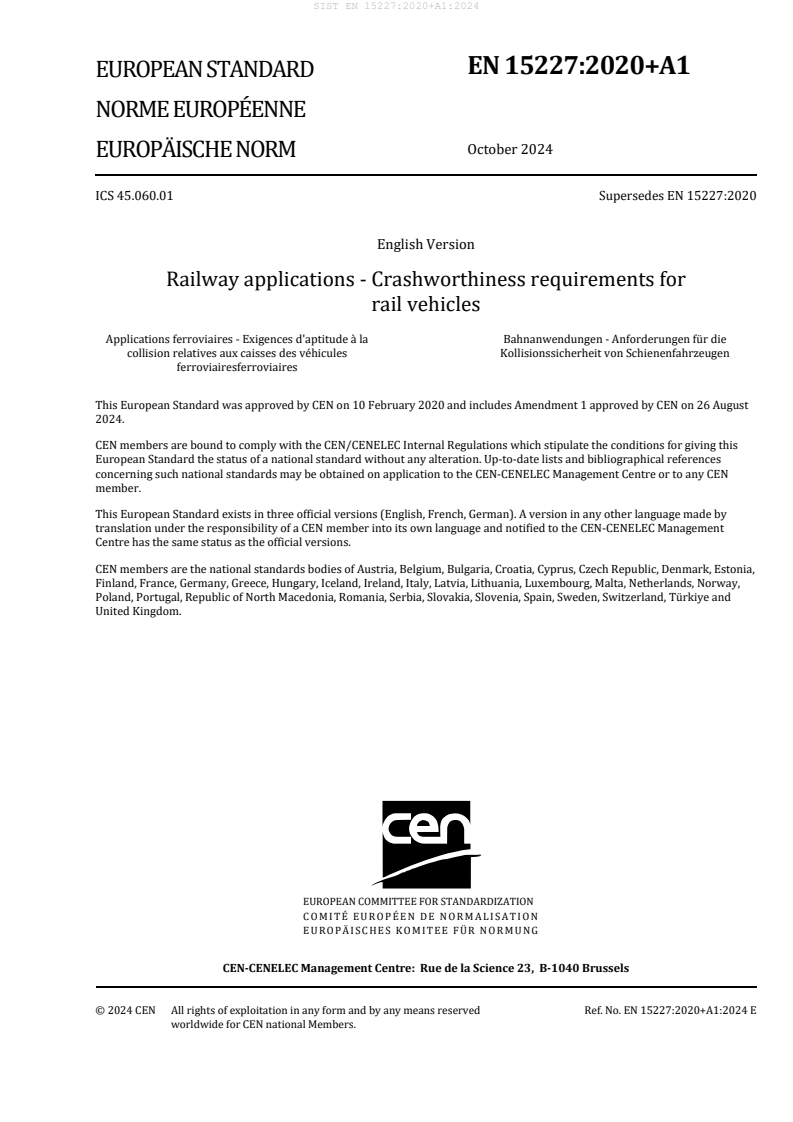
EN 15227:2020+A1
EUROPEAN STANDARD
NORME EUROPÉENNE
October 2024
EUROPÄISCHE NORM
ICS 45.060.01 Supersedes EN 15227:2020
English Version
Railway applications - Crashworthiness requirements for
rail vehicles
Applications ferroviaires - Exigences d'aptitude à la Bahnanwendungen - Anforderungen für die
collision relatives aux caisses des véhicules Kollisionssicherheit von Schienenfahrzeugen
ferroviairesferroviaires
This European Standard was approved by CEN on 10 February 2020 and includes Amendment 1 approved by CEN on 26 August
2024.
CEN members are bound to comply with the CEN/CENELEC Internal Regulations which stipulate the conditions for giving this
European Standard the status of a national standard without any alteration. Up-to-date lists and bibliographical references
concerning such national standards may be obtained on application to the CEN-CENELEC Management Centre or to any CEN
member.
This European Standard exists in three official versions (English, French, German). A version in any other language made by
translation under the responsibility of a CEN member into its own language and notified to the CEN-CENELEC Management
Centre has the same status as the official versions.
CEN members are the national standards bodies of Austria, Belgium, Bulgaria, Croatia, Cyprus, Czech Republic, Denmark, Estonia,
Finland, France, Germany, Greece, Hungary, Iceland, Ireland, Italy, Latvia, Lithuania, Luxembourg, Malta, Netherlands, Norway,
Poland, Portugal, Republic of North Macedonia, Romania, Serbia, Slovakia, Slovenia, Spain, Sweden, Switzerland, Türkiye and
United Kingdom.
EUROPEAN COMMITTEE FOR STANDARDIZATION
COMITÉ EUROPÉEN DE NORMALISATION
EUROPÄISCHES KOMITEE FÜR NORMUNG
CEN-CENELEC Management Centre: Rue de la Science 23, B-1040 Brussels
© 2024 CEN All rights of exploitation in any form and by any means reserved Ref. No. EN 15227:2020+A1:2024 E
worldwide for CEN national Members.
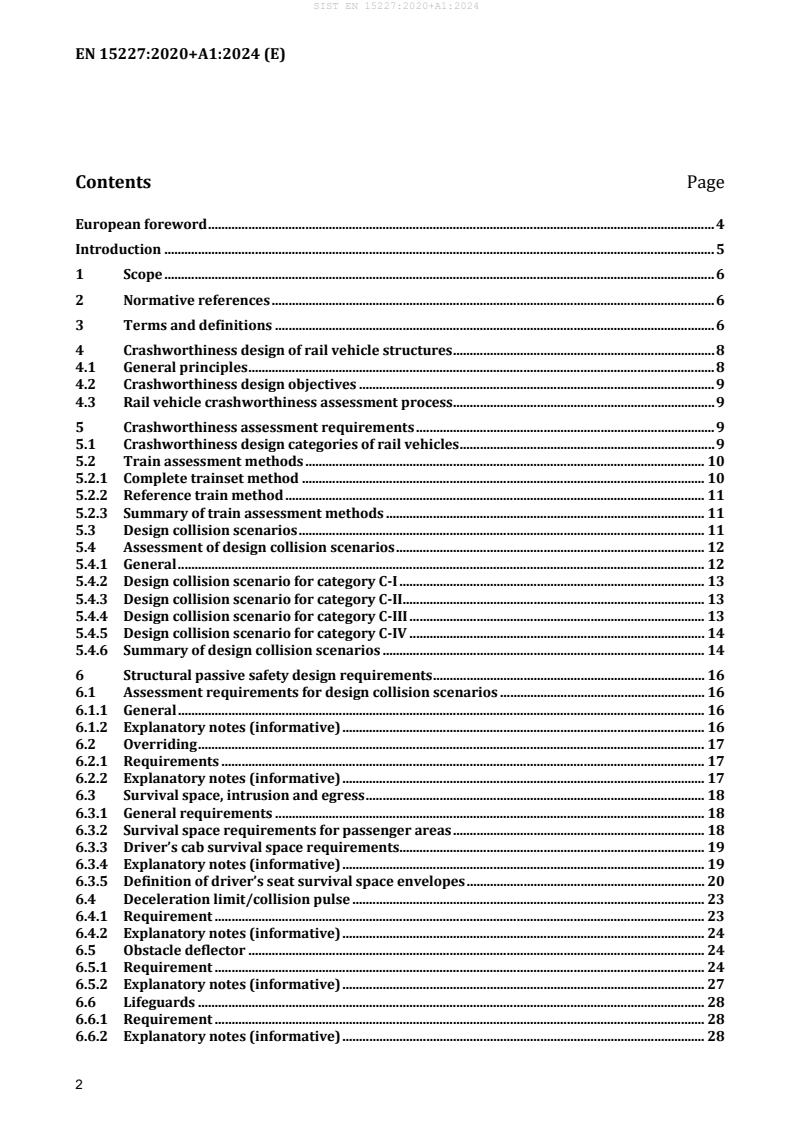
Contents Page
European foreword . 4
Introduction . 5
1 Scope . 6
2 Normative references . 6
3 Terms and definitions . 6
4 Crashworthiness design of rail vehicle structures . 8
4.1 General principles . 8
4.2 Crashworthiness design objectives . 9
4.3 Rail vehicle crashworthiness assessment process . 9
5 Crashworthiness assessment requirements . 9
5.1 Crashworthiness design categories of rail vehicles . 9
5.2 Train assessment methods . 10
5.2.1 Complete trainset method . 10
5.2.2 Reference train method . 11
5.2.3 Summary of train assessment methods . 11
5.3 Design collision scenarios . 11
5.4 Assessment of design collision scenarios . 12
5.4.1 General . 12
5.4.2 Design collision scenario for category C-I . 13
5.4.3 Design collision scenario for category C-II . 13
5.4.4 Design collision scenario for category C-III . 13
5.4.5 Design collision scenario for category C-IV . 14
5.4.6 Summary of design collision scenarios . 14
6 Structural passive safety design requirements . 16
6.1 Assessment requirements for design collision scenarios . 16
6.1.1 General . 16
6.1.2 Explanatory notes (informative) . 16
6.2 Overriding . 17
6.2.1 Requirements . 17
6.2.2 Explanatory notes (informative) . 17
6.3 Survival space, intrusion and egress . 18
6.3.1 General requirements . 18
6.3.2 Survival space requirements for passenger areas . 18
6.3.3 Driver’s cab survival space requirements. 19
6.3.4 Explanatory notes (informative) . 19
6.3.5 Definition of driver’s seat survival space envelopes . 20
6.4 Deceleration limit/collision pulse . 23
6.4.1 Requirement . 23
6.4.2 Explanatory notes (informative) . 24
6.5 Obstacle deflector . 24
6.5.1 Requirement . 24
6.5.2 Explanatory notes (informative) . 27
6.6 Lifeguards . 28
6.6.1 Requirement . 28
6.6.2 Explanatory notes (informative) . 28
7 Validation of crashworthiness . 28
7.1 Validation programme . 28
7.2 Combined validation programme . 29
7.2.1 Step 1: Test of energy absorbing devices and crumple zones . 29
7.2.2 Step 2: Test Calibration of the numerical model . 29
7.2.3 Step 3: Numerical simulation of the design collision scenarios . 29
7.3 Reduced validation programme . 30
7.4 Conformity assessment . 30
Annex A (informative) Parameters of design collision scenarios . 31
A.1 Introduction . 31
A.2 Determining the design collision scenarios for collision risks which differ from the
normal European operations . 32
A.2.1 Design collision scenarios . 32
A.2.2 Risk analysis . 32
A.2.3 Factors to be considered in the risk assessment . 33
A.2.4 Collisions following derailment . 33
A.2.5 Bibliography of relevant accident information . 34
Annex B (normative) Requirements of a validation programme . 35
B.1 Test specifications . 35
B.1.1 Test programme . 35
B.1.2 Acceptance criteria for calibration/validation tests . 35
B.2 Numerical simulations . 36
B.2.1 Numerical model validation . 36
B.2.2 Simulation modelling . 36
Annex C (normative) Reference obstacle definitions . 38
C.1 80 t wagon with side buffers . 38
C.2 80 t wagon with centre buffer freight coupler . 39
C.3 129 t regional train . 41
C.4 Level crossing 15 t deformable obstacle . 43
C.5 Urban road traffic 3 t rigid corner collision obstacle . 44
C.6 Urban road traffic 7,5 t obstacle . 45
Annex D (normative) Reference train definitions . 49
D.1 Reference trains for locomotive, power head, driving trailer and coach design . 49
D.2 Locomotive design . 49
D.3 Power head and driving trailer design . 49
D.4 Coach design . 50
D.5 Coach design limited to specific leading vehicles . 51
Annex E (informative) Migration rule for this European Standard . 53
Bibliography . 54
European foreword
This document (EN 15227:2020+A1:2024) has been prepared by Technical Committee CEN/TC 256
“Railway applications”, the secretariat of which is held by DIN.
This European Standard shall be given the status of a national standard, either by publication of an
identical text or by endorsement, at the latest by April 2025, and conflicting national standards shall
be withdrawn at the latest by April 2025.
Attention is drawn to the possibility that some of the elements of this document may be the subject of
patent rights. CEN shall not be held responsible for identifying any or all such patent rights.
This document includes Amendment 1 approved by CEN on 26 August 2024.
The start and finish of text introduced or altered by amendment is indicated in the text by tags !".
!This document supersedes EN 15227:2020."
!Deleted text"
If a vehicle has been successfully assessed using the previous edition of this standard, and the
technical changes of the new edition of EN 15227 do not affect this assessment, the vehicle can be
regarded to conform to the new standard. Otherwise, if the vehicle needs to be reassessed, it is
sufficient to assess only the modified technical requirements and new requirements.
Any feedback and questions on this document should be directed to the users’ national standards
body. A complete listing of these bodies can be found on the CEN website.
According to the CEN-CENELEC Internal Regulations, the national standards organisations of the
following countries are bound to implement this European Standard: Austria, Belgium, Bulgaria,
Croatia, Cyprus, Czech Republic, Denmark, Estonia, Finland, Former Yugoslav Republic of Macedonia,
France, Germany, Greece, Hungary, Iceland, Ireland, Italy, Latvia, Lithuania, Luxembourg, Malta,
Netherlands, Norway, Poland, Portugal, Romania, Serbia, Slovakia, Slovenia, Spain, Sweden,
Switzerland, Turkey and the United Kingdom.
Introduction
The objective of the passive safety requirements described in this European Standard is to reduce the
consequences of collision accidents. The measures considered in this European Standard provide the
means of protection when all possibilities of preventing an accident have failed. It provides a
framework for determining the crash conditions that rail vehicle bodies can be designed to withstand,
based on the most common collisions and associated risks.
This European Standard adds to the basic strength requirement defined in
!EN 12663-1:2010+A2:2023" by setting additional requirements for structural passive safety in
order to increase occupant safety in case of collisions.
In the event of a collision, application of this European standard provides protection for the occupants
of new designs of crashworthy vehicles through the preservation of structural integrity, reducing the
risk of overriding and limiting decelerations. This protection does not extend to interactions between
the occupants and the vehicle interior or to occupants of other rail vehicles, to other railway
employees and customers who are not in vehicles, or to third parties.
1 Scope
This document specifies crashworthiness requirements applicable to new designs of:
— locomotives,
— driving vehicles operating in passenger and freight trains;
— passenger rail vehicles operating in passenger trains (such as trams, metros, mainline trains).
This document identifies common methods of providing passive safety that can be adapted to suit
individual vehicle requirements.
This document specifies the characteristics of reference obstacle models for use with the design
collision scenarios.
This document also specifies the requirements and methods for demonstrating that the passive safety
objectives have been achieved by comparison with existing proven designs, numerical simulation,
component or full-size tests, or a combination of all these methods.
2 Normative references
The following documents are referred to in the text in such a way that some or all of their content
constitutes requirements of this document. For dated references, only the edition cited applies. For
undated references, the latest edition of the referenced document (including any amendments)
applies.
!EN 12663-1:2010+A2:2023, Railway applications - Structural requirements of railway vehicle bodies
- Part 1: Locomotives and passenger rolling stock (and alternative method for freight wagons)
EN 15663:2017+A1:2018, Railway applications - Vehicle reference masses
EN 17343:2023, Railway applications - General terms and definitions"
3 Terms and definitions
For the purposes of this document, the terms and definitions given in !EN 17343:2023" and the
following apply.
ISO and IEC maintain terminological databases for use in standardization at the following addresses:
• IEC Electropedia: available at http://www.electropedia.org/
• ISO Online browsing platform: available at http://www.iso.org/obp
3.1
active safety
systems and measures which take actions that aim to prevent a collision occurring
Document impacted by FprA2:2024. A consolidated publication will be published later and the reference will need to be
updated to EN 15663:2017+A2:2024.
3.2
collision mass
effective vehicle mass used for collision simulations
3.3
collision speed
ν
C
velocity difference between trains or train and obstacle at the start of the collision
3.4
crashworthiness
ability to mitigate the consequences of a collision in a controlled manner and reduce the risk of injury
to the occupants
3.5
crumple zone
part of the vehicle body (usually at the vehicle ends) which is designed to deform in a controlled
manner and absorb energy
3.6
design collision scenario
collision scenario that is applicable for design and assessment
3.7
energy-absorbing device
device which is attached to the vehicle structure, designed to deform in a controlled manner and
absorb energy
EXAMPLE Energy-absorbing coupler
3.8
full-size test
test where the specimen is made using full-size components from the vehicle being assessed
3.9
!centre buffer freight coupler
centre buffer coupler for transmission of push and pull forces used in freight operation
Note 1 to entry: SA3 coupler (Willison principle), AAR coupler (Janney principle), latch type coupler
(Scharfenberg principle) are examples of centre buffer freight couplers."
3.10
leading end
end of a vehicle which in normal service can be the front of a train
3.11
level crossing speed
ν
LC
applicable rail vehicle speed at level crossing
3.12
lifeguard
structural element positioned in front of a wheel with the objective of preventing small obstacles from
passing between the wheel and the rail
3.13
normal European operating conditions
operating conditions comparable to those described by the documents listed in the bibliography
3.14
obstacle deflector
device mounted on the leading ends of vehicles to limit the consequences of striking an obstruction on
the track
3.15
passive safety
structural design characteristics intended to reduce the consequences of a collision
3.16
survival space
space to be preserved for passengers and staff inside a rail vehicle for the design collision scenarios
3.17
reference train
train configuration that is used for the assessment and validation of locomotives, power heads, driving
trailers and coaches that do not form part of a trainset
4 Crashworthiness design of rail vehicle structures
4.1 General principles
The risk of train collisions is primarily controlled by active safety systems and/or operational
procedures. Where these systems are inadequate due to particular circumstances or due to external
events, structural crashworthiness provides a set of passive safety measures that will reduce the
consequences of an accident.
The objective is to provide a level of protection consistent with the most common collisions and
associated risks through the application of the design collision scenarios specified in this document. It
is not practical to design vehicle structures to protect the occupants against all possible accidents or to
consider all possible vehicle combinations.
Normal European operating conditions are assumed. The design of new vehicles for use in passenger
trains assumes operations with compatible rolling stock that also meet this European standard. It is
recognized that operational requirements may require new crashworthy and existing non-
crashworthy vehicles to exist in the same train but such combinations of vehicles are not required to
comply with this European Standard.
The applicable design collision scenarios, and suitable parameters for normal European operations are
given in 5.3.
Annex A gives additional information regarding the derivation of the design collision scenarios and
describes situations when they may need to be modified and the processes that should then be
followed.
If the operational conditions are such that a design collision scenario cannot occur, or there is evidence
that the probability of it occurring or the associated risk is so low as to be broadly acceptable, there is
no need to consider this design collision scenario in the vehicle design. These conditions should be set
out in the vehicle specification.
NOTE Train control systems which segregate different types of traffic on the same system or modes of
traffic that are segregated by infrastructure (e.g. no level crossings) can satisfy this requirement.
If the system has characteristics that result in significant collision risks that are not addressed by the
design collision scenarios considered in this European standard, they should also be considered in the
form of additional design collision scenarios, which should form part of the vehicle specification.
The requirements apply to the vehicle body, and to those mechanical elements directly associated with
it that may be used to absorb energy in a collision, such as couplers, drawgear and buffing systems.
The requirements do not cover the safety features of doors, windows, system components or interior
features except for specific issues relating to the preservation of survival space.
Not all vehicles in a train have to incorporate energy absorption, provided that passenger train
configurations formed entirely of new vehicle designs comply as a whole with this European Standard.
4.2 Crashworthiness design objectives
To provide protection for the occupants of rail vehicles in the event of a collision, the requirements
take into account the following objectives:
— absorption of collision energy in a controlled manner;
— reduction of the risk of overriding;
— maintenance of survival space and structural integrity of occupied areas;
— limiting deceleration;
— reduction of the risk of derailment and the consequences of hitting a track obstruction.
Specific requirements and assessment criteria to demonstrate that these objectives are satisfied are
set out in Clauses 5, 6 and 7 (see 4.3).
As a by-product of providing occupant protection, the level of damage to the vehicle body is likely to be
reduced in accidents. If more restrictive limits are intended to be placed on damage resulting from any
of the design collision scenarios set out in Clause 5, these should be part of the vehicle specification
and do not form part of the safety requirements set out in this European Standard.
4.3 Rail vehicle crashworthiness assessment process
For a new rail vehicle, the stages of the crashworthiness assessment process shall be:
— allocation of a crashworthiness design category (see 5.1);
— determination of the relevant train assessment methods (see 5.2 and Annex D) and determination
of the applicable design collision scenarios (see 5.3 and 5.4). If non-standard design collision
scenarios are required, see Annex A for guidance on the methods that should be adopted;
— validation of the crashworthiness assessment (see Clause 7 and Annex B).
— assessment of the applicable design collision scenarios with respect to the applicable
crashworthiness design criteria (see 5.4, Clause 6 and Annex C);
5 Crashworthiness assessment requirements
5.1 Crashworthiness design categories of rail vehicles
For the application of this European standard rail vehicles are classified into crashworthiness design
categories. These categories depend on the main characteristics of the rail network infrastructure and
on the type of operation.
The appropriate crashworthiness design category or categories shall be defined in the vehicle
specification.
Rail vehicles are divided into four categories as indicated in Table 1, with an indication of the type of
operation and vehicles generally associated with each.
Table 1 — Crashworthiness design categories of rail vehicles
Category Definition Examples of vehicle types
C-I Vehicles except urban vehicles and trams Locomotives, coaches and trains
designed to operate on international, national
and regional networks
C-II Urban vehicles designed to operate only on a Metro vehicles
dedicated rail network, with no level
crossings and no interface with road traffic
C-III Vehicles designed to operate on urban and/or Tram-trains, peri-urban trams
regional networks, in track-sharing
operation, and interfacing with road traffic
C-IV Trams
5.2 Train assessment methods
5.2.1 Complete trainset method
This method is applicable for trainsets and railcars.
When assessing a trainset with significantly different vehicle structures at each end, collisions at both
ends shall be considered. For impacts between identical trainsets only impacts between identical
trainset ends shall be considered.
When assessing a trainset which is only operated in one direction and which has significantly different
vehicle structures at each end, then head-on collision impacts at the leading ends and rear-on
collisions of a leading end against a non-leading end shall be accounted for.
When assessing a trainset which can be assembled and operated in different configurations of a same
architecture, the shortest and longest trainset shall be considered, e.g. if a trainset can be configured to
a fixed formation of 4 to 8 vehicles, the formation with 4 vehicles and the formation with 8 vehicles are
assessed.
When assessing a trainset which can also be operated in a train of two or more trainsets, the
assessment of only one single trainset is sufficient but when assessing a trainset with retractable or
foldable coupler systems which can also be operated in a train of two or more trainsets the assessment
of two trainsets is necessary.
NOTE The energy absorption devices of coupled trainset ends sufficiently decouple the energy required to
be absorbed by each trainset in case of collisions. At the leading end of the train with retractable or foldable
coupler systems the coupler is normally retracted or folded away. The behaviour of these couplers at the
intermediate ends during collisions of trains with two or more trainsets is demonstrated with the assessment of
two trainsets.
When assessing a trainset which due to its design is always operated as a train of at least two trainsets,
the minimum number of trainsets to form a train shall be assessed.
Some trainsets may not have a control cab to lead a train at both ends (for example just a control panel
for shunting), but are intended to be always operated as trains in both directions. Therefore the
minimum operational train consist will be the one with a control cab positioned at each end.
5.2.2 Reference train method
This method is applicable for locomotives, power heads, driving trailers and coaches which are used
with a variable formation of vehicles. For such vehicles applicable reference trains shall be used for the
assessment. For applicable reference trains and assessment requirements of different vehicle types
see Annex D.
5.2.3 Summary of train assessment methods
The applicable assessment methods and references to Annex D are indicated in Table 2.
Table 2 — Vehicle types and assessment methods
Vehicle types Assessment method
Trainsets and railcars Complete trainset method
Locomotives Reference train method (see D.2 for reference train definitions)
Power heads and driving Reference train method (see D.3 for reference train definitions)
trailers
Coaches Reference train method (see D.4 and D.5 for reference train definitions)
5.3 Design collision scenarios
In the following, four design collision scenarios are specified. Annex A discusses the derivation and
application of the design collision scenarios in more detail.
1. Design collision scenario 1): a leading end impact between two identical trains;
The moving train is impacting an identical stationary train. Both the moving and stationary train
have to be assessed.
This scenario is also representative of collisions with similar trains fitted with compatible
coupling arrangements.
2. Design collision scenario 2): a leading end impact with a different type of rail vehicle;
Depending on the crashworthiness design category the train to be assessed is colliding with a
regional train equipped with a !centre buffer coupler" or a wagon.
This scenario is representative of collisions with other rolling stock or with buffer stops.
If the type of rolling stock typically encountered differs from the defined reference obstacles, then
Annex A should be used to define more appropriate obstacles.
3. Design collision scenario 3): a leading end impact with a road vehicle;
The train to be assessed is colliding with a large obstacle at level crossings or, where appropriate,
with common urban road traffic obstacles.
This scenario is representative of collisions with large road vehicles.
4. Design collision scenario 4): a leading end impact with a low obstacle.
Obstacle deflectors and lifeguards of the train to be assessed shall fulfil specified strength and
performance criteria.
This scenario is representative of collisions with obstacles having their centre of mass below the
train head stock (e.g. a car on a level crossing, animals or debris).
If vehicles cannot operate up to the collision speeds specified in this European Standard (e.g. shunting
locomotives) the crashworthiness requirements need not be applied.
If the normal European operating conditions assumed by this European Standard do not apply,
appropriate scenarios and limiting design cases shall be defined in the vehicle specification. See
Annex A for guidance on defining suitable requirements.
Table 3 summarizes these design collision scenarios with respect to the different crashworthiness
design categories. The relevant obstacles, relevant operational characteristics and collision speeds are
given.
Tables 6 and 7 set out the performance requirements for obstacle deflectors and lifeguards.
5.4 Assessment of design collision scenarios
5.4.1 General
For all crashworthiness design categories and all vehicle types the following requirements apply.
The design collision scenarios shall be assessed using any combination of:
— numerical simulations,
— calculations and
— physical testing.
Colliding trains, stationary trains and obstacles are un-braked on straight and level track. The
impacted collision obstacle (train, wagon or obstacle) is stationary. Boundary conditions for impacted
wagons and obstacles are included in their definition (See Annex C).
For design collision scenario 1, for all crashworthiness design categories, the initial vertical offset at
the point of contact shall be 40 mm, with the stationary train at a lower level than the moving train.
There is no initial vertical offset at intermediate ends in each train.
Front coupler systems can be considered to be interlocked during design collision scenario 1
independent of their vertical gathering range.
The collision mass is the design mass in working order in accordance with
" plus 50 % of the mass of seated passengers. The masses of staff and
!EN 15663:2017+A1:2018
seated passengers do not need to be represented at their centres of gravity but may be directly
included in the vehicle structure mass.
The applicable design collision scenarios and corresponding requirements for the crashworthiness
design categories C-I to C-IV are set out in 5.4.2 to 5.4.5 and finally summarized in 5.4.6, Table 3.
5.4.2 Design collision scenario for category C-I
All crashworthiness design category C-I vehicle types except coaches shall be assessed for the
following:
a) design collision scenario 1 at a collision speed of 36 km/h
For locomotives fitted with !centre buffer freight couplers", the design collision scenario 1
shall be assessed at a collision speed of 20 km/h
b) design collision scenario 2, an impact against an 80 t freight wagon fitted with side buffers at a
collision speed of 36 km/h. The reference obstacle is defined in C.1.
For locomotives fitted with !centre buffer freight couplers", the design collision scenario 2
shall be assessed for an impact against an 80 t freight wagon fitted with a !centre buffer freight
couplers" at a collision speed of 20 km/h. The reference obstacle is defined in C.2.
c) design collision scenario 3; a collision at the leading end against a level crossing 15 t deformable
obstacle. The reference obstacle is defined in C.4. The level crossing collision speed shall be the
lesser of (ν – 50 km/h) or 110 km/h, where the level crossing speed ν is the lower of
LC LC
• the maximum train speed and
• the designated line speed at level crossings
Unless otherwise required, an assessment against design collision scenario 3 is only necessary if
there are level crossings on the routes to be operated.
d) design collision scenario 4; leading end impact with a low obstacle. Vehicle leading ends shall fulfil
the performance requirements for obstacle deflectors and lifeguards as given in 6.5 and 6.6.
Crashworthiness design category C-I coaches shall be assessed according to the requirements given in
D.4 or D.5. This is equivalent to design collision scenario 1 for these vehicles. The other design collision
scenarios are not applicable for coaches.
5.4.3 Design collision scenario for category C-II
Crashworthiness design category C-II vehicles shall be assessed for design collision scenario 1 with a
collision speed of 25 km/h.
NOTE The other design collision scenarios are not applicable to crashworthiness design category C-II.
5.4.4 Design collision scenario for category C-III
Crashworthiness design category C-III vehicles shall be assessed for the following
a) design collision scenario 1 with a collision speed of 25 km/h
b) design collision scenario 2, for collisions with a different type of rail vehicles:
• for service conditions where track is shared with vehicles equipped with side buffers, an
impact against an 80 t wagon with a collision speed of 25 km/h. The reference obstacle is
defined in C.1.
• for service conditions where track is shared with vehicles equipped with a !centre buffer
coupler", an impact against a 129 t regional train with a collision speed of 10 km/h. The
reference obstacle is defined in C.3.
The types of rail vehicle used as reference obstacles are suitable for normal European operating
conditions. If the type of rolling stock typically encountered differs from the defined reference
obstacles, then Annex A should be used to define more appropriate obstacles.
c) design collision scenario 3; at leading ends for operations with level crossings, an impact against a
level crossing 15 t deformable obstacle with a collision speed of 25 km/h. The reference obstacle
is defined in C.4.
d) design collision scenario 4; vehicle leading ends shall fulfil the performance requirements for
obstacle deflectors and lifeguards as given in 6.5 and 6.6.
The requirements for category C-III provide sufficient safety for a tram network operation, i.e. the
requirements of category C-IV need not be demonstrated separately.
5.4.5 Design collision scenario for category C-IV
Crashworthiness design category C-IV vehicles shall be assessed for the following:
a) design collision scenario 1 with a collision speed of 15 km/h
b) design collision scenario 3, which shall be assessed at leading ends for the following cases:
• An impact against a 3 t rigid road traffic obstacle positioned at 45 degrees to the track with a
collision speed of 25 km/h. The reference obstacle and the design collision scenario are
described in C.5.
• Impacts against a 7,5 t road traffic obstacle positioned at 90 degrees to the track and a lateral
offset of the centre of gravity of the obstacle relative to x- axis of train of ± 1000 mm with a
collision speed of 15 km/h. The reference obstacle and the design collision scenarios are
described in C.6.
5.4.6 Summary of design collision scenarios
The design collision scenarios set out in 5.4.2 to 5.4.5 are summarized in Table 3.
Table 3 — Design collision scenarios and collision obstacles
Design collision scenario (see 5.3) and collision speeds v
C
1 2 3 4
Crashworthiness design
categories
leading end
leading end
impact between leading end impact with a
(see 5.1)
leading end impact with a large road vehicle impact with a
two identical different type of rail vehicle
low obstacle
trains
Crashworthiness Detailed Identical train 80 t freight 129 t 15 t deformable 7,5 t 3 t rigid Obstacle
design category requirements wagon regional obstacle obstacle obstacle deflectors and
(see Table 1) train lifeguards
(see C.1 and (see C.4) (see C.6) (see C.5)
C.2) (see C.3)
See 6.5 and 6.6
= (ν - 50 km/h)
LC
a a
C-I 5.4.2 36 km/h 36 km/h n/a n/a n/a for
≤ 110 km/h
requirements
C-II 5.4.3 25 km/h n/a n/a n/a n/a n/a n/a
See 6.5 and 6.6
C-III 5.4.4 25 km/h 25 km/h 10 km/h 25 km/h n/a n/a for
requirements
C-IV 5.4.5 15 km/h n/a n/a n/a 15 km/h 25 km/h n/a
NOTE: n/a = not applicable
a
for C-I locomotives fitted with !centre buffer freight couplers" the collision speed for design collision scenarios 1 and 2 is 20 km/h
6 Structural passive safety design requirements
6.1 Assessment requirements for design collision scenarios
6.1.1 General
For the train or individual vehicle that is being assessed, conformity shall be demonstrated with the criteria
set out for:
— overriding (6.2),
— survival space (6.3) and
— deceleration levels (6.4).
Absorption of collision energy in a controlled manner is demonstrated if these criteria are satisfied.
The criteria for overriding, survival space and deceleration levels are applicable to trains or individual
vehicles to be assessed but are not applicable to other vehicles that are used as obstacles (as defined in
Annex C) or parts of reference trains to simulate the design collision scenarios.
6.1.2 Explanatory notes (informative)
Elements of the vehicle structure (crumple zones) and coupling system that are intended to deform during
the collision should:
— absorb and dissipate collision energy by predetermined deformation, collapse or failure;
— distribute the remaining collision energy into the vehicle structure without uncontrolled deformation or
collapse;
— where multiple collapse elements are used, collapse in a predetermined sequence.
In any practical structure there are likely to be significant perturbations in the collapse force but it should
have a generally increasing trend.
It is usually necessary to control the material properties to tighter limits than is normal in the material
specifications (with more closely defined upper and lower bounds) in order to achieve consistent collapse
behavio
...